Skulk

noun: skulk; plural noun: skulks

  1. a group of foxes.

I don’t know if two foxes are enough to equal a skulk, but there has been, on two occasions that my wildlife camera will testify to, a pair of foxes visiting my back garden.

For my October birthday, my husband gifted to me a wildlife camera, which wasn’t set into action until late November. Before setting up the camera, I assumed we’d see raccoons and opossums on a regular basis, sprinkled with appearances by rats, and only rare visits from foxes or owls. As it happens, the opposite has happened: almost nightly, at least one native Grey Fox gracefully ambles through the pond area, with somewhat rarer sightings of the other three critters. I should add that I see foxes during the daytime hours and have had them visit my garden, but those daytime sightings are only occasional. I never dreamed that fox(es) came into my garden most nights. I couldn’t be more pleased that they’re comfortable in the environment that I’ve created.

With the term skulk, I usually think of the other definition (verb: keep out of sight, typically with a sinister or cowardly motive.). I don’t see the foxes as that kind of skulky but instead, shy and alert to danger at all times. Their graceful, sinuous movements along the pathways, and through the garden itself, is delightful to observe.

Are these two siblings, or a mother and almost grown kit? Or are they mates? Whatever their family ties, I suspect that during the day they sleep under one of the many outdoor sheds belonging to surrounding neighbors and situated in back yards, though maybe the foxes change sleeping locations from time-to-time.

Will there be kits in the spring? I sure hope so! I’ve observed foxes in our neighborhood for many years, but I’ve never seen a family with kits–a skulk–or a fox that is clearly a juvenile. But the foxes are around, year after year and in all seasons, so some successful breeding is happening.

There are other terms for a group of foxes. I could call these two a troop of foxes, or a leash of foxes, or a lead of foxes, and or an earth of foxes. I think I like ‘earth of foxes’ the best!

Whatever they are, as singles, couples, or groups, these beautiful animals are very welcome in my garden to rest, catch rats or insects, drink water, or just hang out.

Ice Arrives

This winter has seen plenty of overnight light freezes in my garden, but only in the last few days were the conditions ripe for the formation of Frostweed, Verbesina virginica, ice sculptures. Two mornings ago, the day dawned cold, bright and sunny, with icy, exploded frostweed a new addition to the garden.

As I trundled around the garden, I observed many low-to-the-ground ice sculptures revealing themselves in light and shadow. Many plants produce ice sculptures during the first hard freeze of the season, but none with quite the drama of frostweed.

Morning sun highlighted fanned crystal formations, held firm along broken stems, as sturdy braces

The temperature never rose above freezing that day and into the night, the fragile ice sculptures held. Indeed, by the next morning, many of the sculptures had expanded. The second day was cloudy, no sun rays to brighten the ice. Some newer sculptures, instead of traveling upwards the stems, remained close to the ground, the ice reminiscent of floral decorations from warmer days past.

I haven’t pruned the winter garden, at least not in any major way. But here, it’s clear that stems were cut, the ice crystals limited to hugging the ground, swirling around the stems, snuggled on fallen leaves.

Frozen water proves stronger than sturdy stems.

This frostweed created the tallest of the ice formations in my garden, whirls around the stems, some 2 feet up from the ground. Green winter grass, coupled with some evergreen wildflower foliage, is a fetching background to the ice and winter-dormant stems.

Compare this photo with the first: it’s the same plant with more ice, less intact stems. Such is the way of frostweed ice sculpture work, rendering a new paradigm for the plants’ seasonal life. It’s an end, of a sort, though in reality, only a resting time. The roots below are priming for spring green.

This morning, snow is a light blanket in my garden. It’s not a powdery substance, but instead, sleet and snow mixed. It’s also quiet, the birds mostly still asleep or too cold to sing, except for the Carolina Wren–he’s awake. The Grey Fox, a regular night visitor to my garden, was out last night, caught on the wildlife camera prancing around the white ground, probably hunting. I hope it’s now in some warm, protect place, resting for the adventures to come.

This winter ice, whether snow, sleet, or busted plant stems, is fleeting–like so many things in the garden.

The Mob is Back

On roughly an every-other-year-schedule, Cedar Waxwings show up in droves during January, remaining in Central Texas through March. On a daily basis they visit my pond by the dozens, even hundreds. Gregarious birds, it’s rare to see a waxwing alone. They’re always with their besties, swooping in to bathe and drink, rushing upwards to safety when some unknown event triggers their (apparently very sensitive) flight mechanisms.

This Cedar Waxwing, Bombycilla cedrorum stayed still long enough for me to observe and snap a photo, posing to show its good side.

It dipped and drank, gracefully exhibiting the signature waxwing yellow tail feather ends and red wing feather tips. Cedar Waxwings are stunningly beautiful birds.

I felt lucky to grab a photo with a small group, none of which fuzzily winged from the frame just as I snapped the shot. Thanks, birds!

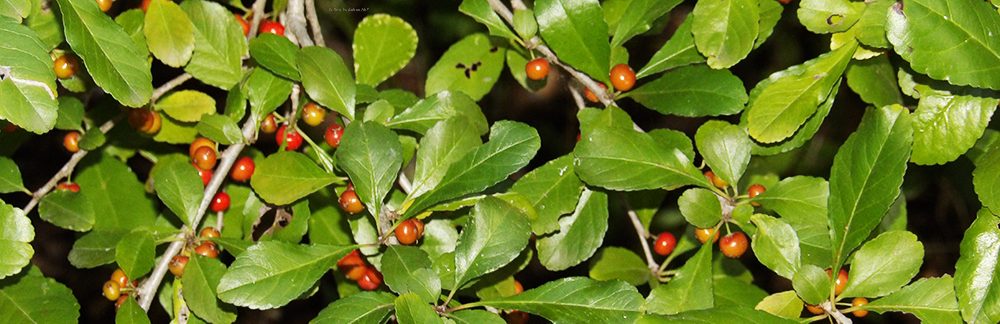
While the waxwings certainly enjoy the pond and visit it throughout their winter vacation here in Austin, the most important thing they get from my garden are fruits from various plants. This waxwing is aiming to pluck a ripe, red berry from my Possumhaw Holly, Ilex decidua.

I couldn’t get a perfect photo of a waxwing eating a berry; either the berry was smeary or the bird was smeary. At least in this shot, it’s obvious that the bird is leaning down for a bite of berry.

Within an afternoon or two, these cheeky birds, with assists from a couple of Blue Jays and Mockingbirds, stripped the tree of its fruits for this year. I’m sorry to see the pretty berries no longer decorating the tree, but I’m pleased that my garden provided a favorite food for these lovely birds. There are still red fruits on my non-native Burford Holly, Ilex cornuta, but one day soon, the waxwing mob will descend for a communal nosh and those berries will be history–just like the Possumhaw fruits.

I love seeing these charming birds in my garden, with one exception: berry bird poop on the patio, chairs, plants, rocks…

Garbage in, garbage out, I guess.