Bee Mama Missive: Ramping Up

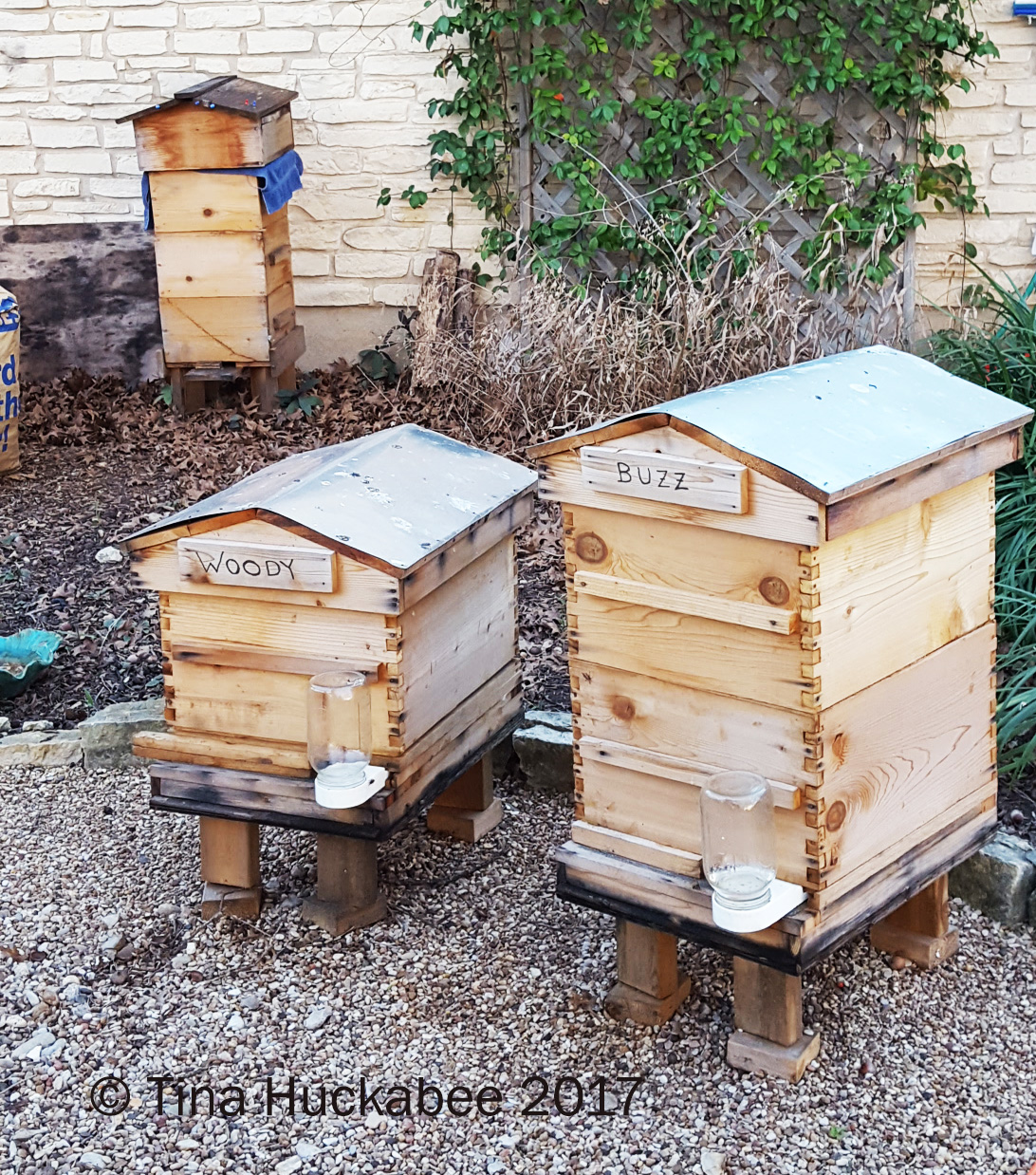
We’re ramping up for spring and another (hopefully) successful year of honeybee keeping with our two newer hives, Buzz and Woody, and the remaining original hive, Scar.
20170122_164326copy

Woody and Buzz, the Langstroth hives, are in the foreground and Scar, the Warre hive, resides in the background.

Fresh from a day-long beekeeping seminar that we attended a few weeks back and armed with loads of new and refreshed honeybee information, we’ve been eager to check out our hives and see how the girls fared over winter.  Though it feels a little early in the season, it’s been a mild winter with the exception of a few days in the 20s F (-6ish C) in December and early January.  Our original plan for a first hive check was to test for varroa mites, but it’s either proven too cold (below 65 F /18.3 C) or, as it was this past Sunday, above 65 F, though too humid.  Varroa mites are a serious threat to honeybees and unfortunately most commercial and hobbyist bee hives have some varroa mite levels. The trick is to keep tabs on the mite levels so that they don’t overwhelm a hive and subject the bees to fatal viral overloads. Truthfully,  Bee Daddy and I haven’t been particularly good about keeping a regular check on varroa mites; in fact, we’ve been downright irresponsible about checking for varroa mites.  Partly that’s because we’ve hived honeybees who enjoy a proven resistance to varroa mites (thank you, BeeWeaver!), and partly because…we just haven’t.  I’ve seen mites on larvae a few times when I’ve pulled off comb and last year we lost a hive, Mufasa, to a fatal viral load, most likely due to a varroa infestation.  You can read about that sad event here.

This year, our 2017 bee keepers’ resolution is to be better bee keepers and we will check for varroa at least four times over the course of the season.

Ahem.

It was good to see what was going on in our honeybee hives after so many months.
RICOH IMAGING

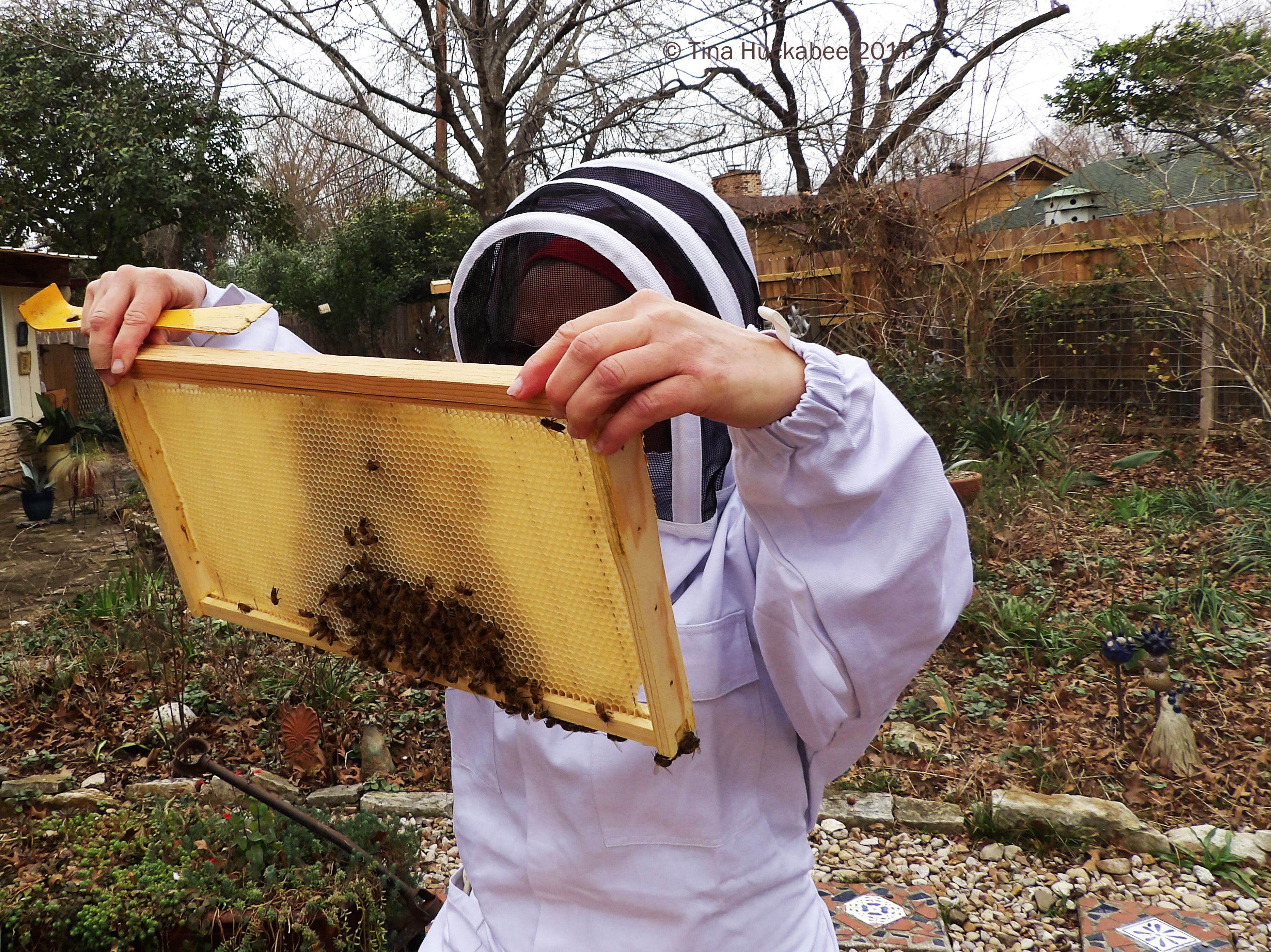
This frame has comb and nectar, but little else.

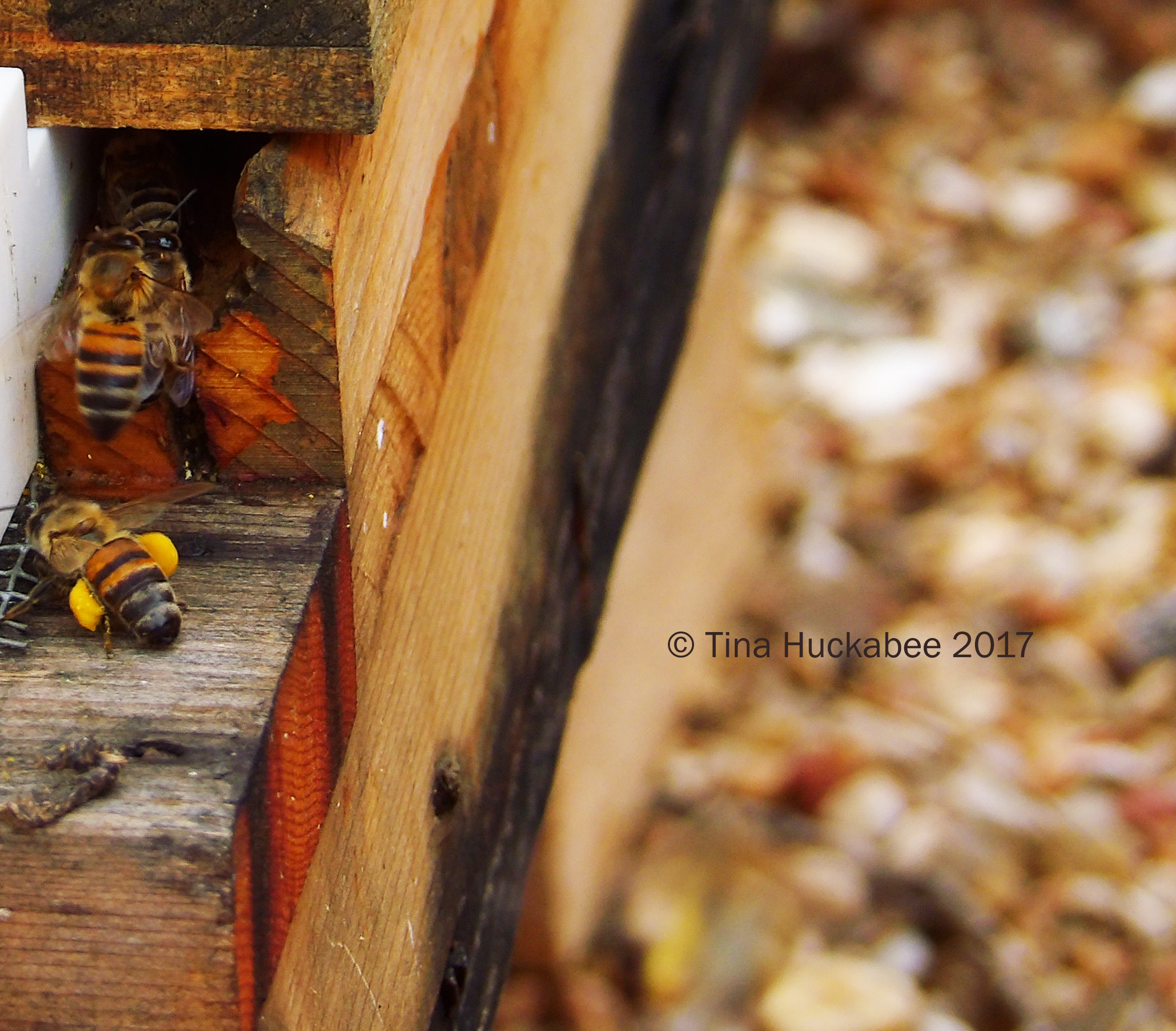
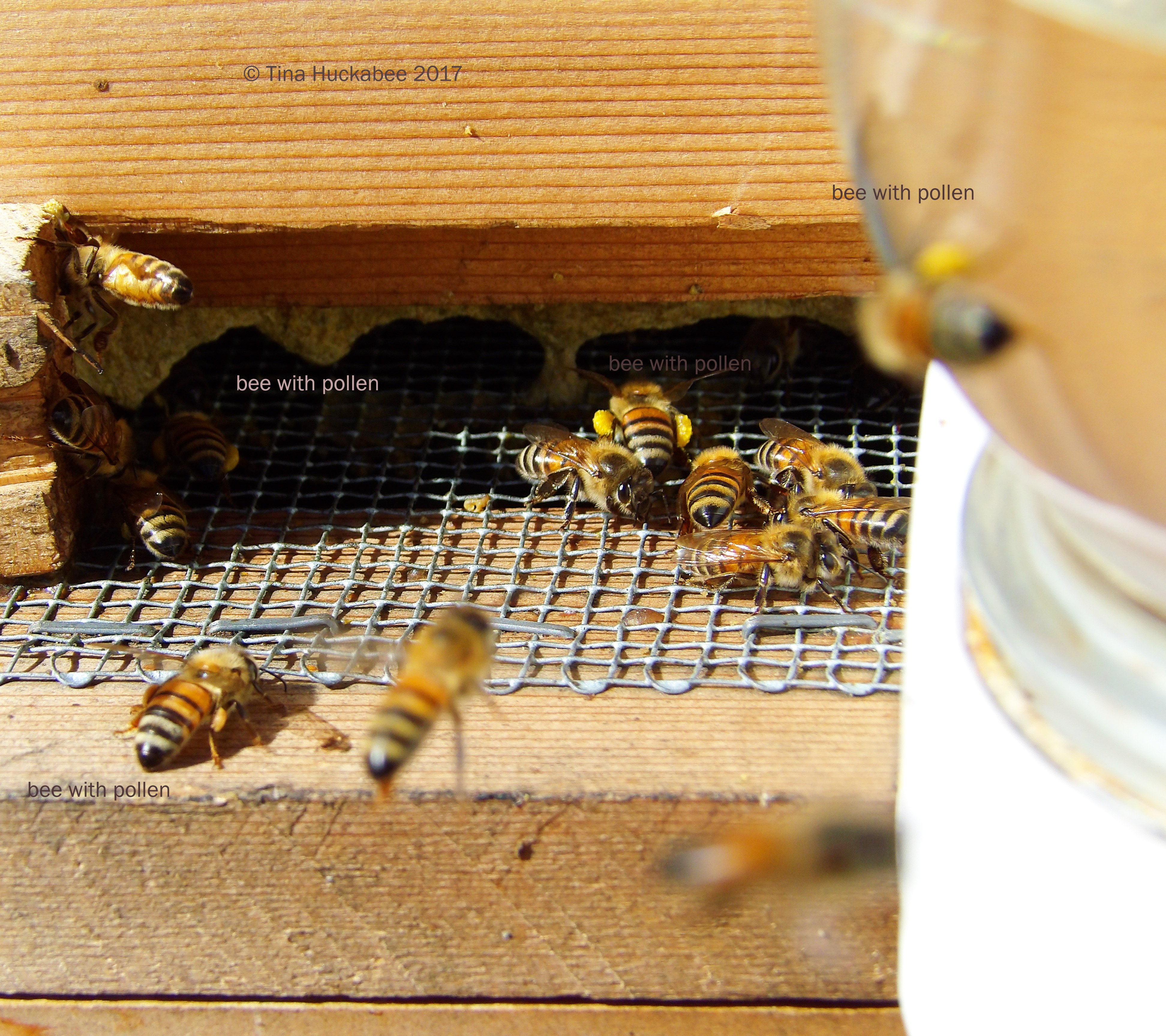
Buzz is buzzing along beautifully and Woody survived winter and though small, is thriving.  The girls have been foraging and bringing in pollen of varying colors:
RICOH IMAGING

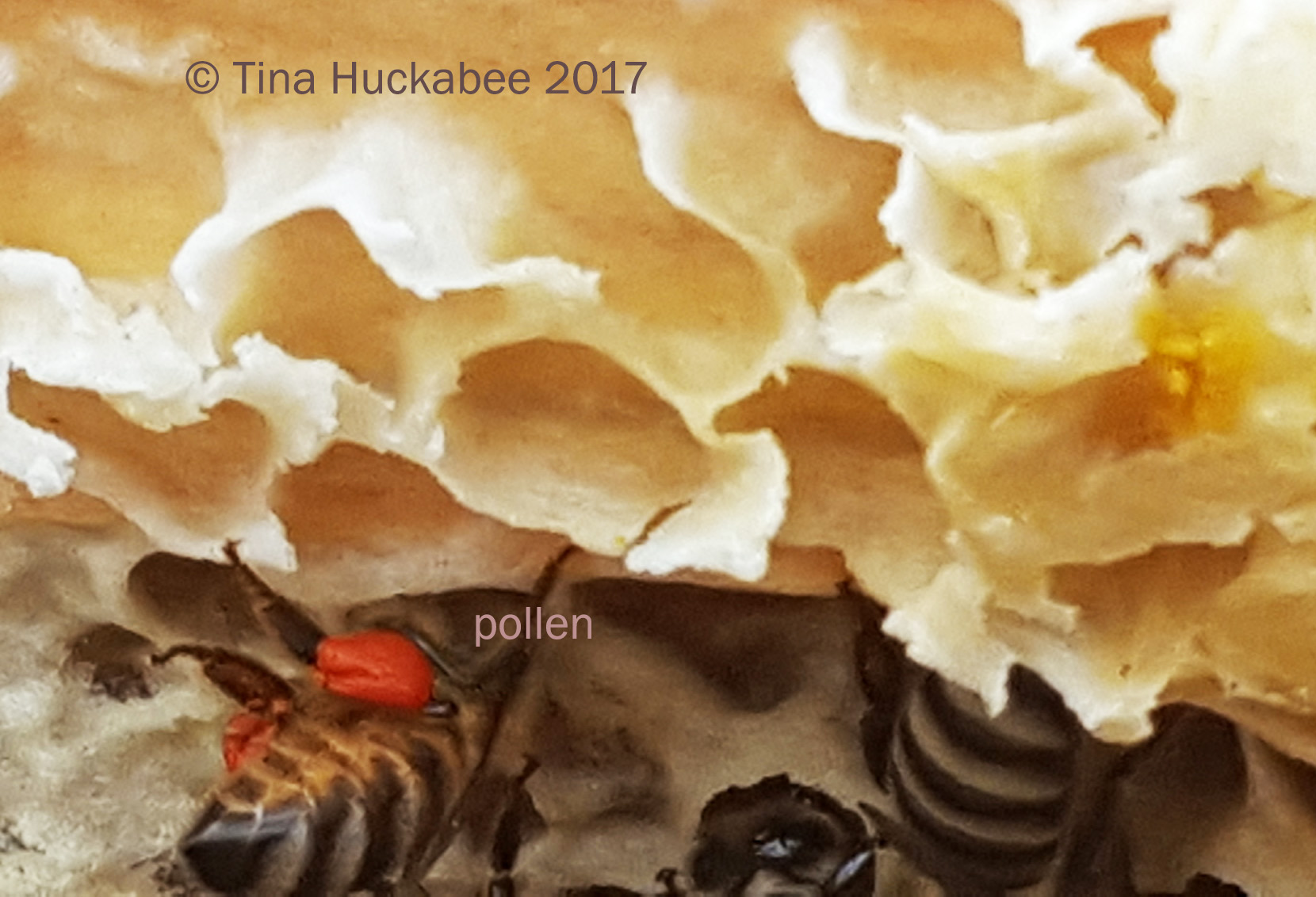
The corbicula is also called a pollen basket. I use a Tina-term “pollen pantaloon.”
RICOH IMAGING

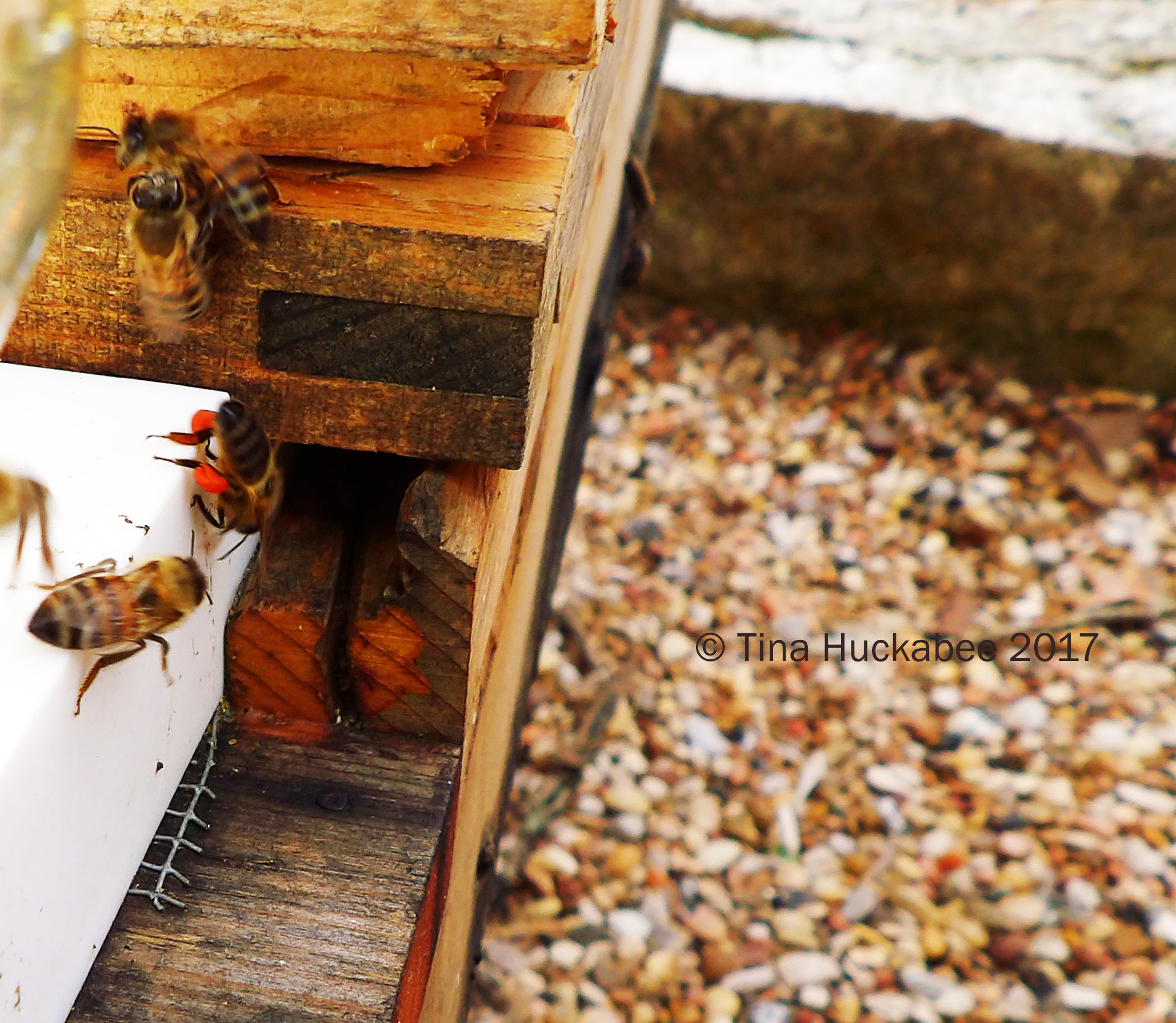
I’m enamored with the salmon-red pollen; I have no idea which plant produces it, but wow!
RICOH IMAGING

RICOH IMAGING

20170205_1224250copy

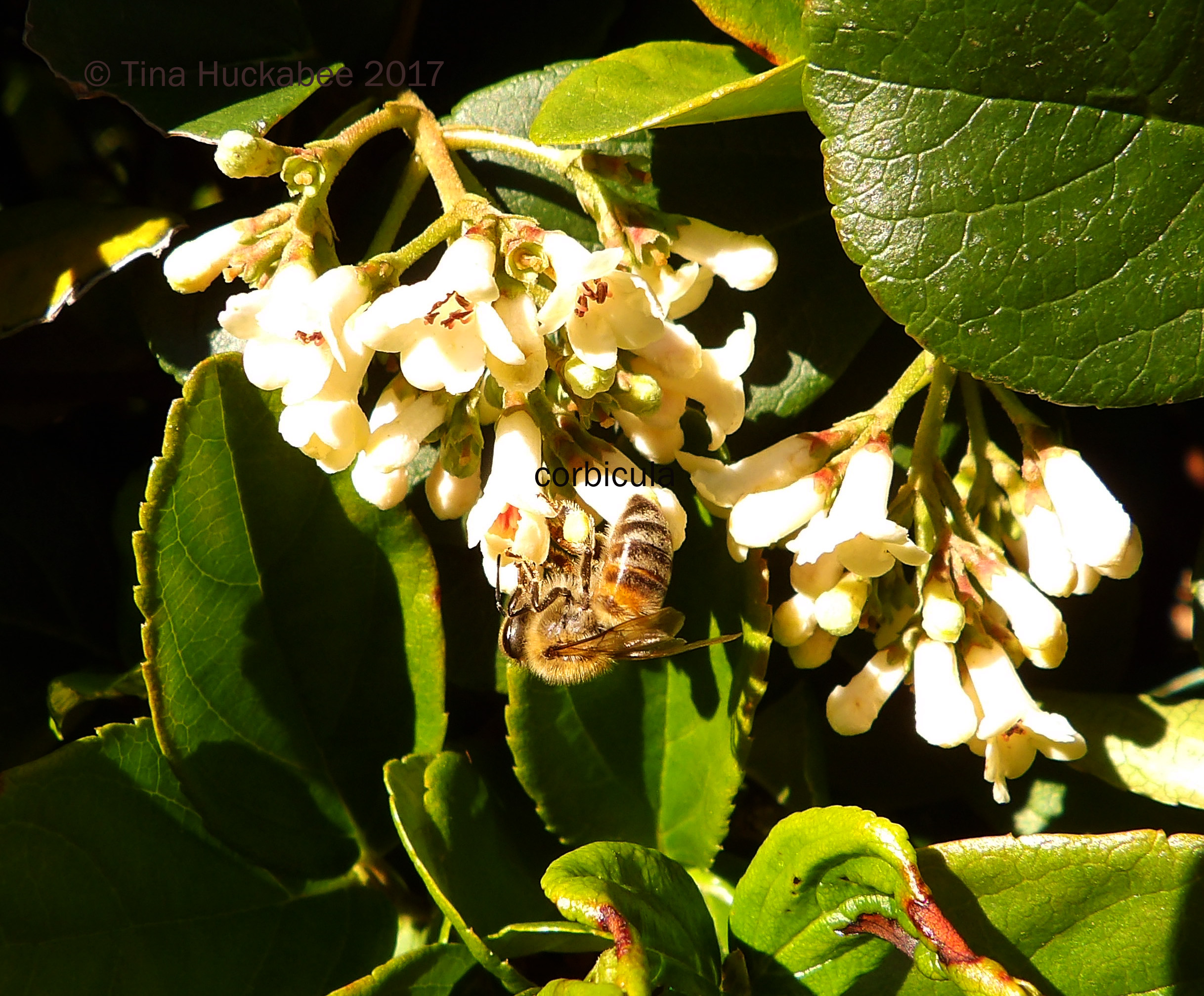
The bees have also been bringing in lots of creamy white pollen, much of which I suspect comes from a neighbor’s stand of viburnum.
RICOH IMAGING

Creamy white pollen taken from the flowers and stored in the corbiculae, pollen baskets, or pollen pantaloons.

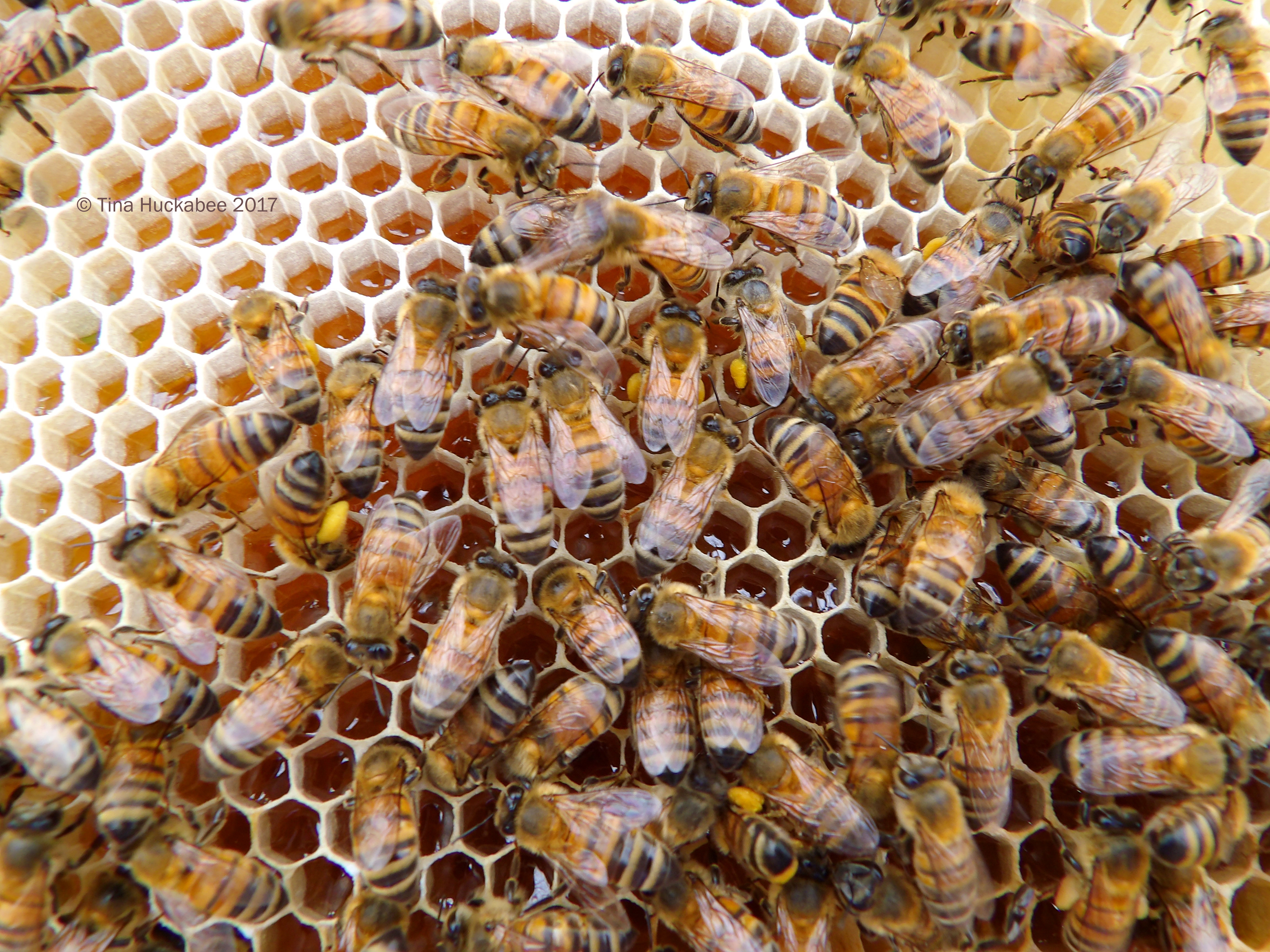
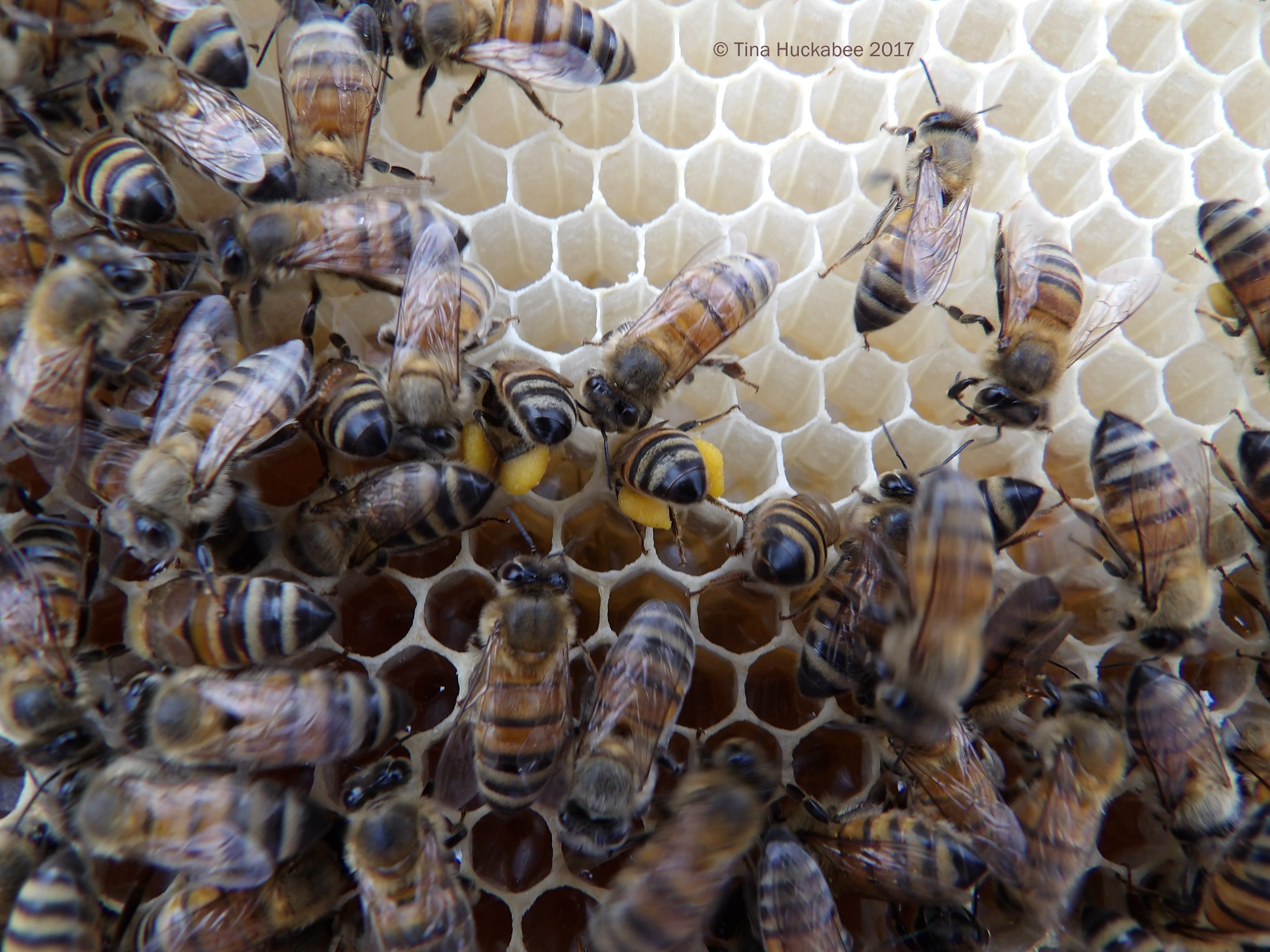
As always, lots of good, old-fashioned yellow pollen is collected–no doubt from a variety of sources.
RICOH IMAGING

RICOH IMAGING

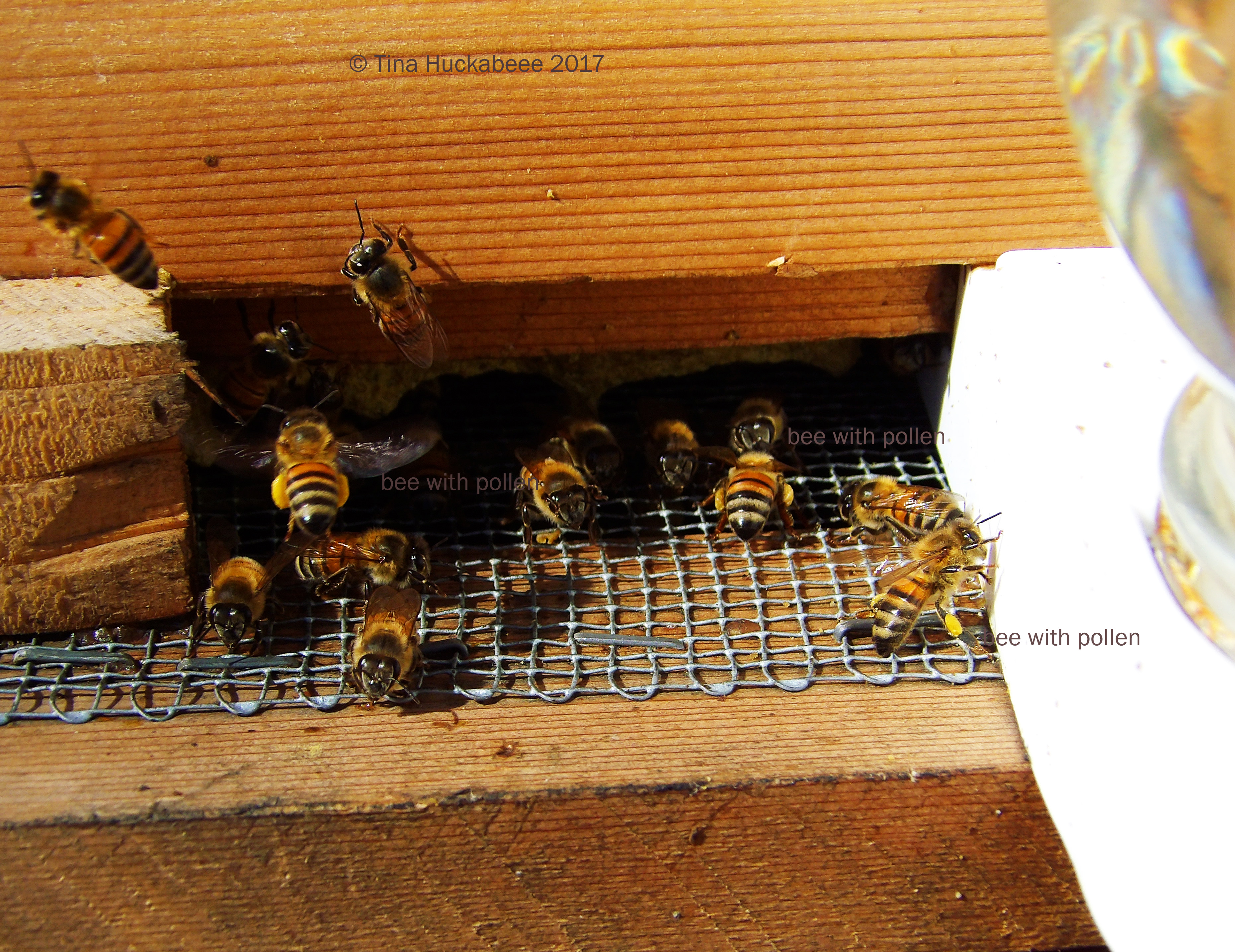
Can you count the number of bees carrying pollen?  I counted five!
RICOH IMAGING

Honeybees forage up to three miles and I know that viburnum, rosemary, flowering quince and perhaps a few early trees are in flowering mode.  My Leatherleaf Mahonia, Mahonia bealei,  was certainly one source of nectar and pollen a few weeks ago, but there’s nothing currently blooming in my garden that the honeybees are interested in, though I have seen a few of the tiny wild bees working at some native salvia species that have pushed out some blooms in the last week or so.

Honeybees forage for nectar, which is their carbohydrate source, and pollen, which serves as protein.  A diverse and well-rounded diet is key to a healthy life and honeybees certainly benefit from a diversity of flowers.  That the honeys are pulling in pollen and nectar from a variety of early sources is a good thing.  I planned to take a photo of the comb with differing pollen colors, but completely forgot about that once I was in the hive and looking at the good work of the queen, with support from her workers.

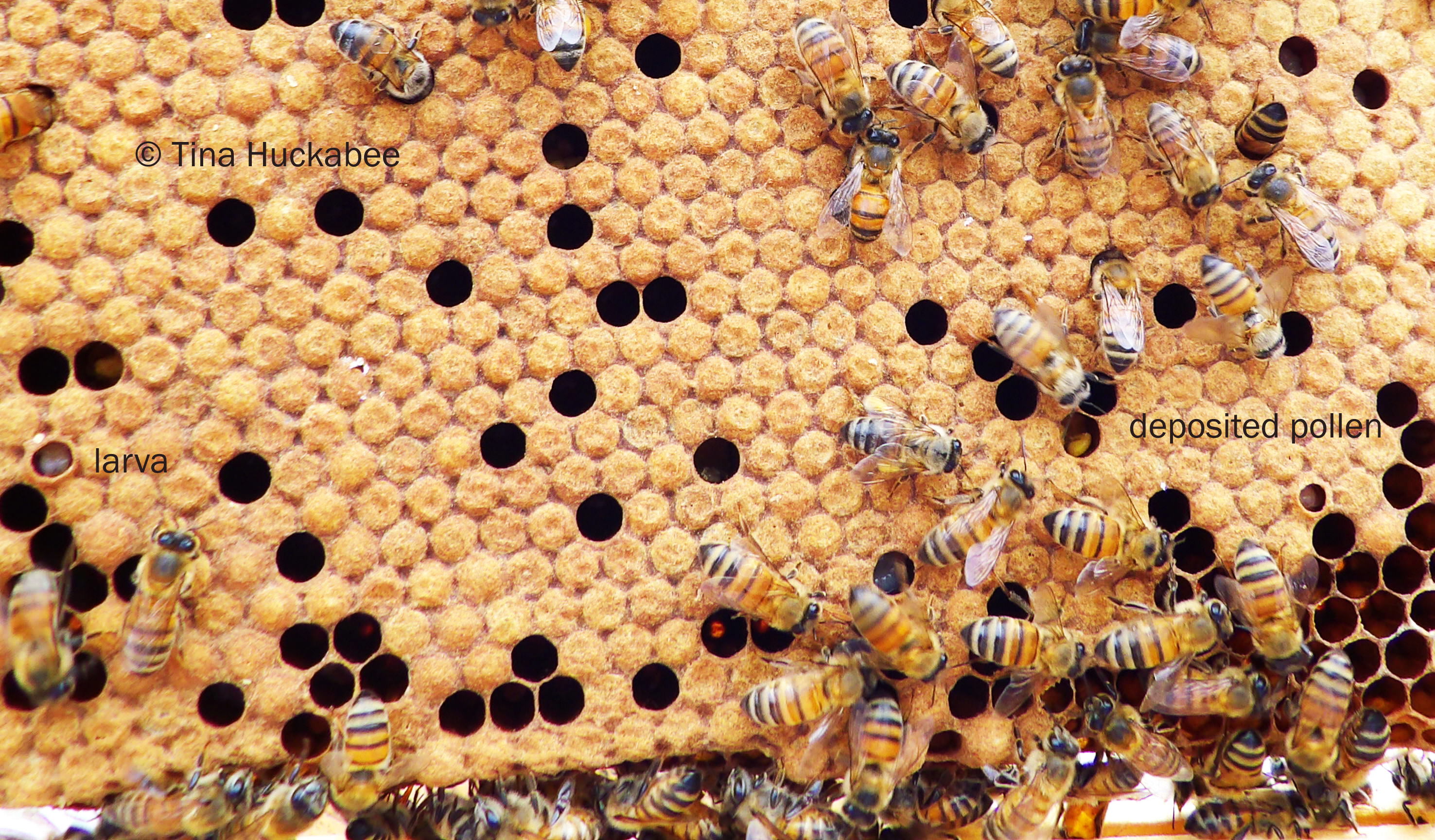
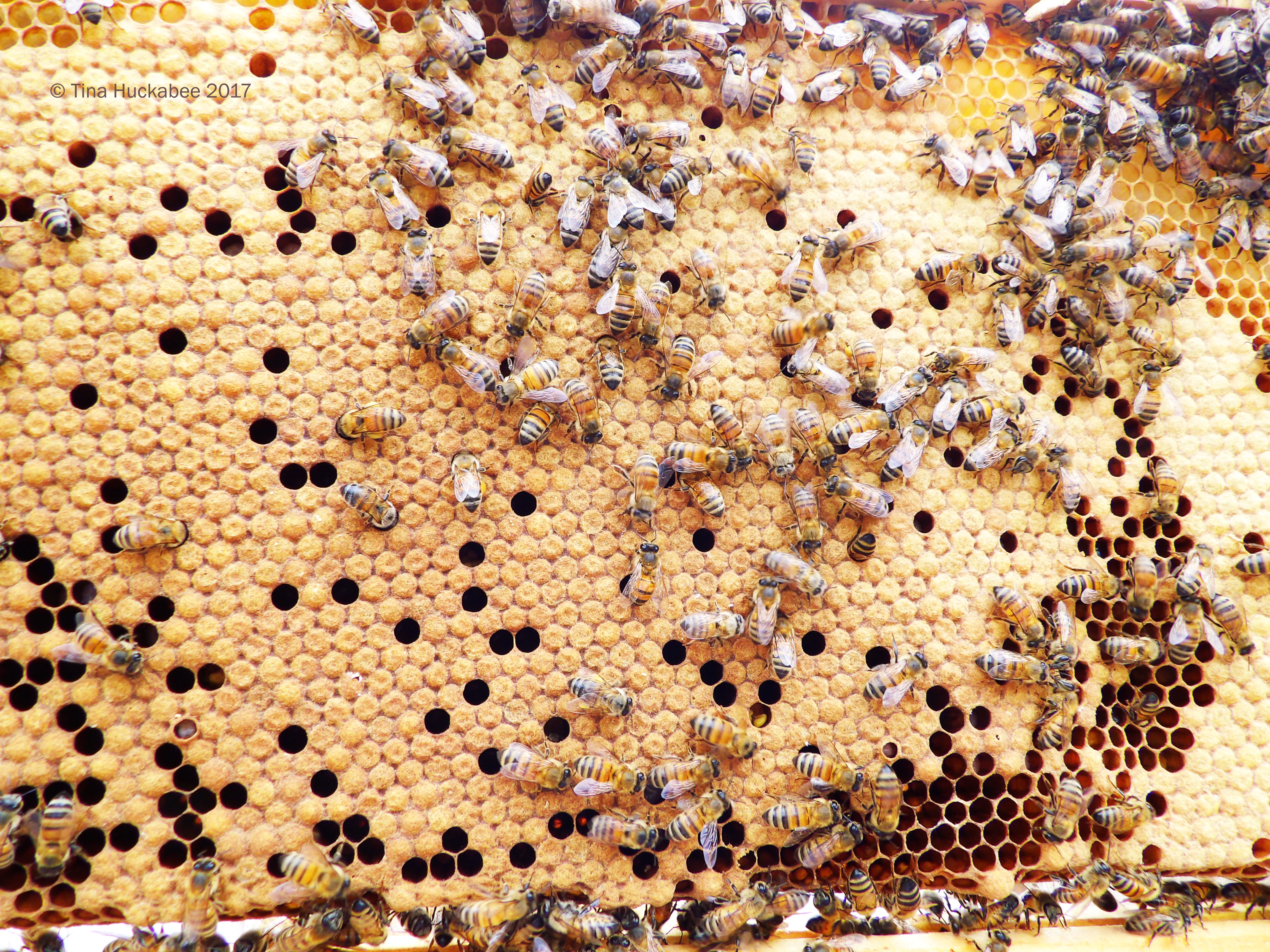
This comb–and it wasn’t the only one–demonstrates  a beautiful pattern of capped brood, meaning that Buzz’s queen is healthy and  laying eggs. The next generation of honeybees is in the works!
RICOH IMAGING

RICOH IMAGING

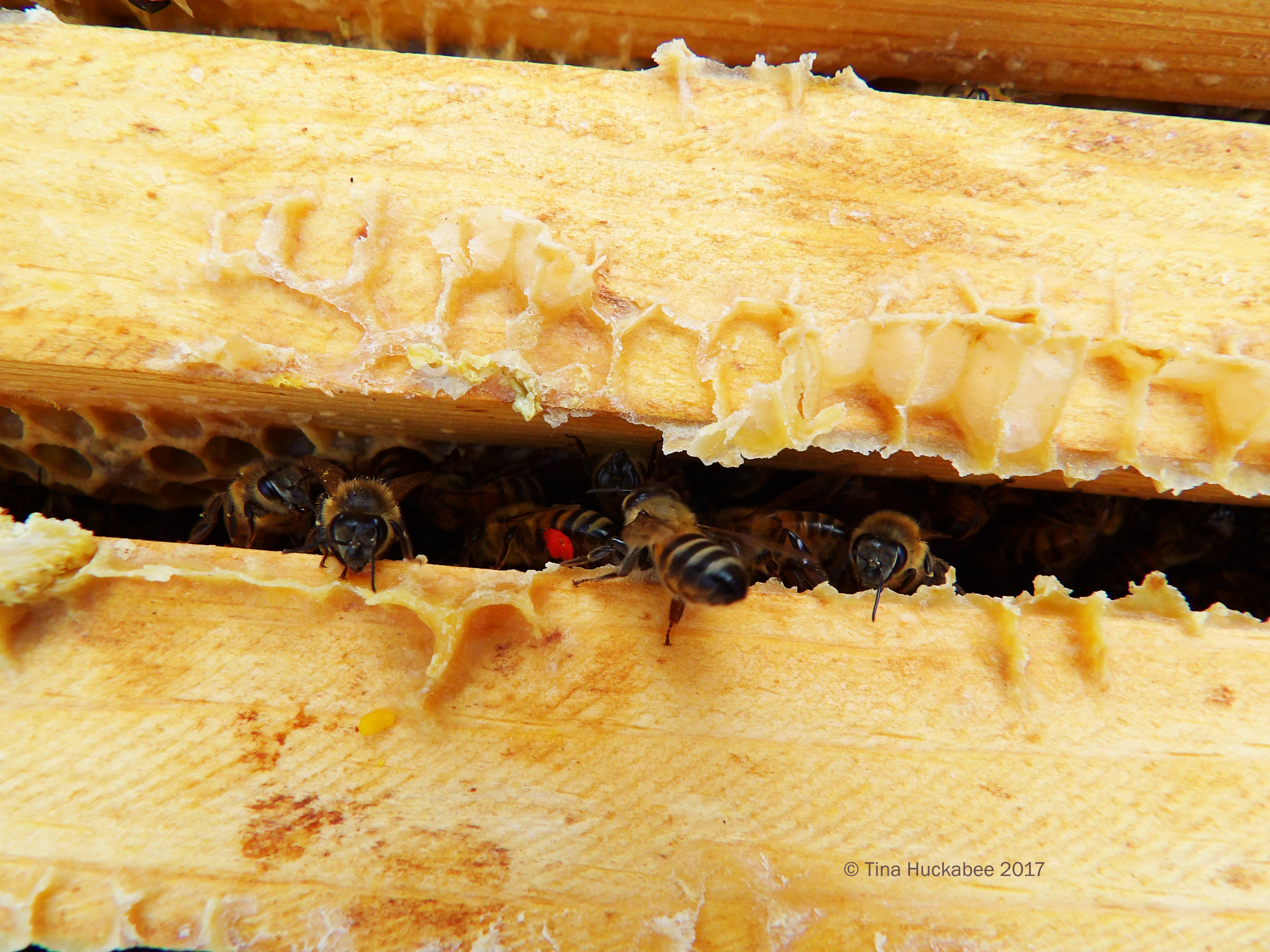
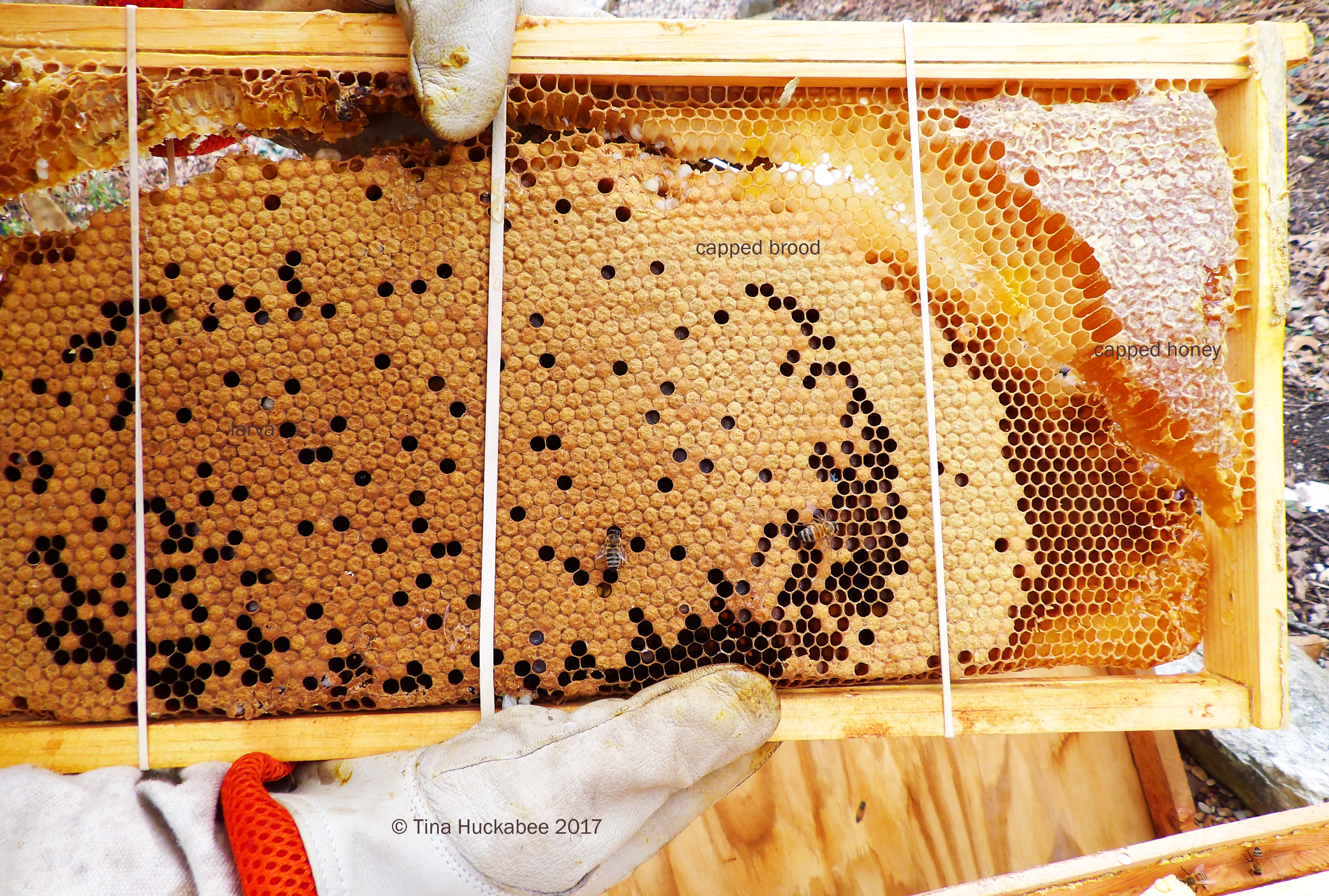
While pulling up some frames to check, I tipped one full-of-comb frame and the comb broke.  ARGH!  It’s not the first time I’ve made that mistake (when will I learn?), but when I’ve done that in Mufasa or Scar–the Warre hives, with top bars and not frames–we had to sacrifice the comb, or if it was full of honey, take the honey.  There is simply no remedy for placing a broken comb attached to a bar back into the hive, because there is no way to “hold” the comb in place. Now that we use Langstroth hives with full frames, a dumb mistake is fixable.
RICOH IMAGING

This frame is mostly capped brood, but there are some uncapped brood (larvae) and there is also some honey in the top right corner.

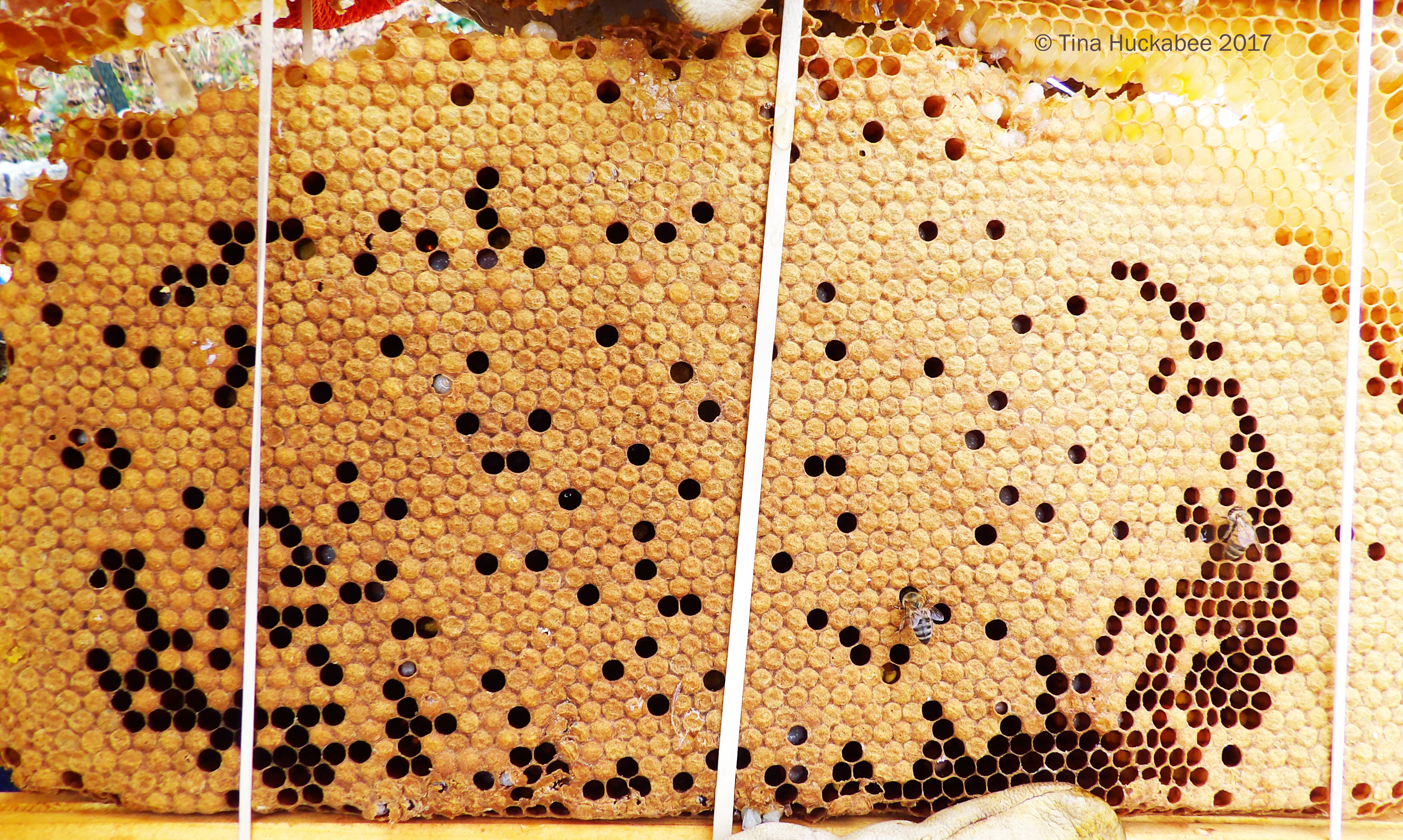
Three rubber-bands wrapped around the girth of the frame will sufficiently hold the comb in place and allow industrious little bees to repair the beekeeper damage by building new comb and continuing their honey-making or baby-bee tending.
RICOH IMAGING

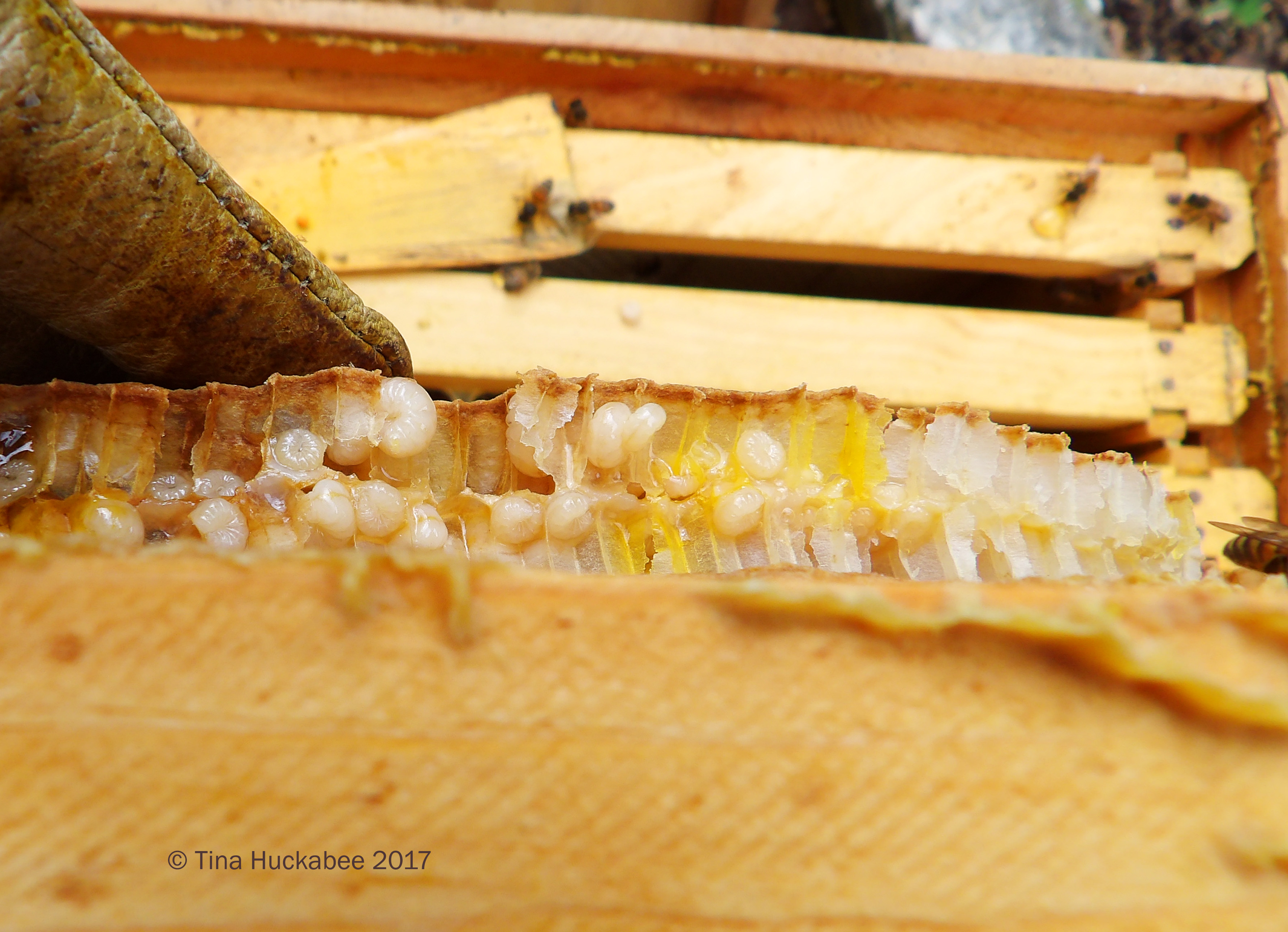
Unfortunately, some of the larvae about half-way through their development were victims of the comb breakage.  The bees will harvest the doomed larvae as a protein source–bees waste nothing.  Once they’ve rebuilt the comb,  Ms.Queen will probably lay more eggs in the new comb.
RICOH IMAGING

Ramping up indeed!  I was pleased to see that Woody and Buzz seem healthy and next time we open up the hives, we plan to conduct our first varroa mite check for the season.

Sadly, Scar is on her way out as a viable hive.  There were five full combs of honey in the top box–we took three out–but the lower boxes contained mostly empty comb. There is no brood, indicating that the queen has probably died and while there are worker bees busily foraging and still engaging in most of their bee work, there’s no new generation to nurture.  Last year, we decided that once our Langstroth hives (Buzz and Woody) were up and buzzing, we’d allow Scar to atrophy naturally–there would be no extreme measures to keep her going.  Still, I’m a little sad and must admit to a temptation to re-queen her.  But Scar is a difficult hive to maintain and I’ve become quite spoiled at the ease of working with Buzz and Woody in all their Langstroth glory, so I imagine I’ll keep with the original plan and let Scar go. Scar’s bees will live out the rest of their lives over the next month or so and then she will be empty.

I’ll plant something bee-friendly in that shady spot in Scar’s memory: maybe a nice Evergreen sumac, Rhus virens  or Turk’s capMalvaviscus arboreus.


Some Favorites: Wildlife Wednesday, February 2017

Today is the first Wednesday of February and time to appreciate wildlife in our gardens–happy Wildlife Wednesday to you all! In this fraught time, experiencing nature can be a balm for frayed nerves, as well as a respite for contemplating resistance to the specter of autocracy. To be a part of the natural world doesn’t require travel outside of your town or city if you make time to visit a municipal park or greenbelt, volunteer as a wildlife gardener at a school or religious institution garden, or set aside your own personal garden as a refuge for wildlife–and yourself.  None of these are difficult to achieve and the benefits are enormous: for you, your community, and the wildlife you share the world with.

Though the few blasts of winter’s chill has rendered my garden the muted beige and grey palette that is the Texas winter landscape, there are pops of color in the form of the resident native birds, like the Blue Jay,  Cyanocitta cristata,

…and  the Northern CardinalCardinalis cardinalis.

I’ve never successfully identified Blue Jays by gender–male and females look alike to me, though I assume they see differences among themselves. Cardinals however are easily distinguishable, the female Northern Cardinal softer in coloring than her stunning male counterpart.

Not quite as dazzling as her fella, she’s certainly pretty enough for this human to enjoy observing.

Typical of the drab girl-coloring common in the avian world, this female House FinchHaemorhous mexicanus, doesn’t share the splash of red that her partner enjoys.

Female House Finch

Male House Finch

Though not as flushed and blushed as her mate, Ms. HF is pretty cute.  House Finches are numerous in my garden and chatty to boot.  In late spring and early summer,  their song is almost non-stop.

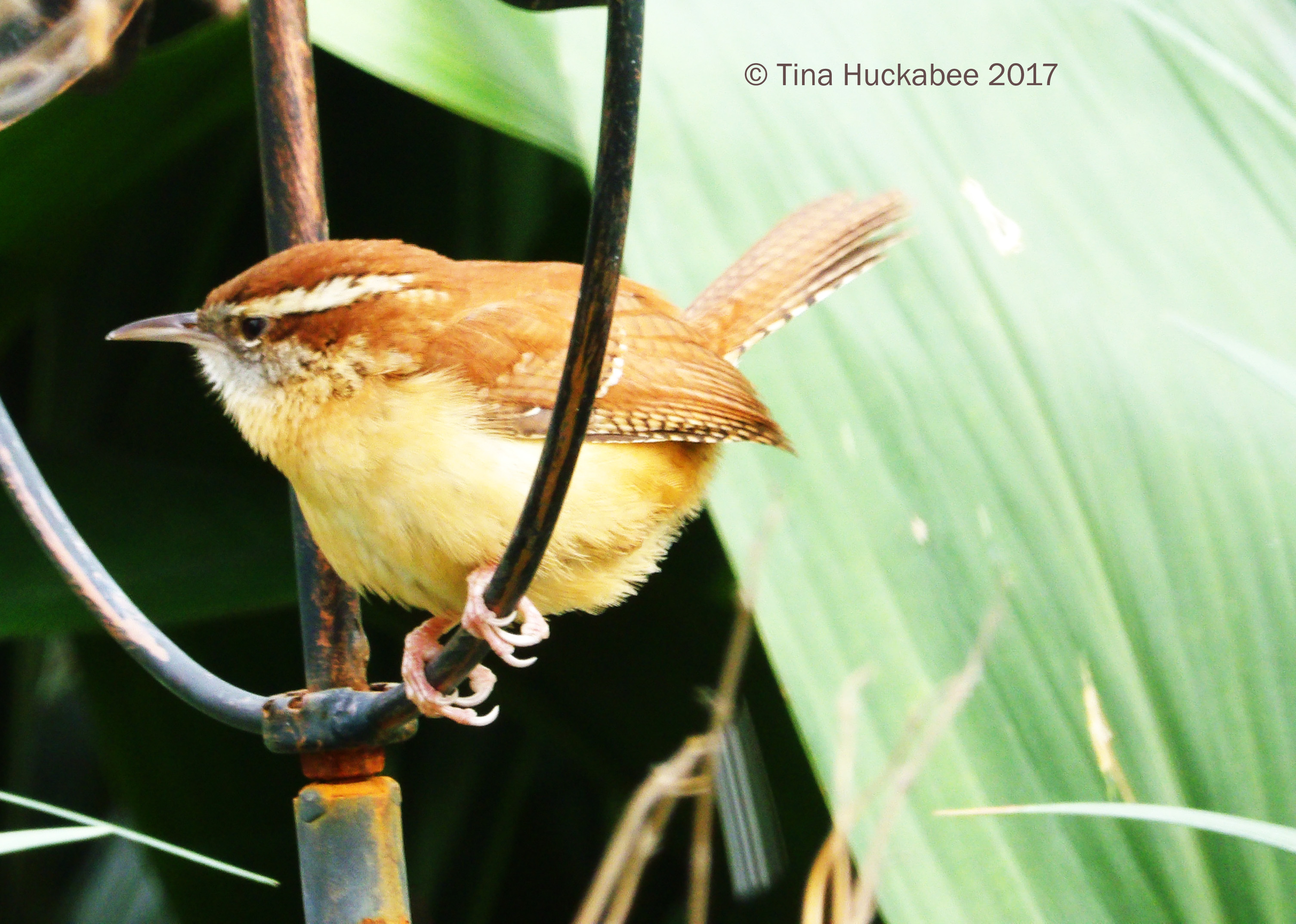
Another vocalist in my garden–and a species where the males and females are indistinguishable to me–is the Carolina Wren, Thryothorus ludovicianus.

These little guys and gals are real charmers.  Males sing beautifully, often, LOUD, and with a variety of song. The adults scold with a tchtch, tchtch, tchtch  when nestlings are threatened or feeding is interrupted and that is a frequent backdrop of my garden’s bird song symphony.

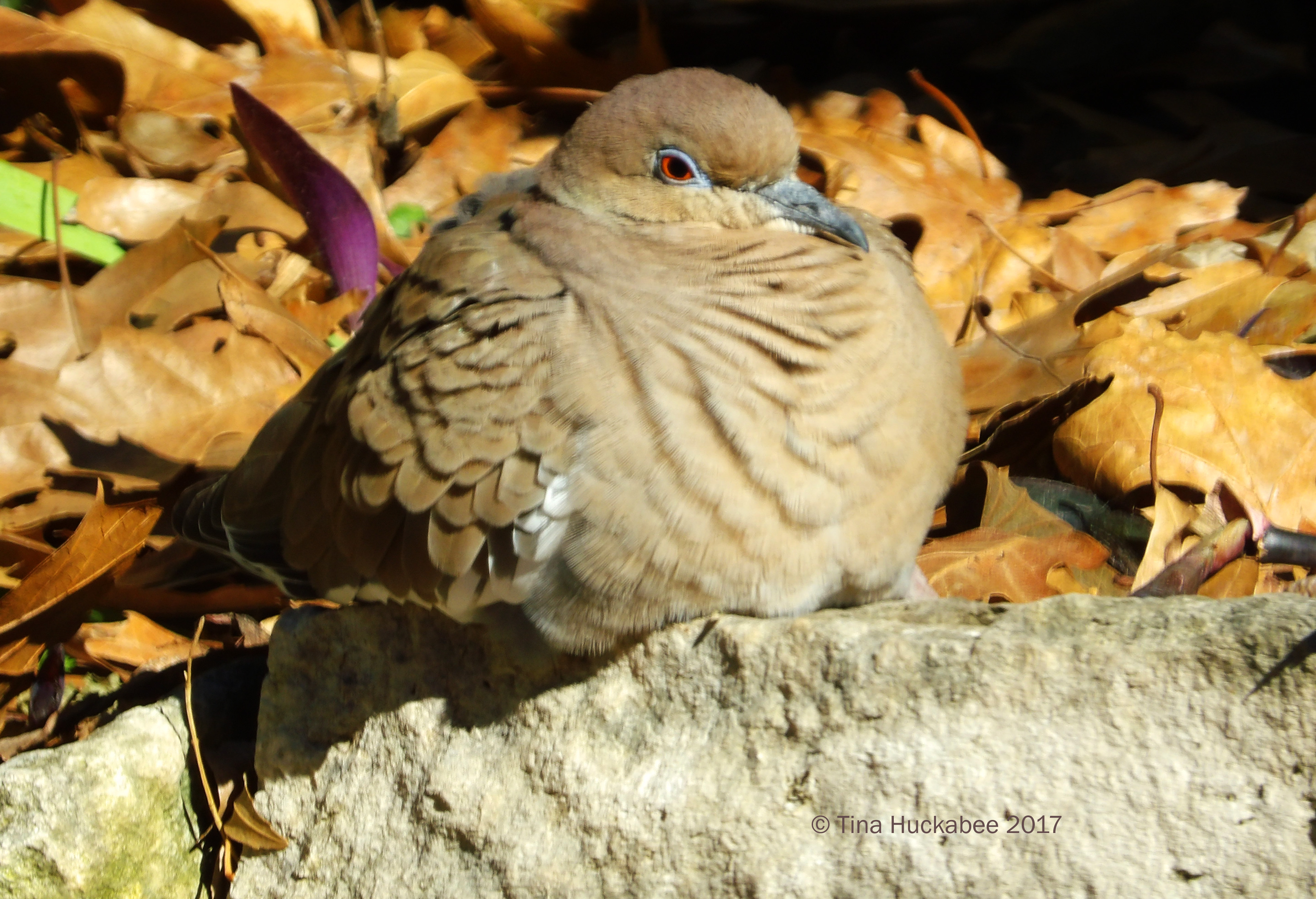
The White-winged DoveZenaida asiatica, wins the award for birds a-plenty.  These are birds that I rarely photograph because  my familiarity with them breeds a certain level of…yawning boredom.  White-winged Doves are everywhere, every day, all the time.  According to Cornell Lab of Ornithology, this species was originally a bird of desert thickets, feeding on the seeds of grasses and berries in trees.  Year-round residents in Texas, White-winged Doves are one species that most non-gardeners and non-birders recognize because they’re generously represented in cities and suburbs. While I’m not a huge fan, I tolerate them, even when they land along the edge of the bird baths–backwards with tail in, or over, the water–and immediately poop in it.  Yuck!

Typical for doves though, they have a rather sweet  appearance, as this one demonstrates while resting on a bed of fallen leaves during a chilly day.

White-wing Doves are known for their “blue eye-shadow.”


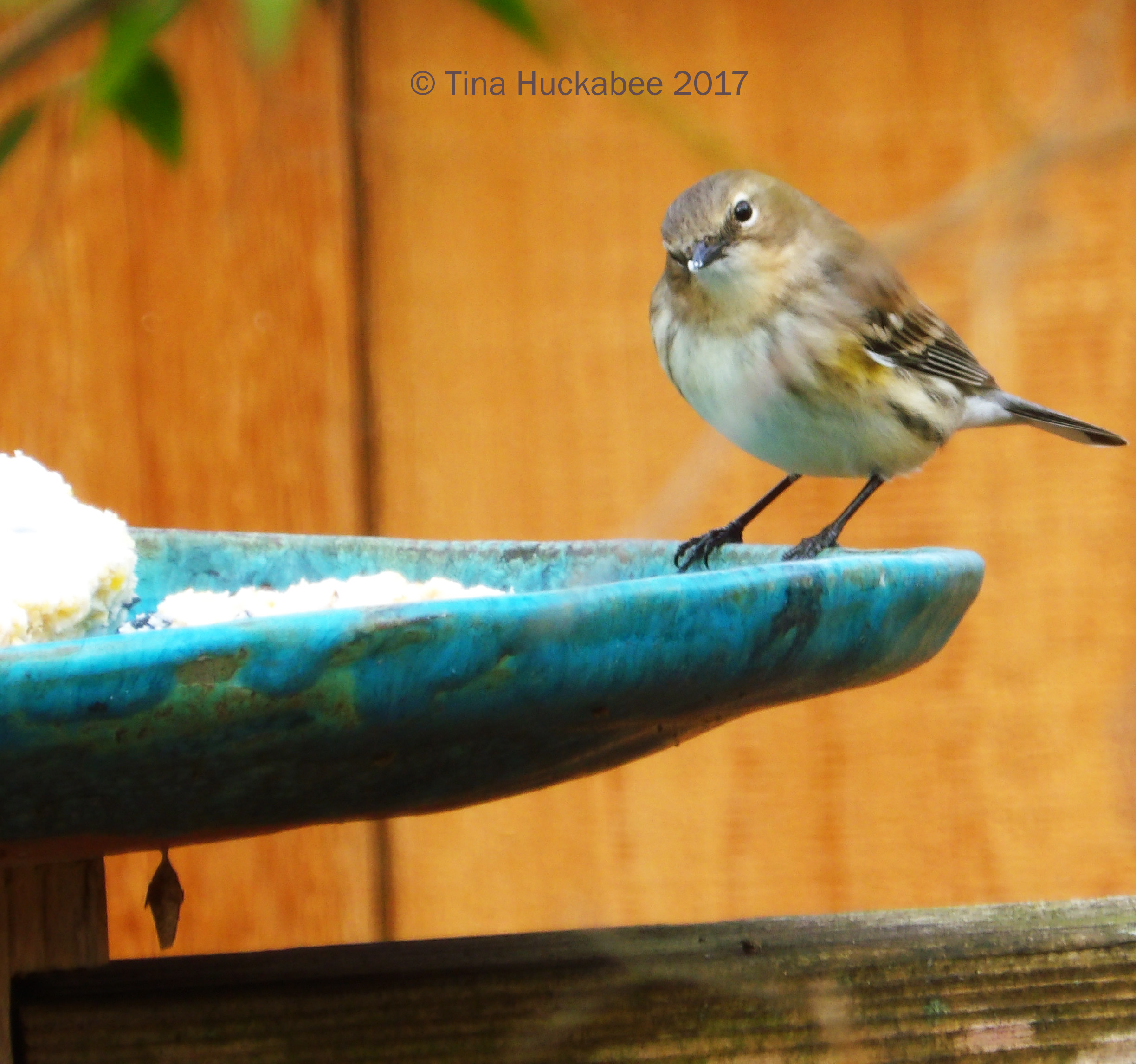
Butter Butts are back!  Yellow-rumped Warblers, Setophaga coronata,  are winter Texans and very welcome in my garden.

They hop along the ground, looking for seeds, but they also enjoy the suet I’ve placed in a couple of spots.

I think this one is voicing opposition to my taking this photo.

I think the two that I’m seeing regularly are females, but last year there was a male in the mix. These seasonal warblers will hang around until March or early April. I hope that I can identify individuals by the time they leave for their summer breeding grounds much farther north in Canada and the northern states of the U.S.


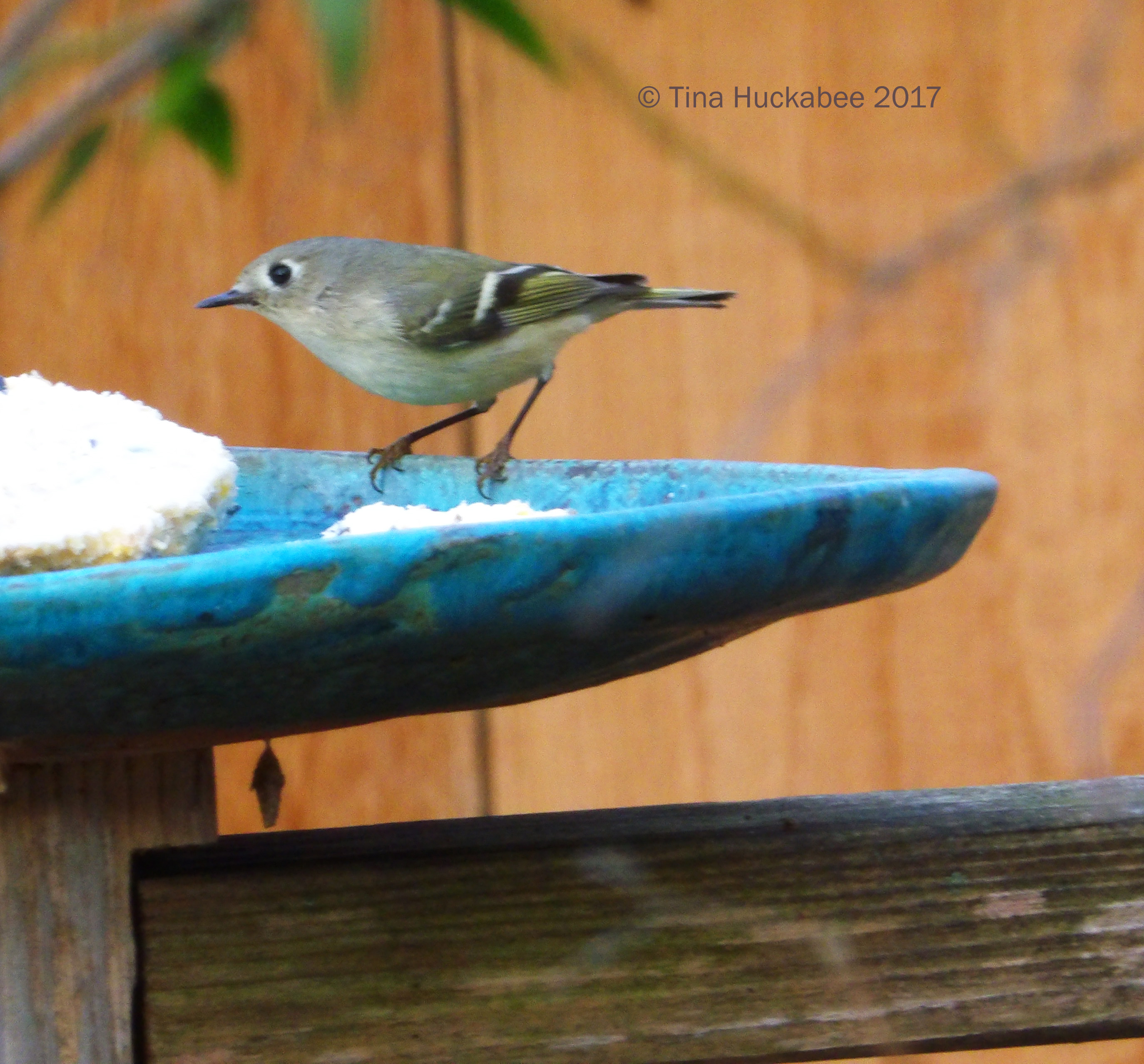
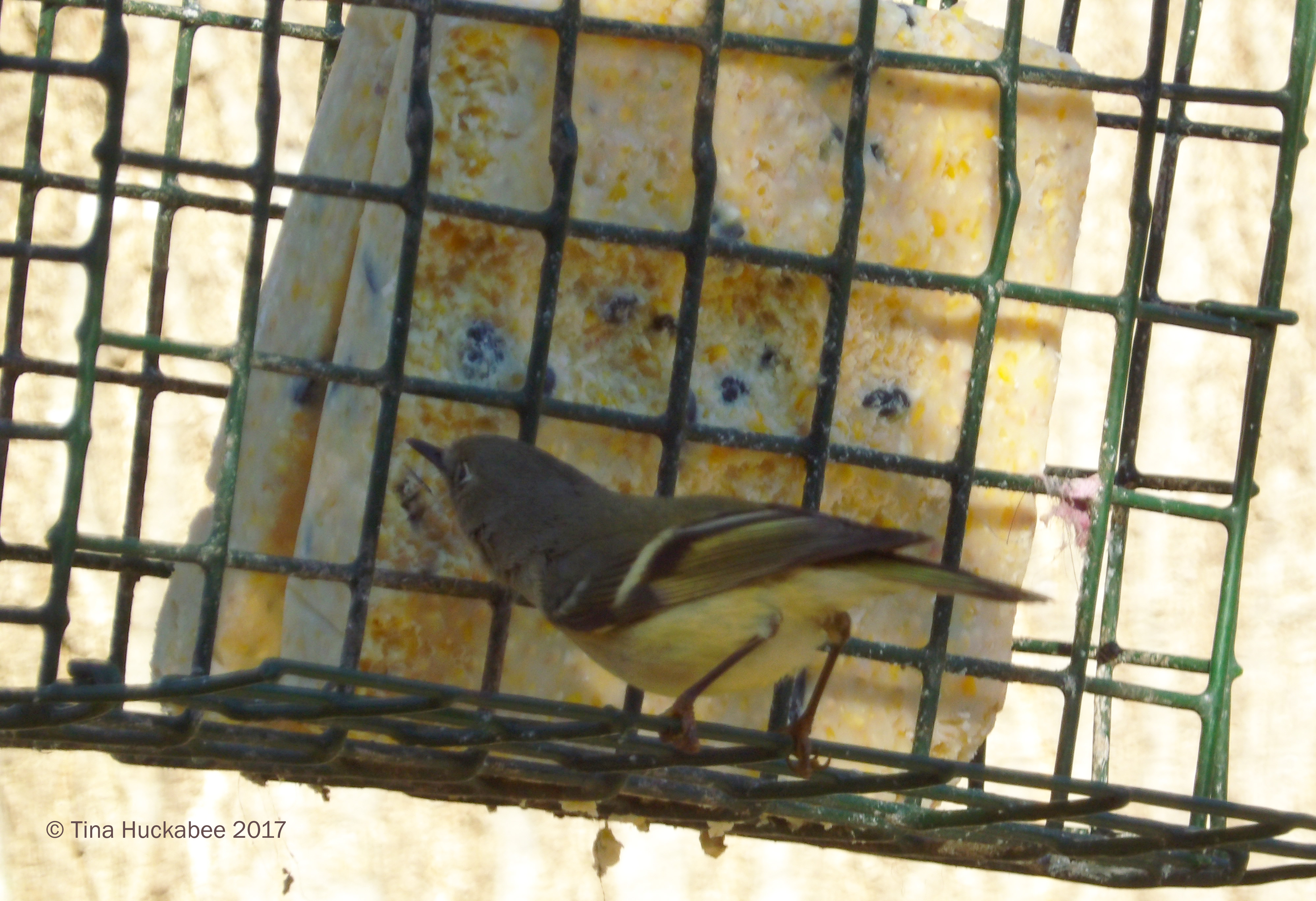
My newest favorite bird species and one I think has visited my garden before, though I’ve only definitively identified it this year is the Ruby-crowned Kinglet, Regulus calendula.  A rapid-fire flyer, itty-bitty, and oh-so-darling, these song birds are fond of insects and suet. They flick their tails as they flit from branch to branch and are stationary only for very brief periods of time.  I’ve seen both a male and female in my garden and though they look similar, there is one striking difference.  Okay, probably more than one, but one that I can readily see.

This Ruby-crowned is diving into the suet.

The two in my garden take turns snitching suet from the feeder.

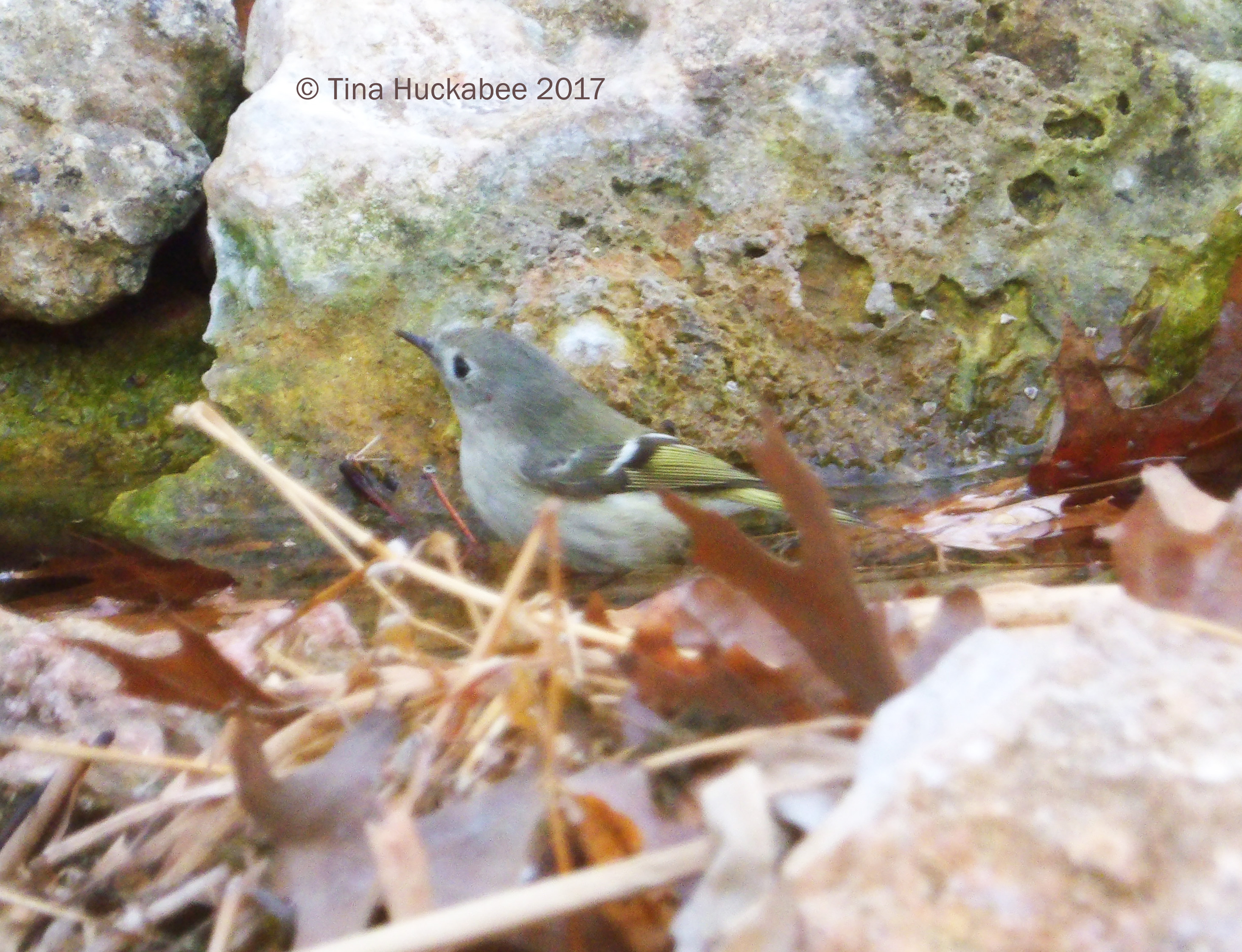
After feeding comes a bath in the bog area of the pond.

The male is identifiable because of the startling red feathers on top of his head that he fluffs up when he’s issuing a warning or flirting with a girl. In this photo, it’s a barely visible suggestion of a red stripe.

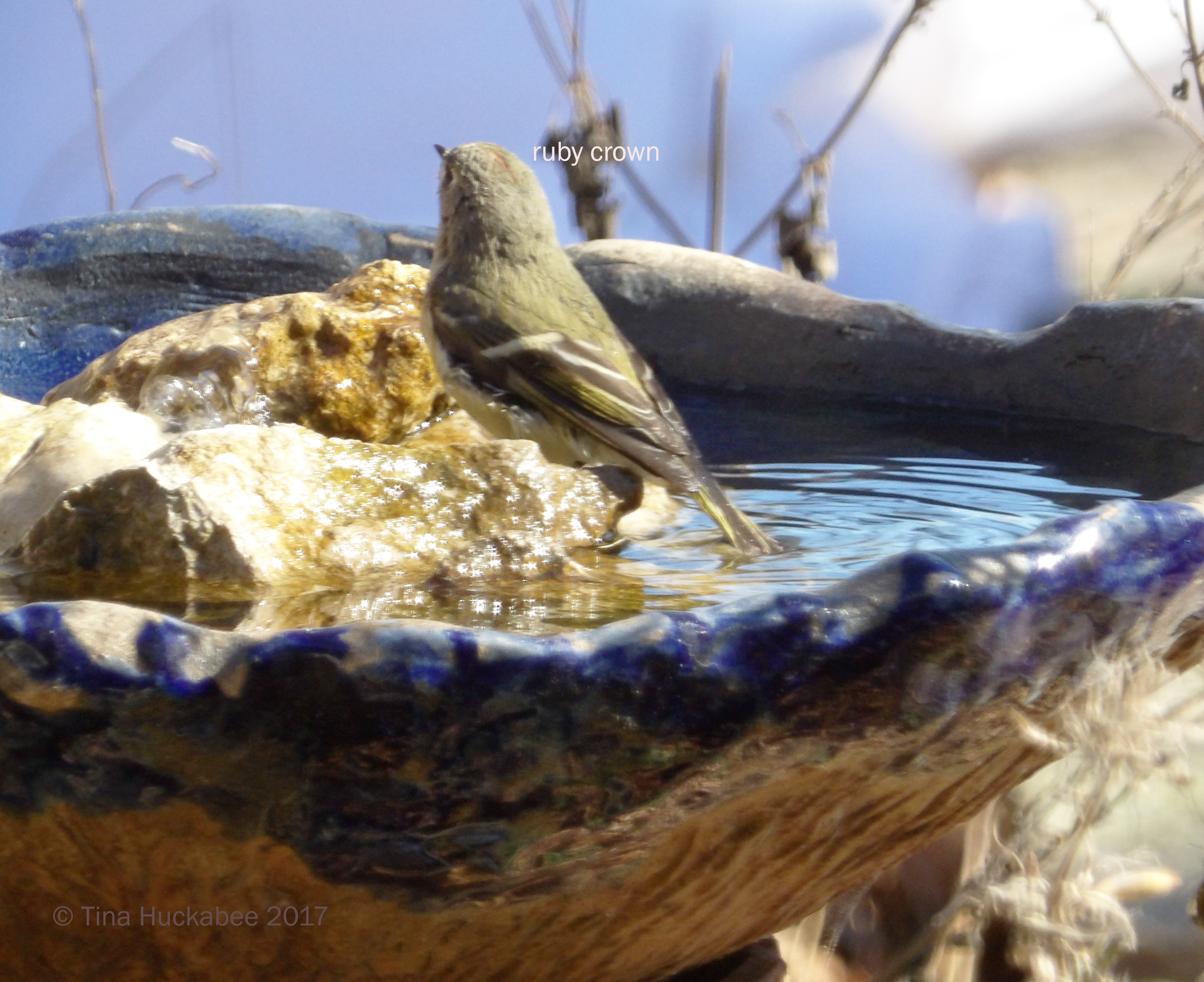
Along with flirting and blustering, bathing is included in the list of what elicits the ruby-crowned flash,

…and after-bath fluffing revs up the red feather action, too.

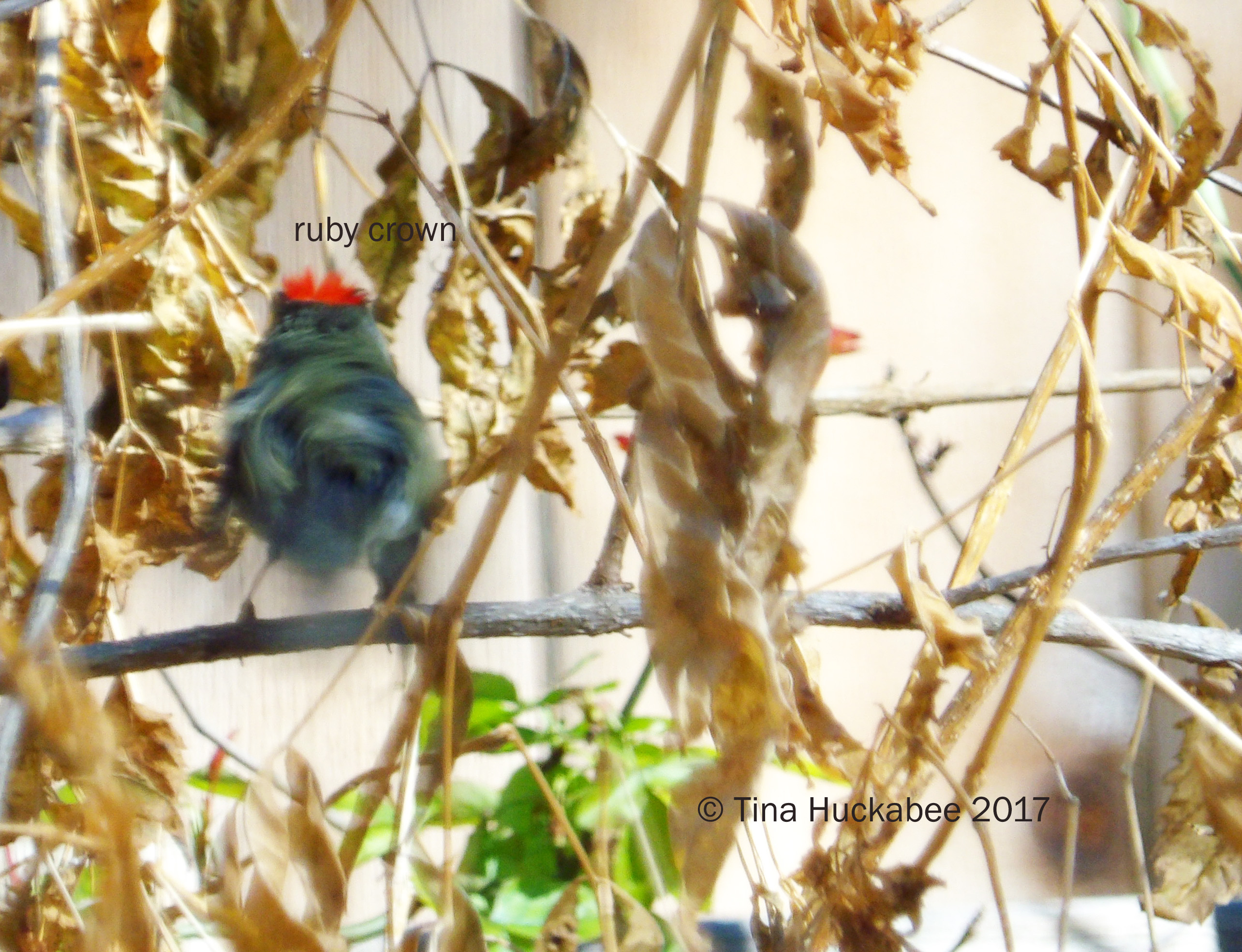
The ruby crown looks like he’s sporting a little campfire on his head.

It’s remarkable just how RED that crown is when it’s up and flashing.  When it appears, it’s truly a ruby jewel in the garden;  when the sun spotlights the ruby crown, it positively glows.

Those aren’t great photos and I’m working for better during his winter stay. The Ruby-crowned Kinglets are so fast that competent captures of these little birds has been a challenge.

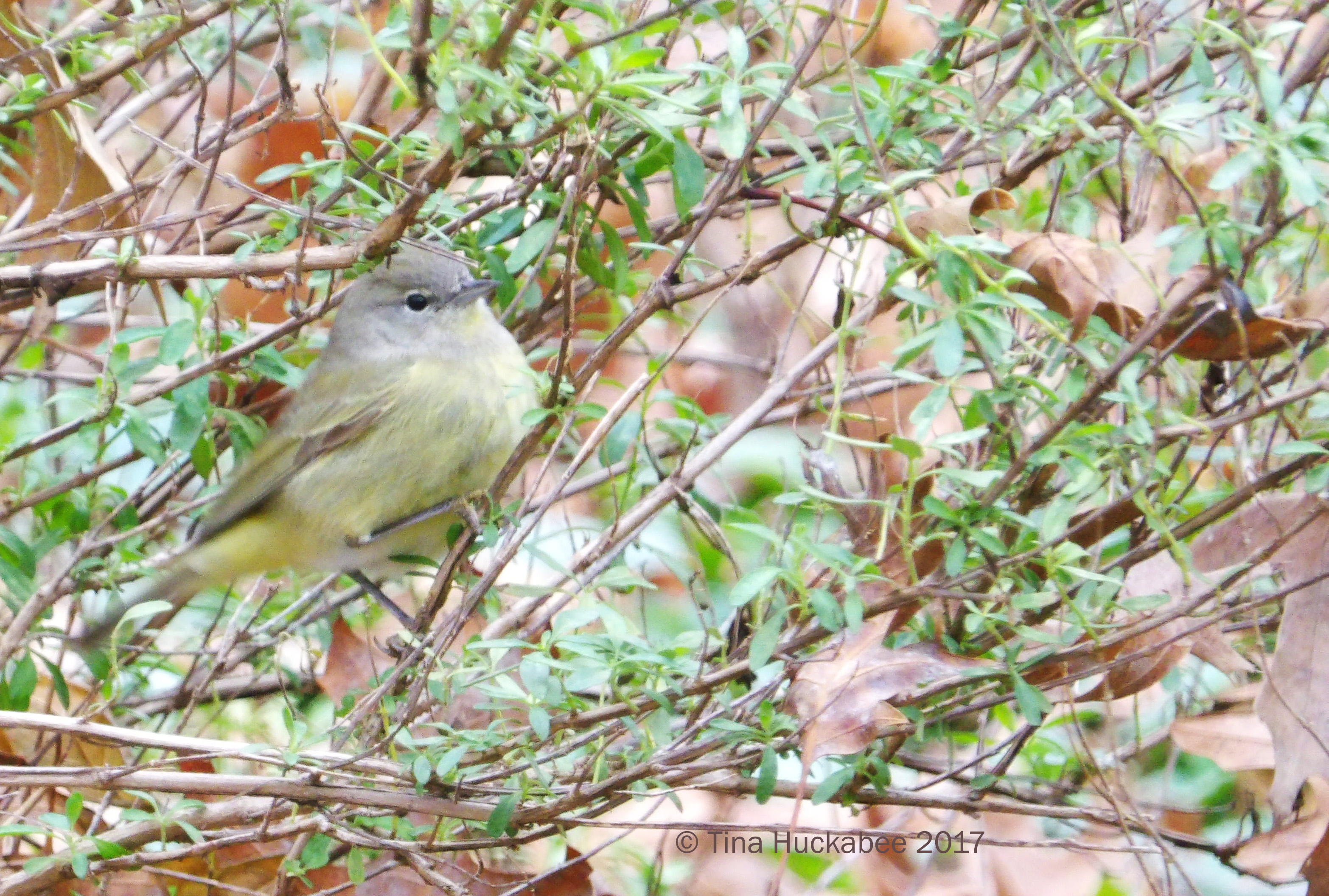
Another winter warbler who visits daily is (at least) one Orange-crowned Warbler, Oreothlypis celata.  He/she/they (there might be more than two) are shy and are often chased around the garden by the larger Yellow-crowned Warblers.  I’m not sure why, but I observed that behavior of Yellow-rumps toward Orange-crowneds last winter too.

Birds are bullies sometimes, just like people are bullies sometimes.

Orange-crowned Warblers sing a sweet cheep cheep and that’s usually how I find them in the oak trees. They favor flitting through the shrubbery, snipping off insects and are more reticent at the feeders than either the Butter Butts or the Ruby-crowned Kinglets.

Such a sweet face!


Toward the end of the month, the Cedar WaxwingsBombycilla cedrorum,  appeared in their usual flocks of many.   This beauty is an anomaly as he sits quietly and alone, proudly perched in the Red Oak.

There should be ample opportunity to see and hear these beautiful birds before they leave in late spring for their summer breeding grounds.

I hope your garden is full of wildlife and that you observe, learn, and appreciate their place in the world. Let your garden be a place of renewal and strength.

Did wildlife visit your garden this past month? Please post for February Wildlife Wednesday. Share photos and stories of your garden wildlife to promote and appreciate your region’s natural habitat and diversity. When you comment on my post, please remember to leave a link to your Wildlife Wednesday post so readers can enjoy a variety of garden wildlife observations.

Happy wildlife gardening!

Evicted!

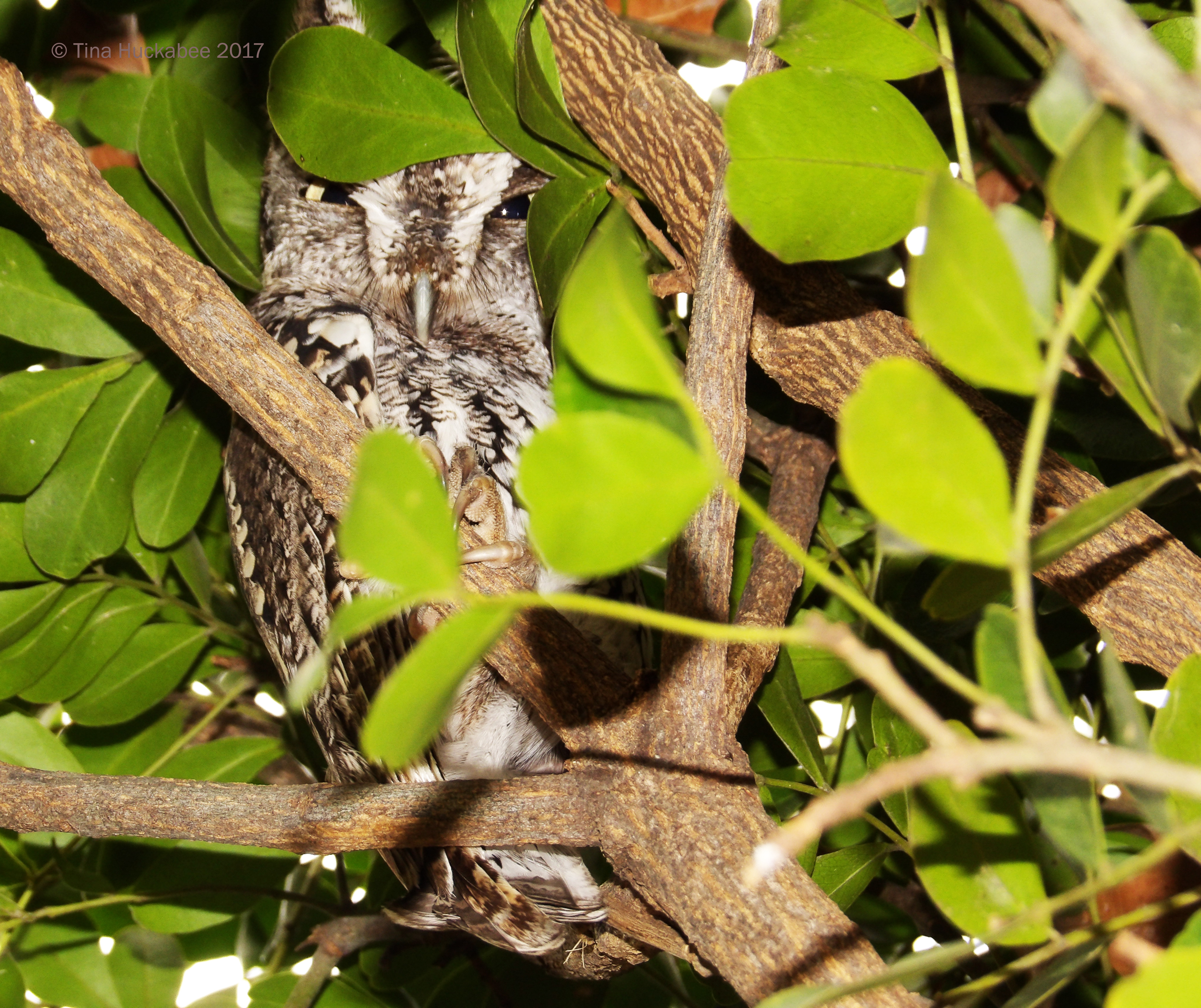
Winter’s bare trees allow for good bird watching, especially when it comes to the local raptors.  It’s also the time of year when we prepare to host Eastern Screech Owls, Megascops asio, as they court, breed and fledge their young in the Red Oak tree in our back garden. We’ve been privileged to observe these shy beauties for the last 8 years and certainly hope that they once again choose our back garden for their home territory in these next few months.  I haven’t seen an owl yet this season and I’ve missed them this winter.   Once in early October and then once more in early November, I heard a Screech Owl whinny  announcing to others this is MY territory!, but I haven’t  heard the common owl trill as the owls are living their lives: hunting, flirting with a potential mate, and then working with that mate to raise a family.

Since late November, I’ve spotted a young Virginia opossum, Didelphis virginianus sitting in the owls’ oak tree at night,

Not a great shot, but you get the idea.

…as well as occasionally scuttling through my garden early in the morning.

I also suspect the same opossum as the thief who had stolen a small board at the entrance to one of my honeybee hives–I found it in a corner of my garden, weeks after it went missing, dropped nowhere near the hives.  Because I’d noticed bits of non-oak leaves and Mexican feathergrass shards caught in the branches just below the owl nest box, I thought the opossum might be squatting in the box, but I  never actually saw her enter or exit. Squirrels have moved in to the nest box in the past and I hoped that a rogue opossum would be too large.

I hoped, but I was wrong.

As Screech Owl breeding season is nigh, we’re placing a new camera in the owl house this year because we enjoyed watching Mama Owl in her box last year–until the camera pooped out just after she laid her 5th egg.

This past weekend, the ladder out and up and tools at the ready, The Hub was up in the owls’ tree.

Steady there!

I remained terra firma and sollicita because 2016 wasn’t a great year for his bones–all 20 that he broke due to a bike accident and related glitches. That’s all we need: for him to tumble off the ladder in the service of wildlife watching. Thankfully, he didn’t tumble, but he did find an owl box interloper in the guise of this fella:

20170122_164932copy

20170122_164940copy

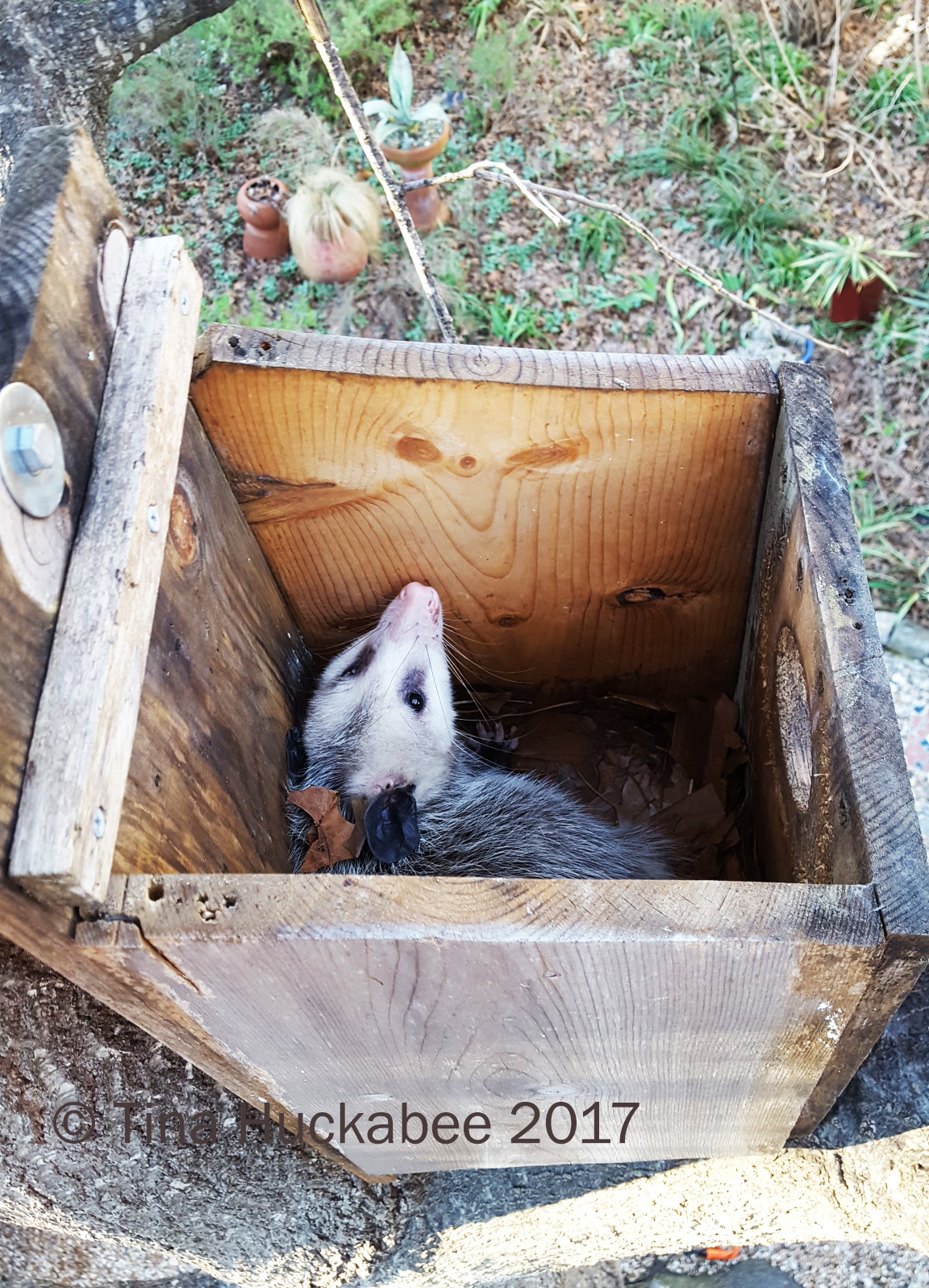
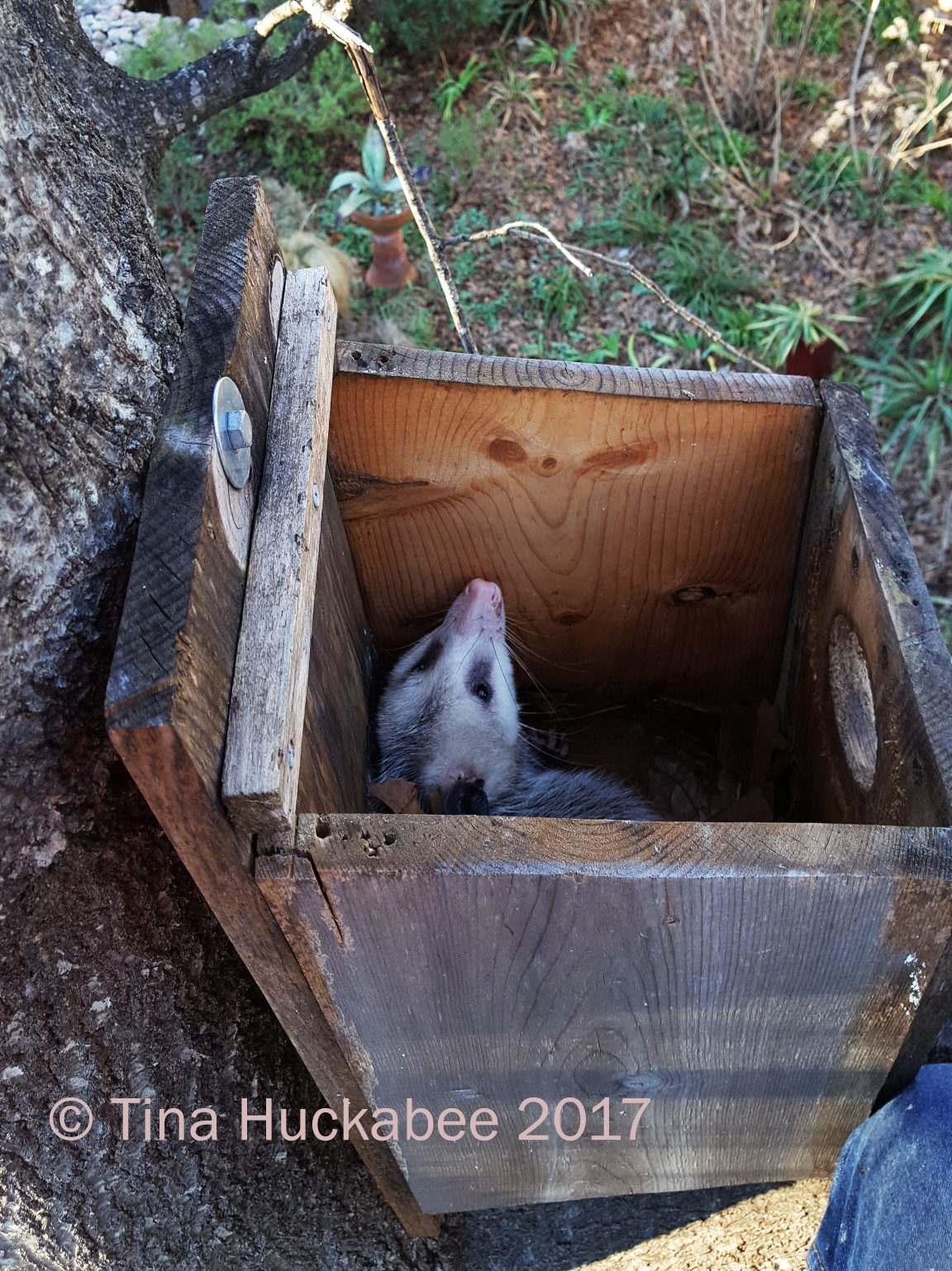
Actually, I suspect she’s a young, possibly pregnant, female opossum. What to do with a malingering marsupial snuggled in an owl nest box?

I have no objection to opossums. I don’t mind them sipping at the pond and bird baths, eating from the compost bar, or even rummaging through my garden, but I do mind, very much, that this one has decided she needs the owls’ house for her own.

Once the top of the box was removed, the opossum didn’t comply readily with our wishes for her to vacate the premises, nor did she cooperate when The Hub attempted to scoop her out onto a branch with a long stick. She peeked over the top of the nest box once or twice,

Too high up to jump!

Is there an opossum-sized ladder I can use?

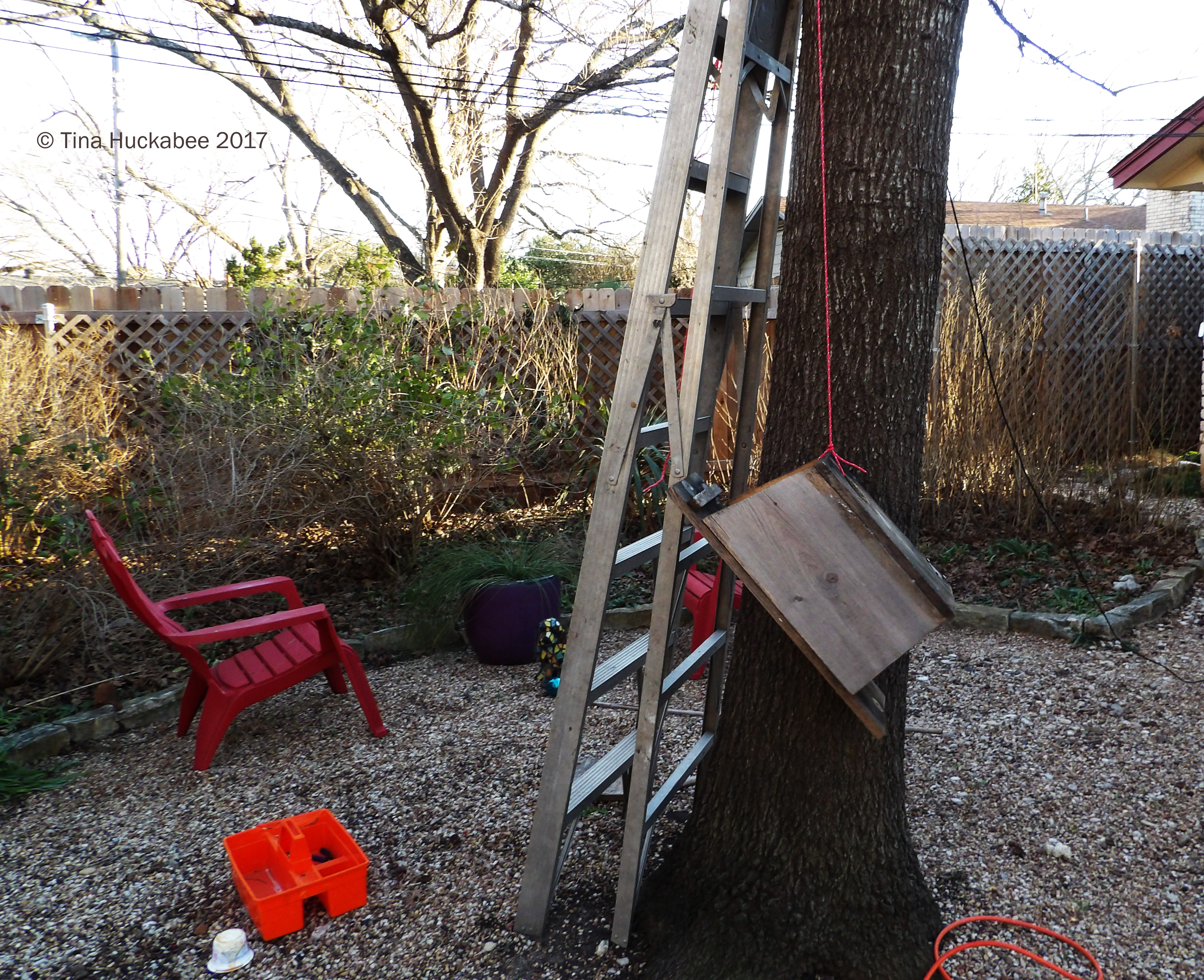
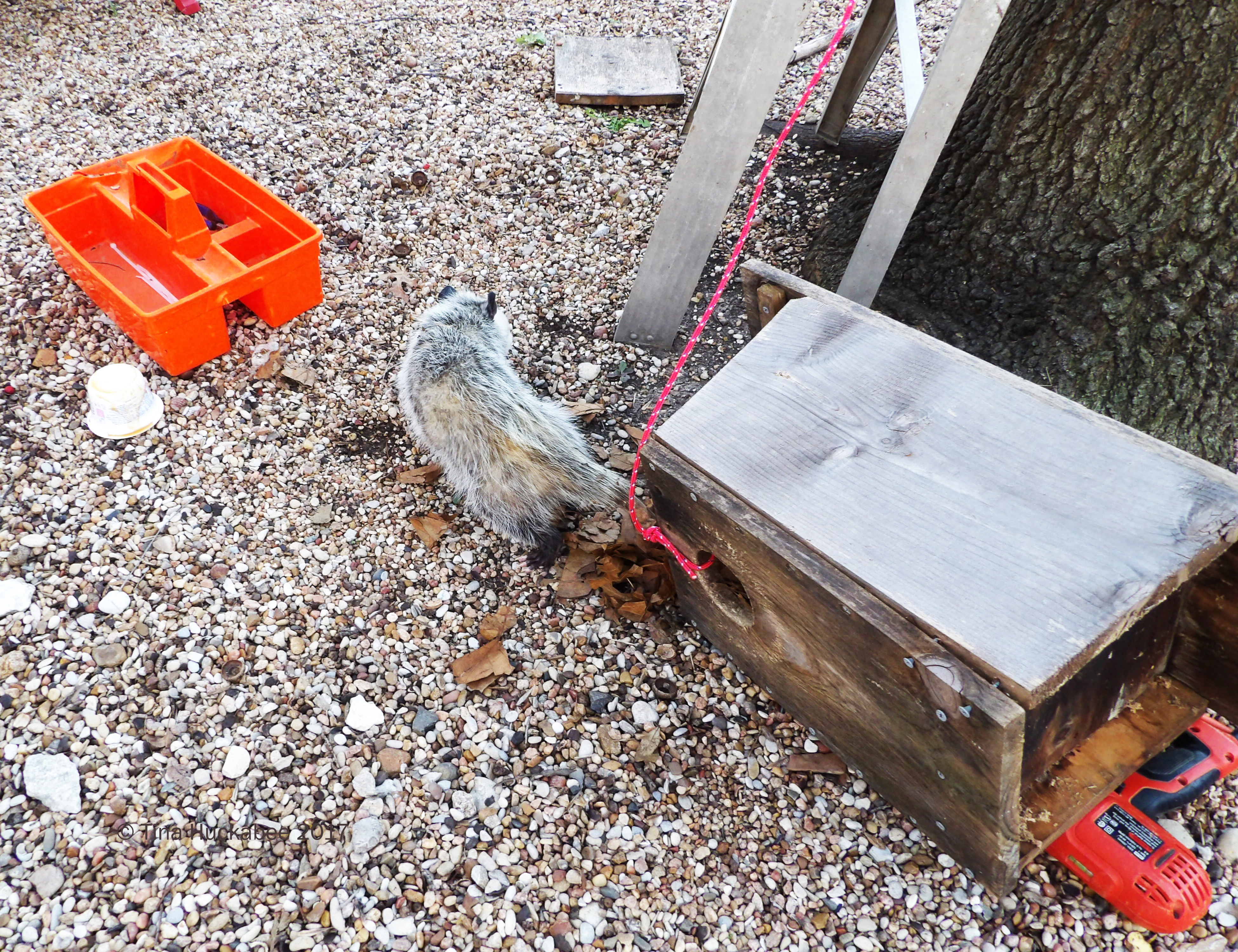
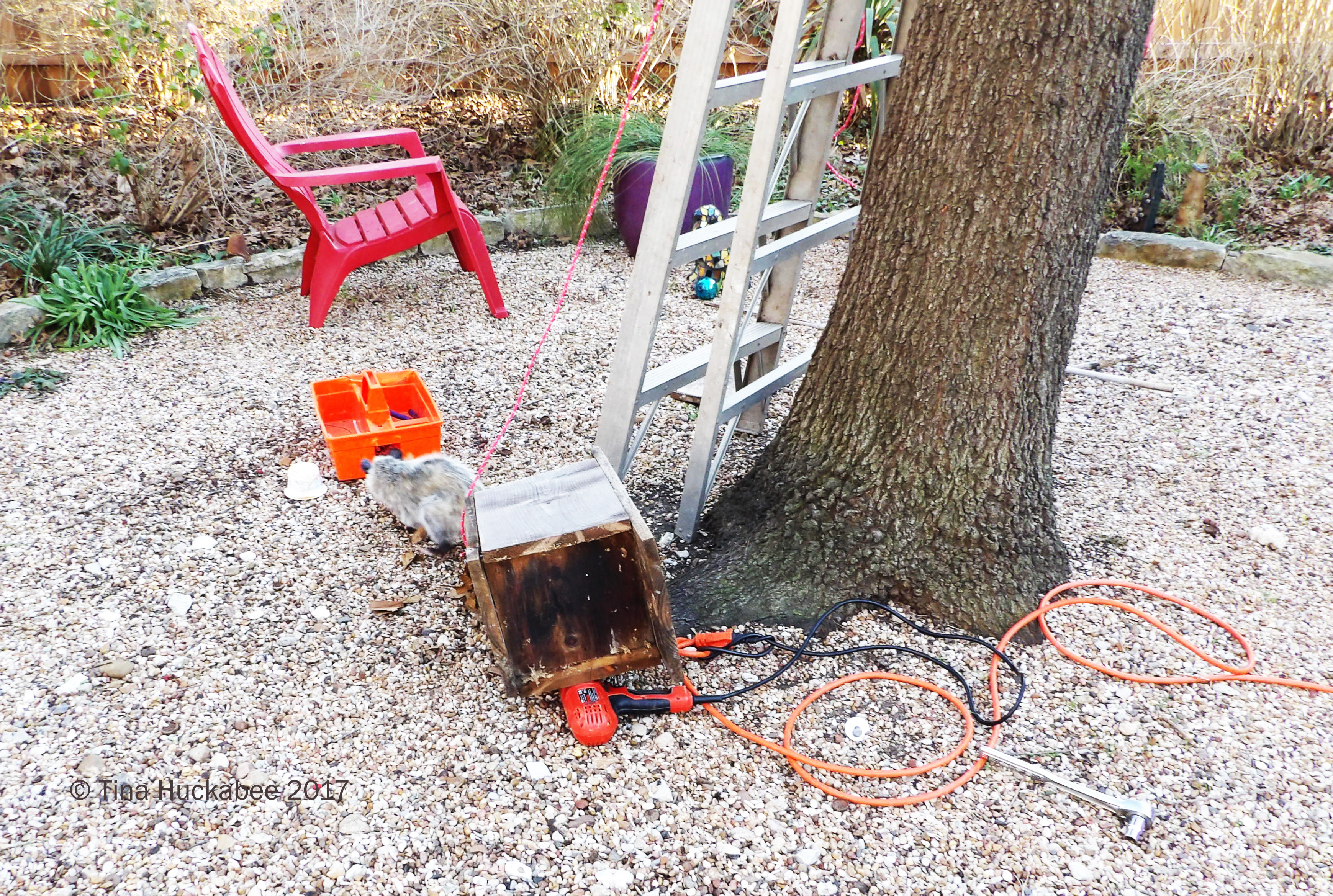
…but decided that staying put and hissing was her best bet. With The Hub remaining up in the tree, we contemplated our options:  leave the opossum in the house or scoot her out, forthwith? We decided that the best thing to do–for us, the opossum, and the nest box, would be to carefully lower the nest box to the ground,

Going down…

Almost there!

Thwarted–no more owl nest box squatting for you, missy!

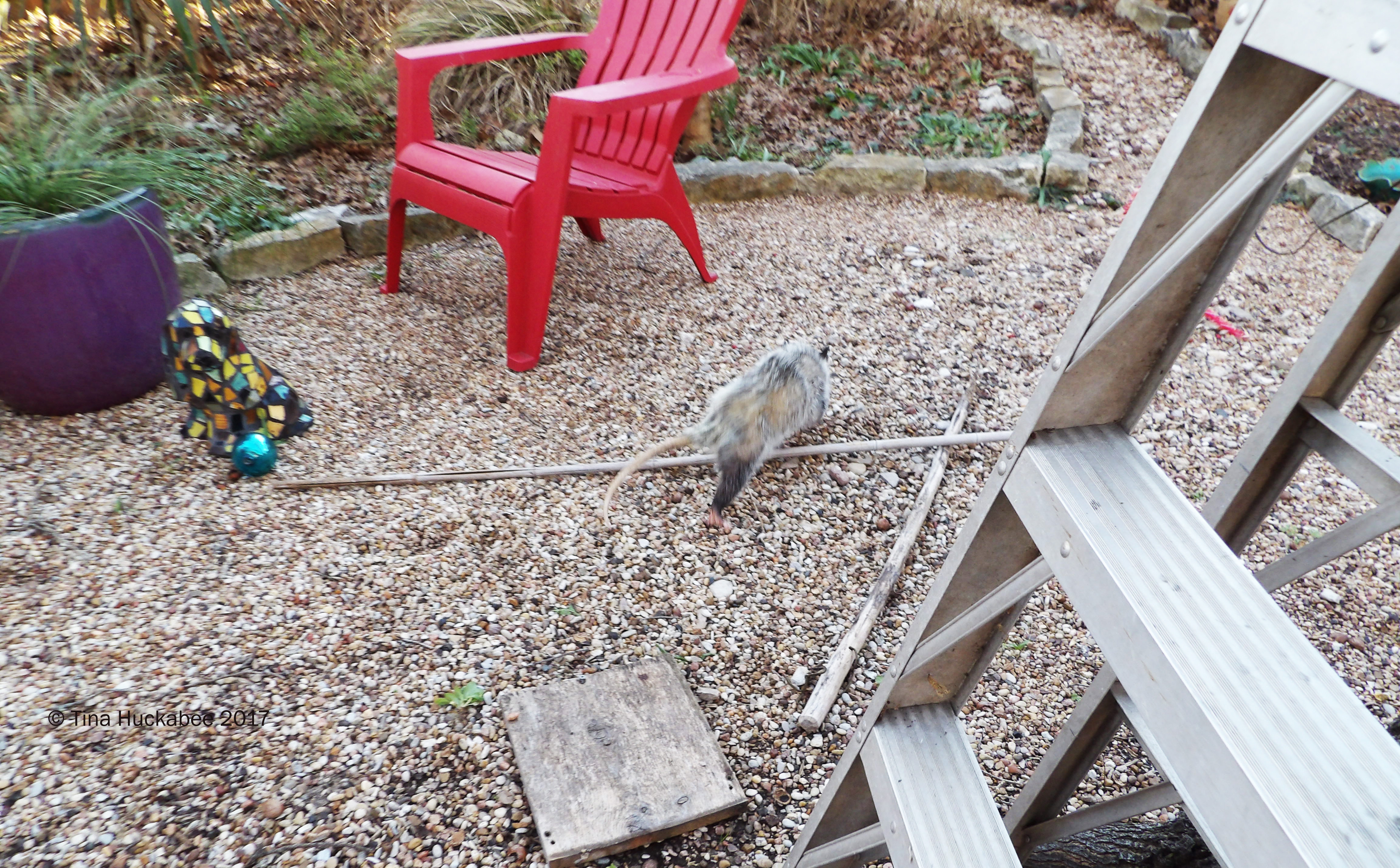
…allowing her to safely waddle off,

…which she did, in a huff.

I admire her steadfastness at claiming the box and for the obvious efforts at collecting leaves and grass for her nest and I do feel badly that we evicted her from such prime real estate.  But we didn’t build the box for her and I’m sure she’ll soon find another cozy spot in which to nest.  Opossums are not the brightest of critters, but they are remarkably adaptable–they eat almost anything and can nest almost anywhere.

Opossums thrive in urban environments–like my back garden.

We’re leaving the nest box down for the week and plan to put it back up into the tree, camera affixed and ready to go, by next weekend.  Learning about and enjoying the life cycle of the Eastern Screech Owls has been a great pleasure for us.  I hope that we can continue with that this spring.

2016 Mama Owl

2016 Daddy Owl

As for Ms Opossum, I have no doubt that we’ll cross paths again.