Bee Mama Missive: Ramping Up

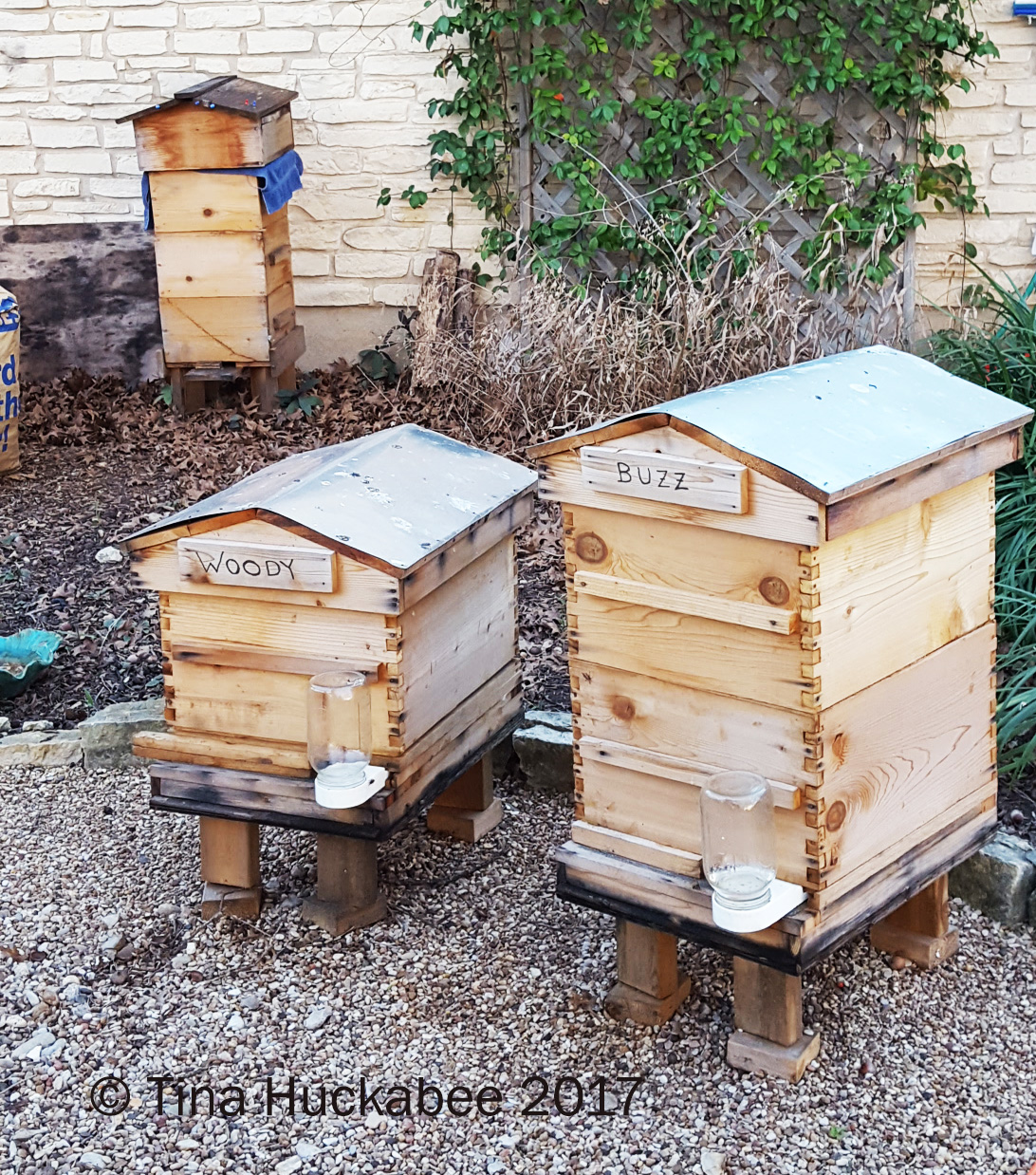
We’re ramping up for spring and another (hopefully) successful year of honeybee keeping with our two newer hives, Buzz and Woody, and the remaining original hive, Scar.
20170122_164326copy

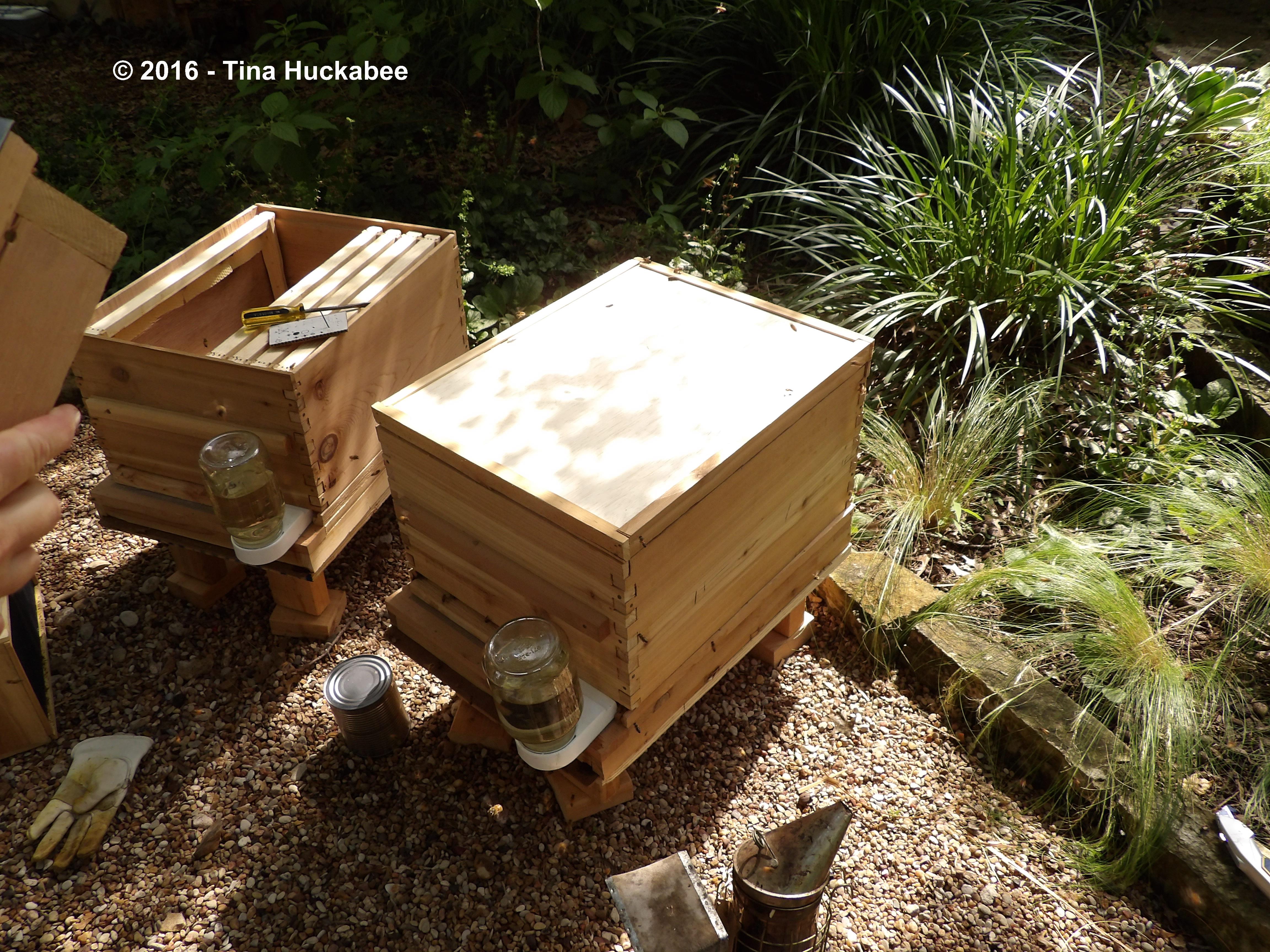
Woody and Buzz, the Langstroth hives, are in the foreground and Scar, the Warre hive, resides in the background.

Fresh from a day-long beekeeping seminar that we attended a few weeks back and armed with loads of new and refreshed honeybee information, we’ve been eager to check out our hives and see how the girls fared over winter.  Though it feels a little early in the season, it’s been a mild winter with the exception of a few days in the 20s F (-6ish C) in December and early January.  Our original plan for a first hive check was to test for varroa mites, but it’s either proven too cold (below 65 F /18.3 C) or, as it was this past Sunday, above 65 F, though too humid.  Varroa mites are a serious threat to honeybees and unfortunately most commercial and hobbyist bee hives have some varroa mite levels. The trick is to keep tabs on the mite levels so that they don’t overwhelm a hive and subject the bees to fatal viral overloads. Truthfully,  Bee Daddy and I haven’t been particularly good about keeping a regular check on varroa mites; in fact, we’ve been downright irresponsible about checking for varroa mites.  Partly that’s because we’ve hived honeybees who enjoy a proven resistance to varroa mites (thank you, BeeWeaver!), and partly because…we just haven’t.  I’ve seen mites on larvae a few times when I’ve pulled off comb and last year we lost a hive, Mufasa, to a fatal viral load, most likely due to a varroa infestation.  You can read about that sad event here.

This year, our 2017 bee keepers’ resolution is to be better bee keepers and we will check for varroa at least four times over the course of the season.

Ahem.

It was good to see what was going on in our honeybee hives after so many months.
RICOH IMAGING

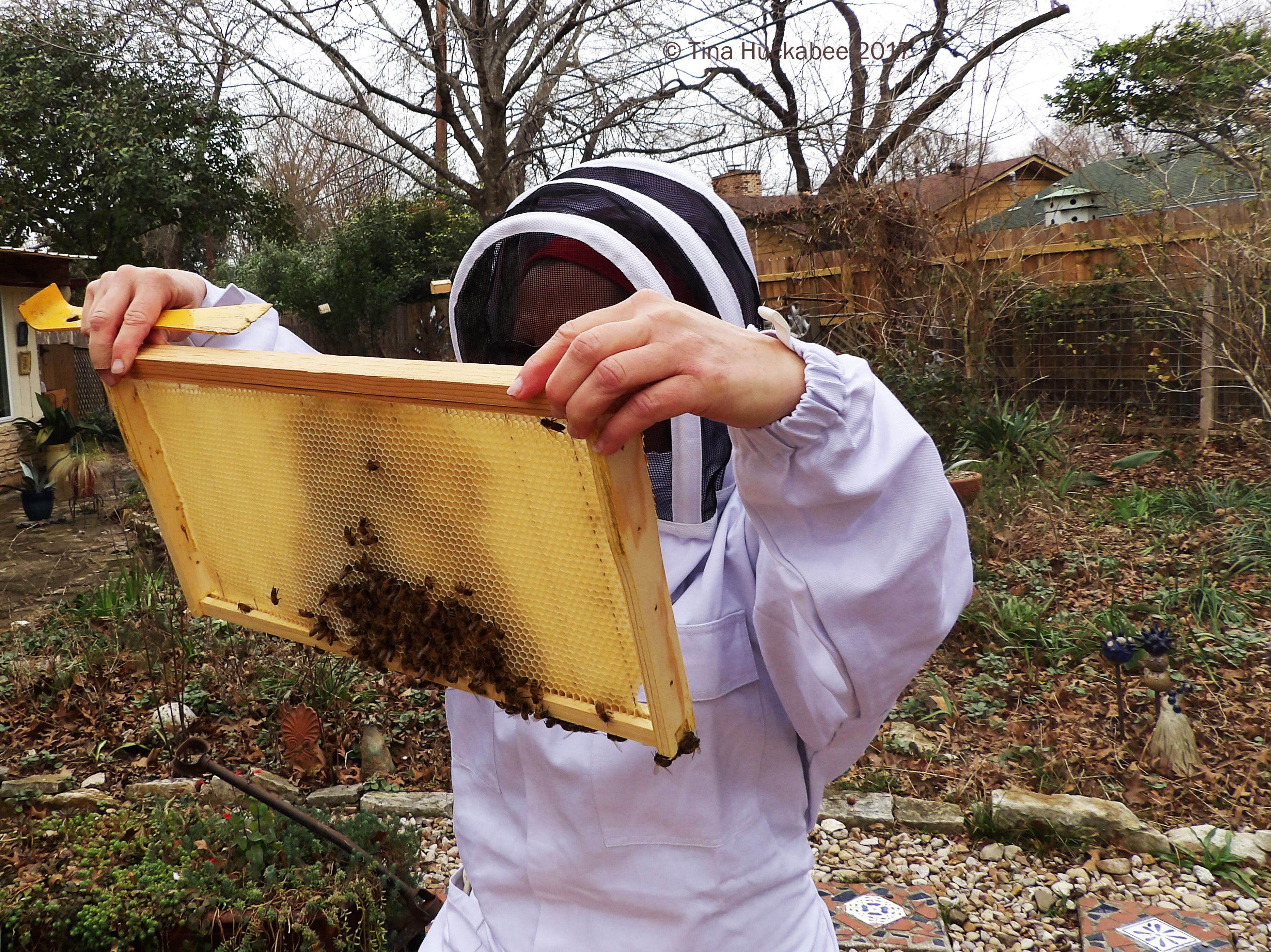
This frame has comb and nectar, but little else.

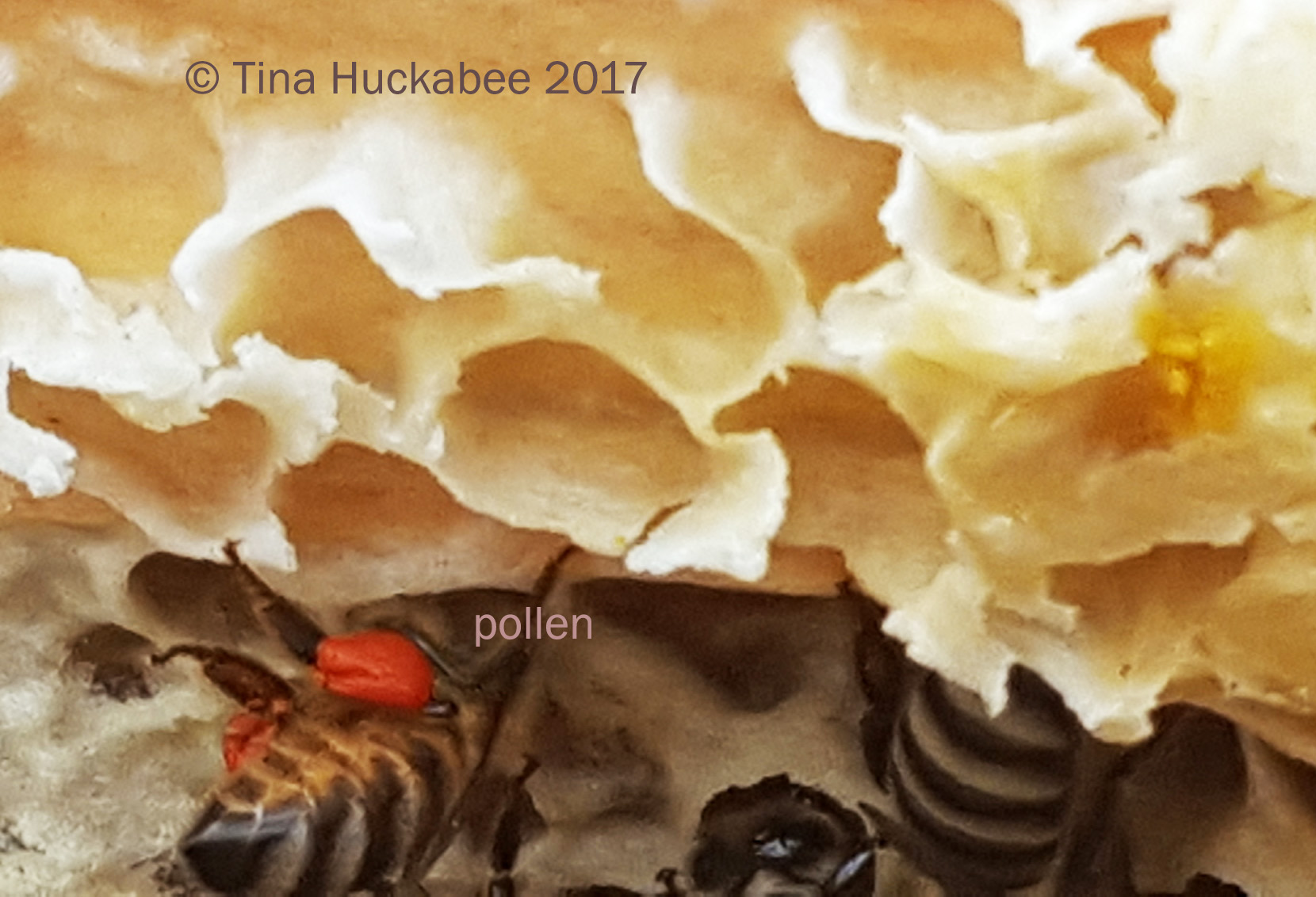
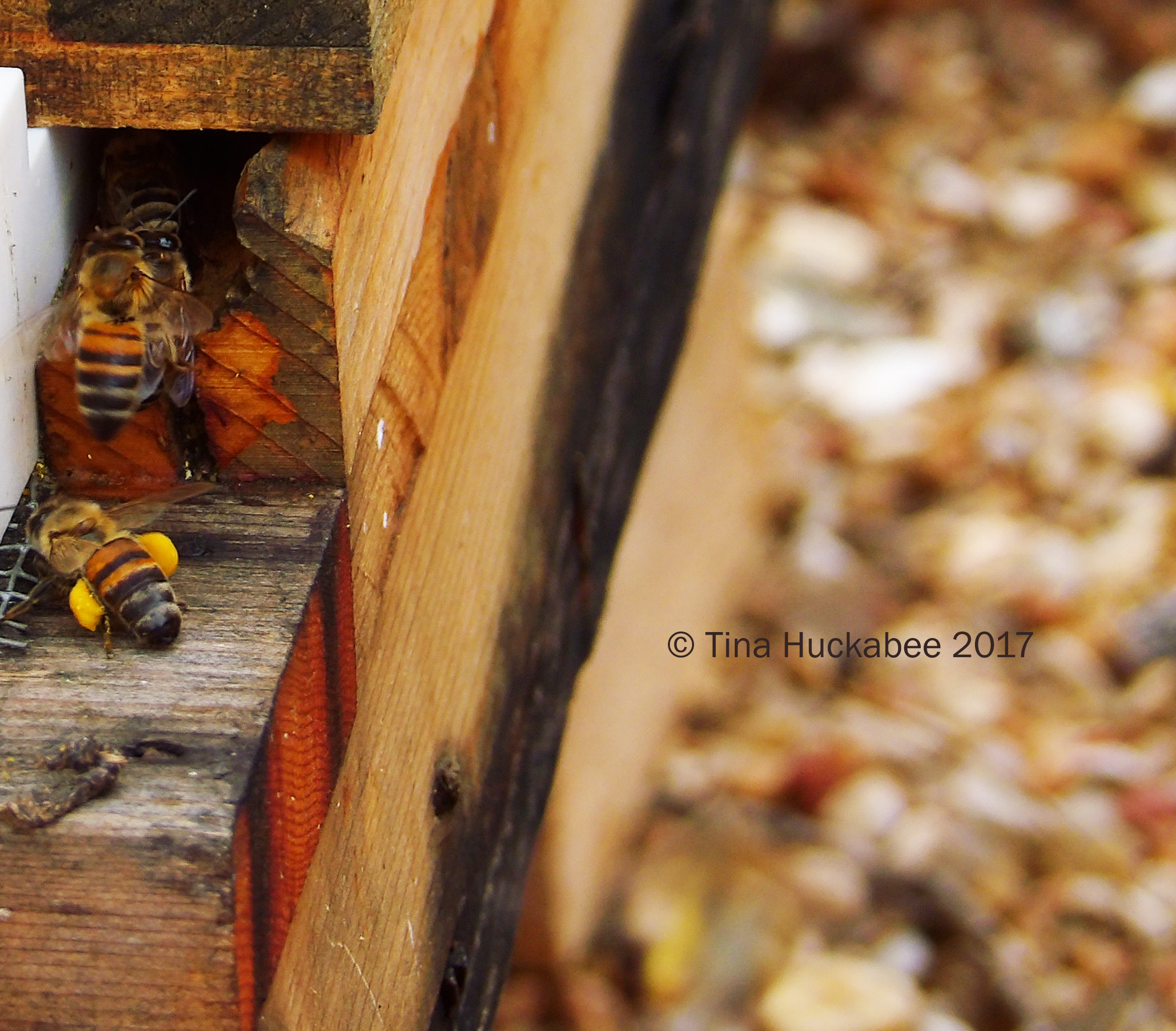
Buzz is buzzing along beautifully and Woody survived winter and though small, is thriving.  The girls have been foraging and bringing in pollen of varying colors:
RICOH IMAGING

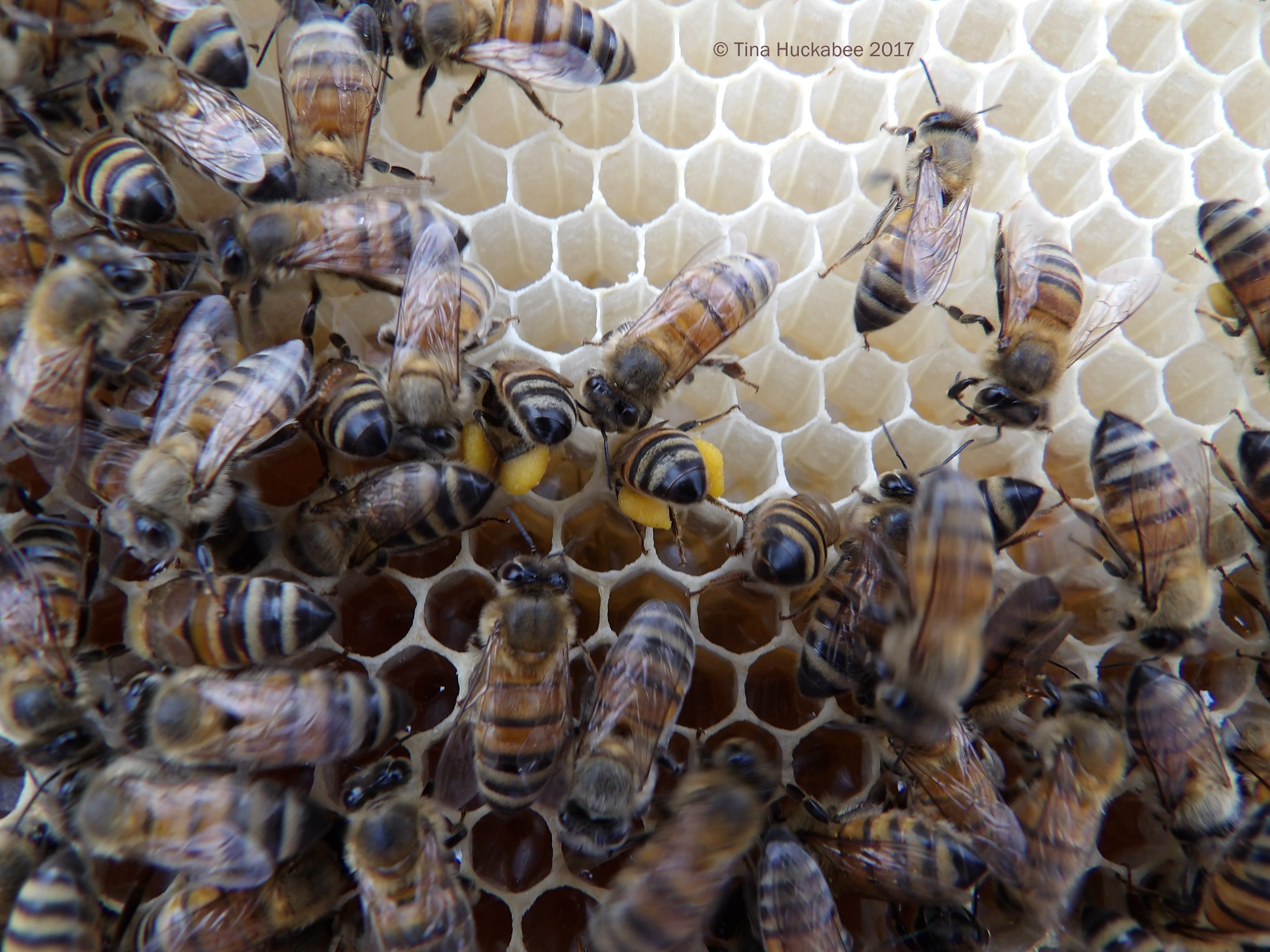
The corbicula is also called a pollen basket. I use a Tina-term “pollen pantaloon.”
RICOH IMAGING

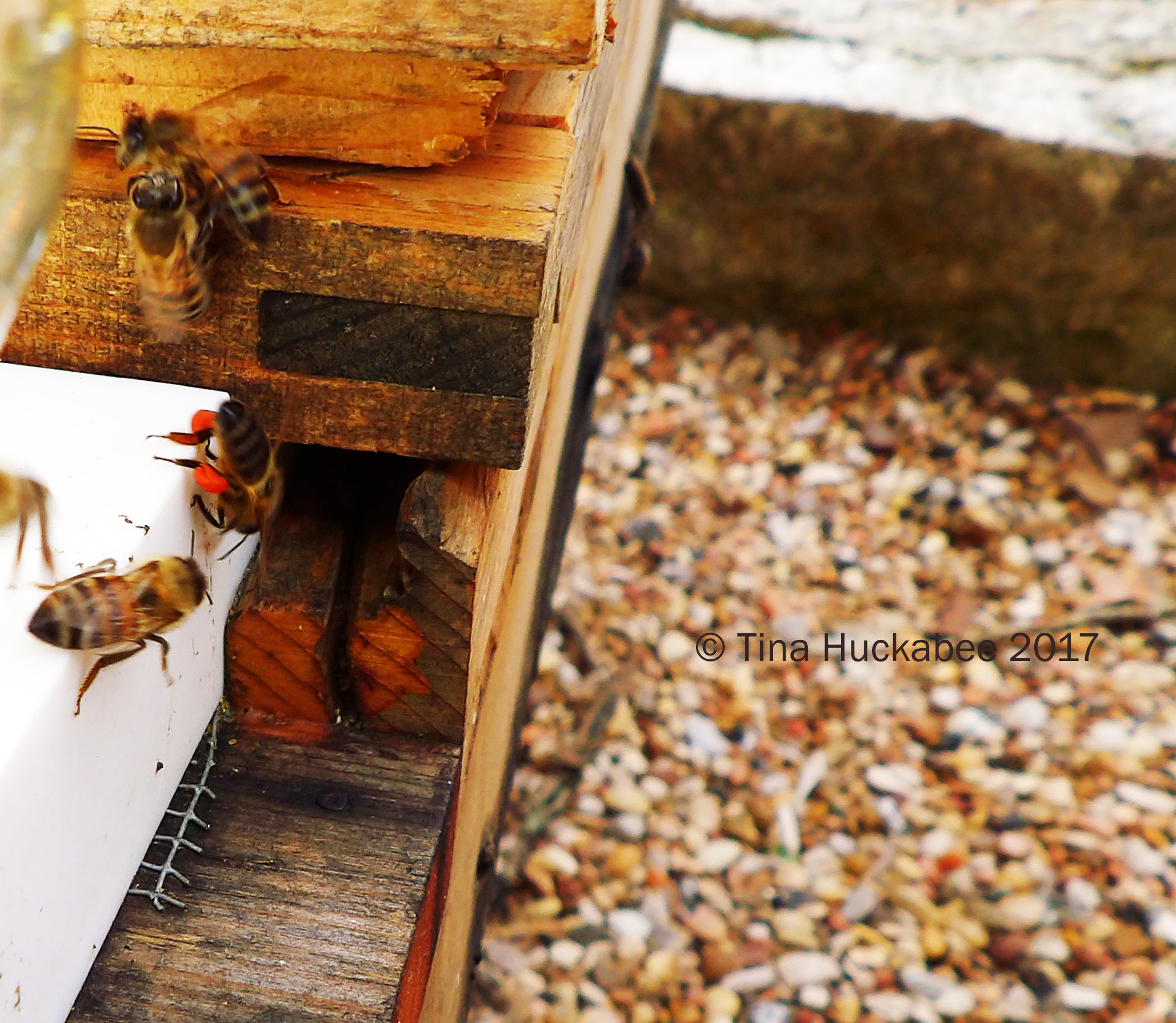
I’m enamored with the salmon-red pollen; I have no idea which plant produces it, but wow!
RICOH IMAGING

RICOH IMAGING

20170205_1224250copy

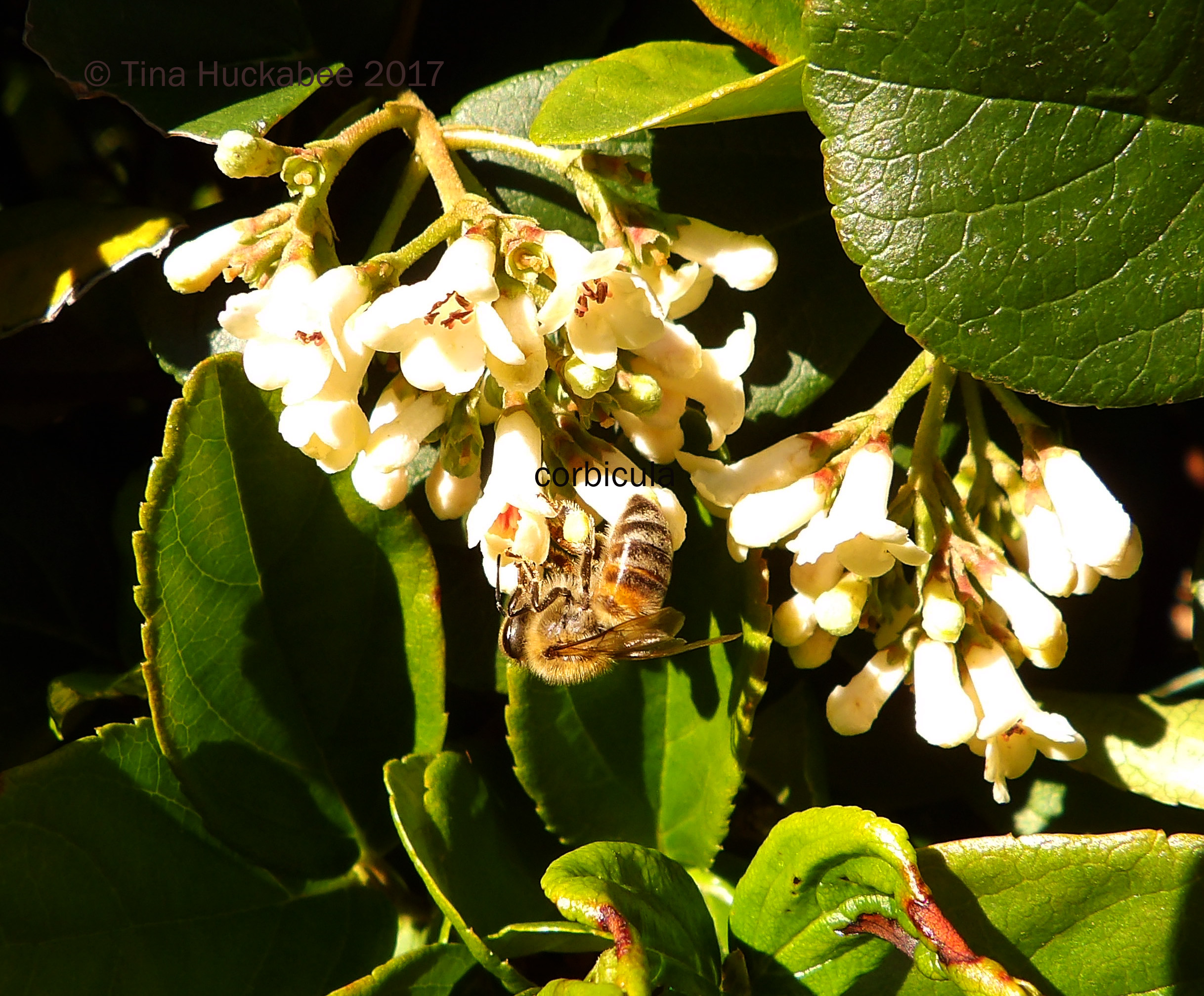
The bees have also been bringing in lots of creamy white pollen, much of which I suspect comes from a neighbor’s stand of viburnum.
RICOH IMAGING

Creamy white pollen taken from the flowers and stored in the corbiculae, pollen baskets, or pollen pantaloons.

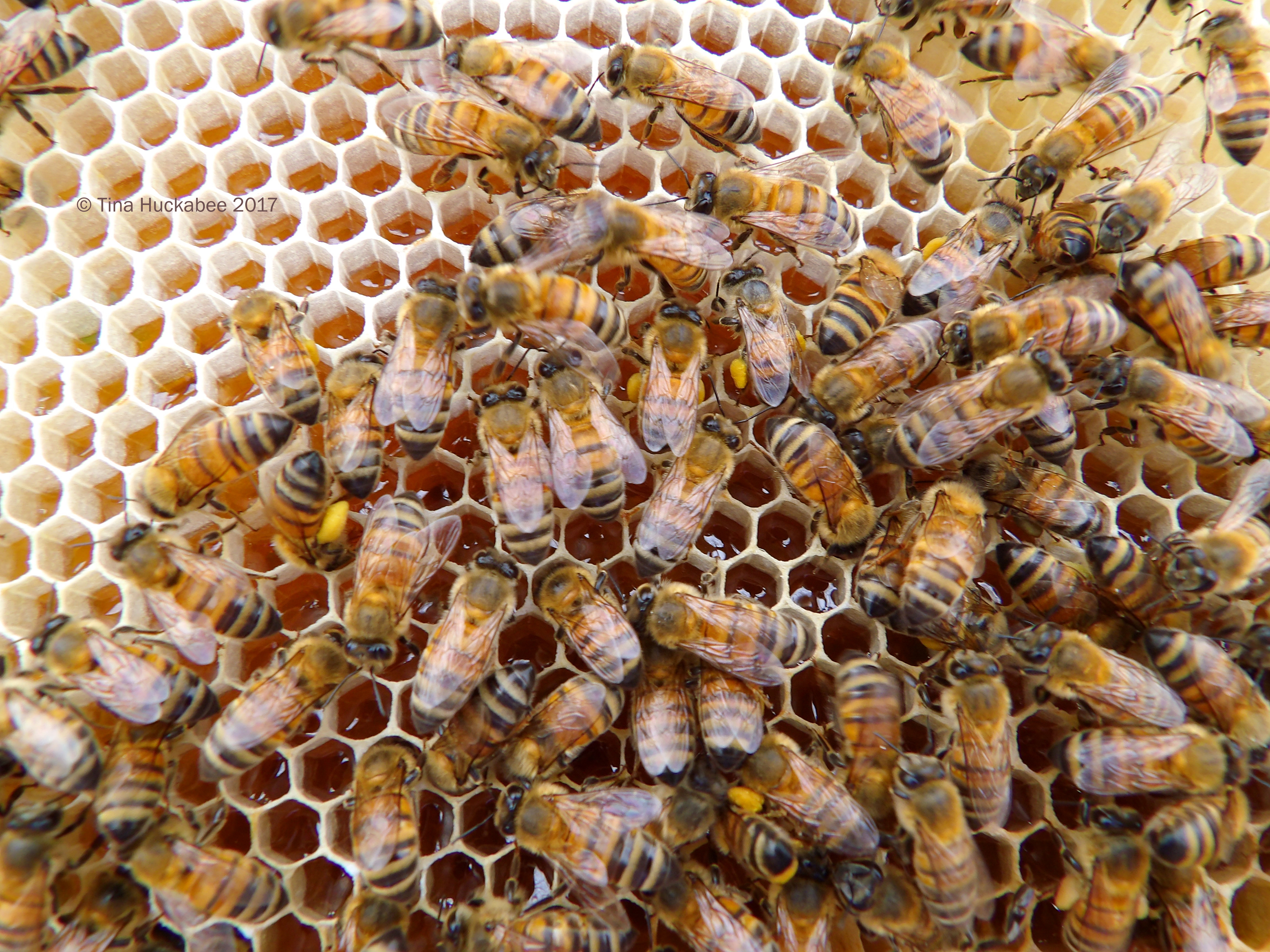
As always, lots of good, old-fashioned yellow pollen is collected–no doubt from a variety of sources.
RICOH IMAGING

RICOH IMAGING

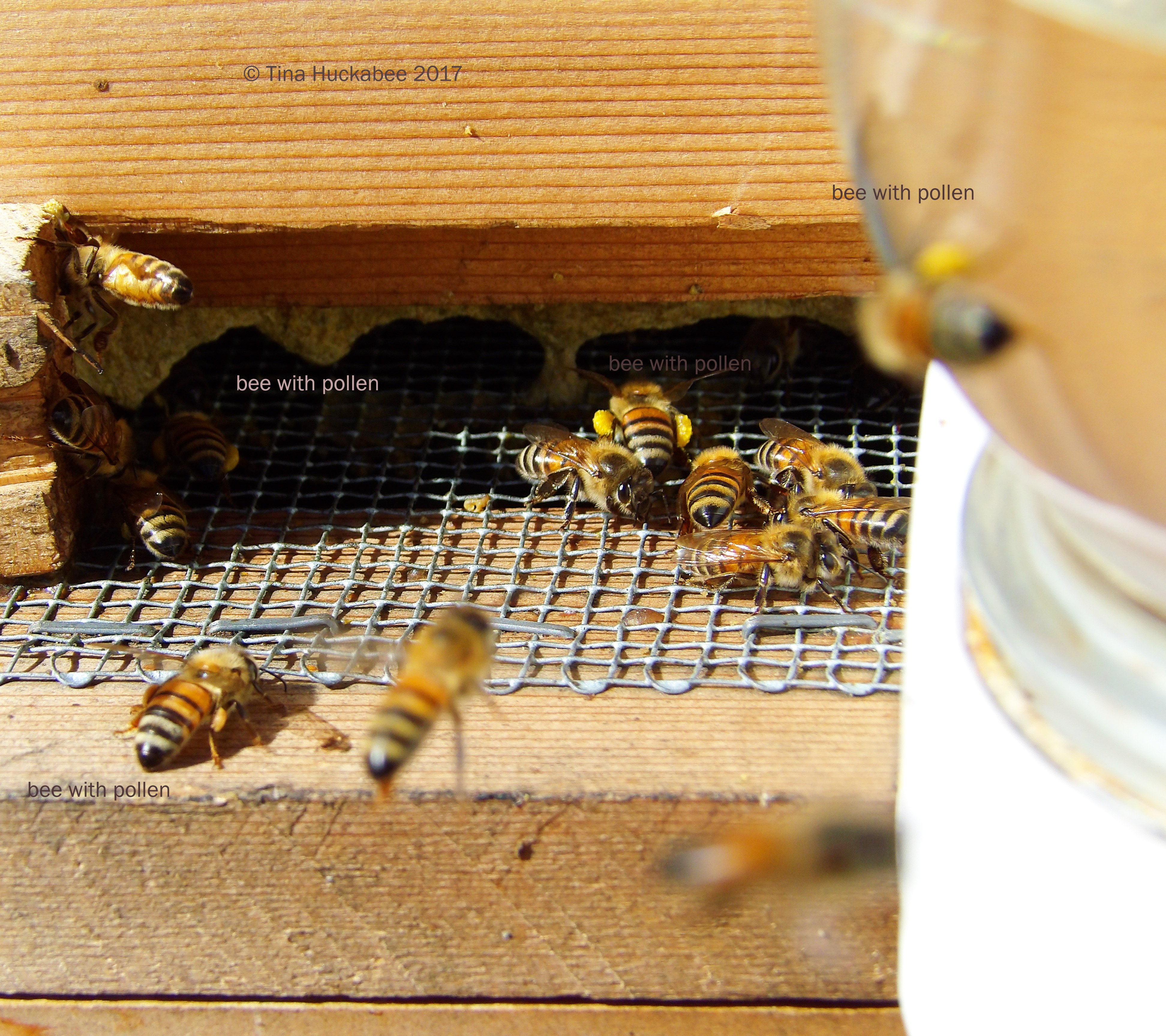
Can you count the number of bees carrying pollen?  I counted five!
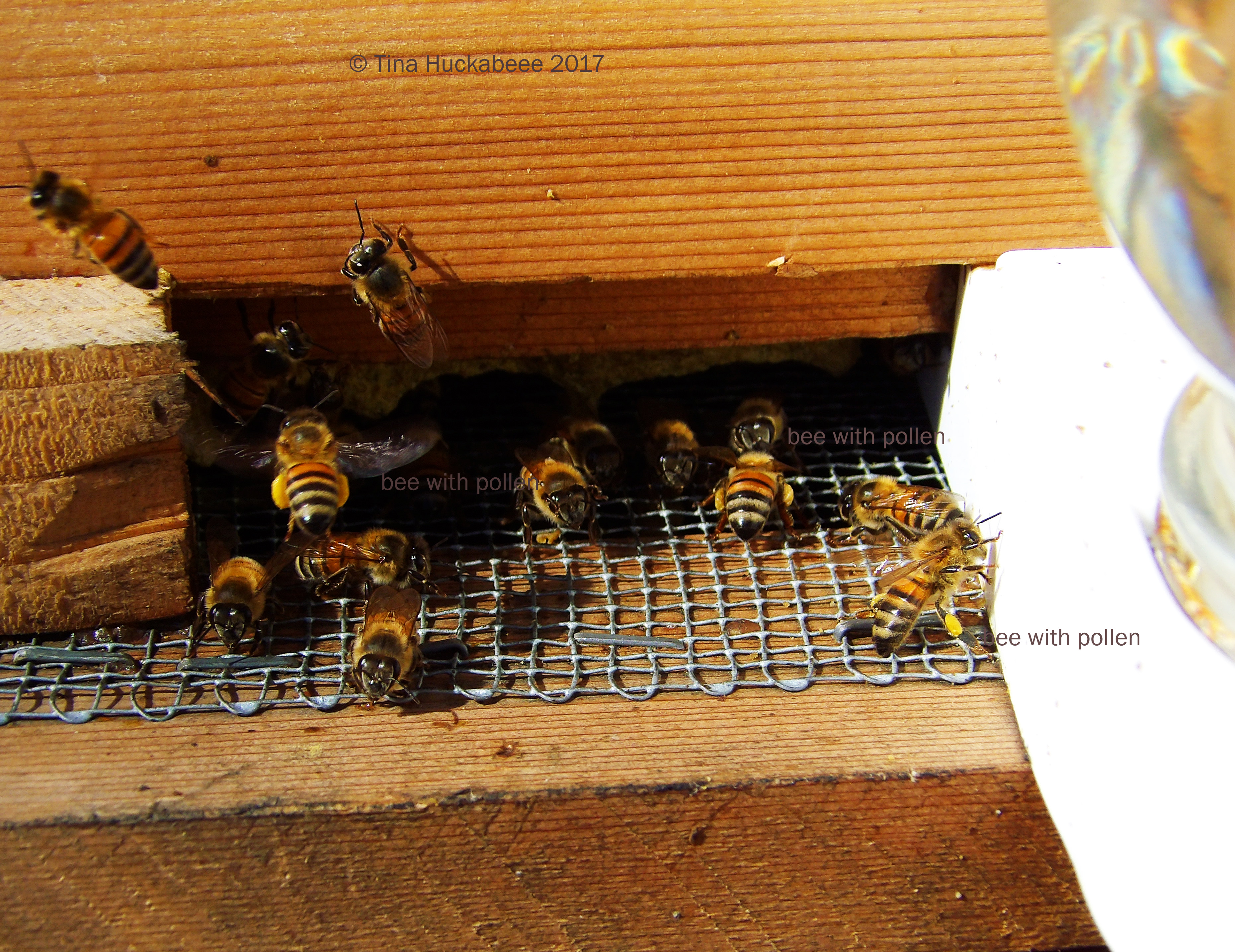
RICOH IMAGING

Honeybees forage up to three miles and I know that viburnum, rosemary, flowering quince and perhaps a few early trees are in flowering mode.  My Leatherleaf Mahonia, Mahonia bealei,  was certainly one source of nectar and pollen a few weeks ago, but there’s nothing currently blooming in my garden that the honeybees are interested in, though I have seen a few of the tiny wild bees working at some native salvia species that have pushed out some blooms in the last week or so.

Honeybees forage for nectar, which is their carbohydrate source, and pollen, which serves as protein.  A diverse and well-rounded diet is key to a healthy life and honeybees certainly benefit from a diversity of flowers.  That the honeys are pulling in pollen and nectar from a variety of early sources is a good thing.  I planned to take a photo of the comb with differing pollen colors, but completely forgot about that once I was in the hive and looking at the good work of the queen, with support from her workers.

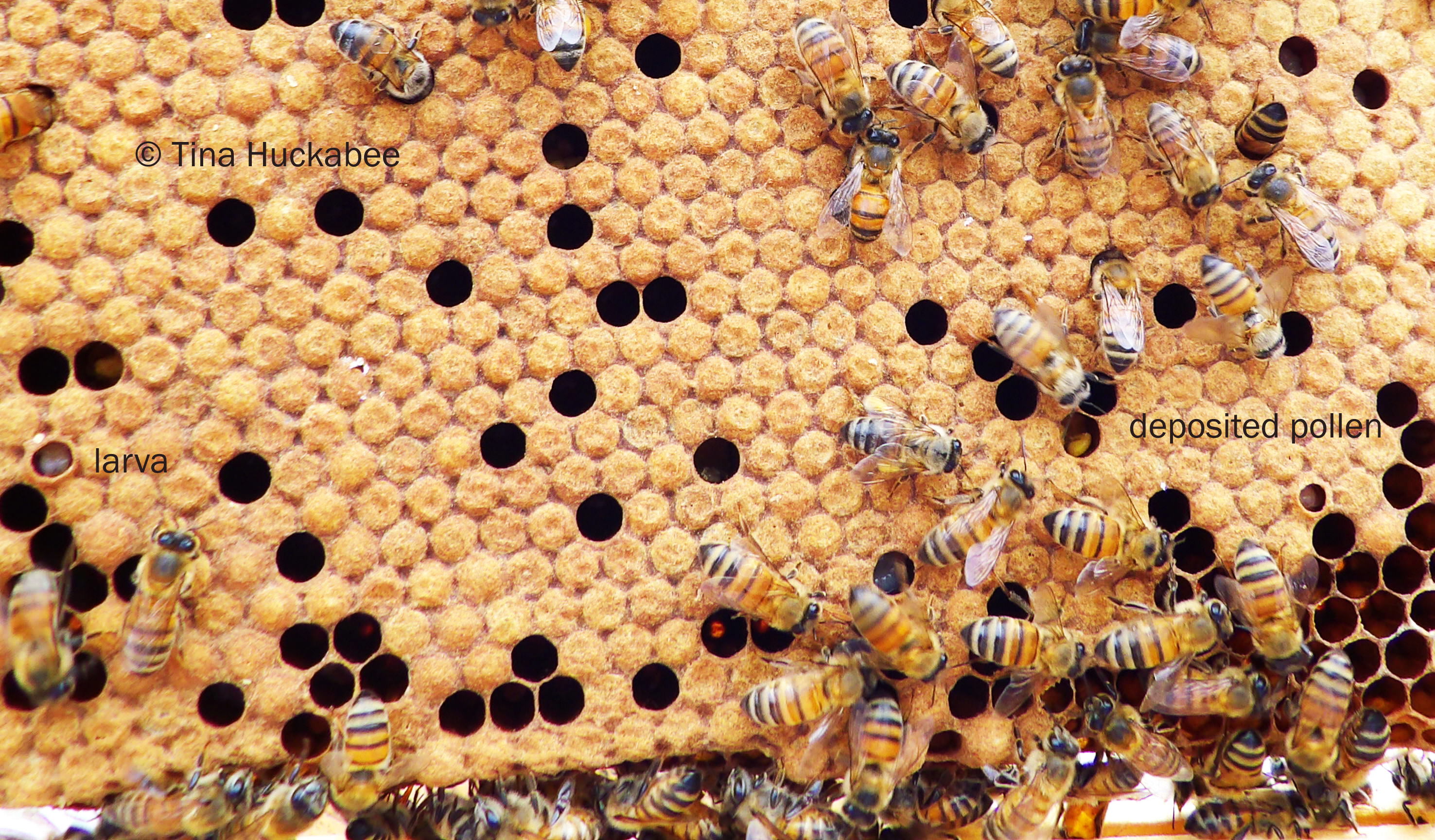
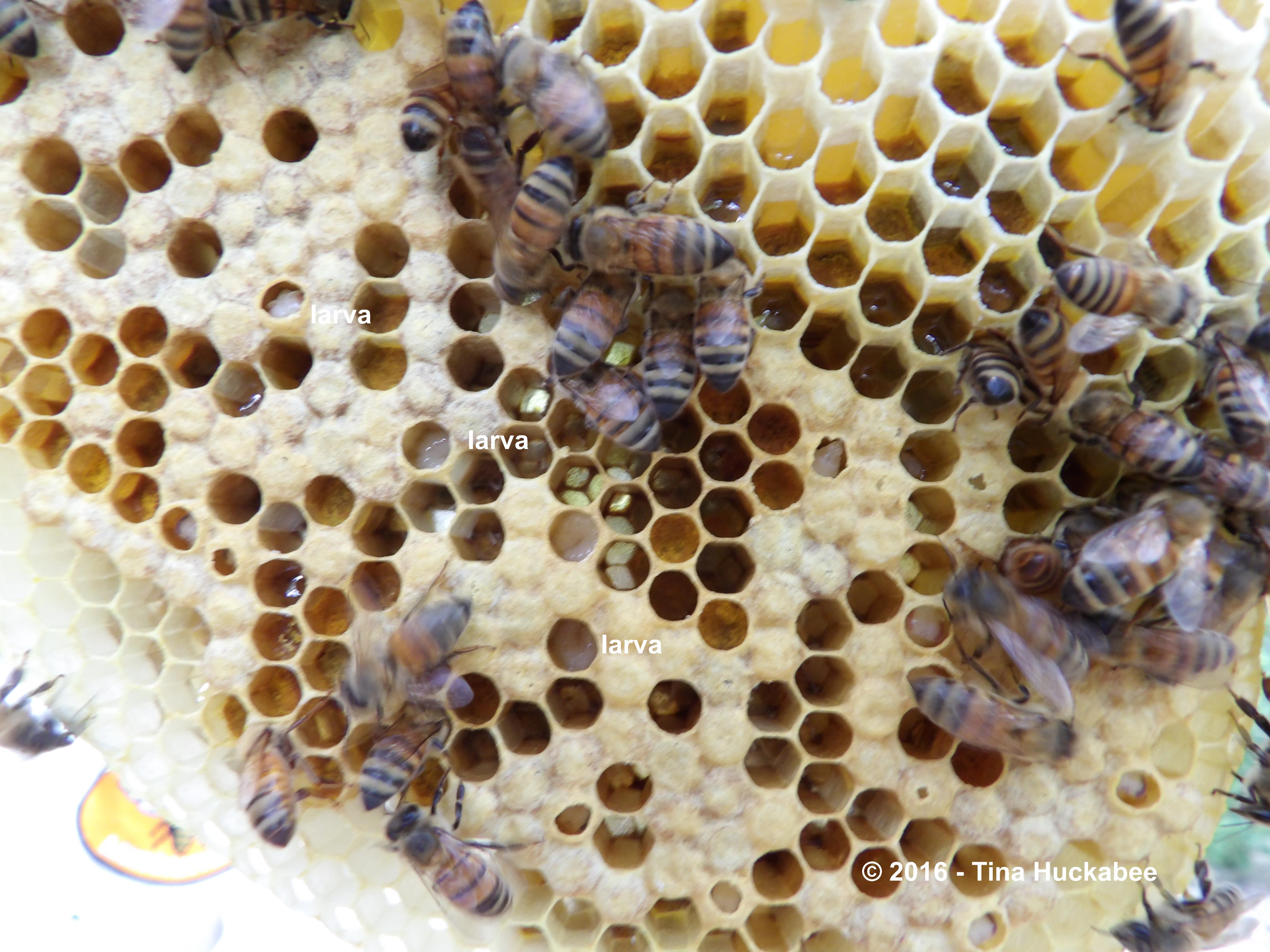
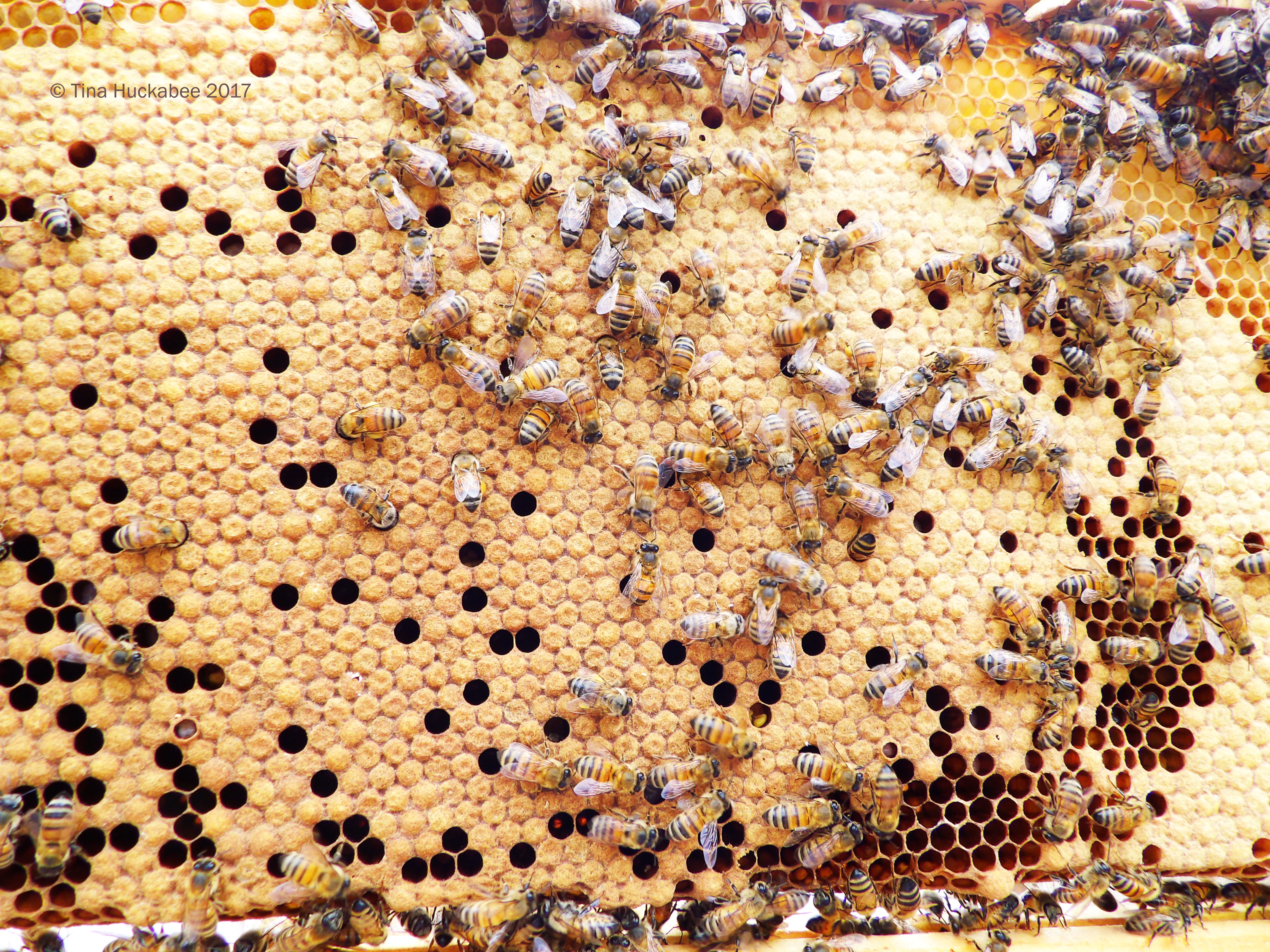
This comb–and it wasn’t the only one–demonstrates  a beautiful pattern of capped brood, meaning that Buzz’s queen is healthy and  laying eggs. The next generation of honeybees is in the works!
RICOH IMAGING

RICOH IMAGING

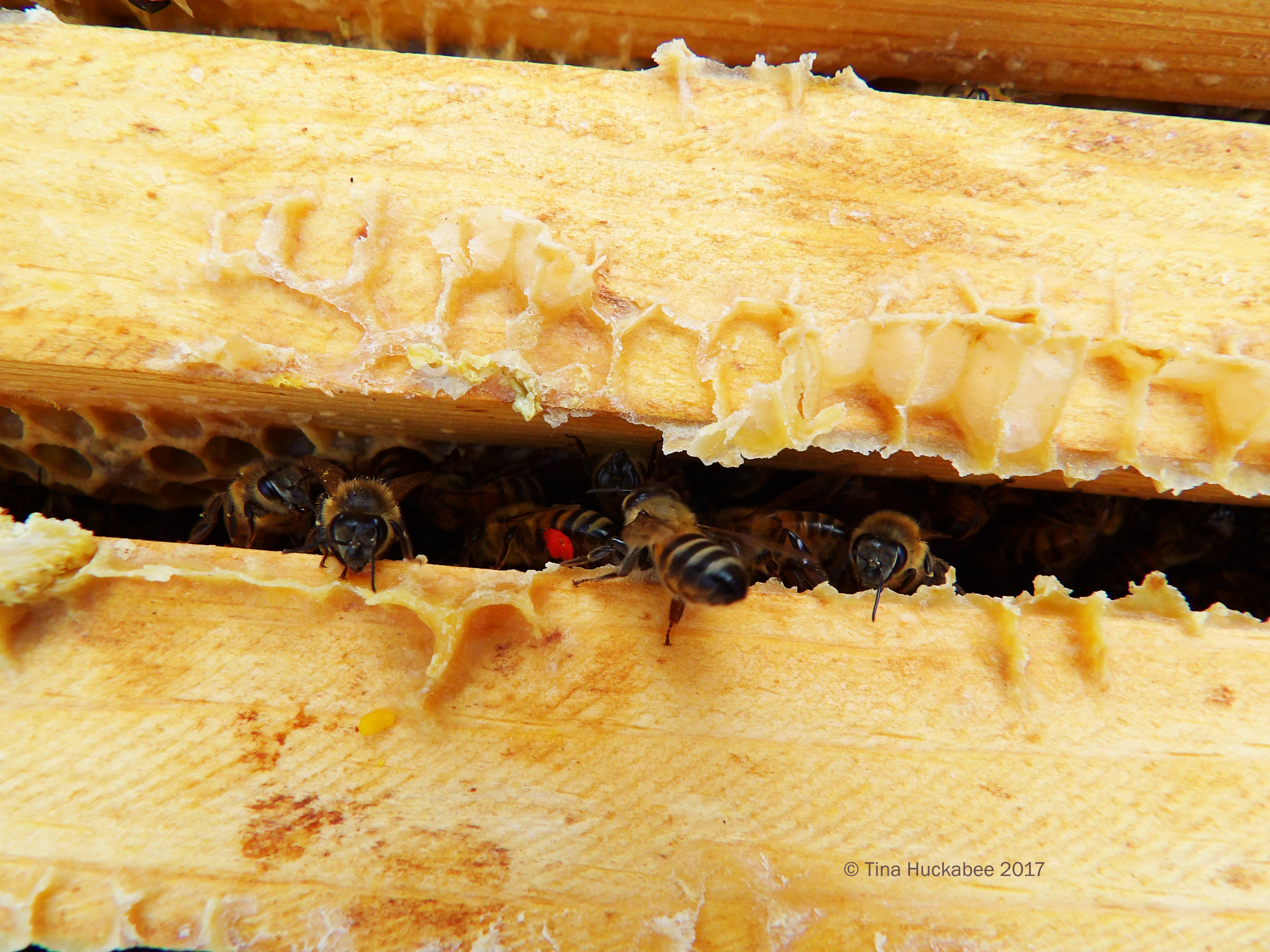
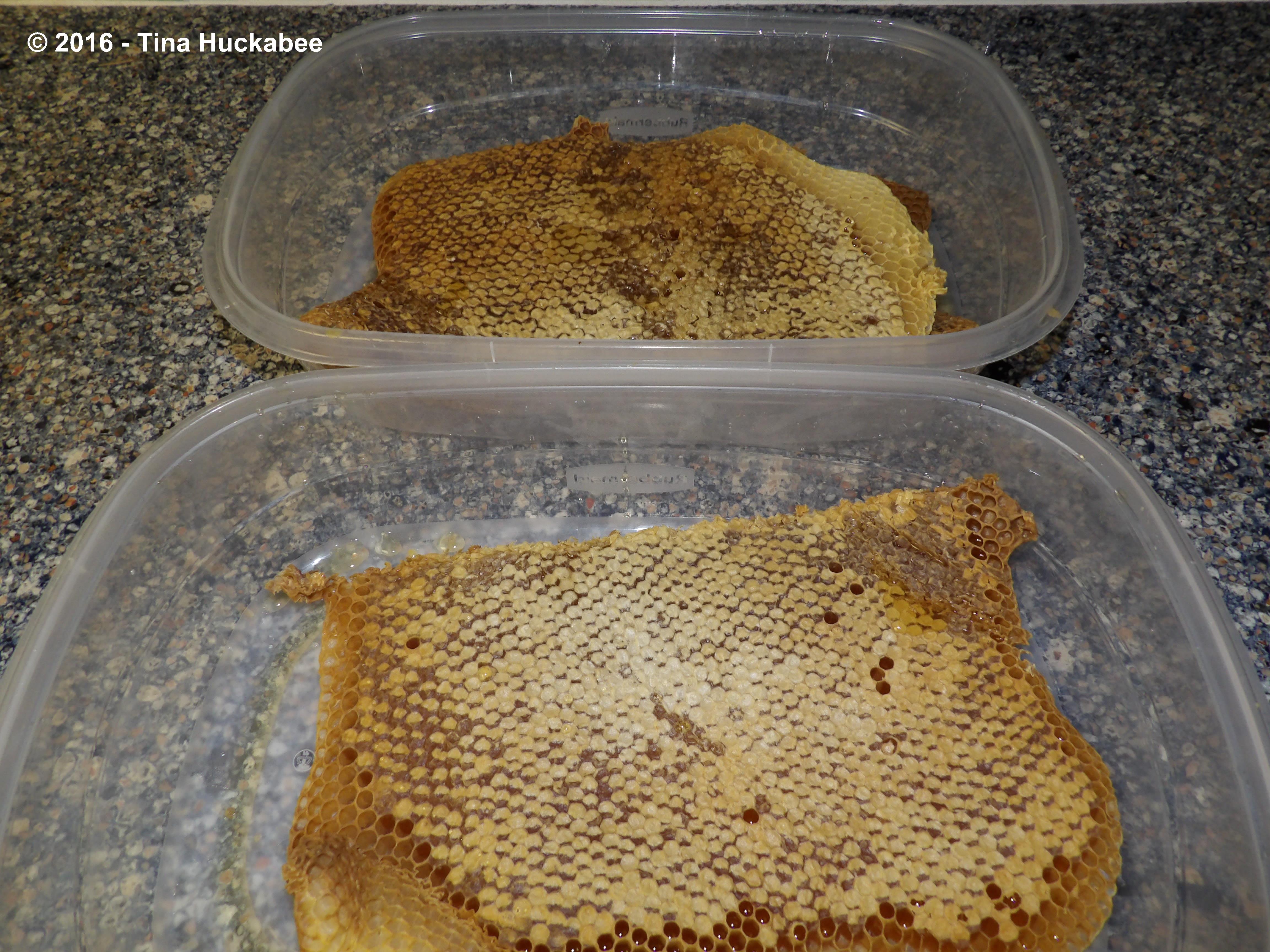
While pulling up some frames to check, I tipped one full-of-comb frame and the comb broke.  ARGH!  It’s not the first time I’ve made that mistake (when will I learn?), but when I’ve done that in Mufasa or Scar–the Warre hives, with top bars and not frames–we had to sacrifice the comb, or if it was full of honey, take the honey.  There is simply no remedy for placing a broken comb attached to a bar back into the hive, because there is no way to “hold” the comb in place. Now that we use Langstroth hives with full frames, a dumb mistake is fixable.
RICOH IMAGING

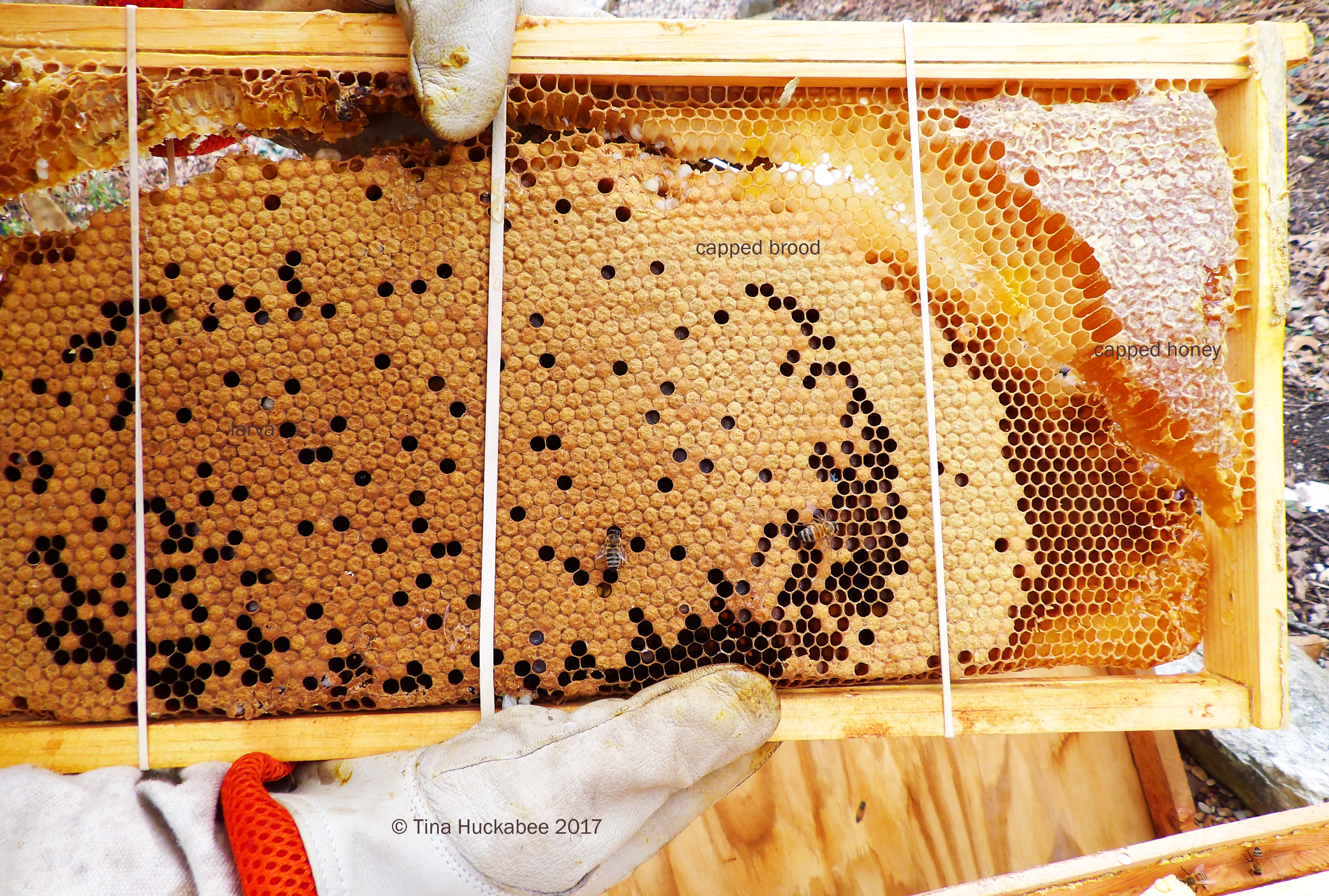
This frame is mostly capped brood, but there are some uncapped brood (larvae) and there is also some honey in the top right corner.

Three rubber-bands wrapped around the girth of the frame will sufficiently hold the comb in place and allow industrious little bees to repair the beekeeper damage by building new comb and continuing their honey-making or baby-bee tending.
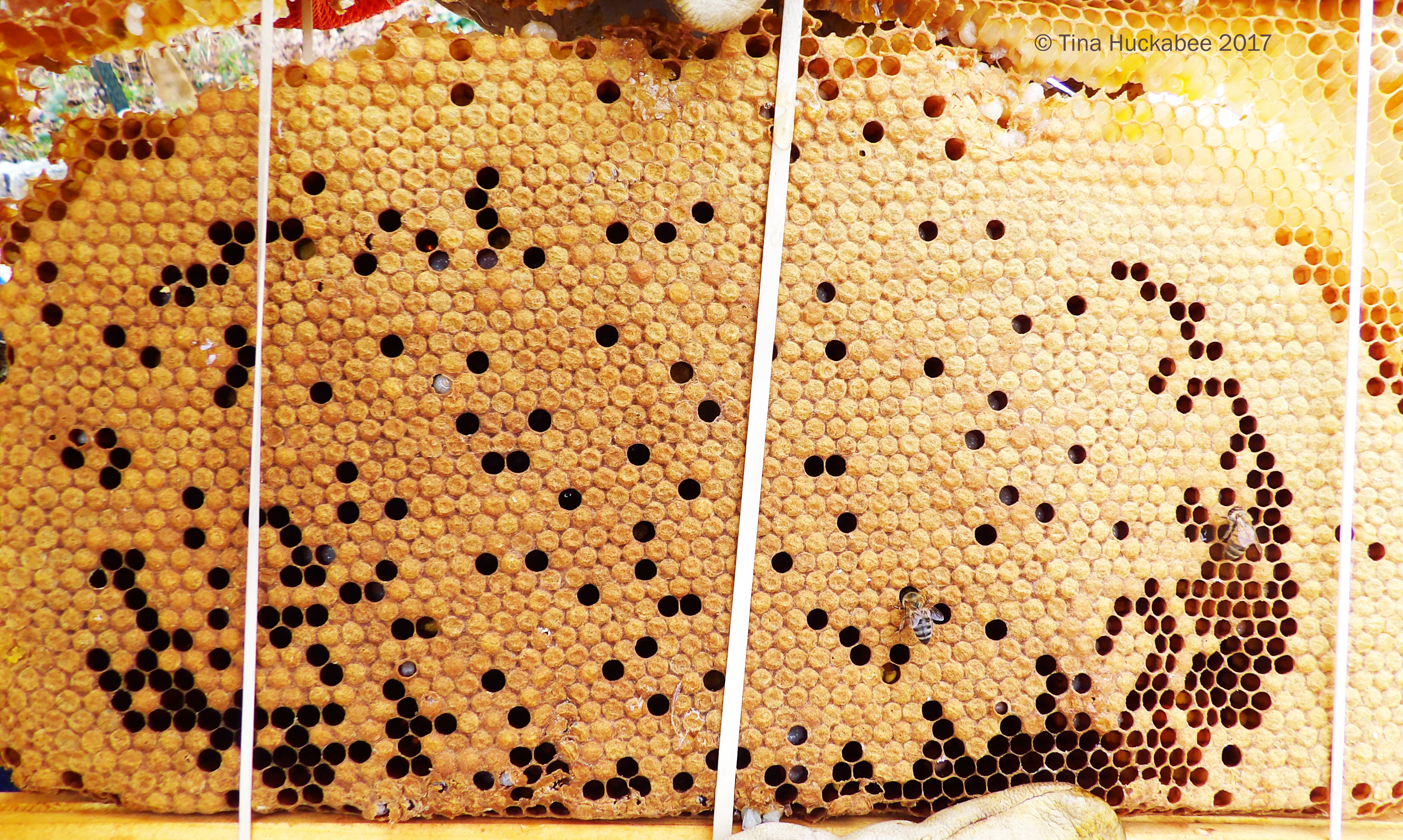
RICOH IMAGING

Unfortunately, some of the larvae about half-way through their development were victims of the comb breakage.  The bees will harvest the doomed larvae as a protein source–bees waste nothing.  Once they’ve rebuilt the comb,  Ms.Queen will probably lay more eggs in the new comb.
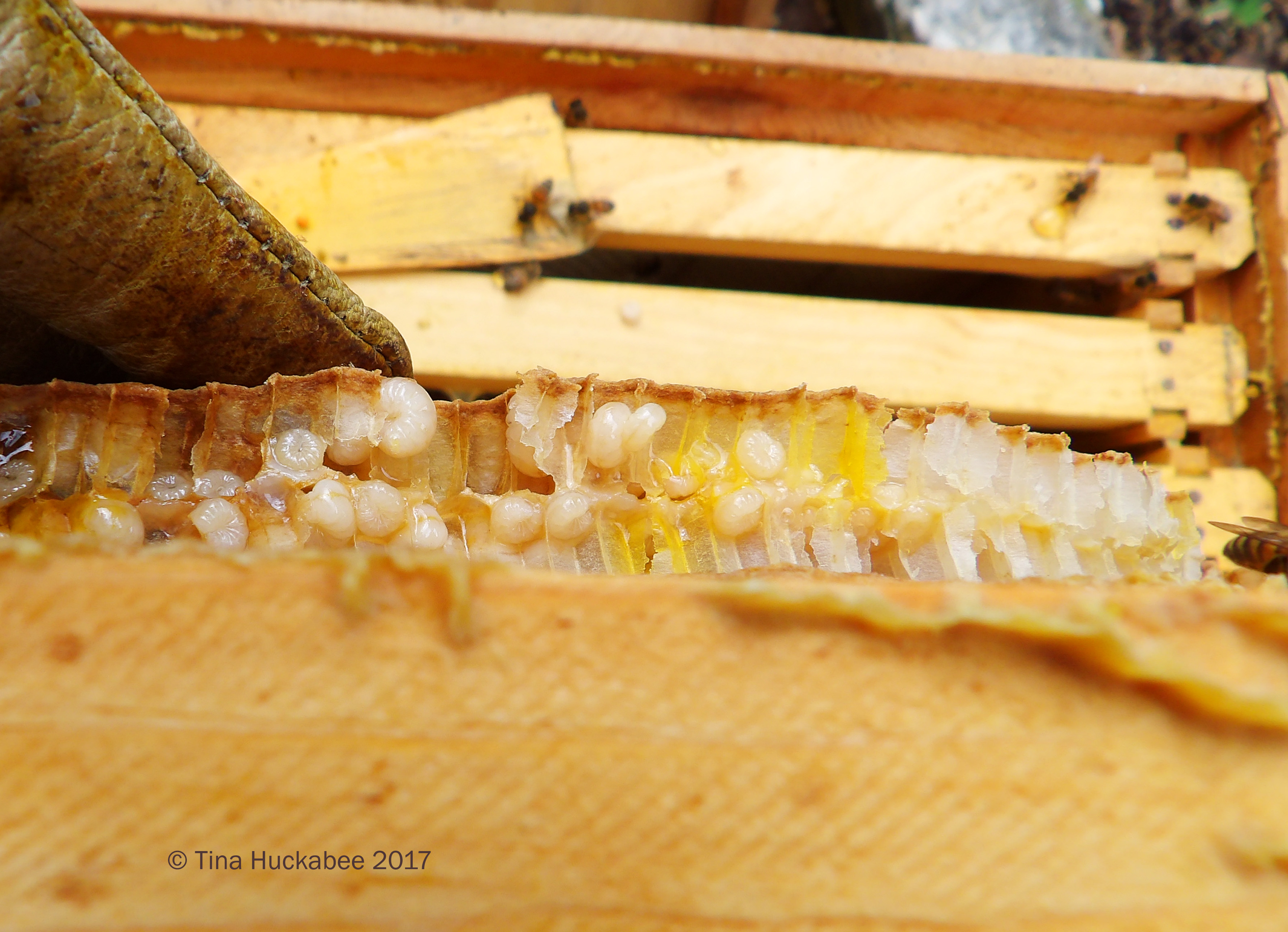
RICOH IMAGING

Ramping up indeed!  I was pleased to see that Woody and Buzz seem healthy and next time we open up the hives, we plan to conduct our first varroa mite check for the season.

Sadly, Scar is on her way out as a viable hive.  There were five full combs of honey in the top box–we took three out–but the lower boxes contained mostly empty comb. There is no brood, indicating that the queen has probably died and while there are worker bees busily foraging and still engaging in most of their bee work, there’s no new generation to nurture.  Last year, we decided that once our Langstroth hives (Buzz and Woody) were up and buzzing, we’d allow Scar to atrophy naturally–there would be no extreme measures to keep her going.  Still, I’m a little sad and must admit to a temptation to re-queen her.  But Scar is a difficult hive to maintain and I’ve become quite spoiled at the ease of working with Buzz and Woody in all their Langstroth glory, so I imagine I’ll keep with the original plan and let Scar go. Scar’s bees will live out the rest of their lives over the next month or so and then she will be empty.

I’ll plant something bee-friendly in that shady spot in Scar’s memory: maybe a nice Evergreen sumac, Rhus virens  or Turk’s capMalvaviscus arboreus.


Bees in Bloom

I suppose the title should read:  Bees in Blooms.

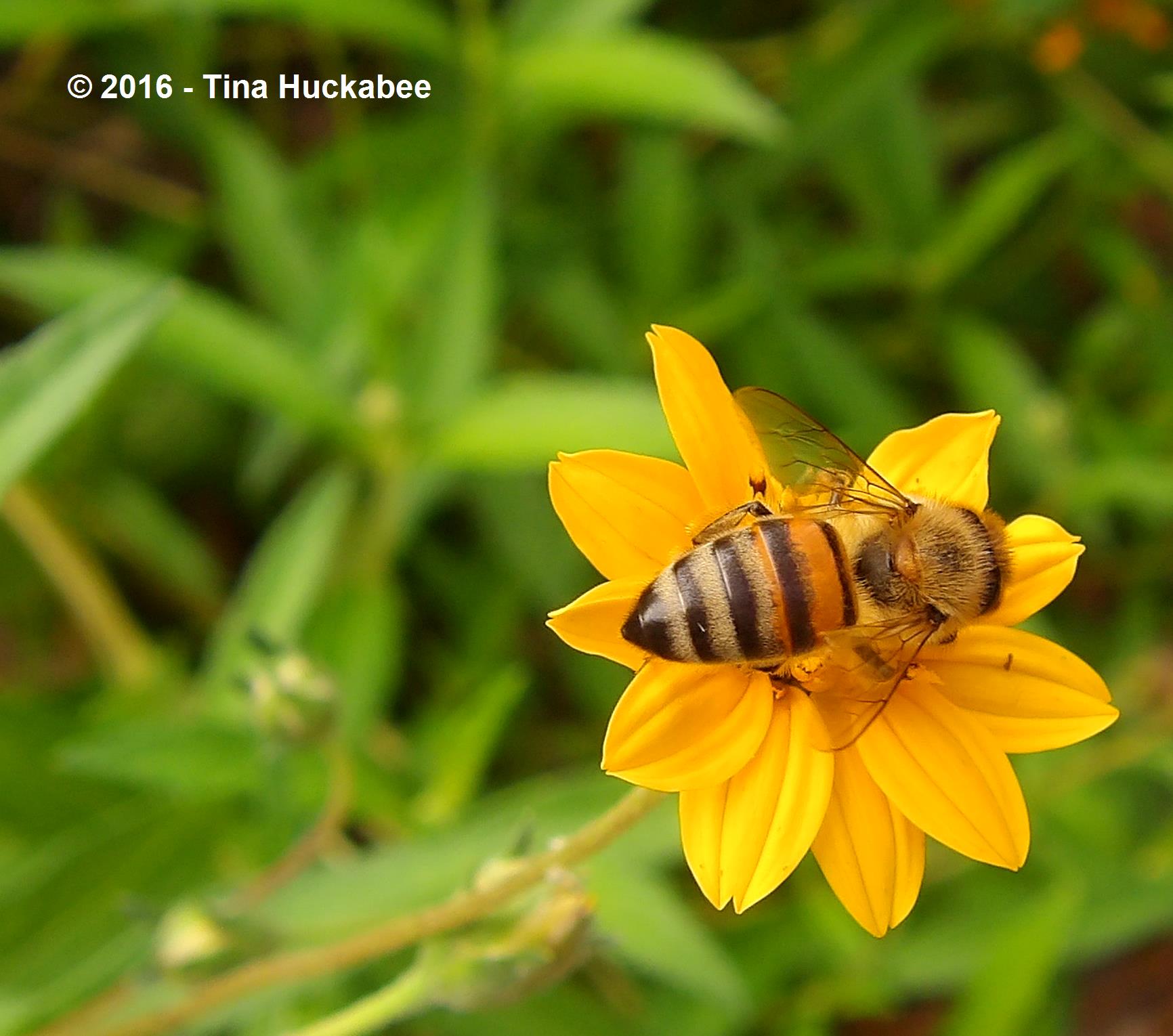
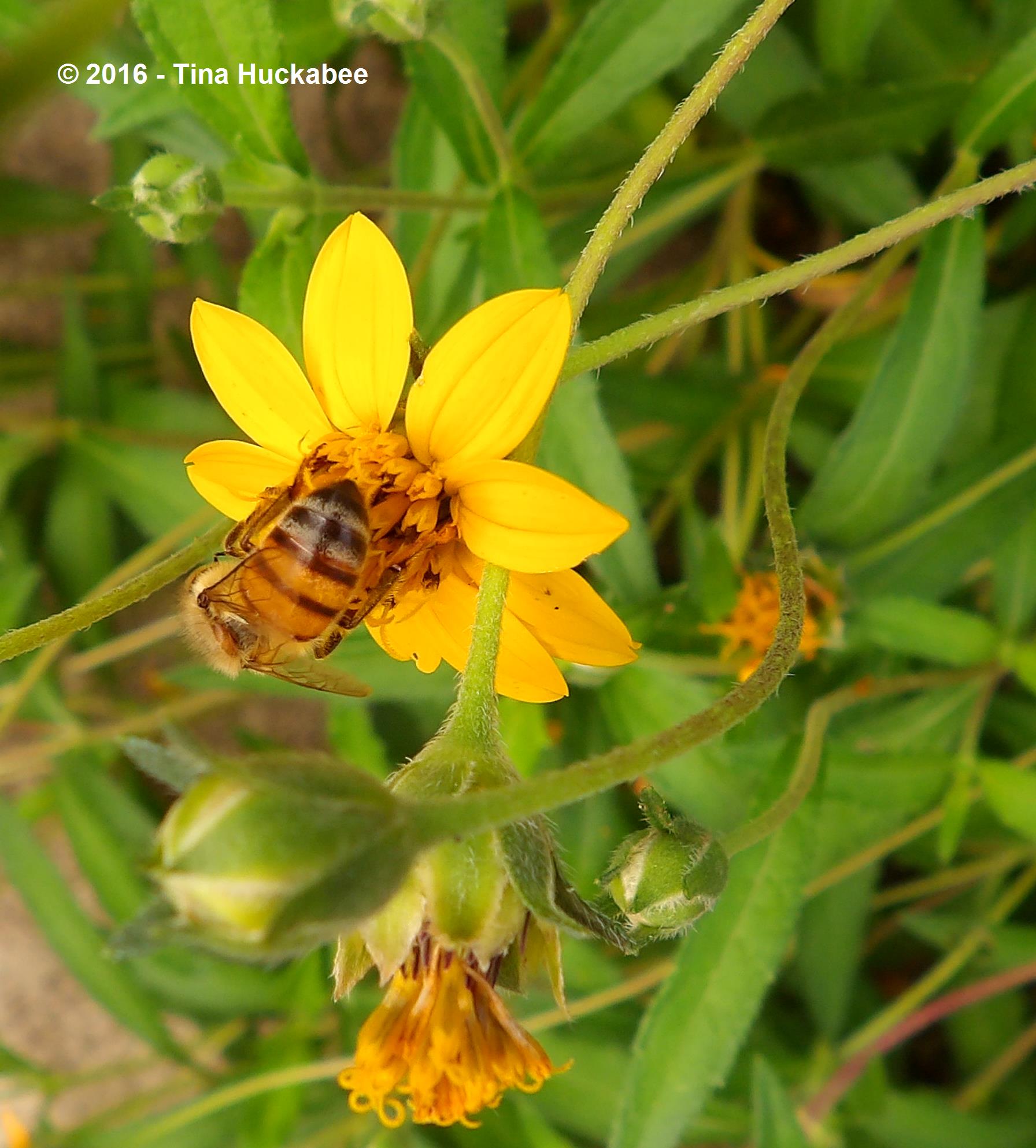
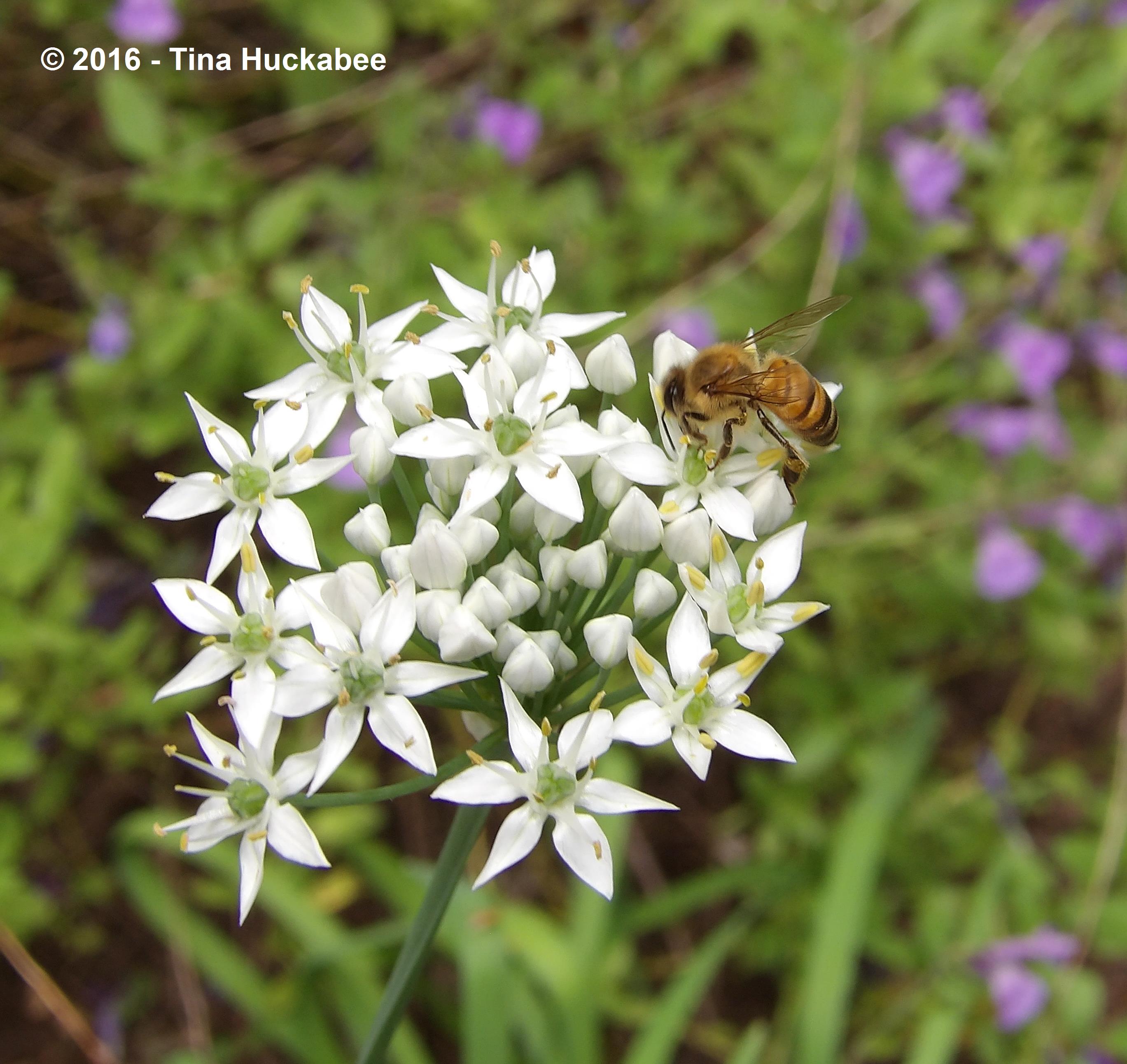
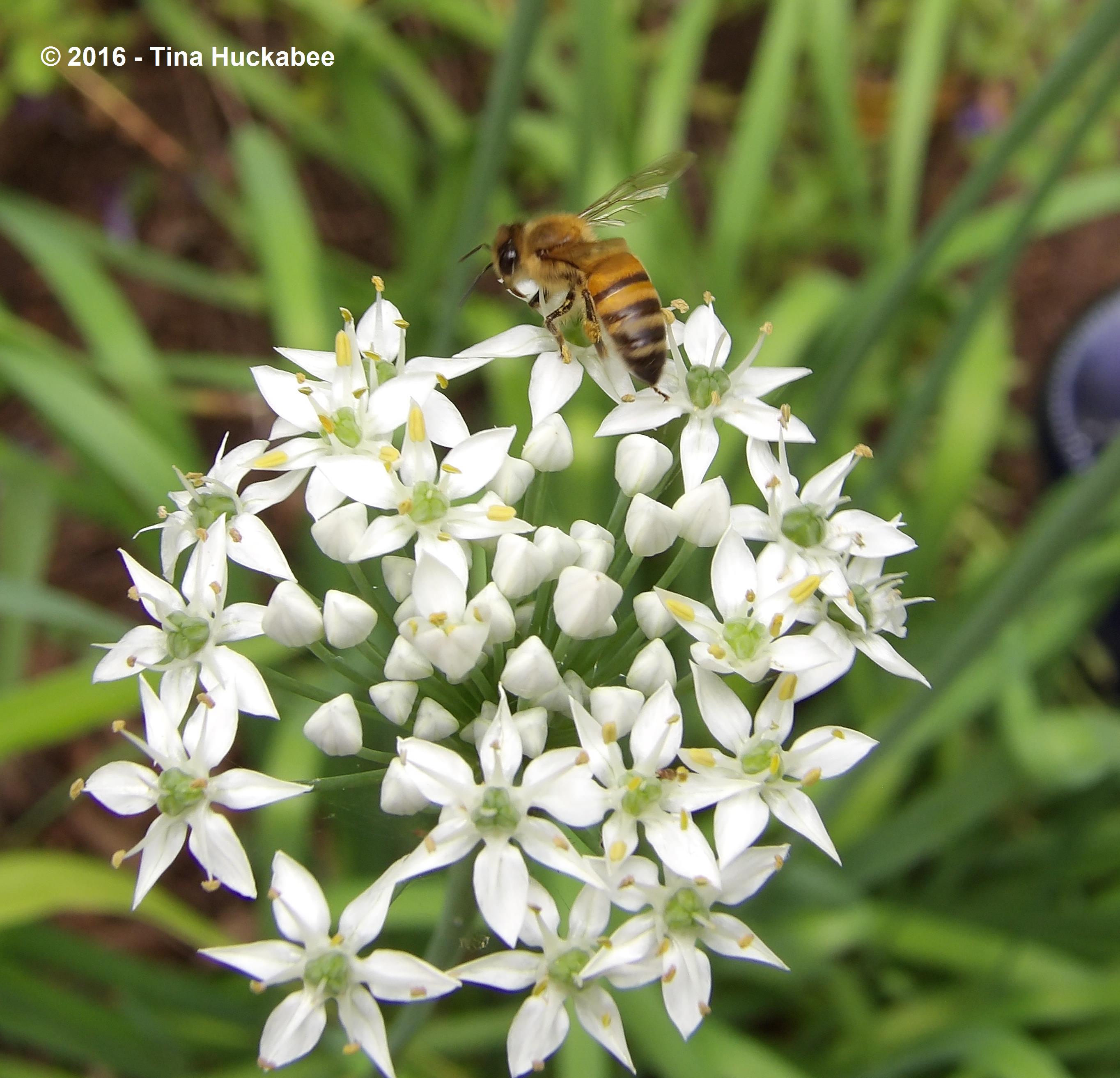
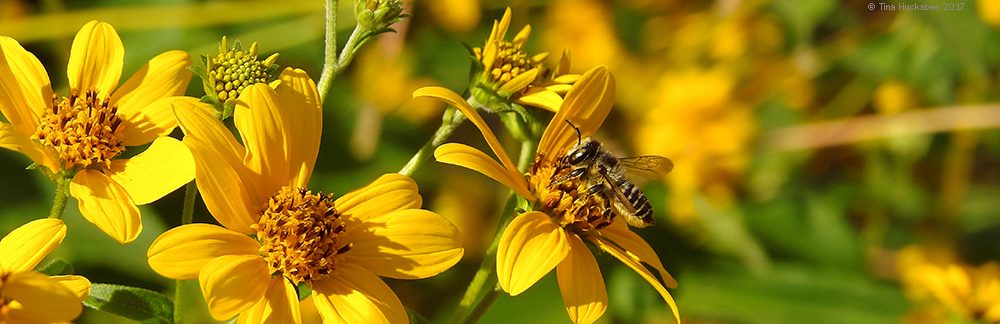
Bees of all stripes and wings are active in the late summer garden, sticking their probosces into the depths of flowers and reveling in pollen. This week, I’m crowning the honeybees as the winners of the bee beauty pageant. From a purely self-interested standpoint, honeybees are significantly easier to photograph, as they’re not speed fliers, nor teeny-tiny, like most of the native bees.

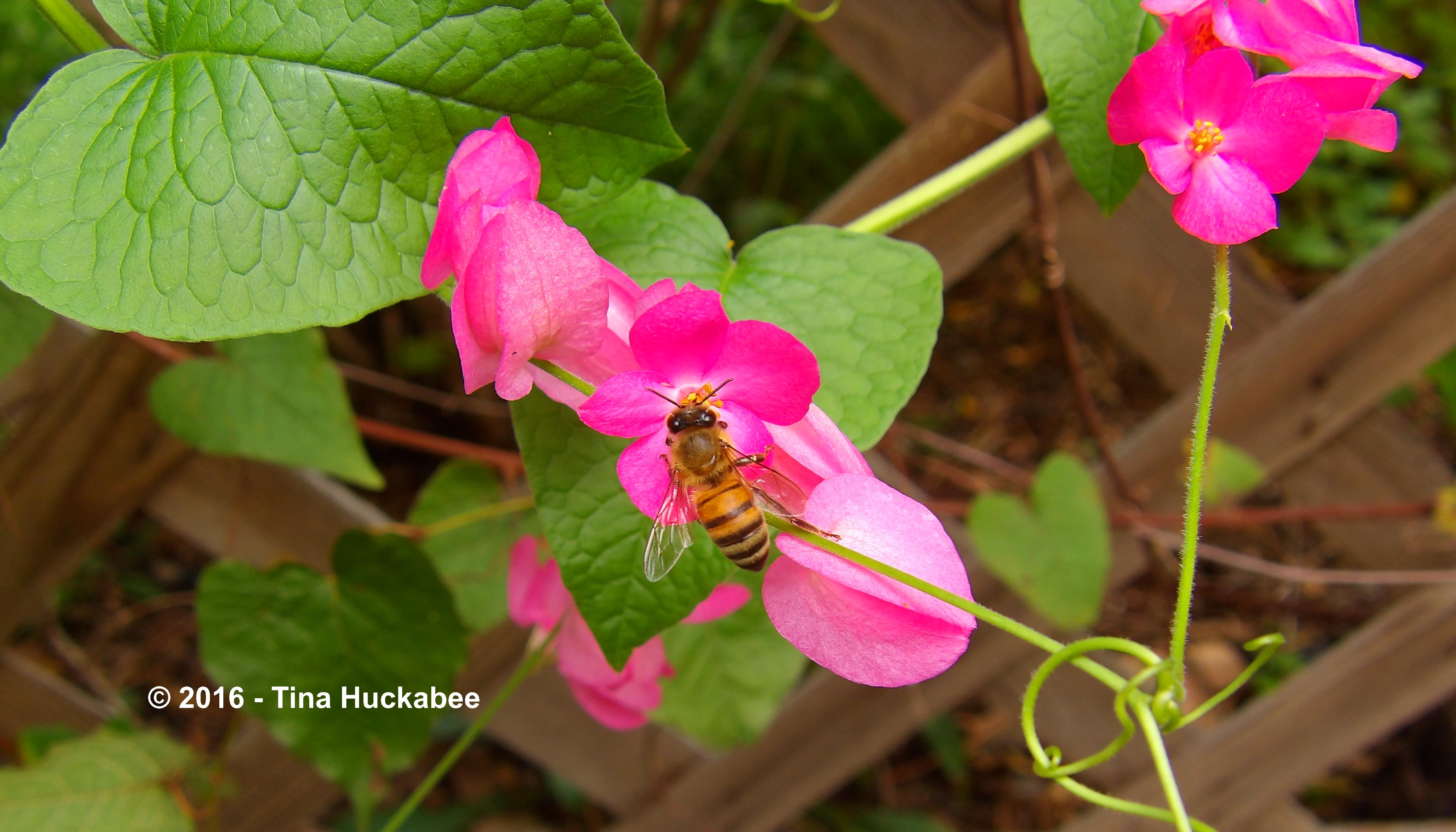
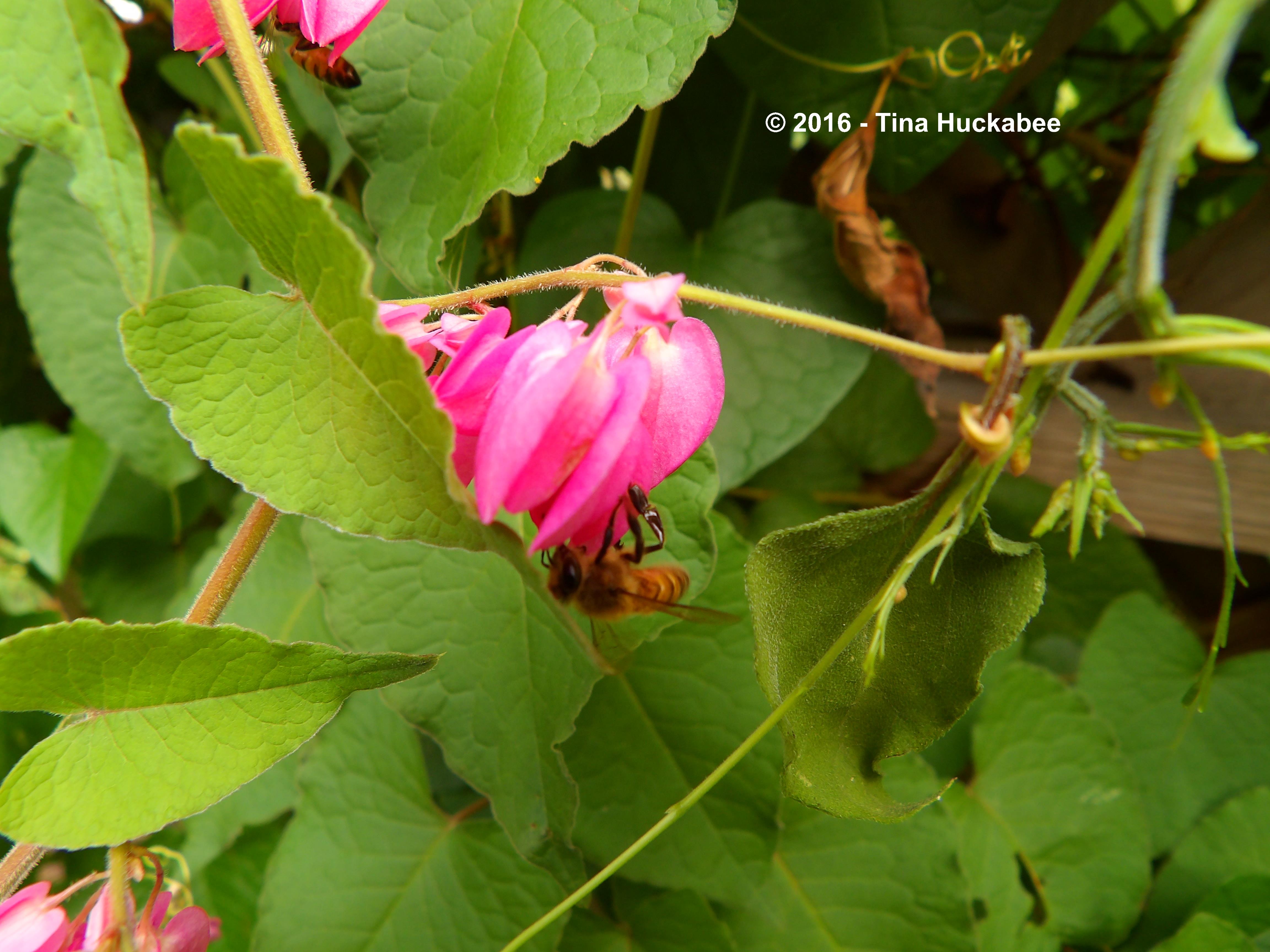
A preferred nectar source for honeybees are the charming blooms of the Coral Vine, Antigonon leptopus.
imgp9746_cropped_2088x2032-new

imgp9744_cropped_4355x2488-new

imgp9737-new

I grow one small bit of this vine and from late summer into fall, the bees are all over it, all the time.  Tagged as an invasive plant here in Texas, as well as some other southern states, in all the years I’ve grown my vine I’ve only seen two or three seedlings develop. That said, I probably wouldn’t grow it if I live in a rural area and not smack-dab in the middle of a city, at some distance from a green belt.  Rural gardeners should steer clear of this plant and choose native-to-region plants instead.

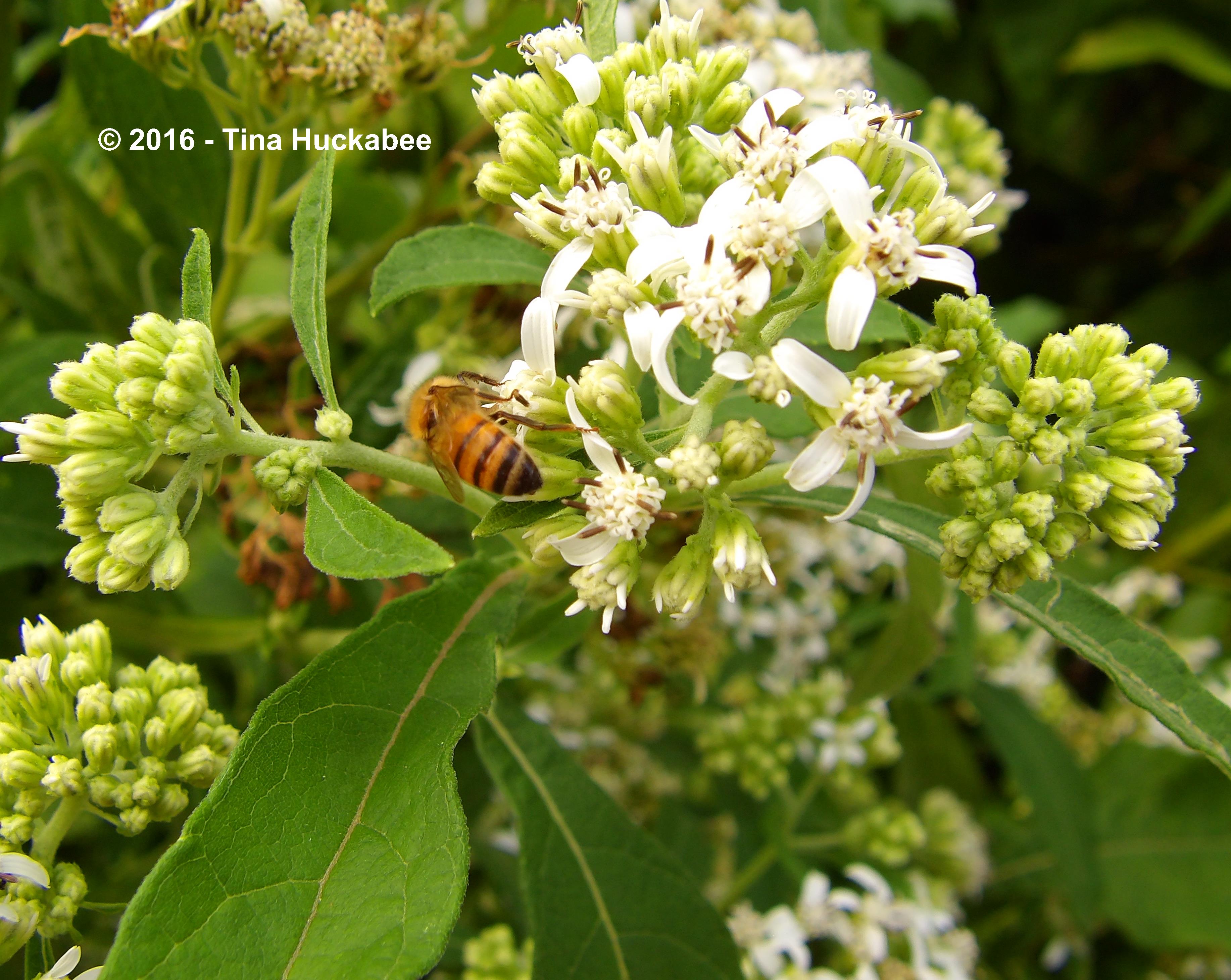
Honeybees enjoy the flowerets of FrostweedVerbesina virginica, a native perennial best known as a migrating Monarch butterfly favorite and a post hard-freeze ice-sculpture plant.

imgp9742_cropped_3668x2921-new

imgp9678_cropped_2649x2843-new


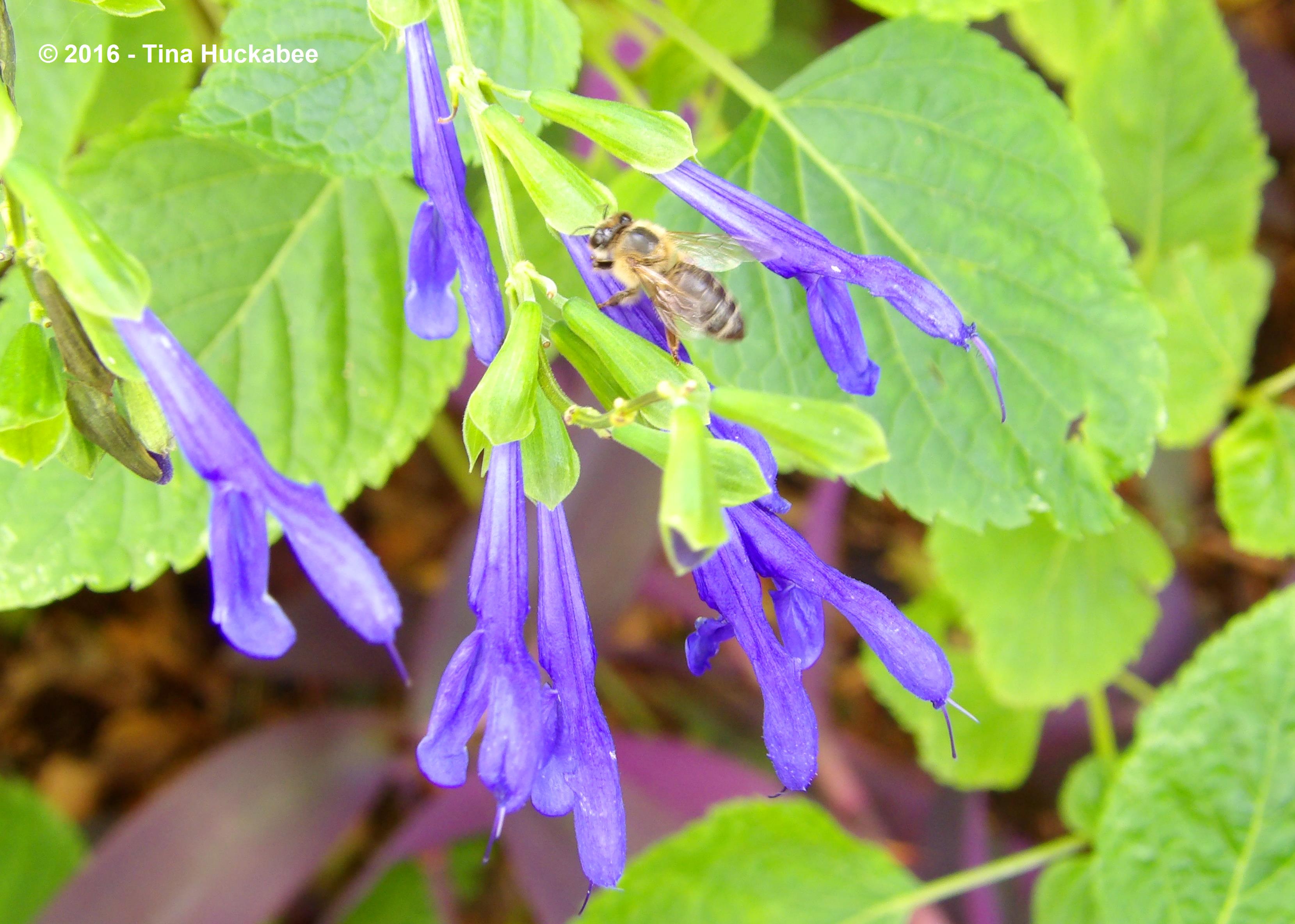
Majestic sageSalvia guaranitica, is lush with its royal blooms this wetter-than-normal summer.   Typically, I see one or two native bee species at this plant, but honeybees have shown interest in stealing nectar.

imgp9706_cropped_3318x2368-new


ZexmeniaWedelia texensis, always hosts a variety of  native pollinators who work its cheery yellow blooms;  honeybees are included in that mix.

imgp9743_cropped_1732x1530-new

imgp9741_cropped_1792x1986-new


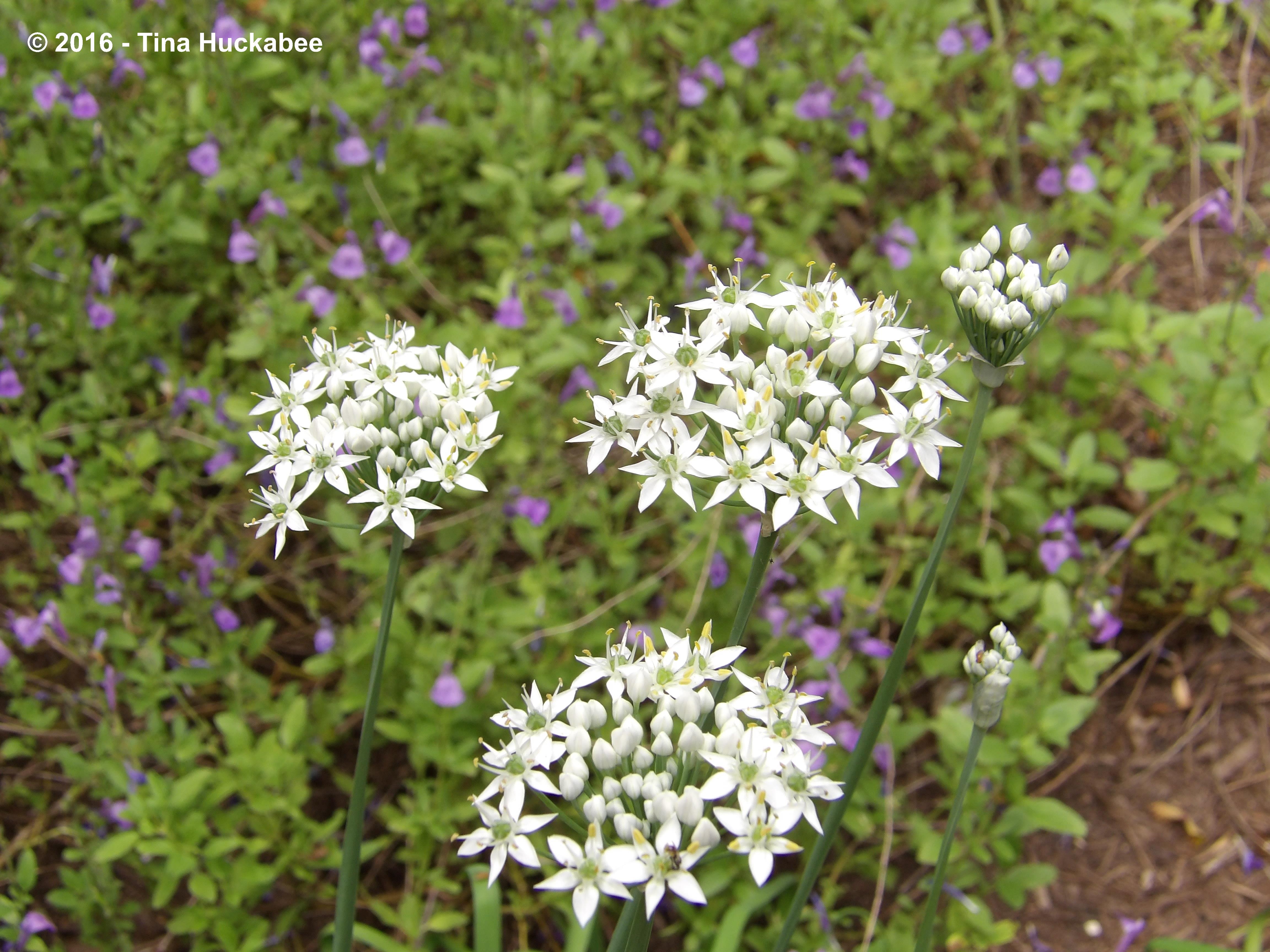
Garlic chivesAllium tuberosum, recently began their short bloom cycle in my garden, but it didn’t take long for the honeys to find them.

imgp9732_cropped_2737x2585-new

imgp9728_cropped_2728x2626-new

I wonder what garlic honey might taste like?  Mmmm!


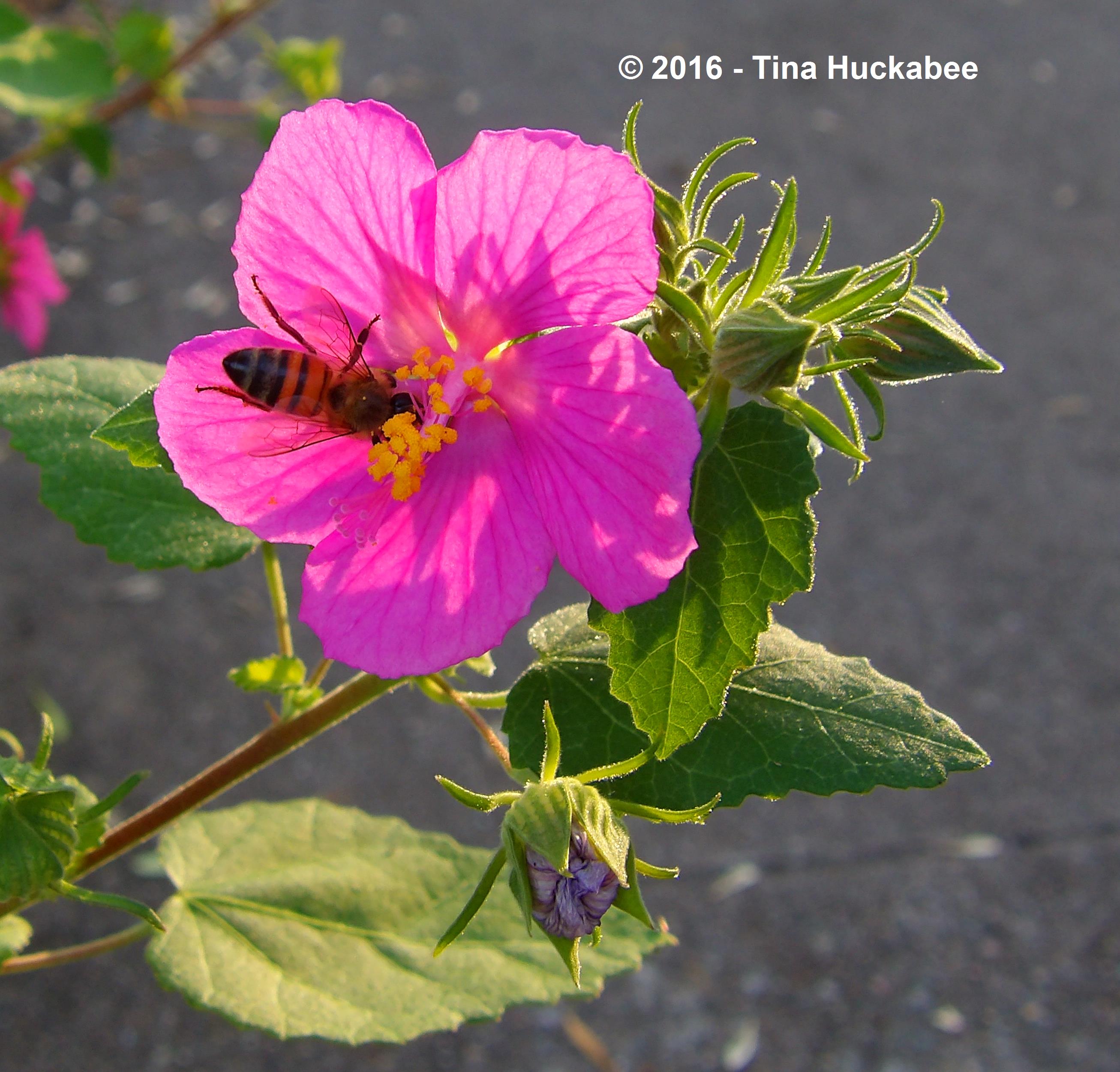
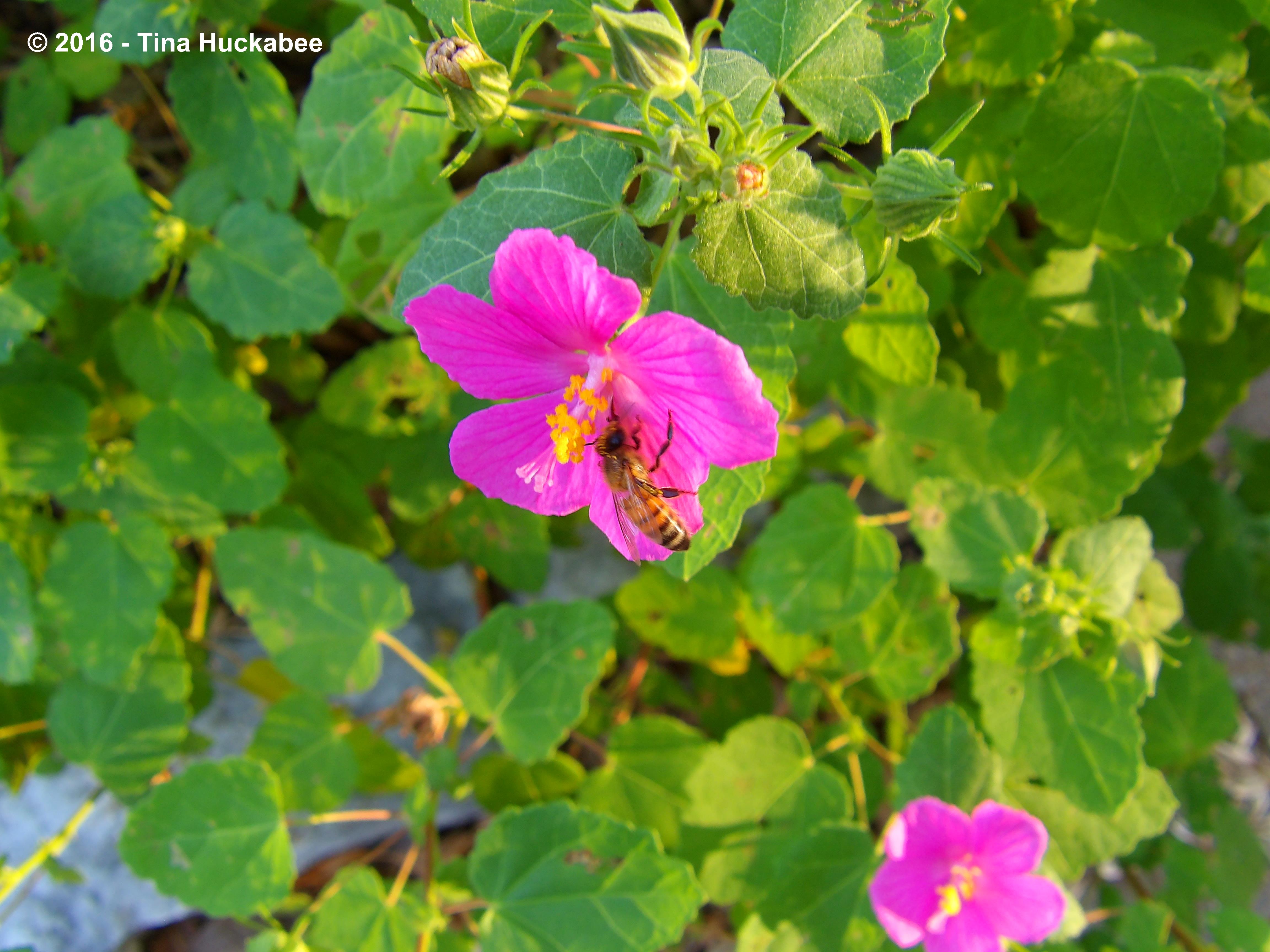
Another perennial preference of honeybees and many other pollinators is the Rock rosePavonia lasiopetala.  I like this back-lit shot with the early morning sun, setting bee and bloom aglow.

imgp9805_cropped_2613x2502-new

As well as this shot, which simply highlights both–and the foliage, as well.

imgp9803-new


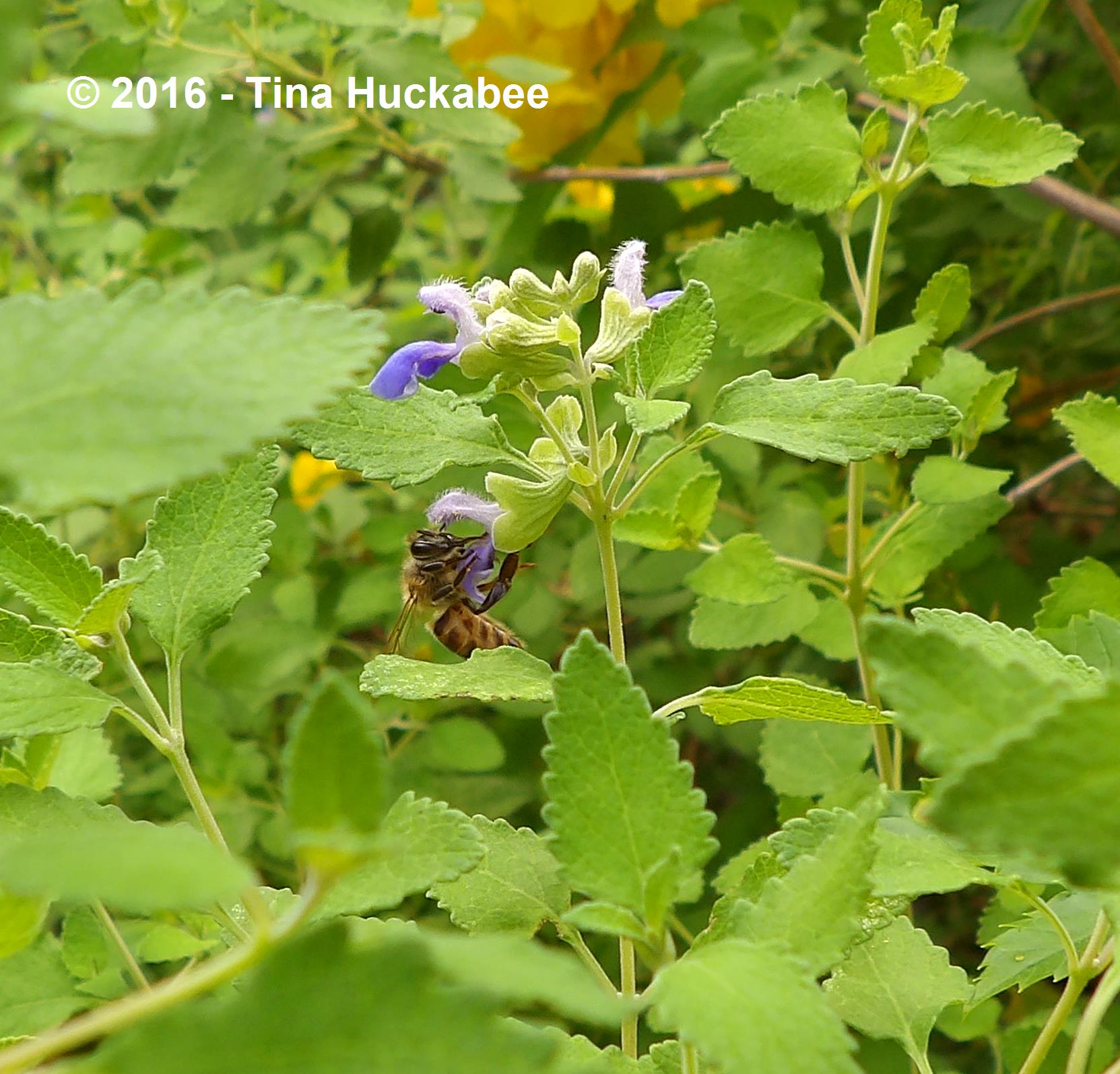
An impulse buy from a nursery a couple of years ago as I observed honeybees clamoring for nectar from its blooms, is this Shrubby blue sageSalvia ballotiflora.

imgp9739_cropped_1663x1594-new

I’d say that the bee is busy and content with its bounty.  The Shrubby blue sage also attracts several species of native carpenter bees, as well as a variety of butterflies.


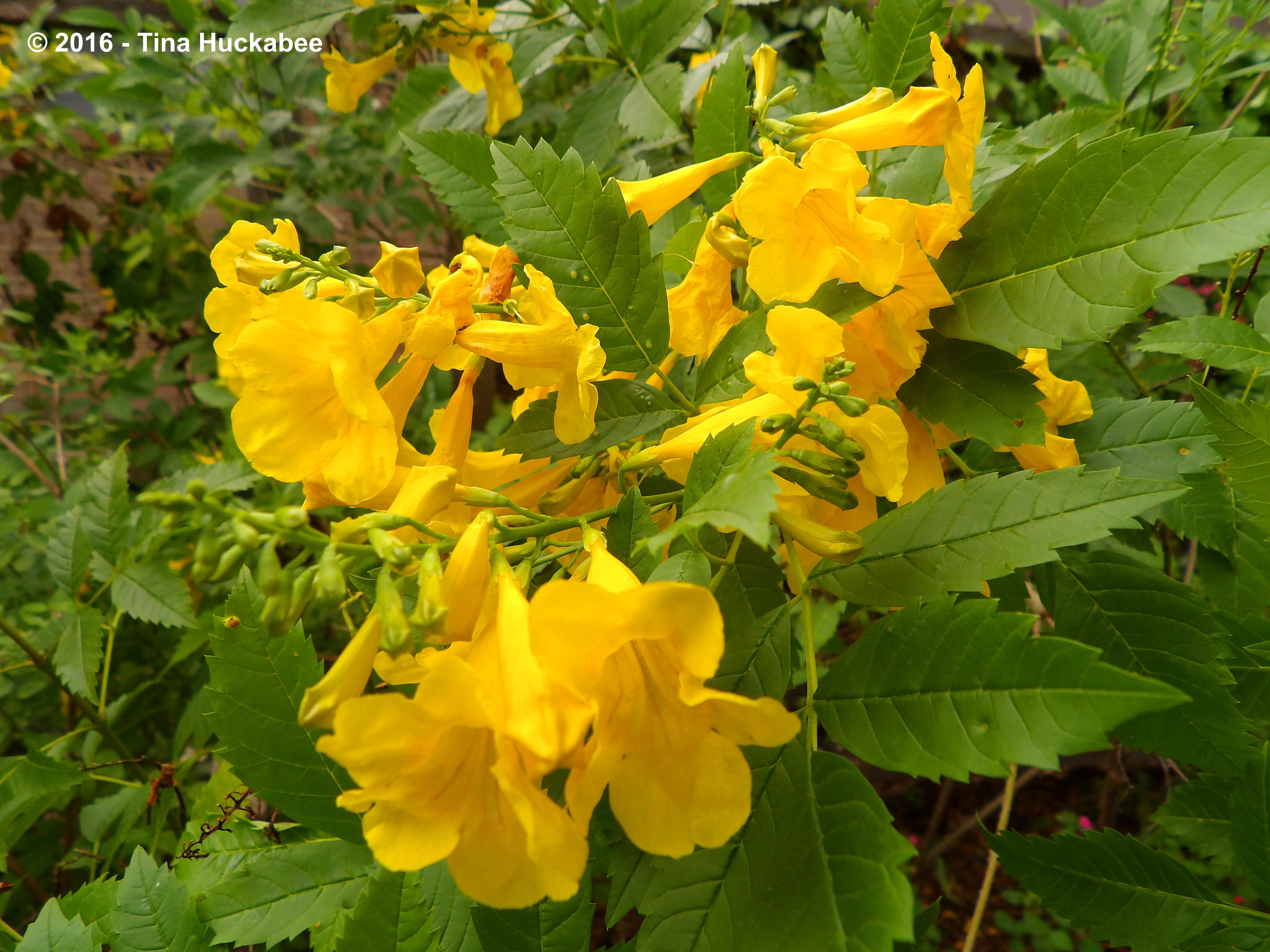
The native-to-South Texas, Yellow bellsTacoma stans, always has bee visitors, but rarely (or so it seems)  at the angle that I can easily photograph.  No bees at this bloom cluster, but these flowers always please.
imgp9738-new

A bee-less photo, but of a great bloomer and nectar source for many different pollinators.


Another bee-less photo is of blooming Garlic chives and in the background, a purple blooming Autumn sageSalvia greggii.

imgp9731-new

 Both typically have pollinators in attendance; I happened to catch the combo in a quiet moment.

I thank Carol at May Dreams Garden for hosting this monthly bloom bonanza known as Garden Bloggers’ Bloom Day.  Join in, share your garden pretties, then click over to her lovely blog to see and learn about blooms from many places.


Bee Mama Missive: Bee Story

Meet Woody and Buzz.

IMGP8749.new

You know Woody and Buzz, don’t you?  Woody and Buzz from Toy Story, the first of the full-length Pixar films which debuted in 1995. We’re continuing the trend of using cartoon character names for our newest beehives, which began with our older and original two hives, Scar and Mufasa, named after characters in The Lion King.   Mufasa the Hive died in December due to an infestation of varroa mites, but Scar is buzzing along just fine.

IMGP8751_cropped_3139x3318..new

In fact, we took three (heavy!) combs of honey from Scar this past weekend.

IMGP8747.new

Whoop!!  Spring honey!

Buzz and Woody are Langstroth hives.  I’ve written about our travails with Scar and Mufasa–both Warre hives–and we’ve been planning two new Langstroth hives for quite a while.   Langstroth hives are considerably easier to work with and we finally hived these babies a month ago. We were planning to hive them in April, but a serious bicycle accident two days before the hiving waylaid Bee Daddy for a time and it was only recently that we finished final touches on the hives and then picked up our new bee-gals.

IMGP8331.new

I now understand why Langstroth hives are the industry standard–they’re SO much easier to work with than the Warre hives.

All the preparations are the same, of course: donning the hot bee suit,

20160528_160916

…readying the beekeepers’ paraphernalia,

IMGP8339.new

…and firing up the smoker.

20160528_161542

But the actual hiving with those lovely frames,

IMGP8332.new

…which fit together with ease, coupled with the larger boxes that they’re placed in, make this beekeeper’s life much easier.

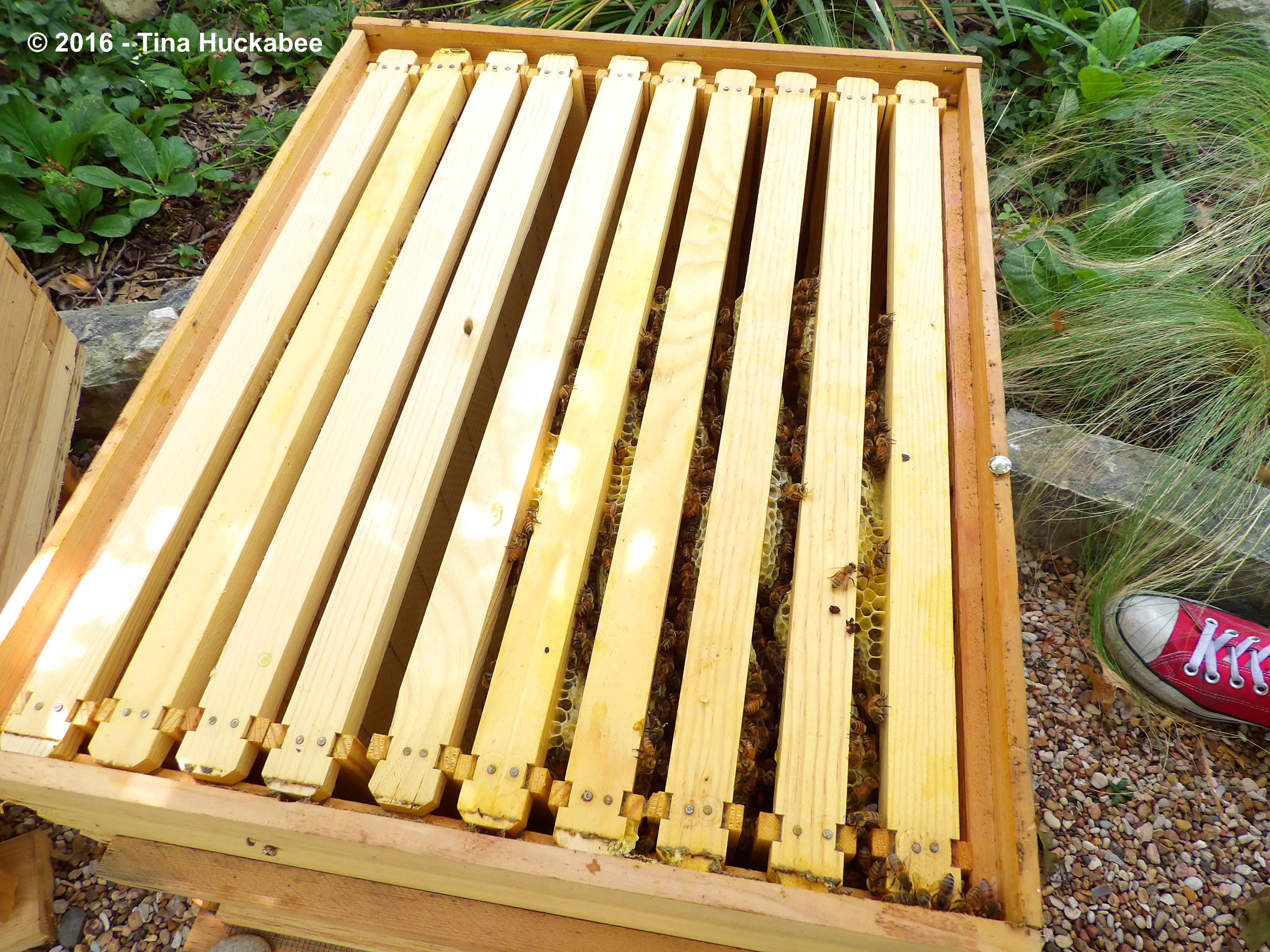
Warre hives Scar and Mufasa were great learning tools and truthfully, we were fairly successful with them–we’ve had darling honeybees and their queens made other darling honeybees and the whole bunch-a-bees made oodles of gooey, delicious honey. But the cramped conditions of the smaller hives, along with top bars rather than frames, made things tricky these past two years as we kept tabs on our bees or when we pulled honey out of the hives.  So we did what others before us have done and transitioned to Langstroth hives.

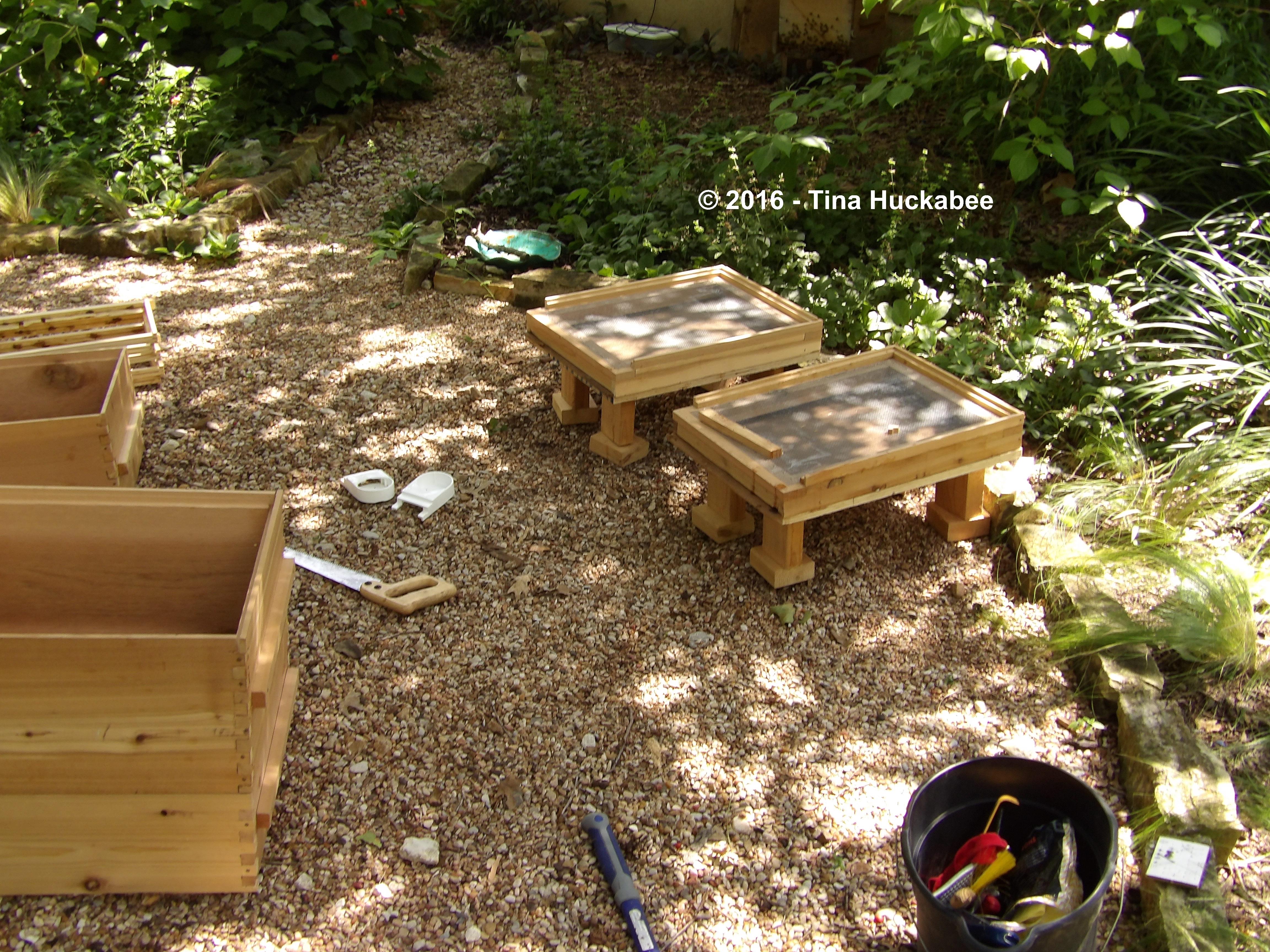
While Bee Daddy was in the garage with his beloved power tool companions, fitting the Langstroth brood box like such a puzzle,

IMGP8334.new

…I was arranging our bee “yard” for the new ladies.

IMGP8337.new

Meanwhile, the Buzz and Woody bee gals were sitting on the living room floor, stuck in their cages, no doubt annoyed and tapping their tiny toes, anxiously awaiting their new homes.

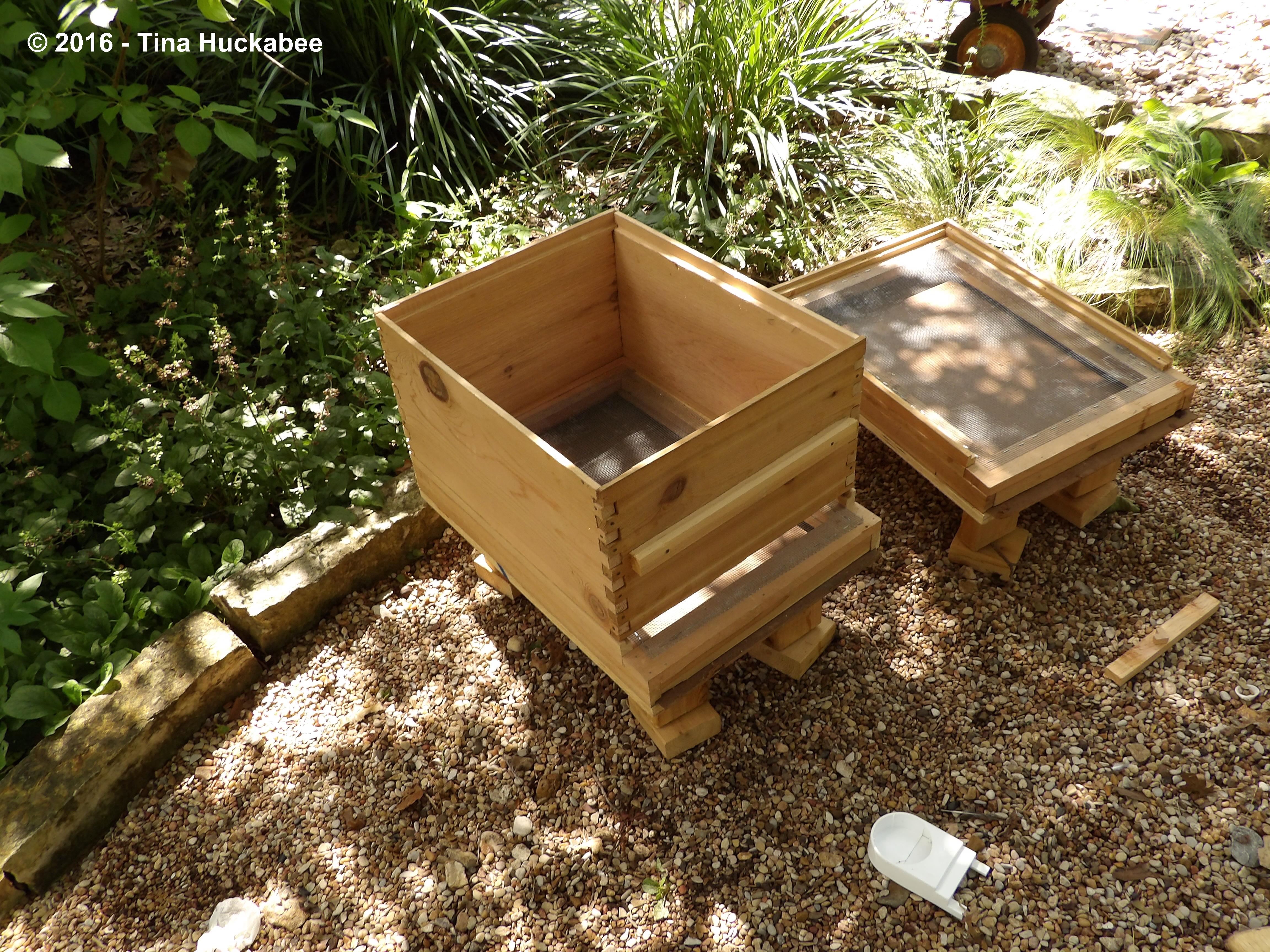
Putting together the hives, we start with a plinth which has a screened bottom board, which will make it easier to check for the dreaded varroa mites.

IMGP8339.new

I set each brood box atop each plinth.

IMGP8341.new

IMGP8342.new

IMGP8344.new

Per instructions, we placed four brood frames (where the worker bees build their honeycomb and make honey, and the queen lays eggs) on one side in each box.

IMGP8347_cropped_3870x3364..new

IMGP8345.new

We added the outside boardman feeders already filled with sugar-water syrup at a 1:1 ratio. Most beekeepers use trough feeders located inside the boxes, but we’ve used the boardmans and prefer not to open the hives each time we add fresh sugar-water.

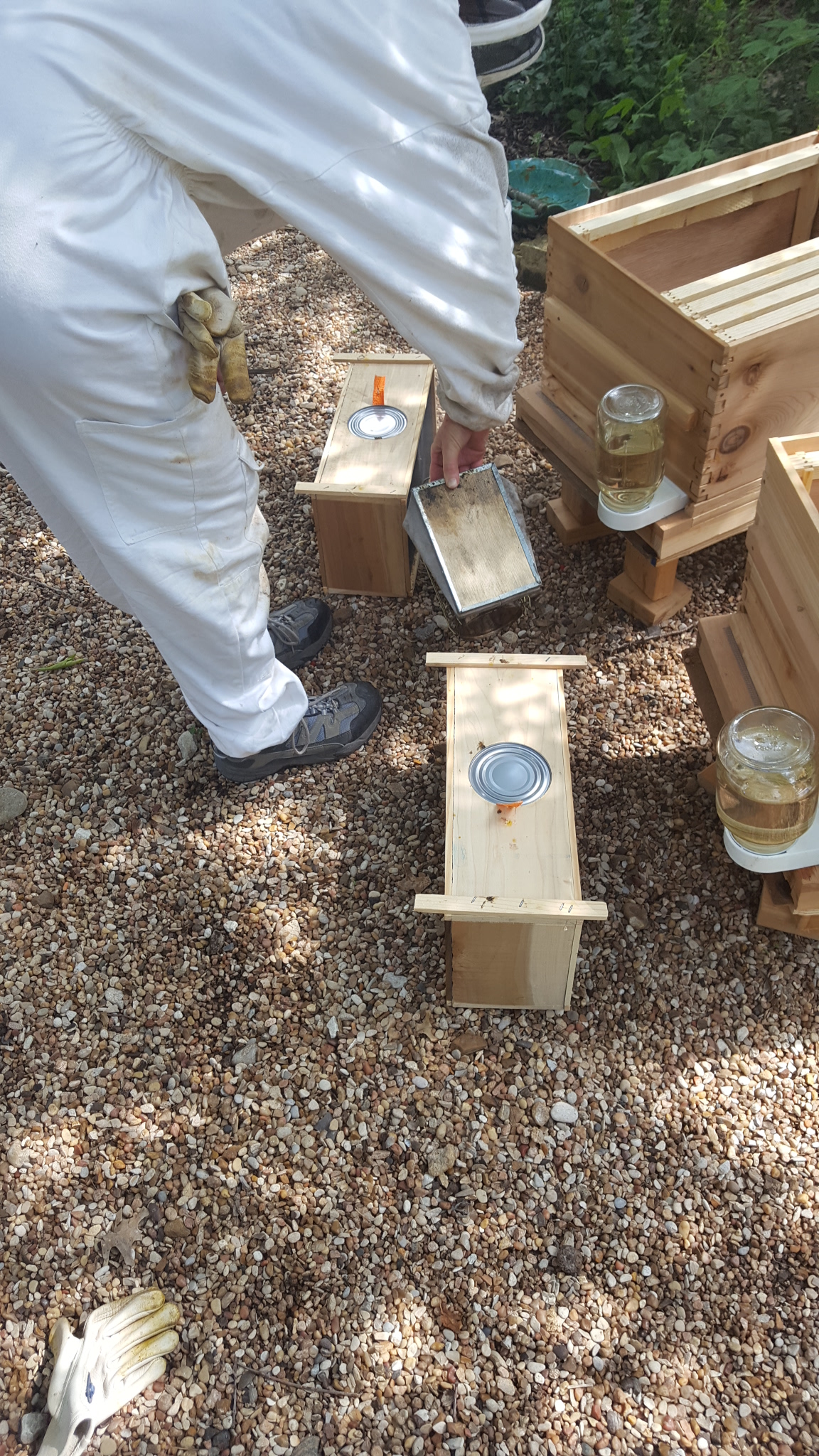
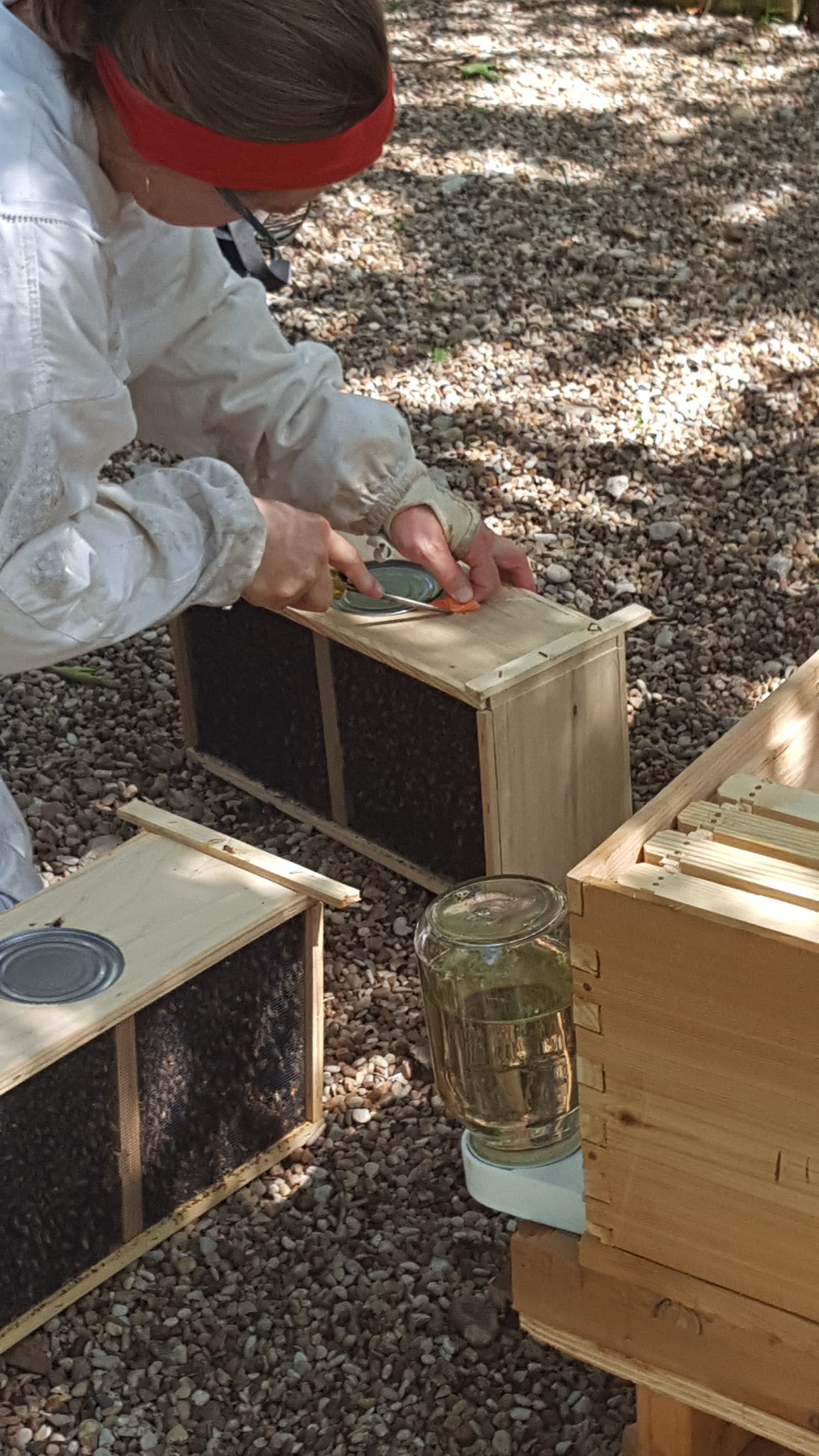
Time to hive!!  We pull up the embedded cans containing their syrup in the traveling cages,

20160528_161633

…which also holds the queens’ cages, attached with the orange tabs.

20160528_161100

IMGP8351.new

IMGP8367.new

Queens from commercial apiaries usually arrive in their own separate cages from the workers.  Our bees come from BeeWeaver Apiaries, located here in Texas.

IMGP8358.new

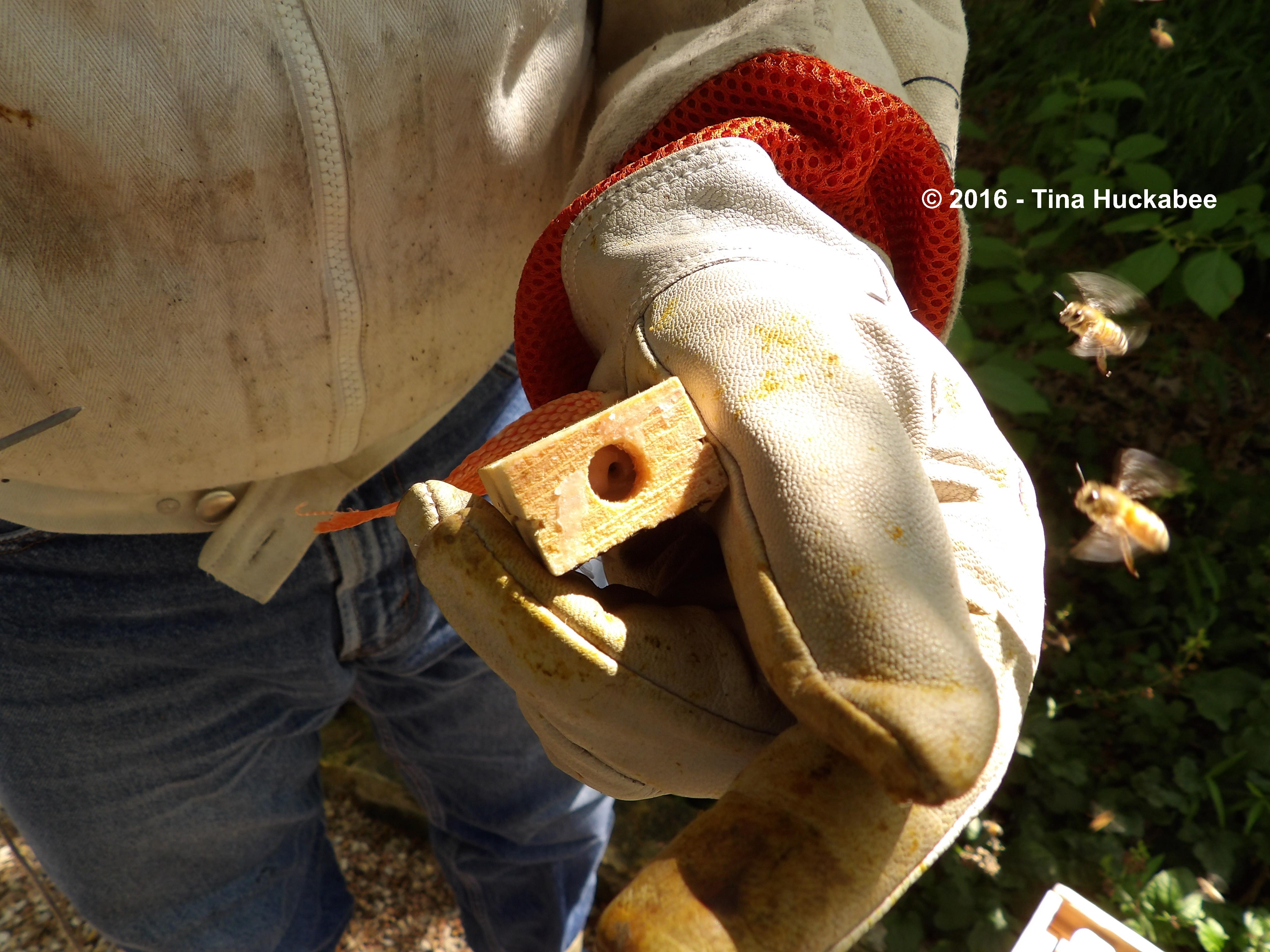
At one end of the queen cage is sugar fondant to feed the queen until she’s safely hived.  The beekeeper pokes a hole in the fondant just prior to placing the cage in the hive so that the queen doesn’t work too hard eating through the fondant on her way to her subjects.

IMGP8370.new

The orange tabs attached to the queen cages allow us to thumb-tack each cage onto one of the frames in each box.

IMGP8359.new

It usually takes a few days for the queen to eat through the fondant and join her girl gang.   By the time the queen enters the hive, her pheromones are dispersed throughout the hive and all the worker bees love her so and will follow her to the ends of the earth.

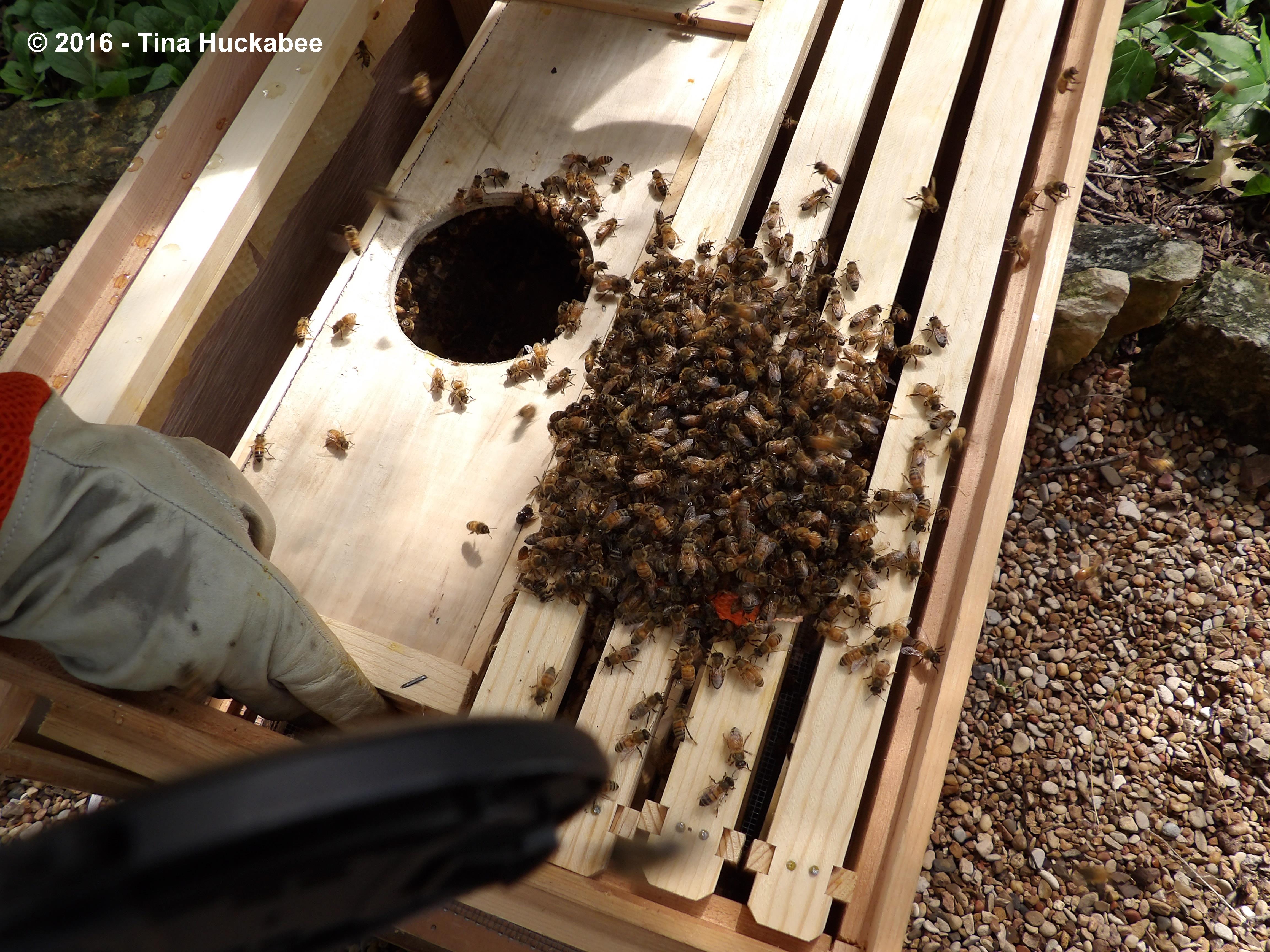
Once the frames are in, the queen cage attached, we pour some bees onto the queen cage.  Then the entire traveling cage, with the rest of the ready-to-work workers, is situated cozily in the remaining open area of the box!  The worker bees will exit the traveling box and begin their work in the hive:  building comb, taking care of the queen, foraging, taking out dead bees, whatever is required of each.

IMGP8376.new

Wow, that was easy!

We placed the lids on top,

IMGP8364.new

IMGP8365.new

…and added the roofs.  Bee Mama sat for a well-earned break!

20160528_163157

Interestingly, later that afternoon, I was watching the hives and Buzz became buzzy–and loud.  Bees vomited out of the hive.  I left to fetch Bee Daddy so he could observe the mass exodus as well and when we returned, who was crawling around on the ground but Ms. Queen Buzz.  Honeybees were swarming all over the area.  We captured Ms. Queen in a glass and gently (you REALLY don’t want to squish your queen!) placed her toward the back of the hive. All the bees followed her directly into hive.  If only humans could follow directions so well.  I suspect that initially we may have place her too close to the hive opening and she managed to find the door to the great outdoors–which is not good for a bee hive.

That was exciting.

Since then, all seems well with both hives–they’re actively foraging and sipping syrup to augment their diet.

IMGP8380.new

We’ve checked the hives twice since hiving and both queens are doing their job and laying eggs: there are larvae of different ages and even adult bees emerging.

IMGP8742.new

IMGP8738.new

Bees know how to stay on task!  We removed the traveling boxes and queen cages from the brood boxes a few days after hiving and added the remainder of the frames. There are still only four frames with any significant amount of comb, but there was more comb at the second check than the first–good progress.  I’m still feeding the bees, though they’re drinking less from the feeders with each passing week.

IMGP8745.new

Buzz and Woody are the gentlest bees we’ve ever hosted.  I think we could work them without smoke, they’re such laid back ladies.

Laid back,

IMGP8648.new

IMGP8429_cropped_3055x2484..new

IMGP8428_cropped_3097x2936..new

…but busy.