While it flies in the face of garden normalcy, it’s been a good winter for many of the flowering perennials in my garden. Few plants were sent deep into dormancy, so flowering florals have been a constant.
This cheery cool season bloomer has brightened the edge of a garden for months. Four-nerve Daisy, Tetraneuris scaposa, is a tidy little thing. Evergreen slender leaves serve as a base for sprightly yellow daisies. Even after a hard freeze, this is a typical winter bloomer.

Owing to the mild winter, there are a couple of Purple coneflower, Echinacea purpurea, eager for spring to begin. Interestingly, the established plants, some of which are years old, haven’t bloomed up yet.

This group volunteered themselves for a pathway decoration. I’ll leave them be–who am I to yank them up when they’re so charming?
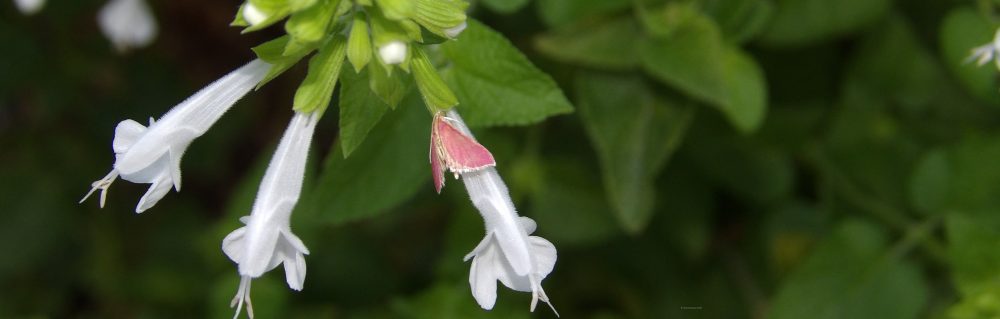
Another beneficiary of our lack of freezes this winter are the Tropical sage, Salvia coccinea. This particular one is red, but the white ones have bloomed all winter too. They’re a little lanky now, but I’m still enjoying the accents of red, so they’ll remain until the new growth catches up with the old-growth blooms.

A cousin of the S. coccinea is this salmon-colored Autumn sage, Salvia greggi. It’s not a bountiful bloomer, but only because it grows in too much shade. Still, the blooms are beginning and will grace the garden for the next couple of months, taking a break during our hot summer, resuming flowering in fall.

Another “victim” of the mild winter is the Mexican honeysuckle, Justicia spicigera. This is a funny plant as it doesn’t have a specific bloom time. In mild winters like the one this year, it blooms all winter, well into spring. In a “normal” winter (whatever that is), it’ll be knocked to the ground, requiring several months to flush out before flowering ensues.

I’ve thoroughly enjoyed these winter-orange blooms and so have the honeybees. Most of the native bees are dormant for now.

Mexican honeysuckle is also a great plant for part shade–yay for me as I have plenty of that!

My two red roses have produced luscious blooms all winter, non-stop. This, the Martha Gonzales rose,

…and its botanical doppelgänger, the Old Gay Hill rose. Easy to grow, disease-free, and gorgeous against the blue Texas sky, both roses are head-turners. I’m not going to prune them just yet, against common gardening wisdom; there will be time later for that.

In the last week or so, the Southern dewberry, Rubus trivialis has burst out in blooms.
The sweet, snowy flowers attract skippers and honeybees, and dot the back of the garden, clambering up a fence and creeping along the ground.

The buds are a pure pink, so provides a bit of a color two-fer. Alas, it’s more than likely that the birds will pick off the berries before I get to them.

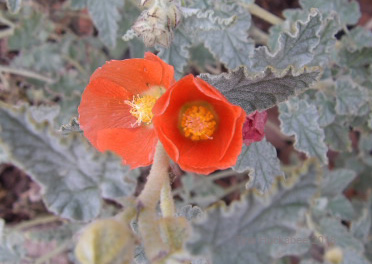
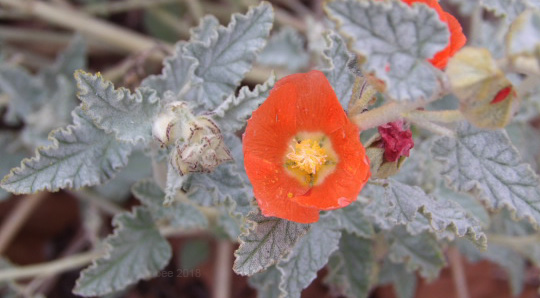
I finally found the one spot in my garden for Desert mallow, Sphaeralcea ambigua. Native to regions west of Texas, this lovely requires full sun and excellent drainage. It’s a high elevation shrub, but the best I could do was pop it into a raised bed. I love it, blooms or not, and the tangerine flowers paired with that grey-green ruffle of foliage is a winning combination.

The native Blue Orchard bees, recently awakened from their own year-long dormancy, have enjoyed the pollen provided by this mallow.

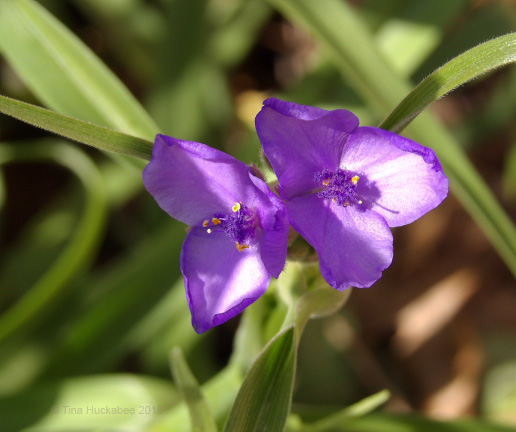
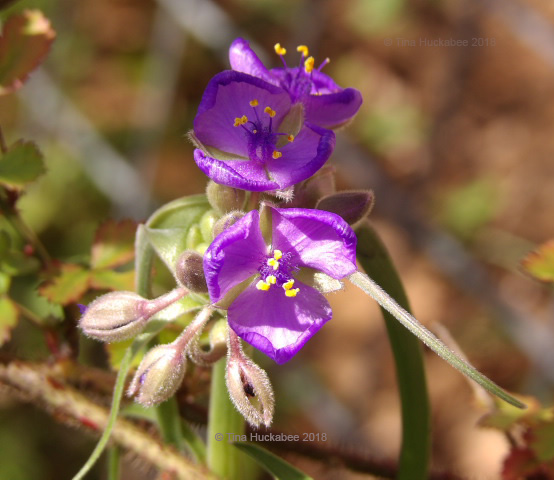
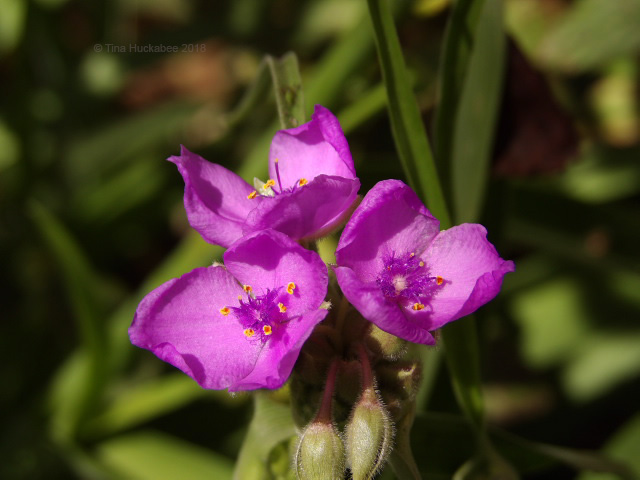
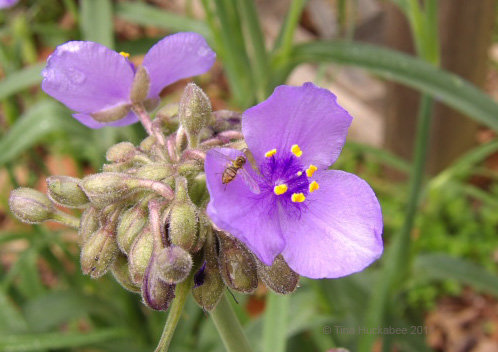
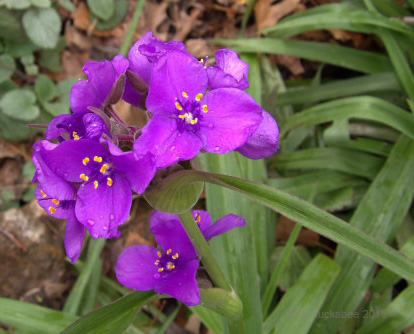
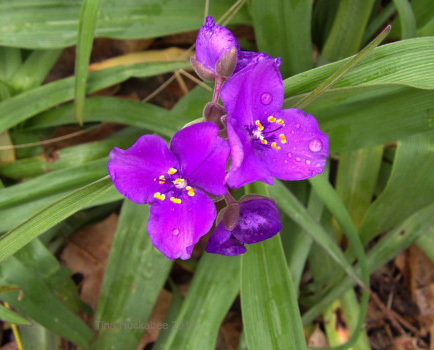
A passalong plant, Giant spiderwort, Tradescantia gigantea, delivers blasts of purple for this gardener and loads of nectar and pollen for the pollinators. Honeybees are in a frenzy gathering the pollen as they gear up for spring.

I have quite a few clumps of this spiderwort and they seed out prolifically. They’re easily pulled up and tossed into the compost, or even better, gifted to unsuspecting gardeners.
I like that the insect (a fly or native bee?) is also interested in the plant. I wonder if he/she is responsible for the hole in the leaf?

Purple power rules the garden with these spring pretties.

Most of these perennials and shrubs bloom at least some during a colder winter, but this year, that floral show has been richer. Of course, as we enter March, the month of spring, an overnight light freeze or two is predicted in the next few days.
Typical.
The native plants will be fine, the irises, reaching to the sky and starting their blooms, might be damaged. Time–and actual temperature–will tell. Regardless, spring is now knocking at the garden gate and winter is mostly done.
How has your winter garden fared?







 My Gardener Says...