Sometimes, she’s thinking outside the box, too. This photo was taking in early January, before the oak lost its leaves. She wasn’t pleased with my cooing and taking her photo for all to admire.
An Eastern Screech Owl couple have been around the garden in recent weeks. I’ve spied them mating (once) and on a couple of videos, the pond wildlife camera featured one of of the owls, male or female this viewer has no clue, hunting rats. The female stays in the box some days, but not consistently, so I’m uncertain whether the box will be the nesting site or if it’s an occasional place to hang out for the day.
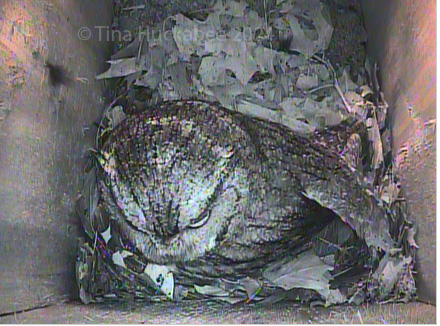
She’s in the box today, this freezing day. Blue Jays perch on the nearest branch and voice their disapproval with her presence. She sleeps, but sometimes stirs nervously when the jays are yelling at her.
I think this is a different couple than the pair that nested in here the previous three years. Their trills are different, the female is skittish, winging to her daytime sleeping spot before sunrise, rather than ‘Uptown Girl’ who enjoyed her time out of the box in the early mornings before sequestering in daylight hours.
I hope these two choose our box for their chicks and that the chicks fledge successfully.
We’ve hosted nesting Eastern Screech Owls, Megascops asio, in the back garden for about 14 years. For most of those years, the parents raised the chicks successfully and I’d observe them even after they fledged. In other years, and for a variety of reasons, the owls’ breeding season failed. For about 8 or 9 of the Screech Owl years we’ve also employed a working camera in the nestbox. Or rather, the camera would be working at the beginning of the process (mama spending time in the box) but would then go dark for some undiagnosed issue which proved fatal to a viewing a clear video, or, like last year, when a prolonged deep freeze snapped the cable.
This owl breeding season finally delivered a thriving owl family (the most important thing!) and a camera that caught it all–from eggs to owls.
Mama owl, named ‘Uptown Girl’ (by yours truly), sits on the the first egg, which she laid on March 15th.
The second egg appeared 3 days later on March 18th, the third entered the world on March 20th. I observed and kept track of the eggs, then chicks, with photos from the owl cam, the best viewing always at sundown, as mama took a break from the nestbox for a few minutes each evening.
All three chicks hatched about a month later; the two oldest hatched on the same day, the third arrived the following day.
This photo was taken on April 16. Uptown Girl is at the nestbox window, no doubt ready for a break from the fuzzballs. Her tail feathers are visible at the top of the photo.
If you’re squeamish about the owls’ diet, you might scroll past this next photo, though it does require imagination to recognize what their meal was. This photo is from April 24th.
The older they are, the cuter they are! As they grew, they continued to excel in the fluff department and were so fun to watch. They’d nip and nuzzled one another, preen, and look around their limited real estate. This photo is from May 2nd.
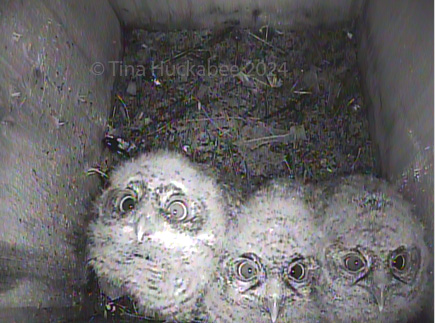
Bright eyed and bushy tailed on May 4th! (Well, two of them, anyhow.)
Finally! On May 5th all three are looking up with an owly cheese! for the camera. You’ll notice that they’re each slightly larger than in the previous photo.
On May 6th, they’re facing south, toward the nestbox hole that will soon be the portal to their lives as fledgling owlets.
Once the owlets filled the nestbox space with their size and regular wing flaps, mama spent little time in the box; watching the owlets was so much easier with mama out of the way! The owlets were active in the early mornings, sleeping during the afternoons, and then hungry, noisy, and wanting to feed in the evenings. The parents obliged by bringing food after sundown, each parent taking turns with an owl version of of door dash: pop in feed a baby, take off again. Next parent: pop in, feed a baby, take off again. And so on. Sometimes the door dash was a quick morsel of gecko or insect, sometimes there was a whole carcass of bird or rat delivered.
I never watched the nest box during the overnight hours. I imagine the parents delivered meals all night, given how fast these chicks grew. I could see that each day, especially in the last week or so, the owlets were bigger than the day before. They’d stretch themselves tall, their fuzzy heads almost reaching the camera, and wings were in regular flap mode, as they built strength and agility toward their flight training.
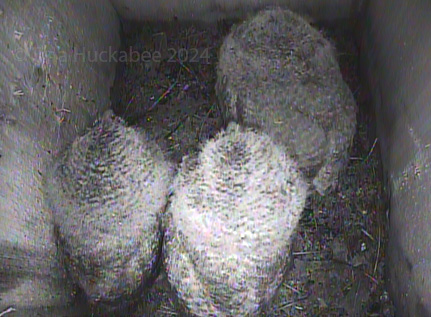
Notice how large they are on May 7th.
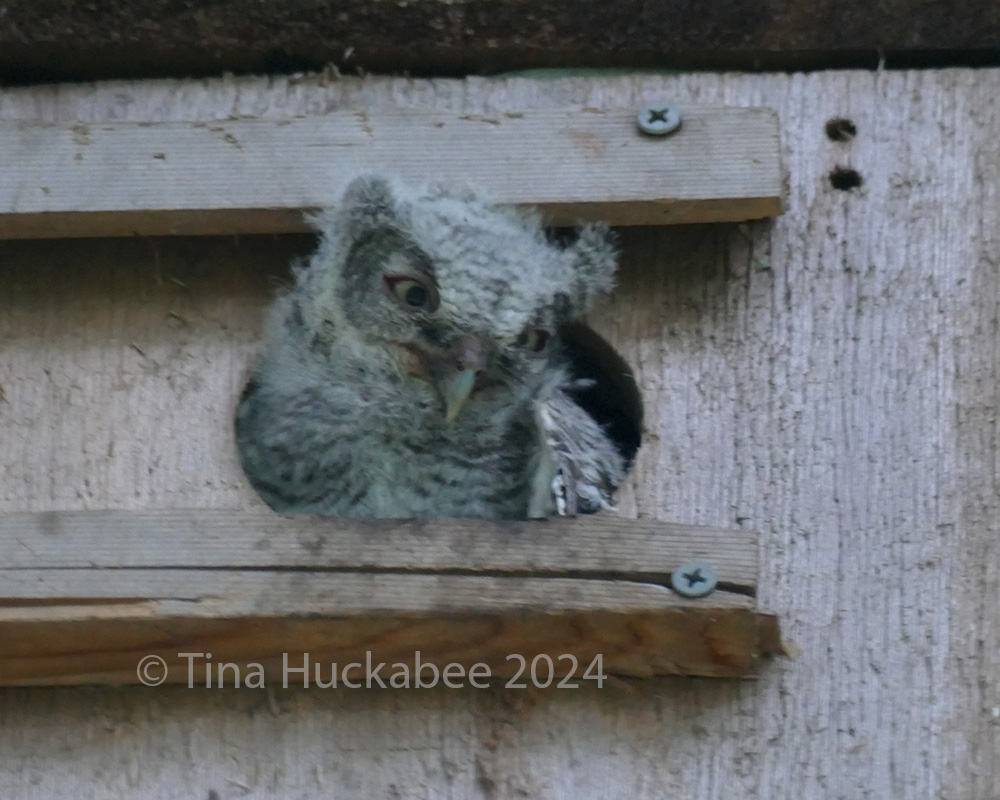
I had several opportunities to capture good photos as the owlets begin peeking out of nestbox hole to the outside world. This poor photo of a darling owlet is the only one I managed, mostly due to my own laziness. I should have been more vigilant; the time the owlets spend at the window just prior to their exiting the nestbox for good, is fleeting.
The two, presumably oldest, owlets fledged on the evening of May 10th; the third one was out of the box the following night. I heard two separate owlet begging calls that night in my neighbor’s tree, but also saw one of the parents in my tree, which indicated to me that while the third owlet was out of the box, it was still in our tree. By the next evening there was no sign of any owls. Typically, I’ve observed the owl families for a few weeks after they leave the nestbox, but this family is gone from the immediate vicinity–at least in the early part of the evening which is when I’m looking.
The parents will encourage their offspring to widen their territory and the next couple of months will be all about survival. By late summer, the young owls will be on their own. About 75% of Eastern Screech Owls don’t survive their first year, so these owlets have a treacherous few months ahead of them and it’s unlikely that all three will make to breeding age. I’ll never know which, if any, have survived, but I feel privileged and grateful for what I observed with this family and impressed with the dedication of their remarkable parents.
All the best to you, little owls–come say ‘hi’ sometime, okay?
The smallest Eastern Screech owlet is interested in what’s up.
These feathery bobble-heads are growing at a remarkable pace. At sundown, their parents visit, usually with moths, geckos, or worms (at least I think they’re worms…) as delectable nibbles for these cuties. While I don’t watch the camera overnight, I’m sure that feeding goes on throughout the dark hours. Often in the mornings, there is one, or more, deceased prey in the box, ready for a daytime meal when the chicks are peckish.
I haven’t taken daily photos to chart their growth, but they’re big and active now and it won’t be too long before they fledge. I’m fascinated with their daily activities, even when the three are lumped-up in a pile of fluffiness, breathing rhythmically.
Mom and Dad stay close by, coming into the box only to feed. Mom is always stationed just outside the entry hole.
Last year, the owls’ nest box was raided in late February, most likely by a Grey Fox or a Raccoon. This year, to prevent a predator from climbing up the tree and snatching the eggs or chicks, we wrapped the tree with linoleum flooring that comes from a roll, cut to size specification, at your neighborhood big box store. We nailed the width of the flooring to the trunk when mom owl had settled in the box to raise a family.
The tree isn’t near our roof or another large tree, so there’s no concern about a predator climbing up an adjoining structure, then lumbering over to this tree to gain access to the nest box. This makeshift collar has a thick linoleum coating which would be difficult-to-impossible for claws of a smaller mammal to penetrate for vertical traction, thus preventing successful climbing. Grey Foxes can jump up to 6 feet in height, so we placed the bottom edge of the collar at about 3.5 feet, the top edge reaches just over 7 feet high.
The collar looks a little goofy, and no doubt the tree is embarrassed by its attached swath of fake wood, but the fix is temporary and has provided some safety from predators for this owl family. It’s nearly 7 weeks since the the egg holding the oldest owlet (most likely the one on the left in the photo) was laid. Soon, these owlets will see their big, new world for the first time.








 My Gardener Says...