What’s Black and White and Cute All Over?

Migration season is mostly done and in my garden, it was a meh event this spring. I observed very few of the usual suspects either around my pond or in the garden proper. Those who showed up, Summer Tanagers, Lincoln Sparrows, Common Yellowthroats, and Clay-colored Sparrows, were brief in their visits. Absent were the Painted Buntings, Nashville Warblers, White-crowned Sparrows, and Orioles. I didn’t see any of those and I miss them. I enjoyed a quick look at a Canada Warbler, which I haven’t seen in a few years.

My pond has always been the draw for weary migratory birds, but the front garden is in full bloom and seed production with quite a bit of bird activity, and that’s the place to be if you’re a bird or a birder. The front garden is also a much more challenging area in which to watch birds; there’s no window for me to hide behind and no good place to plant myself where I won’t disturb my feathery friends. I also suspect that the wet spring in Texas has allowed for plenty of water and food sources for the migrants, so fewer dipped into urban gardens.

During an outing at Travis County Audubon’s Baker Sanctuary, I was privileged for the first time to observe some endangered Golden-cheeked Warblers. Males, females, and fledglings put on a nice show for excited birders, the birds swooping around native trees, cameras and binoculars pointed upward to catch the winged things. I knew I wouldn’t be quick enough with my camera, so chose to observe and appreciate this rare sight. Central Texas is the only place where Golden-cheek warblers breed and their breeding areas are in very specific habitats. These are not common birds in backyard settings.

In recent weeks, my backyard birding has been focused on watching hungry, often noisy, fledglings who are out of the nest, but still learning from their parents. Most are in trees, squeaking, squawking, and flapping their wings, foliage obscuring baby birdie meal time. Occasionally, parent and chick visit the feeders together, like this mama and fledgling Downie Woodpecker, Dryobates pubescens, pair.

Baby is at the left of the photo, hanging on to the pole that holds the feeder. It looks like she’s already had some food, as she forgot to wipe her beak. As an aside, I’ve seen her land at the pole, then slide down, fluttering up to hold on to the pole, unable to maintain her grip. Learning where the food is and practicing methods for proficiently obtaining that food is all part of her learning process.

The young one flit to the feeder, where mama was ready with a peanut.

I watched these two for several days, then noticed the fledgling visiting the feeder on her own. She was reticent initially to land on the feeder, but eventually gained confidence–and peanuts–as she became successful in feeding herself. I’ve seen young Blue Jays, Northern Cardinals, Black-crested Titmice, and Carolina Chickadees in similar situations. It’s much harder to observe the fledglings while they’re in trees, but as they learn to feed at the feeders, it’s enjoyable to watch and cheer their learning progress.

I’ve heard and seen our fledgling Eastern Screech Owls, but only rarely. I think they’re still around, but their territory will widen as their hunting skills improve. Summer backyard birding will be watching the neighborhood birds, seeing the fledglings molt to their adult plumage, and anticipating the fall migratory birds.

February is for Wildlife Lovers: Wildlife Wednesday, February 2020

Virginia is for Lovers is a long-time advertising slogan used to appeal to tourists interested in visiting Virginia and it’s apparently been a successful one.  My riff on that slogan is February is for Wildlife Lovers in celebration of Wildlife Wednesday during this month where love and pairdom is paramount: a month of hearts and chocolates–and the birds and the bees–though for our purposes here, it’s the birds and the butterflies.

February is the month when human couples send flowers, share candy and/or make reservations at absurdly expensive and noisy restaurants.  But some of my backyard birds are also busy in the art of love, or at least, in the art of settling down to the business of wooing, mating, and preparing for a family of winged things.

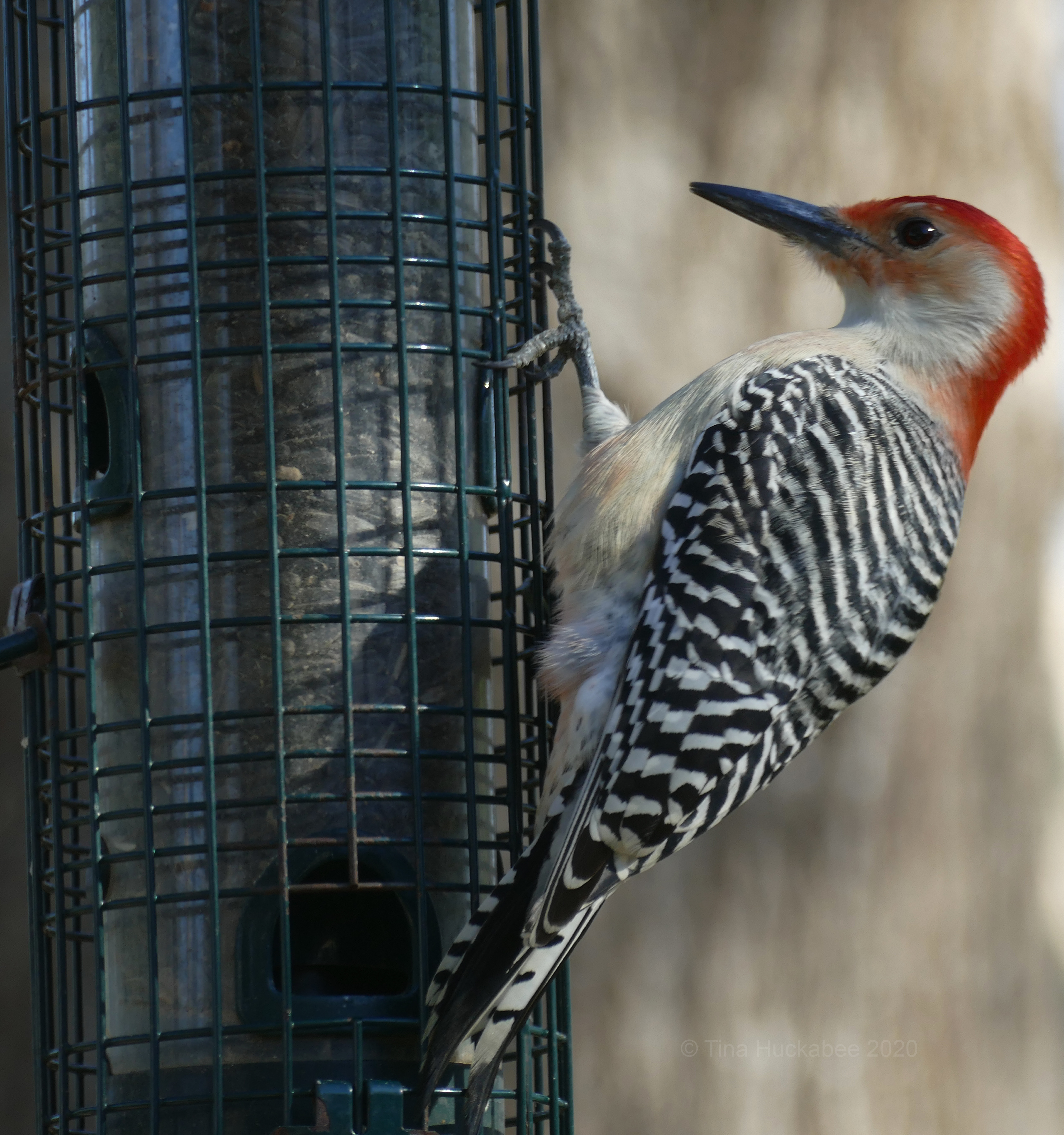
I typically see either the male or the female Red-bellied WoodpeckerMelanerpes carolinus, but I rarely see both partners on the same day.    A couple of weekends ago, that paradigm changed, the female visiting first, in the tree.

It’s not a classically well-framed shot, but I love the stink-eye that she looks like she’s giving me.   Red-bellied eye-rolling is about to commence!

After moving up along a main branch of my Red oak tree, she fluttered down to the black-oiled sunflower feeder for a quick snack.  The female Red-bellies have little-to-no blush of red on their bellies and their splash of head red starts toward the back of their heads, extending down the nape of their necks.


A short while later, a handsome woodpecker chap visited the same tree and feeder.

“Did ya get a good shot of my rosy, woodpeckier chest?”

With more red on his face, head, and belly, he’s a brightly patterned catch.  I assume these two comprise the same couple who raised two clutches of junior woodpeckers last year.  Red-bellied woodpeckers are monogamous and each share in nest building and chick raising.   The males choose the nesting site, starting the pecking work on the hole;  if the female accepts the offer and the site, she and her partner finish the construction together:  the couple that builds together, stays together!   Red-bellies are known to use the same tree for their nests, but build a new nesting hole for each new set of eggs.


At about the time that the Red-bellied couple visited, I enjoyed a similar sighting of both a female, then male Downy Woodpecker, Dryobates pubescens, again on the same day.   The female has no red on her cute little head, but she’s adorned in snazzy black and white on her head, wings and back, with a lovely white tummy.

The male Downy has a dab of red atop his head, accompanied by similar-to-his mate black and white patterned feathers.  Like the Red-bellies, the Downies are monogamous and both partners parent offspring.  Last spring I enjoyed the privilege of watching Daddy Downy teach his little one how to flit from tree-to-feeder, then back again.  Daddy birds rock!

I look forward to a new set of woodpecker kids in the neighborhood.  The Red-bellied Woodpeckers nested in my neighbor’s tree–the one that my SIL now owns–and I’m certain that my SIL will enjoy watching these charmers as they build the nesting hole(s) and once again, become parents.

I don’t know where the Downy Woodpeckers nest.  They fly in a northwesterly direction from my back garden, but I don’t know what tree, or trees, they’ve chosen to secure their little ones in past breeding seasons.

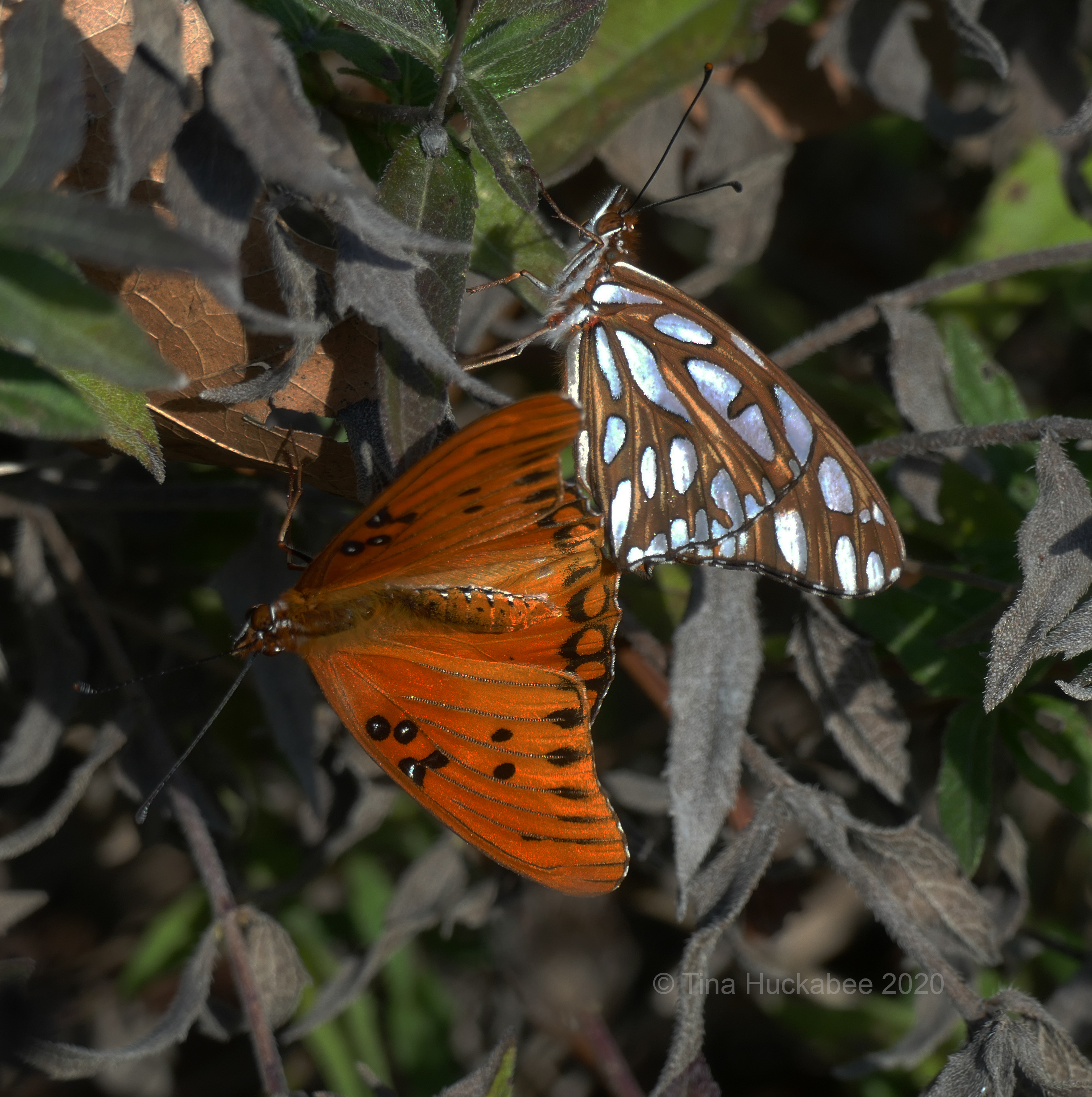
More pairing is underway with the mating of Gulf Fritillary butterfliesAgraulis vanillae.  Butterfly wooing is quieter than bird wooing and mostly involves undulating flight patterns between the partners, who then rest somewhere as they seal the deal.

Due to our mild winter, there are active butterflies and not only Gulf Fritillaries, though they’re clearly in breeding mode with egg laying to follow.  While I’d like to have some hard freezes (this month–NOT in March!), I haven’t at all objected to butterflies during this typically drab time of year.  There are still some flowers for nectaring and my passion vine–the nursery for Gulf Fritillary caterpillars–is green and able to provide sustenance for the larvae, given that a hard freeze hasn’t yet killed it to the ground.

The breeding season for birds, butterflies, bees–and heck, everything else–is about to begin.  It’s a time that gardeners can provide food, in the form of seeds and fruits, and with diverse choices of plants, as well as water and cover.  If your garden is welcoming to wildlife, you can sit back and observe remarkable events in your garden:   you’ll enjoy watching the wildlife lovers and their offspring and you’ll become a wildlife lover.

Please leave a link to your post when you comment here and happy wildlife gardening!

Knock Wood

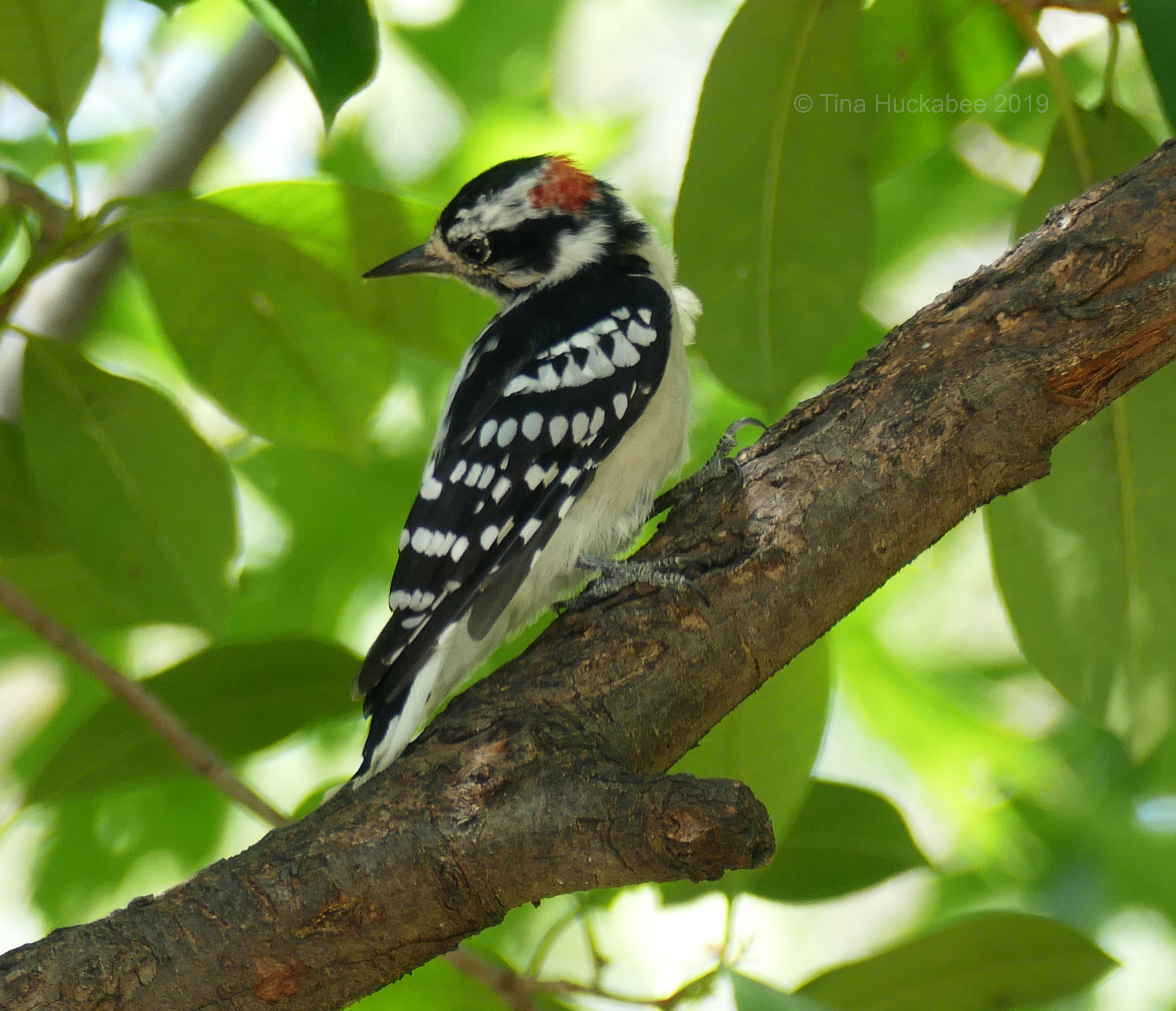
In a quiet part of an afternoon, I watched a male Downy WoodpeckerDryobates pubescens, as he rested in foliage shade.

I thought he might be waiting for the right time to pop down to the peanut feeder, which hangs just below where he perched.   But he didn’t want peanuts, he seemed content to sit, and like me, watch.

Until this past spring, I enjoyed only fleeting glimpses of downies in my garden.  Typically they’ve visited during winter months, in bare trees, and as pairs.  Always they were up high in those trees and constantly in motion, brief black and white visages until gone from my sight.  In April (or so) I placed a peanut feeder in the garden and since then, the downies are regular visitors, though summer saw a downturn in downy activity.

Mr Downy’s red cap is a head turner that will surely attract a mate, if it hasn’t already.

I wonder if this is Daddy Downy who visited regularly last spring with his mate and offspring? Or perhaps this is the offspring?  Though I originally thought baby downy was female, I could be wrong.  Downies know better about these things than birding gardeners.

Birds are less active in my garden during the summer months.  The resident birds are around, feeding, bathing, and harassing one another, but mostly done with chick-rearing and not yet interested in mate-finding. The migratory birds are long gone north for nesting adventures.  Hummers hunt nectar from the plants and disappear in flashes.

I’m tickled that a new birding season has already begun.  Migrating birds from breeding grounds in far North America are appearing in my garden as they make their way to wintering homes in Mexico, and Central and South America.  The resident birds and winter visitors will settle in for the next breeding season, preening new plumage and pairing for new progeny.  With good luck–and plenty of peanuts, black-oiled sunflowers, and food from native plants–this backyard birder will relish the autumn, winter, and spring bird bonanza.