Poop and Owl(s)

Recently, I walked along to path to my beehive, Bo-Peep, to check on the consumption of sugar water after a cold spell. As I was walking back along the same path, realized that I’d stepped in dog poop.

Wait, I don’t have a dog! What I’d stepped in was not the poop of a dog but scat from a fox! I know there are foxes in our neighborhood because I saw a pair not long ago, early in the morning. I’m also fairly sure I know where they live and it’s not far. These neighborhood foxes are most likely Gray Foxes, Urocyon cinereoargenteus. I love the fact that there are foxes in our midst, shy and elusive, but very much a part of the wildlife tapestry and great hunters of rodents. That being said, foxes are omnivores and along with rodents, will eat bird eggs and baby birds, as well as many other things. But in an urban environment, they have a place and are adaptable and comfortable even if we rarely encounter them.

Last year, a pair of mated Eastern Screech Owls, Megascops asio, wooed one another and settled into our nest box, the female laying four eggs. At that time, our owl nest box camera was functional (it has since given up the ghost), but I loved watching mama in the box, shifting and snuggling over the eggs, and dad bringing her treats of rats in the evening. One morning in early March, I logged on, got the inside view and there was nothing in the box–no eggs, no mama owl. I found broken egg shells at the base of the tree and realized that the nest had been raided, I assumed by a raccoon, as they’re very common in our neighborhood. Like foxes, they’re omnivores consume a wide variety food.

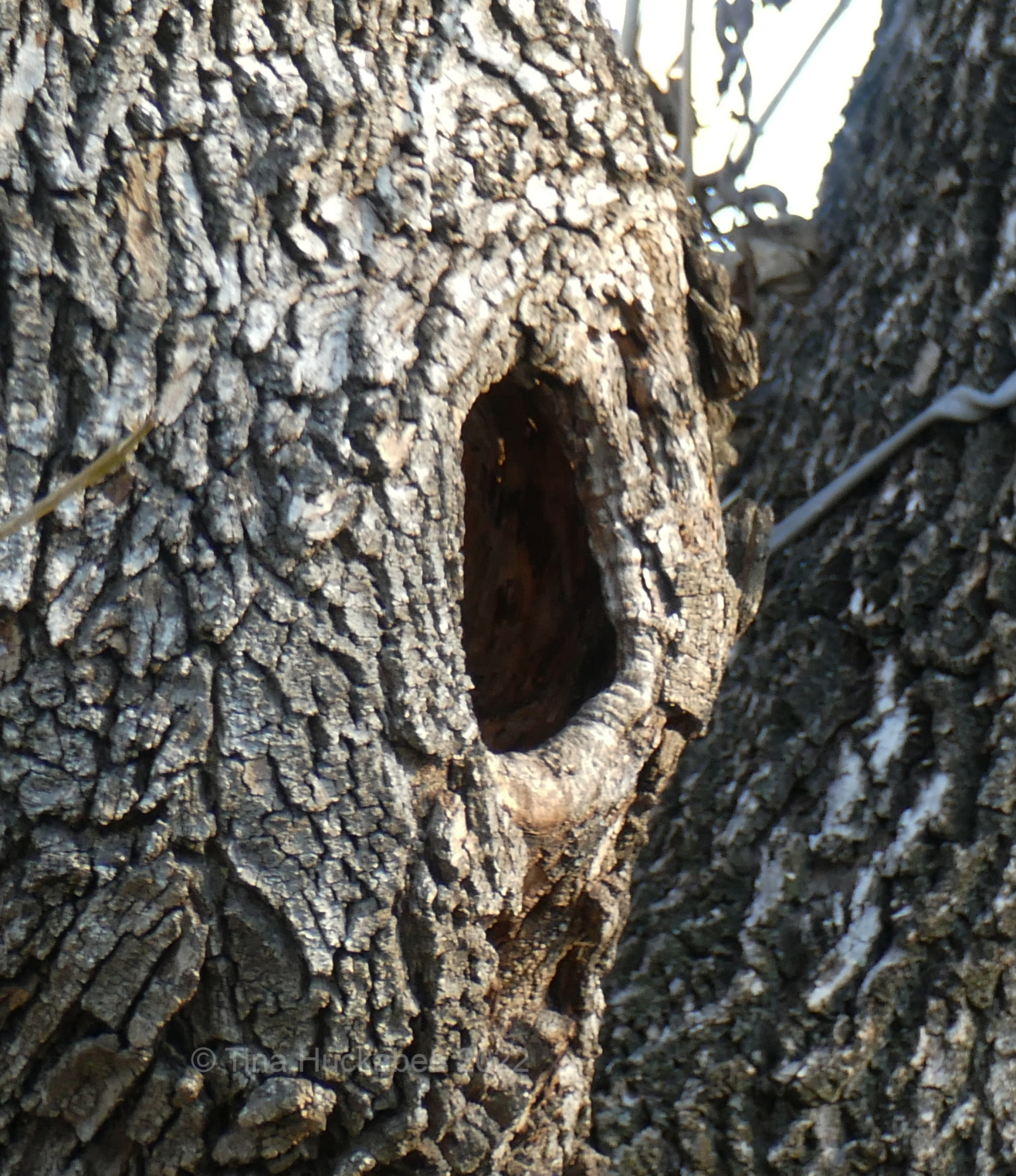
During that nesting time last year, dad would rest in the hole of my back neighbor’s dead Arizona Ash tree. The hole has a clear view of the nest box and isn’t far away. In the last two weeks, I’ve spied an owl (the same male?) in that hole almost every day. The Blue Jays know he’s there–that’s how I found him–following their warning calls as they harass him from time-to-time. Without the help of the caterwauling jays, I would have never known he was there, he’s so well camouflaged.

I know when he’s sleeping inside the hole or perhaps not there at all, when I can see the deep, dark of the hole. These two photos of the same hole were taken on different days.
This morning, at about 7am, I was hanging up the bird feeders and setting out unshelled peanuts along my back fence, when I saw an owl perched in a different, smaller tree–a Crape Myrtle–belonging to the same back neighbor. It was light, just barely, and it’s not typical to see owls out in the open after daybreak. The owl was still and facing my sister-in-law’s back garden. Just then, I heard the call of a Cooper’s Hawk, Accipiter cooperii, and observed two in her large backyard tree One of the hawks was enjoying an early breakfast.

The smaller male perched nearby while the female ate. They were closer together when I initially saw them and the dining hawk definitely bigger, which indicates that she’s the female.

It’s not a great photo, but shows both of these beauties. Did the male bring its prey to the female as a love offering? I mean, it is almost Valentine’s Day!

I was surprised at the early morning catch by the hawks, I usually see them hunting later. I now suspect that the little owl in the myrtle was caught in the open and was remaining still, as the hawks are a clear threat to her.

The Blue Jays arrived for their morning peanuts, discovered the owl in the myrtle and in a flash (that I missed, as I was glancing at the hawks) the owl flew to the nest box, trailing yelling jays after her. Just after that bit of bird drama, I glanced at the tree hole, saw an owl face there and snapped the photo shown the beginning of this post. I now know that there is a pair of nesting Eastern Screech owls in my back garden: dad is in the tree hole, mom is in the box. This pair is quiet and shy–just like last year’s owls. Are the the same pair? Probably, but only they know for sure. And really, isn’t that all that matters?

So why did I start this story with the fox scat? Last March, when the screech owl nest was destroyed, I assumed it was a raccoon that did the deed. For some time now I’ve wondered if, instead of a raccoon being the predator, that it was a fox that snatched the eggs. Foxes climb well, I know they’re around and that they’ve been in the back garden. I didn’t see any raccoons in or around my garden in this past year (though I’m sure there were visits from some) and I’ve spied the foxes several times. Additionally, in the past, but mostly during summer, I’ve seen snakes in the garden and it’s possible it was a snake which raided the box. The truth is that I’ll never know for sure who ended the owl couple’s chance at a family that time and whatever the predator, it has to eat too and likely had offspring to feed. After all, owls are predators and eat plenty of smaller birds.

Now that I’m aware that there are two owls, probably a mated pair and likely the same couple as last year, I hope to be proactive in helping them protect their nest box. There are guards that can make it difficult for predators to reach the nest and I’ll figure out something along that line. If past experience holds true, the owls will have eggs by the end of this month, definitely by March.

As for the Cooper’s Hawks, I will keep an eye out for their nesting digs. They’re big birds and a nest is likely placed in a large, evergreen oak tree.

Nesting season 2022 is underway!

Rest up, Dad. You’ll soon (hopefully!) have other beaks to feed!

Dinner

Sitting in my new, husband-made Adirondack chairs, I mulled needed changes to the back garden. As I gazed outward toward the targeted area, considering what needs to go, what needs to stay, and what replacements are best, or desired, I glanced to my left, up and over my privacy fence, to my back neighbor’s mostly dead Arizona Ash. The poor ash might be dead, but it regularly hosts plenty of life, including this gorgeous, immature Cooper’s Hawk, Accipiter cooperii, who was enjoying dinner.

(Just a warning: there’s a slightly gross photo coming, not too bad, but if you’re squeamish, you might want to move on to some other reading.)

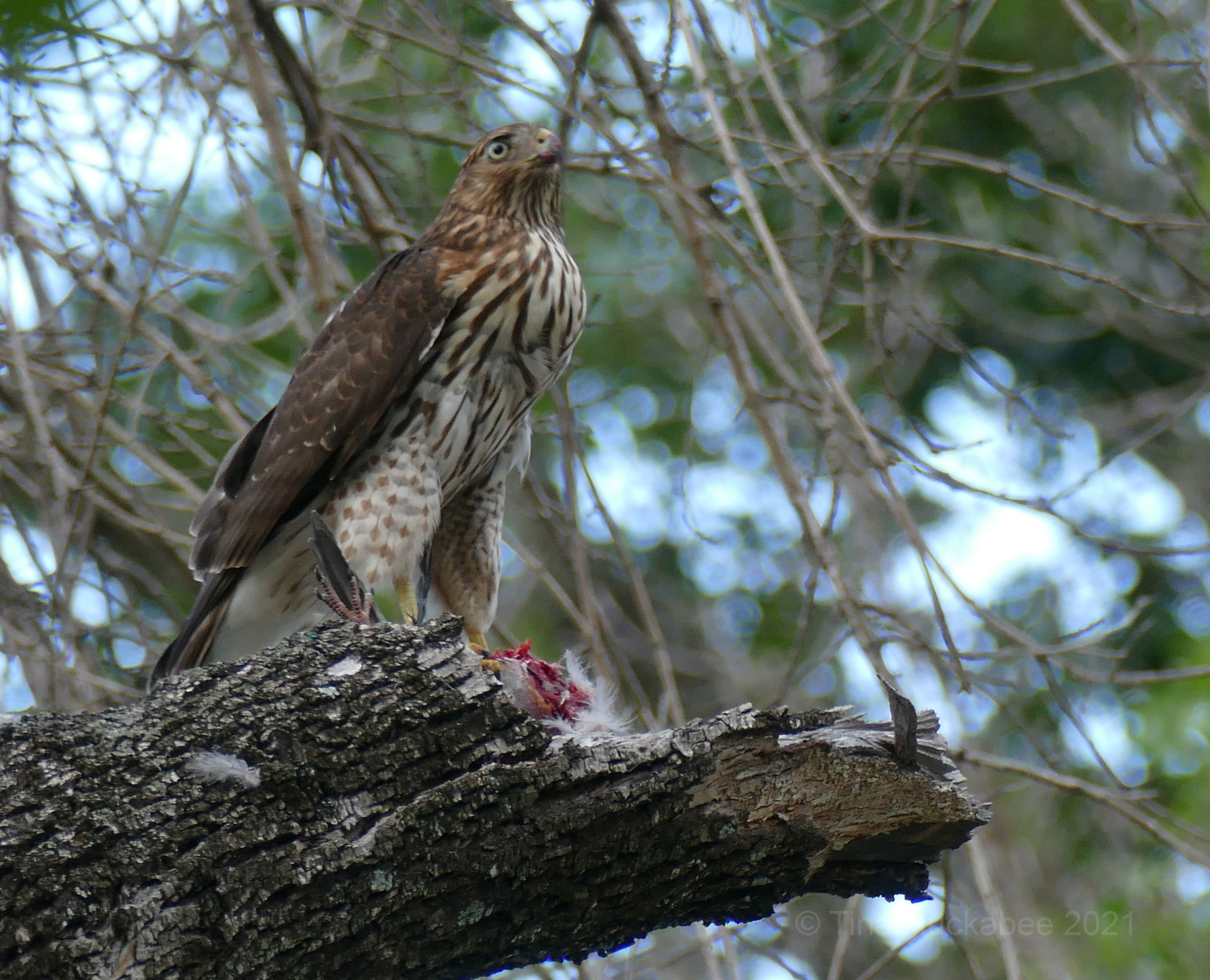
I watched this magnificent bird for about an hour, by far the longest period of time I’ve ever observed a hawk. I’ve seen this hawk plenty of times, swooping through the trees and gliding over the neighborhood in search of prey, but it’s a rare treat to watch a raptor for such a long time, relatively up close and personal, and not startle it away. A few years ago–in the Before Times–I spent some time observing a hawk in Golden Gate Park in San Francisco, dining on some of SF’s finest. That was bird nerd entertainment, but this observation of the Cooper’s Hawk’s meal time, comfortably in my own garden, was fascinating and revealing. As the hawk pulled and stretched its meal, I could hear the slight snap of skin and sinew. As it plucked its prey, feathers, big and small, sleek and fluffy, floated down, probably settling in the neighbor’s pool. I imagine those feathers are still floating. During the meal, some small, downy feathers attached to the hawk’s sharp beak–as in the first photo. The hawk didn’t mind the bit of fluff as it ate.

The hawk was focused on this meal, hungry no doubt. I’m sure its hunting isn’t always successful; I’ve seen it swoop through the neighborhood trees, scattering birds, but flying off empty-taloned. This time, the hawk was victorious; the poor White-winged dove a victim of the hawk’s hunger and hunting prowess.

At one point, something startled the hawk and it mantled over the meal, keeping a keen eye out for someone intent on stealing. I didn’t see anything that would threaten dinner, and within a minute or so, Hawk was back at it: pulling, eating. Later, a group of noisy Blue Jays voiced disapproval of the hawk’s activity, but none ventured too close and kept a respectful distance while Hawk continued its meal, undisturbed and unimpressed with the Jays’ cawing. The Jays flew off in a huff.

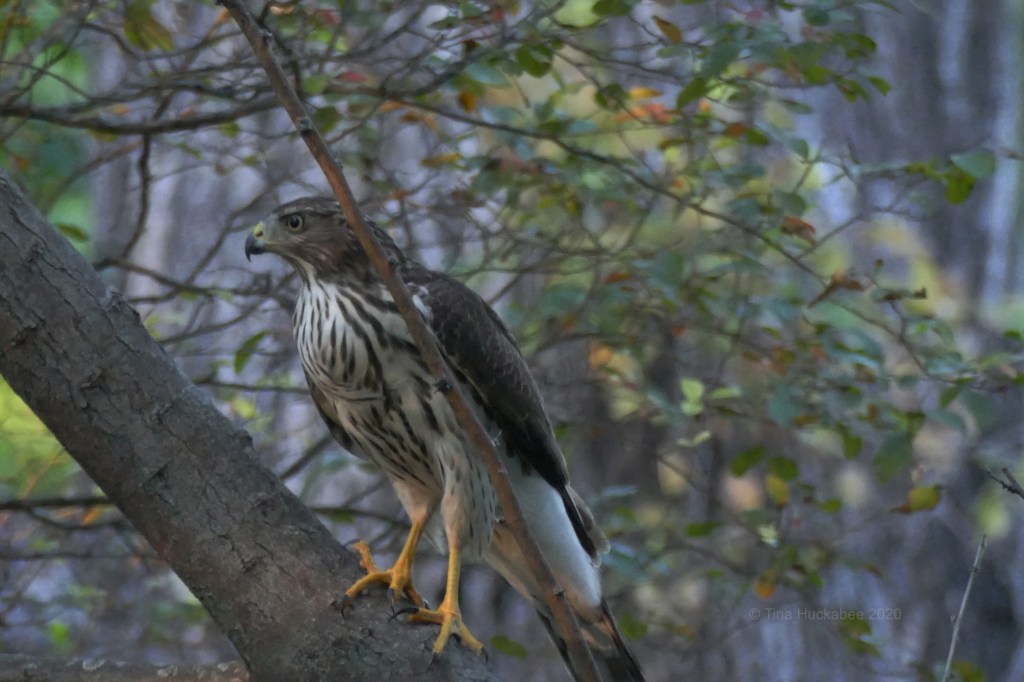
Such a beautiful hawk. As it matures, the streaking on the chest and tummy will become more of a red and white checker-board pattern. Its wings and back feathers will turn slate grey. The hawk’s eye color will morph from its current golden to burnt orange. Cooper’s Hawks dine mainly on birds, but I’ve seen one with a squirrel, and I’m sure when hapless rat comes within catching range, they eat them, too. Raptors eat what they can catch. Cooper’s Hawks are common in urban settings and have adapted well thanks to the number of people who feed birds; there are plenty of birds to pick from, especially fat doves!

While I watched Hawk, someone else was at dinner, too. This juvenile or female Black-chinned Hummingbird, Archilochus alexandri worked the flowers of nearby Turks’ cap. As it’s early October, most of the males have migrated, but I’m still enjoying the zooming, chirping, and chasing of the females and juveniles. They’ll be gone soon too, headed south to Mexico and Central America.

Just as I acknowledged my own rumbly in my tumbly, being ready for dinner, Hawk flew off, the remains of his catch firmly in talon, ready to settle in for the evening with snack for later.

Out For Dinner

We were in the middle of an early dinner, sitting at the kitchen table observing the late day sunshine stream through part of the back garden. A movement caught my eye and I saw a hawk land in the neighbor’s Crape Myrtle tree. The small tree’s spidery branches, jade green foliage, and lavender blooms reach up and over the privacy fence and peek into my garden, and that evening, supported a Cooper’s Hawk, Accipiter cooperii, as it perched and scanned the landscape for a bird meal. The hawk sat for a minute or two, enough time for me to drop my fork and grab the camera. I had a fairly clear view of the big bird through the window and didn’t want to spook the hawk by going outside, so a through-the-window photo was required! The hawk didn’t sit still though, shifting its position and looking this way and that way, so a front-on photo was impossible. But I like that this shot caught its head, visually framed between two intersecting limbs.

Additionally, as it perched in this spot, the rays of the waning sun showcased the hawk’s beautiful markings. This character is a juvenile; its eyes are golden, rather than the deep red-orange of an adult bird.

The hawk’s juvenile inexperience was also evident in its behavior. Looking for who-knows-what, after a minute or so in the myrtle, it flew to the open space beneath my large red oak tree (where Woody the beehive sits) and landed on the ground. It circled, wings out, then took flight toward the house, immediately banking right and then back toward the myrtle, landing instead in my Retama tree, Parkinsonia aculeata. This tree is about 10 feet to the right of the myrtle. I suppose the hawk wanted a different look-see around the garden; after all, the birds might be easier to spot from a different angle. Because I didn’t have a good view of the hawk’s newly chosen perch, I belted to the back of my house, taking this photo through my bedroom window.

This shot, focusing on a different part of the garden, is darker. There are no direct rays of the setting sun brightening the tree’s foliage or bird’s plumage.

My year-round, resident birds–Blue Jays, Cardinals, Chickadees, Titmice, Wrens, White-winged doves, and House Finches are less active now and whatever feeder activity they engage in is usually completed earlier than when this hawk showed up for dinner. I’m guessing it was hungry and is still refining its potentially formidable hunting skills, but doesn’t always meet with success. Cooper’s hawks mainly hunt birds and while I hate to see songbirds become meals, that’s the way of the natural world; that said, my neighborhood hawks are welcome to the abundant doves and seasonal starlings. I’ve been hearing lots of Blue Jay alarm calls recently and glimpse hawk action several times a week, either with the sudden scattering of multiple potential prey birds or with a large shadow through the trees.

As autumn ushers in shorter days and eventual cold and foliage drop, (not necessarily in that order), it will become easier to observe the various predators who make their homes near mine. I’ve provided a garden which both nurtures and protects prey, while tolerating predators, allowing a full circle of wild life–Bringing Nature Home. Rather than swaths of sterile turf and the non-nonnative plants garden aesthetic of the past, I grow a garden which replicates and reflects nature, supports life, and is found directly outside our windows and doors.

For some instructive reading about reclaiming nature in your own space, check out the book, Bringing Nature Home, by University of Delaware’s Professor Doug Tallamy, and his website, highlighted above.

What wild things have you observed in your garden? I hope there are plenty of wild stories to share. As well, I’m linking with Anna of Flutter and Hum for Wednesday Vignette. Happy wildlife gardening!