Blue Bees are Back Again!

As nature does when days grow longer and temperatures warmer, spring brings tender baby leaves which soon grow big and plump buds with unfolding petals. Wildlife is energized and preoccupied with family responsibilities, and insects emerge from dormancy, also preparing for their next generation.

Blue Orchard bees, Osmia lignaria, have materialized in my garden this past week. They are blue, buzzing, and beautiful.
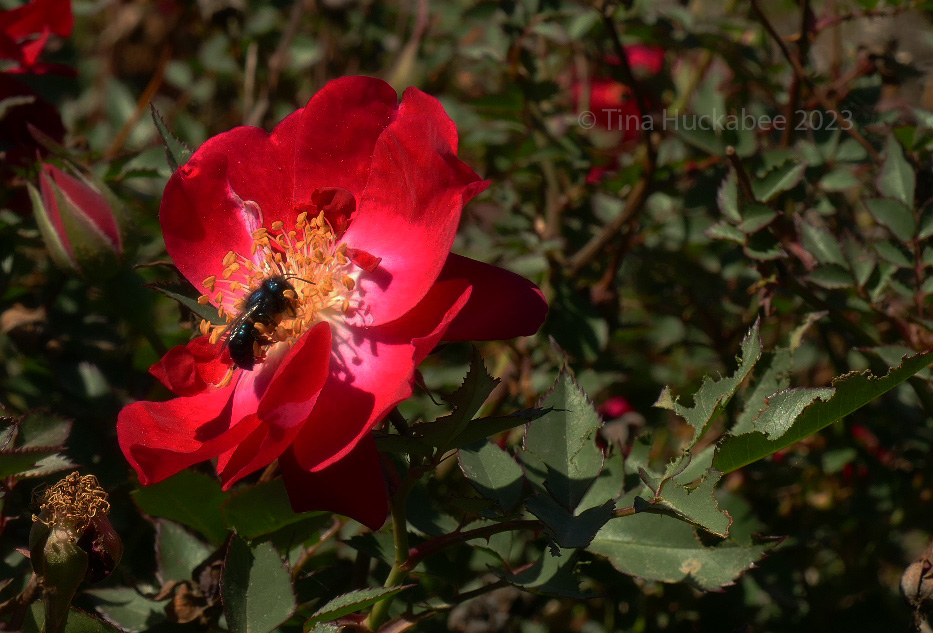
Having a sip or collecting for a nest, this Blue Orchard bee worked the flowers of Martha Gonzales rose.

The adult Blue bees flying around now are the eggs laid and hatched a year ago. These are solitary bees and unlike honeybees, not part of a hive. Females lay their eggs in holes of wood or masonry and don’t have a crew of sisters to care for them. The adults prepare the nests by gathering a mix of pollen and nectar known as “bee bread” and then lay their eggs on that bread to nurture the larvae once hatched. Each egg is sequestered in its own room to grow and develop, each room separated by a mud-n-leaf matter wall. Female eggs are laid in the deep end of the hole, the male eggs toward the front of the hole.

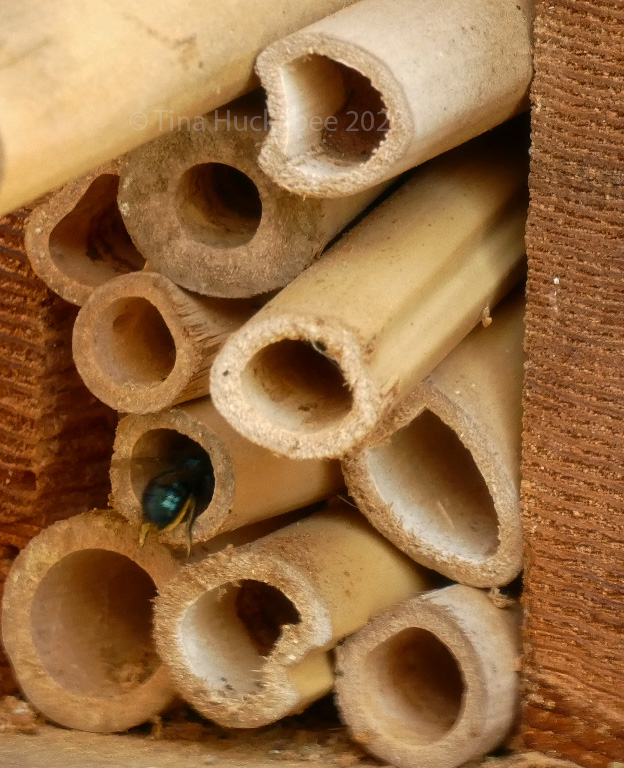
Mama bee working in a hole. She is near the front, completing the egg laying in that hole. She is likely to find or make another set of holes in which to repeat the process.

Another difference between honeybees and Blue bees (as well as other native bees) is that the Blue bees carry pollen on their abdomens, rather than on their leg pockets or corbiculae as honeybees do.
Pollen is visible on this bee’s belly. The pollen is the bit of yellow seen at the side of her abdomen.

It’s been a good spring for these bees, more activity than I recall from last year. I’ve seen many working around the Martha Gonzales roses, nibbling leaves to add to the nest sites.

These are such gorgeous bees! They’re fast flyers though and always on the move, which is challenging for clear photos. As I observe and attempt to photograph, these bees are blue flashes, sparkling in the sun.
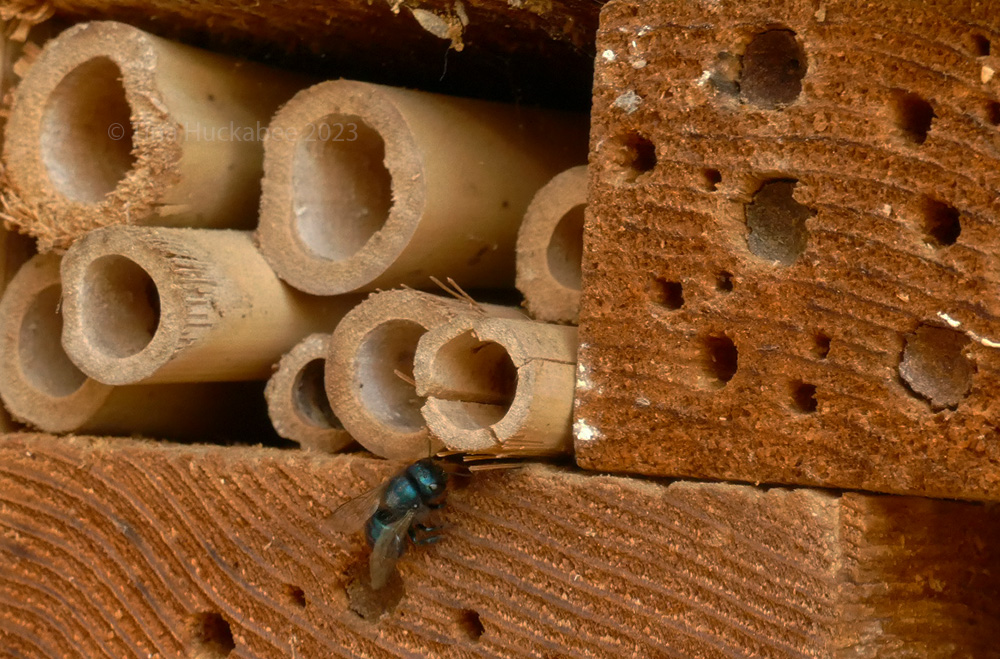
A lucky shot of this bee heading for its nesting hole.

Near this bee apartment, made from untreated wood with drilled holes and bamboo tubes, there is constant activity, flying in, zooming out, and dotting the wood with metallic color.
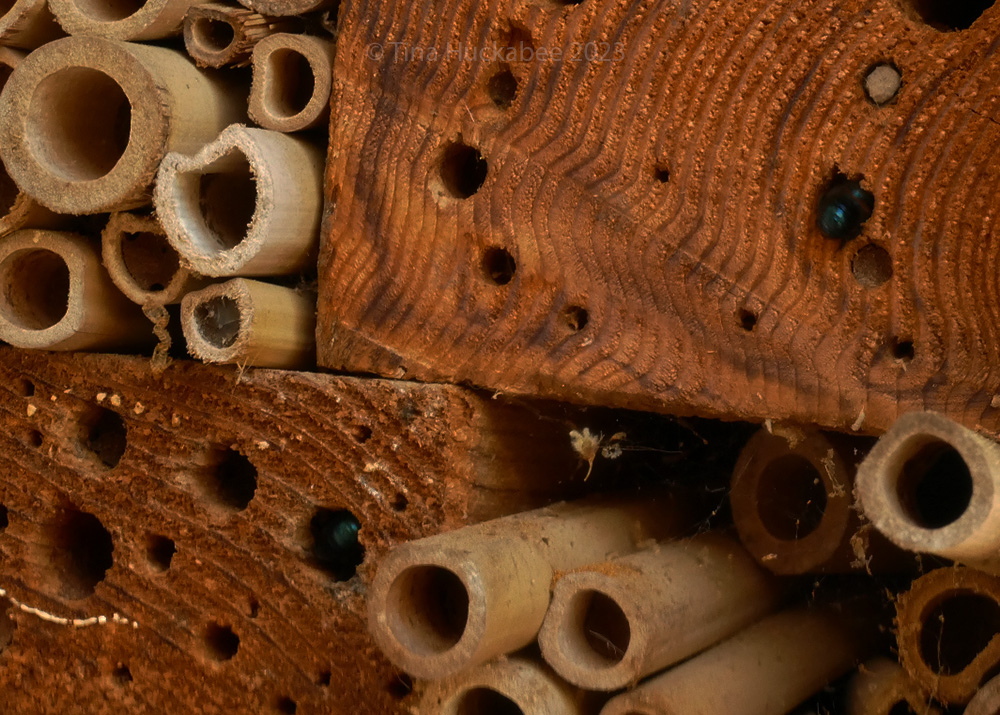
Blue Orchard bees are used in commercial farming because they’re excellent pollinators, besting the beloved honeybees. I’m happy that they found my garden and each early spring add to its life and activity–and beauty.

It’s easy to attract these and other wonderful native bees to your garden. Plant a variety of native flowers that bloom throughout the growing season; provide water, some shade, and dried wood, like large limbs from shrubs or trees. I don’t stack my wood piles, but lay the wood randomly (mostly in the back of my gardens) so that rats don’t have a safe place to set up their homes. Leave some area of your place on the Earth free of grass and garden so that there is available bare soil for ground nesters. Don’t use pesticides.

You can also build bee houses, too.

While bee houses or hotels aren’t as labor intensive as honeybee keeping, it’s still a good idea to clean out or replace (if using bamboo) the holes annually so that fungal and parasite problems are avoided. There are plenty of online resources and information for attracting native bees and giving them a safe place live out their lives. County Master Gardener groups, botanic gardens, and native plant groups are just some of the organizations promoting the inclusion of native bees in home gardens. Wherever you live, you can access information for your region on native bees and their habits. If you’re in Texas, check out these links to learn more and there’s lots more out there!

https://citybugs.tamu.edu/2018/06/11/caring-about-the-other-bees/

https://txmg.org/denton/north-texas-gardening/community-gardening/about-texas-native-bees/

https://biodiversity.utexas.edu/news/entry/leafcutter-bee-nest

https://biodiversity.utexas.edu/news/entry/a-proper-home

https://jmgkids.us/kids-zone/pollinator-hotel/

A Bracket of Beehives

A few years back, I visited the Oregon State University (OSU) Oak Creek Center for Urban Horticulture which is a 6.5 acres space dedicated to research involving sustainable agricultural practices.  OSU is well-know for its horticultural programs.

On a partly cloudy, cool and breezy autumn day, I wandered the fields of experimental and heirloom vegetables, lined with perennial gardens abloom with pollinator plants.  During the walk, I happened upon a charming apiary hosting an array of beehives.  Tucked in a shady grove, the apiary was adjacent to a lab located in an older home renovated appropriately for the work of horticulturists and entomologists.  The delightful OSU apiary showcases different types of bee homes and augments research about and demonstrations of commercial and home horticulture.

At the time, I wasn’t yet a backyard Bee Mama, but was definitely interested and learning about the buzzy beauties.  I took photos of the apiary, dutifully downloading them to my computer upon my return to Texas, fully intending a post about the apiary.  I focused on writing about other gardening subjects near and dear to me, though I certainly recall the apiary adventure and planned a post about the apiary.  Recently, with year-end/beginning-of-year photo file tidying, I was reminded that the ‘OSU apiary’ folder was awaiting its turn for a blog post with a round of accompanying photos.

On that lovely afternoon in Corvallis I meandered along a mulched pathway and viewed a variety of beehives which sat, perky and productive, in service to honeybees buzzing in and out and all around,  going about their important business.


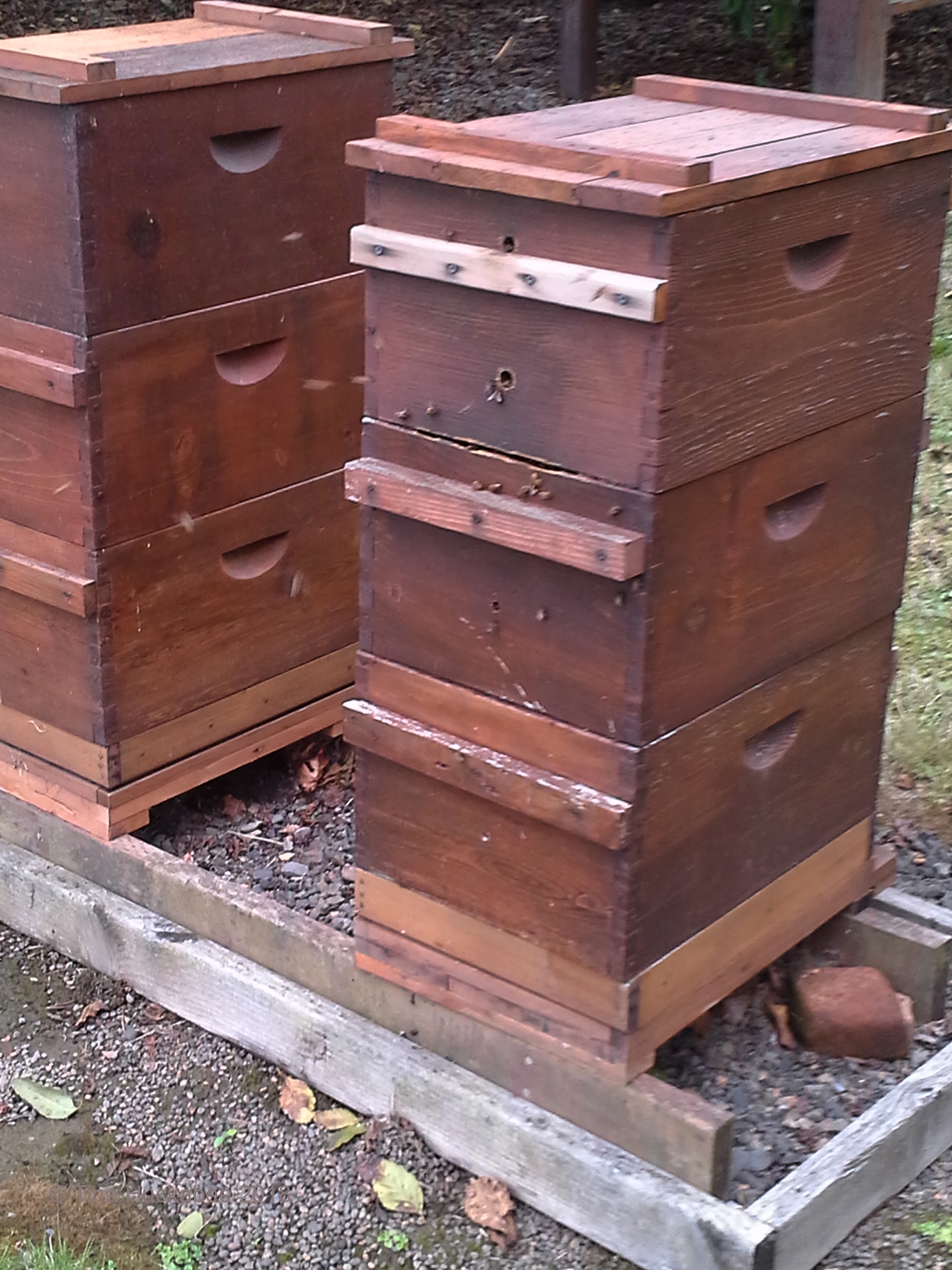
The classic Langstroth hive is a staple of any honeybee hive demonstration.  These two hives are each stacked with three brood boxes, or deeps.  This is where the queen hangs out, laying eggs and being taken care of by the worker bees and where the workers tend to the other tasks for hive integrity–making comb and honey and cleaning the hive.

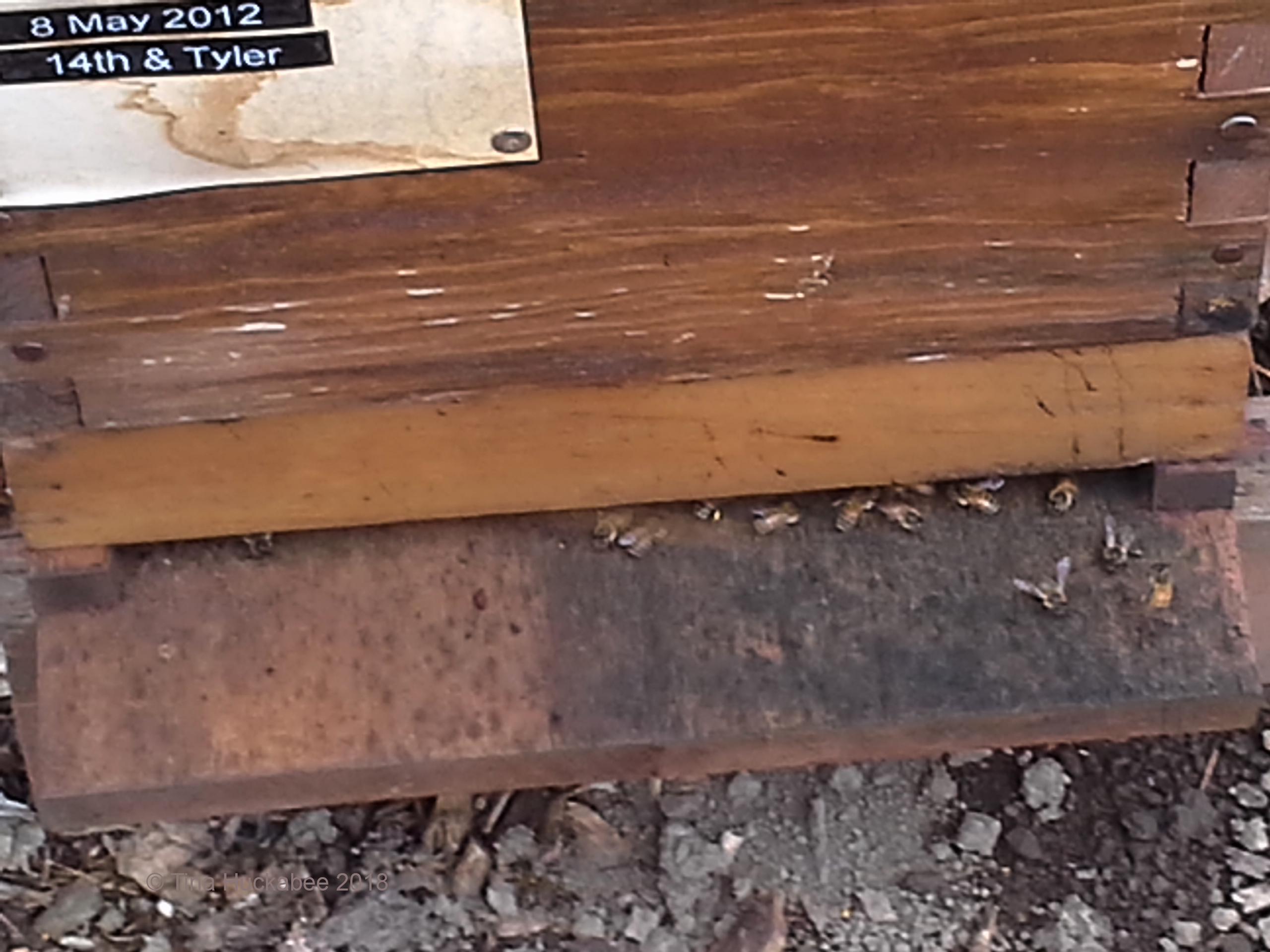
At the bottom of these hives, the entire length of the box is open about a half-inch tall for the bees’ entrances and exits.  This is called the bottom board.

I typically reduce the bottom board opening to my hives so that my bees don’t have to defend a large area;  I leave about 2-3 inches for their comings and goings, but I think the standard practice is demonstrated above–leaving the entire width open.


I like this hive!  Just in case you’ve just landed from outer space and you have no idea what these stacked boxes are for, there’s a  bee door ‘knocker’ of sorts which may give you a clue!  I’ve often seen honeybee hives painted white, but I prefer boxes of natural wood, or boxes painted in brighter colors, as well as bee boxes with painted decorations or decals.

You’ll notice that each of these boxes differ slightly in height.  The taller box is the brood box which houses the queen, larvae, workers, and lots of honeycomb.  The shorter boxes are called supers and contain honeycomb (and worker bees of course!), but no larvae.  Once a hive is robust, a beekeeper may place a super at the top of the hive so that the honey is more easily extracted without damaging the queen and larvae. For those supers where the keeper only wants honey for extraction, the queen is prevented from crawling into the shorter boxes by a mesh called a queen excluder.  The mesh is too small for the big-thoraxed queen to squeeze through, but worker bees are svelte enough to easily manuever as they go about their daily routines.  In the white Langstroth above, the strip of unpainted wood between the top and second-to-top box is probably the queen excluder. In some hive management techniques, beekeepers will rotate boxes, placing a super at the bottom of the hive; you can see that demonstrated in the above photo.

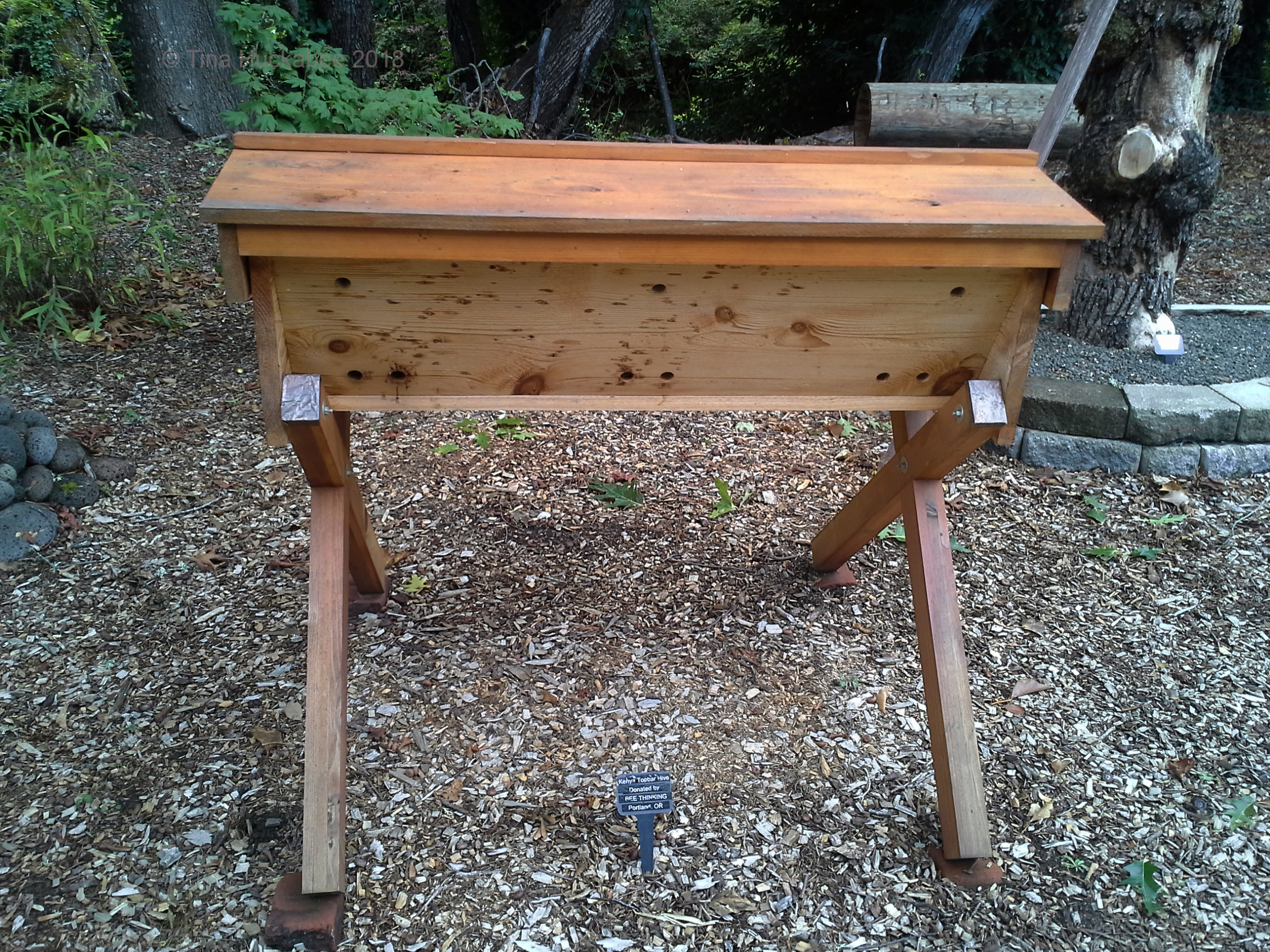
This hive is a Kenyan top bar hive.  It has only one chamber and no frames. Bees build the honeycomb downward from bars, top bars, which hang horizontally across the width of the box.  The bees enter and exit through holes drilled in the box,

..like so.


With honeybee hive displays, it’s always fun to see the innards of a hive. This one demonstrates the workings of a top bar hive.


I liked this one!  It was a replica of an ancient Greek hive, discovered in an archeological dig.  This pot was thrown by a local Corvallis potter; she threw the pot, carving an opening at the bottom for the bees. I think this would make a very hot hive in the Texas summer, but perhaps Oregon is cool enough for a ceramic hive to function.


Have an old commercial plant pot sitting around and don’t know what to do with it?  As I recall, this makeshift hive was just such a pot.  The beekeeper drilled holes for the bees and placed cut wood atop the pot.

It’s a bit slap-dash for my taste, but there were bees living in it, so I guess it works just fine for a hive.

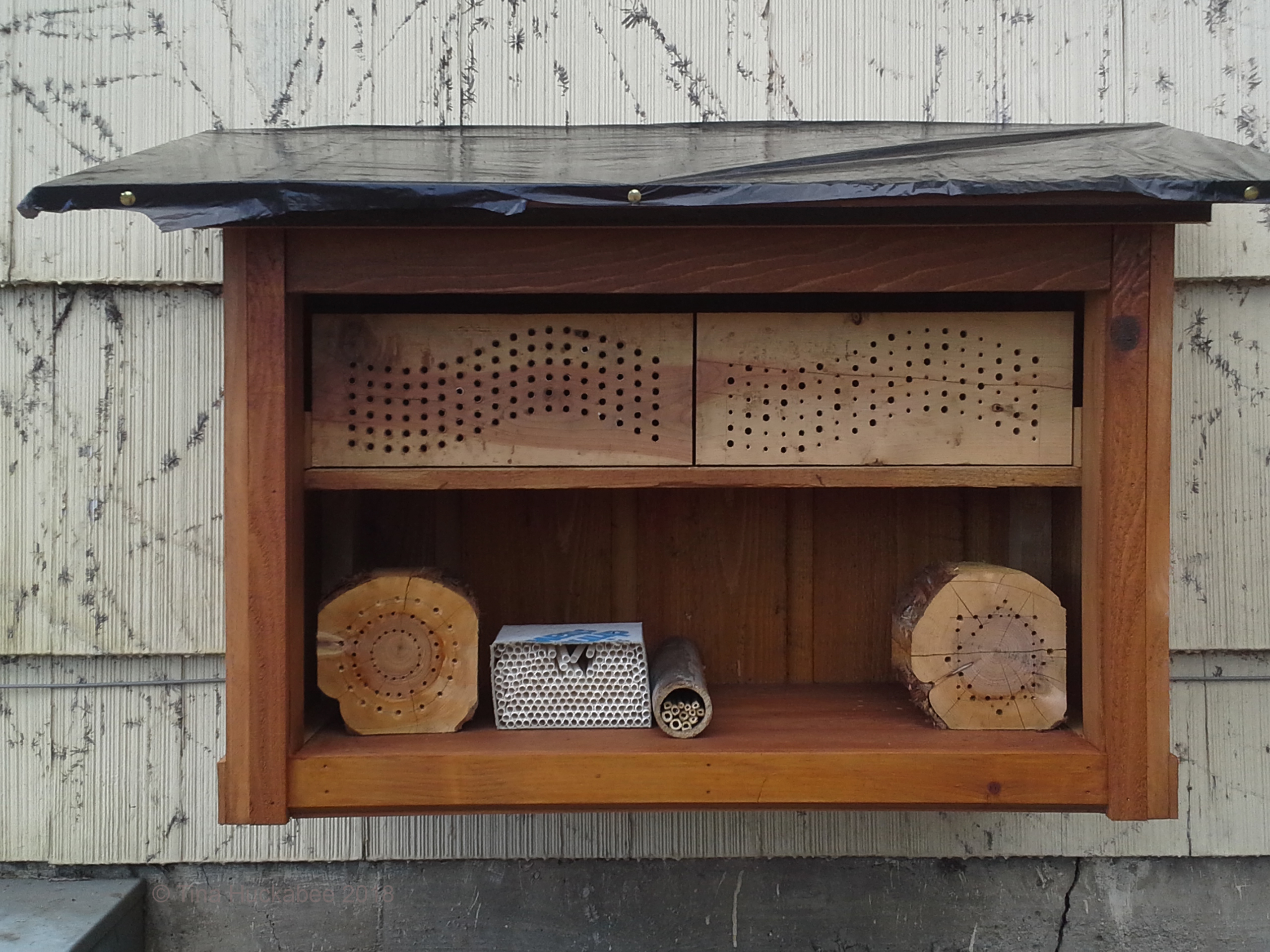
The apiary wasn’t just about honeybee hives, but also hosted examples of native bee/insect hotels.

Bee Daddy constructed our honeybee hives first, but we’ve since added Bee Daddy built bee/insect hotels for our native bees, which you can read about here.  If you want bees, but don’t have the time or interest in honeybee hives, check out the many designs for native insect hotels on the internet.  They’re easy to make, and it’s fascinating to observe and learn about native bees.  Native bees are even more threatened–and arguably more important for our ecosystems–than honeybees.  Leaving bare ground somewhere on your property, placing bee/insect hotels and cut limbs in the garden, refraining from pesticide use, and planting native and pollinating plants will help both the wild/native bees and the honeybees.

For an informative story about native/wild bees and their importance, check out this story from National Public Radio’s Weekend Edition Saturday: Honeybees Help Farmers, But They Don’t Help The Environment

I’ve been to Corvallis several times since the apiary visit, including for the complete solar eclipse in August 2016.  Unfortunately, I haven’t returned to the OSU apiary, but I imagine that it’s still there, housing happy honey and native bees, and serving as a fun and interesting educational exhibition for people.