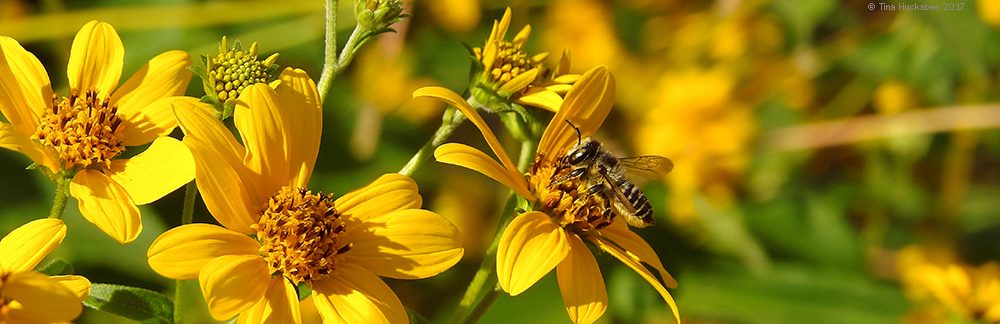
Each July, without fail, at least one of my clump of Crinum lilies blooms. These plants have never been prolific bloomers, though the flowers are some of the loveliest and most fragrant in my gardens. Years ago I dug up a handful of bulbs from my parents’ South Texas garden and mine have flourished, much as theirs did. I’ve since separated my bulbs and established new groups, creating clusters of strappy lily greenery throughout my back garden. I have no firm idea what the plant’s name is, though the flowers look most like an heirloom lily called Grandma’s Pink Lily.
For the most part, these plants serve as foliage accents in my gardens. I grow six individual clusters of Crinums: rich green foliage emerging from bulbs in the ground, arching gracefully, providing a cooling appearance in the hot summer months. Some receive little sunlight, others a bit more, but none grow in full sun as they fry in our July/August heat. I wish they were evergreen, but they give up the growing ghost at winter’s first hard freeze.

This Crinum group spans a small garden wedged between the path to the pond and the limestone patio.

It is also the most consistent bloomer of all my Crinum clusters. Always in July, this group sends up a fleshy stalk or two, which then sprouts five to ten blooms that open over the course of two to three weeks. It’s also the group which receives the most sunlight, at about half a day’s worth during the summer months.
This group has never produced a bloom, but I like the long, green straps near the bird bath along the path to the beehive.
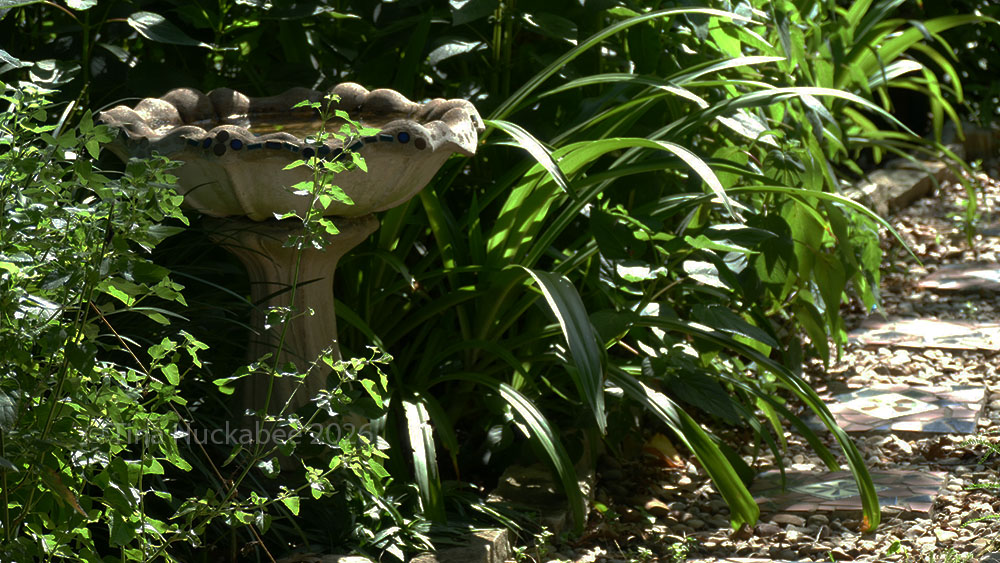
This bunch only receives early morning dappled light, but does occasionally flower.
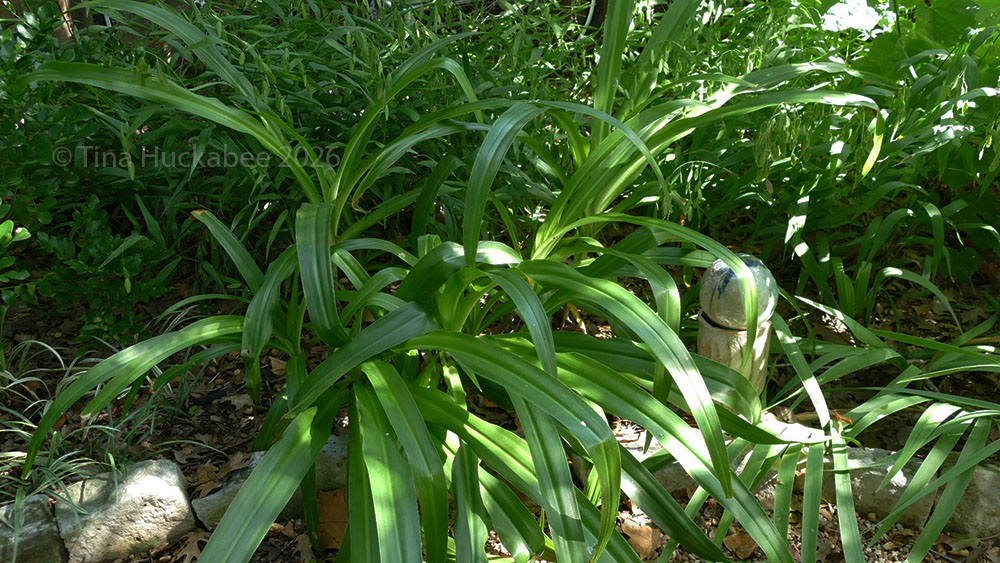
This Crinum crew has only been in place for about four years. I planted three bulbs as an accent partner to the Turk’s Cap behind them. This year, one stalk grew up and the pinks made their debut on the garden stage!
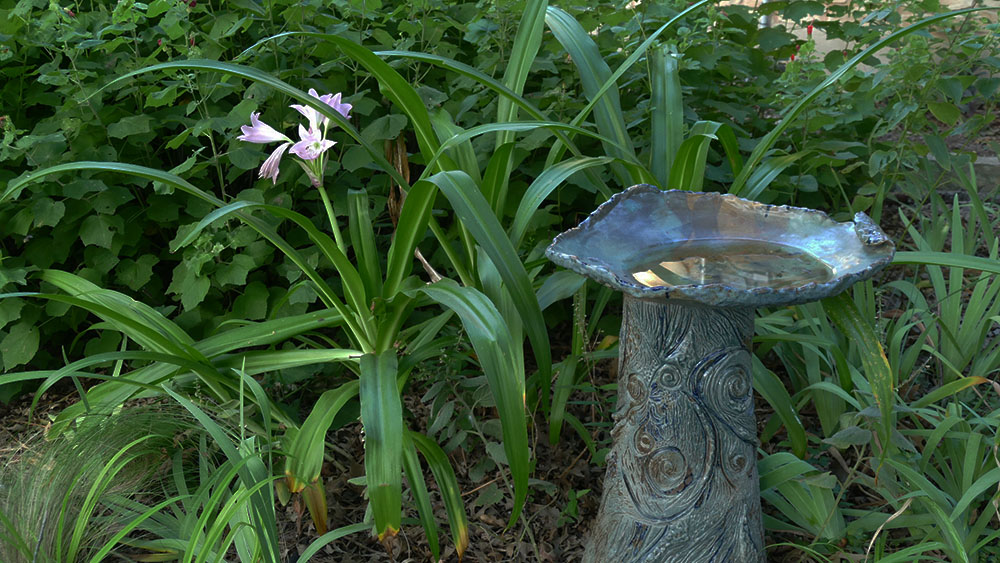
The large, sweet-pink flowers open in the evenings, remaining open for about two days.

I didn’t see any pollinators as I snapped shots, but in the past I’ve witnessed Horsefly-like Carpenter bees visiting the blooms. As well, I imagine that there are some night-time pollinators who partake from the pinky goodness.
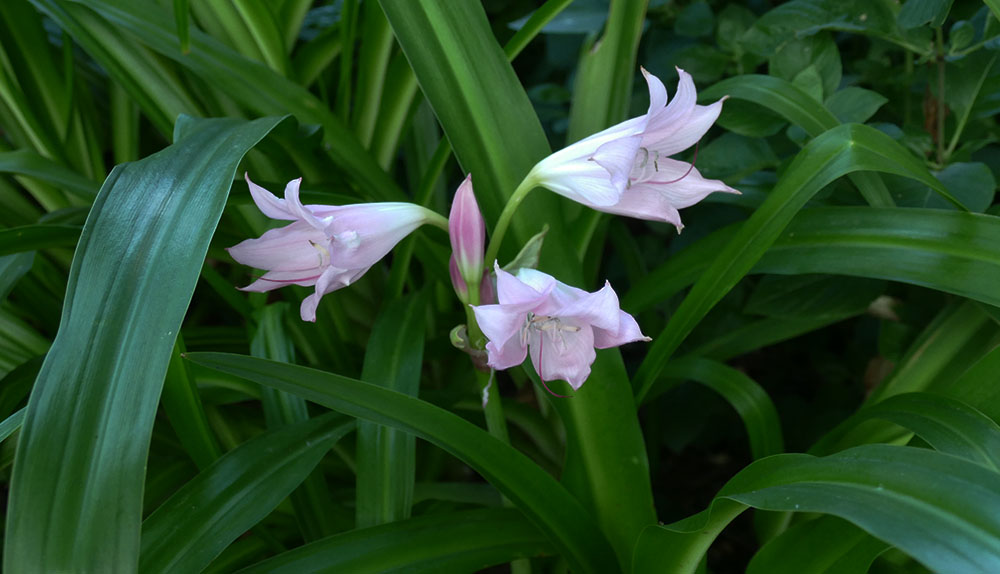
I like the foliage and am content with the fact that these aren’t great flower producers. But when flowers appear, I cheer and relish the summer gift of charming pink and gentle fragrance. Once the flowers are done, the straps remain, green and verdant, until a frost ends their year.

The Crinums’ flowers are done. I remember and appreciate, patiently awaiting another year to enjoy their presence.
 My Gardener Says...
They are beautiful flowers and grew well in Houston, although I did not grow them.
LikeLike
I can imagine that they like the East Texas humidity!
LikeLiked by 1 person
I turned to the Internet and gleaned the following: “The generic name Crinum comes from the Ancient Greek word krinon, which means ‘white lily’. The common name ‘lily’ was added because the flowers look like true lilies, even though the plant actually belongs to the amaryllis family (Amaryllidaceae) rather than the true lily family (Liliaceae).”
LikeLike
I knew crinums are part of the amaryllis family even though they’re called lilies. I have some other amaryllis from my mother’s garden which bloom in spring, although they didn’t this year. I wonder why?
LikeLike
And now you’ve reminded me of “The Flowers That Bloom in the Spring.”
LikeLiked by 1 person
Handsome foliage that reflects light, I imagine it adds a nice form to the garden. The flowers are sublime!
LikeLike
You’re right! I never quite put my finger on why the foliage is so attractive. The straps do reflect light, plus they’re a good, solid green. And the flowers…sublime is a good description.
LikeLiked by 1 person
It’s interesting that we have only one native Crinum species in Texas: C. americanum. Several gardening sites I glanced at said pretty colored ones are cultivars, or species from Africa, Asia, and other tropical areas. I wonder now if the red and white striped lilies I see in ditches and in vacant lots might be crinums: they sometimes seem to be tokens of abandoned homesteads. Yours are living the good life, that’s for sure! The combination of those delicately colored flowers and the strappy leaves is beautiful.
LikeLike
There are gobs of crinums and I think most bloom in spring or early summer. I wish I could remember my parents’ plants blooming, but I might not have visited in bloom time. It really was the foliage that I wanted. The flowers are an additional pow-wow!
LikeLiked by 1 person
The foliage is very attractive, even without the flowers. But I also like the soft pink of the lilies, an unusual color for these flowers, methinks.
This year, our neighborhood deer nibbled off all but two lily buds, giving them no chance to bloom. We were very disappointed.
LikeLike
Yes, that pink is such a pretty one! Soft, but rich. The fragrances is nice too, just very subtle.
Oh, I’m so sorry they nibbled your buds! It’s always a heartbreak when something interferes with the once-per-year growers. One has to be patient when planting…:)
LikeLiked by 1 person
Because the deer were eating everything we tried to grow, we finally fenced in our back yard, but there is no fence in front of the house, where they find plenty to eat. We like them, but wish they would be a little more selective and leave at least a few of the buds and blossoms. 🙂
LikeLiked by 1 person
Deer will do that, for sure! They are a mixed blessing: lovely, an important part of an ecosystem, but too munchie for most gardeners! I’m fortunate that in my part of Austin there are no deer, though they’re widespread in other areas.
Good luck in the future with your lilies!
LikeLike
Love those- and the leaves DO look cool in the heat of summer- my spider lily is similar to that! I was just given a giant pink crinum lily from a friend- you remind me I need to get it in the ground!
LikeLike
Your crinums are lovely. Mine perhaps get too much sun. They never look as attractive as yours.
LikeLike