If a tree falls on a pathway and no on is around to hear it, does it make a sound?
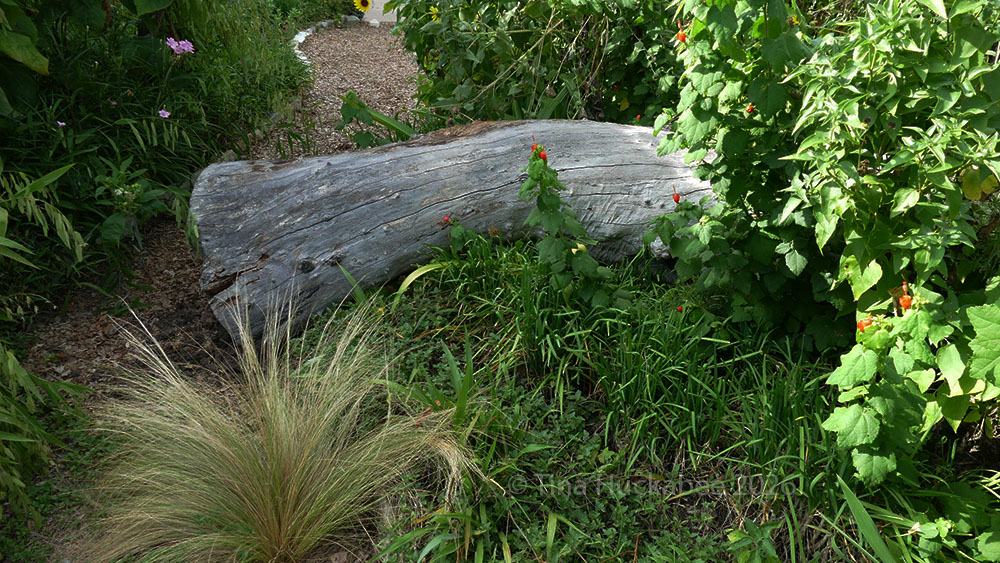
Well, I can’t answer that great philosophical query, as the tree trunk fell when I wasn’t on the pathway to my SIL’ s house. I was caring for her cat and plants while she traveled and I’d walked the pathway at about 3pm, then once again just after 7pm. The pathway between our homes was clear during my mid-afternoon jaunt, but blocked (or mostly so) by early evening. The fall and presumed BOOM occurred sometime late afternoon.
So why was this dead tree, or snag, allowed to stand, as it was so obviously no longer producing leaves? Dead trees are important part of a healthy and vital ecosystem, beyond the obvious foliage-producing life of a tree. According to forest ecologist Dr. Jerry Franklin, of the University of Washington, a living tree “has only partially fulfilled its potential ecological function” and trees’ death and decay are the second important act. Wildlife of all kinds use snags for protection, nesting, and food and for many years and generations. As fallen wood decays over time, it nourishes and enriches soil.
Once a snag falls, it is called a log.
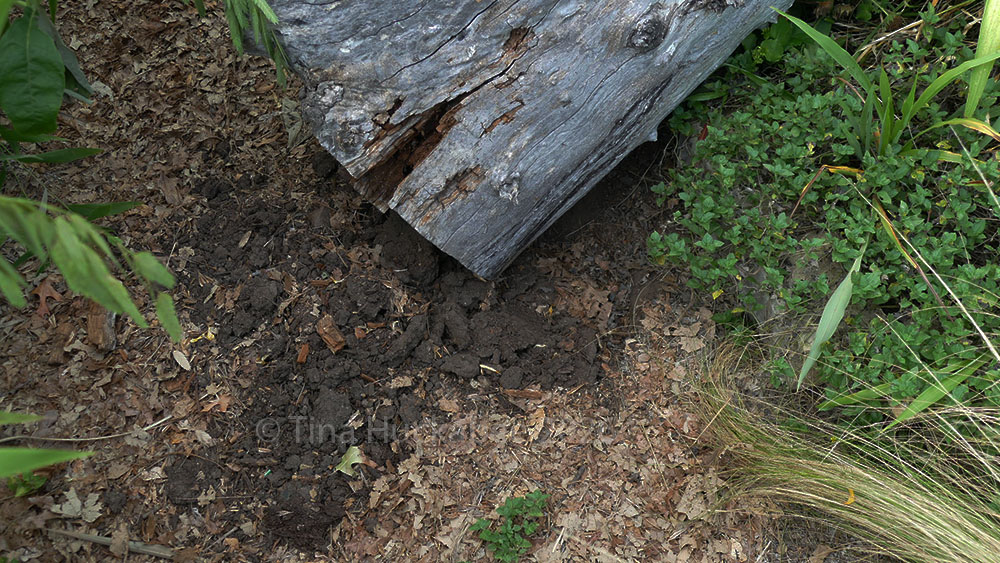
The photo doesn’t clearly show just how deeply the log sank into the soil as it hit the ground, but it’ll require a bit of smoothing out and possibly some additional soil.
The rust color of the trunk is where the large limb/trunk vacated the remains of the old and dead Arizona Ash. There’s plenty of rot in the state of that tree!

A wider view demonstrates where the tree sits, with SIL’s property to the left, ours to the right.
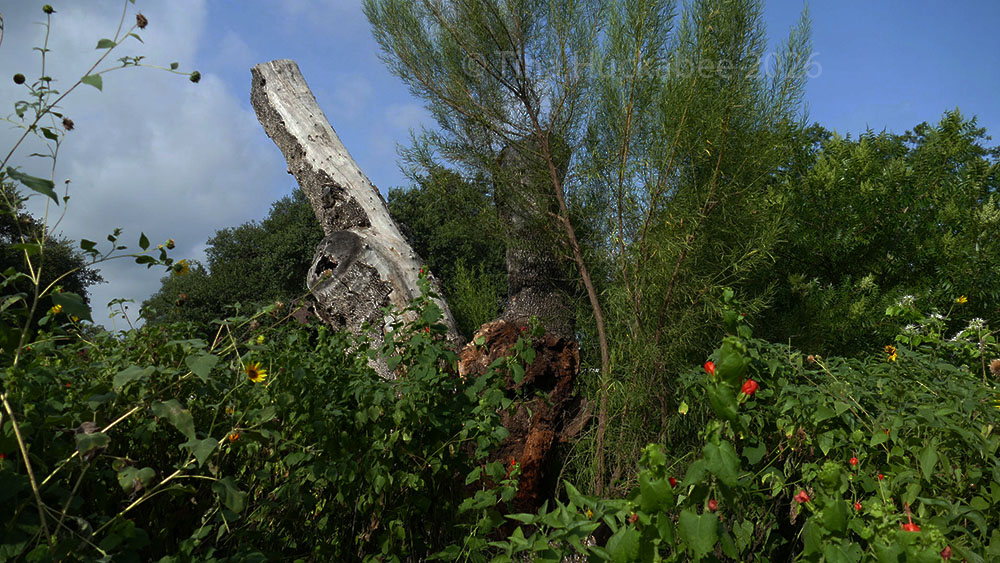
From my garden, the Poverty Weed, Baccharis neglecta, acts as a screen to the remaining two snags.

The Weed planted itself a couple of years ago and I’ve become quite fond of it. This view is from the center of my front garden, looking toward my SIL’s garden.
The downed log is a sizeable chunk of wood!
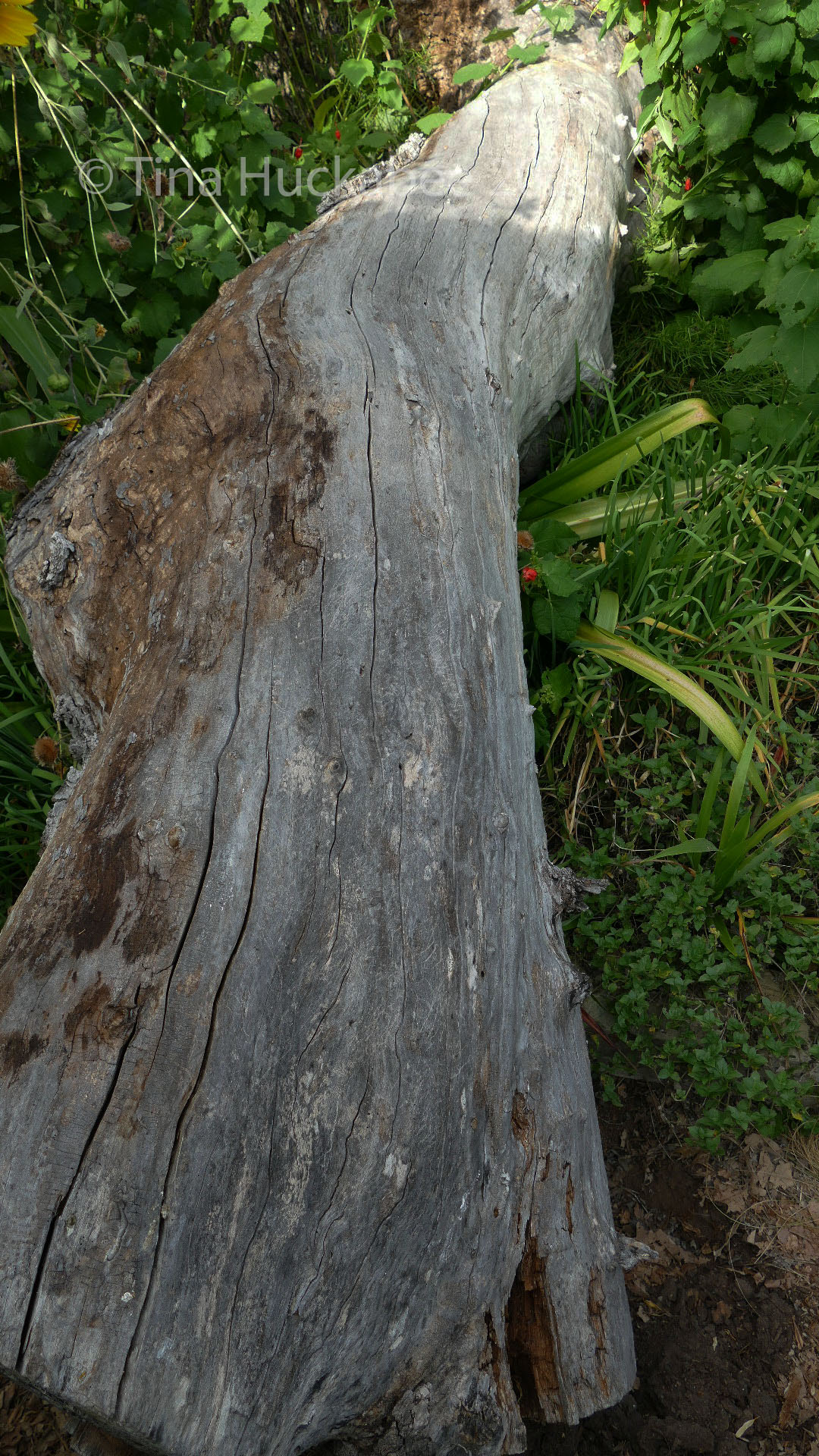
SIL will hire the arborist that we’ve both worked with to chain saw this log into pieces. Depending upon how big and heavy those slices are, I hope to “snag” a few of them to place in my gardens, though whether I can lift and move them is a whole other issue! I utilize downed limbs and decaying wood in my own gardens to serve as homes for critters and to enrich the soil. I’m certain that SIL will also want to do the same in her garden with the remains of her tree. Our beetles, native bees, birds and other critters will appreciate their new digs and food sources, and the soil where the log pieces will sit will improve as the wood decays.
My SIL and I clearly don’t live in a forested area where trees fall regularly and because we live in an urban environment, we are cognizant of the dangers of falling limbs and trunks to ourselves, our visitors, and our properties. The tree has been monitored by an arborist for several years and all of the upper canopy limbs pruned away as they became potential problems. Only the substantial trunk and remaining three (now two) large partial limbs remain. Resident owls and hawks have used the snag to perch, wood peckers have built nests, and many other birds regularly perch for safety and hunt insects in this snag. An even greater variety of insects, beetles, native bees, and who know what other critters have found safe havens in this mass of wood.
A completed woodpecker hole (and one that was started, but not finished), now lie near the ground, but once provided for Red-bellied Woodpeckers and their chicks.

Other holes were created by insects for their progeny.
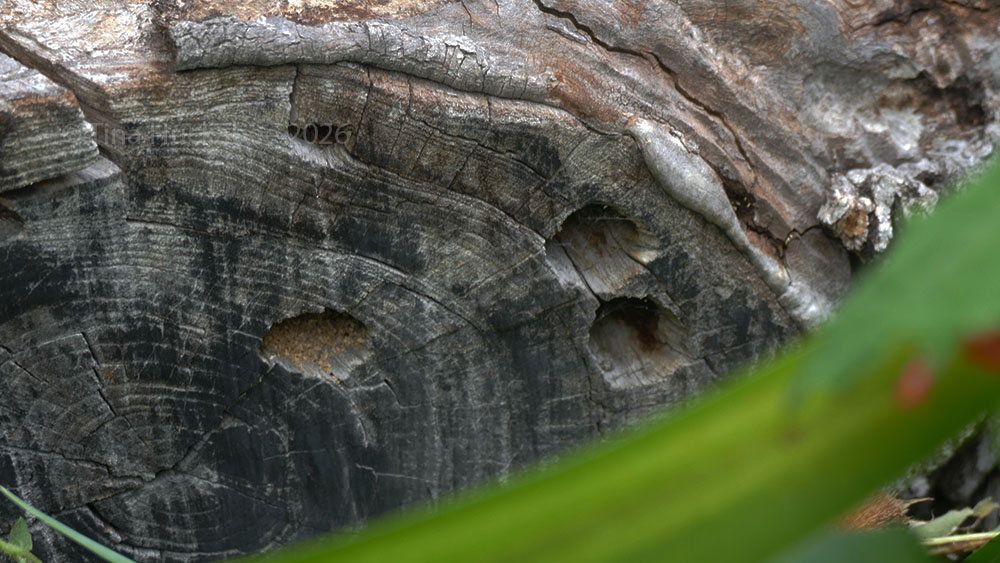
I suspect that our wet spring and summer may have hastened internal rot and caused this one side of the trunk with limb to break away. For safety, it may very well be time to remove the entirety of the tree; that will be a decision for my SIL and her arborist. If so, I’ll miss this hulking thing.
For most of my years in this house (since 1985), this tree has been a monument in the neighborhood. It was one of the largest trees and cast its huge umbrella of limbs-n-leaves over most of my front garden for decades. After it succumbed to winter storm Uri five years ago, the bulk of the tree died and limbs were removed. The dead and dying tree–the snag–added structural interest to the gardens. I will miss the busy activity of birds, squirrels, and other critters in and around the snag. When it’s gone, a defining focal point of each of our gardens will be forever altered.
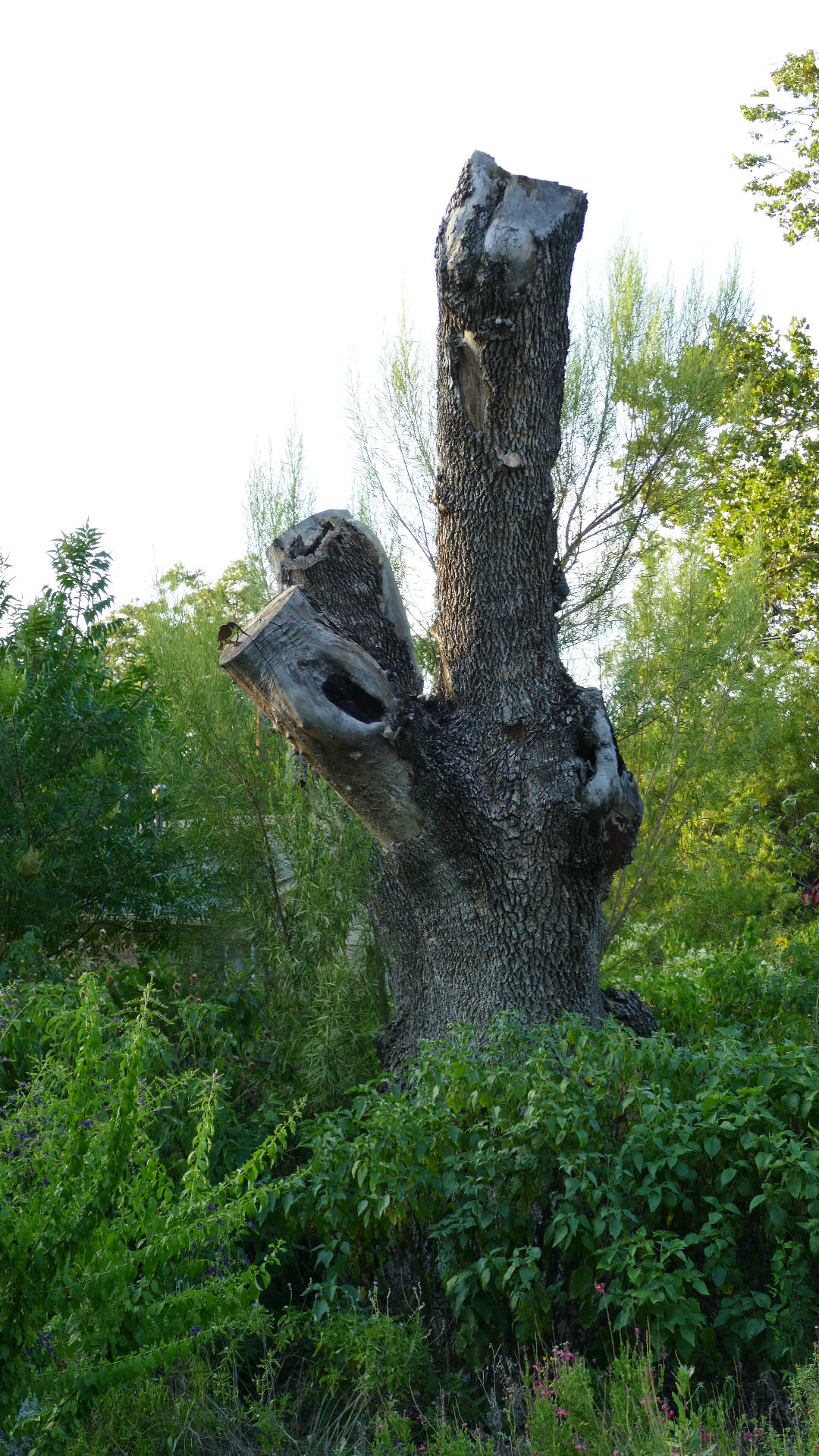
There is a season and a time for every matter under heaven.


Glad no one was hurt when it fell. I love trees at all stages and think snags possess their own beauty and usefulness. That grey weathered wood looks like a good bench. 😉 It’s usefulness continues. 👍🏼
LikeLiked by 1 person
I like that idea! At one time Sharon (my SIL) considered hiring an artist to carve on the trunk, but came to the realization that the wood was too soft for that. I have the stump of my smaller Arizona Ash in my front garden and I keep a pot on it. Last few years I grew a bougainvillea, this year and large celosia. But it’s also rotting, so I don’t expect it always to be useful as a table.
LikeLiked by 1 person
Excellent history of this tree and snag and log. Thanks for taking the photos and sharing the story.
LikeLike
Thank you for reading, Sam!
LikeLike
It would not make a sound while falling, good thing you weren’t under it ❗
LikeLike
No kidding! It’s huge and I don’t think I’d be here if I’d been walking by at the wrong time!
LikeLiked by 1 person
I really appreciate this post because most of us don’t often consider the important role trees play in their environment after they die. I really enjoyed seeing the “hole” photos, documenting the lives that were fostered by the tree during its decline. And I was tickled by the Latin name for poverty weed; though I guess nobody knows why it was named for the god of wine, the “neglecta” is perfectly clear and seems particularly apt for this plant.
LikeLike
Often, the European Starlings hassled the woodpeckers until they abandoned the nest, but I know at least once there were chicks and a successful fledging.
I really like that poverty weed and yes, the ‘neglecta’ is appropriate for this ‘weed’! Its bloom time is now, as is the Flameleaf Sumac’s that you gifted me. I love plants that bloom in August!
LikeLike
For what it’s worth, AI claims that poverty weed “is named neglecta from the Latin word meaning to disregard or ignore, because it grows best in neglected, abandoned, and disturbed land.”
LikeLike
And it is neglected! I’ll probably try keeping it somewhat pruned if Sharon has the ash snag completely removed. The Weed has a rangy growth, so the pruning would be just about it not reaching its branches into other plants and bothering them. Or me. 🙂
LikeLike
Your closing quotation, “There is a season and a time for every matter under heaven,” makes us glad that this wasn’t the time for you to get clobbered by a falling tree.
Right from the get-go you snagged my attention with the meaning of snag as ‘a dead or partly dead tree that is still standing.’ Somehow I wasn’t aware of that sense. I see the word can similarly mean ‘a tree or a part of a tree that is sunken in or protrudes above a body of water and is a danger to navigation.’
(By the way, e-mail versions of your posts have stopped coming my way. An announcement for each one does still show up in the notifications menu, the one with a bell for an icon, but I don’t always catch that in a timely way.)
LikeLike
Clobbered is the right word. Had it fallen on me, I wouldn’t be here. I need to go out an measure the circumference. It’s thick, heavy, and potentially deadly.
As for the closing quote, I was really just acknowledging the end of an era in our gardens, a change of seasons, if you will.
Sorry about the email notifications. I have all sorts of problems with WP. I have to re-subscribe just about every time I want to comment on Linda’s and Eliza’s posts, as well as Tonja’s, though so far, I can’t seem to post consistently on hers. On my own blog, each time I reply to a comment (like now!) a window appears and I have put in my name, website, email. It’s an auto-fill, but how stupid is that? Sigh. I think the WP pixies like messing with me.
LikeLike
I was walking along an isolated portion of the Red Buckeye trail at Brazos Bend State Park when CRACK! Seconds later, a quite large limb fell on the trail in front of me. It was the strangest thing ever, since the day was perfectly silent and without wind. It was a good reminder to listen as well as look when we’re out and about; any unusual noise is worth stopping to consider!
Methinks I spotted a Hamlet reference in your mention of something rotten in the state of that tree!
At the San Bernard refuge, there are informational placards along one of the trails, and they include a couple about the value of dead trees and the fungi that slowly take them over. It takes time, but they do return to the earth. I’ve been watching one snag at the Dudney Nature Center for years. I took this photo in 2020 because of the yaupon berries caught in it. Now, it’s nothing but a barely noticeable heap of rotting wood on the ground. Nature has her ways!
LikeLike
And those CRACKS are really loud! I’ve wondered about people (including myself) who walk with ear ‘doodles’ (my term!) as they’re listening to music, audio books, whatever–would they hear the crack? The snag is big enough it would have probably killed if I was out and, for whatever reason, didn’t hear/or move fast enough. Sobering, to say the least. I’m glad your branch fell in front of you and not on top of you! Trees are big heavy things.
I’m glad there’s more information on trails, gardens, and the like about dead trees and their value. The don’t fit into the American narrative of beauty in a garden, but they are important players in a healthy environment.
LikeLiked by 1 person
When I had that awful virus that took out my hearing, I didn’t go wandering with my camera until I was satisfied I could hear perfectly again. It was nearly six weeks of waiting, but not being able to hear alligators grunting, snakes slithering, sneaky humans sneaking, and other such noises kept me home. I use my ears as much as my eyes when I’m in nature; I can’t imagine using earbuds. Without them, I can hear sounds as slight as longleaf pine needles dropping to the ground.
The loss of pleasurable sounds was quite an experience as well. It was weeks before I could hear birds again. Of course the first ones I heard were the laughing gulls and screaming bluejays!
LikeLike
Ears are definitely important! Glad you’re over that and can use all senses when in nature.
LikeLike
I’m joining our fellow bloggers in expressing my relief at you not having walked under the remnants of the tree right as crashed down!
Thank you for singing this ode to trees in all stages of life as well as in “death.” They continue to be useful even after we consider them dead, but so much life continues on and in and around them even at that stage.
All the more reason to be aghast at so many trees dying in what seem to be wildfires everywhere. We, who are alive now, will not see most of them get replaced in our lifetimes. It’s very depressing.
LikeLike
Yeah, would have been a squished Tina, that’s for sure!
I love snags and old wood, there’s so much interesting going on with them.
Yes, I feel for the trees and all the wildlife. Nature will renew, but how successfully in the long run is questionable. I’m sad and angry. Sigh.
LikeLiked by 1 person
Sad and angry and sighing with you . . .
LikeLiked by 1 person