This is the second spring that a pair of Red-shouldered Hawks, Buteo lineatus, have chosen to nest in my neighborhood. Their nest sits snug in a large Red Oak tree around the corner from my street; it’s the same nest that they built last year and you can read about it here.
In recent weeks, one or both adults have spent time perched at the top of my SIL’s life-supporting snag, the remains of the once living Arizona Ash tree. Usually, there is one adult atop the snag, but often the mated pair sit companionably together, preening and observing the goings-on in the neighborhood.
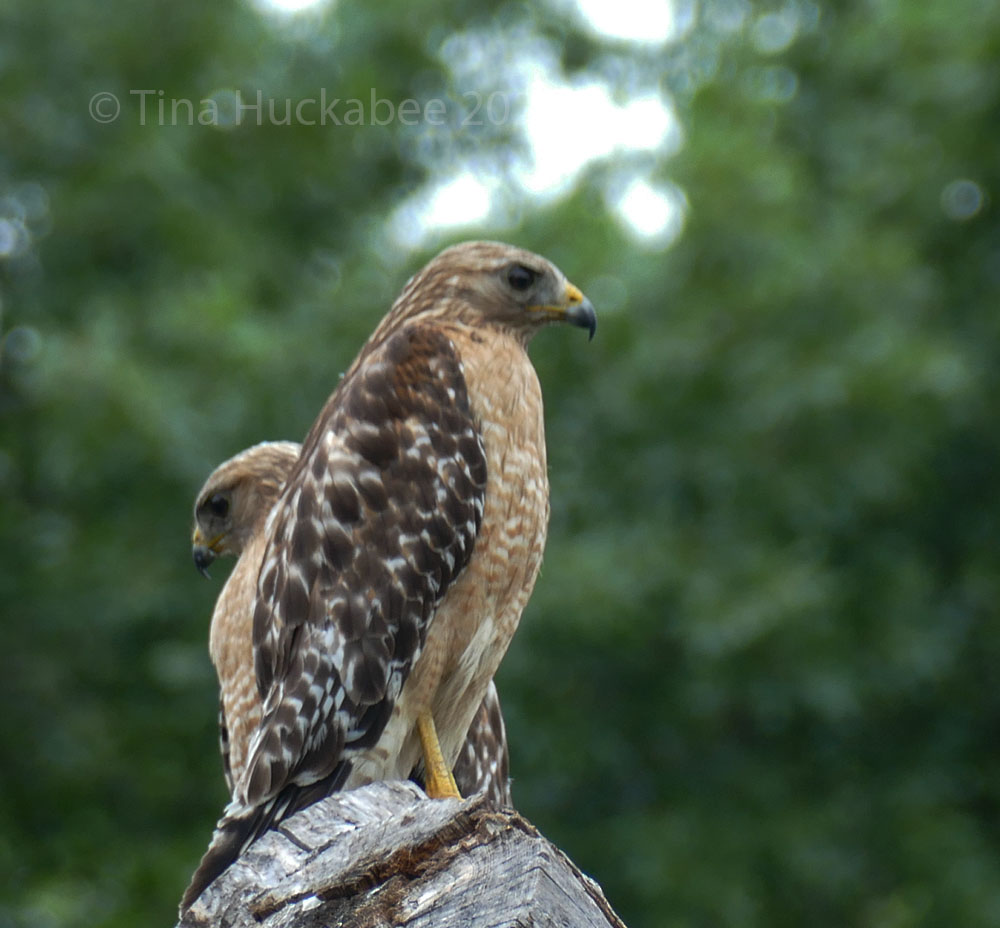
It’s nice to observe the still, calm birds and to clearly see the front and back feather patterns of the hawks. The front red shoulder with barred chest combines with the warm, burnished brown and banded tail feathers in back to create a lovely bird. The bird on the left (I think it’s the female) demonstrates the name of this hawk quite well with the ‘red’ draped across the shoulder. Red-shouldered hawks’ intelligent dark eyes watch for prey, their formidable talons catch that prey, typically in flight.
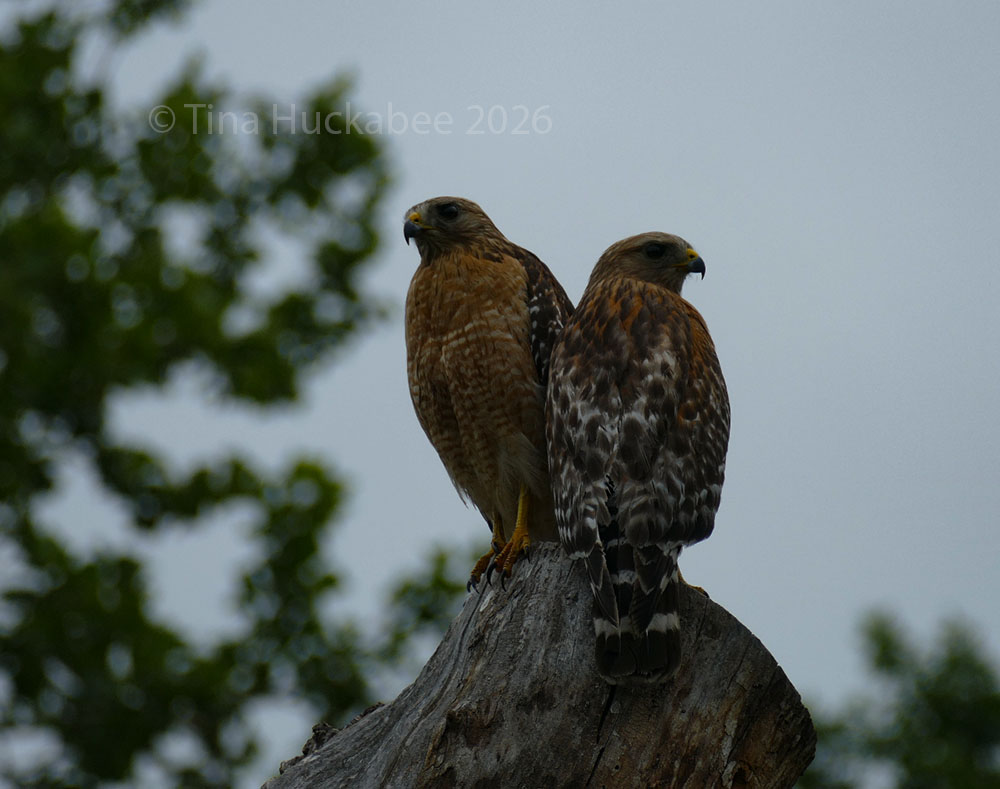
These are magnificent birds, beautiful, graceful–and huge!
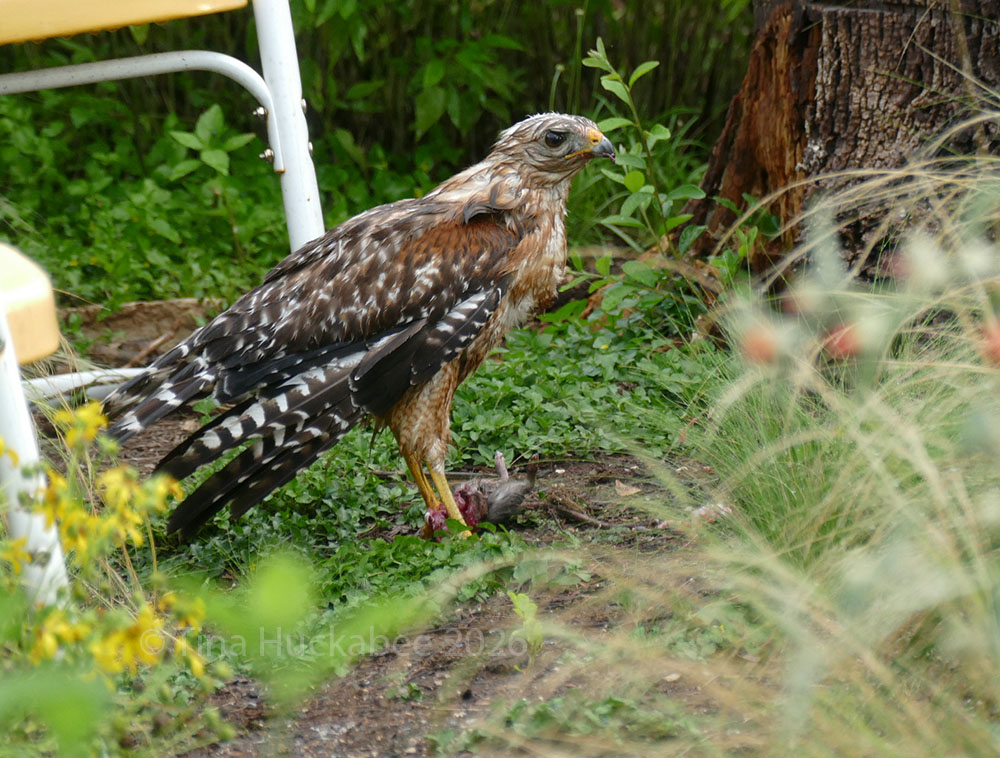
If you’re squeamish about a hawk’s meal, close your eyes as you scroll passed this next photo. I’d been called outside by a neighbor about a non-hawk event and when I headed back inside, saw this adult, smack dab in the middle of the sitting area of my front garden, enjoying its meal of rat. The hawk was wet, as a downpour had occurred earlier, but that didn’t negatively impact its meal. The hawk wasn’t happy with me when I grabbed my camera for a photo. It called at me a couple of times, then picked up its meal and hopped to part of the garden where I couldn’t easily follow, and so, could eat in peace without the bother of an obnoxious human.
Fair enough.
Aside from these two gorgeous adults, it’s more than just double hawk trouble! The couple produced two baby hawks, eyasses, which have become visible in the nest as they’ve grown. They’ve traded their white fuzzy feathers for semi-adult plumage, and I believe they fledged this week, in the last day or so. No more bobbling baby hawk heads, the nest appears empty of its young occupants.
I caught a shot of these cute little raptors about 5 days ago. It always amazes me how quickly wild babies grow, especially birds.
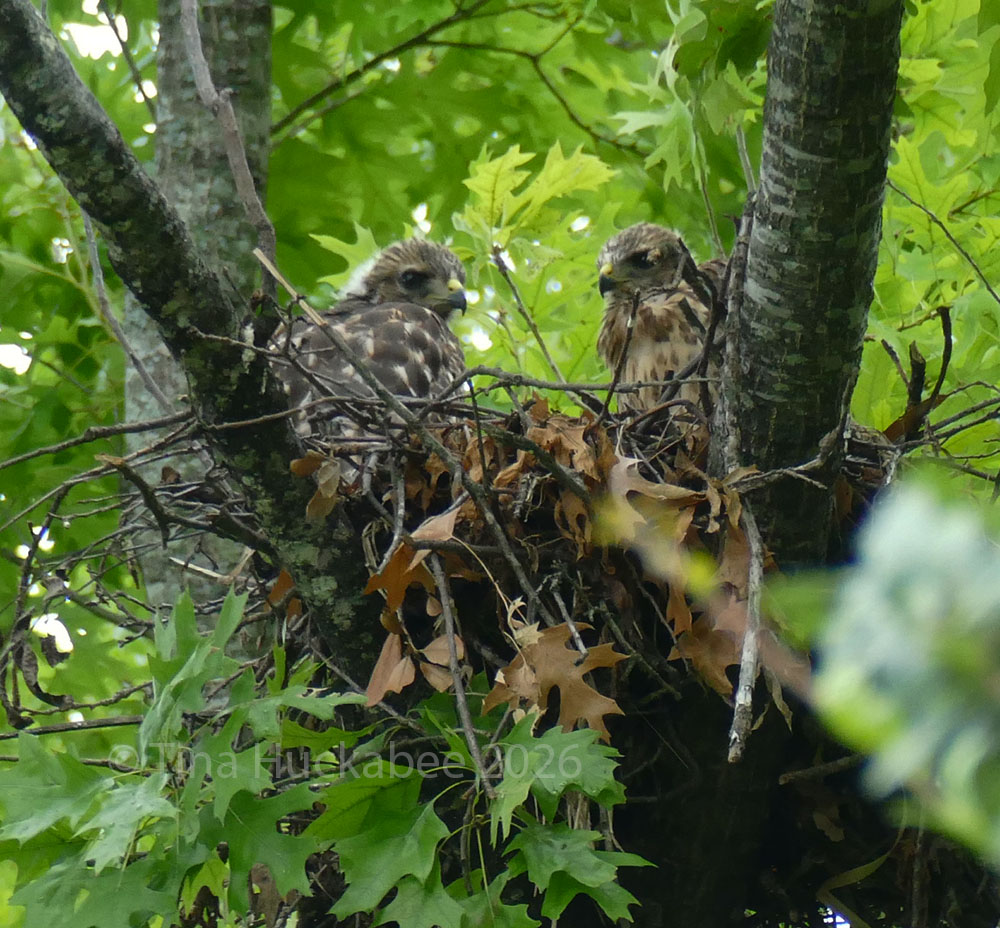
I hope to see this family hunting in the ‘hood and I look forward to more hawk watching as summer moves forward. My neighborhood hosts this pair and their offspring, a pair of Red-tailed Hawks, Buteo jamaicensis, and at least one pair of Cooper’s Hawks, Astur cooperii. That’s a lot of hunting in the skies. I wish them all rodenticide-free rats and mice, as well as other delectables (ahem–we have plenty of White-winged Doves, European Starlings, and House Sparrows) for the taking.
Just sayin’.
 My Gardener Says...
Amazing that there are so many nesting hawks in your neighborhood. I think I asked this before, but are you in the typical suburban neighborhood with a house to the front, side, and back? I had some spottings back home, and we were surrounded by forest, but not like your hood.
LikeLike
It is remarkable, I think. Added to that, we have lots of owls, mostly the Screech, and foxes, as well. Yes, it’s a typical urban neighborhood, but we do have lots of mature native trees. I just think there’s plenty to eat. I do worry about the folks who have the rat bait out and have undertaken a word-of-mouth public education about the dangers of rodenticide, but still…
LikeLiked by 1 person
I had the same thought, that for a typical Austin neighborhood you have a lot of avian residents and visitors, especially birds of prey.
LikeLike
A beautiful slice of nature to observe so close to home. Great captures, Tina!
LikeLike
Thanks, Eliza! Yes, they’re in my own front garden and around the block!
LikeLiked by 1 person
Great post! Lots of info; lovely photos!
Amy Culbertson
LikeLike
Thanks, Amy. I learned a new word: eyas, or plural, eyasses!
LikeLike
‘Eyas’ was new to me too!
LikeLike
Well, I was thinking that baby owls are owlets, what are baby hawks and the internet knows everything. 🙂
LikeLiked by 1 person
As your linked etymology noted, an eias was an alteration of a nias. It’s an example of a process called resegmentation. In this case, hearers heard the n as if it was part of the indefinite article an. The process is still alive. For example some people have resegmented another into a nother, after which nother has taken on a life of its own, as when someone speaks of a whole nother [whatever].
LikeLike
That’s a whole nother take on this post! As always, thank you for this lesson in language, Steve!
LikeLike
I was vastly relieved to read that your double trouble involved your hawks, rather than pests and disease afflicting your garden!
Do you think it’s possible that the relatively high number of hawks in densely populated urban neighborhoods (it’s the same here) might be due to exactly that denser human population? That is, more people putting out more bird feeders increases the populations of birds and rats that could make the neighborhoods so attractive to the hawks.
Whatever the reason, the chance to watch baby hawks as well as the adults would be a real treat!
LikeLike
I hadn’t really thought about it, but you’re probably right that the extra feed out for birds could draw the predators, birds and others. I don’t know how many people feed birds in this neighborhood, but as it’s a popular thing to do, coupled with our trees and proximity to the urban Shoal Creek (though the northern and more shallow end of it), probably makes for good eating for all.
LikeLiked by 1 person
Pingback: When a Tree Falls on a Pathway | My Gardener Says…