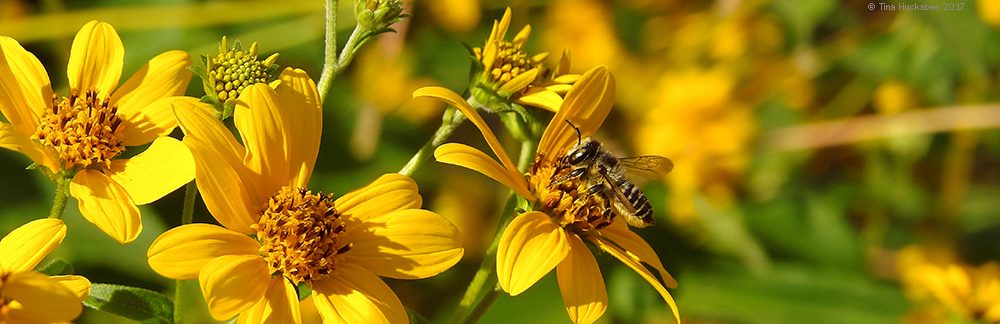
A few weeks ago as I strolled through my front garden, I noticed activity in the large group of Burford Holly, Ilex cornuta ‘Burfordii’, shrubs that I planted decades ago along the side of our garage. Not a native to Texas, this plant is nonetheless a tough, xeric evergreen and a good wildlife plant. Mockingbirds and Bluejays have nested in the dense foliage during many a spring breeding season. Other birds, like migratory warblers and native Carolina Wrens busily bop around the tangle limbs hunting insects. Each late winter, hordes of Cedar Waxwings descend upon the shrubs devouring the ripe red berries in an orgy of eating, stripping the shrubs of those fruits within one day and leaving beet red bird poop splatters on the driveway and any car parked nearby. Our honeybees are fond of the tiny flowers that bloom in March.
On the morning of the stroll I noticed flitty movement by quite a few winged things. A group of Eight-spotted Forester Months, Alypia octomaculata, were enjoying the bounty of the Burfords as the tiny flowers were abloom. It was hard to photograph these pretty moths, as they were rarely still for more than a few seconds.
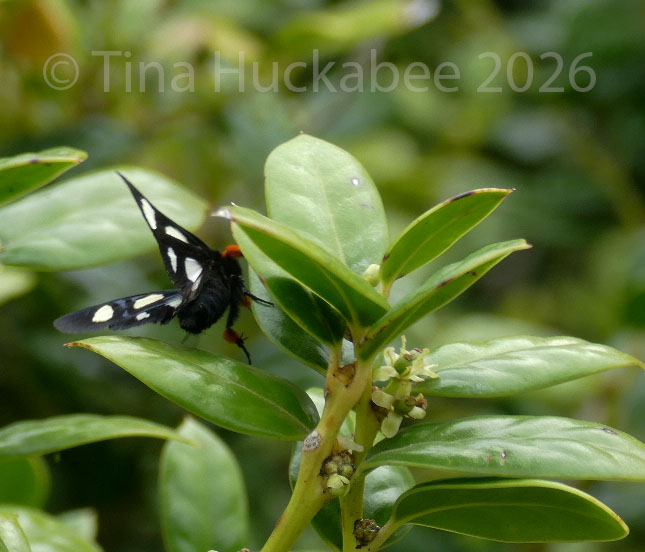
Strikingly beautiful, these moths are mostly black with white and cream spots, blueish-green bands rest on either side at the top of their heads, and dabs of orange bulge on their legs. I first mistook the orange spots as some sort of mothy corbiculae, but no, the orange is decorative, or most likely has some other evolutionary purpose.
You can see four of the spots on this moth’s wing, but can you count all eight?
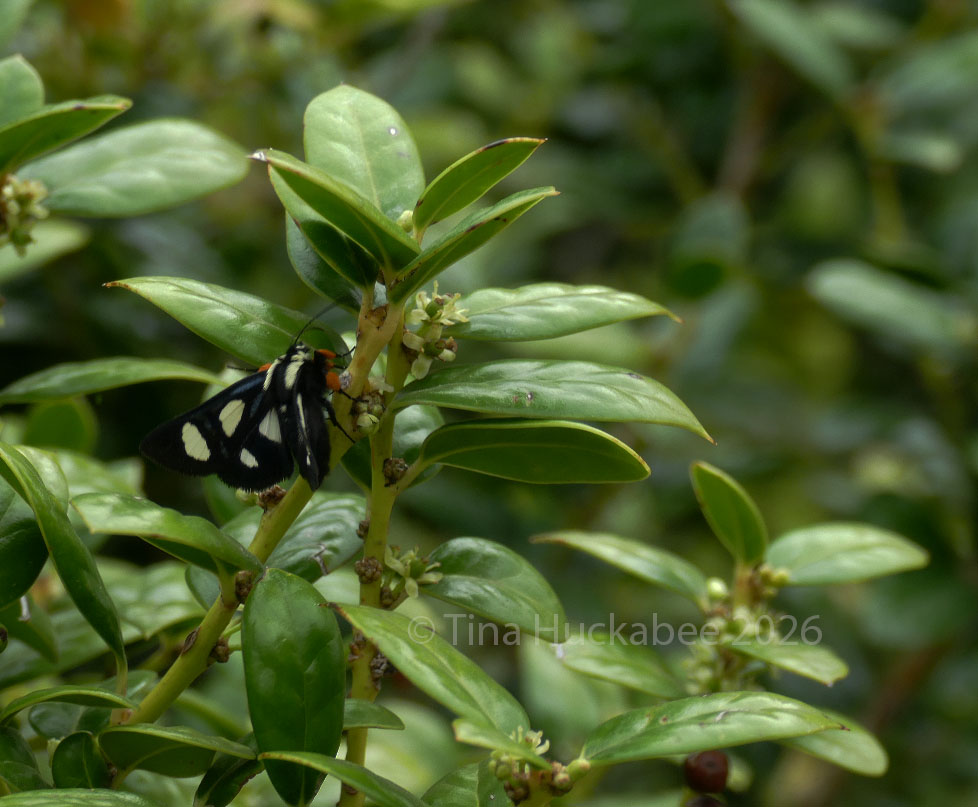
There we are! Eight spots are visible in this photo, some are creamy yellow, others are white.
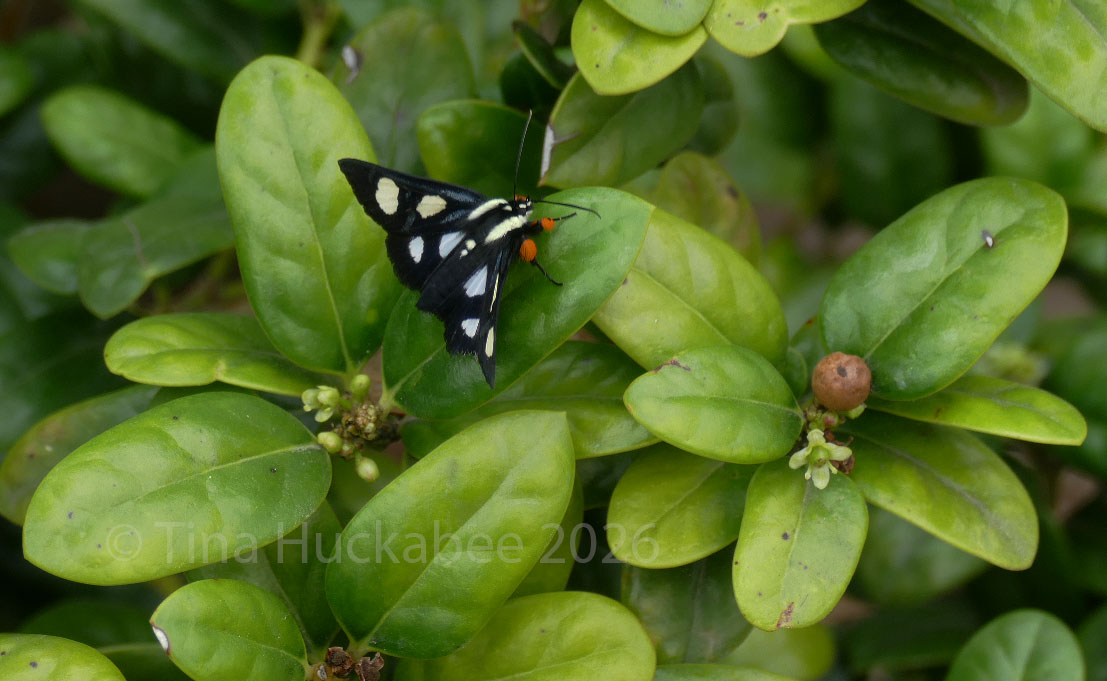
The moths’ visit was brief–I didn’t see them again after that morning. They are a common moth, living in most parts of the Continental US and also the southern part of Canada. As well, in the link at the top of this post you’ll see the map of these moths’ homes and that there are Eight-spotted Foresters in Greenland and along the West Coast of Africa.
I grow Virginia Creeper, Parthenocissus quinquefolia, which is the host plant for this moth species, but I don’t recall ever seeing any caterpillars on the foliage. Moths and butterflies (and other insects) evolved alongside plants, and plants where insects lay their eggs are called host plants. When you see foliage munched, it usually means some insect’s offspring are eating and there’s no reason to panic or grab some noxious poison, it’s how a healthy ecosystem works. A vibrant ecosystem requires no chemicals to upset nature’s fine-tuned balance.
I’ve seen Eight-spotted Foresters before, but they’re certainly not regular visitors to my garden. I’m glad they came this March; it’s always good renew an acquaintance.
 My Gardener Says...
I think we have Eight-spotted Foresters here, too. They are hard to miss!
With a bit of practice, one learns that munched leaves are mostly a cause to cheer for! 😉
LikeLike
They have an enormous range! I’m always interested in who munched!
LikeLike
This is an instance of seeing spots before one’s eyes that’s okay. I think I’ve seen this kind of moth, too, without knowing what it is.
LikeLike
It’s so pretty, I think! I’m sorry it’s not around more, but it was a treat to see so many of them that day.
LikeLike