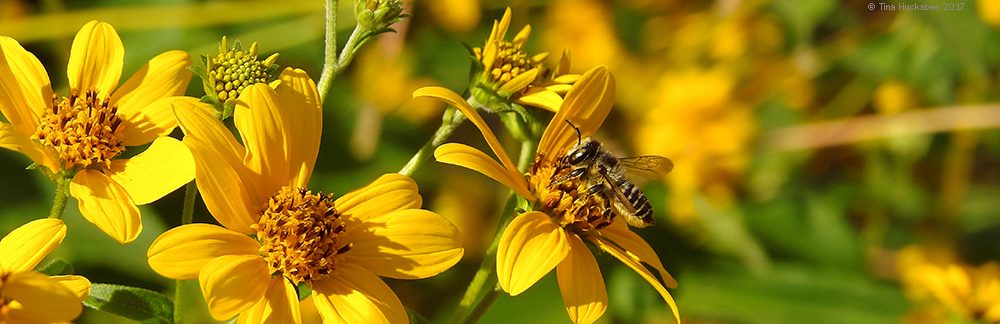
While heavy rain in Central Texas has produced horrific tragedy in certain areas, it’s also filled our reservoirs and my garden has benefited as well. Before the wet arrived, I’d returned from a trip to New Mexico, thrilled that my unwatered Texas garden looked so lush after time spent in a beautiful, but more arid, landscape. Then the rain came and the lush garden doubled-down on foliage and bloom production. This mid-July, flowers are flourishing and pollinators are beside themselves with the abundance.
Along with the floriforous summer perennials, this lone Hill Country Rain lily, Cooperia pedunculata, popped up recently amongst some Mexican Feathergrass, Nassella tenuissima. I purchased bulbs some years ago, planting them deep in the dirt, as the front garden offered little hope for enough sun to make the plants happy. There were blooms for a time, then there weren’t; it’s been a few years since rain lilies were a part of my garden.

I’m fairly sure this lily is the C. pedunculata, because I remember the bulbs being labeled Zephyranthes drummondii–which is a synonym. These sweet flowers appear after significant rain along urban and rural roadsides and patches of undisturbed land. They bloom, then set their charcoal, papery seeds, which are dropped forthwith or carried by the breezes to other places. Their stems retreat to the soil, new stalks with their single blooms reappearing at some later date, after another rainfall.
In a recent post profiling his stunning photos of rain lilies, Steve of Portraits of Wildflowers asked, in response to my comment about his photos, if I’d ever gathered seeds of this flower. The answer is ‘yes’ and I suspect that this recent lily gift is the result of one of the seeds from years ago. I don’t recall planting a bulb in this spot, though it’s possible that I did, but I do recall scattering seeds in the back garden.
I’ll let the seeds from this flower mature, and when ready, I will–with intention–scatter them, though most likely in my front garden, rather than the shadier back garden.
I might also buy more bulbs. Is it possible to have too many rain lilies gracing a newly rained-on garden?
 My Gardener Says...
In answer to your question of whether it’s possible to have too many rain lilies gracing a newly rained-on garden, I say we can never have too many of them. A decade or so ago I saw some large and dense colonies along and to the west of Mopac, but in recent years no such impressive rain lily colonies have come my way. I’d love to see a colony like that again.
LikeLiked by 1 person
I definitely want more, in the front garden, there’s ample room for them to pop up at will. I’ve always enjoyed the ones on the east side of MoPac, on Great Northern. I don’t travel that road as often as I once did (my kids went to Gullett Elementary), but they’ve always been lovely there.
LikeLike
A decade and more ago I used to get plenty of pictures along Great Northern Blvd. but then the construction of the sound-blocking wall blocked not only sound but also access to the places where I most often took pictures.
LikeLiked by 1 person
Rain lilies seem to be happy surprises. We don’t have them here, so I’ve never experienced this phenomenon of nature. A veritable pot of gold at the end of a rainbow!
LikeLiked by 1 person
We don’t have them here in West Virginia either. I have never seen one. It is a really pretty flower!
LikeLiked by 1 person
Thanks, Vero–it is a lovely thing and always a little bit of a surprise!
LikeLiked by 1 person
♥♥♥
LikeLike
Yes, I’m always “Oh, a rain lily! Oh, of course!” when I see one! I’d suggest maybe a pot of cream at the end of the rainbow? 🙂
LikeLiked by 1 person
My memory may be off (it certainly happens!) but I recall sending you some rain lily seeds that you scattered around. At the time, I didn’t realize we have two species, and the seeds I sent would have been Zephyranthes chlorosolen (Cooperia drummondii). I never came across Z. drummondii until I started roaming a bit of central/south central Texas; they just don’t appear around here. One of the first things I noticed with the ‘hill country lilies’ was the leaves: much wider and longer, and more leathery, than the leaves on ours.
I haven’t been out and about much of late, so I’ve seen only one rain lily. I’m glad yours have popped up; I hope you get more!
LikeLike
I didn’t remember that, so maybe this one is a gift from you! I honestly can’t remember how long ago that I purchased bulbs, I know it’s been in the last decade–but that covers, oh, about 10 years, or so? 🙂
I’m going to gather the seeds ( need to keep an eye on the plant’s seed production) and scatter the seeds in spots around the front garden.
Than you for the seeds you’ve sent to me over the years, they’ve most definitely added to the beauty and diversity of my garden!
LikeLiked by 1 person