As summer wrapped up and autumn commenced, the neighborhood birds quieted their activities. They’re around–nibbling here, noshing there–yet have been infrequent visitors to the sunflower and safflower feeders that hang in the garden. I do see plenty of bird activity midst the seed and berry producing perennials–that’s why I planted them! As I stroll through, rustling in the underbrush produces a flight of feathers to higher perches, but it’s difficult to catch good glimpses or clear photos of these winged wild things.
Autumn’s migratory season is a memory. I observe fewer birds in both number and variety during autumn migration compared with during spring migration. This autumn there was a quick look-see of a Baltimore Oriole, Icterus galbula, and brief barely-there view of a Yellow-breasted Chat, Icteria virens. Smaller, muted-colored birds are always a challenge to watch, but they were here, in limited numbers: Nashville Warblers, Lincoln Sparrows, Common Yellowthroats, and the like. Some moved on to winter homes south of Central Texas, but others remain, settling in for winter, before spring beckons to recreate their families. There’s at least one Orange-crowned Warbler, Leiothlypis celata, and one Ruby-crowned Kinglet, Corthylio calendula, in my back garden on a regular basis. Whether these two are males or females, I have yet to discern.
The migrant who stayed long enough for the watcher to watch was this handsome Hermit Thrush, Catharus guttatus. What a sweet little face it has and how about those breast/tummy spots?
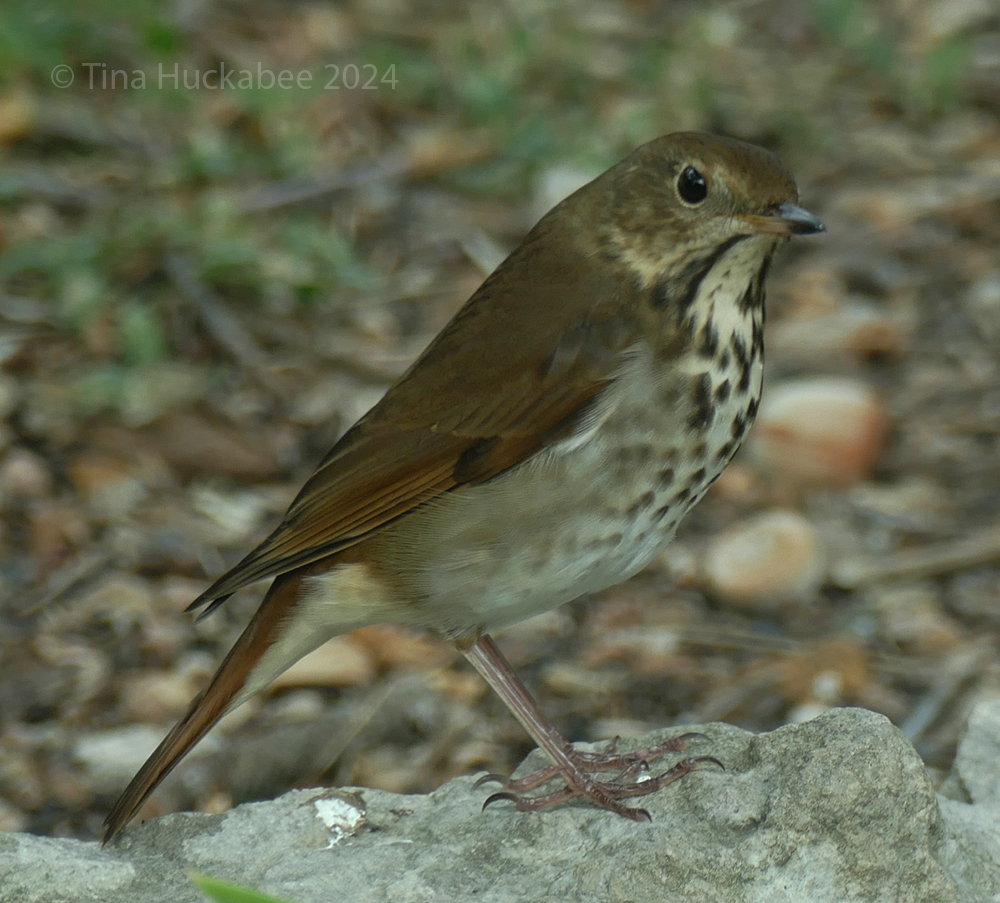
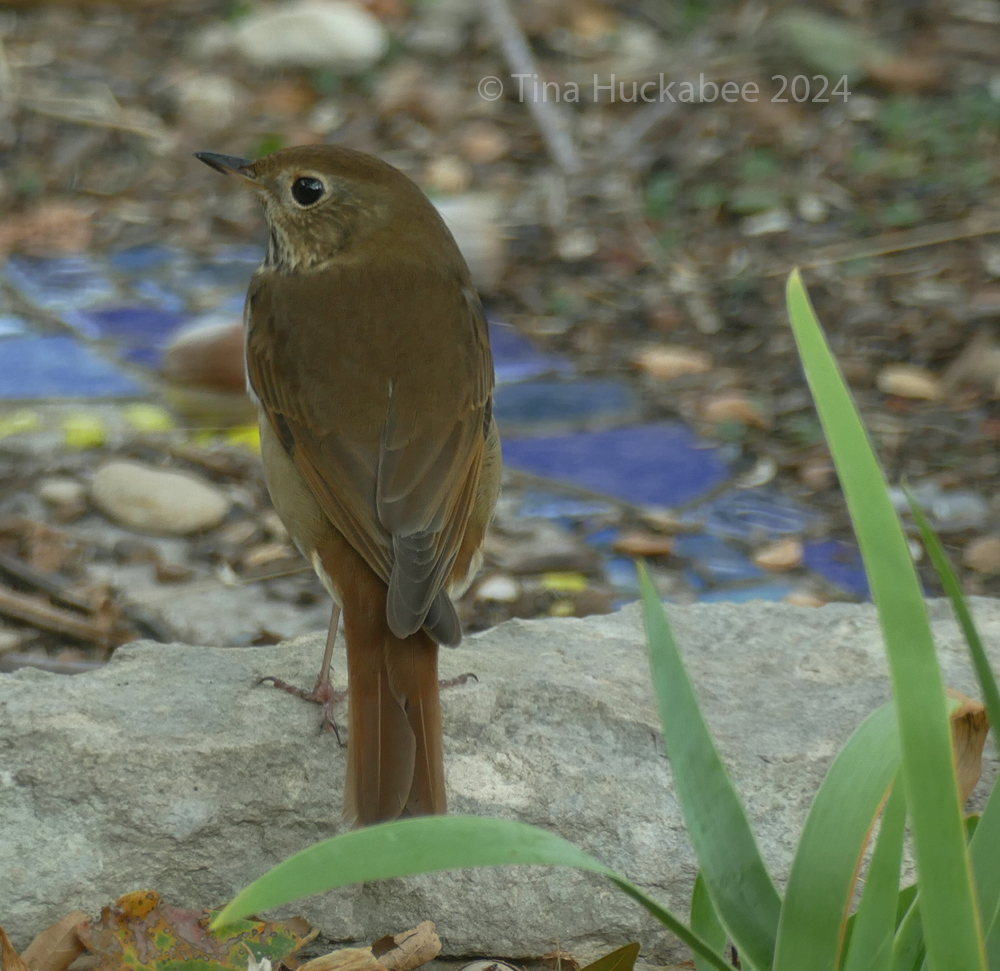
It mostly hunted and pecked along the ground, looking for seeds and small insects as its busy beak swept back and forth along the ground and through mulched areas. After a while, it took a break from its meal-finding to splash in a bath. Here, resting, it shows off its rufous backside. Hermit Thrush’s tails show a redder hue than other thrush tails.
September through November is a quiet time, an empty nest time, for the resident birds and I miss their feathery antics and calls. During this time, they rest, their adult bird needs minimal. As the days grow shorter, then lengthen, the birds become more active, preparing for the territorial-defending and calorie-consuming seasonal mating and chick rearing responsibilities revisited on an annual basis in spring and summer. The increased attentiveness in the garden, coupled with winter-visiting migratory birds, will make for interesting bird watching in the coming months.
 My Gardener Says...
I love thrushes, their melodious songs are ethereal. Nice captures, Tina!
LikeLike
They are very cute birds! I don’t get to hear their song in my garden, as they’re here during nonbreeding time of the year, but I’ve heard it on Cornell’s site, and it is beautiful.
LikeLiked by 1 person
As comparatively infrequent as you say your avian visitors have been, you still list a bunch of species you’ve seen. Your phrase “feathery antics” caught my attention. I don’t remember running across it till now, but a search shows that other people—mostly birders, it seems—have used it.
The guttatus in the species name for the thrush means ‘spotted, speckled’ in Latin, which your picture shows is appropriate.
LikeLike
It’s a speckled critter, to be sure! I guess I did have a decent variety of migratory birds, it just seemed like there were fewer in number. I notice that there were 2 Orange-crowned warblers at my peanut feed this afternoon and the Kinglet is still zipping around. That made me very happy!
LikeLike
It is hard to get photos of the birds hopping around in the trees. I had a Woodcock in the back yard, but couldn’t get a shot of it.
LikeLike
I’d love to see a Woodcock! So cool that you have one so near you. I notice that Austin Wildlife Rescue took one just recently. It was injured (don’t remember how) but is expected to make a full recovery.
LikeLiked by 1 person
I have seen them on and off over the years. The are hard to see as they blend into the leaf litter. I always get the feeling that they feel lost.
LikeLike
That’s funny. I guess sometimes birds do get lost. There was the Cattle Tyrant in Corpus Christi last year (which may have been sighted again) and a few years ago, there was a Blue-footed Booby here in Central Texas.
LikeLike
They are sweet little birds aren’t they? They migrate through here, and it’s always fun to see them. Great photos. 🙂
Beth @ PlantPostings.com
LikeLike
They are pretty birds, even if their coloring is muted. I just love their sweet faces!
LikeLike
It is a quiet time of year, isn’t it? My bluejays, cardinals, wrens, and starlings have disappeared, as well as the woodpecker. On the other hand, there still are some white-winged doves, sparrows, and chickadees coming to the millet and sunflower hearts. I did see something I assumed was a sparrow until I noticed the longer, slender beak and just a touch of yellow. I haven’t gotten a good look at it yet, but I wouldn’t be surprised if it were a warbler. Oh — and there have been what I think are goldfinches twittering in the tops of the live oaks.
Otherwise, all the action is squirrel related. My gracious, they’re busy, especially with chasing one another around. I read that their winter breeding season is from December-February, so it’s possible that territorial squabbles and boy-chases-girl action is going on!
LikeLike
It’s been VERY quiet. It’s nice, though I do miss the hub-bub in the garden. The little Lesser Goldfinches have been all over because the Plateau Goldeneye are seeding out and they’re all-in for the seeds. Occasionally, one will visit my sunflower feeder.
And yes, our squirrels are chasing one another too! And squeaking and chirping. They’re not interested in the peanuts I put out, but everyday, I see at least one with a pecan in its mouth.
LikeLiked by 1 person
Great photos of a lovely visitor!
LikeLike
Thank you, Brian!
LikeLike
These are lovely portraits of the Hermit Thrush, Tina. Thank you for sharing. I love all thrushes but the otherworldly song of this particular thrush must be one of my absolute favorites. Yours likely didn’t sing at this time of year, but it’s something else to look forward to for next spring.
Wishing you some surprise avian visitors this winter.
Tanja
LikeLike
While I enjoy seeing a decent variety of migratory songbirds in my garden, other than a few ‘cheeps’ I don’t hear their songs. In June/early July my husband and I spent time hiking in Olympic National Park and it was there that heard the songs of so many birds that I see in my garden. I didn’t see many of them, except for quick flights, here and there, but I just loved hearing their beautiful songs!
LikeLiked by 1 person
It’s soul-satisfying to be able to learn what bird is singing even if we don’t get to see it. Hermit Thrushes in my experience are among those birds who are heard more than they are seen.
LikeLike
We’ll have a much harder time defending the natural habitats of the songbirds we love if we don’t find every way to resist the ignorant, hateful, destructive new policies of this new regime with its plans to remove environmental protections for clean water, clean air, and instead unleash more pollution and pesticides. I spent an hour in the orchard yesterday with a hermit thrush who comes quite close, I always feel like the dwindling birds are pleading with us to stop destroying nature, stop climate collapse. The way this last election was counted means terrible consequences for wildlife and humans.
LikeLike
You’re not wrong about any of this, Dorothy. I think those of us with the interest and knowledge of using native plants in our gardens, planting with the goal of conserving precious water and providing for the wild things that have experienced declines in their habitats is how we can push back at the destruction. I know it doesn’t seem like much, but small things do matter. We must keep our hopes and dreams focused on a better future.
LikeLike
Thank you Tina, so true, every small thing, and the beautiful small things and our love for them can give us courage
LikeLike
It seems lame, but truthfully, I think it’s now about local community and small act of kindness. Hang in there!
LikeLike