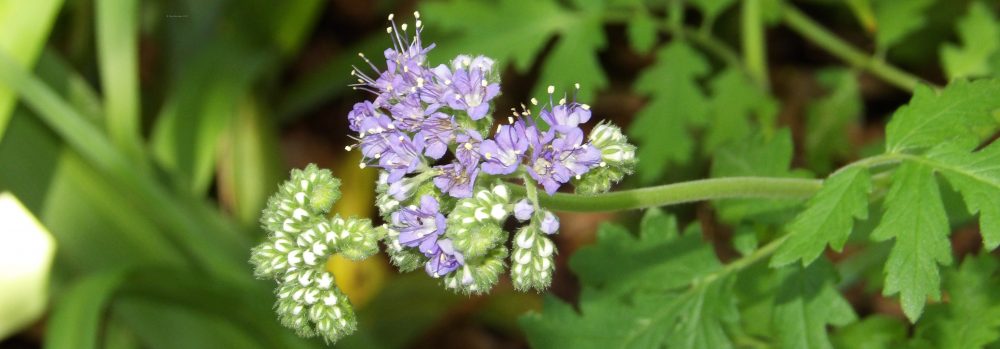
Sightings of migrating Monarch butterflies, Danaus plexippus, have been few and far between this autumn. I’ve observed one or two, here and there, the burnished beauties’ wafting through my garden, wings wide open, brightened honey-colored by the sun’s rays. By late September and early October, despite ongoing drought and heat, some of the Monarchs’ favorite blooms were in full, flowering mode, ready and waiting for brief visits from the passing butterflies.
Frostweed, Verbesina virginica is always a favorite.

Gregg’s Mistflower, Conoclinium greggii, is another autumn blooming Monarch magnet.

Pollinators, including Monarchs, love Turk’s Cap, Malvaviscus arboreus var. drummondii.
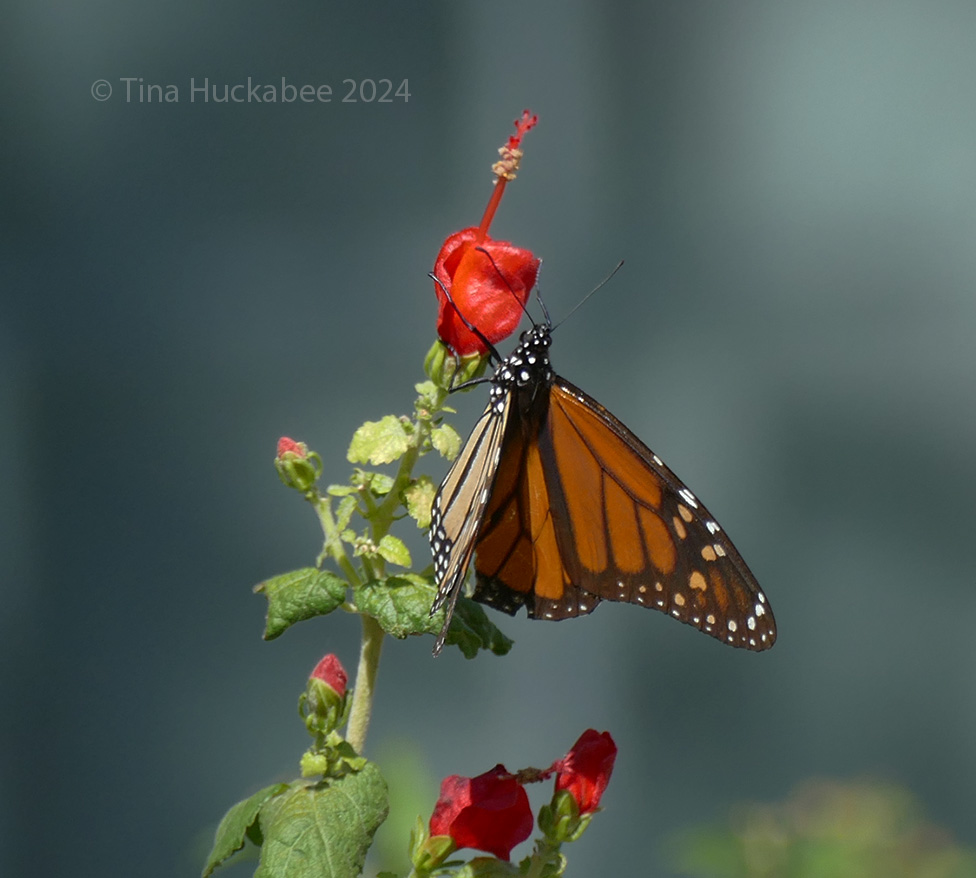
Though it was heartening to see the Monarchs, a few passing through doesn’t suggest a migrating group.
That changed a wee bit this past last week. For a couple of days, I counted 14-15 Monarchs working the graceful flowers of my Mexican Orchid Tree, Bauhinia mexicana.

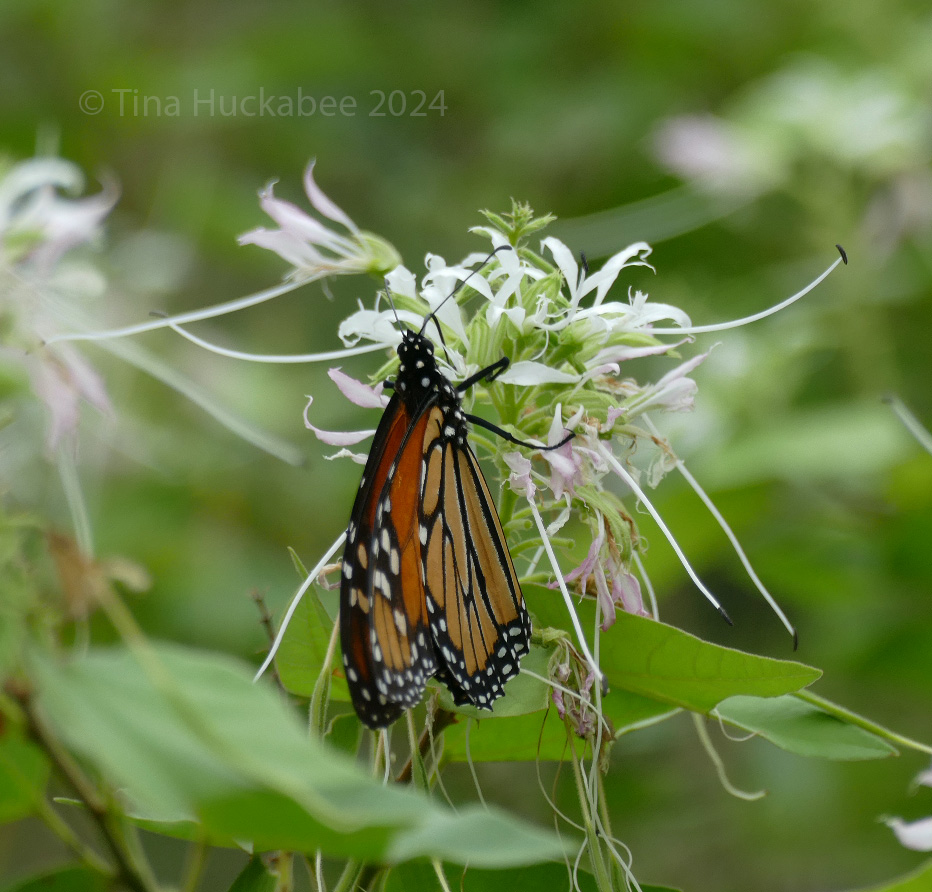
Here, there’s one in the foreground and two in the background; there’s also a little dab of umber in the left background. That brown beauty is a Queen, Danaus gilippus, a cousin to the Monarch.
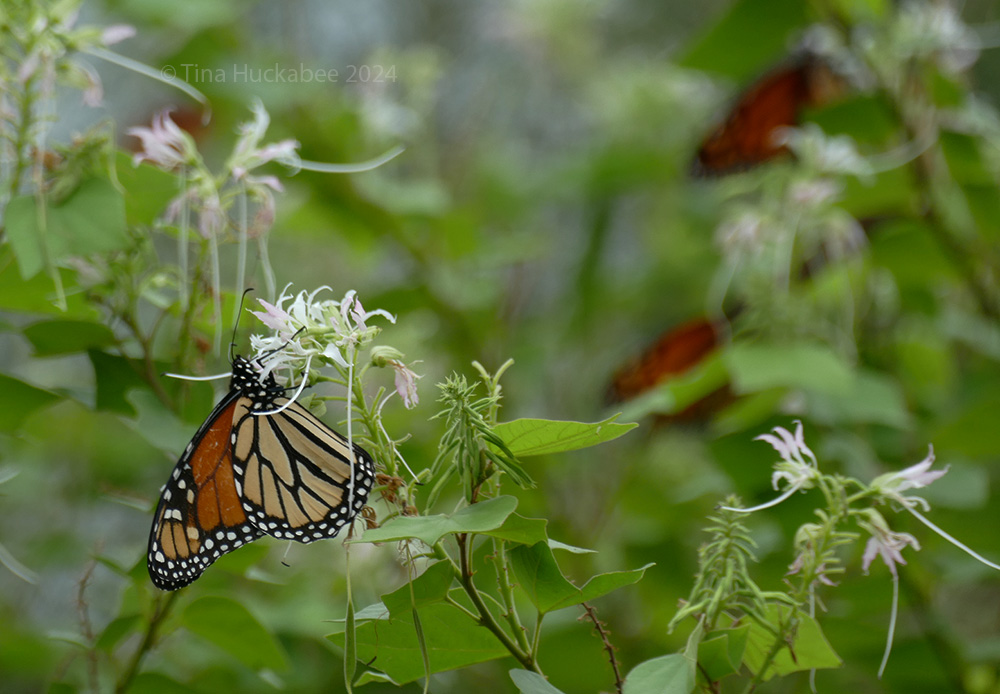
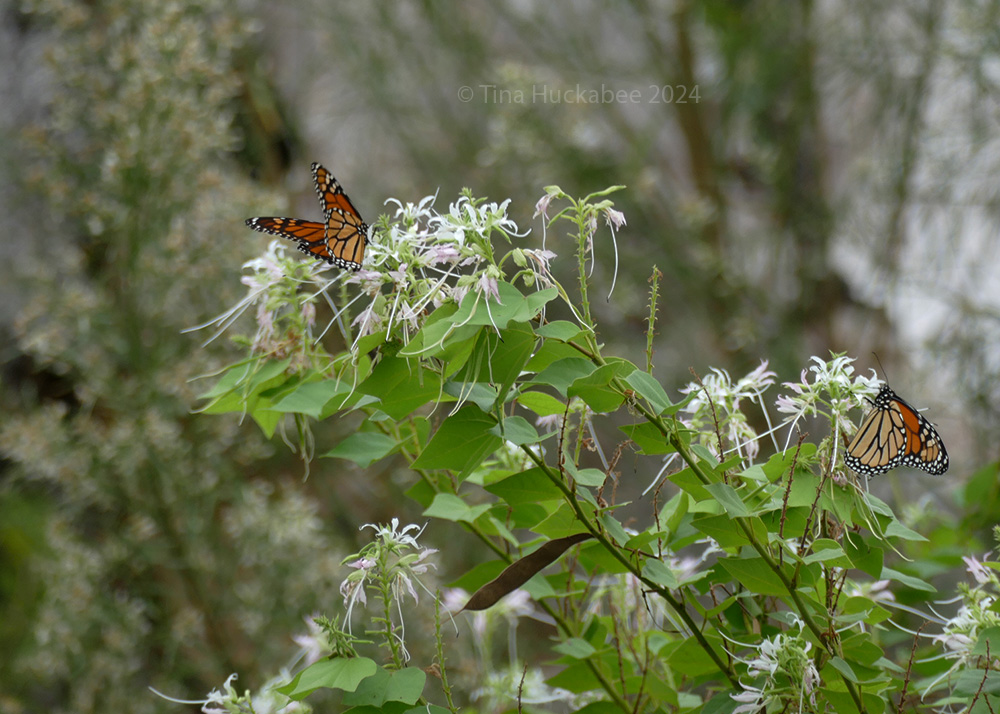
These two Monarchs worked the orchid tree flowers, while in the blurry background, False Willow or Poverty Weed, Baccharis neglecta, hosts its own party of pollinators. The willow attracts many native bees, honeybees, and some of the small skippers. It’s alive with movement.
I probably should have shot a video of the fluttering butters rather than trying to capture photos. The darned things continually moved from bloom to bloom and when they were bored with that, played hide-n-seek behind the ungulate-shaped foliage. I’d focus on one or two, then whoosh, they wing out of the camera’s sight. It was nigh impossible for this picture-taker to capture the glorious activity around the flowers.
This small group, welcome though it was, doesn’t come close to the numbers of Monarchs that have graced my garden in the past. But given the survival challenges that Monarchs face, I am pleased that there were so many for a day or two, and that I had ready for them nectar-rich food sources. Recent research has suggested that the migrating Monarchs are losing the will to migrate, due to a host of factors. For more information about this sad, but perhaps evolutionary trend, check out this article from Texas Butterfly Ranch.
I’m not sure if the group I observed constitutes a flutter of butterflies–a term that refers to a mass of butterflies, but I do love the use of the term flutter, along with the other words used for butterfly gangs, like the following: a flight of butterflies, a kaleidoscope of butterflies, a rainbow of butterflies, a shimmer of butterflies, a swarm of butterflies, and a wing of butterflies.
Many or one, Monarchs are a joy to witness, a balm for the soul.

 My Gardener Says...
Lovely shots, Tina. I hope your fewer sightings is just an anomaly and not a trend. It hurts to think we might lose this amazing migrational wonder.
LikeLike
Thank you, Eliza–you and me both!
LikeLiked by 1 person
Wow! Lovely to see your butterflies enjoying your blooms. We will have to wait for spring for our next fix.
LikeLike
Depending on how mild our winter is, it’s possible to have some butterflies November through February. Not many, but a few.
LikeLiked by 1 person
No doubt the drought brought about less flutter of butter, a slimmer shimmer, and a reduced warm swarm.
LikeLike
Lol. Funny guy!
LikeLike
You did good with the photos. I finally have some Monarchs in my yard, probably 4 or5, and they would not pose for me.
LikeLike
They do seem to have minds of their own, that’s for sure!
LikeLiked by 1 person
Lovely photos, Tina. I’m glad you had at least a small number of migratory monarchs; I only ever see one or two at a time.
Thank you for sharing a selection of collective names. All appeal, and while flutter and shimmer seem most descriptive, I find kaleidoscope particularly evocative.
On behalf of the monarchs, thank you for your welcoming garden. 🙏🦋
LikeLike
Kaleidoscope wins, hands down! I just love the all the names though, so charming.
LikeLiked by 1 person
I agree, Tina. Charming names for charming creatures.
LikeLiked by 1 person
The person who invented and named the kaleidoscope was David Brewster, who also created the first 3-D camera.
LikeLike
Oh my goodness: beautiful images of some beautiful monarchs! I miss them up here, but hoping more will come your way in the days and weeks ahead–some were later than usual up here because we’re having a mild autumn. Thanks for sharing your photos and thoughts.
Beth @ PlantPostings.com
LikeLike
They are a little later than usual, Beth. I hope their migration is safe, but there are so many potential issues, it’s a wonder that as many get to Mexico as do. I still have plenty blooming, so c’mon, monarchs!
LikeLike
The Monarchs are obvious here now; I’m seeing about a dozen a day while working. In past years they’ve shown up just before our first strong front of the year, and from what I’ve heard, it’s on the way. Your photos are great. They’re another reminder of how useful a well-tended garden can be when it comes to photographing these little jewels. They can spend more time sipping instead of searching. You clearly made fine use of their sipping time!
LikeLike
Glad you have so many. I wonder if the drought has delayed their migration this year, sightings seem a few weeks later than ‘normal’. It is a bonus to just walk outside, camera in hand, and snag some photos. That said, I don’t know how many times I walk outdoors, camera in hand, and I swear, they all fly away!
LikeLiked by 1 person
I suspect temperature has played a role as well. The rut is later than usual this year, and fishermen have been complaining that the shrimp have been late leaving their marsh nurseries. Everything seems ‘behind schedule’ — even the fish that generally leave the bays for the Gulf every autumn haven’t moved. A lot of the duck hunters are complaining that many bird species seem to be dallying up north — although there have been some reports of white pelicans and sandhill cranes flying in.
LikeLike