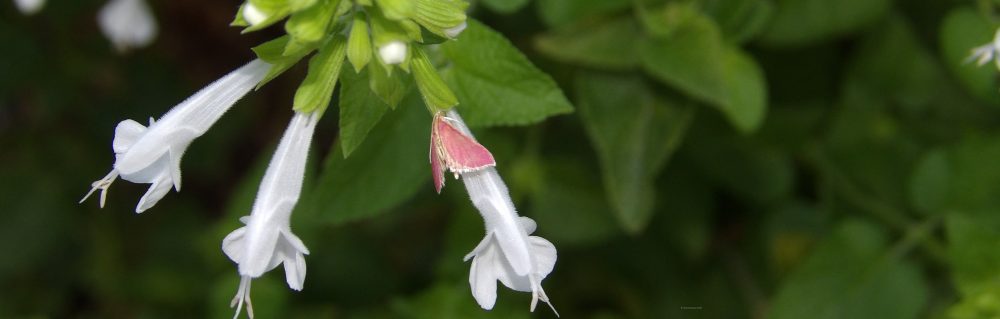
My July garden is humming and buzzing along. With regular rain, and hot–but not yet scorching–typical Texas temperatures, pollinators, birds, and other assorted critters are rejoicing in the bounty of blooms and seeds. The garden is doing what it’s supposed to do: feed wildlife.
Summer is also a good time to reflect (ahem, gnash teeth and fret) about mistakes in the garden. I excel at gnashing and fretting, it’s one of my best things: Why did I plant that there–what was I thinking?? How have l let that beloved, beautiful plant become such a garden bully? That being said, this summer I haven’t spent much time in the garden until recently. Six to eight weeks before our toasty summer moves aside for…less toasty late summer /early autumn, light pruning and dead heading chores a good idea, and as I go, I plan for changes to the garden. While I’m noting problems and tidying messes, I appreciate the garden, where it is and what’s in it, at this moment in time.
American Bumblebees, Bombus pensylvanicus, abound! They’re favoring the remaining American Basket Flowers, Centaurea americana, but also visit the Mexican Orchid tree blooms and other flowers in the Aster family.

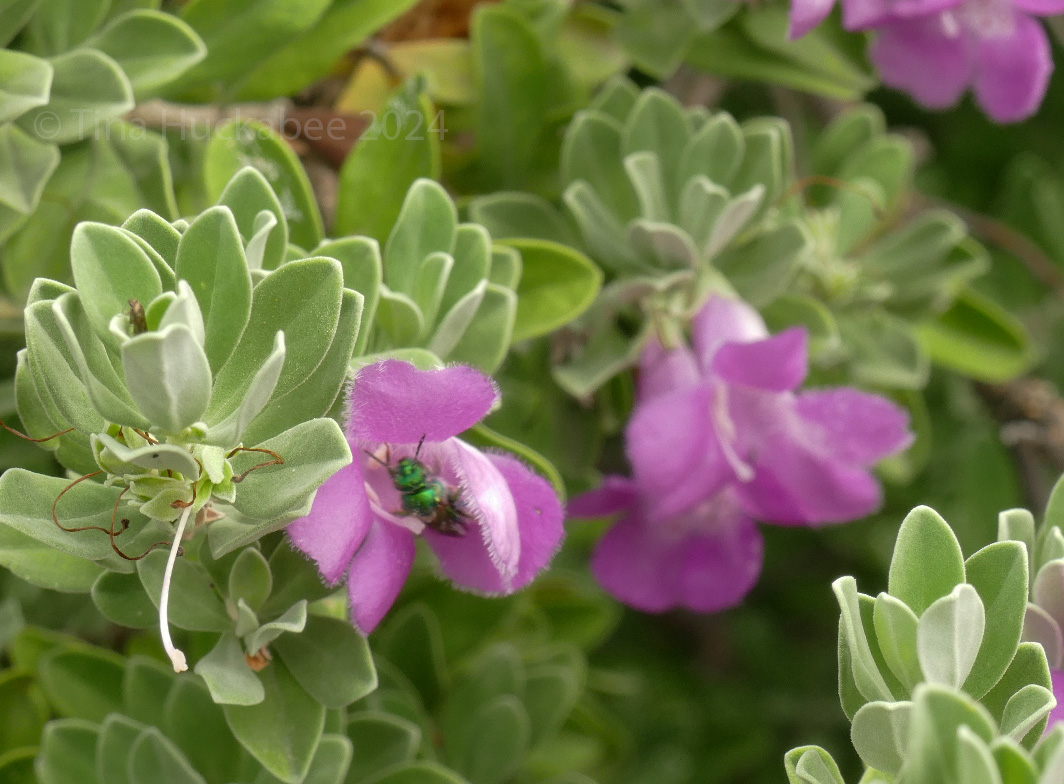
I caught this small, green metallic Sweat bee, Halictidae, as it rapidly zipped from flower to flower of the Cenizo shrub, Leucophyllum frutescens. Often called ‘Barometer Bush’ the lavender flowers appear when there is rain possibility. My shrub has bloomed fairly consistently this summer, to the delight of many winged things–and this gardener!
I was observing one of my favorite kinds of bees, the Horsefly-like Carpenter Bee, when I spied this curious character.
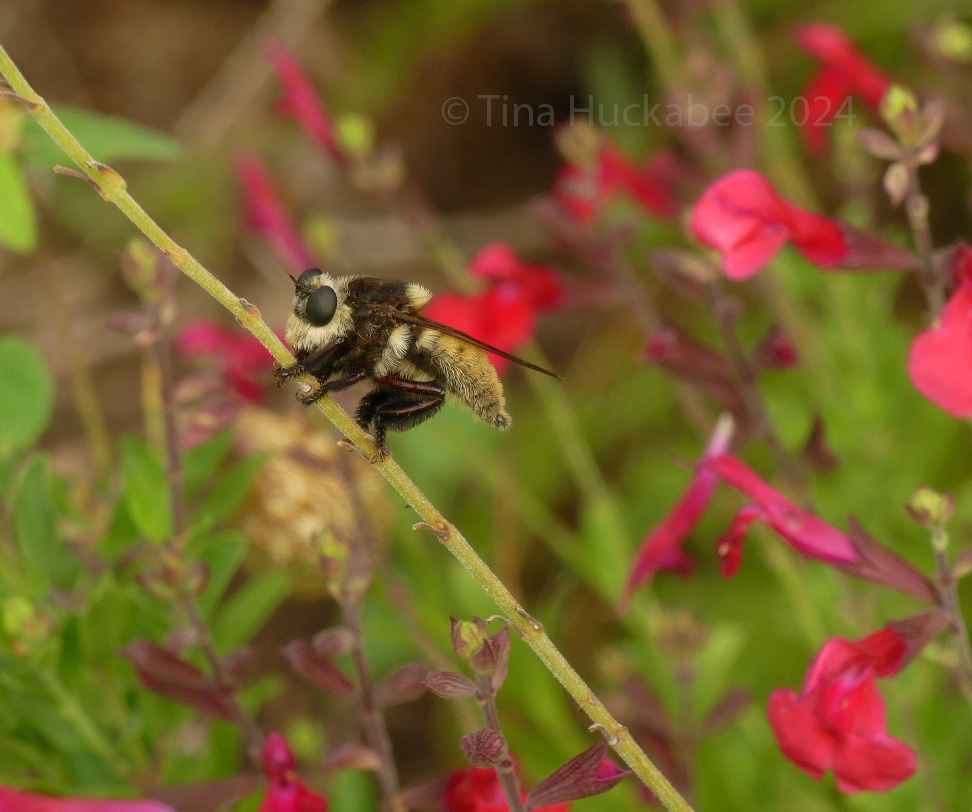
I knew it was a fly of some sort, rather than a bee, owing to its one pair of wings and its short antennae, and those impressive eyes. But what kind? I don’t think I’ve ever seen this insect before. Within a couple of clicks, I came across BugGuide’s page on the Southern Bee Killer, Mallophora fautrix. I love the way my bee killer clutches the stem, the rosy flowers of Autumn Sage, Salvia greggii, as colorful companions in the background. And that face, it’s adorable! The fuzzy legs look like they’re ready to spring into action–and they probably did, though I didn’t see it happen. According to information about bee killers, they perch on stems, awaiting a chance at hapless prey, ready to pounce on mostly honeybees and wasps. Well, my garden certainly has plenty of both kinds of meals for this dude. Good eating, bud!
The honeybee population in my garden is somewhat diminished as one of our hives, Woody, absconded earlier in June. If you’d like to read about absconding, this article is a good resource. At Woody’s previous hive check, all seemed well: there was capped and uncapped larvae, indicating a healthy, active queen, and some honey was being made. At the next hive check, shortly before we traveled in mid-June, there was no activity. Nothing. The bees were gone; they ate all the honey before they left, they didn’t say why they left, nor did they leave a forwarding address! I suspect they left because of some heavy rain, but only the bees know why they took off for different digs. I hope they landed in a safe place. Bees abscond sometimes (rain, or heat, or…whatever), but it’s a bummer for a beekeeper. Still, having one hive (which is thriving) to check on every two weeks makes hive checks quicker and I don’t mind that during the hot summer.
There are butterflies in my garden, but only this Large Orange Sulphur, Phoebis agarithe, deigned to stay relatively immobile for long enough to snap a pic. These yellows, and their smaller yellow cousins, are common in the late summer and autumn garden.

This coming week is a week of rain. Rain in July, what a concept! I’ve pruned some plants, now they’ll flush out with renewed glory. I’ve even transplanted some plants–a rarity in mid-summer–and those might just survive. The garden continues its production for summer and is preparing for a new season in just a few short months.
 My Gardener Says...
The Carpenter Bee looks like a little alien. I was wondering how your hives were doing.
LikeLike
That’s exactly what I thought! It has a cheeky look about it, too!.
LikeLiked by 1 person
You’re funny: “The bees were gone; they ate all the honey before they left, they didn’t say why they left, nor did they leave a forwarding address!”
After rain here yesterday, the forecast for a good chance of more every day in the week ahead does indeed seem a novelty for the latter part of July.
As soon as I saw your bee killer I imagined it was some kind of robber fly. After I followed your bugguide link I confirmed that it’s indeed in the Asilidae group, known as robber flies.
LikeLike
‘Robber fly’ doesn’t sound nearly as dangerous as ‘bee killer’ though!
LikeLike
We also had a hive abscond, right before nectar flow. Sigh. Bees are such fascinating curious little creatures, with their own minds for sure!
We’ve got the sulphurs in our garden too – although they usually don’t arrive in North Carolina until later/August. It’s been August-hot for over a month though, so maybe that’s why, ha
Beautiful pictures!
LikeLike
Thanks, Rebecca! Our hive vamoosed before nectar flow, too! Maybe that’s a thing they do? Little scamps! I always tell people that beekeeping is 2/3 science and 1/3 art, the ‘art’ part being reading the honeybees’ minds!
The sulphurs are all so pretty, but I find them tough to photograph, as they’re particularly flitty and fast moving.
LikeLiked by 1 person
Lovely, lovey. And the pollinators are happy. Yay!
Beth@PlantPostings
LikeLike
Thank you, Beth–and the pollinators are very busy AND happy, it seems!
LikeLike
Reconstruction of the Norman Y. Mineta San Jose Airport eliminated the historical marker of the site where honeybees were originally introduced to the West. Such history should be more important.
LikeLike
That is a shame.
LikeLiked by 1 person
Yes, but almost no one here is from here. Not many are concerned about history.
LikeLike
That bee-killer is quite the character, with his furry suit and pants! My first impression was a type of robber fly, which we see here often. One like to perch on my clothesline for some reason!
Hope your rain is gentle as well as the temps. Autumn will be here before we know it!
LikeLike
Yes, robber fly is another of its names; I just though bee killer had a certain drama about it. 🙂 The rain has mostly been gentle; it’s just been such a long time since we’ve enjoyed a wet summer. I forgot how nice it is.
LikeLiked by 1 person
The cenizo around here began blooming like crazy on Thursday or Friday (I can’t remember which), and sure enough: here came the rain. We’re certainly happy that it’s ‘rain without a name,’ but it’s going to keep us wet for several days.
After Beryl, one of my favorite weather dudes discovered that a really large tree that went down in his yard not only was hollow, it was filled with an enormous bee colony. Being a knowledgeable and responsible sort, he called a beekeeper who removed the bees and moved them to a more suitable spot. He did mention that he’d been seeing more bees than usual in his yard!
That’s a lovely photo of the orange sulphur. I don’t think I’ve ever seen one of those. I see other sulphurs, though — they do seem to be especially flitty!
LikeLike
My Cenizo is going nuts, and I’ve got a lot of it this year, considering some wayward seeds made their way into my rock garden, and now I have three new cenizos. My yard is a cloud of purple now. Also got some bonus lantana seeds blow over in from a neighbors yard, so lots of blooms I didn’t have to pay for or plant this summer.
LikeLiked by 1 person
The cenizo shrubs have had a really good year. Mine has been in nearly constant bloom. I saw one this morning while I was walking that was absolutely stunning and covered with pollinators.
LikeLike
It’s definitely a wet summer, to be sure. I’m glad a beekeeper was called. They love to find bee hives that need new homes, and I’m sure the bees were happy to be placed somewhere safer!
I’m happy to see my cenizo so flowery this year. It gets just the minimum of full sun, so its blooming has always been limited–but not this year! The native bees are really loving it!
LikeLiked by 1 person
I think many gardens are the result of trial and error. I know ours is another example! We live, plant, regret, and learn. But meanwhile, we should enjoy those plants that are doing well and are feeding wildlife.
Sorry you lost one of your bee hives. Let’s hope they are alive and well somewhere else.
LikeLiked by 1 person
Oh, that’s certainly true. One learns more from mistakes than successes, both in life and gardening. 🙂 And I do enjoy what grows and what visits! Like you, I hope our Woody bees found a safe home, maybe high up in some tree, where no one can see them and they’re safe from the over-pruners.
LikeLike