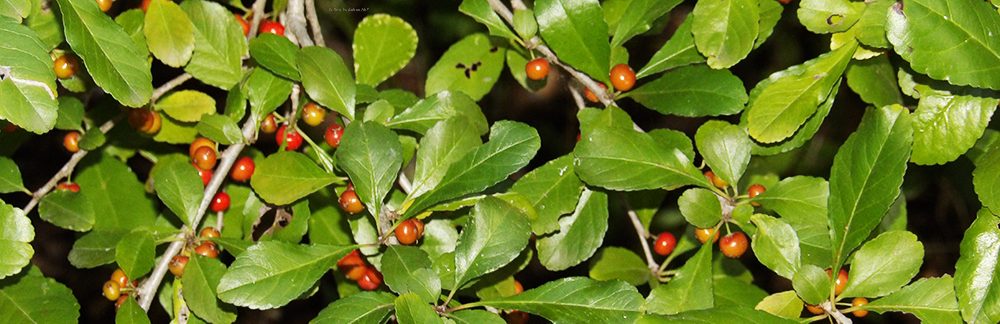
As it happens most years during the first deep freeze of winter, Frostweed, Verbesina virginica, has graced my winter garden with its swirls of ice sculptures.

Along with the most common name of ‘Frostweed’ which pays descriptive homage to this winter phenomena, ‘Iceplant’ and ‘Iceweed’ are also names for V. virginica.

Twirls-n-curls of ice ribbons form, usually at the base of the plant, when the temperature drops significantly below freezing.

As the freeze deepens, water in the stems is released, freezing in beautiful formations along the stems, undulating around the base of the plant and often traveling upwards along the stem.
In this photo, at the top left, notice burst open stems. Ice crystals have filled the gaps.
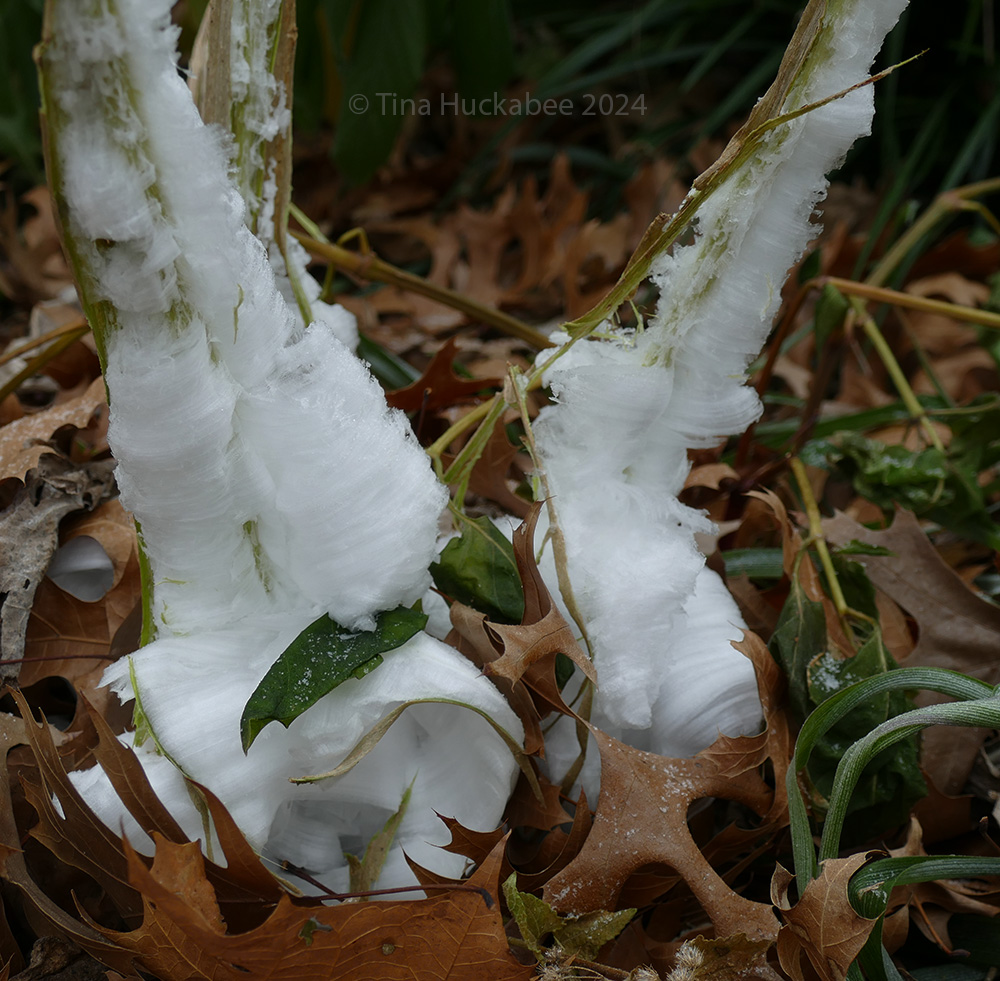
The ice sculptures themselves have many names: ice ribbons, ice flowers, ice fringes, ice fingers, ice filaments, ice leaves, frost flowers, frost ribbons, frost freaks, frost beards, frost castles (Forrest M. Mims III), crystallofolia (coined by Bob Harms at The University of Texas), rabbit ice and rabbit butter. I think ice flowers and frost flowers are the most poetic of the names, and frost freaks and frost castles the quirkiest. I typically refer to them as ice ribbons.

Frostweed is particularly well known for extravagant ice ribbons, but many plants produce similar ice crystals during the first freeze. In my own garden I’ve seen various salvias, lantanas, and other asters form ice ribbons around their frozen stems, but none challenge the beauty, complexity, or size of those created by Frostweed.
All of these ice ribbons are from Frostweed plants and their appearance in the garden is as brief as they are beautiful. Once the freezing conditions are finished and the temperature rises, the delicate crystals melt. The ice ribbons will not form again until next winter’s first, hard freeze. Ice ribbons are once, and done, and ephemeral.

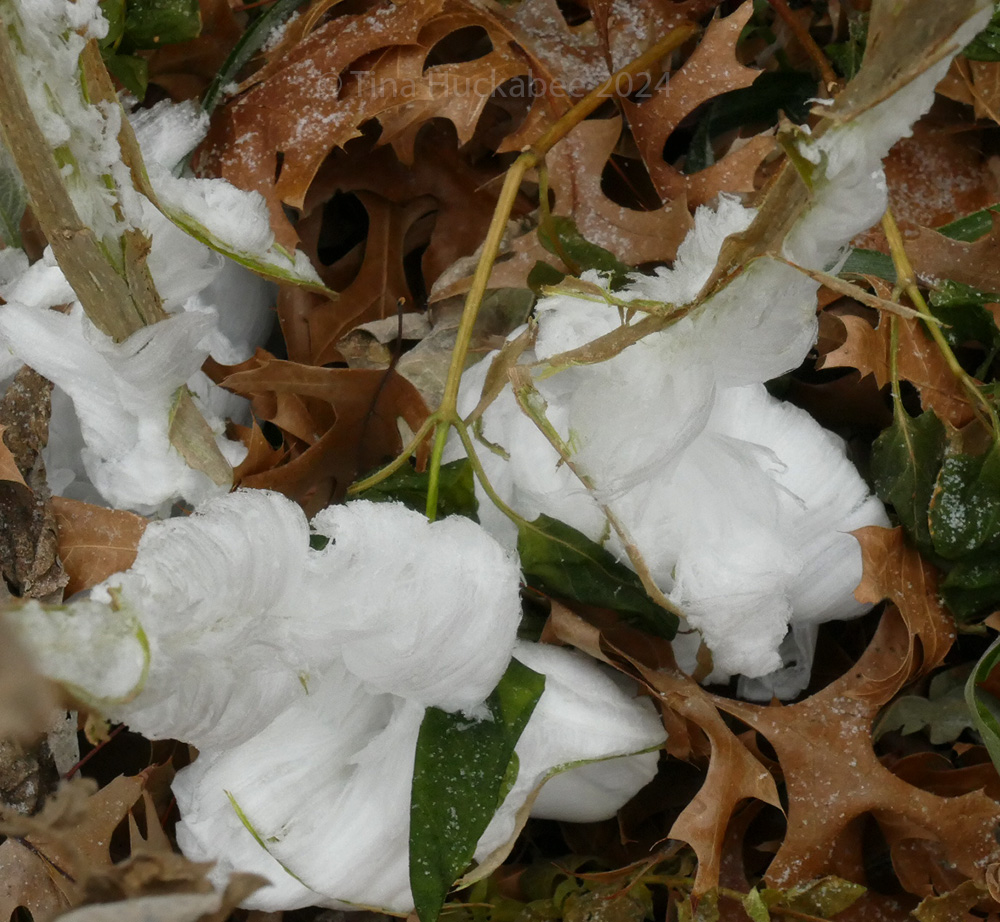
I pruned back this Frostweed in November, planning to remove it from the edge of my garden. I left just a bit of stem and root, mostly out of forgetfulness or laziness or some combination of both. I’m glad that I didn’t yet remove what’s left of the plant.

What a lovely gift on this frigid day.
As I walked through the garden, bundled, but cold, a Northern Mockingbird chirped. It allowed let me get close to where it perch, fluffed feathers and all, in the Red Bud tree. We shared a moment in the quiet cold.

 My Gardener Says...
This is so cool! I’ve never heard of or seen ice ribbons. Maybe it’s in the colder climates? They’re quite beautiful.
LikeLike
The are beautiful. I’m not really a good enough photographer to really capture their beauty, but up close and personal, they’re magnificent! I live in Central Texas, so generally, we’re not that cold, but we do receive some very cold days most year and that’s when frostweed and some other plants make their ice sculpture.
LikeLiked by 1 person
I like your catalog of the many names people have given to this kind of ice. In your pictures you’ve documented some enticingly quirky curls of it.
My experience is that a given frostweed plant can extrude ice more than once, though in a smaller—often much smaller—amount. I’ve yet to come across an explanation of why some frostweed plants don’t get triggered even though nearby one do. Whatever the reason, it leaves open the possibility that a season’s second or third freeze may trigger a frostweed plant for the first time, which results in the maximum amount of ice for that plant.
LikeLike
These names came from the LBJWC page on Frostweed and I added the link. There are quite a few names!
It’s interesting that you’ve seen frostweed do the ice capades more than once, I’m not sure I’ve seen that, or, maybe I just haven’t paid close attention. I checked all of my plants yesterday, assuming that the sculptures would be there, but there wasn’t much. I guess it took 17 degrees for that to happen! 🙂
LikeLike
I just saw a post in a Texas nature group on Facebook from someone who said that when she went back to a frostweed plant she found more ice on it than in had had the day before. Let’s hope your frostweed ice keeps increasing until the eventual thaw.
LikeLike
This stuff is SO weird! Even if it grew here, it would not react like this without significant frost.
LikeLike
Thanks for the info! I’ll be sure the check things out in the morning…once it warms to, oh say, 25F. 🙂
LikeLike
Thanks for sharing these ephemeral beauties with us, Tina. I’ve seen quite a few frostweed photos on Facebook too. Always fascinating. They remind me of those old-fashioned ribbon candies, only more delicate.
LikeLike
They really are remarkable and up close, so sheer and delicate. I just found a couple more in my back garden that I didn’t see earlier. No more photos though in this 22 degrees. 🙂
LikeLike
Such a beautiful and fleeting event, pretty phenomenal!
LikeLike
I look forward to the sculptural art every winter, Eliza!
LikeLiked by 1 person
I really enjoy seeing frost ribbons in your garden, so beautiful, and surprising to me! I’ve yet to see anything like it here in Wyoming.
LikeLike
It’s certainly something to look forward to seeing, once the cold sets in, but I wish the sculptures would last longer. We’re forecast to get to 34 today and that’ll probably be it for the year.
LikeLike
We’re at 22 this morning, so we share temperatures, if not ice plants. I know where there are a couple of stands of frostweed, but they’d require driving, and driving over a couple of bridges, so I think I’ll pass on a possibly unsuccessful search. If I had some in a garden, it would be a different matter. As it is, I’ll just enjoy yours. It is a wonderful phenomenon, and you certainly have some beautifully formed ice.
In a minute, I’ll content myself with going out to see if there’s ice in the birds’ bowls. I suspect there is!
LikeLike
It’s 17 here, but we’re forecast to get to 34 today and if that happens, no more ice ribbons.
In a little while, I’ll heat up some water for our birdbaths, but with the pond’s waterfall and since I drip (more like a stream…:) my outdoor faucets, there is some water for the critters. I’ll be glad to warm up just a bit, but there’s another front on its way and we’ll be right back to the 20s by the end of the week. Still, I think it’s clear today, so I’ll enjoy the sun.
LikeLiked by 1 person
Thank you for sharing your frosty beauty, Tina. This is not a phenomenon I have ever witnessed in person, but I find it very intriguing.
I hope things will warm up again soon, both for you and your garden residents and visitors.
LikeLike
Thanks, Tanja. We have warmed a bit and I forgot to check the ice sculptures this morning, but I assume they’re gone now. They are brief in existence.
LikeLiked by 1 person
I have only read about them on yours and Steve’s blogs.
LikeLiked by 1 person
It’s so fascinating. I love to see posts about this plant this time of year. We don’t have this particular plant here; I think it’s hardy to zone 8. So it’s fun when people share photos of the frozen ribbons. 🙂
LikeLike
The ice sculptures are winter gifts! Alas, mine are gone, probably until next year. Glad you enjoy the photos, Beth.
LikeLike
I got a kick out of how many Texans were sharing frost flower photos this week! we have to have something to brighten our week!
LikeLike
Me too! Photos of Frostweed swirls were everywhere this past week. Almost worth its own post. 🙂
LikeLike