Migration season has arrived and the first bird that I’ve identified as a non-resident and stranger to these parts is this handsome Eastern Kingbird, Tyrannus tyrannus. According to Cornell Lab of Ornithology’s map, my area here in Austin, Texas is on the edge of its breeding range, but I’ve never seen an Eastern Kingbird before, though Western Kingbirds are fairly common.

This visitor perched in the Red Oak tree near my pond, fluttering occasionally over the pond itself, presumably snacking on insects. A flycatcher, Eastern Kingbirds eat insects, hunting them on the wing. They also enjoy small reptiles and fruit, especially in their wintering grounds in South America.
King then spent time in the smaller Roughleaf Dogwood tree, Cornus drummondii, which is full of ripe berries for the munching. I didn’t see the bird eat any fruit, but Kingbirds routinely nosh on fall and winter fruits, and that is exactly why I planted a couple of these hardy and attractive small trees: spring flowers for the pollinators, fruits in late summer/fall for the birds.

Cornell’s Kingbird information mentions a red crest that these territorial and aggressive birds flash as a challenge to a predator. This one didn’t exhibit any red that I saw, though it clearly has a defined crest. I’m guessing this is a female or juvenile male bird. As adorable as it looks, these birds are bullies! They have no problem going after bigger birds like hawks and crows, and are aggressive with other birds and small mammals. Apparently, this bird is appropriately named in both its common name (Kingbird) and its scientific name (Tyrannus tyrannus). The good folks at Cornell remind us that the term Tyrannus means “tyrant, despot, or king.”
The Hub and I are planning a wildlife/birding trip to Costa Rica in the not-too-distant future and in a phone call with the guide that we’ve hired for the trip, I mentioned that an Eastern Kingbird had visited my garden. He commented that Kingbirds were “good-looking birds” (I agree!) and mentioned that in Costa Rica, they travel in in big flocks. I wonder if this bird will be in Costa Rica at the same time we visit–maybe we can exchange travel stories!
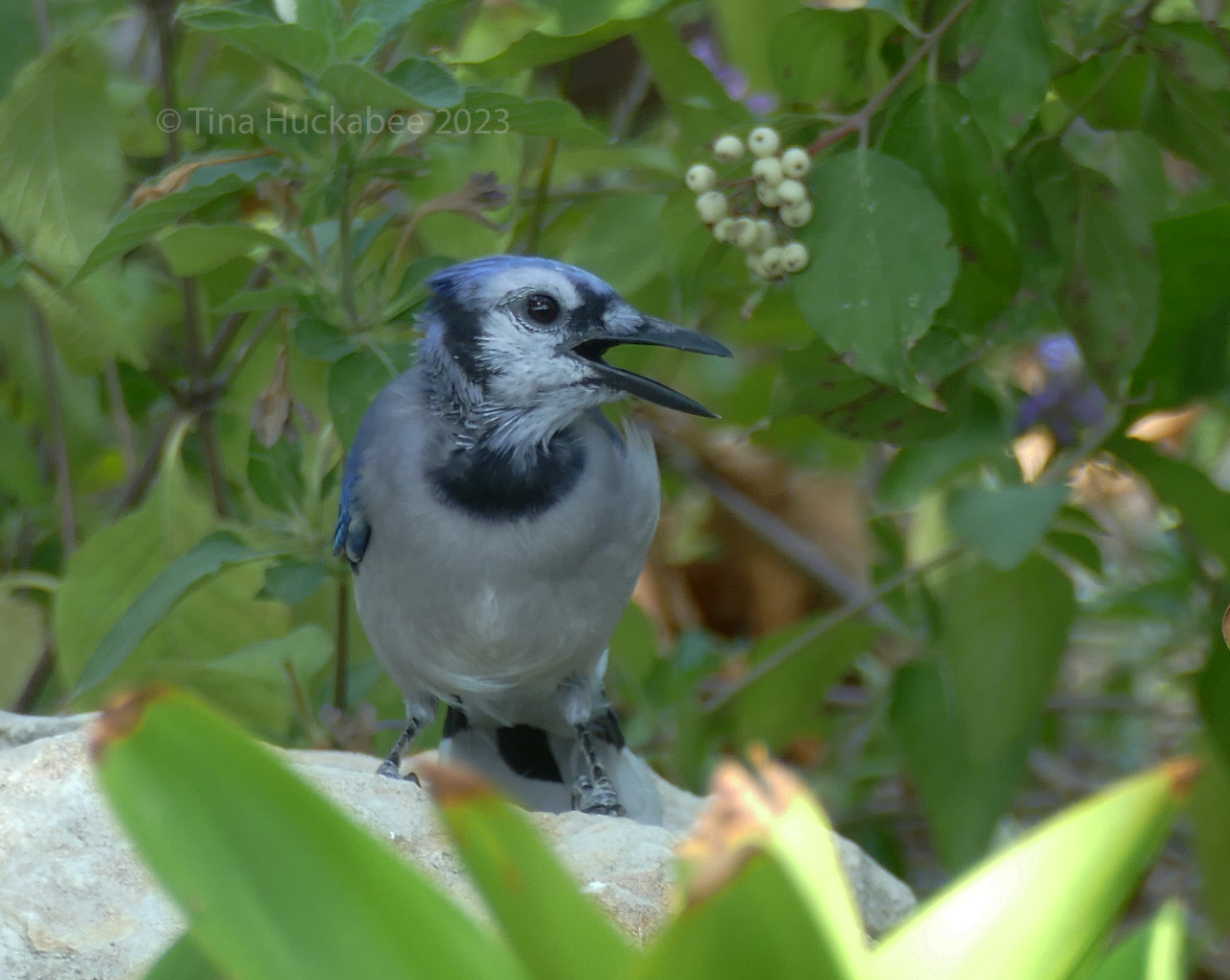
The King looks cute-n-goofy in these photos, but it was hot outside, thus the open beak.

A resident Blue Jay popped into the scene, but kept its distance from Royal Highness.
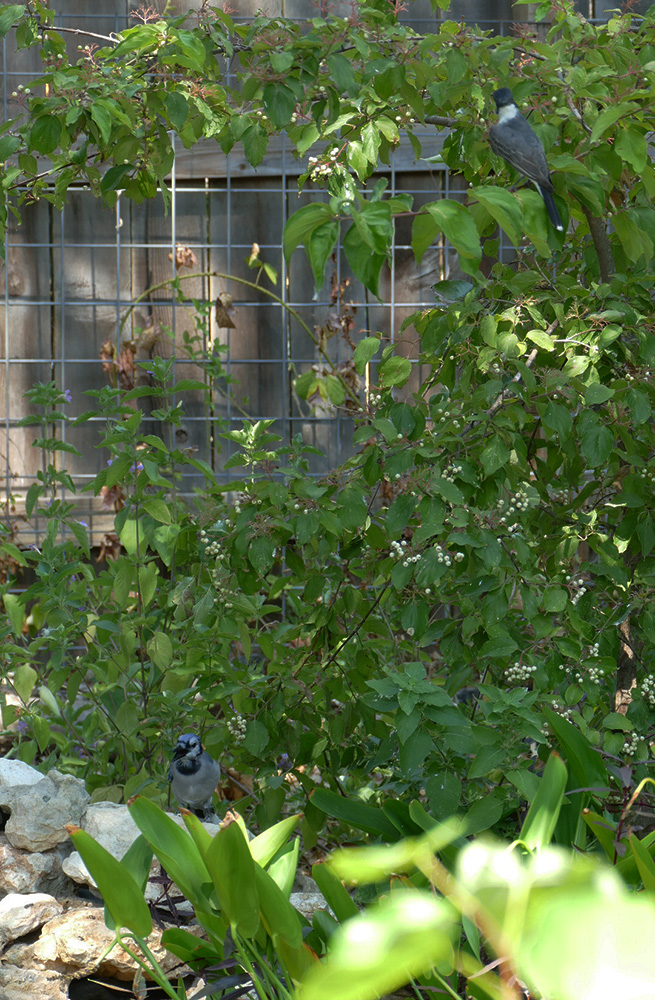
Kingbird perched in the Dogwood, above the lowly Jay, no doubt lording over its temporary territory. The Blue Jay stayed near the bog area of the pond, just hanging out, being a Jay.
Bird migratory season has arrived. I don’t see either the variety or numbers of birds in fall migration as during spring migration, but it’s time to keep a keen eye on the pond and gardens for more than the usual suspects. It’s time to observe and appreciate their beauty and contributions to diverse ecosystems. My garden will serve as a respite for shelter, food, and water for these remarkable creatures during their long, arduous travels.
 My Gardener Says...
Have you ever been able to determine whether any individual migratory bird has stopped in your yard in different years?
LikeLike
That’s an interesting question and I’ve wondered if I have repeat visitors, but no, I don’t know that. I’ve always wondered how they find my garden. I don’t live in a gardening neighborhood, most people just have grass, though we do have nice trees.
LikeLike
There is usually a nesting pair of kingbirds in the field above our house where a lone oak is their aerie. He is very vocal about proclaiming his territory! Bossy birds, but I like them.
I’ve been seeing many migrants coming through the past few weeks. Cornell’s Birdcast is lighting up! I miss our summer friends when they leave. 😦
LikeLike
Oh, I’m a little jealous! I thought the Kingbird was really a pretty bird. I would love to see a family of them. I felt very fortunate that he/she stopped by my garden. I’m trying to water a bit more than I usually do for the hummingbirds as they gear up for their migration. I grow quite a bit that they like, but with our drought and heat (which has abated…a bit!) there’s not quite as much blooming right now. I’ll be curious to see the migratory birds come through the city more than usual, as all of Texas is pretty dry.
LikeLike
I hope more folks like you are putting out water sources for the wildlife. Such a tough journey they must endure, they can use all the help they can get.
LikeLiked by 1 person
I think lots of people are doing just that, but in the stretches of rural land with dry creeks, I wonder how the bird and others will fare?
LikeLike
I saw about 10 Eastern Kingbirds while birding at Aquarena Springs this morning. They must be passing through. I’m sure they’ll be happy to escape the Texas heat!
LikeLike
That’s exciting, Barbara! I hope I see more of these birds, they’re so pretty!
LikeLike
He’s a handsome fellow. Your birding trip sounds like a lot of fun and excitement.
LikeLike
It’s a pretty bird, to be sure. We’re looking forward to the trip. Everyone I’ve ever spoken with about Costa Rica who have traveled there loved it!
LikeLike
Your trip sounds fabulous! I sometimes watch the Panama fruit feeder cam that Cornell maintains; I’ll bet that some of the species you’ll see have been caught on that cam. As for the Kingbird, I’ve seen exactly one: atop a dead tree on the edge of a Louisiana bayou. Whether it was Eastern or Western I can’t say, but I’d bet on Eastern.
Sometimes, migration is signaled as much by absence as by presence. I realized last week at work that the swallows are gone. The coots are much the same. They arrive and depart without a sound. They flock up, and then they’re gone. Or, they suddenly appear in the marinas. It’s always fun to look up and realize a ‘scout’ or two have arrived. At that point, it won’t be long until flocks appear.
On a different topic entirely, I found the Kevin Cole poem about bees and honey extraction. I’ve learned enough from your posts to be able to appreciate it!
LikeLike
We’re excited too about the trip! I just got my typhoid vaccination and I did the Heb A/B a few years ago. Other than malaria pills, hopefully that’s it!
The Western Kingbird is tan and light yellow, so they do look different. I don’t know about the Panama cam, I’ll need to look that up. The guide we’ve hired (recommended by someone) has mentioned the various birds we’ll see, or likely see. I did tell him that rather than being a uber-birder (which I’m not) I’m really interested in the pollinators and plants. He’s seem just fine with that. I think Costa Ricans are pretty proud of their gorgeous little country.
I love this poem! Thank you so much for sharing it! I also enjoyed the one you profiled. I looked him up and read a couple of other poems, they were lovely.
LikeLiked by 1 person
You must always have your camera ready. I am not seeing the fall or spring migration that I have in past years. I believe I have had a repeat winter hummingbird that returned for several years. I did contact a local expert and he said it was very likely. The bird perched in the same place and displayed the same behaviors. I can’t wait to see photos of your trip!
LikeLike
Great photos
LikeLike
Thanks!
LikeLike
Congratulations on receiving the royal stamp of approval on your garden, Tina!
I love black-and-white birds and always enjoy seeing or hearing Eastern Kingbirds. It would be nice to reconnect with him/her in Costa Rica. If only there were a way of knowing. 😊
LikeLike
Like you, I really like black and white birds, so I was chuffed to have this one visit. Others are coming through, but I haven’t seen another Eastern Kingbird.
Wouldn’t it be wild to see the same bird(s) in a different location? 🙂
LikeLiked by 1 person
Maybe you can mark it with a little dab of paint somehow, so you can recognize it again. 🙂
Just kidding! But it would be amazing to see it again in Costa Rica.
LikeLike
What a great bird!
LikeLike
It really is, Donna!
LikeLiked by 1 person
There’s been a resident eastern kingbird here for the first time, I think. The kingfisher never stayed long this summer. The great blue heron also stopped visiting. Another name is “butcher”. I believe it. I am happy the eastern kingbird protected the comet and koi in the pond though.
LikeLike
It’s a beautiful bird, to be sure! I’d never seen a kingfisher, but just returned from a trip to Costa Rica (truly awesome!) and saw four of their six kingfisher species. So fun!
LikeLike