Symmetry

I was adjusting the blinds at one of my front windows, when I stopped to appreciate, then photograph, this late afternoon, late winter scene.

The ceramic container holding the American century plantAgave americana, is hugged by a cushion of poppy greenery.  I should have thinned the seedlings long ago, but their verdant green beguiles, enchants the gardener, and therefore remain.  As the weeks pass and the days lengthen and warm, the poppy stalks will grow to at least 18 inches in height, eventually topped by scarlet blooms, with plenty of pollinators in attendance.

Just behind, Big muhly grass, Muhlenbergia lindheimeri, acts as a halo, fanning out  gracefully, late day sunshine highlighting leaf and panicle which are toasty at the upper ends, spring green near the bottom.  That green indicates the time to prune in nigh;  I’ll trim all of my grasses in the next week–the last of my winter pruning–in preparation for new growth, a new season.  Of course in nature, these grasses aren’t pruned by anyone, they simply continue:  brown-to-tan leaf structure sloughing off, its work done, making way for the new, the green–a process practiced and followed, year in and year out.  

An evergreen Barbados cherryMalpighia glabra, barely visible behind the muhly, echos fresh green growth, its dense cluster of foliage perfect for wildlife cover. Garnishing the scene and in the far distance, a neighbor’s Live oak tree, foliage intact, towers over all.

For more garden scenes, vignettes, thoughts, see Anna’s Flutter and Hum and her Wednesday Vignettes.
Escapee

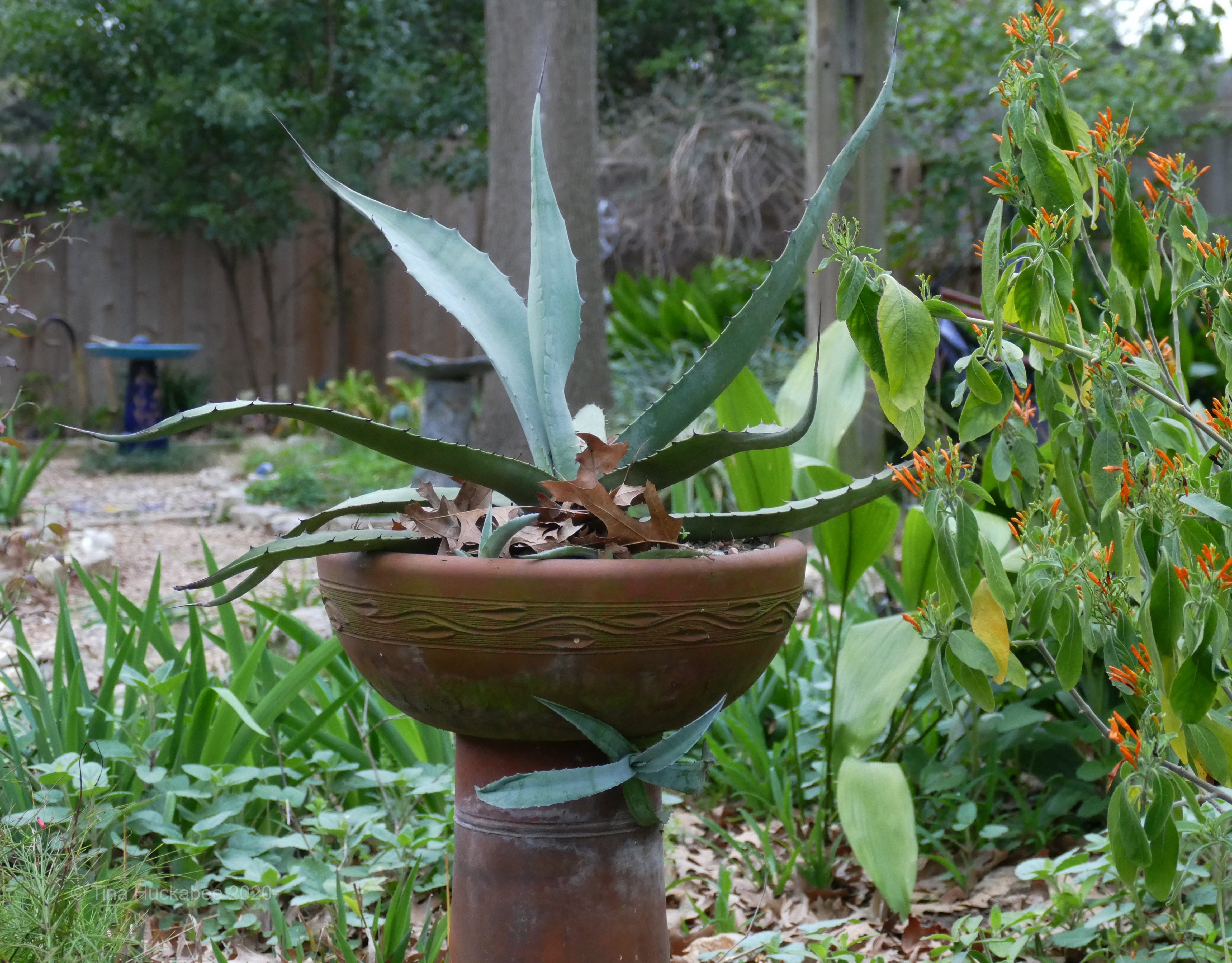
It looks like someone wants outta here!

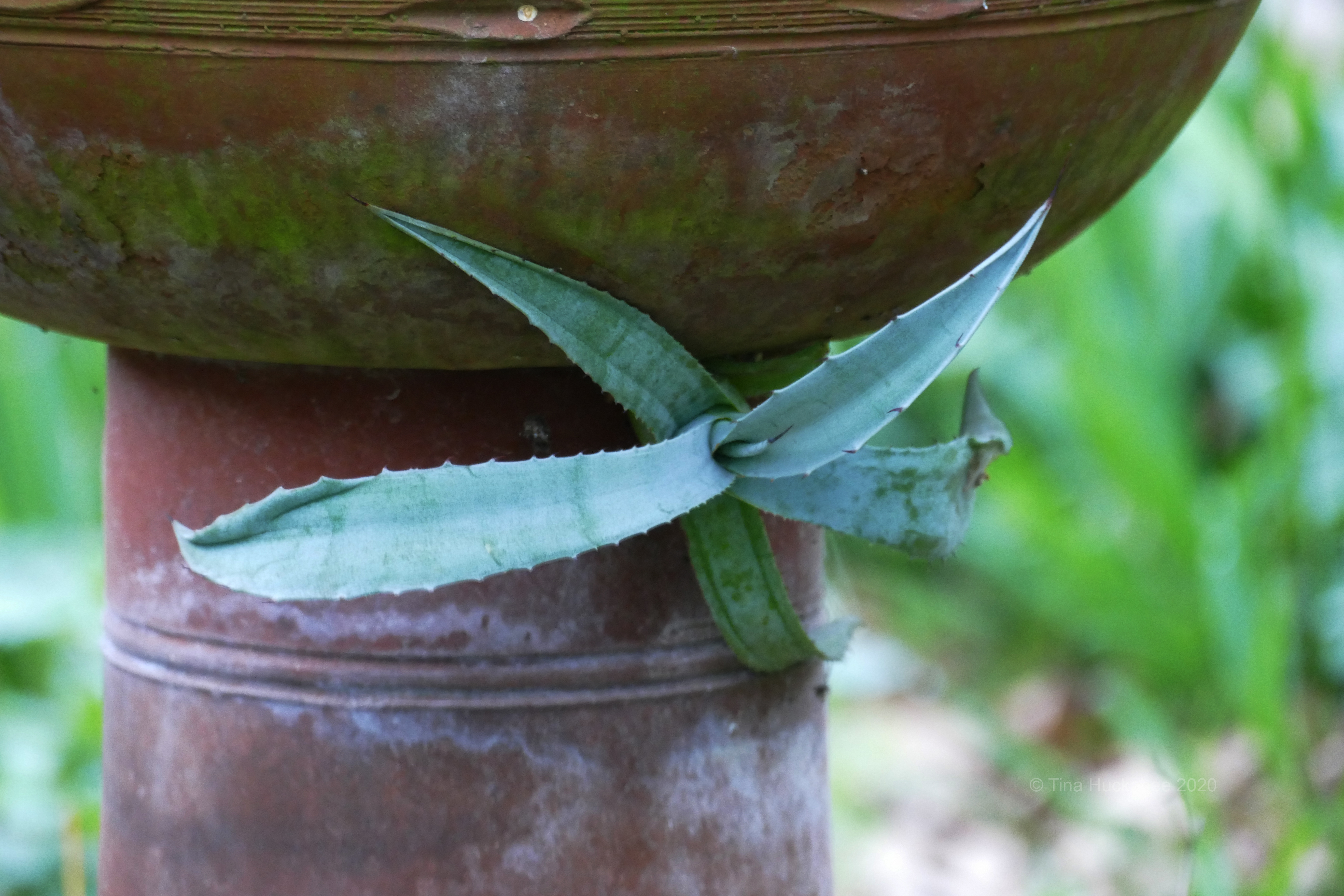
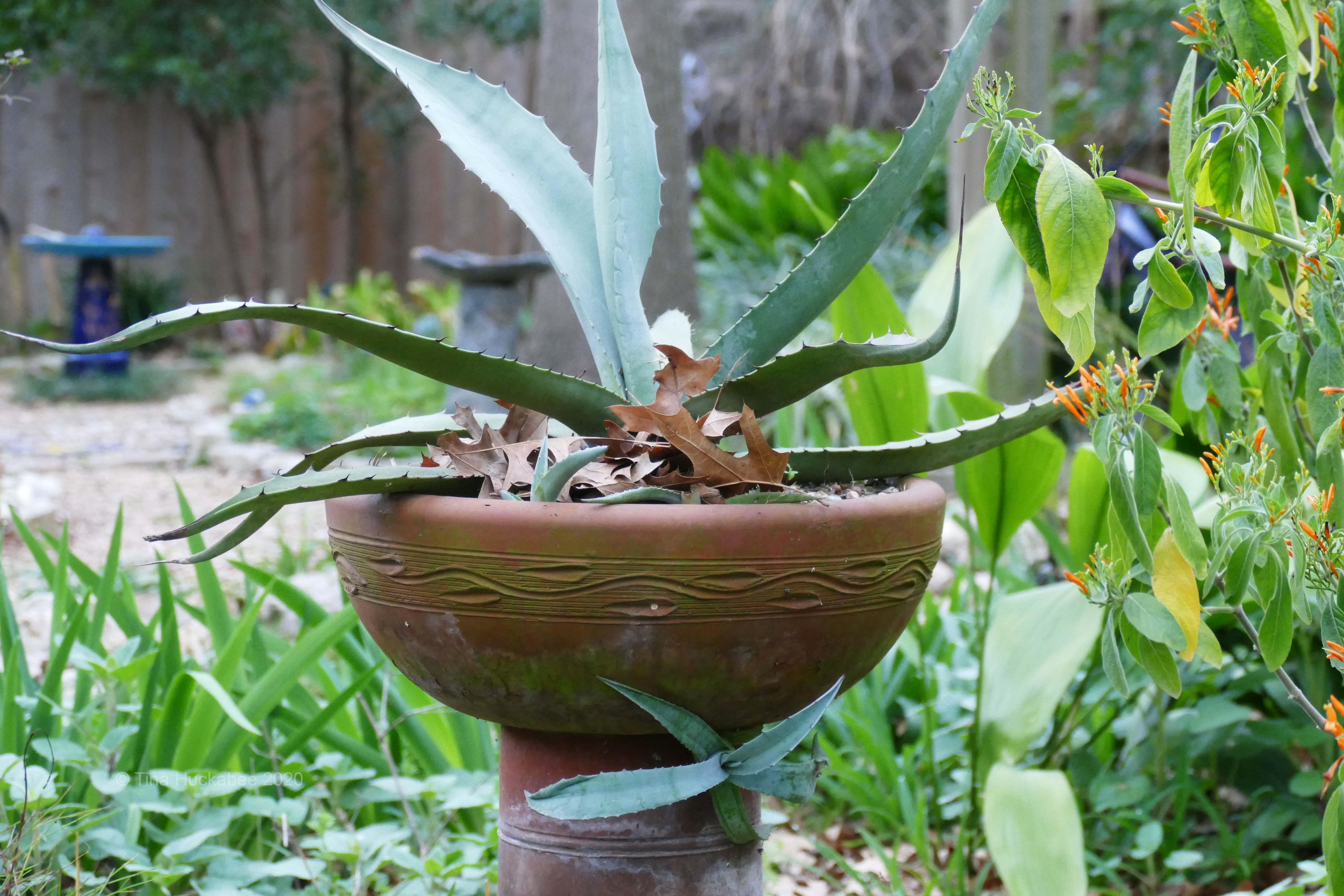
I’ve been watching this miscreant American century plant, Agave americana, for a while, since it was a wee pup.  It seems happy enough in its neither here, nor there sort of state.

Cheeky plant!

Playing hide-and-go-seek?

Sneaking out the back door?

Rocking the agave version of an agave bow tie to its matching agave hat?

Maybe its simply doing what this species of agave do: pupping right, left, bottom–where ever.  If you look at the base of the larger plant, there are two other pups, just waiting in the wings to grow up.  Also, there are fallen oak leaves which should have been picked out weeks ago, but those are even more temporary than the agave pups, which will be pulled soon.  For the leaves, a surgical strike with careful fingers will do the trick, but for the agaves, gloves are a must.

I grow several American agave specimens in pots and ONLY in pots; I never plant them in the ground.  In the ground, given time and space, they become too big, too unwieldy, too dangerous.  I’m not a member of the spiky plant club, not a fan of plants that poke me in places that don’t want poking–you know, eyes, arms, legs, butt.  That said, I think agaves as a group, and this species in particular, are quite beautiful, the color its own blue-gray-green marvel; truly a stunning plant.  The graceful-but-with-spikes-attached structure of these plants is eye-catching in the garden and a foil for the shrubs with  lush, soft, and archetypal, garden foliage.

So, all of my American agave plants grow in pots.  Even when they try to escape.

I haven’t decided how long I’ll let this scoundrel succulent hang out here, hiding from  the others, but for now, I see no reason to yank out its spiny self.  I’m interested in observing just how big this baby gets.

Maybe it’ll get as big as the one in the basin.  Of course by then, the one in the basin will be even larger and it may need yanking.  So like all gardening, it’s a never-ending saga, a tale as old as time.

For more garden sagas, check out Anna’s Wednesday Vignette.


Winter Oranges

Wet, cold, and gloomy describes recent days, but after all, it is February and some winter weather is expected.  My Farmhouse Delivery of local produce came yesterday, and with it, some oranges.   The the rogue grapefruit keeping the oranges company is from last week’s delivery and became my afternoon snack.  Yum.

Hamlin oranges and Ruby-red grapefruit from Texas valley farmers.  There were originally four oranges…

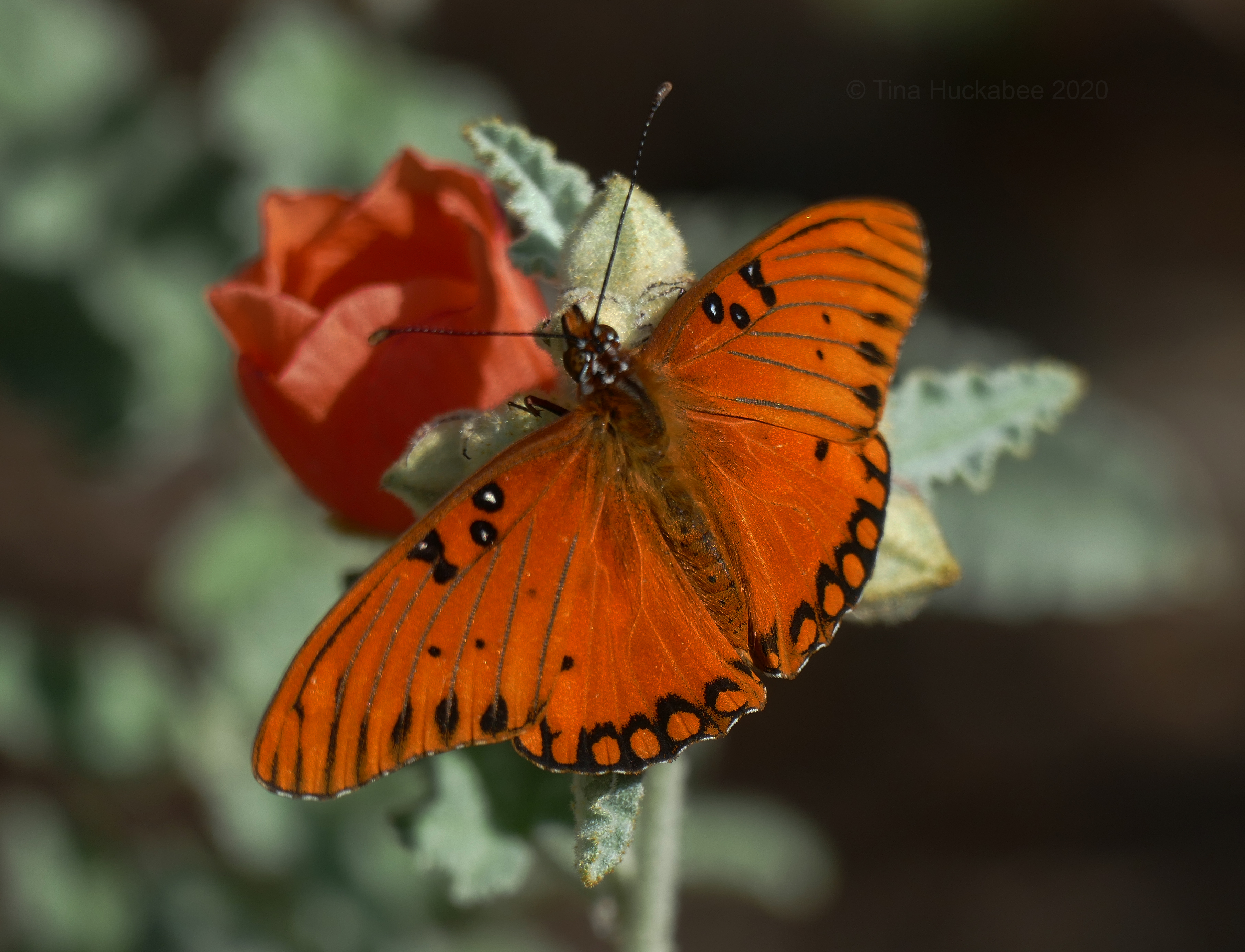
Fresh fruit aside, my real appreciation of winter oranges has recently resided with butterflies and blooms, here demonstrated by the orange-winged Gulf Fritillary, Agraulis vanillae, nectaring on a softer version of orange represented by a Globe mallow bloom, Sphaeralcea ambigua.  My garden has enjoyed a surplus of the fritillaries this winter because its host plant, passion flower vine, remains green and providing for fritillary caterpillars hatching from eggs.

Globe mallow is a cool season bloomer. It’s a native shrub to high altitudes in far West Texas and New Mexico, but grows well here in Central Texas–in the right conditions.  I struggled to find a place for this beautiful plant, but only have one spot where it’s grown successfully: it’s happily planted in a raised bed which is in year-round, full, west-facing sun.  The mallow has stunning grey-green, frilly foliage, paired with salmony-orange flowers.

Another orange winter beauty is the Mexican honeysuckleJusticia spicigera,  which blooms prolifically during our milder winters.  I especially like this plant because of its water-wise character in summer, its ability to thrive in shade-to-part-sun, and its role as a great pollinator attractor. During the warm months of the year, honeybees, native Carpenter bees, and a variety of butterflies all flock to these orange delights.  In recent weeks I haven’t noticed any pollinators on the tubular blooms, not even the active fritillaries, but I know the nectaring insects will be back for their “orange” juice in the near future.

The orange has brightened my garden this winter, because even with tepid temps, there aren’t many flowers abloom.  That will soon change:  I’ve spotted an iris and a columbine, each with at least one bud that should open in the next week or so.

The oranges cheer dull days, timely and welcome reminders of joy in color and life from gardens.

Thanks to Anna and her Wednesday Vignette.  Pop over to her beautiful blog and check out other February musings.