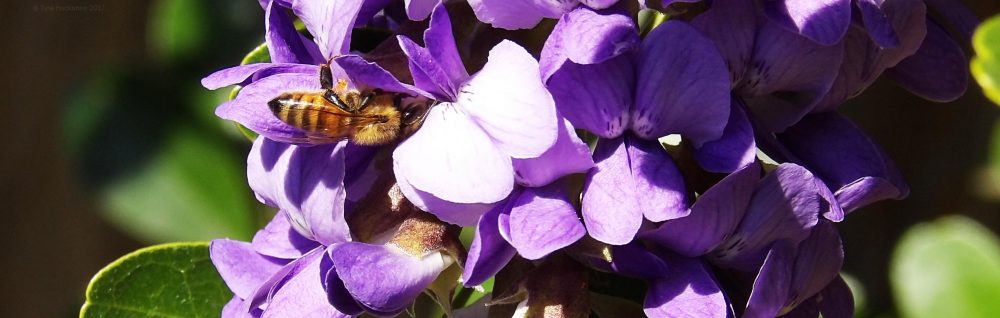
Bee Mama Missive: Bees–They’re What’s For Dinner

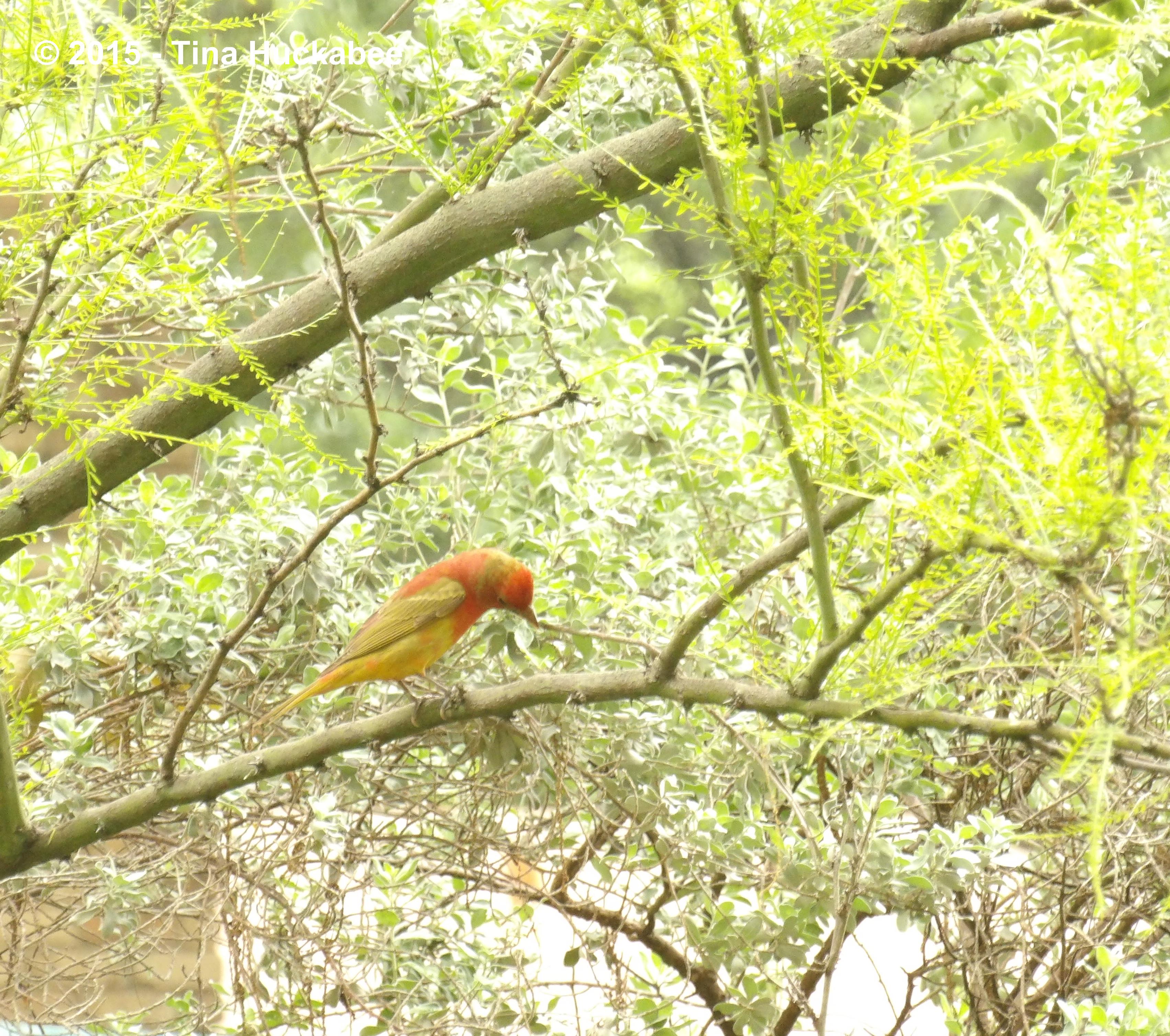
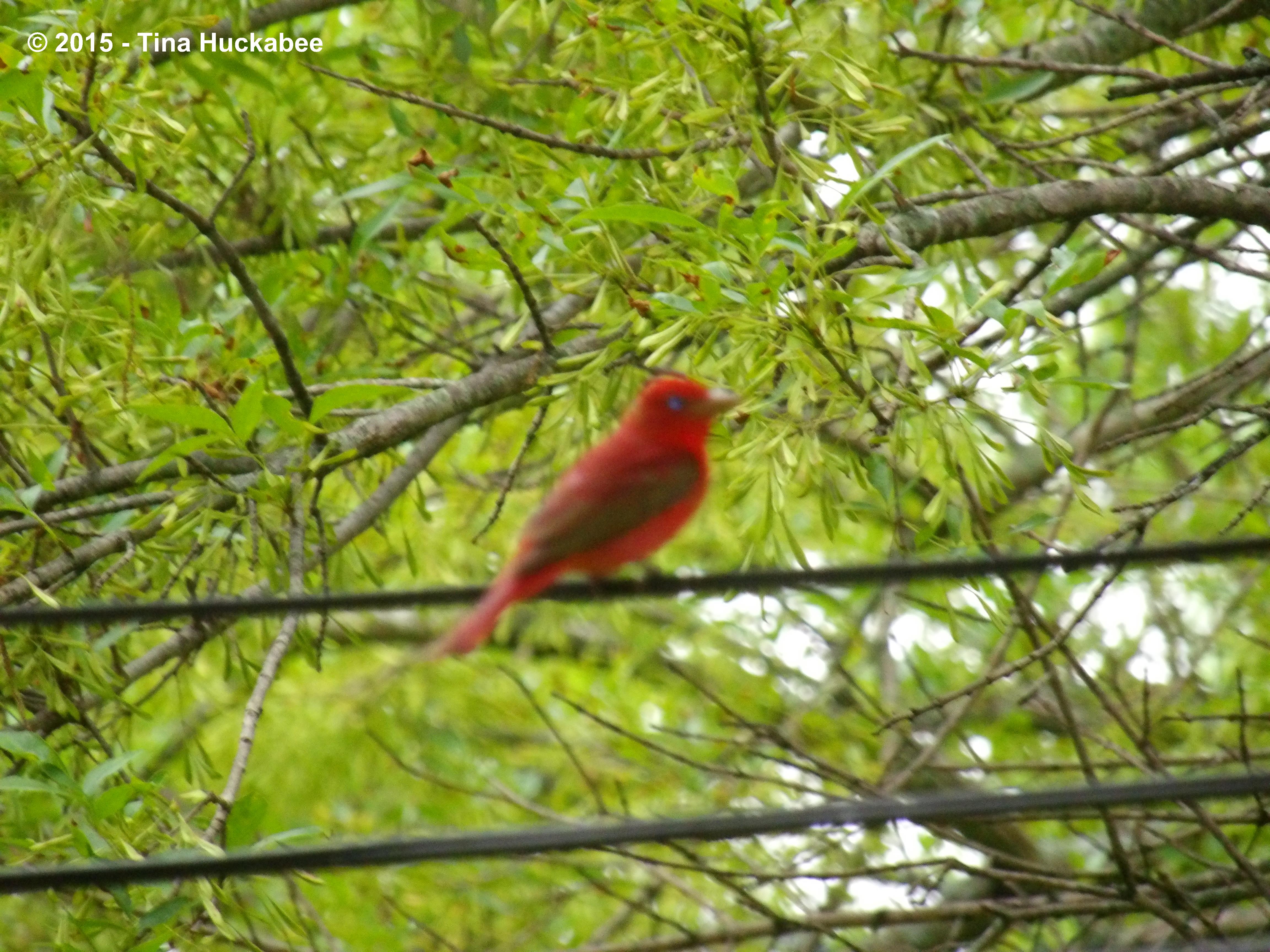
Paraphrasing an advertising tagline from the American beef production industry, I think Bees-they’re what’s for dinner is applicable  to the Summer Tanagers, Piranga rubra,  who are visiting my garden.  In the last month, I’ve observed at least three different Tanagers flitting around my back garden.
IMGP7685.new

IMGP7696_cropped_3728x2576..new

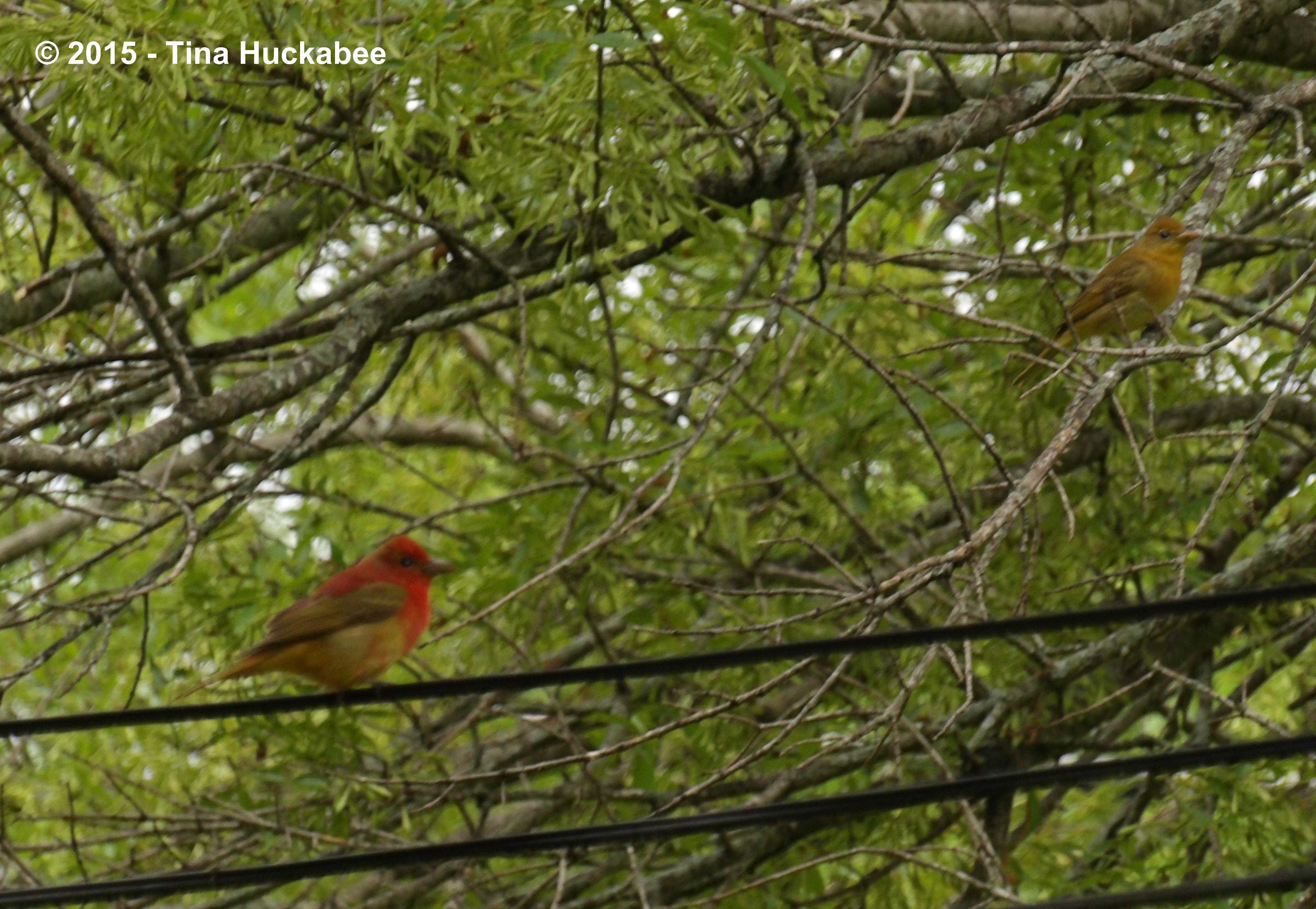
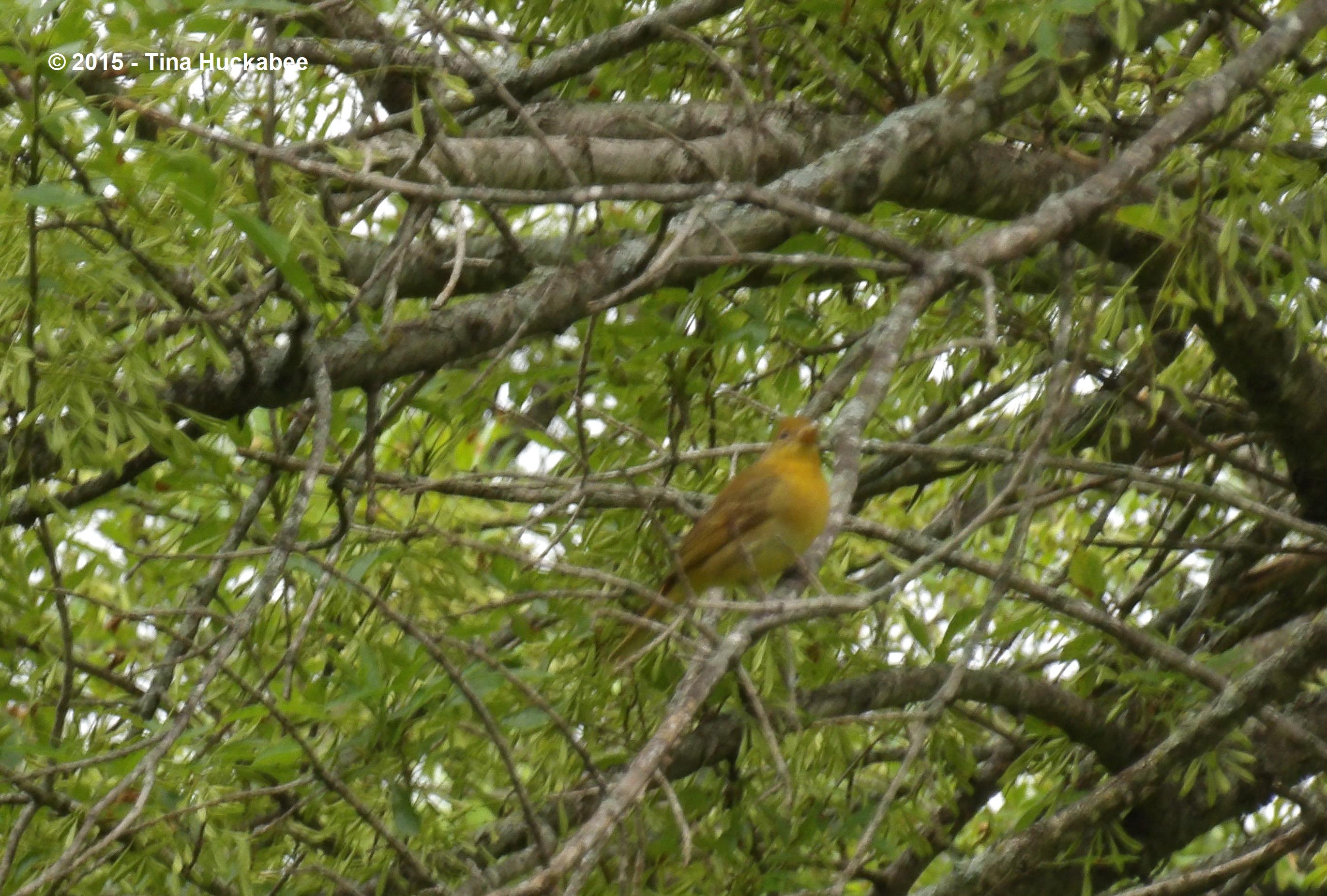
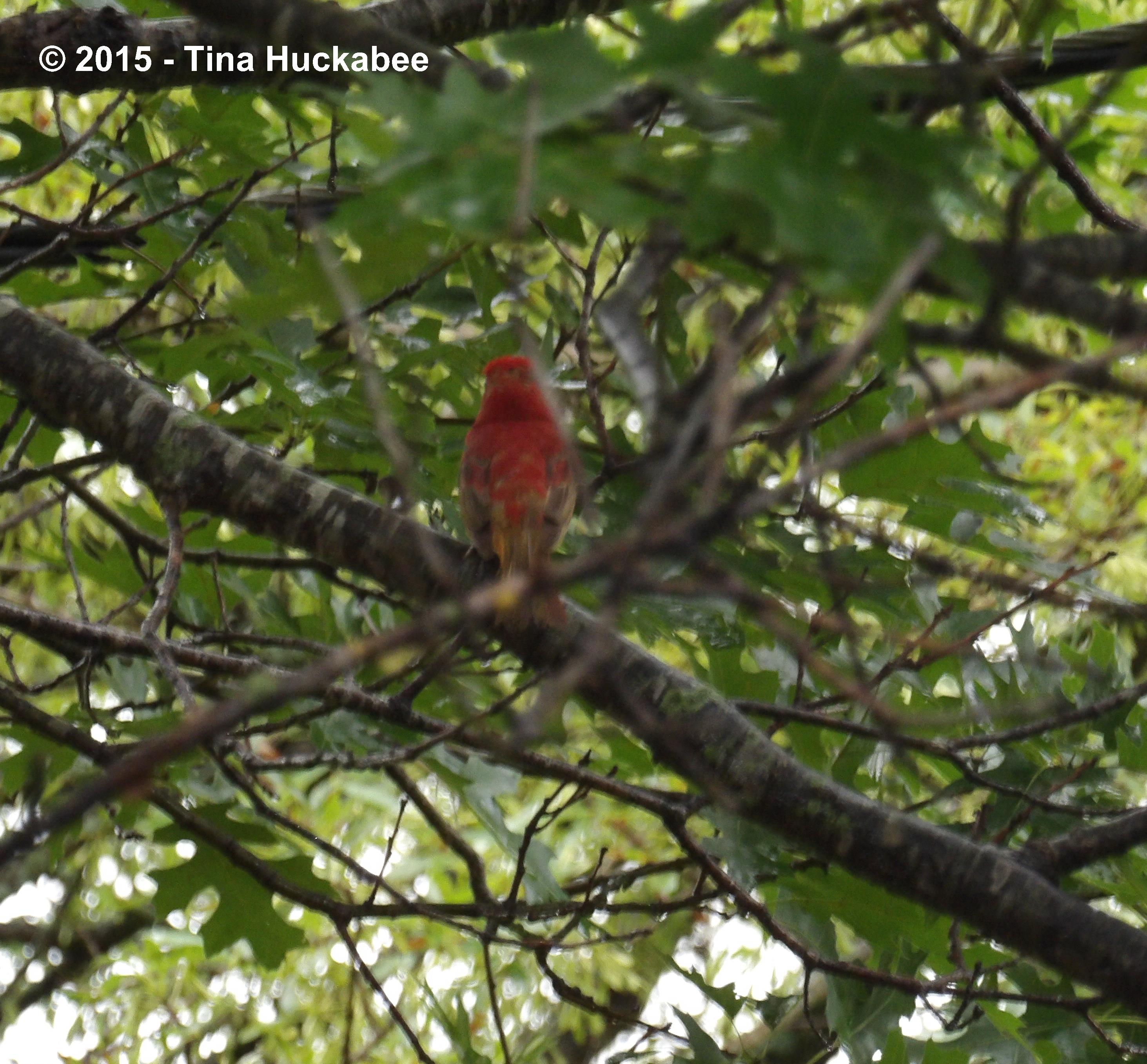
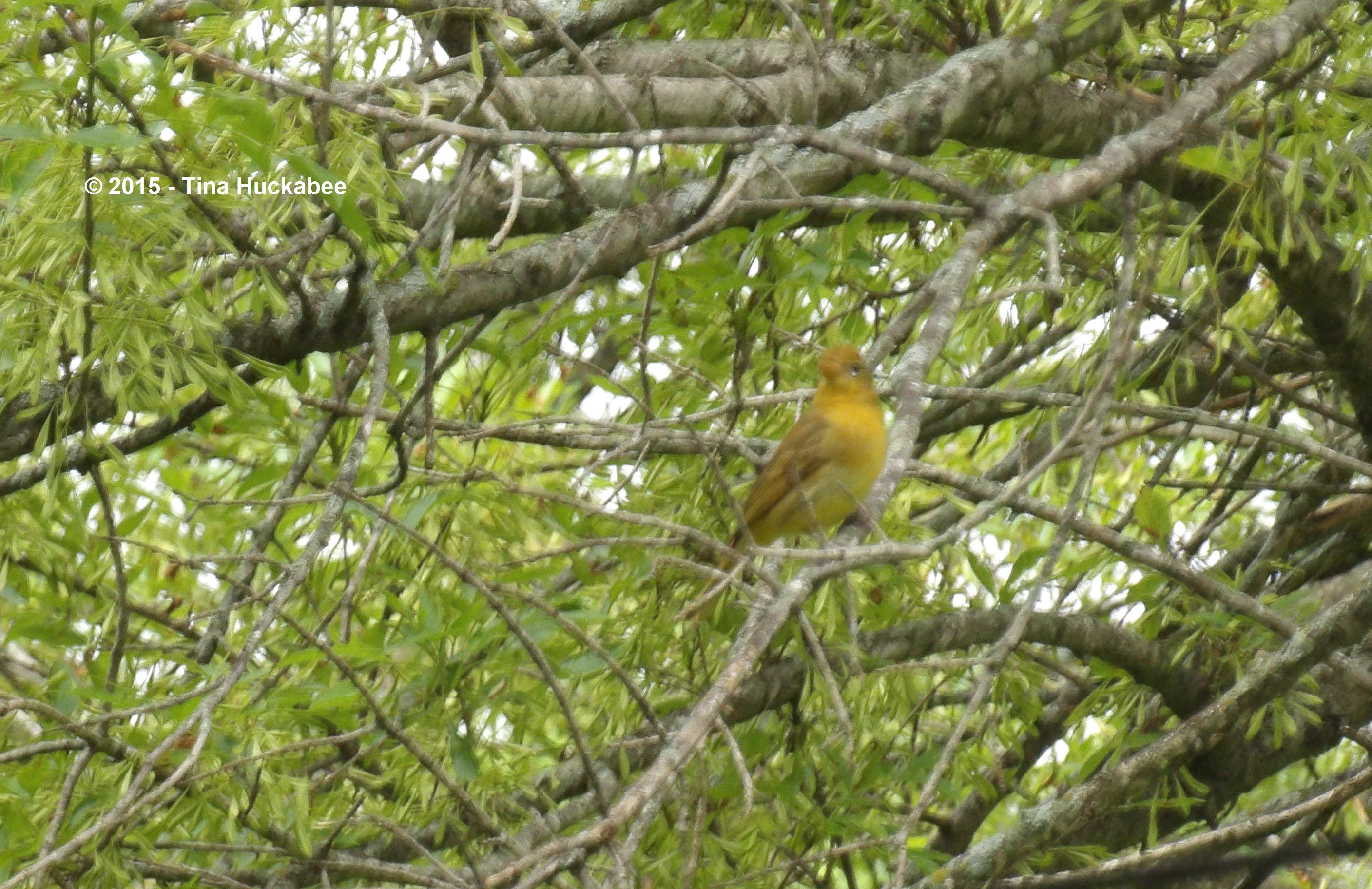
You’ll have to excuse the photos–I’ve yet to take a clear pic of any one of these stunning birds, but the male is pure bright red, the female is yellow, and the red/yellow combination is an immature male.  I have no idea where they’re nesting, but these eye-poppers breed in Central Texas and surrounding areas west, south, and eastward during summer.

When I first saw the birds, all three over the course of a weekend, I was baffled about why they were landing only on the house side of the Shumard Oak tree and nowhere else in the garden. They’d land in the tree, hop from branch to branch, moving constantly. Occasionally one would flit to the Retama tree or, more likely to the electric/cable wires adjacent to the Shumard.  Eventually each bird would fly back to the neighbor’s tree, or beyond, which is the direction they always come from.  I couldn’t figure out what they wanted from that particular spot in the Shumard.  The Husband mentioned off-handedly, “Maybe they eat bees.”
IMGP7697_cropped_2742x1852..new

Really?  The birds and the bees?  One is the hunter and one is the prey?   I checked the Cornell Merlin phone app while I was watching the Tanagers that Sunday afternoon and Summer Tanagers are, in fact, bee and wasp eaters. The Tanagers were landing in the Shumard just above where the honeybee hives are located.
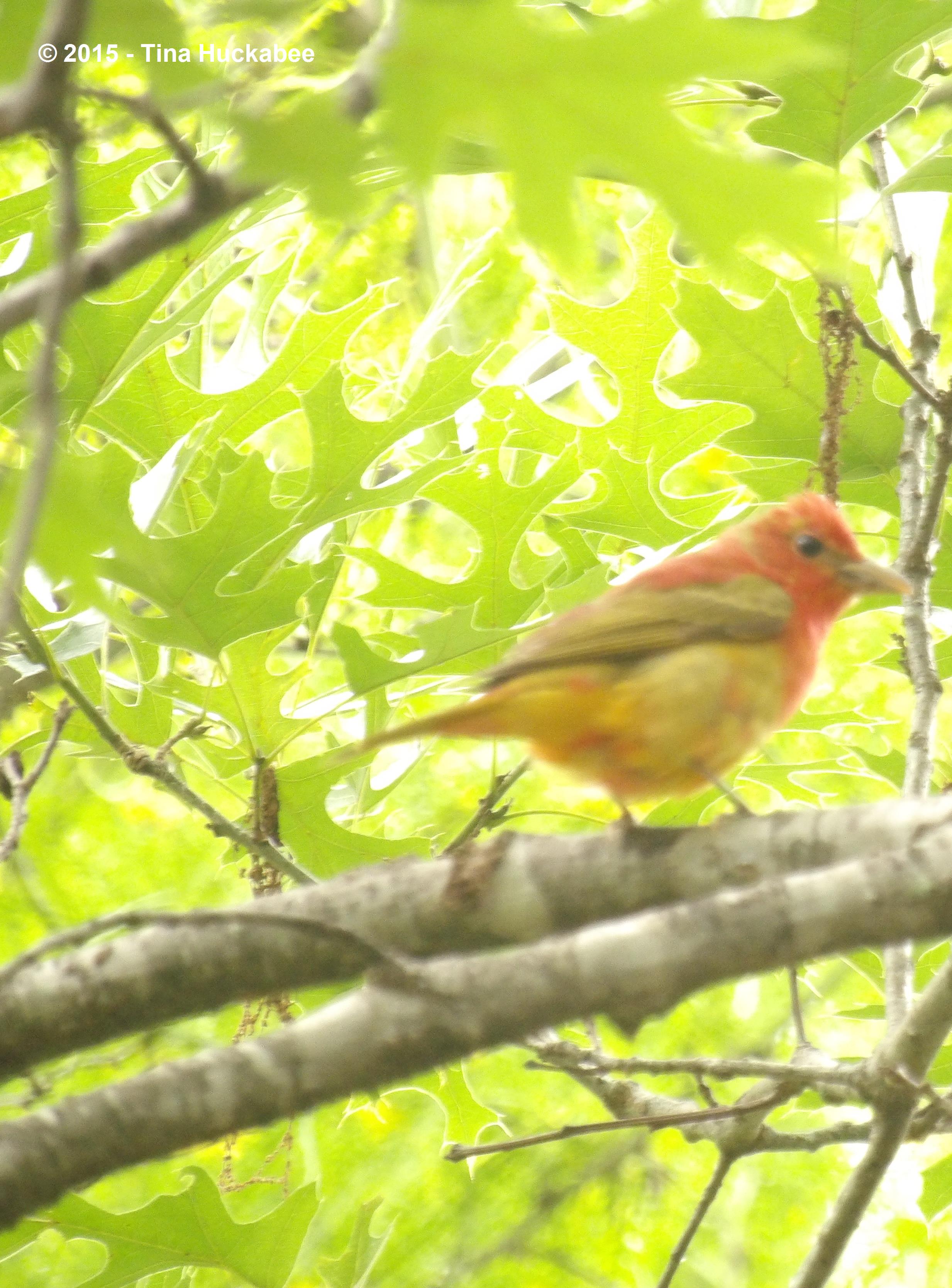
IMGP7714_cropped_2466x3336..new

Who knew?

IMGP7720_cropped_3405x3014..new

Indeed, I’ve watched them fly into the flight path of my honeybees, swooping in, then banking off sharply as if they caught something; I assume the brilliant hunter flew off to an unseen spot to eat.  I’ve witnessed an immature male Tanager flutter just above a Purple Coneflower, where a native bee was hard at work nectaring.  The Tanager hovered briefly, then seemingly decided that maybe honeybees were more easily picked off for a meal and he flew away.
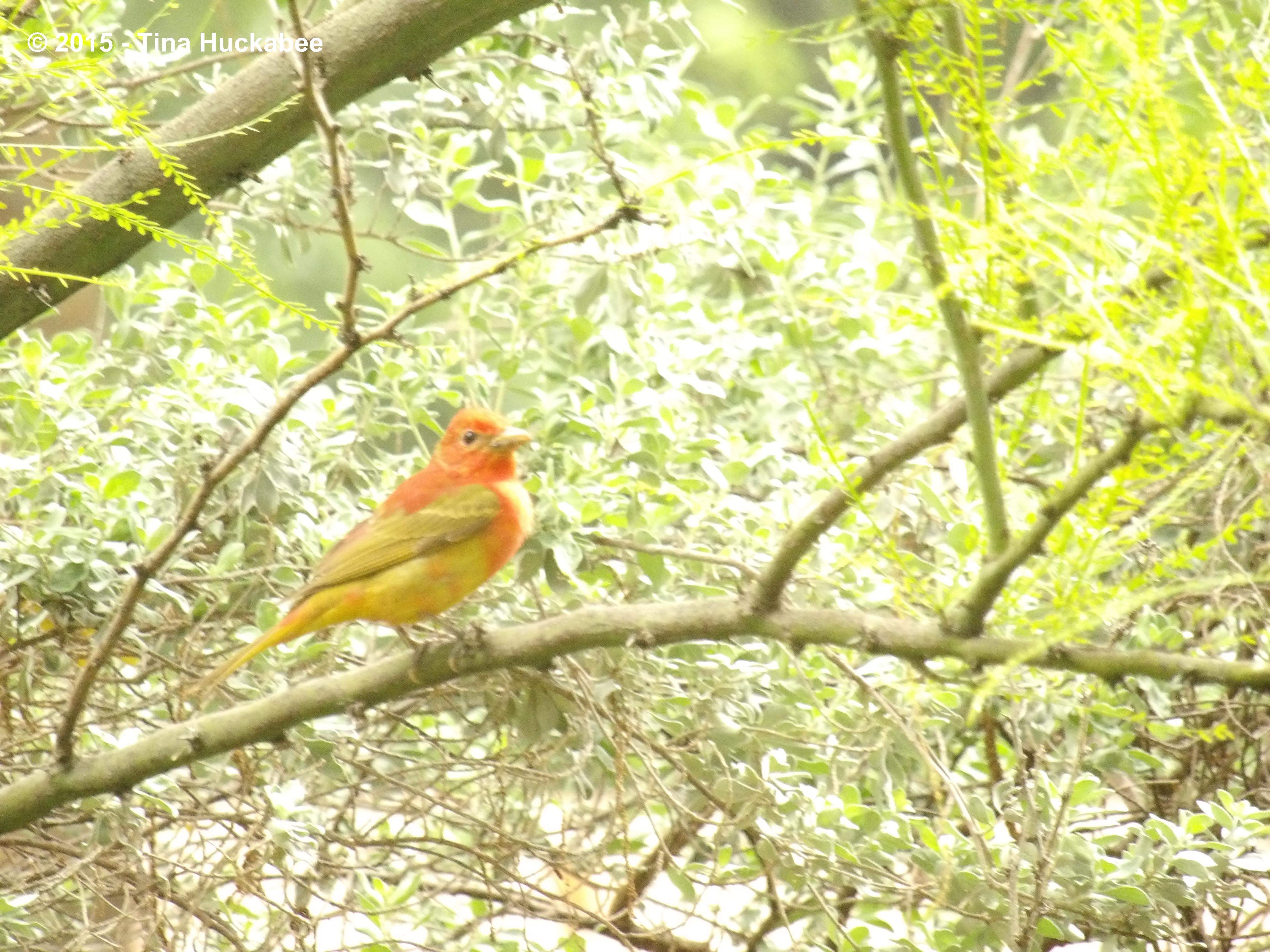
IMGP7723.new

At about the  time that the Tanagers were making daily, or nearly daily, appearances, I also realized that both of our honeybee queens were dead.  I’m not sure what happened to the queens, as they were dutifully laying eggs at the beginning of spring. We might have accidentally rolled them during a hive check (probably) or, they might have simply died or were so weak that the worker bees decided to replace them–that happens.  The previous weeks, as part of my spring beekeeper management, I’d conscientiously destroyed queen cells (that the girls insisted upon making), in order to quell their desire for procreation.  I did such a good job that the ladies were left without their leaders.

Beekeeping is hard.  Especially when the beekeeper doesn’t know what in hell she’s doing.

So I found myself in a bit of a fix: two dead queens, which means two dying hives–and   Summer Tanagers gobbling honeybees on a regular basis.  Even without the hunting birds, the bees are doomed if I don’t requeen both hives, and the Tanagers assure that inevitability sooner, rather than later. What to do?  A quick check on the Beeweaver Apiaries website showed that they were sold out of queen bees until June.

JUNE!!  My hives won’t make it to June.  I emailed  the owner, whom I met last year, explained my predicament and she took pity on me, or more likely, my hapless honeybees.  She immediately ordered two queens sent, via UPS, on an overnight shipment to me.  Beekeepers stick together and help each other.

The queens were to arrive on a Thursday and when they didn’t as expected, I shifted into sleuth mode  to discover where my queens were stranded. UPS claimed that the package was delivered to my address at 9am.  I wasn’t home at that time, but Bee Daddy was and there was no delivery of queens or anything else.   I combed the neighborhood on my bicycle, searching  for a misdelivered queen bee package. I received some odd looks from neighbors when I explained what I was looking for and that proved interesting.  And weird. I won’t go into the details about what I did to find the package of bees, but the queens and their attendants were misdelivered that morning to an address that was one number off of mine and about ten houses away.

Yes, I made a formal complaint to UPS.

The hives were requeened and new bees are hatching as I write–there will be plenty of honeybees for the Tanagers to eat.
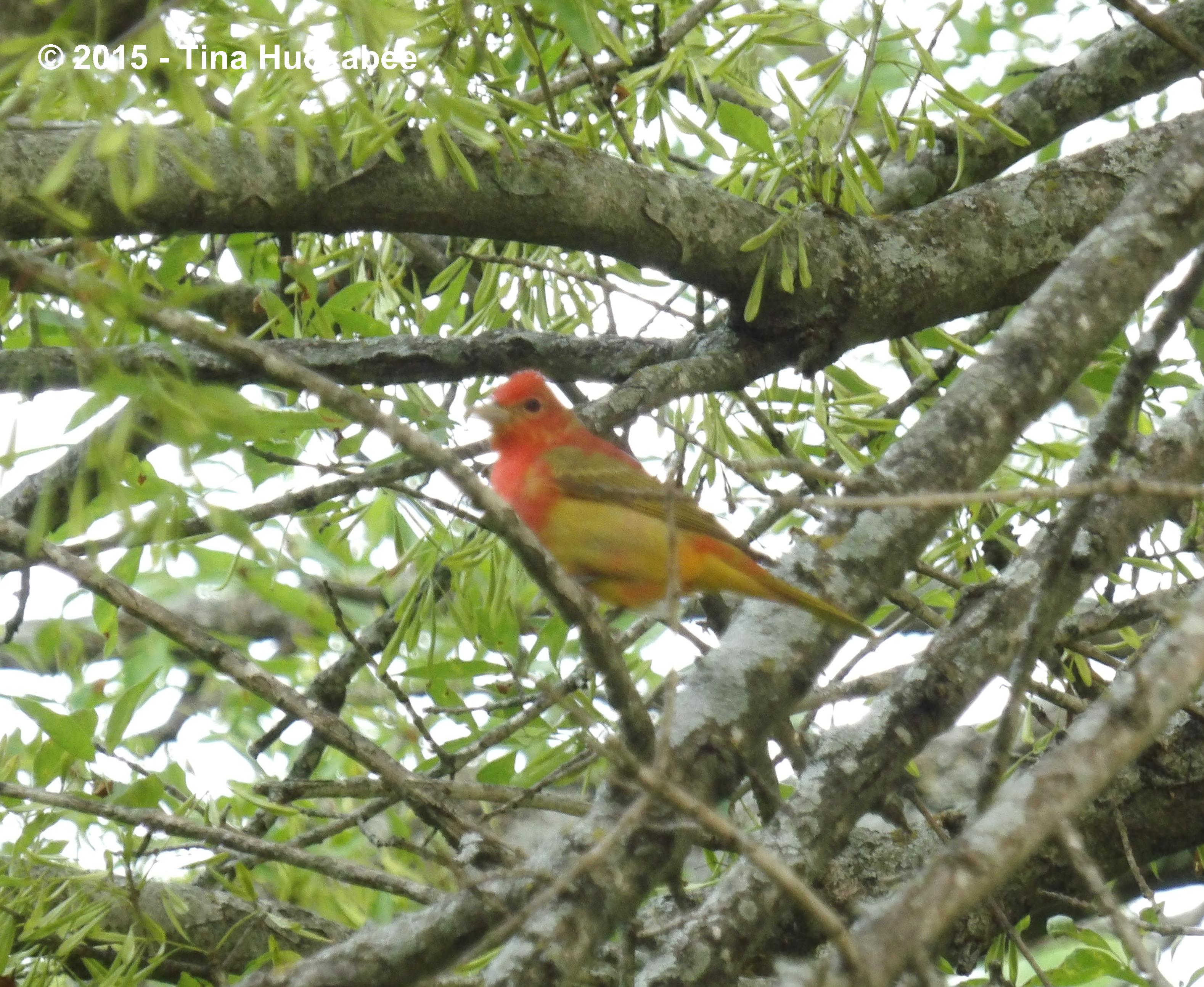
IMGP7756_cropped_3157x2589..new

WAIT A MINUTE!  That’s not why I have honeybees! I have honeybees so they can pollinate my gardens and the gardens around the neighborhood.  I have honeybees so that I can enjoy and share their incredible honey.  I DON’T have honeybees so the Summer Tanagers can hunt and eat them.
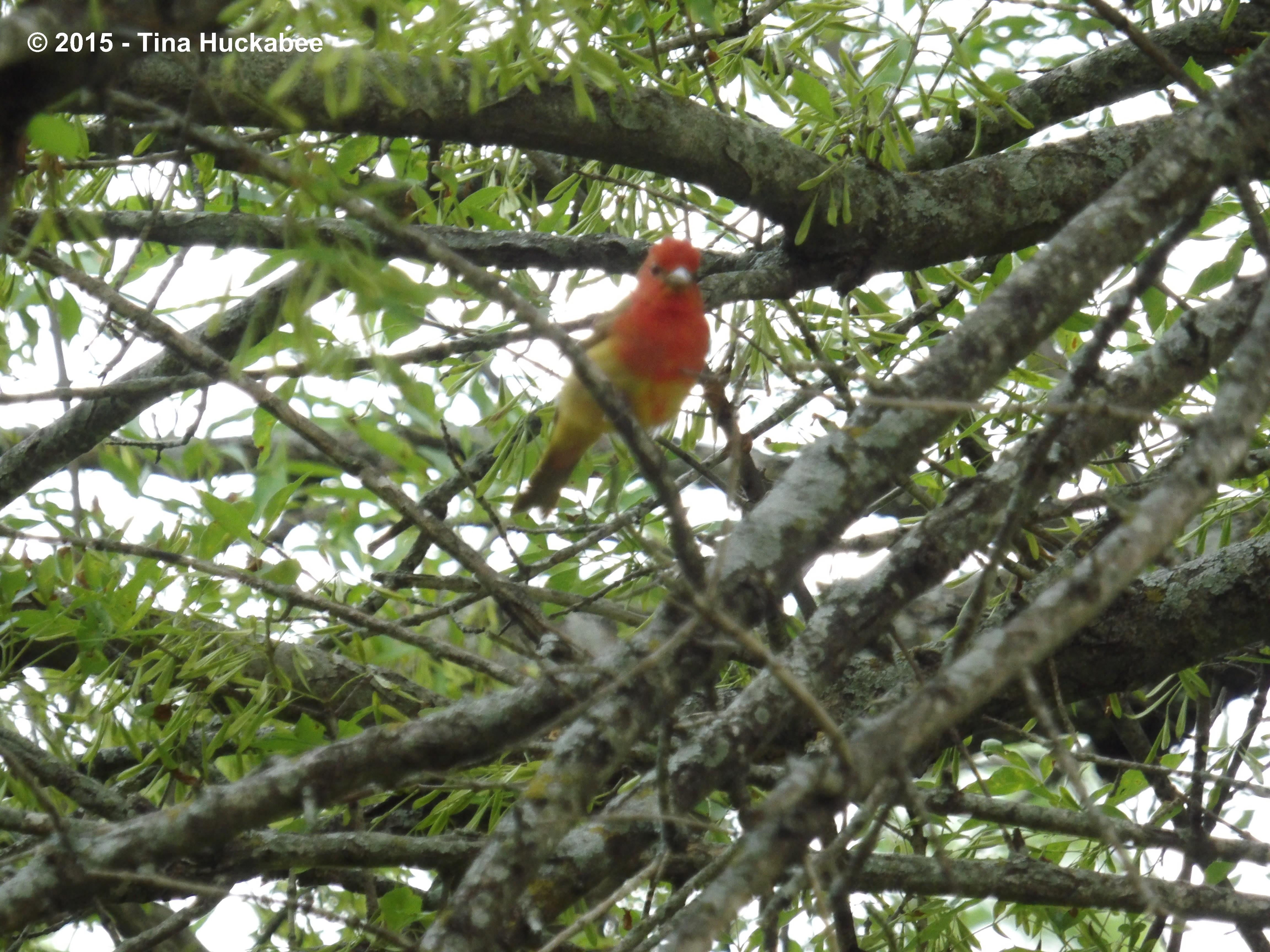
IMGP7769.new

But hunt and eat they do.  One of my bedroom windows is just above where the hives are located.  One morning recently, I opened the window to a gorgeous male Summer Tanager, perched in the Shumard,  gazing hungrily down at the hives.  He was so intent on snagging a bee for his breakfast that he didn’t notice  my movement at the window.

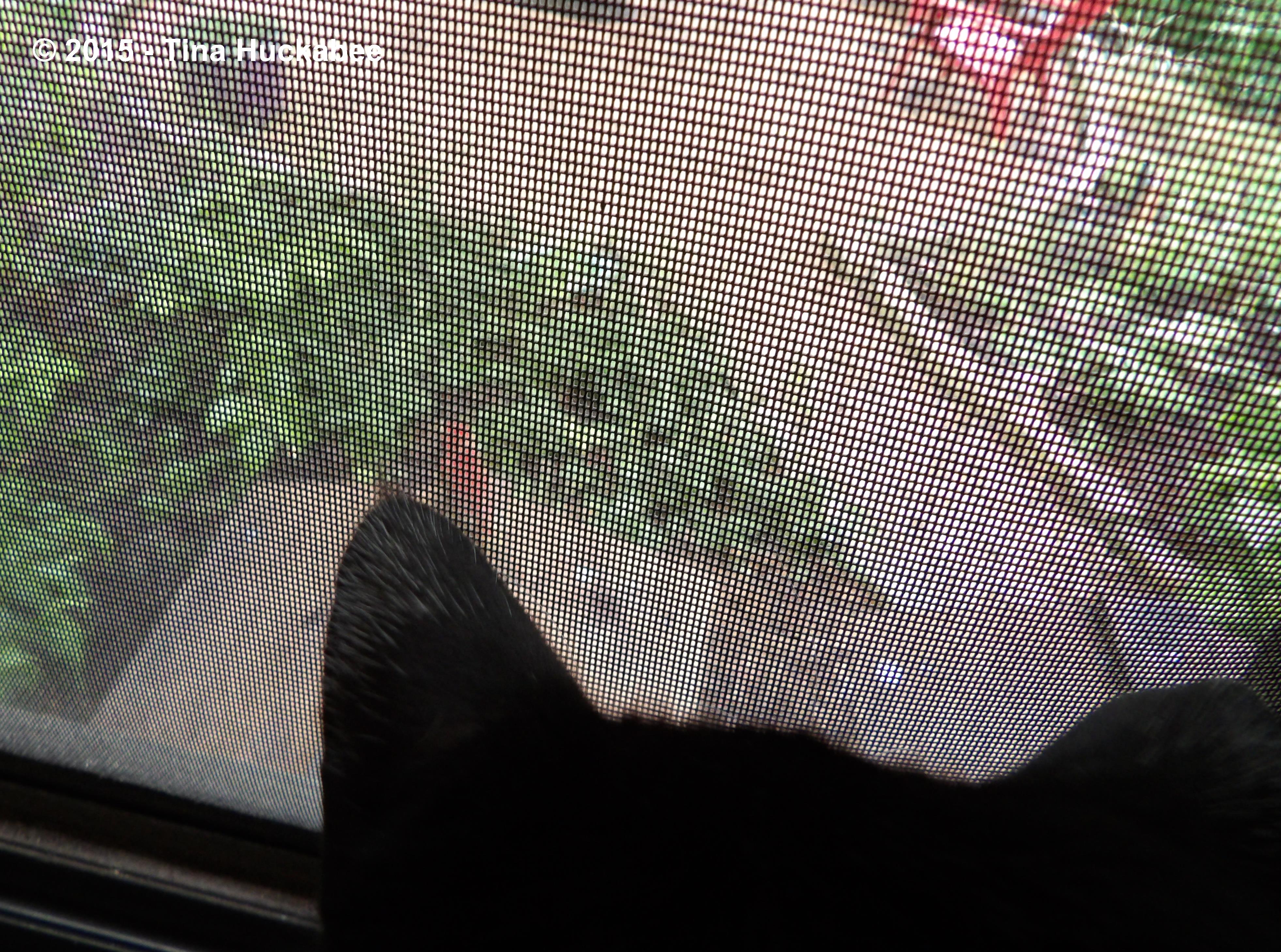
This past Sunday morning, my little Astrud cat was staring at something as she sat on that window sill, as she often does.
IMGP8380_cropped_3926x2917..new

Can you see him through the less-than-pristine screen?  The Tanager is poised on top of Scar (one of my hives).  The beautiful avian scamp flew downward for a second, likely to the entry board of the hive, then flew back to the top with his prize: a honeybee in his beak  for lunch.  He mangled my beloved little bee and deposited her down his gullet–while perched atop the hive.  That takes a certain amount of impertinence.

Additionally,  I have  mixed emotions about witnessing the effrontery.

Do I mind the Tanagers hunting the bees?  No, actually, I don’t.  I do feel a little sad about the hardworking foragers, toward the end of their lives, being snarfed down by the gorgeous feathered fiends.  And having hives readily available is tantamount  to shooting fish in a barrel.  After all, it’s not even like the Tanagers have to hunt that hard. The hives are right there and the bees are coming and going constantly, with no thought to their own personal safety–the health of the hive is what drives them.

Meanwhile, the Tanagers have found a pretty sweet deal.

In targeting my honeybees for the benefit of their tummies, the Tanagers won’t decimate my hives.  Yes, they’ll kill some and if they’re around all summer, many.  But the honeybees are in much more danger from pesticide or herbicide use on a plant they might forage from than they are from the Summer Tanagers. I don’t garden with chemicals, but the bees forage within a three-mile radius–who knows what they take nectar and pollen from? The Tanagers will kill some bees, but they won’t cause either of my hives to collapse because of harmful chemicals. The balance of prey to predator won’t be disturbed–as long as all other factors remain relatively equal.

Ahem.  Good beekeeping practices are part of that equation.
IMGP8382_cropped_2926x2714..new

So I’m welcoming the Tanagers to my garden and consider myself fortunate to observe these fascinating and beautiful birds.  I don’t see them everyday.  In fact, a couple of weeks passed and I didn’t see any Tanagers.  Then, saw one or two for several days–hanging around the beehives, of course.  Besides bees and wasps, Tanagers also eat fruit, though I didn’t see  them at the ripening blackberries.
IMGP7698_cropped_2815x1824..new

Apparently, the Tanagers have plenty to eat.  Truthfully, I rather them dine on the honeybees than the native bees, since the honeybee hives are protected and have a healthy location in which they thrive.  The native bees nest in and around my gardens, but they also nest elsewhere and may not always find such a tolerant and beneficent host.

Beekeeping and wildlife gardening–a tricky balance with those two, but there clear advantages with both endeavors and my garden and the surrounding environment are the winners.

I’m sure the bees are delicious to the Tanagers, but I think I’ll stick to eating honey.

Either way, bon appétit!
Bee Mama Missive: Lumpy And Squishy

Squishy and sticky, actually. But lumpy and squishy are a part of the family lore. When my almost 20 year-old son was very little, he was a picky eater.  He’s not any more, but as a tyke, whenever he wouldn’t eat or even try a new food, his excuse was that it’s lumpy and squishy. So lumpy and squishy became our go-to phrase when we don’t like or want to eat some particular food.

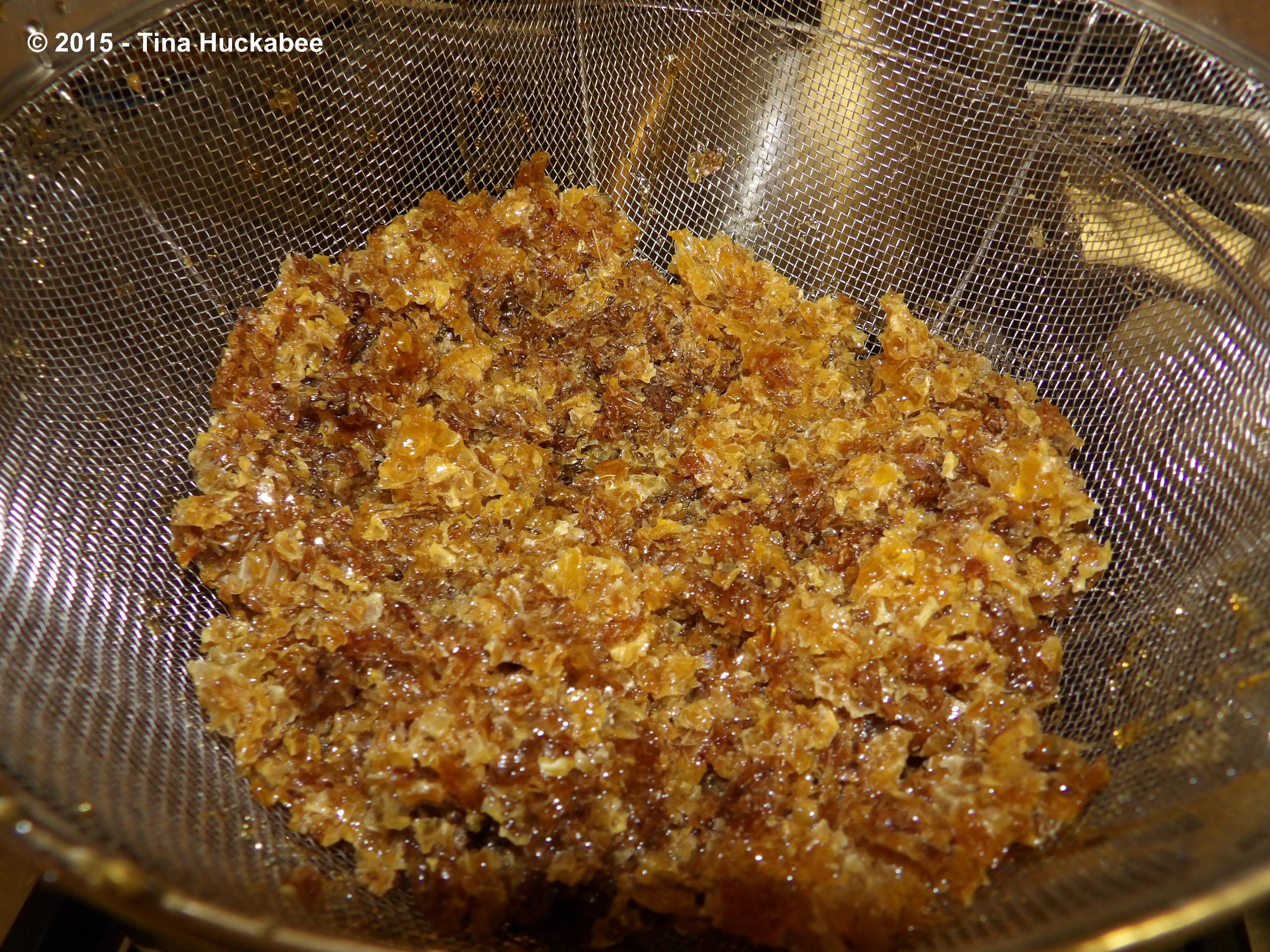
I would suggest that this,

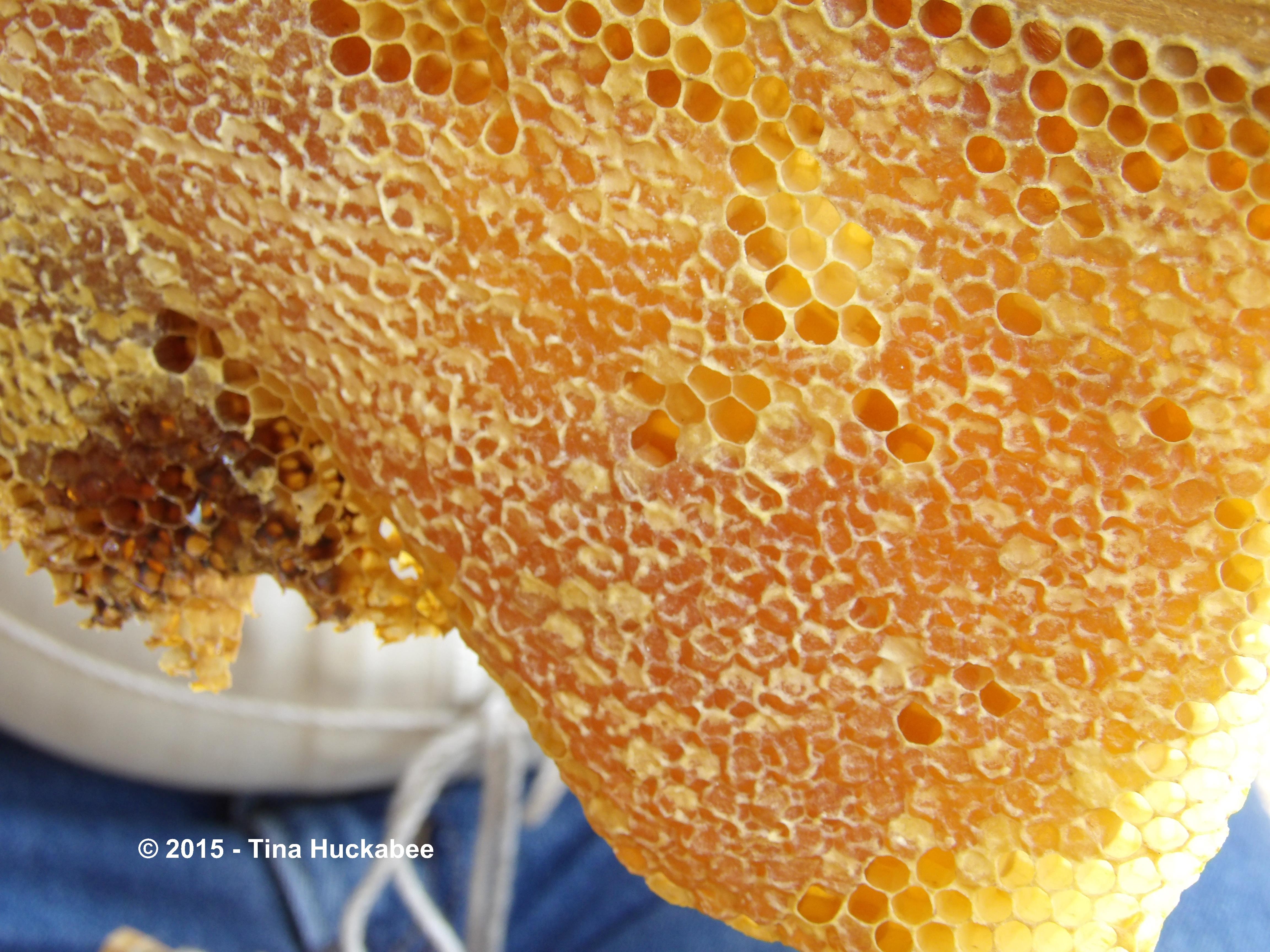
IMGP5417.new …is lumpy and squishy.  But try it?  You betcha!!  This golden glory is what remains of one of the batches of honeycomb that Bee Daddy and I harvested from our honeybee hives recently and that I drained a total of about a gallon and a half of honey from.    I should also add that in addition to being lumpy and squishy, the honey is also sticky and delicious.

Really, really delicious.

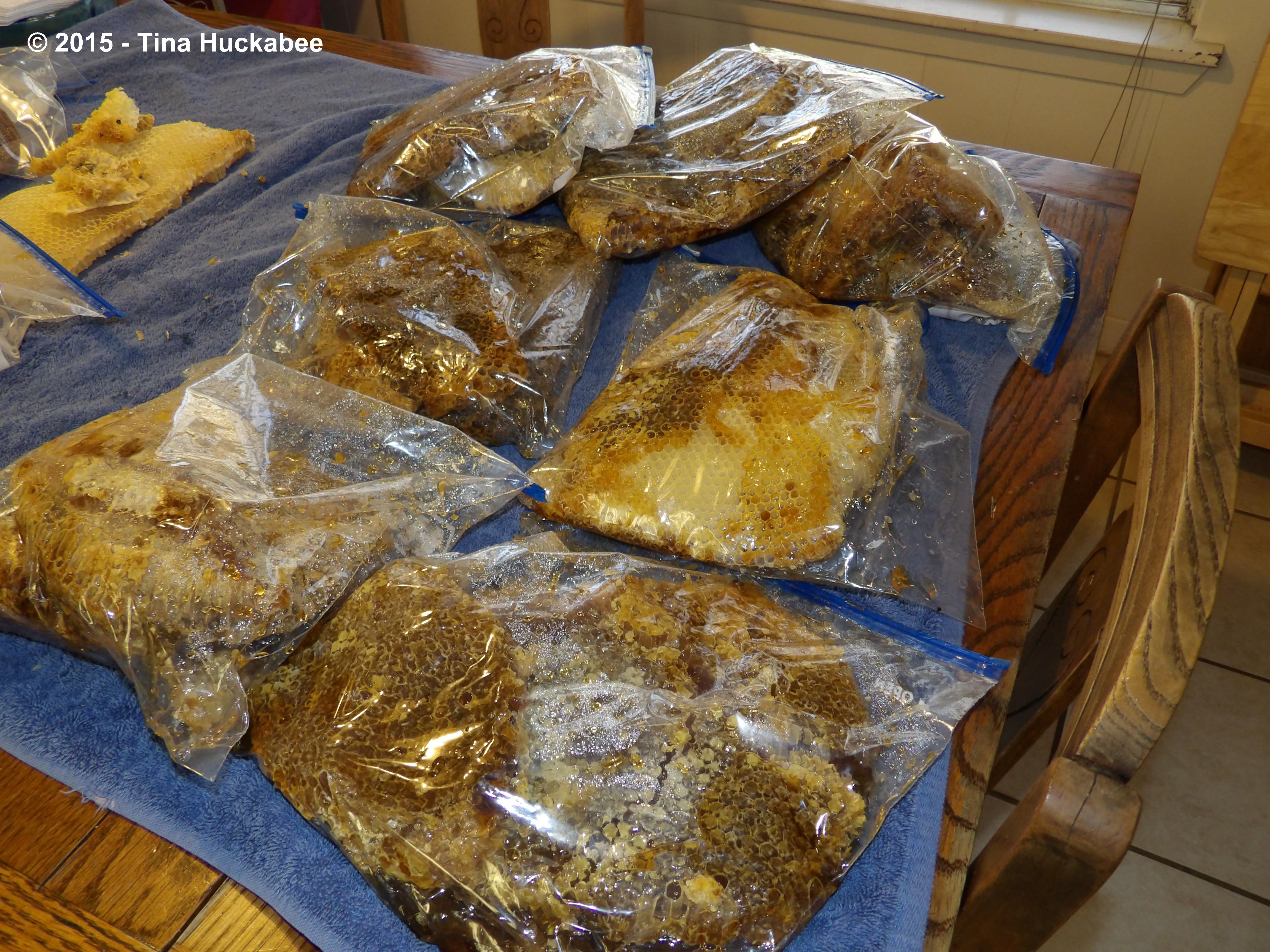
After checking our hives recently, we ended up with bags full-to-bursting with honeycomb which needed squishing in order to extract the precious, yummy honey.

IMGP5370.new

If I was a serious beekeeper whose goal was to reap honey throughout the year, I would have a different type of hive (Langstroth) and invest in a honey extractor.  As it currently stands though, my beekeeping goals are about adding pollinators to my local environment and if we get some gorgeous and sweet benefit from the bees, that’s a-cherry-on top for our efforts.

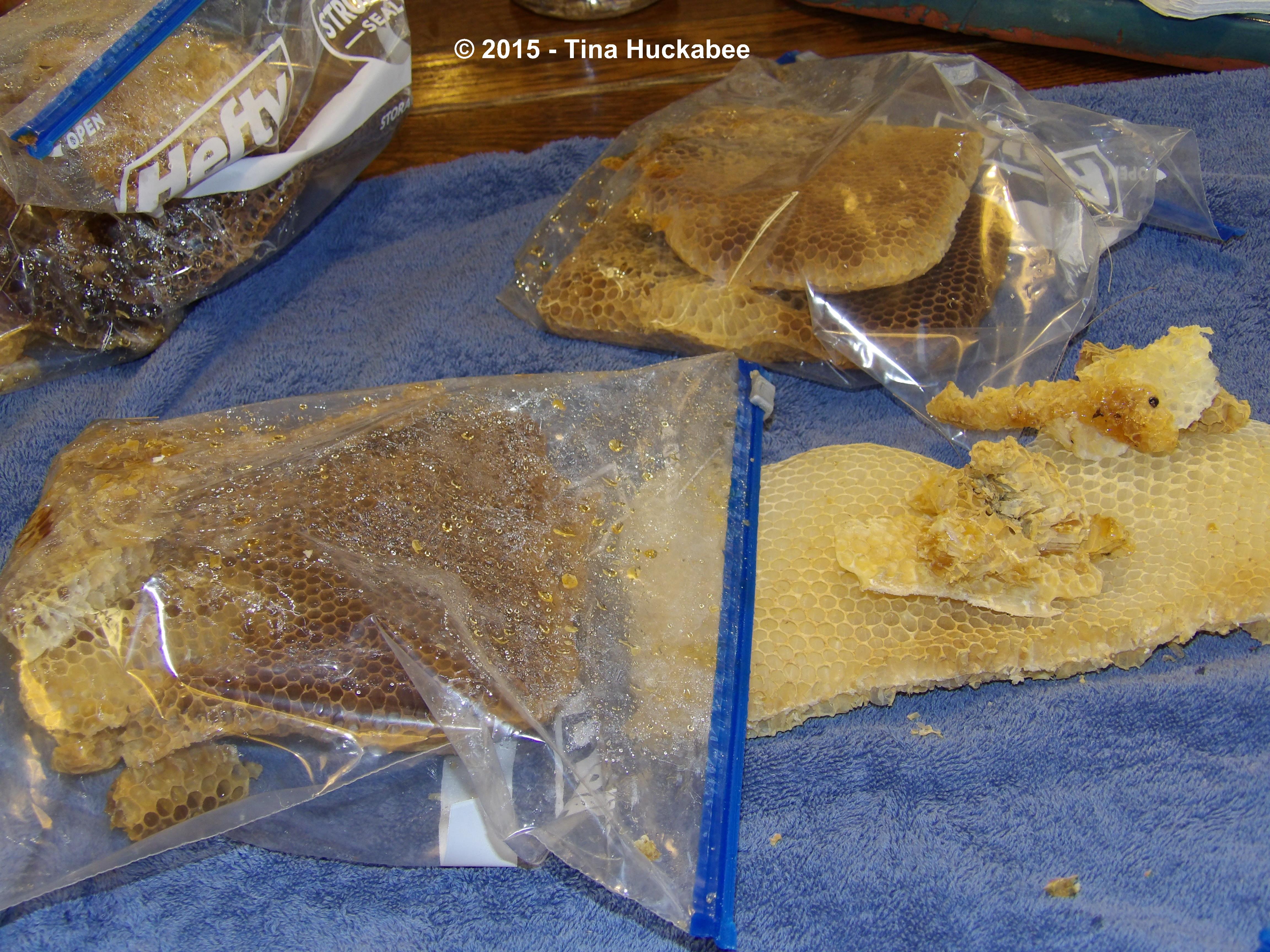
Honey is the byproduct of honeybees, so here I am with roughly ten bags of honeycomb,

IMGP5368.new IMGP5369.new

…plus some partially filled comb.

IMGP5409.new

IMGP5410.new

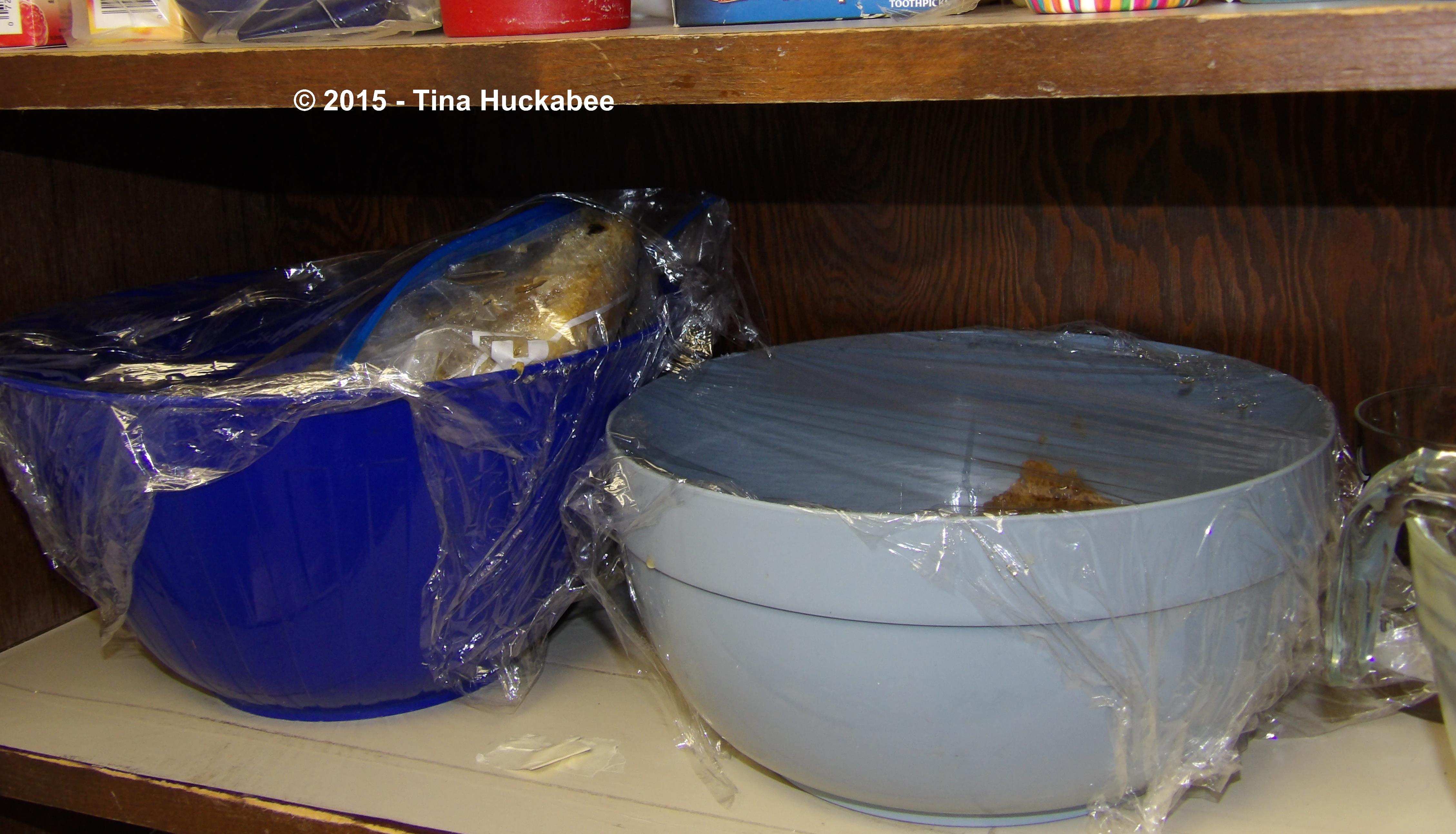
Because the extraction is time-consuming (I’ve done this once before after the smaller spring honey harvest), I knew the work would commence over several days, so the first order of business was to store our ziplocked booty.  I placed the bags in bowls and cookie containers and made room on pantry shelves throughout the kitchen.

IMGP5422_cropped_4515x2585..new

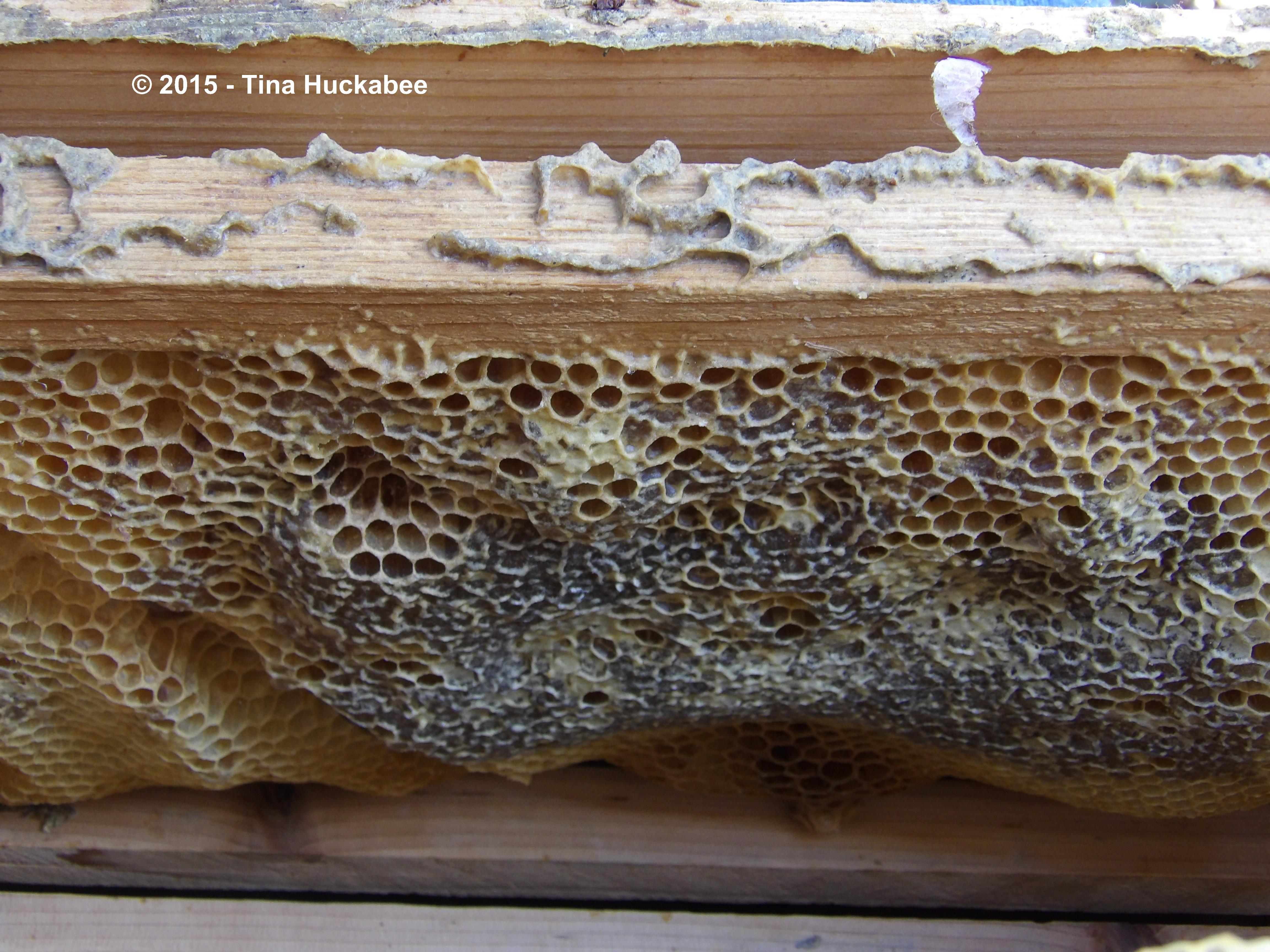
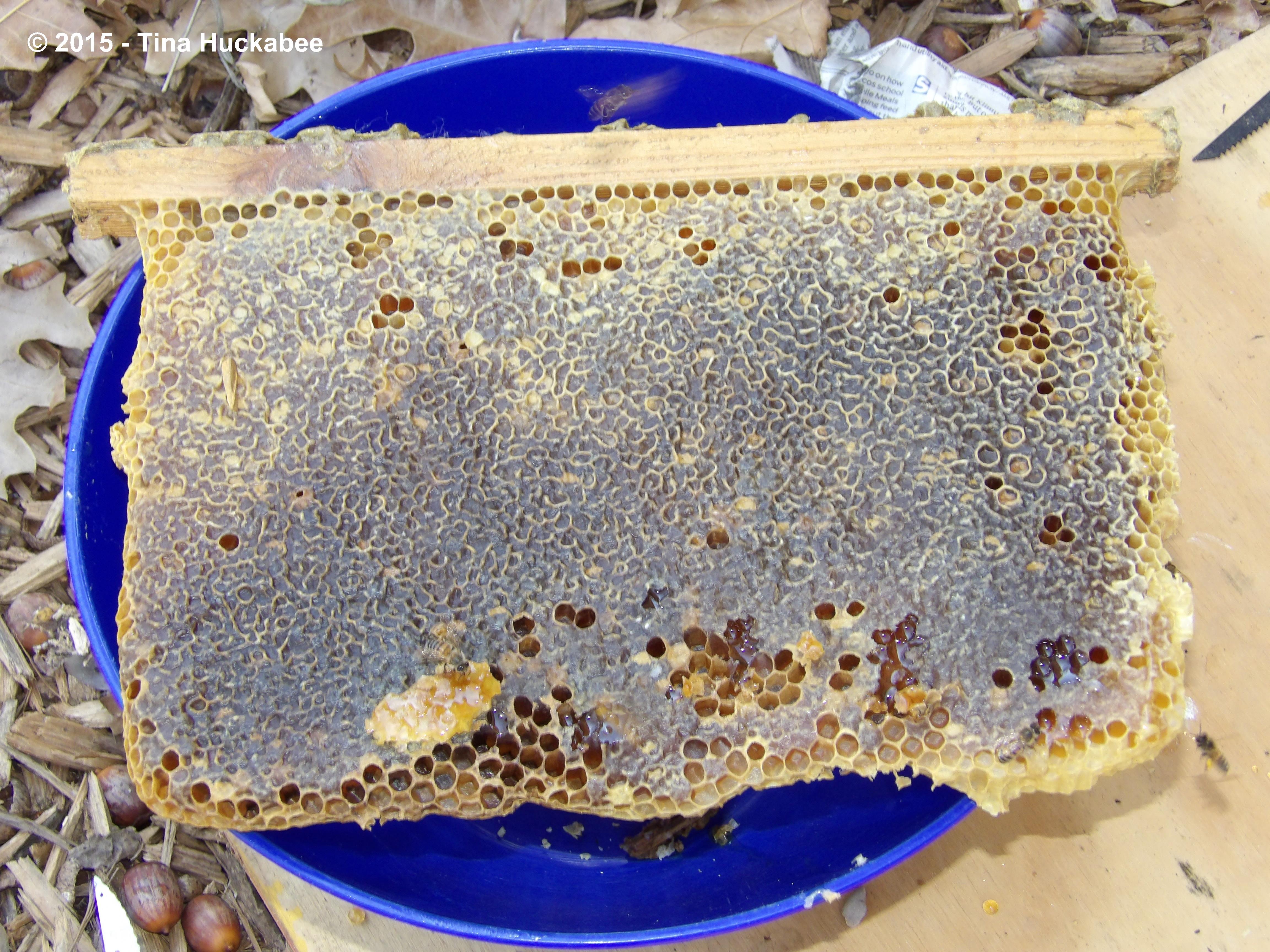
If we had Langstroth hives, the comb would be built in an actual frame that we could place in a spinner to extract the honey. Our Warre hives demand that the comb be cut out in its entirety in order to extract the honey.  The Warre hive is designed with top bars and the bees build their comb downward from the bar.  Once the bar is removed from the hive, the only option is to crush the comb to open up the cells and let the honey drain and drip. Which is what I did, on and off, all last week.

IMGP5419.new

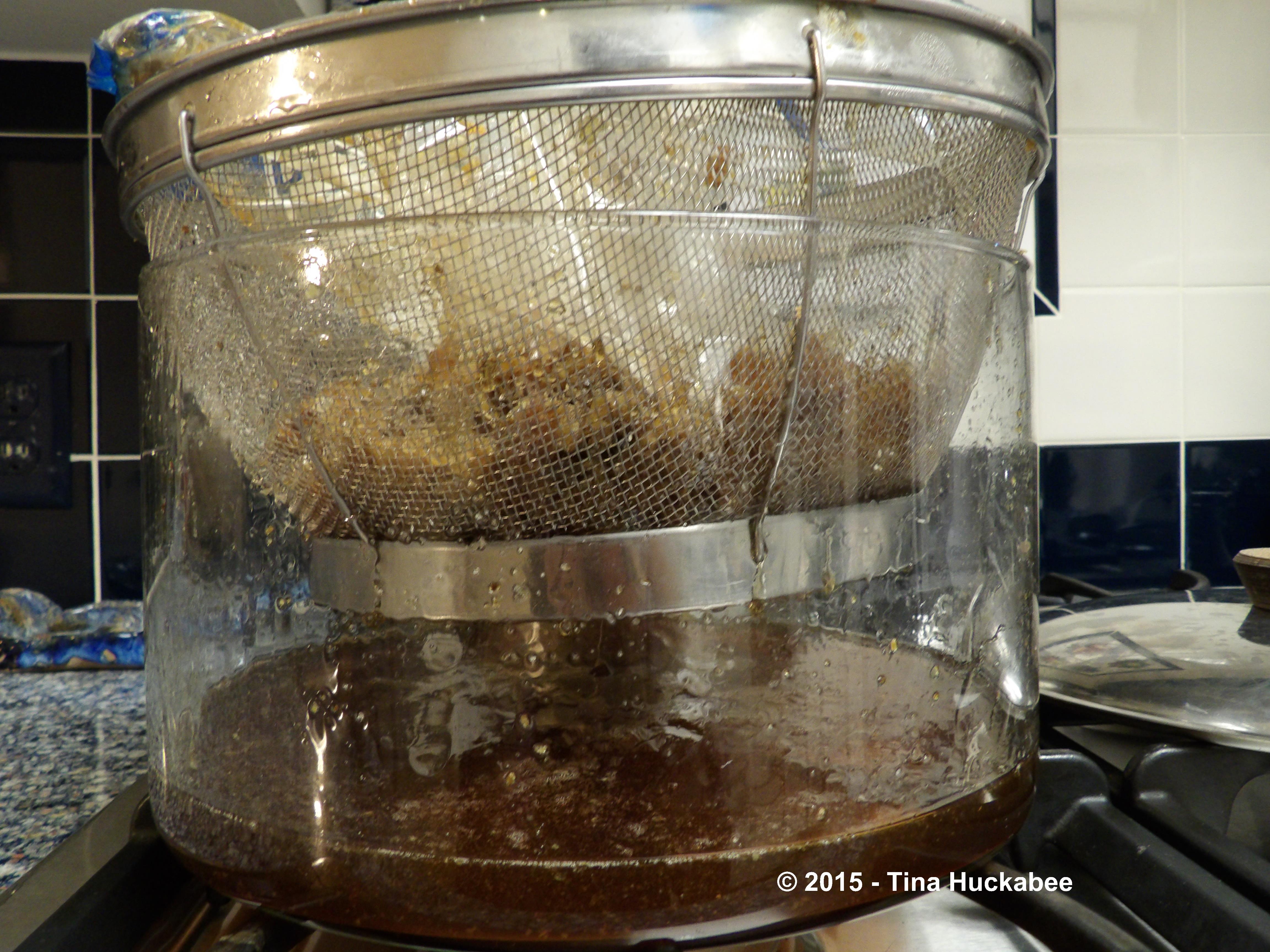
In batches, as I found time, I broke off bits of comb, place those bits in a strainer then proceeded to crush the comb with a solid wooden spoon as my patience and wrist allowed, then let the released honey drip at its pace through the strainer into this large glass bowl.

IMGP5415.new

Sometimes I left it dripping overnight or set it up the dripping mechanics first thing in the morning while I was gone during the day.  Once I was weary of the crushing and there was a reasonable  amount of honey in the bowl, the more beekeeper-intensive and time-consuming part of the process ensued.  I’d warm the honey for a few minutes by setting the bowl in a large dutch oven with about two inches of heated water, then pour honey through two different tea strainers nestled in funnels, which emptied directly into former salsa, preserve, and jelly/jam jars.

IMGP5413.new

The first pouring or two typically went well and fairly quickly, then the strainers would clog up with honey detritus, like bits of wax which survived the first straining round.  I’d wash the tea strainers to clear the netting, situate the strainers back into the funnels, pour more honey through until I’d finished the batch of honey. A bag crushed completed, bottles filled with sweet amber gold, I’d dig into another bag, crush more comb, wait for the draining honey, and commence straining and dripping.

IMGP5414.new

And so it went for several long, sticky days.    It took most of the week in on again/off again honey work to finally achieve 18, 12-14 ounce jars of honey.

IMGP5450.new By the time this photo was taken, we’d already given some away and delved into a jar ourselves.  Yummmm.  Fabulous honey on homemade buttered biscuits, on warm whole wheat toast, and occasionally on a spoon, directly into the mouth….

Yes, I need to be walking and biking more.

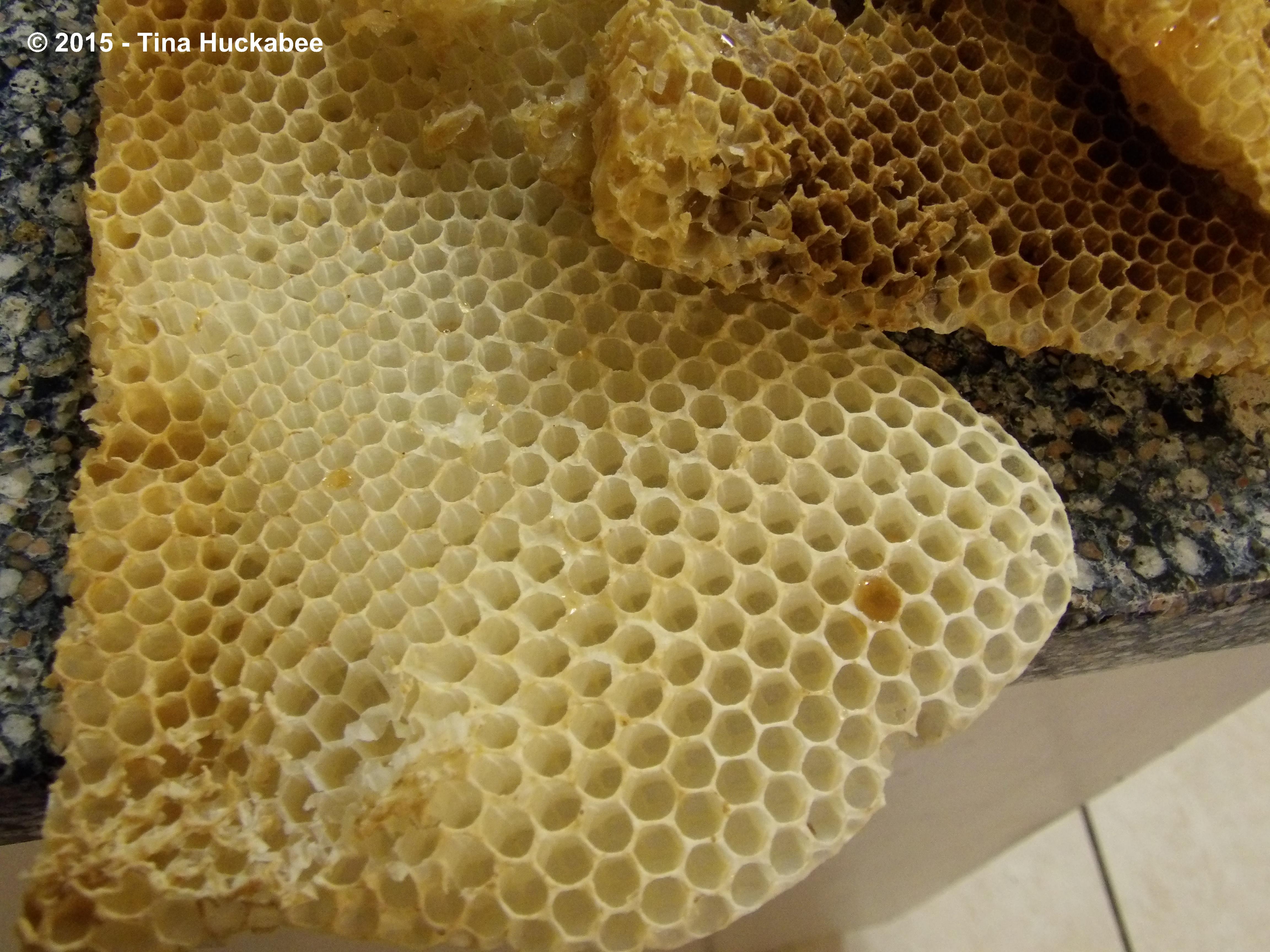
Once most of the honey was extracted and bottled,  with plans for eating and gifting, what to do with the honeycomb?  I’m bothered a bit by the destruction of the comb because it’s so beautiful and so perfect.

IMGP5412.new

It feels wrong to destroy such beauty, but destroy I must if the honey is used by anyone but the bees.

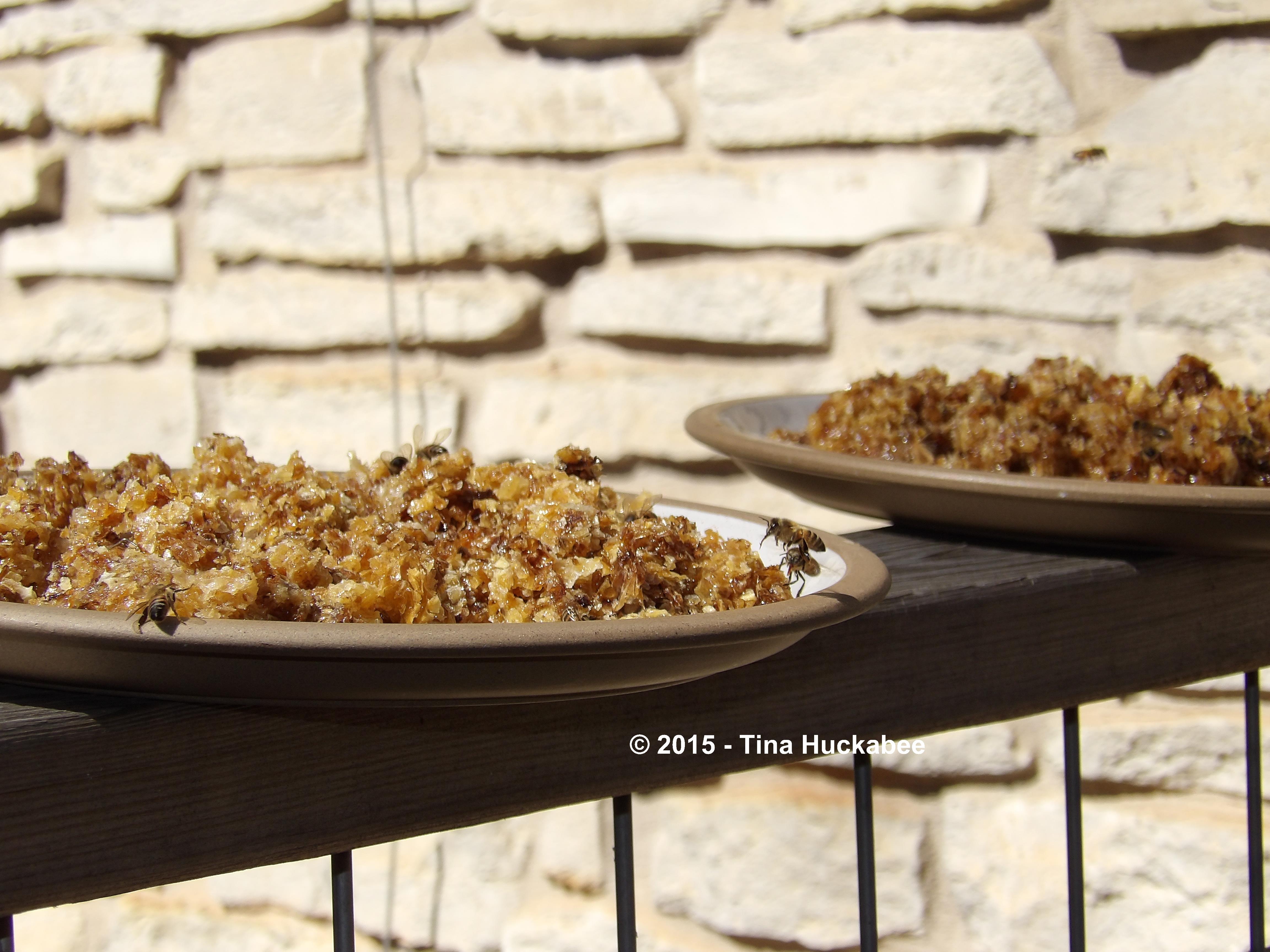
It’s very early spring here with not too much in bloom just yet.  I’d started feeding my bees about a week before we checked the hives because I didn’t realize how much honey was left and I will continue feeding for a week or two more, before spring busts out all over, in full floriferous fashion–to assure the hive has strong start to their brood and growing season.    I decided rather than simply throwing the crushed and abused honeycomb in the compost (which isn’t a horrible idea) I’d set it out for the bees to eat.

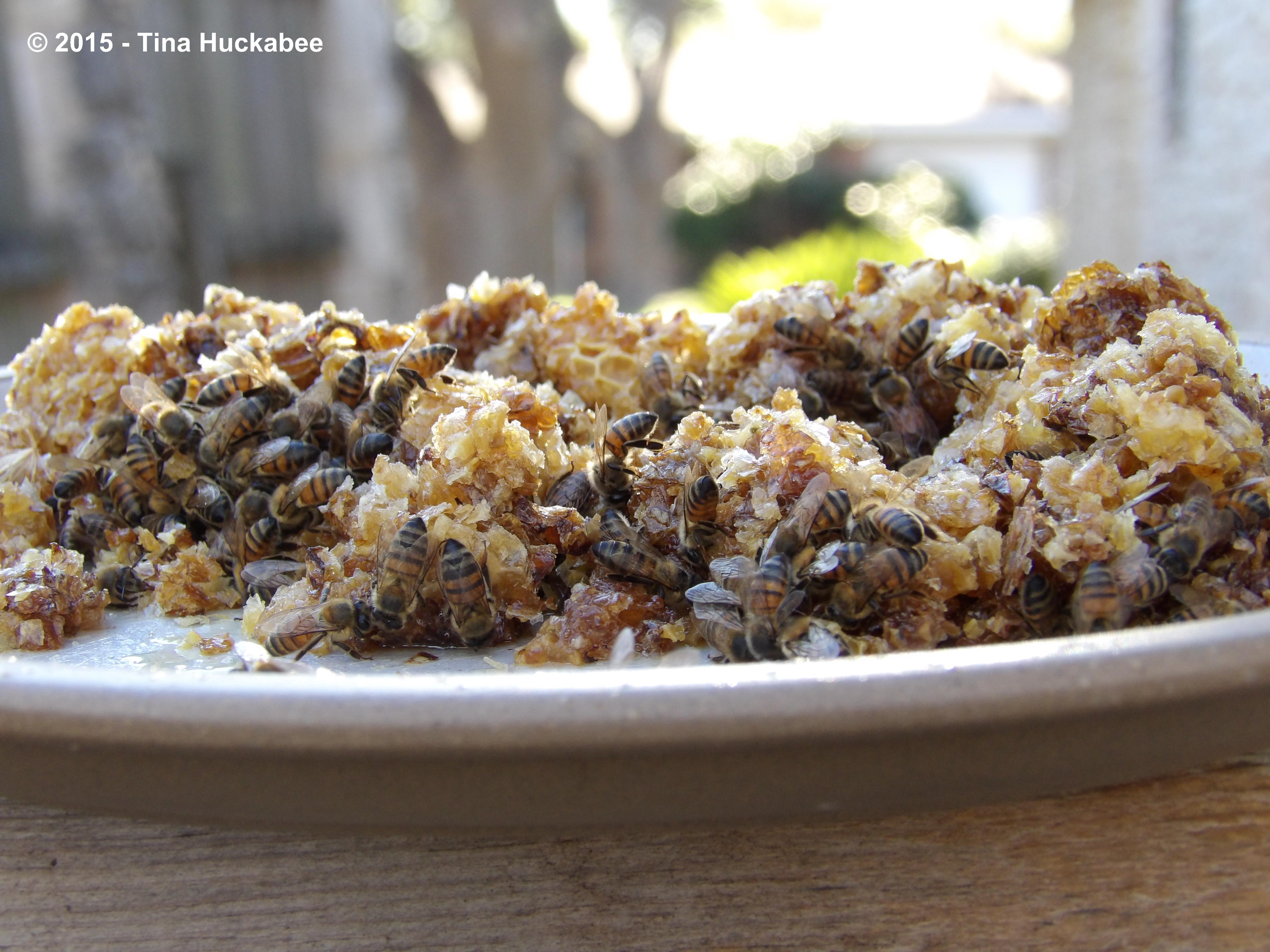
And eat they did and still are on balmy days!  Spooned on plates, the crushed comb with plenty of honey still trapped, allowed the bees to engage in binge eating frenzy,

IMGP5434.new

…filling their abdomens with sweet , gooey goodness and returning to their hives with to do what honeybees do.IMGP5439.new

IMGP5440.new

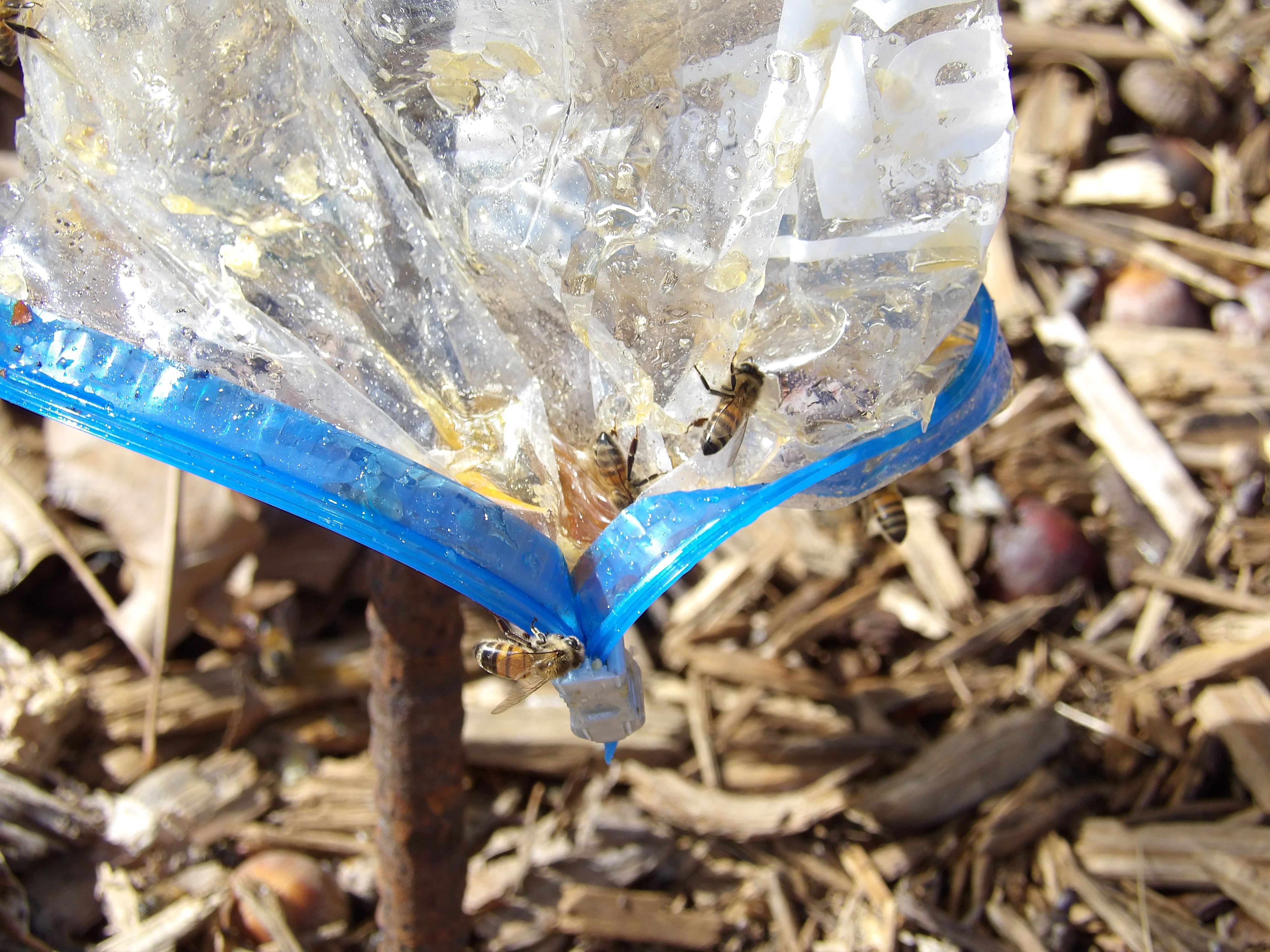
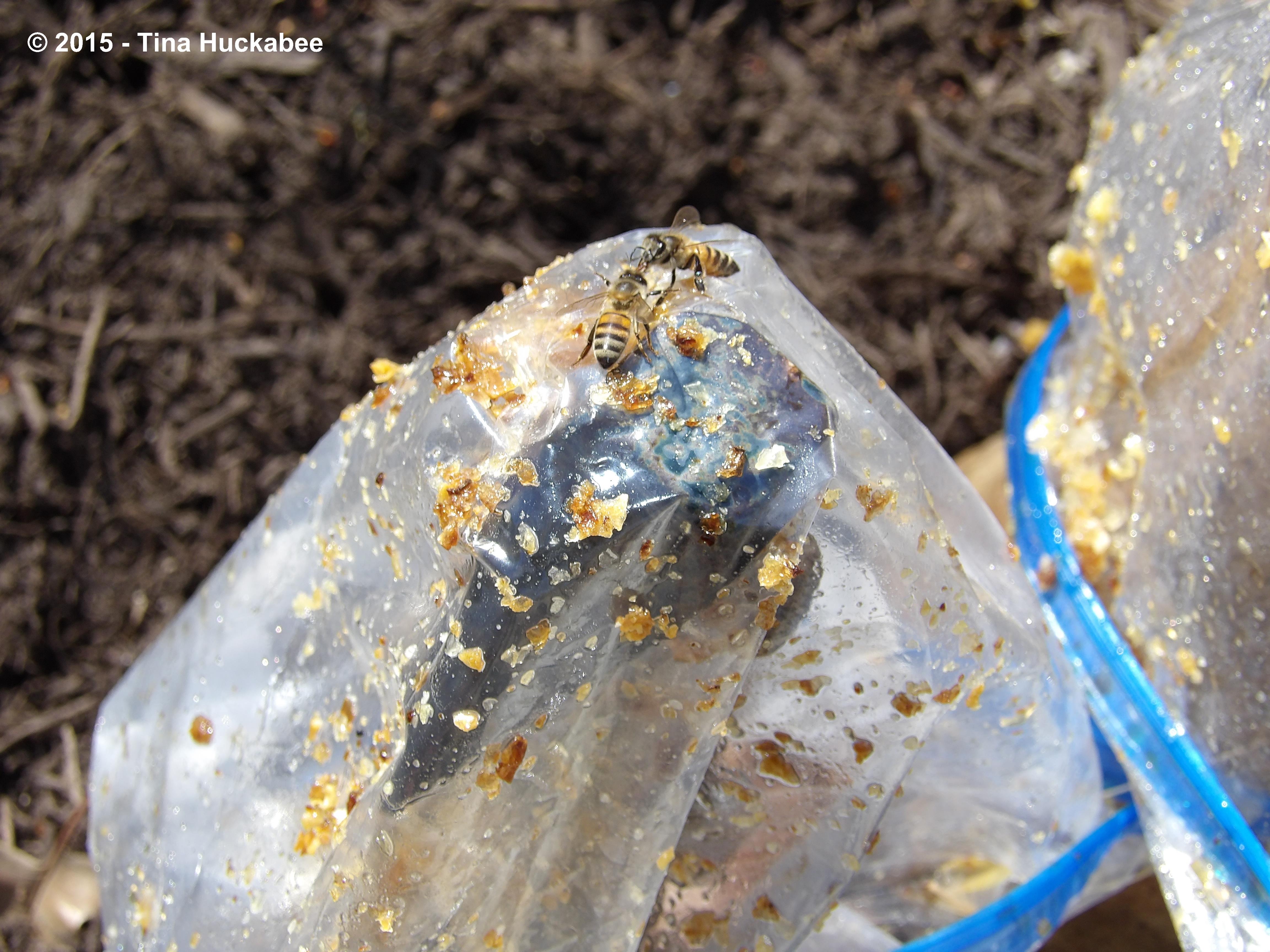
Look at ’em go!  Happy, busy honey-filled bees. I placed the bags we’d used in the gardens over rebar,

RICOH IMAGING

..and  over ceramic yard art.

IMGP5424.new IMGP5425.new

IMGP5427.new

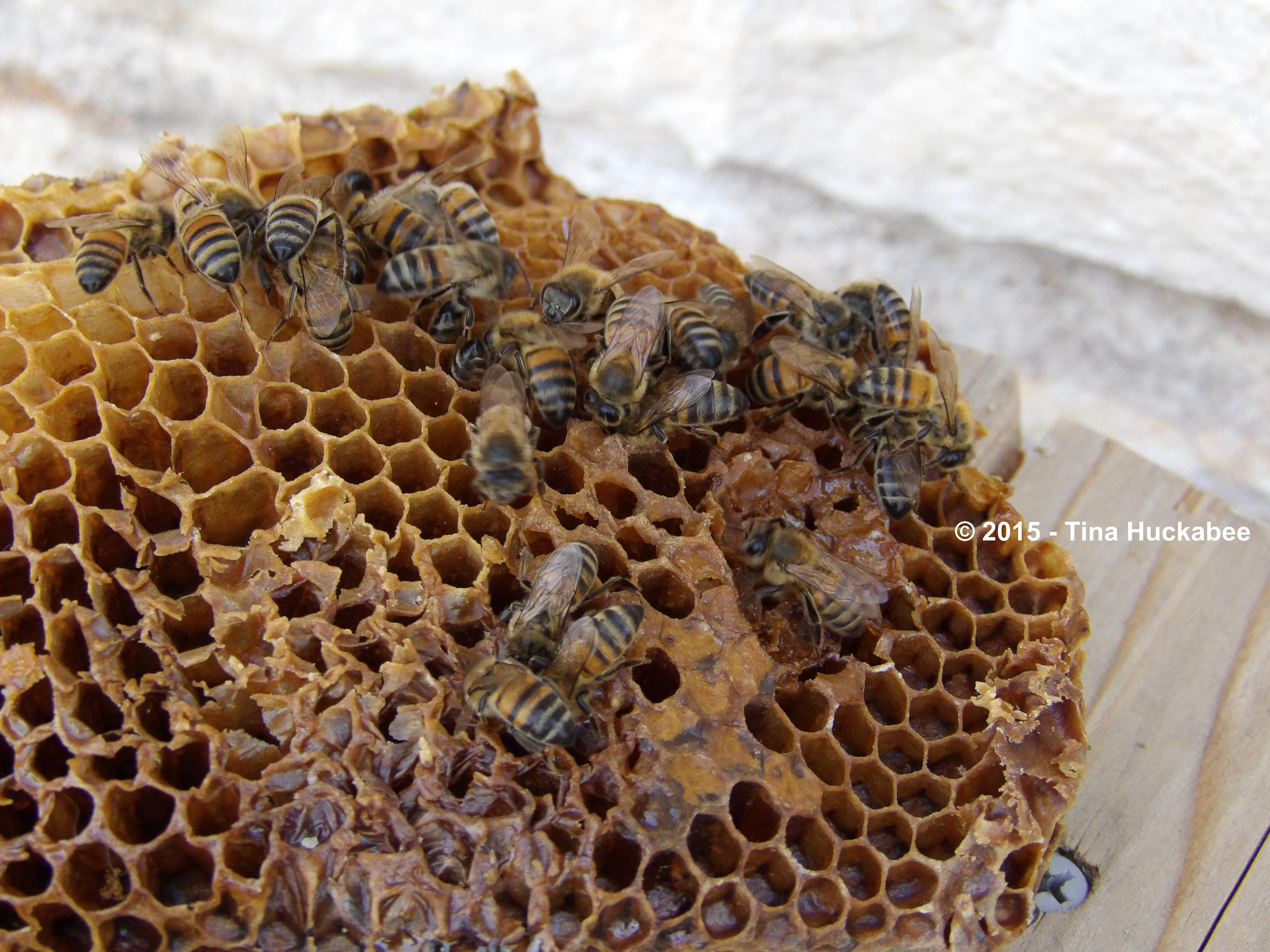
I also deposited the bits of broken comb on top of the hives.

IMGP5444.new IMGP5445.new

Except for some very cold days this week in which they stayed warm and cozy in their hives, the bees have worked that honeycomb for honey and are still doing so, though it’s turned cold again. The only thing a beekeeper should feed her bees is white sugar/water mixture and their own honey.  For now they’re getting their own beautiful honey to enjoy and take to their hive for strength, endurance and because they’re honeybees!  The bees can’t reuse the wax, though they are excellent recyclers in so many other ways.  I’ll leave the comb out, crushed and otherwise, until the bees lose interest in teasing out remaining honey, or eat what honey is there. Once the comb is depleted of its honey, it’ll go to the compost.  Or maybe I’ll put out a call the the Austin area beekeeper bunch and give it away to someone wanting to make candles–or, the like.  No more kitchen comb work for me, at least until the next harvest.

And with all those jars of honey tucked away in my kitchen cabinet, I suddenly have all these friends….

IMGP5442.new

Bee Mama Missive: Honeybee Love

As good beekeepers, we follow advice from those who know more than we do–which includes the vast majority of attendees at the monthly Austin Area Beekeepers Meetup.  The advice this month was to open hives, check out the gals, see if they’re starving or if there’s honey left over after winter, and institute swarm management.

That term sounds like something you’d hear in a leadership management course.  Ugh.

Swarm management.  It’s basically crowd control.  Perhaps more accurately, a kind of birth control. A honeybee hive is a superorganism.  A superorganism is a collective of individual organisms which work together as a whole, where the individuals cannot survive without the collective.  The way a hive procreates is to divide itself by swarming into a new hive.  A new queen is anointed, she leaves the hive, taking workers, maybe as many as half the workers, with her to happily settle in a tree hole or ceramic pot, as happened in the garden of a friend of mine.  Swarming is not something we want for our bees. At some point in the future, probably next spring, we plan to hive our bees into one or two Langstroth hives, eventually ditching our Warre hives. That’s not happening this year–we don’t have time to build new hives.

So as part of our swarm management responsibilities and because it’s simply time to see how the ladies are faring, we opened our hives to check for any leftover honey stores, to see if our queens are laying eggs with resulting larvae, and if there are any queen or drone cells developing.

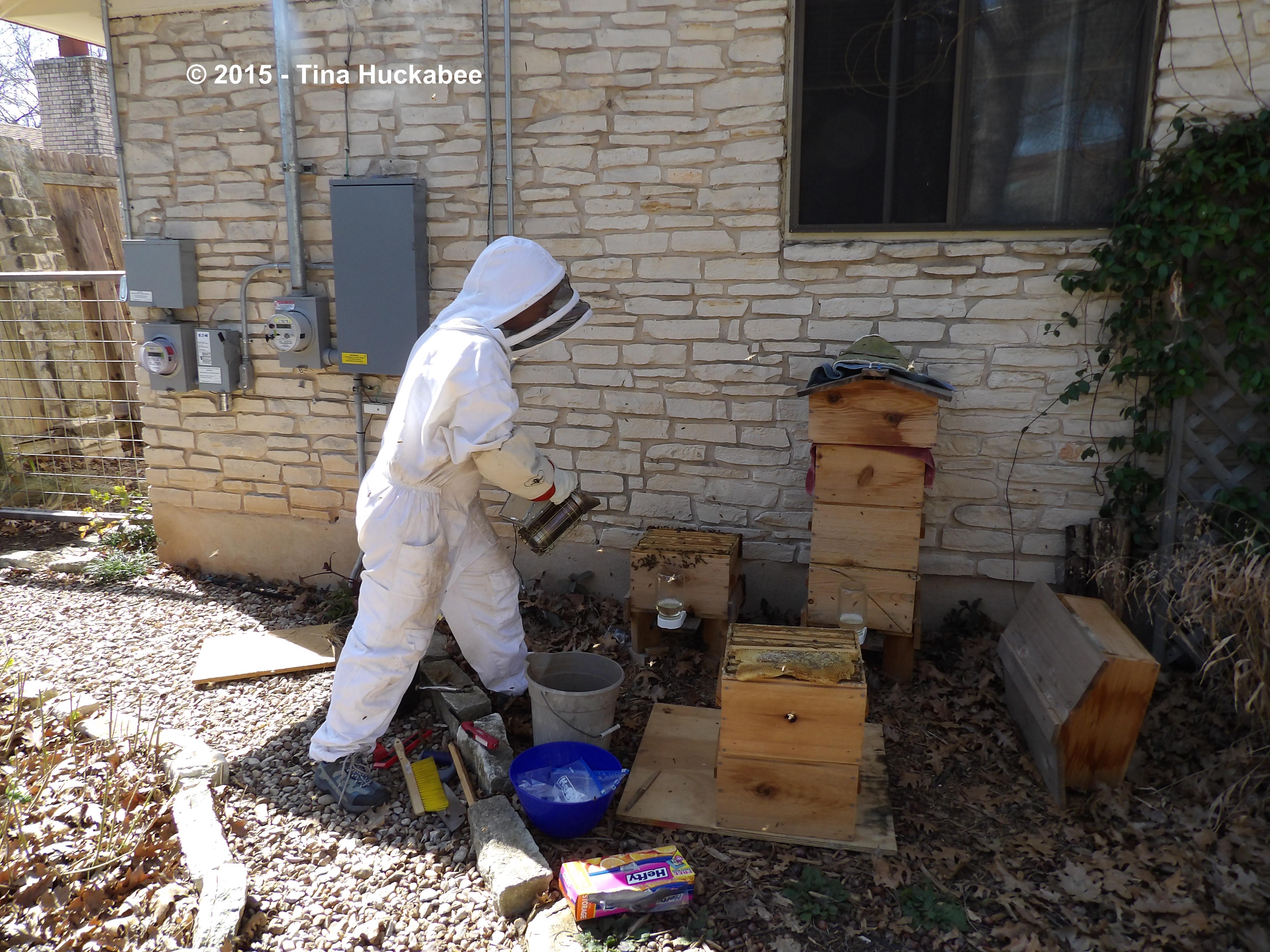
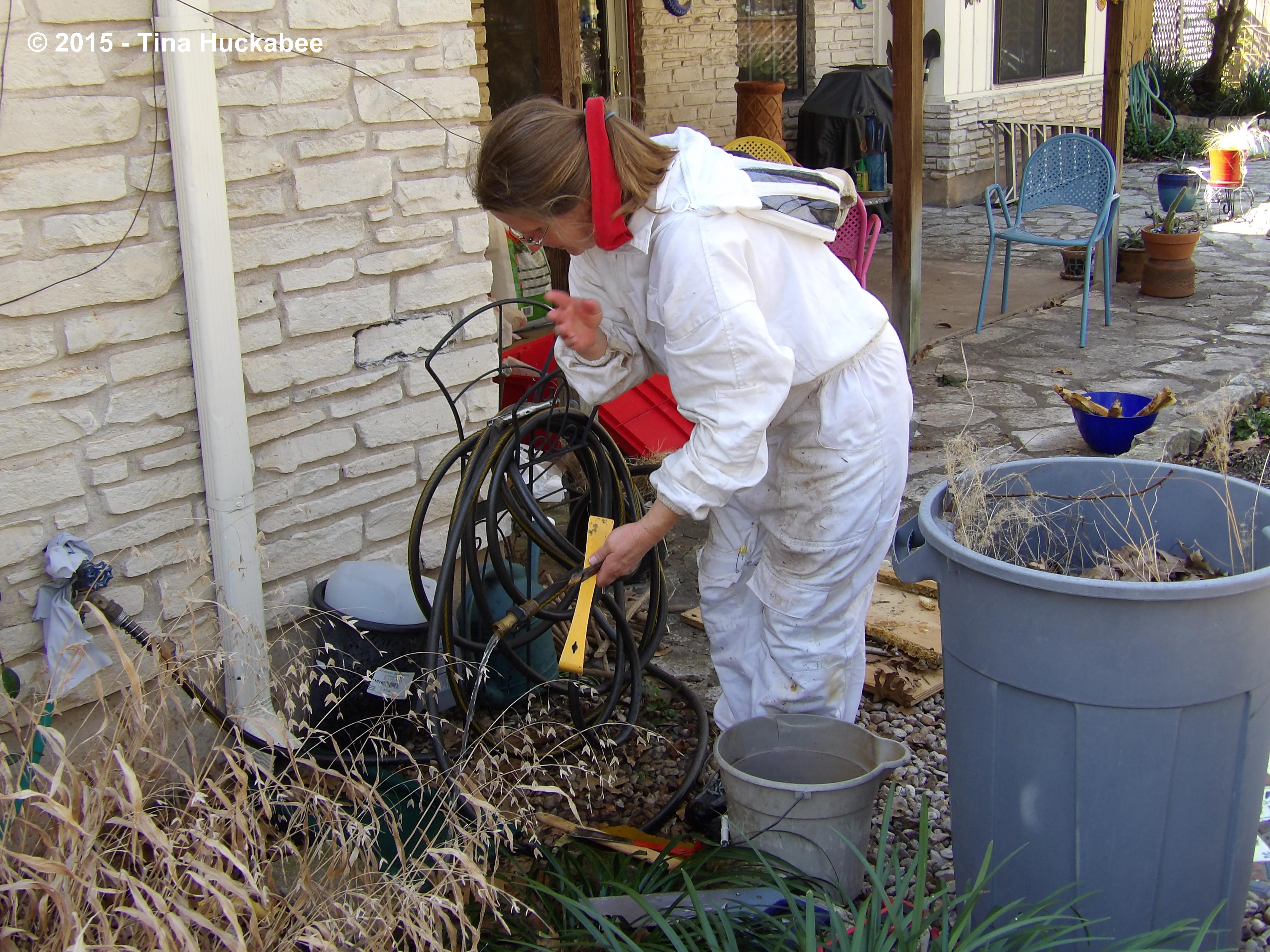
On Valentine’s weekend Bee Daddy and I donned our bee suits,

IMGP5331.new

…fired up the smoker,

IMGP5353.new

…organized our honeybee paraphernalia and got to it.

As a refresher, our hives are Mufasa and Scar.

IMGP5330_cropped_3374x3234..new.new

For those of you who are parents of a certain age, these names will be familiar–from the overplayed Lion King movie which was released in 1994 and by 1995 was on DVD (remember those?) and that a little tiny girl watched while Mommy held the new baby brother.  At least, that’s how it was at our house.

The names were given (in the case of Scar) for obvious reasons–oops that table-saw blade pulled the wood right out of Bee Daddy’s hand, leaving a scar on the wood and a partially numb finger on the Bee Daddy.

Yes, there was lots of blood and a long afternoon visit to our local Emergency Room.

Mufasa is so named because that’s the obvious next choice.

This was the first full hive-check in quite a while as we haven’t opened the entirety of each hive since re-queening last July. This February examination was a complete physical, if you will.  Mufasa was first on our list of hive appointments.  We took off the top box and there was only empty comb.

IMGP5352.new.new

I knew that already because I’d peeked in there occasionally on the warmer days of winter.  Mufasa has always been our smaller, less hardy hive, so I wasn’t surprised or disappointed that the bees hadn’t mustered the numbers to honey-ize the top box.  Off it went, stored for later use in the season. If all goes well–good flower production and pollen/nectar gathering in conjunction, we’ll pop it back on later in the season.

Then we checked the second, or middle box.

IMGP5337.new

A side story:  In September, as we checked our hives, a comb with full, capped honey broke, which I decided to leave in the box as is, knowing that it wouldn’t be easy to extract once the bees reconnected it to the box.  You can read about the dropped-comb incident here. Now after winter, the time of reckoning is at hand–we must carefully cut each top bar with comb, to check honey stores and brood development. And that check includes the cross-comb developed from the dropped comb.

IMGP5334.new

Oh, the stress of it all.

After slowly and carefully cutting away the comb from the sides and the bottom of the box (which directly attached to the bottom brood box), we were very happy with the results.

IMGP5336.new

IMGP5339.new

Mufasa’s second/middle box was moderately full of capped honeycomb, with some empty ready-to-be-filled comb.

IMGP5340.new

We removed the cross-comb and cut the comb off a couple of the top-bars.

IMGP5341.new

IMGP5342.new

… and bagged some rich honeycomb for later honey extraction work in the kitchen.

IMGP5349.new

We left some comb with honey and some empty comb so the bees have honey on cold rainy days and room for brood and more honey stores–whatever is their preference. Both of those goals are in keeping with swarm management–give ’em room to grow, so some of the more rebellious members of the hive don’t have an excuse to leave home.

Finally, we checked the bottom, or brood box and what good news for Mufasa and tangentially, for us!!

IMGP5332.new

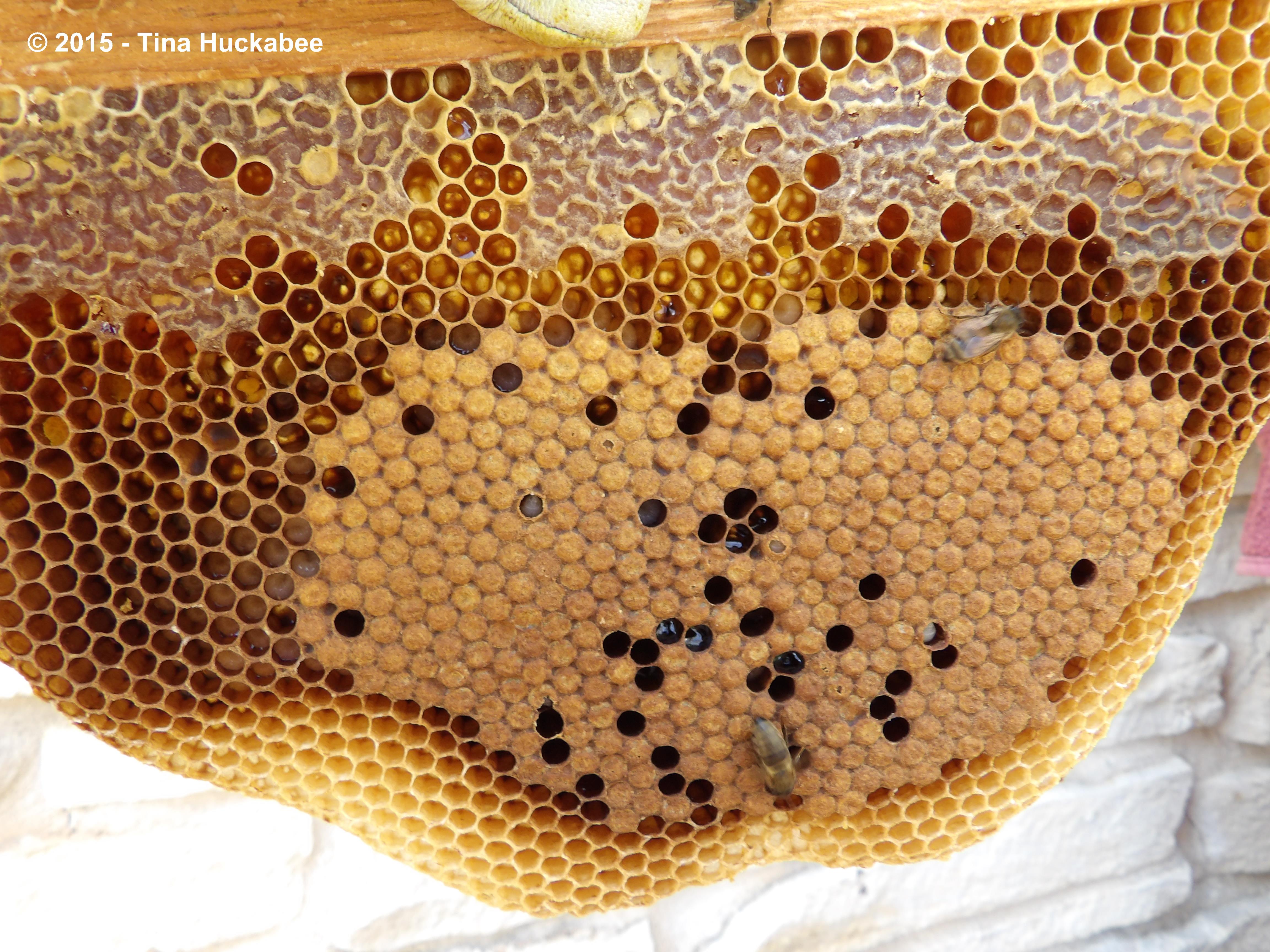
Whoop!! Queen Mufasa (the name suggests a little gender bending there–Mufasa was a dude lion, Queen Mufasa is a queen bee), is ramping up for spring, laying eggs and the larvae are growing and developing. You can clearly see that there are capped and uncapped larvae.

IMGP5343.new

What a great queen she is and how ’bout those workers, eh?

IMGP5344.new

The development of adult bees occurs in stages and is driven by pheromones according to what hives need: workers, drones, or queens.  Capping instigates the final stage in development–what emerges two to three weeks after the egg is laid is an adult bee.  All of these are workers (because of where they’re located and how they’re capped) and the hive will need workers once spring nectar flow begins–in about three weeks.  The timing is perfect!  We didn’t see any queen cells, which is a good sign. Queen cells develop on the sides or bottom of the comb and are larger and oblong–very different from what the photos here show. That no queen cells exist signifies that the bees are content with their queen–she’s healthy and laying eggs and everyone, it appears, is down with that.
We closed Mufasa,

IMGP5354.new

…grinned, did a little dance and high-fived each other, then moved onto Scar’s examination.

IMGP5356.new

IMGP5357.new

IMGP5358.new

It was, essentially, more of the same.  Lots more.  In Scar’s top box, all eight top bars were full of capped, glorious honey.

IMGP5359.new

Heavy, heavy bars of honey.

IMGP5360.new

We removed all eight, cut the comb, bagged it and stored the box for later use.  The second box was similar, though some comb was empty.  We left some full honeycomb, as we did with Mufasa.  The brood box was also full of good news.  Like Mufasa, Scar contained capped and uncapped brood, no queen cells, and stored honey.

I’d call the examination of both hives a good day at the office.  Both Mufasa and Scar have a brood box and a secondary box for expansion.  If the year goes well, the bees will produce enough brood, honey, and comb that we’ll add another box in late summer or early fall, just like we did last season.  I don’t think that far ahead though–there are too many factors and variables in beekeeping.  For the present, in late winter, the immediate future looks good for both hives.  Fingers crossed that success continues into the new year and growing season.

Time to clean up and,

IMGP5362.new

….what do I do with all that honeycomb????IMGP5365.new