I suspect my garden is a meeting place for reptiles, and has been, well, since the beginning of the garden. My constant garden companions are the Green Anoles, Anolis carolinensis. They’re everywhere: slinking from behind the decorative shutters of my home windows, sidling up the trunks of trees, scurrying through the undergrowth of the garden. Sometimes, they come into the house. Last week, my husband came from the kitchen to where I was in the back of the house, an anole firmly clamped on his finger. He’d seen it in the kitchen, attempted to corral the lizard, which only encouraged it to dash under the pantry door. Once in the pantry, the lizard’s options were limited and the intrepid lizard hunter cornered and captured the misplaced green thing. Mr. Anole clamped down on the hub’s finger hanging on with all its might. Husband showed me his prize, we both had a giggle, then he exited the house to return the rogue reptile to the garden. I didn’t have the presence of mind to catch a photo of the finger-with-lizard-attached, but it was a quite a sight. The anole didn’t hurt the hub (nor, the other way around) as its little teeth are…really little and can’t penetrate human skin. But if you’re a small insect (also known as food), those teeth will inflict some damage.
There are plenty of other reptiles in the garden, as well. The season of the noisy, amorous American Toad, Bufo americanus, has arrived. Added to the calming sound of the pond waterfall, are now the guttural–and loud!–croaks of these fellas, also in the pond. Looking for feminine toad company, the warty dudes sing mostly after dark, until about midnight. I like their serenades but wish they’d dial it down, just a bit. There are little tree frogs, too, that I’ve never seen, but hear each spring and summer, starting now and continuing through July. Chirp, chirp, chirp go these little frogs, but fall mute as I approach where they sit in the dark, hidden from my eyes.
Recently, the Blue Jays alerted their avian friends (and consequently, the gardener) to this chap:

He/she is a Rat Snake, Elaphe obsoleta lindheimeri, probably the same adult that I saw briefly last summer. It’s a little hard to tell from the photo, but this slinky, slithery beauty is about four feet long. It was lounging on the ground, stretched out along the base of my back fence which borders a neighbor’s property.
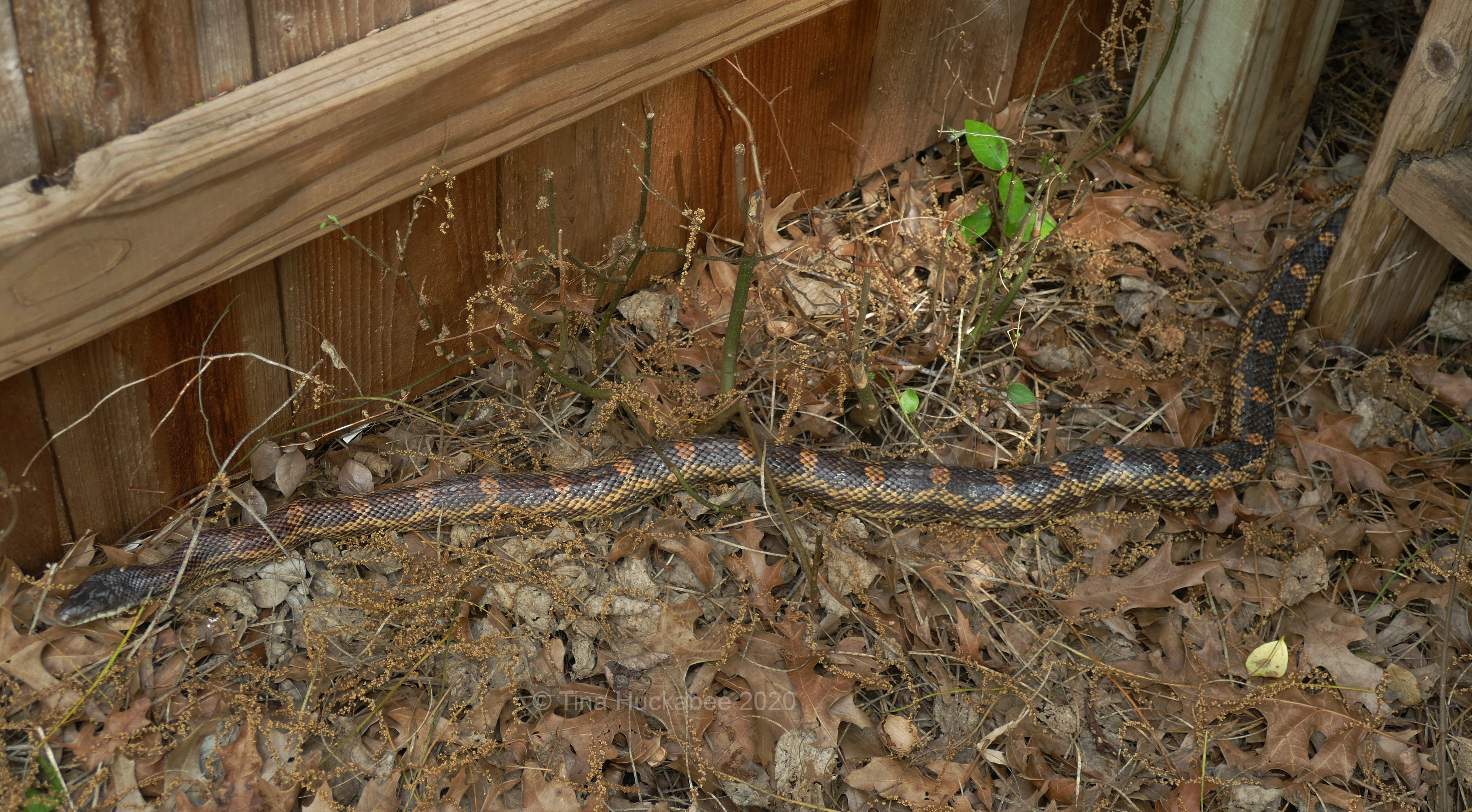
The neighbor was working in his back garden, so I peeked over the fence to let him know about the snake–he’s also a wildlife appreciator. He grabbed a step-stool, peered over the fence and was thrilled to see the gorgeous snake. We chatted for a bit, then I went indoors. A little later, he emailed me to say that the snake had scaled (pun intended!) the 6 foot wooden fence and had plopped over onto their property. Their sweet dog, Tula, was too interested in the snake, so he gently urged the snake to go under an attached fence, to lounge in his dog-free next door neighbor’s back yard. He contacted the neighbor so that if she saw the snake, she wouldn’t freak out; he assured her that the rat snake isn’t harmful to humans.
Like most snakes, rat snakes are shy and avoid contact with humans. They eat rats and mice (Yay!), but also birds, bird eggs, and other delectables smaller than themselves. I’m not thrilled about the bird/baby bird meals, but to have a rat snake in the garden is a gift and confirmation of a healthy ecosystem.
For the first time EVER in my garden, I observed a Texas Spiny Lizard, Sceloporus olivaceus.

Green Anoles are common in my garden, but never-ever have I seen a Texas Spiny Lizard in my outdoor space. I saw it crawling up the fence separating our back garden from my SIL’s garden. I used the camera’s zoom feature as I couldn’t get too near this new garden buddy, as it was intent upon skedaddling as I moved in for closer shot.
When I worked at Zilker Botanical Garden, I regularly saw Texas Spiny Lizards; they were my garden companions in that place, much like the Green Anoles are in my home garden. Like the Anoles, the Spiny Lizards eat insects, but also, smaller vertebrates. Did you catch that that Anoles??
Spiny Lizards are bigger than Anoles by about three times in length, with more robust bodies. They also have larger scales, with muted coloring allowing for their camouflage in native trees. Spiny Lizards typically spend much their time in trees, so maybe they’ve been around, and inexplicably, I never noticed. Regardless, I’m happy that one, at least once, graced the garden.
Then, there’s this clown.


I was watching a swarm of honeybees (yes, mine…) as they made their way to my SIL’s tree in the neighboring garden, when I caught sight of this character. While I think that Mr. Green’s head (and that expression on his face!) is funny, I also think he’s a clever lizard. He’s obviously lying in wait for a meal delivery of honeybee. I’ve witnessed anoles hiding in the foliage of vines or perennials that also produce flowers visited by honeybees, then watched as Anoles snatch their bee prey at lightening speed, retreating into the protection of the foliage for a sweet, crunchy meal.
Nature’s cycles continue, even while we humans are locked-down. If you’re able, now is a good time to observe events that progress successfully without human intervention and to take comfort in those natural happenings. I recognize that I speak from a position of privilege: I have a home, (nothing fancy), but nevertheless, a single family home with accompanying land where I’ve nurtured a full-of-life garden. I realize that many (most) don’t have what I have and I know that I’m very, very fortunate.
But nature is a balm in a world turned upside-down and inside…inside. Be well, look out for your loved ones and neighbors, don’t gather in groups, but make your way outdoors if possible. And wash your damn hands!
What wild happenings have you seen while you walk, or in your trees, or on the ground? Please leave a link to your wildlife story when you comment here and good wildlife gardening and watching!