Yellow or Mexican Butterfly Vine (Mascagnia macroptera): A Seasonal Look

While not the real deal, I welcome these butterfly doppelgangers to my garden:

The chartreuse seedpod is beginning its morph to the mature-seed incarnation.

This golden toast heralds the final seed product.


These two seed pod examples develop on a fabulous vine, the Yellow or Mexican Butterfly vineMascagnia macroptera. 

Butterfly vine is a native to Mexico, but grows southward into Central America.  Several sources I’ve come across mention that the early English naturalist and botanist, Joseph Banks, observed Butterfly vine growing in Brazil.  

I’ve grown my Butterfly vine for at least a decade, maybe longer–I don’t remember exactly when I planted it.  The thick, twisted main trunk confirms that mine isn’t a newby vine.

I first came across Butterfly vine when I was a volunteer gardener at my children’s elementary school about 20 years ago.  One grew at the back of a portable building, with western exposure and no water source readily available.  I recall that it was summer that I found the vine–a Texas summer, folks–and the vine was as fresh as a daisy and blooming its clusters of petite yellow flowers.

Full sun, drought-tolerant, deer resistant, and attractive?  Yep,  that’s a vine for me!

My Butterfly vine grows in an opposite situation, receiving only dappled or diffused light, depending on the season. Yet it thrives with the same great qualities as in full sun, though with fewer blooms most years.  The only maintenance that I employ with this vine is the same one that I do with my hair: tuck away those annoying, wayward tendrils that fall into my face!  I’ve never experienced any negative issues with this vine:  no debilitating diseases, no invasive insects.  

During a hard winter, where there’s at least one multi-day freeze well into the 20s or teens, the vine may be rendered dormant.  The last cold winter like that was in 2014.

The “butterflies” certainly held their own that winter, even when the rest of the vine suffered freeze damage.

Even with the vine losing its leaves to the hard freeze, the foliage returned vigorously from the roots and along the mature stems once longer days and warmer temperatures arrived.

Last year’s winter was mild, but a late, hard freeze blasted through in March. This is how the vine responded:

The vine lost a good portion–but not all–of its leaves; what was lost, came back quickly.  

In a mild winter like this one of 2019-20,  the vine retains its evergreen habit.

With climate change, I’m guessing that this vine is now mostly an evergreen for my  USDA zone 8B garden.  According to Monrovia, Butterfly vine grows in USDA zones 8-10.  I can imagine that for gardens growing significantly farther north than my own,  the vine is an annual or semi-annual plant.  

The vine flushes out during the wet and cool spring months, preparing for its summer/autumn blooming.

Green-n-growing-n-fresh is Butterfly vine’s contribution to the summer garden.  Typically, the yellow flowers don’t appear until mid-to-late summer, sometimes not until autumn.   In full sun, the flowers appear earlier and are more numerous.  Flowers on my vine are scattered, given the shady conditions that they grow in.

The number of bloom clusters also varies according to rainfall or irrigation.  I don’t water much–just twice per month during summer–but if there’s decent rainfall in late July, August, or September, the vine yellows-up nicely.  The vine weathers drought beautifully; I’ve never seen it wilt, nor does it lose leaves during that time.  But for its yellow beauties to perform, some extra wet stuff is an appreciated must.

Butterflies and honeybees sip the nectar, and I’ve seen lizards and smaller songbirds hide in the lush foliage, so I think Butterfly vine qualifies as a solid wildlife plant. 

Even with minimal rainfall, there are still pops of yellow along the vine. The vine blooms throughout autumn, with blooms eventually morphing into their seed-producing, butterfly selves. 

If you live in USDA zones 8-10 plant this lovely, fast-growing, water-wise vine. Yellow or Mexican Butterfly vine is friendly to a variety of pollinators and provides cover for other wildlife.  It’s not invasive and works well on trellises, fences, and arbors. Most years, you and your wild garden buddies will enjoy its spring and summer glory and its evergreen foliage in winter. In a mild winter, the vine retains its foliage and its butterflies. After a hard freeze, all bets are off.

But with this vine, you might have butterflies year-round!!


Spring:

Summer/Autumn:


Winter:

…or,


First Blooms

The first spring blooms have blossomed.  I’ve watched my irises, recognizing that the burst of color was imminent, and here it is.

Dotted with last night’s raindrops, the unknown variety has graced my garden for years.  I’ve researched this lovely, mostly by photos, and have found several species that are similar to what I grow, but I haven’t ever committed to anointing this iris by name.  Weirdly, I look far and wide when I’m identifying native plants and have, on occasion, spent hours scrolling through photos and descriptions in attempts to identify an unrecognized plant.  Yet with the iris plants, I’m content to simply enjoy the beauty of this non-native, without need for a definitive name.

It’s really a misnomer that the irises abloom today are the “first” blooms, since there are several perennials that have bloomed all winter.  But irises are quintessential spring flowers and I think it’s fair to allow them the title of number one–just because.


The true surprise this morning was the first open poppy of spring 2020.

I’d seen the buds, but guessed one or another would open later in the week.  A German friend gave me seeds many years ago;  I sowed those seeds and 20 years later, reap the benefits of their beauty and pollinator activity.   I collect seeds from each crop in late spring, sprinkle those seeds in autumn, and enjoy the bounty in March and April.

The poppies, or at least these firsts, are early.

Honeybees love these flowers, though none were up this morning to work in this first bloom’s offerings. I imagine bees will visit as the sun appears and day progresses.

Honeybees–like the garden–are ramping up for the growing season.

Greening Up

As days pass, there’s no slowing down for emerging buds, unfolding ferns, and  greening up of the garden.  In these climate changing times with weird to mild winters, it’s no longer normative for February to be Central Texas’ coldest month of the year, hosting regular hard freezes with mild days in between. Instead, chilly–not freezing–days are interspersed with warm, April/May-like temperatures.  Non-native plants like irises and introduced trees gear up for growing with the surplus of balmy days, but if a hard freeze rears its icy head, those non-native plants struggle with the unexpected cold. So far, my native plants are “weathering” the weird fairly well.

Alongside older leaves which never bothered to drop, emerged new growth is appearing on a young Rough-leaf Dogwood treeCornus drummondii.  A beautiful, small native tree, it grows well in shade and is a known wildlife winner.

My older Rough-leaf dogwood, a gift from a fellow Austin-area garden blogger (Thanks, Deb!) has grown, grown, grown.  No longer is it a stick with some other sticks coming out the sides, it’s now a real tree (paraphrasing Pinocchio).  New foliage has recently become noticeable, dotting limbs up and down the tree.


Last weekend, I transplanted a well-established Leatherleaf mahoniaMahonia bealei, from my full-sun front garden to my mostly shady back garden.  After half of an Arizona ash tree was damaged in 2017 during Hurricane Harvey rains, the front garden now receives significantly more sun than it did in the mahonia’s early days.  The poor thing was suffering foliage burn during the long summer months; sun fried leaves dropped, causing stress for the shrub.  The mahonia should be happier in my back garden where it will live in dappled shade and that’s the environment this mahonia species likes.

I hope it survives the transplant; it’s an early bloomer–great for hungry pollinators– and a tough, attractive shrub.  I’ll need to remember to water regularly during July, August, and probably, in September.


I like this picture of green, with varying textures.

At the right of the photo, are straps of iris, unknown variety; in the center-front, the foliage of native columbine pair nicely with Katie’s dwarf ruellia.  Back-center, you see a crimson pot topped with the foliage of fuzzy, bright green Foxtail fern.   To its left, another tough non-native, Dianella.  The Dianella tasmanica ‘Variegata’ is a great plant for our long, hot growing season, but oh so tender when the cold winds blow.  I have 5 groups of this plant–I love it–but it’s also the only plant that I must cover when the temperatures take a deep-dive, well below freezing.  So far in this non-winter winter, the Dianella have remained green, white, and stripey, with no need for covering.

Last winter, I notice a seedling of Texas Mountain Laurel, Sophora secundiflora,  nestled at the edge of a clump of amaryllis that my mother gave me years ago.  I’m leaving the Mountain Laurel, but where it’s situated, it will eventually grow large enough block the view of the pond from my kitchen and living room window.  Yikes!  That’s not going to work, but I don’t have the heart to pull it, but pull it out I must. Eventually.

The amaryllis straps should be dormant, but they’re not.  Thanks mild winter!  Behind these two plants, grows another group of Dianella.

I’ve grown this Mexican orchid tree, Bauhinia mexicana for about 10 years. Until the past two years, the tree regularly lost its leaves in winter frosts.  This year and last, it’s had practice at becoming reliably evergreen.  I like the foliage and the tiny song birds really like the foliage, but I would prefer more winter, fewer leaves.

The long-views demonstrates the greening of my back garden.  To be fair, it’s not only that winters are warmer that encourages more garden green, but that I’ve planted more shade appropriate plants–many of which are evergreen, no matter the winter–to better adjust this garden’s transformation from a full sun space, to a mostly shade situation.

Looking southeast. My sister-in-law’s garden is just over the fence.

A northwesterly view.

The long view, again, looking southeast.


Greening, along with some other coloring, is also a winter thing in my front garden.

Iris blooms have emerged and will open…soon.

Ugh, if there’s a hard freeze in late February or in March, the blooms will be mush.  That happened last year:  a mild winter, then a hard, hard freeze during the first week of March.  Most of my individual iris plants had produced stalks and along those stalks sat a minimum of 6-8 blooms each.  I clipped as many irises as I was able, so that the blooms would happen, rather than losing all to the freeze.  Exhibit A:

Exhibit B:

Every glass and ceramic container I owned was filled with irises. EVERY ONE.  While it’s nice to have cut flowers in the house, I’d rather leave–and see–flowers outside.  So, stay away, hard freeze(s)!!

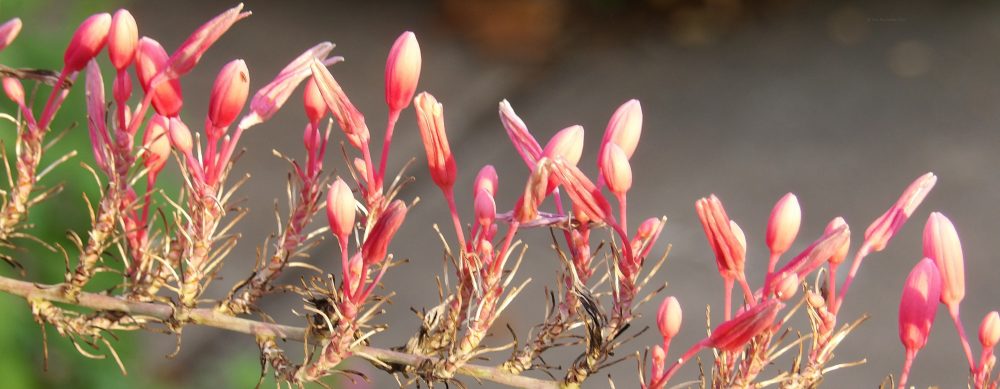
In past years, this sitting area would be less lush, more barren.  This winter, green is queen and blooms…are blooming. Firecracker/Coral plant, Russelia equisetiformis, (bottom left in photo), has produced its tubular red-orange flowers all winter.

Back when winters were normal, the Mexican honeysuckleJusticia spicigera (far left in photo) would be frozen and by now, pruned to the ground; ditto the bronze foliaged Ruellia ‘Chi Chi’ (center-right in the photo).

We live in a new climate paradigm and must adjust and adapt; we’ve waited too late to mitigate these early impacts of climate change.  In my own garden, the best I hope for is utilizing native plants as much as possible because of their evolutionary partnership with the capricious Texas weather patterns, without–and with–the onslaught of our changing climate. Going forward, I accept that non-native plants, even those which have been reliable, will be less so.  Milder, greener winters, early springs, searing summers, and delayed autumns are here.  Now.