The Eyes Have It

A pair of Carolina WrensThryothorus ludovicianus, live near my garden and most days, I see at least one of the pair.  Often, I observe both wrens in the garden as they flit through underbrush picking plant lice from limbs and hop through leaf matter, tossing bits–hither and thither–in their endless search for yummy insects and spiders.  More delightful–and easier to observe–I’m witness to their landing on the sunflower or suet feeders, both placed outside the big kitchen window.  The Carolinas snatch tasty morsels, then zoom to safety on a low branch to enjoy their chosen treat.  These gregarious little wrens are (almost) effortless photographic catches, as they perch on fences, or on the multitudes of spots where they survey the landscape, watching for predators and planning the flight path to their next adventure–or meal.

I snapped this shot a few weeks ago as this adult rested on my back fence, looking this way and that, chirping all the while.  As I watched him or her (going forward, wrens will be “its,” as I can’t tell gender), something looked amiss.
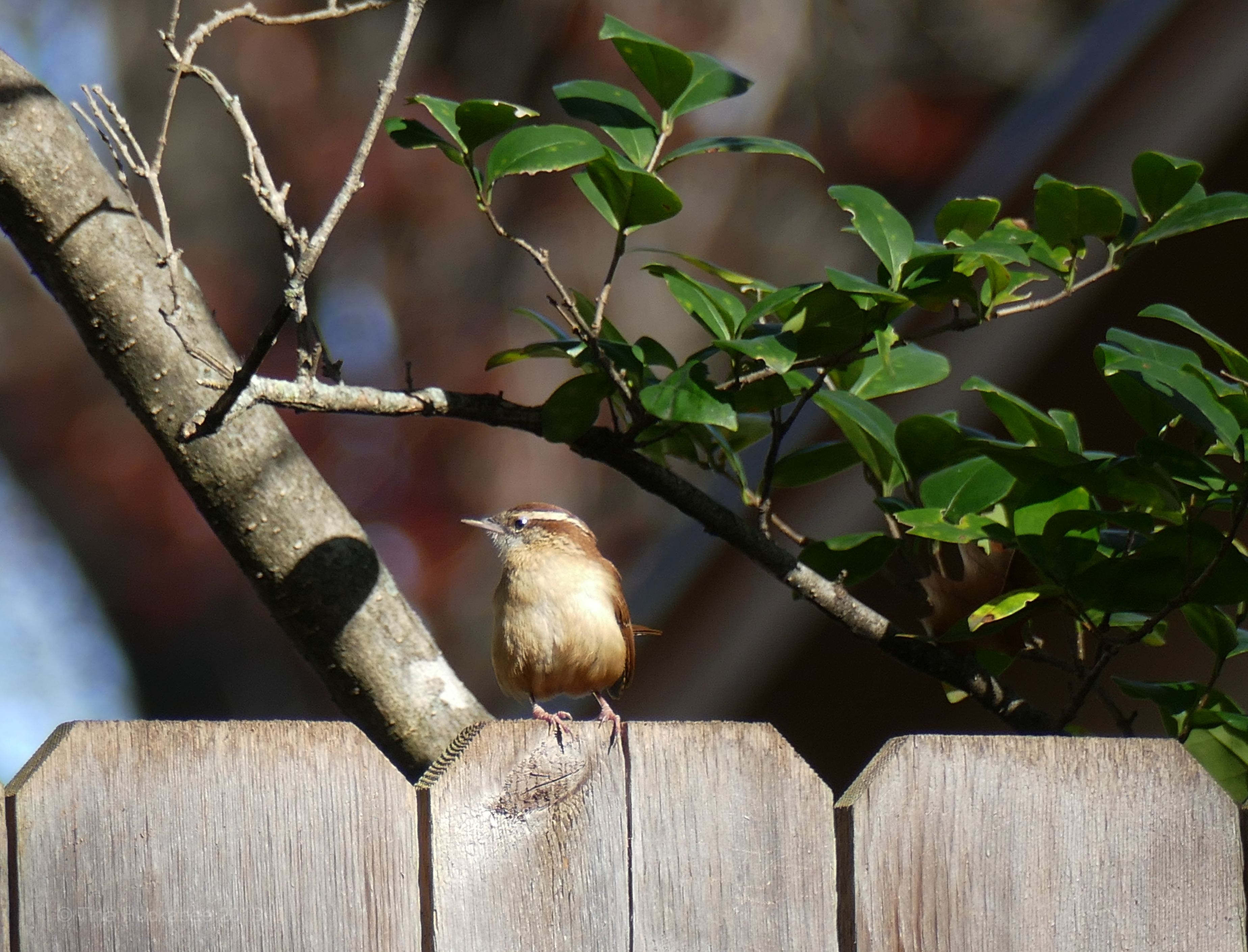
Once I downloaded the photos, it was clear that the wren’s right eye was closed, or mostly so.

For this spunky Carolina Wren (they’re all spunky–that’s a descriptor of Carolina Wrens), one of the eyes has it, and one, apparently, doesn’t.
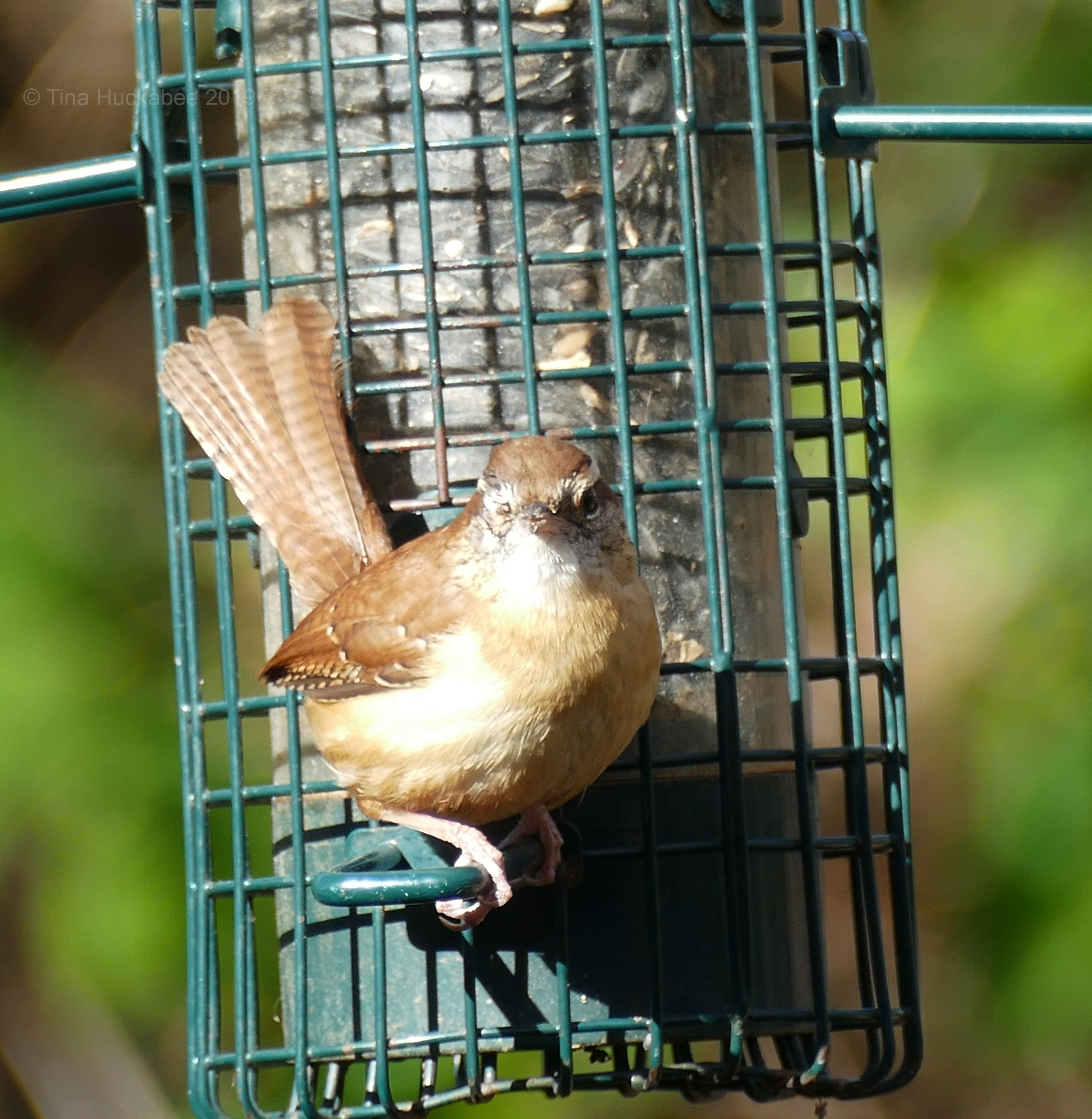
I perused bird sites for any information on eye diseases in wrens, specifically wondering if wrens are vulnerable to the same eye disease that House Finches and American Goldfinches suffer.  I haven’t found any information that suggests that particular connection, and finches and wrens aren’t related species of birds, except that they’re both, well, birds.

Ahem.

As I’ve observed backyard bird business over the last few weeks, I’ve paid special attention to the wrens, and with some good luck (and clean windows), have taken some closer shots of the currently one-eye bird.

The right eye is completely closed.


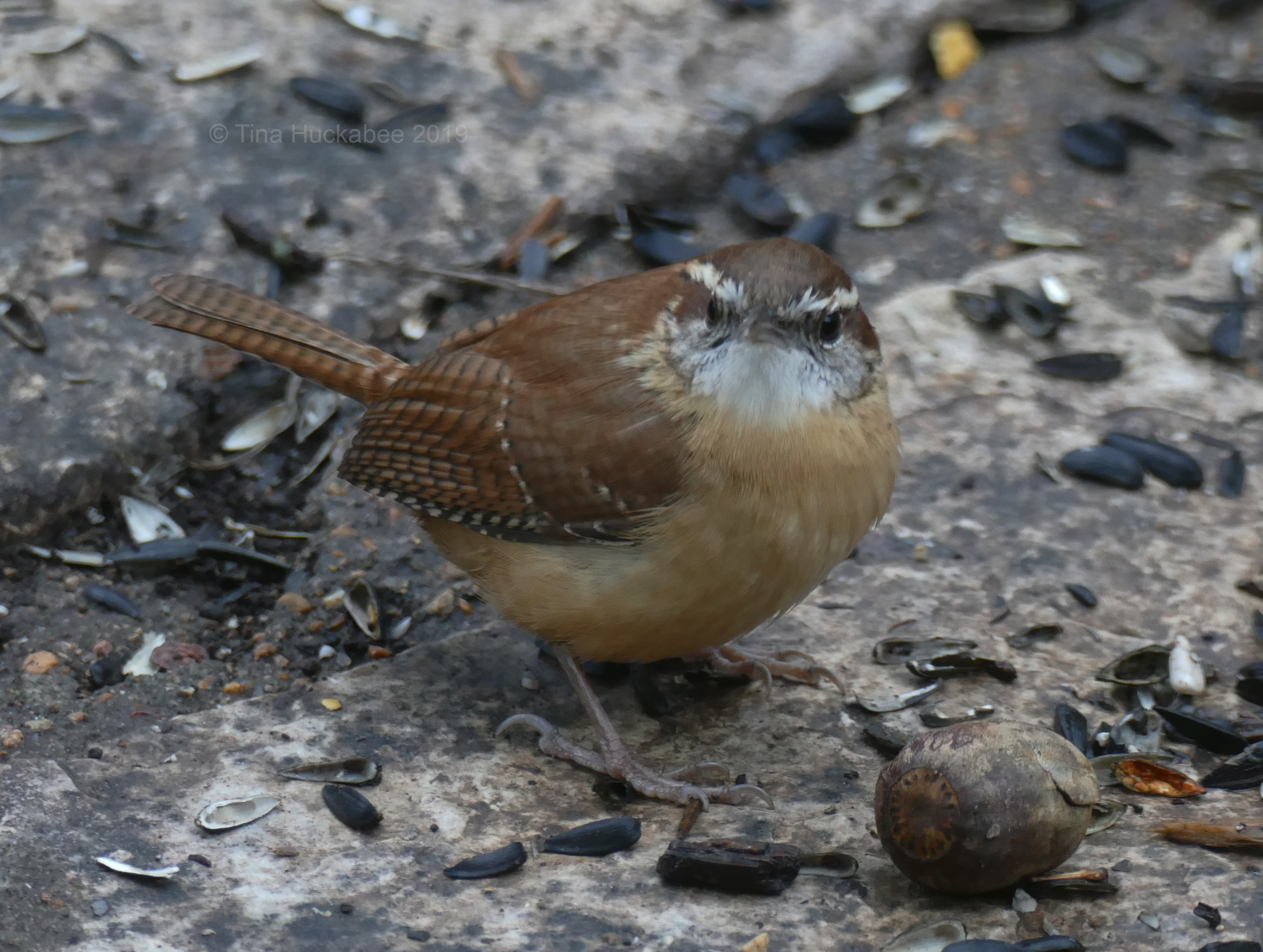
For comparison, this shot of the mate shows a darling adult wren with two healthy eyes.
In the last two weeks, it appeared that the wren’s eye improved.

The eye is clearly swollen, but you can see a bit of wary eyeball peeking through the lids.

In this photo, taken a few days after the one above, the wren in on the ground below the suet feeder and the eye looks better.

Again, up on the suet feeder.

Injury or disease?  It’s impossible for me to say.  Except when the wren turns its head where I can clearly see the injured eye and identify the disfigured wren, I haven’t observed any difference in behavior of one wren from another:  they both fly normally, work, with verve, through the garden for insects and other snacks, and alight gracefully on the feeders for sunflower seeds or suet.  Perhaps the injured wren looks around more readily and nervously than the other, but I’m not sure that’s the case as Carolina wrens are busy birds who aren’t still or placid in their routine behavior.  As I anthropomorphize the wren situation, I wonder if the mate assists the impaired partner, who obviously has limitations of sight, or, is the disabled bird on its own for food?   Has the semi-blind bird learned to compensate for its eye problem by faster flying or furtive movements?  Is the eye healing, or is this a permanent situation? Should I fashion a tiny, wren eye patch and offer it as a gift, and would the wren accept it?


While it seemed like the wren’s eye was improving, in this distance shot of a few days ago, the eye looks closed again.

The mate landed on the branch just after I took the photo and the couple perched for a time, enjoying one another’s company for several minutes before flitting to a different tree in the distance.

The wren on the left is the one with the bum eye.

I assume this is the same pair who raised two chicks last spring and what a sweet show that was. I’m sorry for the wren’s injury, but there’s nothing I can do to help the bird–it’s wild, and by all appearances, has adapted to its eye problem.  Its actions seem wren-normal and it’s clearly able to feed and fly, and those two skills are the foundations of a healthy bird life.  But I do hope the little bird will enjoy restored vision, and will continue its wren ways, and further, that this couple can successfully raise another clutch of Carolina Wren cuties in spring.

I’ll be keeping my eye out for them.


Woo-Hoo!

Or is it hoo-hoo?  Or maybe trilllll and whinny in the early morning hours?

No, it’s relief on my part, so it’s a big yay! 

An Eastern Screech-OwlMegascops asio, snoozes in the box early this morning.

This owl watching season has been an odd one, with this enigmatic bird more than discreet than usual.  I’ve only heard screech song three times this winter, and until this morning, hadn’t a single glimpse of the shy little raptors.   But here she is!  Is she exhibiting her nesting behaviors, perhaps?  I certainly hope so!

Update:  the nest box camera position didn’t capture any part of her owl body as she was hanging out this morning and she didn’t snuggle in for her daytime rest until I published, but here she is, boxed in for the day.

Birding for Fun and Profit

Okay, it’s a click-bait sort of title.  You’re not going to gain any profit, save learning about your winter birds, by watching birds in your own back (or front!) yard, but you can aid ongoing research about North American birds by participating in Cornell Lab of Ornithology’s and Bird Studies Canada’s Project FeederWatch.  Besides, bird watching is fun and interesting, especially for bird geeks!  Who wouldn’t swoon at viewing this handsome chap?

Blue Jay (Cyanocitta cristata) bathing.  Check out the droplets of water on his feathers.  A year-round resident of Central Texas, Blue Jays are stunningly beautiful,  charming–and noisy!

Project Feederwatch enlists citizen scientists (a highfalutin, fancy-pants term for volunteer) to regularly watch birds from specific spots–back yards, front yards, community gardens–from November to April, and then report numbers and varieties of birds who show up due to something  placed to attract those birds.  Appropriate bird paraphernalia includes feeders (duh…), water features, houses and the like.  There are specific counting measures (easy to understand and follow) and the method for uploading to Cornell’s site is easy-peasy.  The weekly time commitment is whatever you want it to be (15 minutes or  hours-long), and with specific parameters–also doable.

The real treat is that instead of being a weird birder, you have a legitimate scientific excuse to watch birds such as this lovely guy:

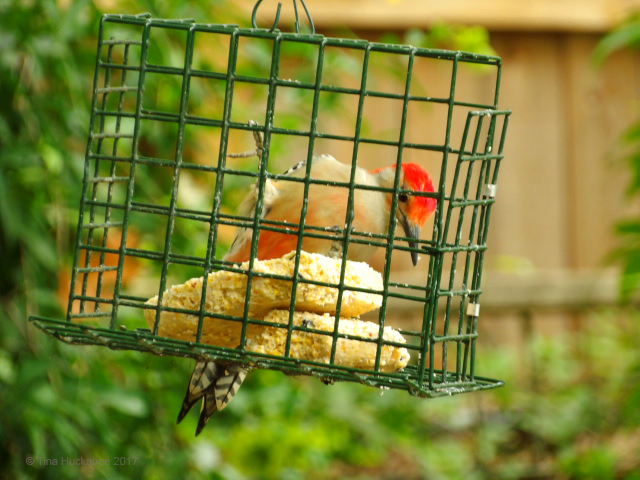
Shy and wary, this Red-bellied Woodpecker (Melanerpes carolinus), is another year-round resident, but I only see them in my garden during winter and early spring.  He and his mate are mad for suet!

Research on North American bird populations by information gathered from regular bird-crazy folk and has yielded vital details about altered migratory patterns and populations, spread of diseases (like House Finch conjunctivitis), and how and what impacts birds throughout the continent.  The data collected assists scientist with the following  (from Project FeederWatch):

  • long-term trends in bird distribution and abundance
  • the timing and extent of winter irruptions of winter finches and other species.
  • expansions or contractions in the winter ranges of feeder birds
  • the kinds of foods and environmental factors that attract birds
  • how disease is spread among birds that visit feeders

And gosh darn it–birds are beautiful and vital for our gardens and the ecosystem as a whole.  Why wouldn’t you want to learn more about their habits if what you learn potentially helps them survive and thrive?

My winter birds are showing up and showing off!

An Orange-crowned Warbler (Oreothlypis celata) waits his turn at the suet feeder. He, his mate and other warblers will likely be present in my garden until April–then head north for breeding.

To participate, check out Project FeederWatch.  There’s a required small fee ($18) US, ($35) CAN, which covers various administrative costs.  Officially, Project FeederWatch started this past week, but jump in whenever you have the time and inclination–bird lovers everywhere will cheer and the fine folks at Cornell Lab of Ornithology and Bird Studies Canada will appreciate and utilize your efforts and data.

Additionally, if you love wild birds and regularly feed them, this timely Cornell’s All About Birds article is a reminder about the various types of feed appropriate for birds and is a good read, whether or not you participate in Project FeederWatch. It’s an excellent reminder that our choices of bird feed should be about their needs and not just what we think they should have.

Orange-crowned Warbler enjoying some fat-filled suet.

Happy backyard birding!