Bloody Red

With scary Halloween just around the corner, I don’t want to alarm readers with the Bloody Red title.  Rest assured, it doesn’t indicate gory events ahead, but instead, something bright and cheery–and bloody red.

Oxblood lilies, Rhodophiala bifida, are naturalized autumn bulb beauties scattered throughout Central Texas. The plants originated from Argentina and Uruguay and were introduced to Texas by German immigrant and botanist, Peter Henry Oberwetter, who settled in Texas during the mid-1800s.  He collected plants, gardened, and bequeathed following Texas gardeners a legacy of brilliance.  Scott Ogden, in his book Garden Bulbs for the South, writes that Oberwetter made both Oxblood lilies and the Texas native Rain lilies, Cooperia pedunculata, available for the budding nursery industry.

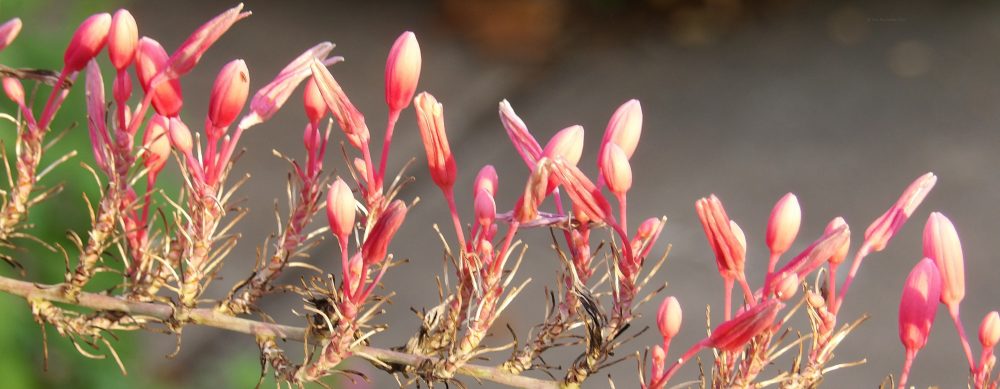
The first fall rains which typically occur in late August and September–those soakers tasked with breaking the summer heat and drought–give permission for Oxblood’s fleshy stems to stretch up and out from the buried-in-the-soil bulbs, seemingly overnight.  In the next days buds appear, with gorgeous crimson flowers to follow.

My Oxbloods were a little late this year owing to our hellish hot and dry September, but they’ve arrived with the dribbles of October rain.  Pops of scarlet look at me! flowers are peeking out from underneath and up alongside, other plants.
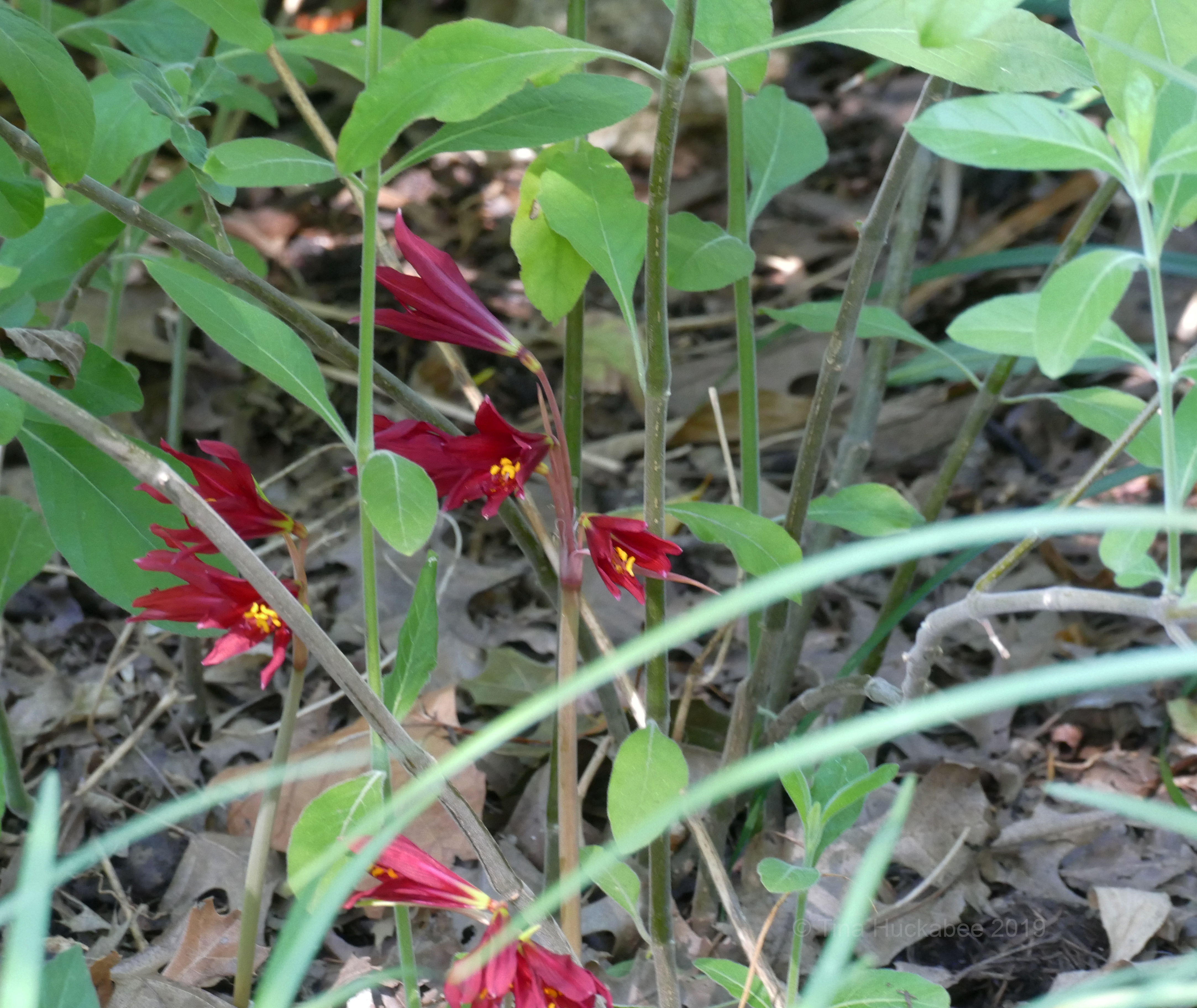
The little crew in the above photo will need transplanting to another spot, or perhaps, to several spots, because they’re currently snuggled underneath a shrub that will become denser with time.  The Oxbloods will eventually be overgrown and disappear–and I don’t want that, do I?

I’ll mark the spot with a stake so that next spring I remember to dig up the bulbs and transplant them to a new place in the garden.  After the Oxblood flowers fade, green, grassy foliage replaces the blooms and stalks, and that foliage remains evergreen for winter.  At some point in spring (that I never notice until too late) the foliage disappears.  If I don’t mark the spot in the next months, by spring the foliage will have vanished and I won’t recall exactly where the bulbs are located.  Been there, done that.

Why not dig up the bulbs now?  An Oxblood truism is that it’s best not to transfer bulbs until the foliage has faded so that the plant completes its natural cycle.  That said, I have been guilty of moving Oxblood bulbs just after they bloomed.  The Oxblood world did not come to a crashing end, though I can’t remember if blooms happened the following fall.  My guess?  Probably there were no blooms until the following year. Plants whose life cycles are disrupted, sulk, and then get their revenge by refusing to bloom.

 Because I am able and I know it’s the right thing to do, I’ll be a fastidious, rule-following gardener, staking precisely and transplant appropriately.

The bloom period of individual Oxbloods isn’t long–just a few days each–but with a number of these bulbs planted throughout my gardens, the blooming is staggered over several weeks, providing a lovely splash-of-scarlet show and welcomed fall color.

Boasting of a bit of Texas (botanical) history and bloody beautiful Oxbloods, I’m joining today with Anna and her Wednesday Vignette.   Check out her beautiful Flutter and Hum for musings of various sorts.


They Have Arrived

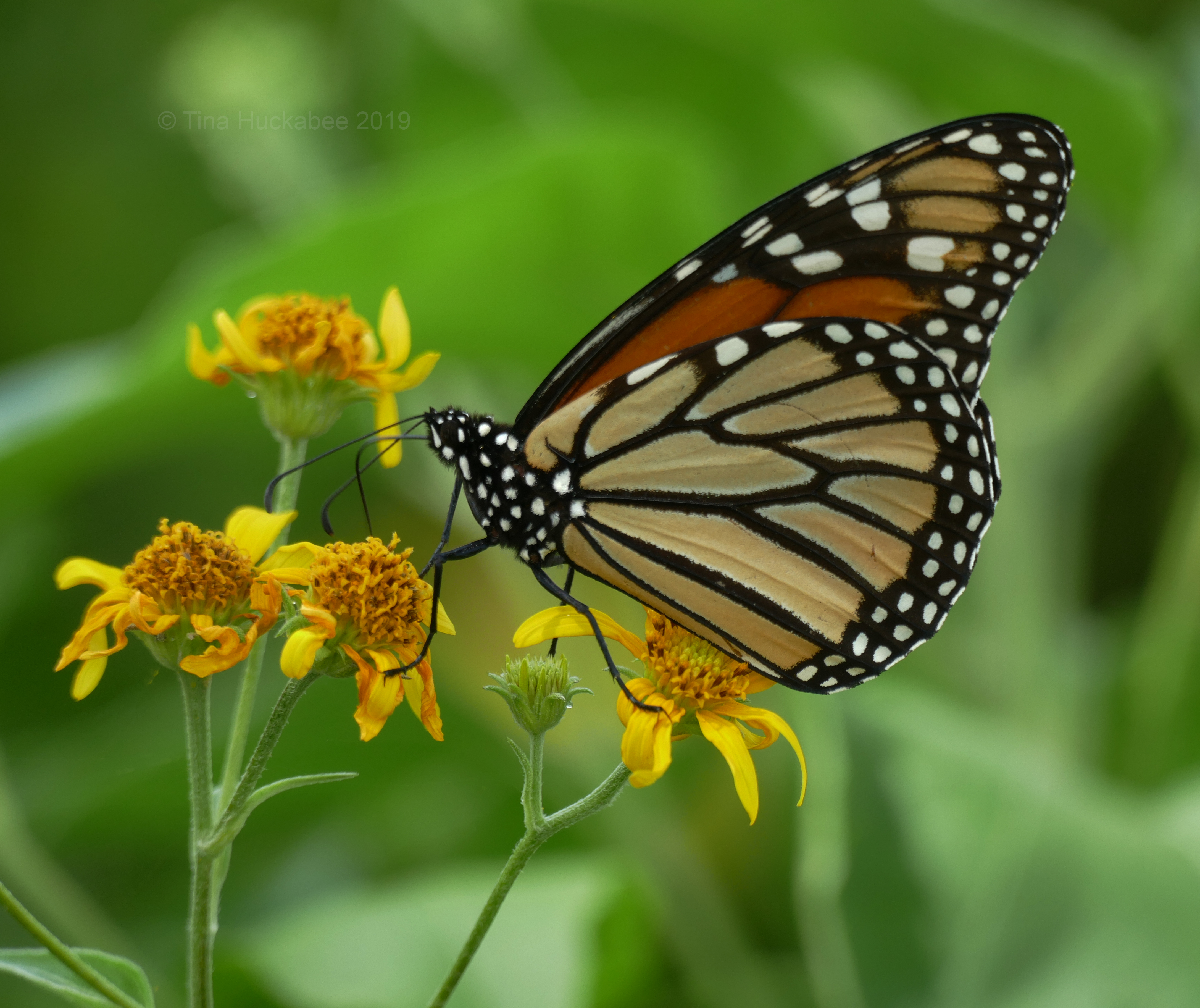
They’re back.  The Monarch butterflies, Danaus plexippus, are now wafting through Central Texas, orange and black wings gracefully flit against the Texas sun before alighting at blooming plants for nourishment, sustaining their long flight, continuing their annual life cycle.

Like so many of us, Monarchs face an uncertain future:  climate change, deforestation in Mexico, overuse of pesticides and herbicides in urban gardening and commercial farming in the United States are just some of the challenges to a viable population of these insects.

I am joyful at the first Monarch sighting in spring and then again, in autumn.  Currently, my garden offers a diversity of flowering plants–native and nonnative–in which the butterflies nectar from before they move southward toward their winter home.  In autumn, it’s all about providing blooming flowers for these hungry, hungry butterflies.

In spring, the availability of milkweed (Monarchs’ host plant) is paramount for the hungry, hungry caterpillars.

Female Monarch on Frostweed (Verbesina virginica)

This generation of adults are those last born in the northern parts of the United States and Canada and are now headed to Mexico.

Female Monarch on Plateau goldeneye (Viguiera dentata)

Once these remarkable insects arrive at their destination, they will gather in dramatic clusters by the millions, high up in the Oyamel fir forests of the Sierra Madre Mountains in Mexico. The unique situation offers cold temperatures and high humidity during the winter–the evolved perfect environment for Monarchs’ winter rest.

Male Monarch on Frostweed. The two black marks located on the hind wings, plus thinner black webbing indicate a male.

The adults who overwinter in Mexico are those who will return through Texas (the major migration pathway) next March, laying eggs on a variety of native milkweed plants.  That first (or is it the last?) generation begins the life cycle all over again: adults mate, females lay eggs, the adults then die.  Eggs hatch, caterpillars eat the milkweed, morph to the next generation, the flights resume.  The ancient rhythm continues in leap-frog fashion, northward through spring and into summer.

Female Monarch on Skyflower (Datura erecta)

At some point in August, six generations later, because of a change in light and through a magnetic pull that the Monarchs have responded to for eons, the last set of adults turn southward and begin their 2000 mile journey toward the Mexican mountain firs which await winged occupation.

Stopping briefly as they migrate to Mexico, Monarchs are enjoying a respite in my garden; the first of many arrived a couple of days ago.

I am an appreciative witness to this natural event.

I’m joining today with Anna and her Wednesday Vignette.   Check out her beautiful Flutter and Hum for musings of various sorts.
 

Praying for Snakes and Birds

As the days shorten and cool, it’s once again a pleasure to be out-of-doors.  In my spare time, I’m re-configuring parts of my garden (when am I NOT re-configuring parts of the garden?), and enjoying the seasonal change from summer to autumn.

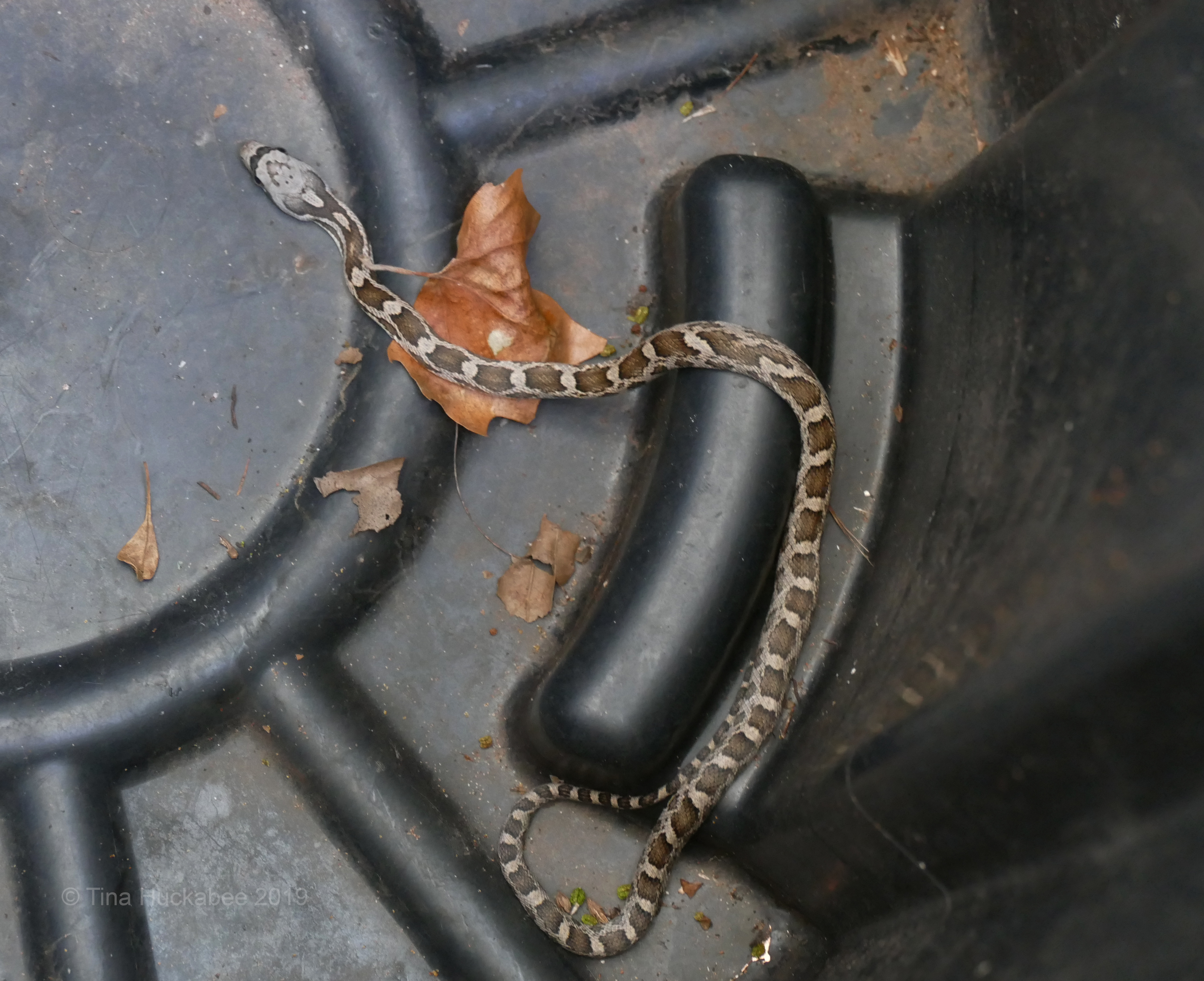
In my compost area, I was wrangling rogue fallen leaves and when I peeked into an empty bin, discovered this slithery fella.

A young Texas Rat SnakeElaphe obsoleta lindheimeri,  I imagine it’s the offspring of a adult snake that I saw in June.  Several times, the Blue Jays were yelling at something in the back corner of my garden.  I’d investigated, assuming that they were screaming at an owl, but they were looking down at the ground and not up into trees.  After several inspections driven by the jays’ caterwauling, I finally I saw a bit of a good sized snake.  The snake was mostly nestled under groundcover, but enough was visible showing a circumference several inches, meaning that the snake is most likely 5-6 feet long.  I left the snake alone, not out of fear, but because rat snakes are good predators to have in the garden.

The Blue Jays were quiet after that, but a few weeks later I heard the alarm calls of a crowd of Carolina Chickadees, Carolina Wrens, and Black-crested Titmice as they fluttered around my back neighbors’ large elm tree.  The little birds were inspecting something in the crotch of large limbs, and only once I grabbed my binoculars could I see that it was several bits of shed snakeskin hung on the bark of the tree.  Rat snakes can climb trees, so I was certain the skin was the remains of my snake.  I emailed the neighbors and they were excited about the find, but never saw the live snake.

Fast-forward through summer and I suppose eggs were laid and snakes were hatched.

Once I snapped photos of the binned beauty and dragged the Hub out to see our slinky friend, we deposited the little reptile in a different part of my garden.  I hope it eats lots of rats and mice, but not the various birds that are around.  Alas, birds and their eggs (remember, rat snakes climb!) are part of rat snake diets.

Predators eat.


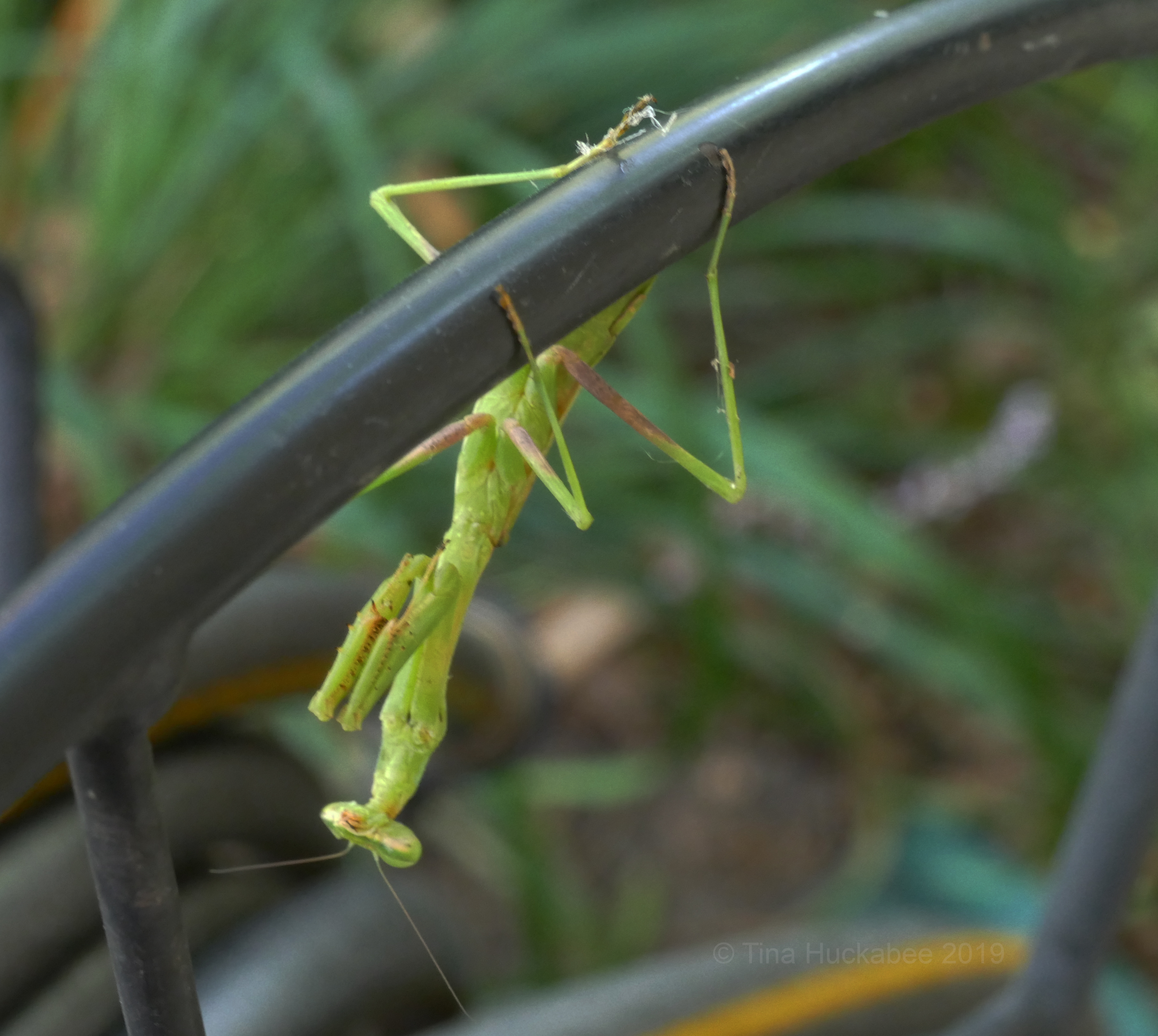
After checking the honeybee hives recently, I spied this smaller, but no less deadly, predator hanging out near our hive, Scar.

“Arms” held aloft, perhaps this adult Praying mantisStagmomantis sp. is praying for me to go away so that it can continue its dinner hunt.

Mantids eat a variety of things, most of which are smaller than themselves, including honeybees.  Flies, butterflies and moths, as well as other insects are also on the mantid menu.  When I checked the next morning, the mantid was gone from this spot, but is probably nearby.

Fall bird migration is underway as they travel from their northern breeding grounds to winter in Mexico, Central and South America.  I’ve seen a Nashville Warbler, Leiothlypis ruficapilla, on several occasions, finally catching it still enough for a couple of shots.

Actually, I have no idea if this is the same warbler I’ve spotted several times, or simply another Nashville sojourner, though all the ones I’ve seen have been male.  Nashville Warblers breed in Canada, migrating southward through a wide swath of the United States, and wintering in Central America.  I’ve seen individuals of this species in my garden before during spring migration, but never during fall.

The only other migratory bird in my garden has been a Yellow Warbler, flitting late one afternoon around the pond.  Their flashing sunshine yellow feathers are hard to miss.   I also saw a magnificent hawk at my pond, but I had bumbled noisily out the back door and so startled it, causing it to take flight immediately.  When will I learn to first look through the glass to check out the surroundings before I open the door and scare everyone away?

There’s never a dull moment in the garden–one just needs decent observation skills and to practice quiet, subtle movements.

I guess I have some work to do.