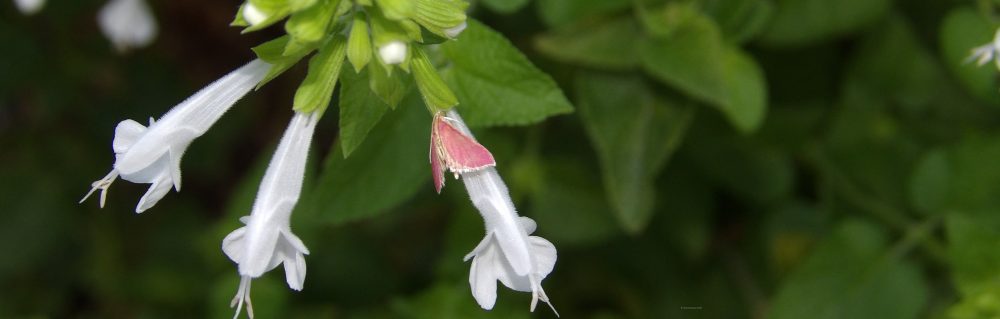
March of the Butter Butts: Wildlife Wednesday, March 2020

‘Butter Butt’ is the affectionate nickname given by birders to the songbird, Yellow-rumped warbler, Setophaga coronata.  I’ve been fortunate to host at least one Yellow-rumped warbler each winter for the past few years.  These attractive warblers, muted in color when I see them in winter, are widespread throughout North America.  My home in Central Texas is in the middle of their geographically wide migratory path; many  overwinter here.
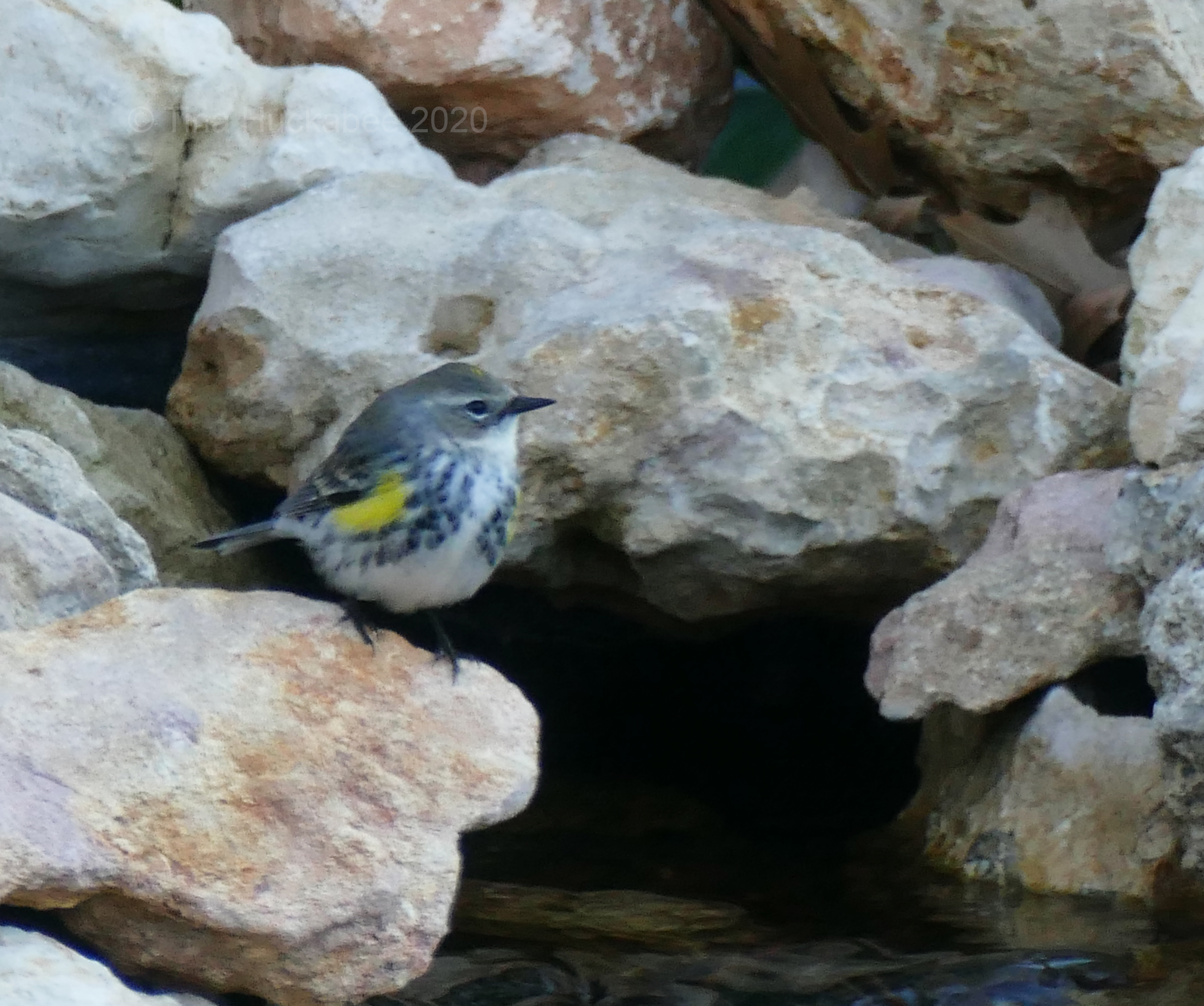
“My” little Butter Butt–and I think it’s the only one this winter–is a female, a member of the “Myrtle” subspecies.  There are two subspecies of Yellow-rumps:  “Myrtle”  warblers, from the eastern half of North America and “Audubon’s” warbler, from western areas.  The primary distinguishing features between the two subspecies are that the male Myrtle has a white throat and black mask across the eyes, while the Audubon’s throat is yellow and has no black mask.  There are other differences too, mostly in amount of white between the males and females on the wings and faces.

I’ve identified my Yellow-rump as female.  She lacks the black mask across the eyes that a male Myrtle Yellow-rump warbler wears.  Even without the mask and the bold coloring, she’s still very cute.

When Butter Butts molt (in late spring) their coloring is quite dramatic. You can see  photos of these beauties in their finest feathered forms, here.   Even without the dramatic breeding colors, I think this little bird qualifies as a head-turner in the looks department.
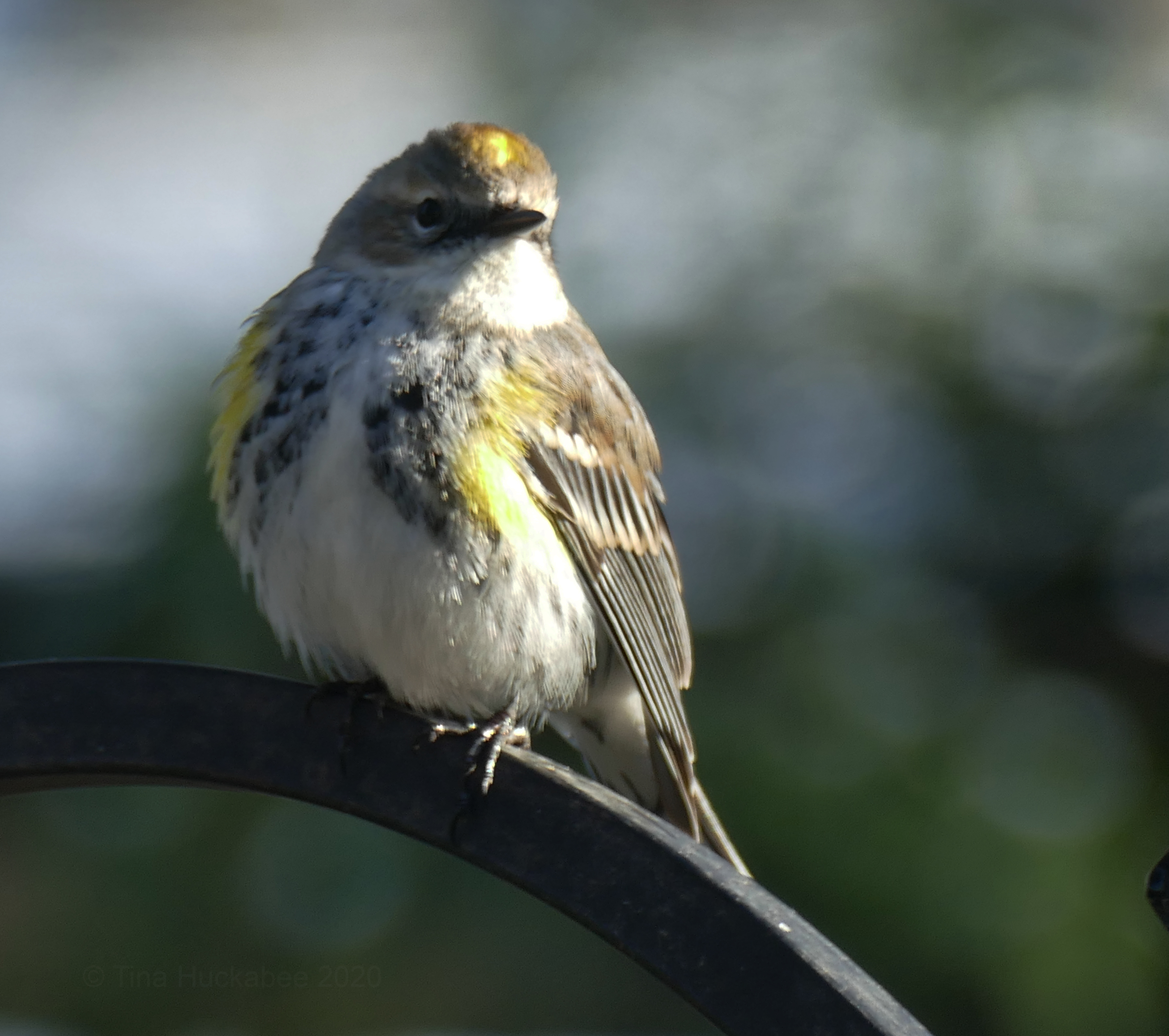
I typically see her at the suet feeder, or bathing in the bog area of the pond.  Plus she frequently forages along the ground in the garden; I have no clue what she noshes under the plants.  Seeds?  Insects?  Probably both!  Yellow-rumped warblers enjoy the widest menu choices of any warbler species.  They eat a huge variety of insects, gleaning those with their pointed beaks from trees and snatching with expertise during flight.  These warblers stand alone–maybe I should say they digest alone–with their consumption of bayberry and wax myrtle berries; no other warblers digest those two berry species.  Ornithologists believe that Yellow-rumps ability to eat the two widely available berries allows them to overwinter farther north than most other warblers. 

I’ve observed scads of little songbirds flitting in my trees and always assumed they’re eating parts of leaves or spring flowers with pollen, and maybe, some insects. But in observing this Yellow-rump as she hops along the limbs and darts through the leaves, it’s clear that she’s focused on insects, rather than nibbling at vegetation for her meals.  Ms. Yellow-rump is a bundle of energy, constantly in movement:  up, down, and all around.   I haven’t witnessed any bug-munching, but most afternoons when I look for her, she’s there, in the trees, hunting for protein.

According to Cornell Lab of Ornithology, Yellow-rumps forage on the outside branches of trees and along those limbs in the bottom third of the tree.  That’s exactly where I’ve noticed my warbler and thank goodness for that!  She’d be even more difficult to observe if higher up in the trees.

In winter, Yellow-rumped warblers spend their time in mixed arboreal landscapes–those areas with plenty of trees and fruit-bearing shrubs, like parks and urban gardens, all good habitats brimming with the needed munchies.  In their breeding areas, far north from Central Texas, they concentrate on insect eating, but easily switch to fruits, if available.  Yellow-rumps nest in coniferous trees, the female building the chicks’ homes along branches.  Both parents feed the chicks, which fledge within two weeks.  They grow up so fast!

These hardy warblers are adaptable, which is why their populations are relatively stable.  That said, it’s always a good when gardeners plant for birds:  native plants are best to provide berries and seeds, to provide cover for protection, and to provide a rich, diverse garden habitat.   Also, habitats free of insecticides is a must, since many birds (not only warblers) require insects for themselves and their offspring.
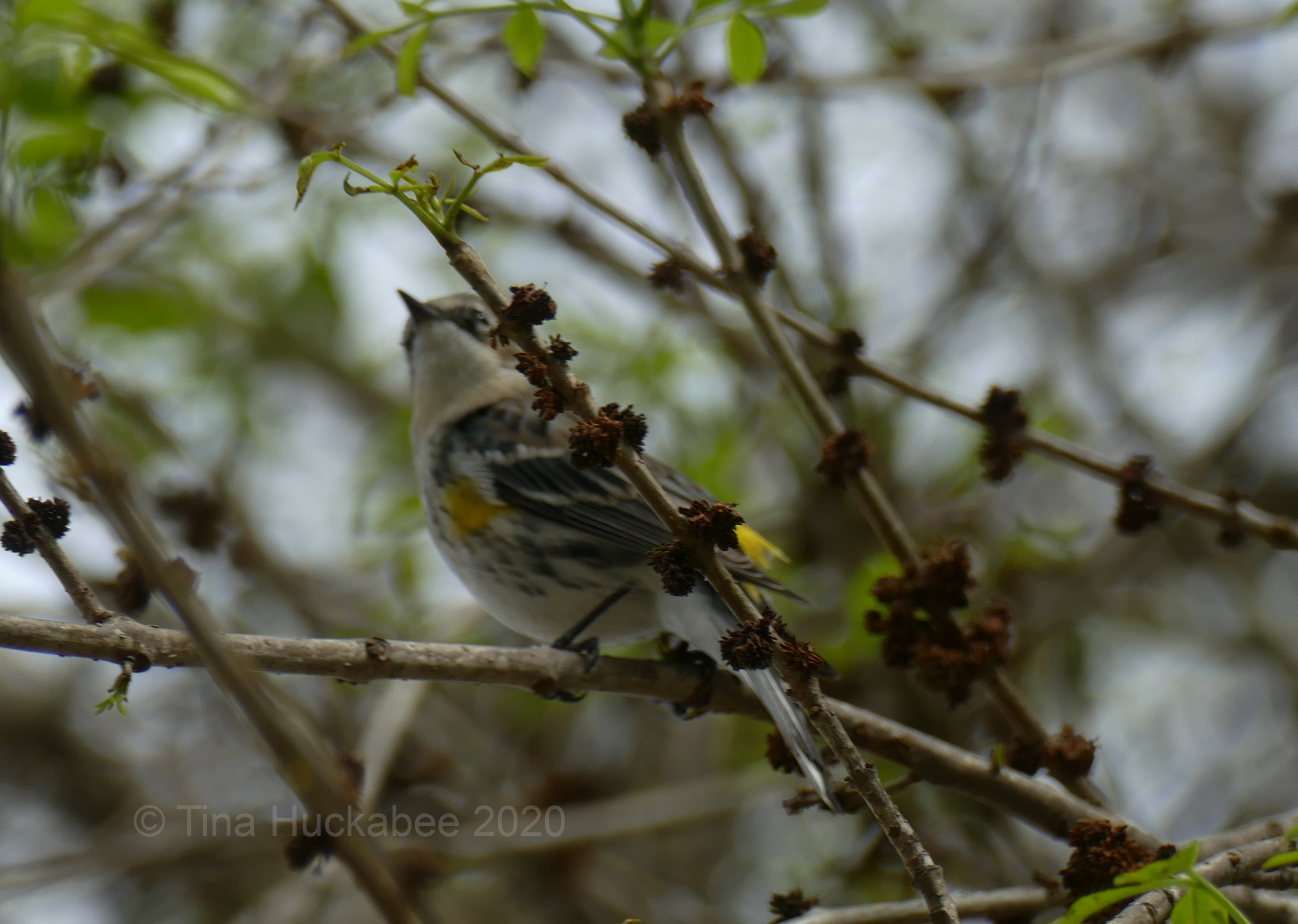
 

And there it is–the famous, often talked about, but only briefly glimpsed–yellow rump!
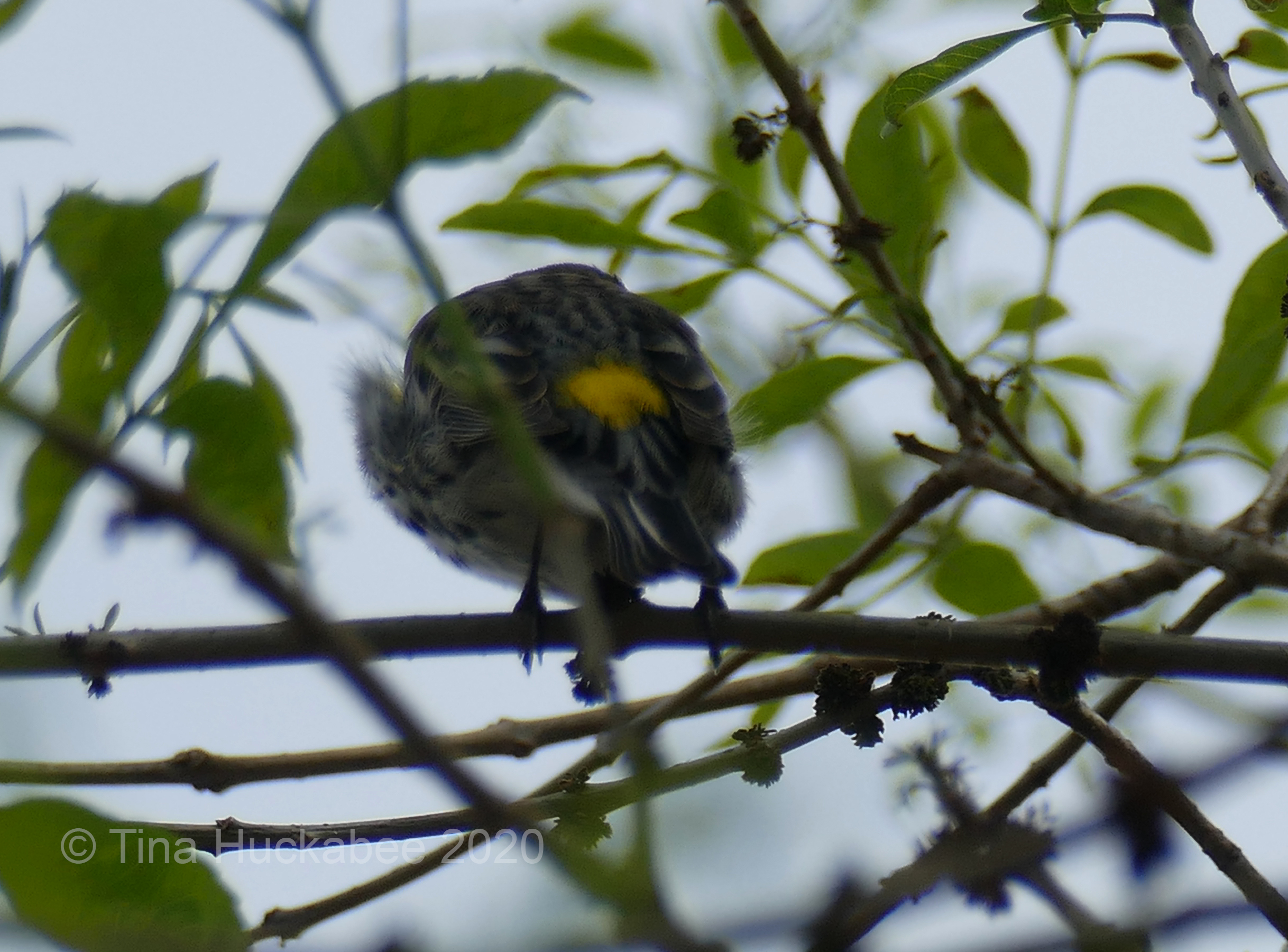
The flash of that bodacious booty is easily visible–at the correct angle, with tail feathers up–as they bop around the ground or zoom through trees, but catching these busy birds to photograph their famous bums is a little trickier. It requires patience and some good luck.

For more great information on this charming songbird, check out the Cornell Lab of Ornithology or Audubon’s site on the Yellow-rumped Warbler.

What wild things are in your garden?  Please share and leave a link when you post a comment–and happy spring and wildlife gardening!

The Natives are Restless

Native Texas plants are back in action!  March always heralds the time of the natives, and many are eager for the season to begin.  They’re  budding up and blooming out!  It’s true that several of my non-native plants are, or have been, blooming:  irises, poppies, and Mexican honeysuckle.  But this native Texan  appreciates native Texas plants which are lovely and posses the evolutionary chops to weather the weird–no matter the confusion of seasons or the Texas weather patterns.


This sweet thing is a hybrid columbine, a cross between the native Aquilegia chrysantha and another native, Aquilegia canadensis.

I grow the two different columbine species in my garden and the plants hybridize with ease, creating a third alternative, with varying color schemes–sometimes more yellow, sometimes more red.  On this particular hybrid, the butter yellow petals and the blushed spurs show off qualities of both types of columbines.

The sunshine-cheery Golden groundselPackera obovata, is modeling its spring wears, though with less oomph than in years past.

There’s still plenty of pop with these diminutive blooms; there’s no denying that yellow is bright.  But last summer, most of the individual plants in my small patch of groundsels succumbed to the heat and drought.  I didn’t realize that the soaker hose buried in this  garden had developed a leak. While a couple of plants not far from the groundsels received good soaks when during their twice per month drink, these poor little things got none of the wet stuff.  That garden boo-boo occurred during an especially hot and dry spell in August and September, and it wasn’t until the rains returned and the temperatures softened that I discovered that there were few remaining groundsels.

I don’t know if these other rosettes will produce bloom stalks this spring–time will tell–but I’ll certainly keep a better eye on things next summer.  Golden groundsel is a tough native plant which doesn’t need babying,  but two months with no water and hot temperatures is a bit too much to ask of them.  It’s a wonder there are any left!


This terra-cotta beauty is the bloom of the CrossvineBignonia capreolata.  

This individual vine grows in shade, up a fence, only producing a few blooms each spring.  Directly across from this vine, at the opposite end of my garden, grows a second Crossvine, also along a fence.  That second Crossvine receives much more sunshine, making many more blooms.  For now, all of its blooms are growing over the fence, where my sister-in-law enjoys them.

Oh, well, I’m sure she won’t mind if I walk over to say ‘hi’ to the wayward flowers.


Giant spiderwort, Tradescantia giganteaare solid, reliable spring blooming natives, dotting gardens and roadsides with purple-to-pink clusters.  Each new day as I walk my garden, ever more of these purple clusters appear, petals open for whatever pollinators happen by.  Spiderwort can be aggressive, filling a garden with bright color and fleshy green stalks and foliage.  But its pollinator power and luscious color are well-worth tolerating its bullying behavior.  The thuggy individual plants are easy to yank up and give away!

The first blooms of these plants show up on short bloom stalks, but as the days lengthen, the bloom stalks grow taller, in kind.  Many spiderwort plants in my garden reach up to two feet tall.

And, the bloom clusters are stunning.

As Texas ramps up for the new growing season, the natives are restless.  Native plants provide sustenance for wildlife and beauty for gardeners and wildflower watchers.  Native Texas plants–and there are many for every season and every growing situation–are ready to strut their stuff.

Not only do I celebrate blooming native Texas plants, today is Texas Independence Day!   Hats off to the Lone Star State!

Symmetry

I was adjusting the blinds at one of my front windows, when I stopped to appreciate, then photograph, this late afternoon, late winter scene.

The ceramic container holding the American century plantAgave americana, is hugged by a cushion of poppy greenery.  I should have thinned the seedlings long ago, but their verdant green beguiles, enchants the gardener, and therefore remain.  As the weeks pass and the days lengthen and warm, the poppy stalks will grow to at least 18 inches in height, eventually topped by scarlet blooms, with plenty of pollinators in attendance.

Just behind, Big muhly grass, Muhlenbergia lindheimeri, acts as a halo, fanning out  gracefully, late day sunshine highlighting leaf and panicle which are toasty at the upper ends, spring green near the bottom.  That green indicates the time to prune in nigh;  I’ll trim all of my grasses in the next week–the last of my winter pruning–in preparation for new growth, a new season.  Of course in nature, these grasses aren’t pruned by anyone, they simply continue:  brown-to-tan leaf structure sloughing off, its work done, making way for the new, the green–a process practiced and followed, year in and year out.  

An evergreen Barbados cherryMalpighia glabra, barely visible behind the muhly, echos fresh green growth, its dense cluster of foliage perfect for wildlife cover. Garnishing the scene and in the far distance, a neighbor’s Live oak tree, foliage intact, towers over all.

For more garden scenes, vignettes, thoughts, see Anna’s Flutter and Hum and her Wednesday Vignettes.