Yellow or Mexican Butterfly Vine (Mascagnia macroptera): A Seasonal Look

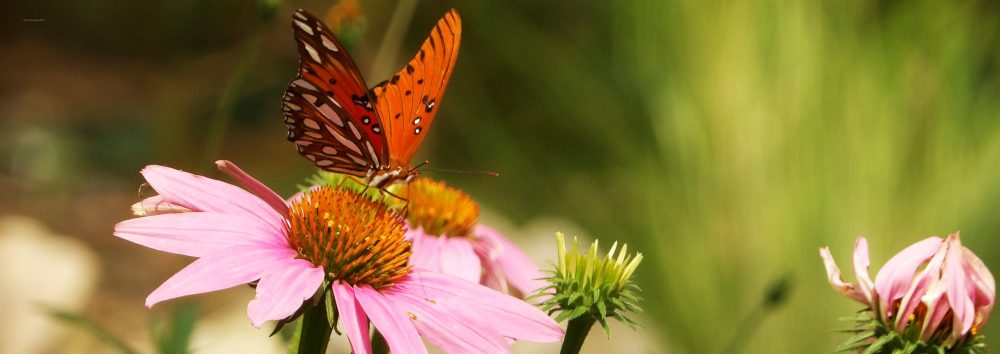
While not the real deal, I welcome these butterfly doppelgangers to my garden:

The chartreuse seedpod is beginning its morph to the mature-seed incarnation.

This golden toast heralds the final seed product.


These two seed pod examples develop on a fabulous vine, the Yellow or Mexican Butterfly vineMascagnia macroptera. 

Butterfly vine is a native to Mexico, but grows southward into Central America.  Several sources I’ve come across mention that the early English naturalist and botanist, Joseph Banks, observed Butterfly vine growing in Brazil.  

I’ve grown my Butterfly vine for at least a decade, maybe longer–I don’t remember exactly when I planted it.  The thick, twisted main trunk confirms that mine isn’t a newby vine.

I first came across Butterfly vine when I was a volunteer gardener at my children’s elementary school about 20 years ago.  One grew at the back of a portable building, with western exposure and no water source readily available.  I recall that it was summer that I found the vine–a Texas summer, folks–and the vine was as fresh as a daisy and blooming its clusters of petite yellow flowers.

Full sun, drought-tolerant, deer resistant, and attractive?  Yep,  that’s a vine for me!

My Butterfly vine grows in an opposite situation, receiving only dappled or diffused light, depending on the season. Yet it thrives with the same great qualities as in full sun, though with fewer blooms most years.  The only maintenance that I employ with this vine is the same one that I do with my hair: tuck away those annoying, wayward tendrils that fall into my face!  I’ve never experienced any negative issues with this vine:  no debilitating diseases, no invasive insects.  

During a hard winter, where there’s at least one multi-day freeze well into the 20s or teens, the vine may be rendered dormant.  The last cold winter like that was in 2014.

The “butterflies” certainly held their own that winter, even when the rest of the vine suffered freeze damage.

Even with the vine losing its leaves to the hard freeze, the foliage returned vigorously from the roots and along the mature stems once longer days and warmer temperatures arrived.

Last year’s winter was mild, but a late, hard freeze blasted through in March. This is how the vine responded:

The vine lost a good portion–but not all–of its leaves; what was lost, came back quickly.  

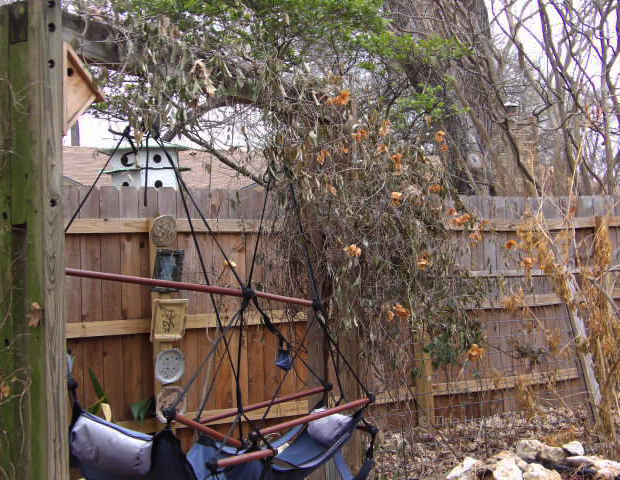
In a mild winter like this one of 2019-20,  the vine retains its evergreen habit.
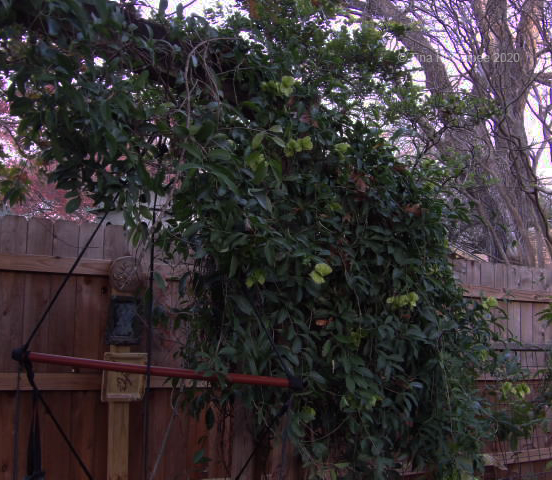
With climate change, I’m guessing that this vine is now mostly an evergreen for my  USDA zone 8B garden.  According to Monrovia, Butterfly vine grows in USDA zones 8-10.  I can imagine that for gardens growing significantly farther north than my own,  the vine is an annual or semi-annual plant.  

The vine flushes out during the wet and cool spring months, preparing for its summer/autumn blooming.

Green-n-growing-n-fresh is Butterfly vine’s contribution to the summer garden.  Typically, the yellow flowers don’t appear until mid-to-late summer, sometimes not until autumn.   In full sun, the flowers appear earlier and are more numerous.  Flowers on my vine are scattered, given the shady conditions that they grow in.
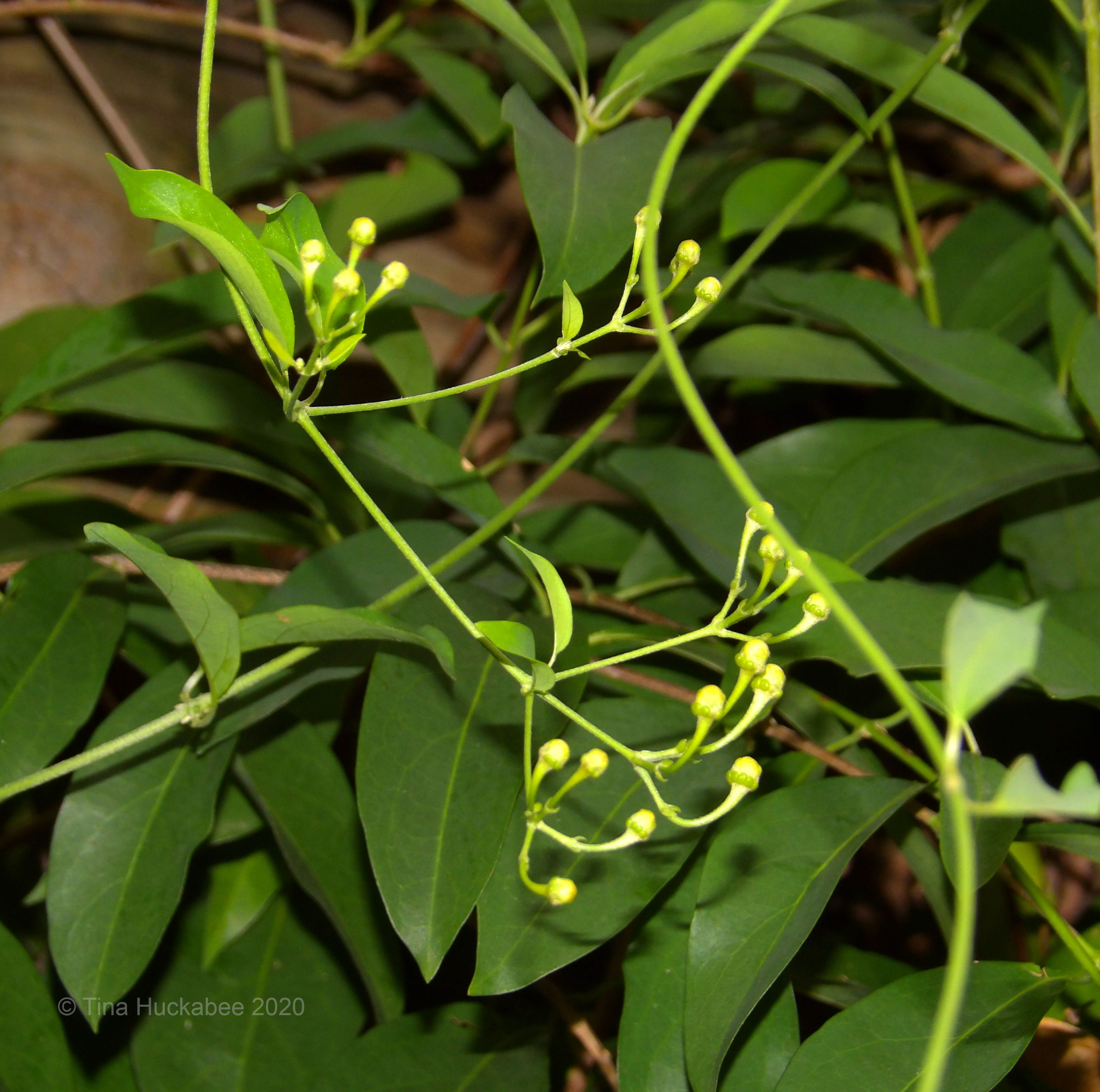
The number of bloom clusters also varies according to rainfall or irrigation.  I don’t water much–just twice per month during summer–but if there’s decent rainfall in late July, August, or September, the vine yellows-up nicely.  The vine weathers drought beautifully; I’ve never seen it wilt, nor does it lose leaves during that time.  But for its yellow beauties to perform, some extra wet stuff is an appreciated must.

Butterflies and honeybees sip the nectar, and I’ve seen lizards and smaller songbirds hide in the lush foliage, so I think Butterfly vine qualifies as a solid wildlife plant. 

Even with minimal rainfall, there are still pops of yellow along the vine. The vine blooms throughout autumn, with blooms eventually morphing into their seed-producing, butterfly selves. 

If you live in USDA zones 8-10 plant this lovely, fast-growing, water-wise vine. Yellow or Mexican Butterfly vine is friendly to a variety of pollinators and provides cover for other wildlife.  It’s not invasive and works well on trellises, fences, and arbors. Most years, you and your wild garden buddies will enjoy its spring and summer glory and its evergreen foliage in winter. In a mild winter, the vine retains its foliage and its butterflies. After a hard freeze, all bets are off.

But with this vine, you might have butterflies year-round!!


Spring:

Summer/Autumn:


Winter:

…or,
 

Searching

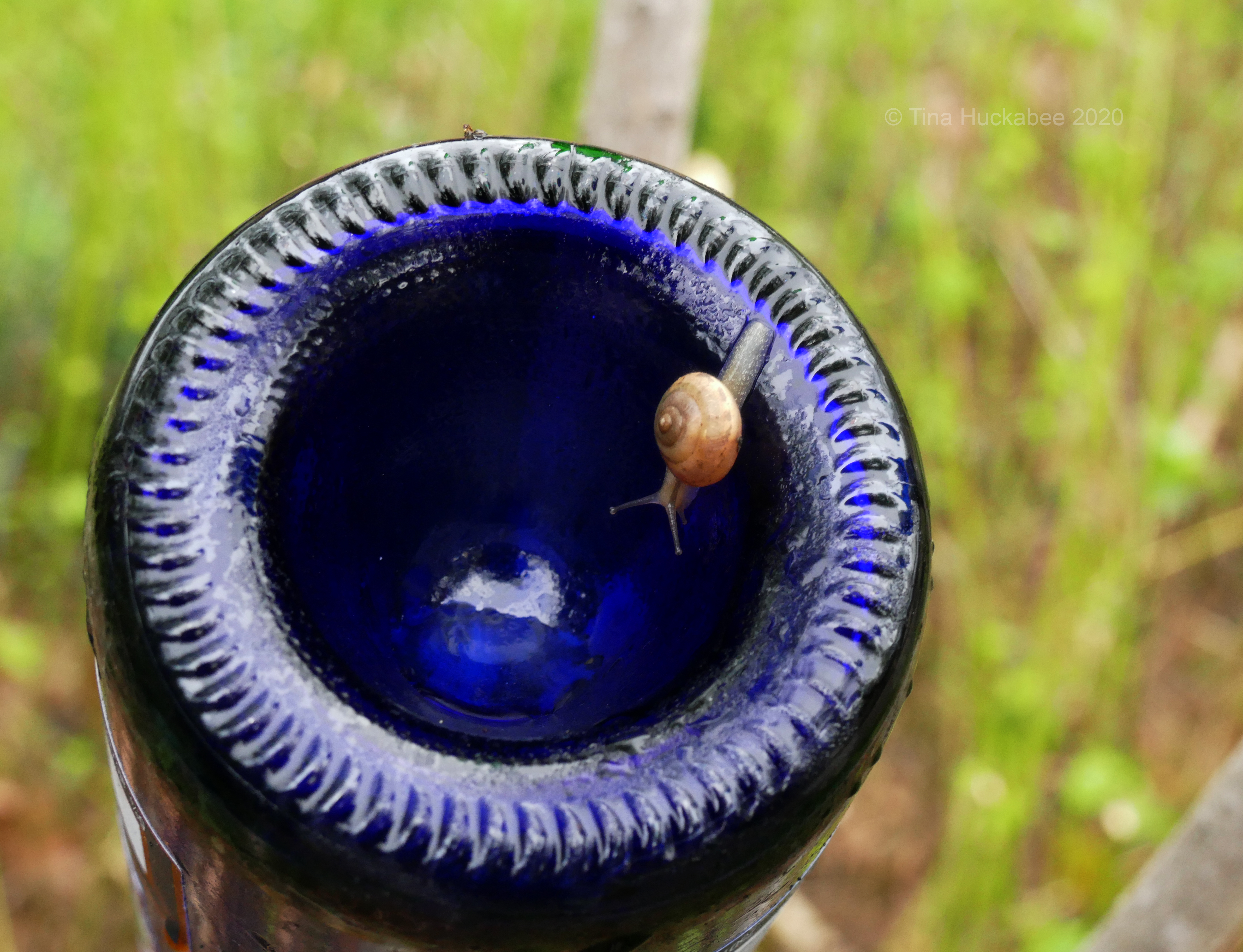
I’d like to know what this little snail is searching for.  Perhaps a leafy bed to lie in?  Or maybe some petals to snack on?  Might it simply like the color blue?

I’m fortunate that snails aren’t much of a problem in my garden.  They’re in the garden, but not damaging.  The trundle along, slow and steady, and quiet.

Except when I step on one.  Snails aren’t quiet when I accidentally step on one.

Crunch

I feel badly when that happens and apologize. I suppose that’s a hollow gesture.

Possibly, curiosity drives this one to search.  It halted progress downward as I approached, wiggling its antennae, sniffing its surroundings.

Do antennae smell scents?  Apparently, they do.  As well, snails use antennae for movement and orientation, and sometimes, for sight.  Useful things.

I hope the snail climbed out, made its way down the bottle tree, and relocated itself to flatter ground before our recent rains.  I haven’t seen it since I snapped this photo, but would I know this snail–irrespective of size–from any other?

Probably not.

If you’re searching for something fun, interesting, or beautiful, check out Anna’s Flutter and Hum for Wednesday Vignette musings.  


March of the Butter Butts: Wildlife Wednesday, March 2020

‘Butter Butt’ is the affectionate nickname given by birders to the songbird, Yellow-rumped warbler, Setophaga coronata.  I’ve been fortunate to host at least one Yellow-rumped warbler each winter for the past few years.  These attractive warblers, muted in color when I see them in winter, are widespread throughout North America.  My home in Central Texas is in the middle of their geographically wide migratory path; many  overwinter here.

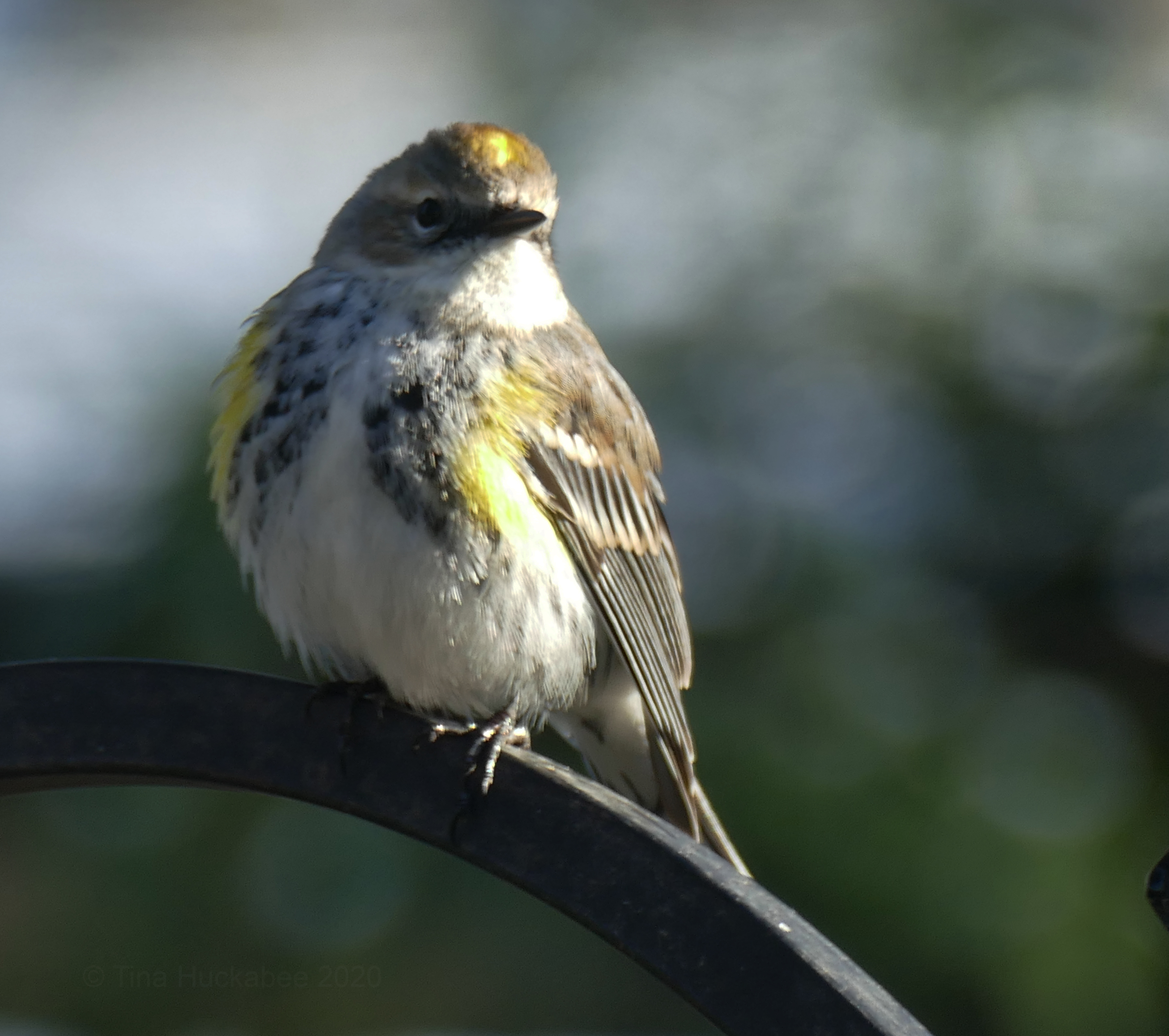
“My” little Butter Butt–and I think it’s the only one this winter–is a female, a member of the “Myrtle” subspecies.  There are two subspecies of Yellow-rumps:  “Myrtle”  warblers, from the eastern half of North America and “Audubon’s” warbler, from western areas.  The primary distinguishing features between the two subspecies are that the male Myrtle has a white throat and black mask across the eyes, while the Audubon’s throat is yellow and has no black mask.  There are other differences too, mostly in amount of white between the males and females on the wings and faces.

I’ve identified my Yellow-rump as female.  She lacks the black mask across the eyes that a male Myrtle Yellow-rump warbler wears.  Even without the mask and the bold coloring, she’s still very cute.

When Butter Butts molt (in late spring) their coloring is quite dramatic. You can see  photos of these beauties in their finest feathered forms, here.   Even without the dramatic breeding colors, I think this little bird qualifies as a head-turner in the looks department.

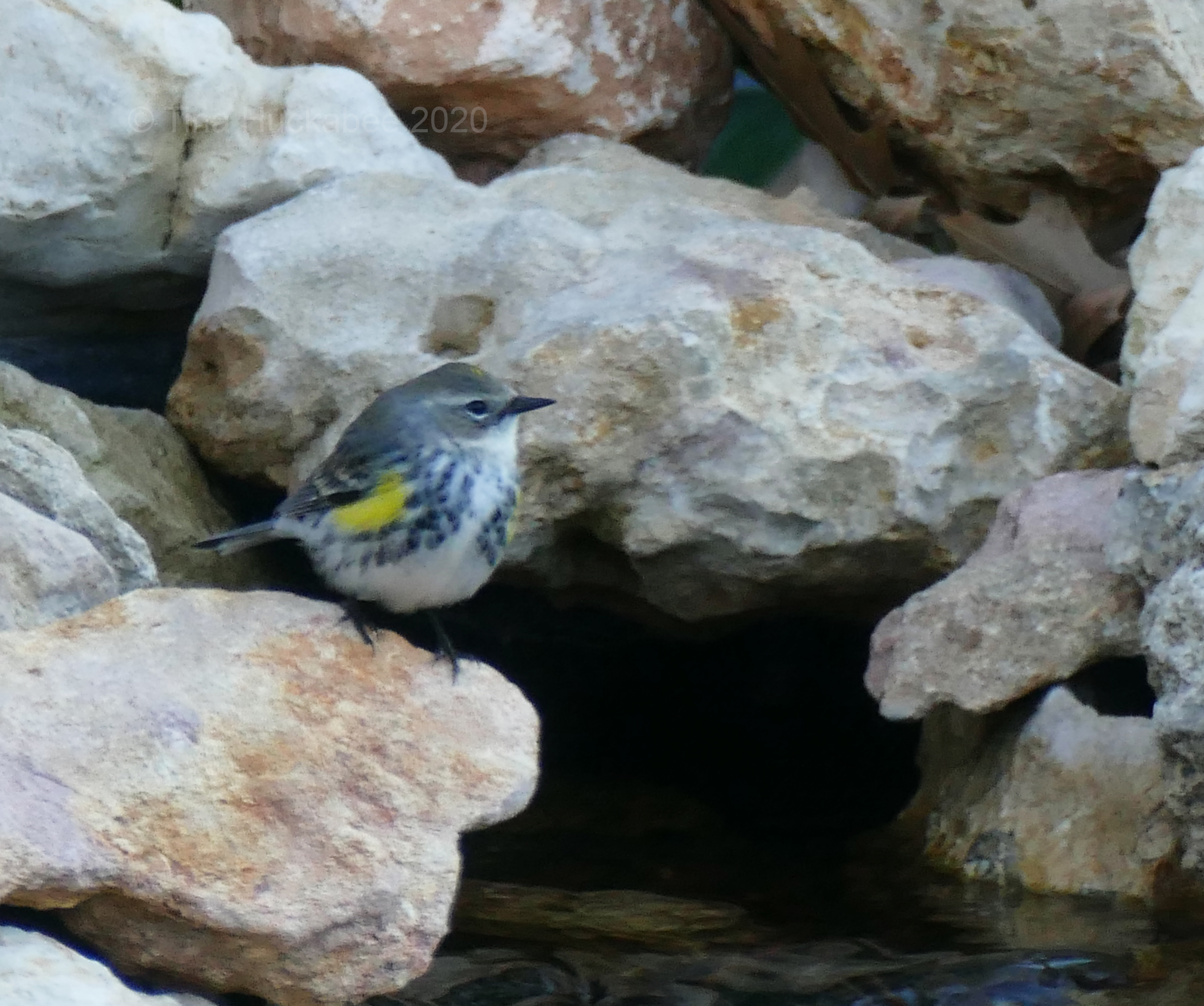
I typically see her at the suet feeder, or bathing in the bog area of the pond.  Plus she frequently forages along the ground in the garden; I have no clue what she noshes under the plants.  Seeds?  Insects?  Probably both!  Yellow-rumped warblers enjoy the widest menu choices of any warbler species.  They eat a huge variety of insects, gleaning those with their pointed beaks from trees and snatching with expertise during flight.  These warblers stand alone–maybe I should say they digest alone–with their consumption of bayberry and wax myrtle berries; no other warblers digest those two berry species.  Ornithologists believe that Yellow-rumps ability to eat the two widely available berries allows them to overwinter farther north than most other warblers. 

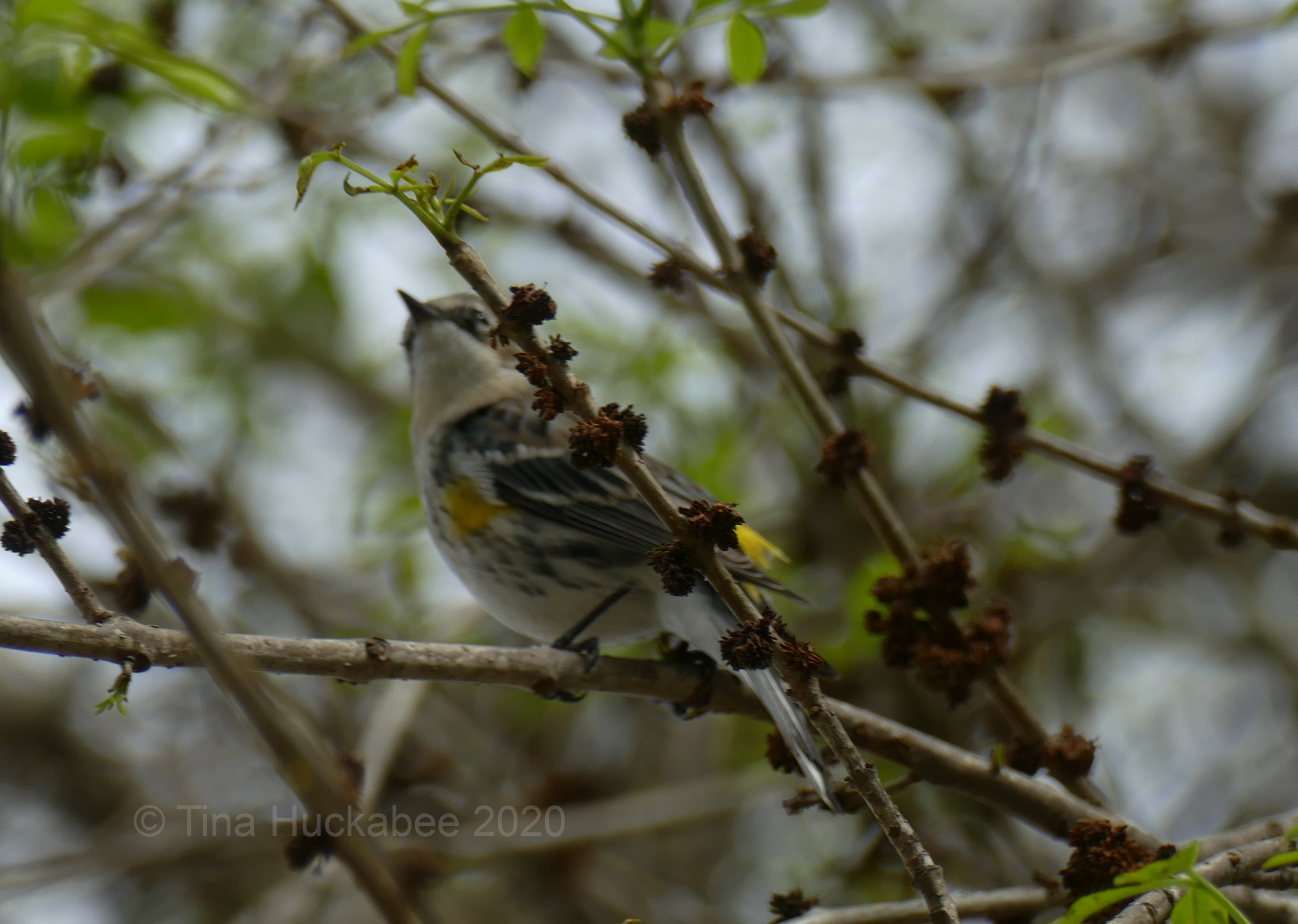
I’ve observed scads of little songbirds flitting in my trees and always assumed they’re eating parts of leaves or spring flowers with pollen, and maybe, some insects. But in observing this Yellow-rump as she hops along the limbs and darts through the leaves, it’s clear that she’s focused on insects, rather than nibbling at vegetation for her meals.  Ms. Yellow-rump is a bundle of energy, constantly in movement:  up, down, and all around.   I haven’t witnessed any bug-munching, but most afternoons when I look for her, she’s there, in the trees, hunting for protein.

According to Cornell Lab of Ornithology, Yellow-rumps forage on the outside branches of trees and along those limbs in the bottom third of the tree.  That’s exactly where I’ve noticed my warbler and thank goodness for that!  She’d be even more difficult to observe if higher up in the trees.

In winter, Yellow-rumped warblers spend their time in mixed arboreal landscapes–those areas with plenty of trees and fruit-bearing shrubs, like parks and urban gardens, all good habitats brimming with the needed munchies.  In their breeding areas, far north from Central Texas, they concentrate on insect eating, but easily switch to fruits, if available.  Yellow-rumps nest in coniferous trees, the female building the chicks’ homes along branches.  Both parents feed the chicks, which fledge within two weeks.  They grow up so fast!

These hardy warblers are adaptable, which is why their populations are relatively stable.  That said, it’s always a good when gardeners plant for birds:  native plants are best to provide berries and seeds, to provide cover for protection, and to provide a rich, diverse garden habitat.   Also, habitats free of insecticides is a must, since many birds (not only warblers) require insects for themselves and their offspring.


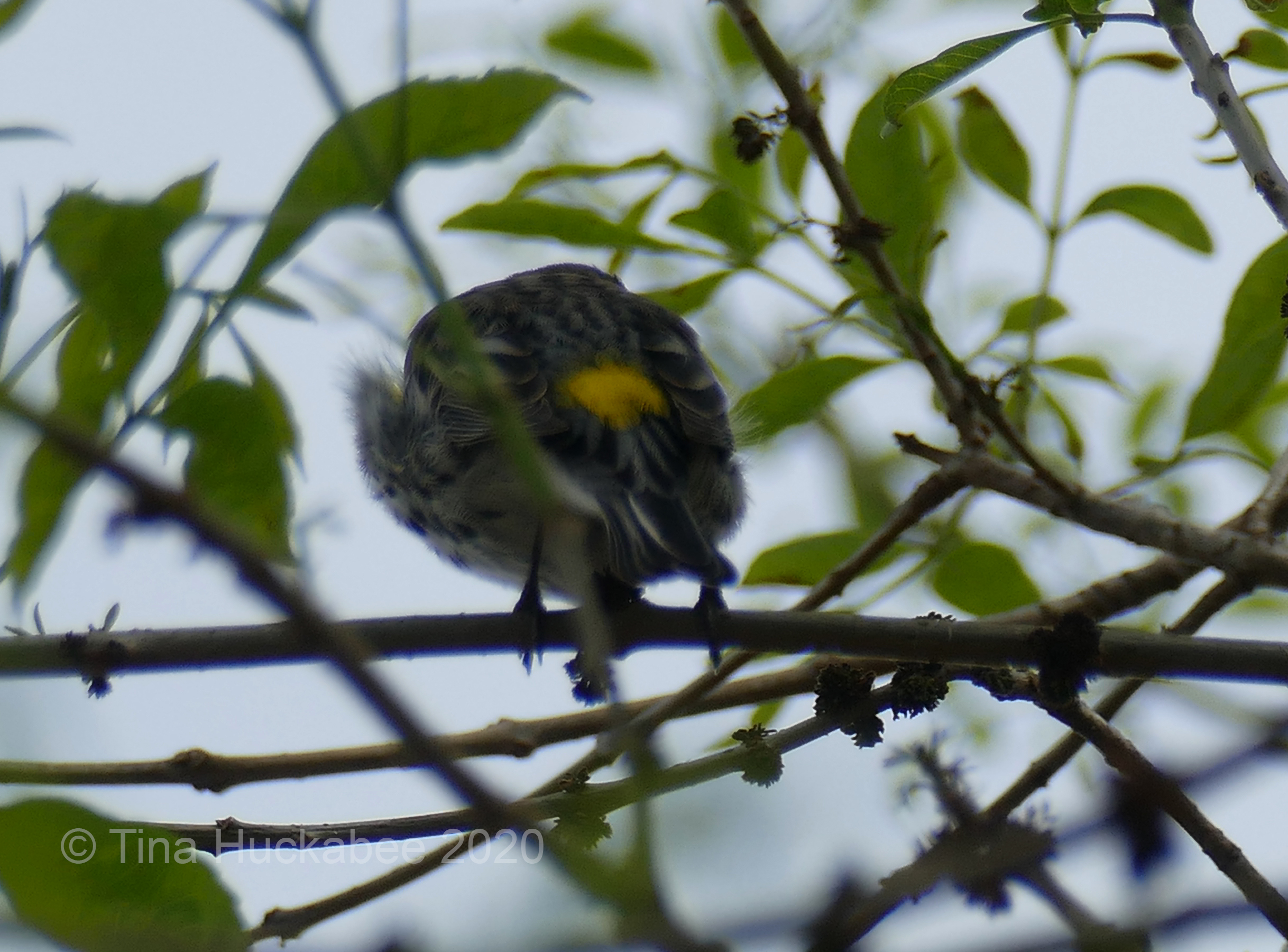
And there it is–the famous, often talked about, but only briefly glimpsed–yellow rump!

The flash of that bodacious booty is easily visible–at the correct angle, with tail feathers up–as they bop around the ground or zoom through trees, but catching these busy birds to photograph their famous bums is a little trickier. It requires patience and some good luck.

For more great information on this charming songbird, check out the Cornell Lab of Ornithology or Audubon’s site on the Yellow-rumped Warbler.

What wild things are in your garden?  Please share and leave a link when you post a comment–and happy spring and wildlife gardening!