Stand Your Ground

I guess this post could be renamed Stand Your Feeder but that doesn’t quite resonate.  None of these birds are on the ground–standing or otherwise–one is eating at the feeder, the other two are waiting their turn.  In this bit of bird drama, it’s the younger fledgling Red-bellied Woodpecker, Melanerpes carolinus, who’s in control, thwarting efforts to dislodge him and ignoring back chat from the the European Starling, Sturnus vulgaris, to the left, and the Blue Jay, Cyanocitta cristata, on top of the feeder stand.  The Red-bellied is munching away at sought-after peanuts as the two adult birds caw and carp.
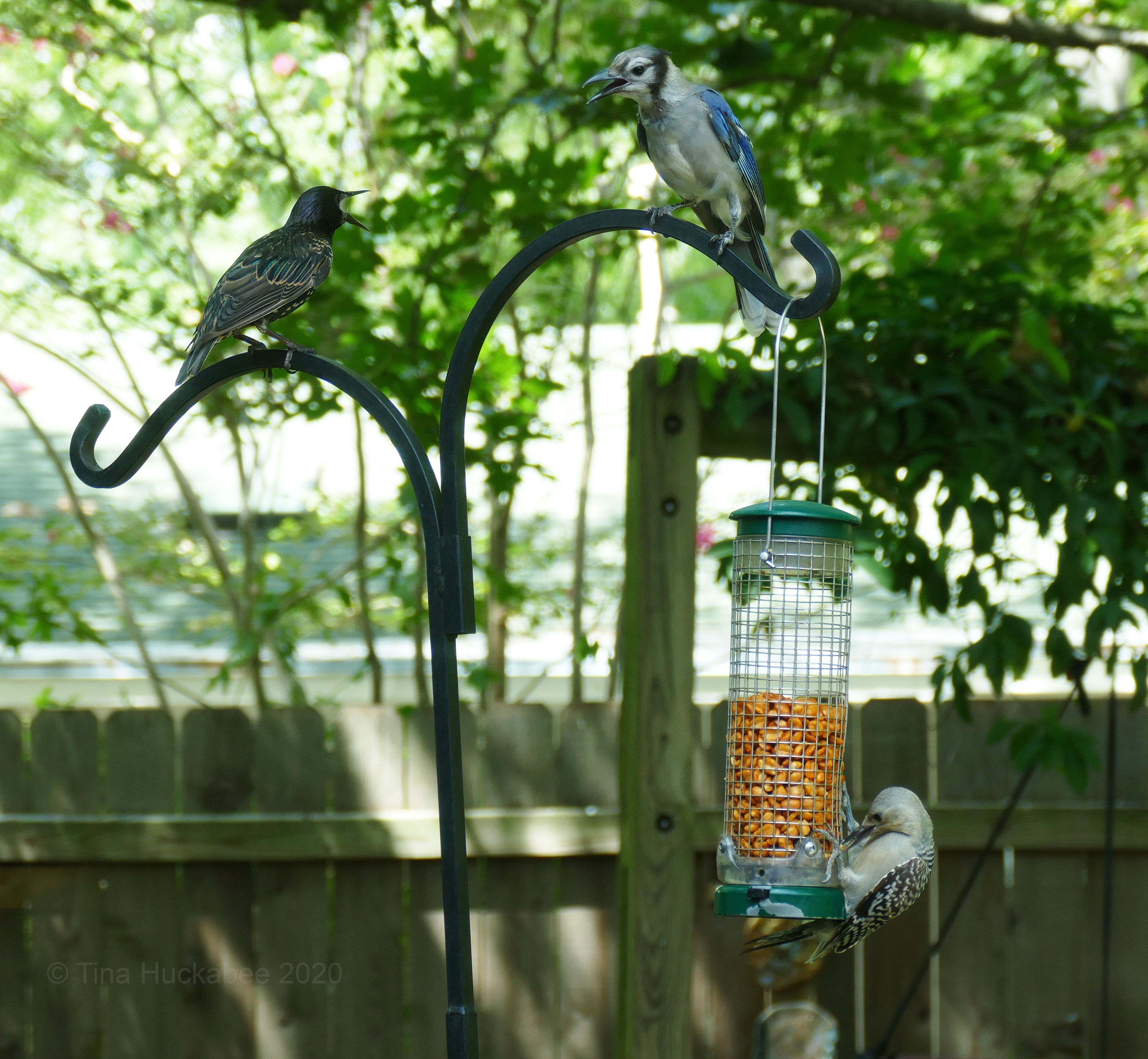
The little Red-belly wins the moment–and the peanuts!

Bird feeders are hot spots of conflict where birds demonstrate their more aggressive tendencies, protecting their food source(s) and trash talking one another.  Feeders invite a microcosm of natural competition that most of us don’t observe regularly, unless we notice the wildlife in our midst.

Here, the juvenile Red-belly responds to the impatient grown-ups regarding their insistence that he hurry up his snacking. 

In my head, I hear Nelson (‘The Simpsons’) obnoxious laugh when I see this teenage  Red-belly looking up at the interfering adults.  I wish that laugh wasn’t in my head.

Teenagers.  They always talk back!

In an Audubon article Who Wins the Feeder Warthe authors describe the “Hunger Games-like world” regularly seen by humans who feed local birds.  From observations by Project FeederWatch and Great Backyard Bird Count  participants, the authors share surprising results of feeder interactions between paired birds, noting the winners and losers. It’s a bird-eat-bird world out there, as they report a FeederWatch citizen scientist’s observation of a grackle’s catching and eating chickadees to prevent their muscling-in (can chickadees muscle-in?) on his feeder.  It’s not necessarily the bigger bird who wins the feeder war, but the bird who has the more aggressive personality–or more formidable beak.  The authors confirm the tenacious character of a diminutive Downy Woodpecker, Dryobates pubescens, who often rules the roost–which I’ve witnessed in my own garden–and recounts a confrontation between a Red-bellied Woodpecker and the larger Pileated Woodpecker: the Red-belly is the victor.  In my garden, a similar scenario played out recently: the younger and smaller Red-bellied Woodpecker kept the adult starling and jay at bay, while the teen noshed his fill.  Who’d want to get pecked by that beak?? 

I participate in both FeederWatch and the Great Backyard Bird Count, but I admit to not always noting the bird interactions that occur.  Woodpeckers are shy, but once on the feeder, demand respect; Yellow-rumped Warblers harass Orange-crowned Warblers; hummingbirds chase everyone, including butterflies; White-winged Doves are stupid.  And they stomp around on my plants.

Jerks.

Back to the peanut rumpus, the starling finally gave up and winged away, but the jay was determined to feed and wait out the woodpecker, complaining to all who would listen and it’s not like we had a choice.

One down, one to go!

After several minutes of nibbling, the youngster snatched a full peanut and shortly after this shot, flew to the nearby oak tree to enjoy his treat.  The chastened blue jay was a bit gormless for a time, eventually hopping to the feeder for its share of the peanut booty.

Who needs The Hunger Games or Survivor (or American politics…) when you’ve got birds in the garden, strutting their stuff and showing who’s boss? 
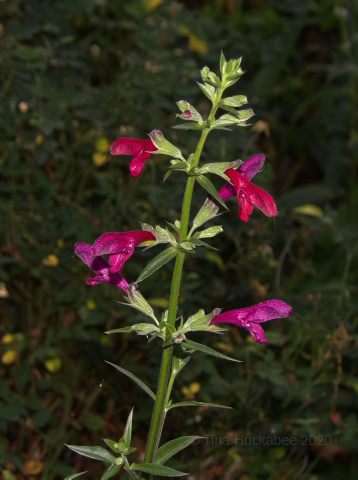
Big Red

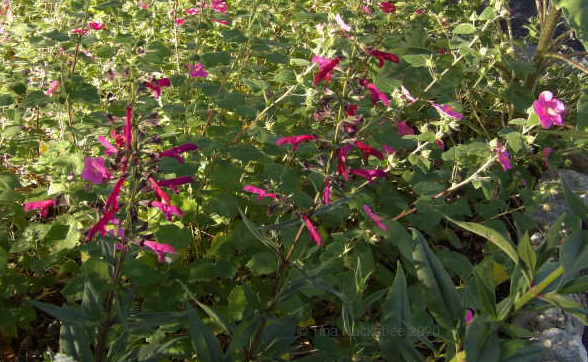
When I was a child, I liked the soft drink Big Red.  Shockingly red and overly sweet, Big Red is a cream soda which originated in Waco, Texas and was marketed throughout the southern half of Texas, which included my native hometown of Corpus Christi in South Texas and my current hometown of Austin in Central Texas.  Fast forward multiple decades, add some (?) maturity, a bit of culinary discernment, and a passion for gardening, and I discovered another Texas Big Red that I love even more: the beautiful perennial, Big Red sage, Salvia pentstemonoides.

I became familiar with Big Red sage when I worked for a handful of years at Zilker Botanical Gardens (ZBG) a couple of handfuls of years ago.  The objects of my admiration grew in a full-sun garden which bordered the main parking lot and was part of a troupe of other tough, native plants.  Big Red sage grew from lush, evergreen rosettes, sending bloom spikes upwards to three feet tall in May.  Rich red blooms decorated the bloom stalks for the summer months.  As I tended the gardens and observed the spring and summer bloom cycles,  I liked the Big Red sage so much that I purchased several for myself from Barton Springs Nursery

I planted the Big Reds in my back garden, adjacent to my pond where they were very happy for 5 or 6 years.  Because my back garden is shadier than the garden I tended at ZBG, the stalks leaned a bit, rather than growing in the erect fashion as preferred, but the plants bloomed well for several years, adding pops of deep magenta along an elegant bloom stalk throughout the summers.  Hummingbirds and several species of carpenter bees were regular visitors, enjoying nectar enclosed within the blooms.

Once the bloom season was over, I’d prune the stalks to their rosette, leaving an evergreen groundcover, in its resting state, awaiting the next bloom season. 

Over the past few years, I’ve moved all four plants to my front garden as they experienced increasing shade and declining blooms where they first lived.   Big Red sage is a plant that should bloom and for as much and as long as possible.  For that, it needs a good dose of sunshine. 

Where they now sit along the driveway and near the street, they receive blasting west sun and bloom well in their sweet spot.   I moved the Big Reds in two different autumns and all transplanted easily, flowering without missing a beat the first springs after their migrations.  These native perennials don’t require much water;  this year, I’ve only watered twice.

The color of the flowers is interesting: early morning sees the blooms in a deep purple/ red hue; the hours following, a pinking-up occurs, though the blooms remain a definite rich red. 

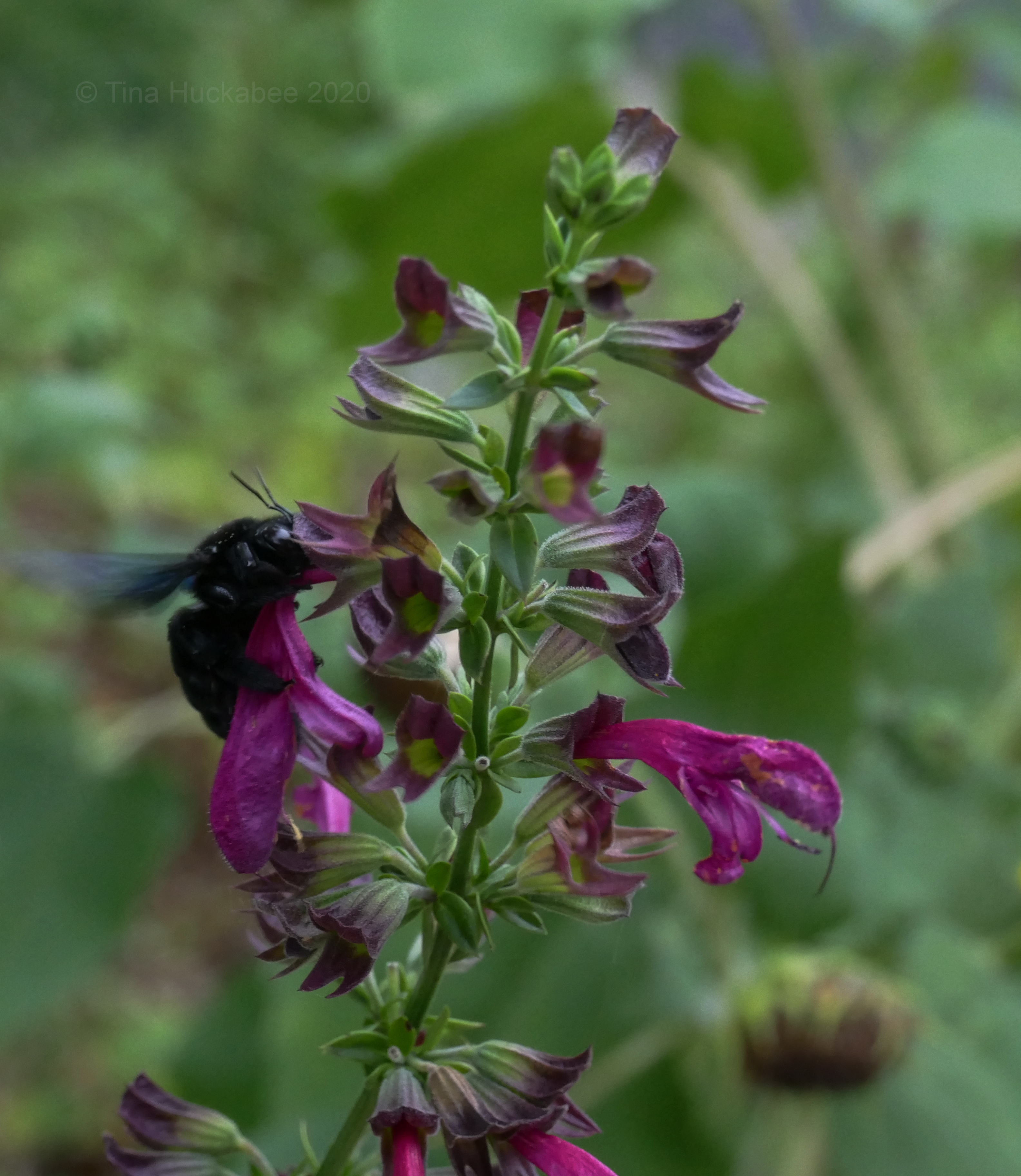
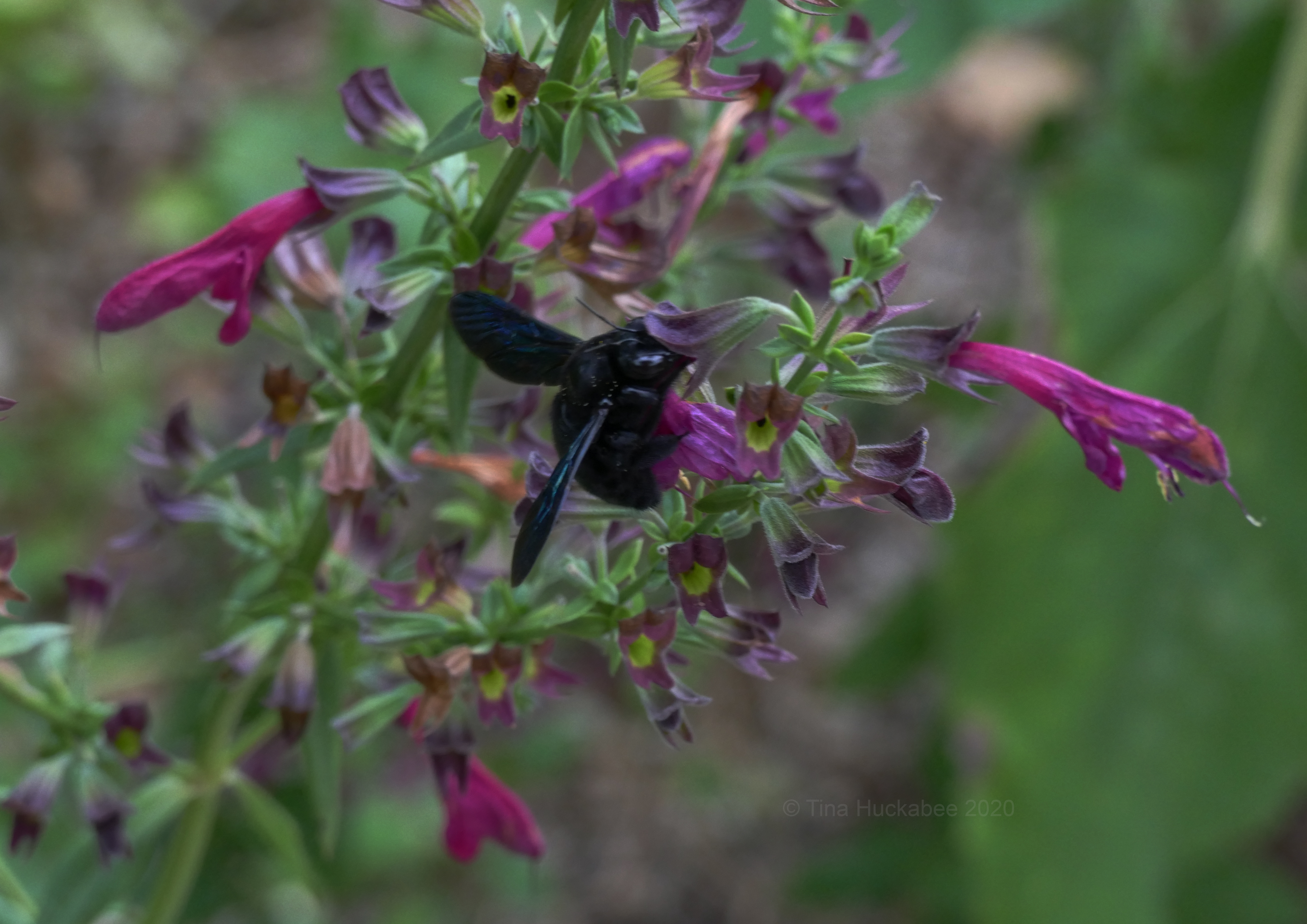
Hummingbirds visit the Big Reds, but the most common visitors are the Southern Carpenter bees and the Horsefly-like Carpenter bees.  Mostly, these bees nectar steal, but presumably–and hopefully–there’s some pollen gathering during those feedings, owing to the carpenter bees’ size and pollen gathering hairs.  That said, my Big Reds have yet to seed out and I’d love to have some baby Big Reds.  It might be that pollination is limited or that I mulch too thickly for fallen seeds to take root.    

I like the way the bee holds on to the bloom itself;  a bee-to-flower hug.

Aside from its beauty in the garden and value for pollinators, the Big Red sage has an interesting history.  It is endemic only to Central Texas, not occurring naturally anywhere else. It was discovered in the mid-1800s and by the mid-1940s was believed extinct.  But in the mid-1980s several different populations of Big Red sage were discovered and several groups of Big Reds have been found since, though some established colonies have disappeared.  According to the Native Plant Society of Texas, the plant’s natural range was originally a “ten county” region around Kendall County; Kendall County now boasts about 60% of the surviving natural colonies. 

Barton Spring Nursery in Austin carries the plant (mine were in one-gallon pots) and Native American Seeds has carried the seeds in the past, though with a quick look-see of their 2020 spring catalog, I didn’t spy any, but it’s an interesting catalog to peruse nonetheless.    I recall that I’ve seen Big Red sage listed in the Lady Bird Johnson Wildflower Center bi-annual plant sales. 

For more about Big Red sage, check out these two articles from the Native Plant Society of Texas: On the trail of big red sage  and New stand of big red sage found  

One of Three

I wear a mask when I’m out and about, but in my mask, I’m not nearly as cute as this little masked miscreant.   The only non-blurry photo I’ve managed, even with numerous sightings of one-to-three juvenile raccoons, happened as one of the critters bumble off from a drop-in at the pond for some tadpole sushi.   As it scuttled from the garden, the young raccoon stopped briefly beside the mosaic dog that marks my beloved Asher’s grave, turned around and posed for the shot.  I don’t think the raccoon is glaring at me, but I’m sure it was annoyed at my interruption of its bog meal.

I’ve dubbed the three siblings Larry, Moe, and Curly.  The first few sightings were only of Larry and Moe, but on one occasion, Curly showed up too.  A trio!  This is about the  time of year for Mama Raccoon to boot the juveniles out of her care as it’s likely she has a new crew to care for.   Raccoons are prolific in their baby-making.

Raccoons, especially the babies and juveniles, are darling;  the adorable face, rakish mask, stripey tail, and their irrepressible curiosity all conspire to produce the inevitable human response: awe, it’s so cute!!  But it’s best to remember that while raccoons have a place in the environment, they are wild animals, they can carry disease, and they can be destructive.  A few years ago a funny foursome of juveniles took up residence under our solar panels.  We’d been traveling for a few weeks and I’m confident that the quiet of the house and garden encouraged their squatting on the roof and under the panels. When we returned, we spied their charming antics, chuckled, then set up a rooftop radio to encourage them to move along–which they all did within a couple of days. 

A few weeks later, Central Texas endured heavy rainfall and flooding when about 14 inches of rain fell in a few hours–the 2013 Halloween Flood.  The next day I noticed some water damage on the ceiling and along a wall in the dining room.  While snuggled under the solar panels, those rascally raccoons had eaten through the shingles to the wood decking–though not beyond. As the heavy rain fell, some of the rain leaked through the roof and into the house. I’m betting they were aiming to set up camp in the attic; thank goodness they didn’t get that far.   Fortunately, the damage wasn’t bad, but repair was required and it wasn’t cheap!  

I’ve had a chat with Moe, Larry, and Curly, suggesting that they spread out far and wide, encouraging them to visit a variety of new and interesting places.  I reiterated that they’re welcome to raid the compost pile (after dark, please!) and to check out the bog for tadpoles, but they are to steer clear of the roof. 

Seriously, keep your fuzzy butts off of my roof!

I haven’t seen any of the three for a few days. Maybe my lecture worked?

Linking with Anna’s Flutter and Hum and Wednesday Vignette.  Pop over for garden stories, which may, or may not, include raccoons.