Out For Dinner

We were in the middle of an early dinner, sitting at the kitchen table observing the late day sunshine stream through part of the back garden. A movement caught my eye and I saw a hawk land in the neighbor’s Crape Myrtle tree. The small tree’s spidery branches, jade green foliage, and lavender blooms reach up and over the privacy fence and peek into my garden, and that evening, supported a Cooper’s Hawk, Accipiter cooperii, as it perched and scanned the landscape for a bird meal. The hawk sat for a minute or two, enough time for me to drop my fork and grab the camera. I had a fairly clear view of the big bird through the window and didn’t want to spook the hawk by going outside, so a through-the-window photo was required! The hawk didn’t sit still though, shifting its position and looking this way and that way, so a front-on photo was impossible. But I like that this shot caught its head, visually framed between two intersecting limbs.

Additionally, as it perched in this spot, the rays of the waning sun showcased the hawk’s beautiful markings. This character is a juvenile; its eyes are golden, rather than the deep red-orange of an adult bird.

The hawk’s juvenile inexperience was also evident in its behavior. Looking for who-knows-what, after a minute or so in the myrtle, it flew to the open space beneath my large red oak tree (where Woody the beehive sits) and landed on the ground. It circled, wings out, then took flight toward the house, immediately banking right and then back toward the myrtle, landing instead in my Retama tree, Parkinsonia aculeata. This tree is about 10 feet to the right of the myrtle. I suppose the hawk wanted a different look-see around the garden; after all, the birds might be easier to spot from a different angle. Because I didn’t have a good view of the hawk’s newly chosen perch, I belted to the back of my house, taking this photo through my bedroom window.
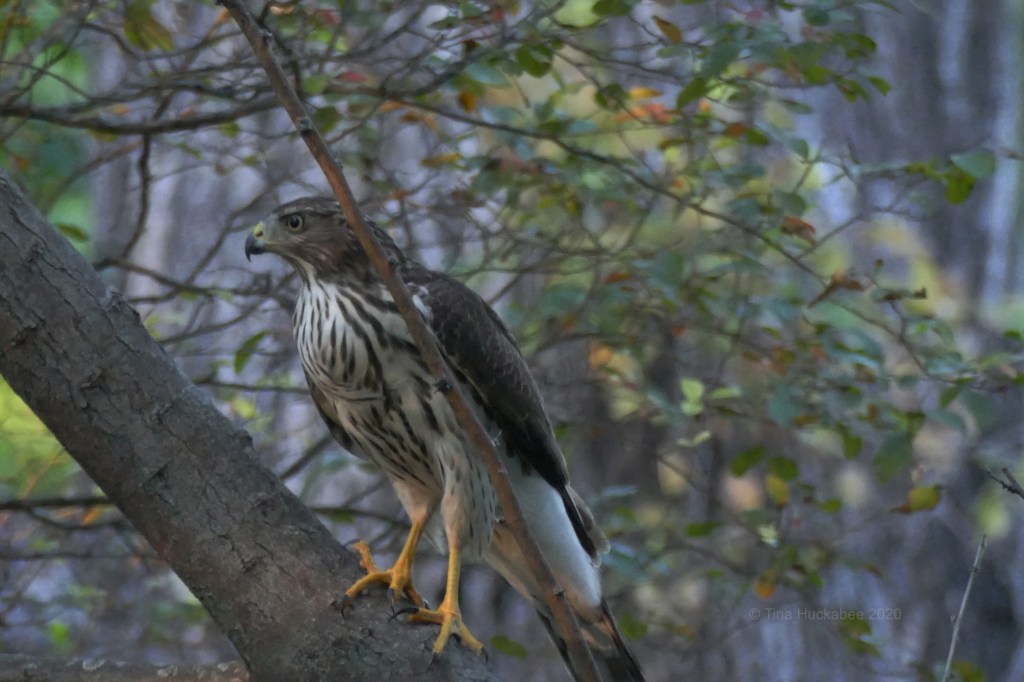
This shot, focusing on a different part of the garden, is darker. There are no direct rays of the setting sun brightening the tree’s foliage or bird’s plumage.

My year-round, resident birds–Blue Jays, Cardinals, Chickadees, Titmice, Wrens, White-winged doves, and House Finches are less active now and whatever feeder activity they engage in is usually completed earlier than when this hawk showed up for dinner. I’m guessing it was hungry and is still refining its potentially formidable hunting skills, but doesn’t always meet with success. Cooper’s hawks mainly hunt birds and while I hate to see songbirds become meals, that’s the way of the natural world; that said, my neighborhood hawks are welcome to the abundant doves and seasonal starlings. I’ve been hearing lots of Blue Jay alarm calls recently and glimpse hawk action several times a week, either with the sudden scattering of multiple potential prey birds or with a large shadow through the trees.

As autumn ushers in shorter days and eventual cold and foliage drop, (not necessarily in that order), it will become easier to observe the various predators who make their homes near mine. I’ve provided a garden which both nurtures and protects prey, while tolerating predators, allowing a full circle of wild life–Bringing Nature Home. Rather than swaths of sterile turf and the non-nonnative plants garden aesthetic of the past, I grow a garden which replicates and reflects nature, supports life, and is found directly outside our windows and doors.

For some instructive reading about reclaiming nature in your own space, check out the book, Bringing Nature Home, by University of Delaware’s Professor Doug Tallamy, and his website, highlighted above.

What wild things have you observed in your garden? I hope there are plenty of wild stories to share. As well, I’m linking with Anna of Flutter and Hum for Wednesday Vignette. Happy wildlife gardening!
Raccoon Appreciation?

October 1 is International Raccoon Appreciation Day.

Apparently, that is a thing.

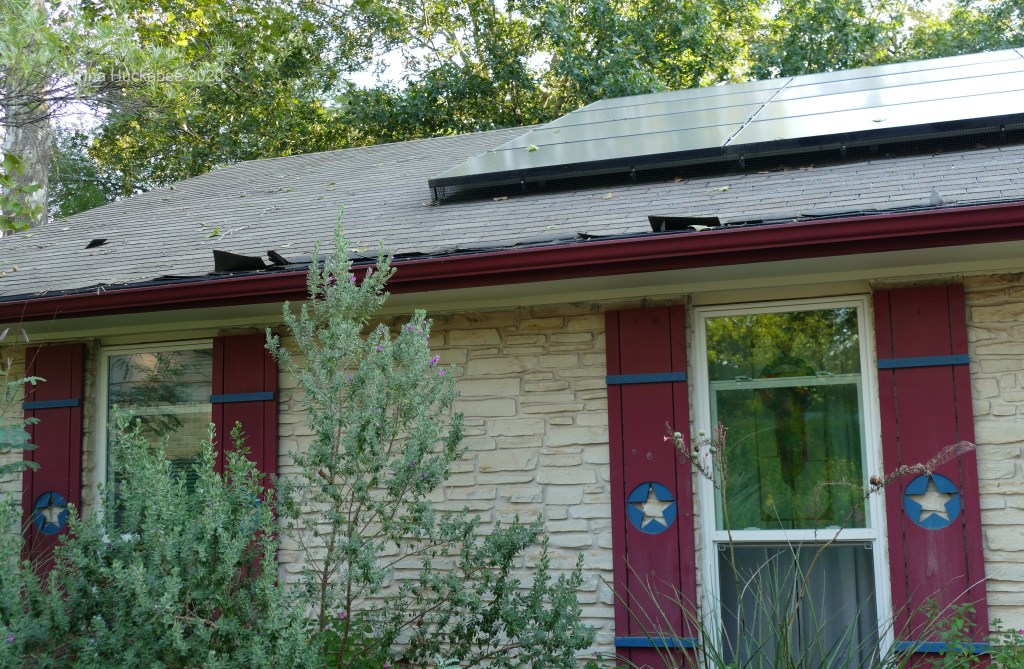
However, due to some excitement last night, I’m not feeling particularly appreciative of the masked marauders as this is what I discovered in morning’s light:

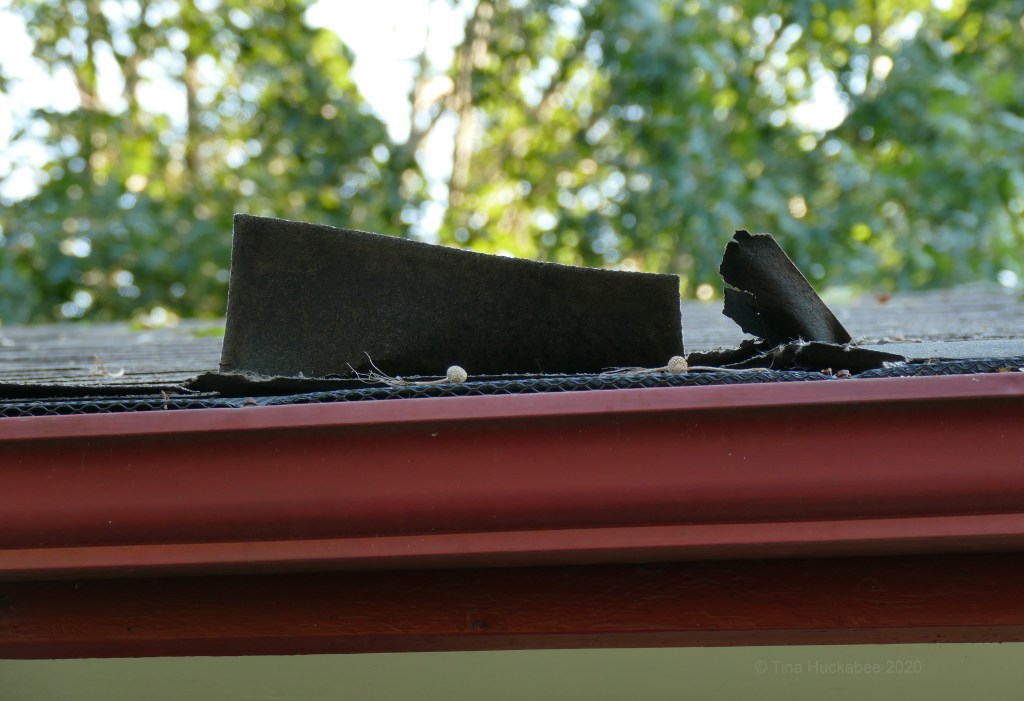
And a close-up:

I heard some scrabbling just above my back door last night, but was too slow with the flashlight to catch the critter in the act. In that spot, only one shingle was pulled up. I then surveyed the front of my house, flashlight flashing, and could see that there were a number of mangled shingles all along the front. Daylight demonstrated the full extent of the raccoon’s activities.

The same thing happened early in the year, in February. I noticed that roof shingles were randomly pulled up, some which had broken and fallen to the ground. We’d heard odd noises on the roof in the previous night or two, but never saw the rogue raccoon. Really, who else would do this? As cute and charming as they are, racoons are destructive; it cost a pretty penny to have the damaged fixed. Here we go again.

In the scheme of things, this is minor and even a little bit funny. But also, pretty annoying.

I’ve come to realize that I can no longer keep the old Photinia shrub which leans toward and near to the house. I’ve been reluctant to take it down because the birds use it for cover, but going forward, they’ll just have to wing to the big oak, which sits close by. The raccoon varmints are crawling onto the roof from the Photinia and celebrating their day–and other days and nights, too–by partying on my roof. The Photinia must come down, as I want to have money to live on when I’m old and won’t if raccoons continue to mess with my roof.

I think I may need to re-think this whole wildlife gardening schtick.

Foliage and Bird

It was a sprinkling of snowy Four O’Clock flowersMirabilis jalapa, that caught my eye one evening, not too long before sundown.  My two Four O’Clock plants (the other one blooms a stunning hot pink) are pass-alongs from a gardener and former blogger.  This old-timey, Southern garden addition-by-way-of-Central and South America, is a night bloomer and grows from a fleshy root which can become quite large.  The creamy flowers brighten a shady area close near my pond;  the flowers open in late afternoon, bloom all night, and close by late morning.  

But it was the metal bird, standing in a diversity of foliage, that resonated as a garden story.  Even though I planted this crew, I didn’t recognize just how different the various leaf forms are and how well they complement one another as they mature. 

Sometimes, it’s challenging to see consciously what will be as a garden evolves.

Clockwise from top left, the blue-tinged Soft-leaf Yucca, Yucca recurvifolia, sits next to the tropical green foliage of the Four O’Clock.  To its right, another grey-blue foliage plant, Drummond’s Ruellia, Ruellia drummondiana, serves as backing for three individuals of strappy, stripy Carex phyllocephala ‘Sparkler’ sedge–and that’s where the quirky bird perches.  A couple of iris straps and dangles of autumnal seeds of Inland Sea Oats, Chasmanthium latifolium complete the oddball group.

The Drummond’s Ruellia and ‘Sparkler’ sedges will grow and will require management: the ruellia will need pruning and the ‘Sparklers’ transplanting.  Maybe the bird will  migrate elsewhere.

For now, the group is simpatico and the gardener is pleased.

It was Anna’s own lovely foliage photo which reminded me of my foliage and bird.  Check out her Wednesday Vignette for garden happenings.