Sunday saw a snow event here in Central Texas, including a few inches of snow for my garden. That much snowfall is unusual, but was a nice change of pace. When we get snow, it’s usually light and doesn’t last too long coming down, nor once it’s on the ground. Sunday’s storm lasted for hours and was quite heavy at points.
It was certainly more than our typical dab of snow.
On Monday morning, I caught this vision of the snow which had covered our solar panels on Sunday, but slid off and was bunched up at the edge of the roof like a loose sock around an ankle.
This morning, three days after the snowfall, there’s still some snow left in shady corners–and on my roof.
To me, the snow looks like the snows of June, those drifts of cotton produced from Cottonwood trees, Populus deltoides, which gather along pathways and tangle in shrubs.
I only half believe most of the weather forecasts that I read or listen to. I generally take a broad view, assuming that the predictions are more ball park suggestions of what might happen day-to-day in my part of the world. Long-term forecasts seem more accurate than the dailies, but meteorology is an inexact science, which makes it fascinating to follow and keeps gardeners on their toes. Sometimes, those are frozen toes.
The forecast for Sunday was 100% rain, possibly turning to snow, with temperatures remaining a smidge above freezing. With the forecast of possible snow for Sunday, I was piqued, but realistic: nah, not gonna happen.
Mea culpa, I’m glad I was wrong! It did snow!
Throughout the day, the pond waterfall lent its melody to the garden during the quiet of snowfall.
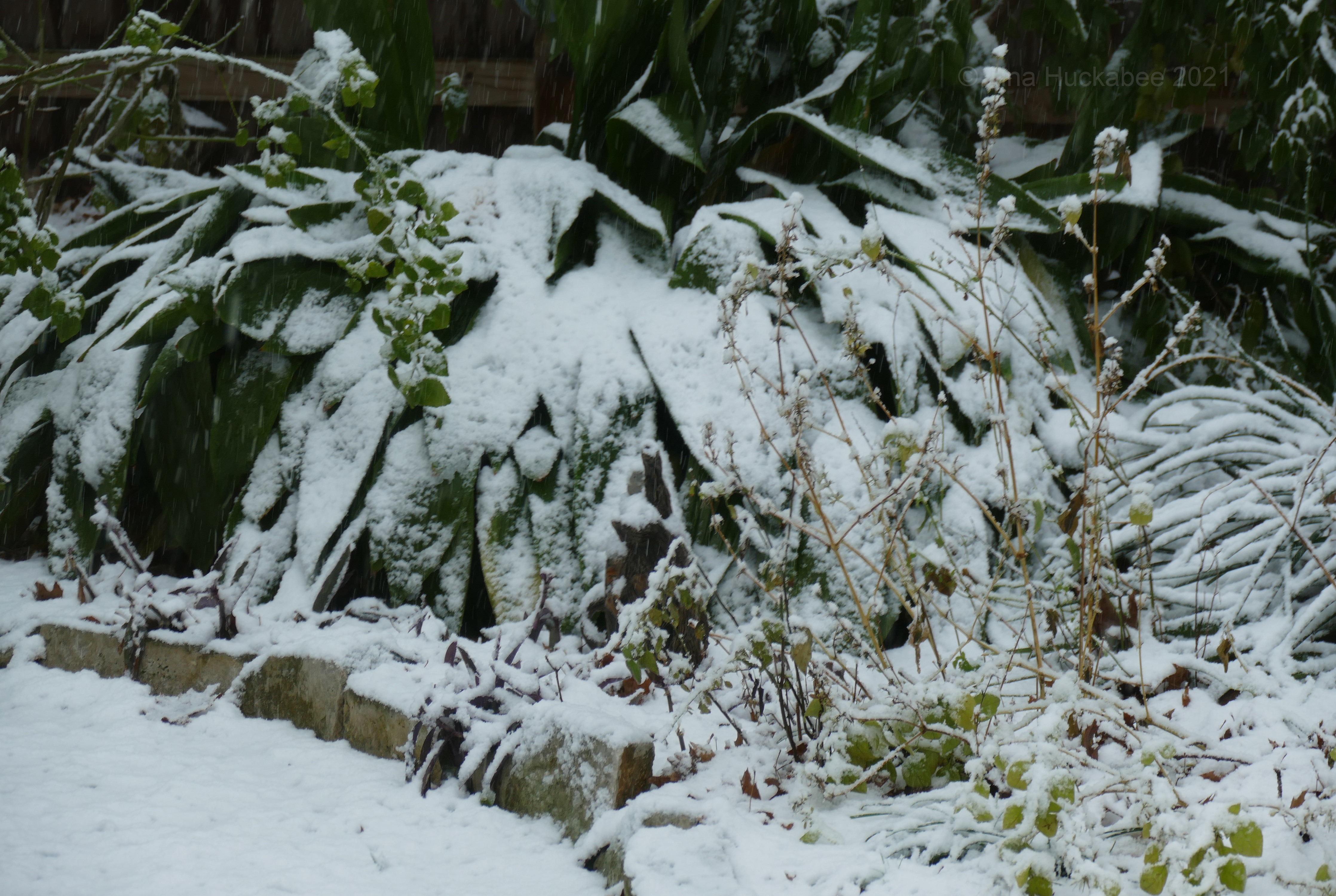
Snowfall is rare here in Austin, Texas. In past decades, we’d receive snow at intervals less than yearly, roughly every-other-year. In these climate change times, we’re much more likely to experience ice storms rather than snowfall. Yesterday, the white stuff began falling mid-morning and didn’t stop until late afternoon. My garden received an 1.5 inches of snow and was a welcome sight and wonderful change.
We prepared the beehives for the next few days of wet and cold conditions, mixing up a 1:1 ratio of sugar and water, just in case the bees have eaten through their honey stores (unlikely, but still…). So far, in these cold temperatures, the bees haven’t slurped the sweet stuff, but sugar water is ready for them in the next few days if they need it.
The bottle with sugar water stands in a holder, lid facing downward. The lid has holes where the sugar water drips and the honeybees sips.
When the snowfall began, I assumed it would be a short event, turning to rain within an hour or so. As the temperature hovered just above freezing, I assumed the whatever snow fell would melt immediately, or nearly so, which proved accurate in the first hour. After a couple of hours of light to heavy snowfall, with no slow-down of snow fall, I donned a coat, hat, and gloves and commenced covering the few cold-sensitive plants in my garden. The only thing I regularly protect from our limited bouts of frosty winter weather are the several groups of Dianella or Flax Lily, Dianella tasmanica. A great plant for our hot summers and one of my favorites, as it’s beautiful in shady conditions, it’s the only plant that suffers true damage during cold temperatures. I really like this plant, so I’m committed to covering.
This little ceramic owl braves the snow and looks dashing with its snow hat. Its two owl buddies were underneath the blanket covering a group of Flax Lily, therefore no snow hats or photos of them!
This morning sees clear skies and melting snow. It’ll warm a bit today, but a hard freeze is forecast for tonight; it’s January, it’s expected.
So for Monday, we say so long! to our brief snowy show and appreciate the distraction from the craziness of the world we live in.
I suspect I’m not alone when I say that I’m ready to kick — and kick hard — 2020 to the curb.
What a year this was, resulting in grief for the many who’ve died and sorrow for all whose lives have been upended in monstrous ways, too many to count or fully comprehend. I don’t have words to express my horror about this past year: utter disbelief at the callous indifference of leaders and the amoral selfishness of fellow citizens. The layers of good manners were ripped off; we now know what we are and what we must repair, given strong, high-minded leadership and implementation of values rooted in decency and fair play promoted in society.
As awful as this past year has been, I look forward to a new year, to wipe the slate clean, to a renewal of hope, and with heart-felt gratitude for the principled acts that became the glue in the midst of chaos. Included in those righteous acts are remarkable achievements in science and medicine and the commitment and compassion demonstrated by health care workers and first responders facing daunting tasks and terrible odds at each shift. Keeping everything working smoothly relied on the dedication of purpose demonstrated by a variety of essential workers, most of whom aren’t well-compensated for their worth in our world. And touching our future as they do, teachers revamped and revised continually throughout the year, always with students’ needs the highest priority.
I admit that some fear, some trepidation, remains; my hope is tempered. Trauma wields lessons and I long for our knowledge gained, ready and prepared for the next, and continuing, challenges. Regardless, my shoulders are squared and my feet are firmly planted as the old year ends and the new one emerges.
So, good riddance to you, 2020. Take your pandemic, your sorry leadership, your self-serving ignorance–don’t let the door hit you on the way out.


 My Gardener Says...