Garden Fairies

My neighbor thinks that Columbines look like fairies in flight.

Me?  I’ve always thought that Columbines look like shooting stars.

According to information about Columbines from the Lady Bird Johnson Wildflower plant database pages, the  Aquilegia (genus) name comes from the Latin aquila, which means eagle.  Apparently some people think the spurred petals look like eagle talons.  Another of the database pages describes the etymology of the word ‘columbine’ as derived from the Latin word columbinus, which means dove. The story is that the columbine resembles a group of doves.  The long spurs are the birds’ heads and shoulders, the sepals are the wings, the petals are the birds’ bodies.  I must say, I’m not quite sure I see that one.

Whatever whimsical, folksy story that gardeners choose to tell describing the Columbine, this is a must-have plant in the shady, xeric garden.

Columbines are native in many parts of the United States. In general though, Columbines are shade loving, cool season perennials. The common Texas Columbines are the yellow and red flowering plants.  These  perennials have beautiful, evergreen foliage,

and stunning flowers in the spring.

Columbines provide (for me anyway) great joy and  have always represented the beginning of spring here in Austin.  When I first started growing Columbines in my garden, they would reliably begin their spring bloom cycle  the second week of March–roughly during Spring Break.  I usually could dead-head them (until I grew weary of that chore) and they’d bloom until early to mid-June.  During this past decade, my Columbines have started to bloom two to three weeks earlier–now usually beginning in late February.   It’s now too hot by mid-June for them to bloom.

During the summer months, they tend to shrink in size (even as small as 4-5 inches in diameter) and sometimes, individual plants will go dormant.   Then, as soon as the fall rains begin, cooler temperatures arrive and the days grow short, they perk up.  Columbines have beautiful winter foliage; the leaves are deeply lobed and bright green.

They  look so delicate, but I’ve seen them covered in ice and once the ices melts, they’re  perfectly fine and maybe even blooming within a few days.

Columbines in the wild are identified by species characteristics and often are endemic to a  specific geographic area.  But those bought in nurseries are cultivars and are bred and sold for their showy blooms and hardiness. The common Columbine that many Texas gardeners buy at nurseries is the Yellow or Hinckley Columbine, or more than likely, a hybrid of those two and perhaps others.  Columbines (even those in the wild) will hybridize easily between species.

Years ago, I bought several “yellow” Columbines (I have no clue what the tag actually called it), although they were probably  A. chrysantha var. hinckleyana, or a variant thereof.  Sometime later, I added to my gardens the Red Columbine (Aquilegia canadensis), also native to Texas.

Over the years, they’ve re-seeded and I now have a variety of hybrids–yellow flowers of differing sizes with a  pink blush on the spurs, petals or sepals.

I still have a couple of pure yellow Columbines,

and a Red Columbine (A. canadensis).  The Red Columbine is the host plant for the Columbine Duskywing butterfly.

Columbines are easy to grow in Central Texas.  They are reportedly deer resistant  and are most beautiful during the cooler time of year (October-May), reaching the zenith of their beauty in March and April.  I’ve seen them grow in a variety of soil conditions, but Columbines prefer a moderately moist, well-draining soil.   Columbines are considered a drought tolerant perennial and in my personal gardens, I  don’t water these plants more than twice per month in our dry, hot summers.  During the summer of 2011, which was record-breaking hot and dry, my Columbines limped along.  I don’t believe that any died but they definitely struggled with the heat.  Most of mine also suffered leaf burn, too.  While that’s not unusual for Columbines in Texas heat, I noticed more damage after last summer.

I simply pruned the damaged leaves and by October, they began to revive and develop new foliage and begin their march toward spring beauty.

Interestingly, in October 2011, I also noticed that there were several blooms on my Columbines.  I’ve never seen that before, although I’ve read that Columbines will “rarely” bloom in the fall.  I assume the blooms were a response to the rain that began after our exceptional drought and heat of the past year.

The only problem I’ve ever experienced with Columbines is that they sometimes develop leaf mites.  The mites appear  at the end of spring and end of the bloom cycle.  An infestation can be diagnosed when the leaves begin to develop an unhealthy looking yellow, with some leaf mottling.  If you turn a leaf over, you can spot the culprits–tiny little spider-like critters.  I’ve only had to spritz mine with a blast of water from the hose (under the leaf) and generally, that takes care of the infestation.  It’s a good idea though, to prune off the damaged leaves.  The plant will generate new ones and soon, the Columbine is back to full health.  That said, it’s been a long time since I’ve had that problem with any Columbines that I grow.

Columbines are a short-lived perennial (4 or 5 years, usually), so let them re-seed from parent plants and you’ll always have some around.

If you have shade and you want a hardy and beautiful blooming perennial, try planting Columbine.  Here in Texas, stick with the Yellow or Red Columbines and you won’t be disappointed.  For a complete tutorial on Columbines, check out the NPIN Database Page on the Lady Bird Johnson Wildflower website.  Just type in “aquilegia” or “columbine” and hit go.The window will appear with a long list of this perennial, you can click on the one(s) you’re interested in and read away!

And then, invite some fairies and shooting stars and doves to your garden.

Foliage Follow-Up-March 2012-So Much!!

Along with luscious blooms, spring is full of verdant and colorful foliage.  And like yesterday’s post on blooms in my garden, it was hard to choose which foliage to profile, but here are my picks.  Thanks to Pam at Digging for hosting Foliage Follow-Up.

I like to plant Fennel (Foeniculum vulgare) for the Eastern Black Swallowtail butterflies, but I also love the gauzy, elegant quality it lends to the garden.  Elegant that is, until the larva eat it down to a sprig.

And that “gauzy, elegant” quality is lessened a bit with the Red Oak pollen tassels plopped all over the plant.

The Red Poppies that I let re-seed in my gardens not only have lovely blooms, but wavy, soft green leaves as well.

One of my favorite spring bloomers is the Lyre-leaf Sage (Salvia lyrata).  A native Texas ground cover which sends up spikes of blue flowers, it also has interesting foliage and is an excellent ground cover.  The scalloped leaves sport a deep burgundy coloring along the veins of the leaves–more prominent in the winter/early spring than at other times of the year, but very attractive year round.

Another favorite is the Mexican Feathergrass (Nassella tenuissima)–it works in so many places, but especially when the sun glints off of its slender, graceful leaves.

I love the look of the bright green, vertical Iris straps juxtaposed with the softer, grey-green scalloped leaves of the ground cover, Heartleaf Skullcap (Scutellaria ovata ssp. bracteata).  This particular Iris plant was nick-named ‘Shoshana’s Iris’ by Pam, after my daughter, who died suddenly in 2006.  I don’t know the “real” name for this Iris, but ‘Shoshana’s Iris’ is what I call it now.  Interestingly, both of these plants are pass-a-longs.  I gave the Iris bulbs to Pam and she gave me the Skullcap.  Nice.

I always love how new rose leaves are tinged with purple-to-burgundy leaves.  The ‘Knock Out’ Rose has especially beautiful new leaves in the spring, even before its blooms begin.

And, the smaller leaves of the ‘Martha Gonzales’ rose blends green with an outline tinge of red.  The heavy dew on the leaves (not to mention the Red Oak pollen tassels, again), add a nice touch as well.

The fabulous Mt. Laurel (Sophora secundiflora) has leaves nearly as fetching as its blooms.  The dark-green, simple leaves are beautiful all year, even after the blooms become seeds for the next generation.

New leaves on the Red Oaks are tender, brilliant and fresh.  The pollen tassels have formed and mostly dropped this past week,

to be picked up (and deposited EVERYWHERE) by the Sweeper of the Garden.

Garden Bloggers’ Bloom Day-March 2012-So Much!!

So many blooms, so little time.  What can I say?  There are so many plants blooming in my garden during this abundant spring that I don’t have enough time to talk about all of them.  It’s a problem I’m glad to have.  After a mild, wet winter and an early, wet spring, there are loads of blooming perennials/annuals in the garden.  Thanks to Carole at May Dreams Gardens for hosting  Garden Bloggers’ Bloom Day.   Here are a few of the lovelies gracing my little garden:

This Firecracker Plants (Russelia equisetiformis) bloomed  all winter.  Normally a herbaceous perennial in Austin, this year mine remained evergreen.

I have several Prairie Spiderwort (Tradescantia occidentalis) blooming.  A very common spring wildflower and a great pass-a-long plant.   It’s a tough plant and a great early bloomer.

The first Pink Autumn (or Cherry) Sage (Salvia greggii) blooms.  I prune mine to about 8 to 10 inches and they grow to about 2 feet in height and width.  I also have the red and white blooming S. greggii.

And, the still floriferous Coral Honeysuckle (Lonicera sempervirens) blooms.  It’s loaded with gorgeous red blooms, just waiting for the hummingbirds to visit.

A German friend gave poppy seeds to me years ago.  I tossed them out and reliably, every spring, these eye-catching beauties bloom.  With the rain this winter and spring, they’re especially prolific.  And HUGE!!  One group is  well over 3 feet tall.

The first Iris to bloom in my gardens this spring.  This is an unknown Iris, given to me by…someone a long time ago.  Every spring, it’s a  hardy and reliable bloomer.

To me, the Yellow Columbine (Aquilegia chrysantha var. hinckleyana) is the harbinger of spring.   In the past, this perennial wouldn’t bloom until mid-March.  Now, it starts about two weeks earlier.

Its relative, the Red Columbine (Aquilegia canadensis), blooms in companionship with the Yellow.

And, since the two species naturally hybridize, I have a number of these perennials shrubs in which the flowers are yellow, with a blush of red.  I love that!

The Crossvine (Bignonia capreolata), is a very well-behaved vine.  I cut mine back a couple of years ago and with the drought and heat last year, it’s made a slow recovery.  But it has plenty of tangerine/yellow blooms this year.

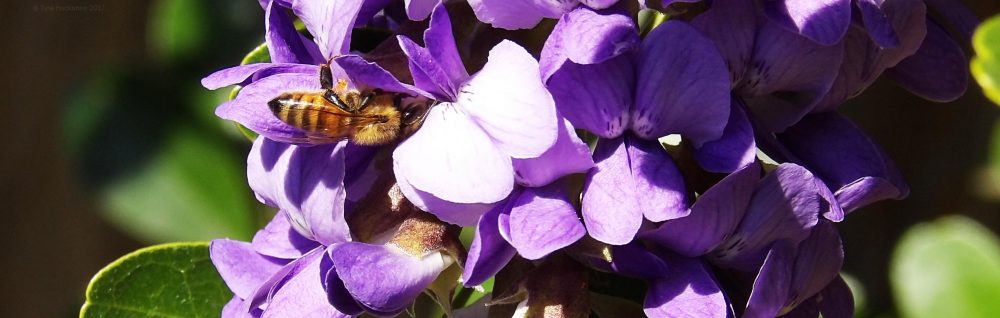
The ubiquitous Mt. Laurel (Sophora secundiflora), has been stunning this year in Austin, including the one in my back garden.  I even saw a magnificent one in Corpus Christi, recently.

And, finally, the Guardian of the Blooms protects the Old Gay Hill Rose and the Globe Mallow (Sphaeralcea ambigua), from the invading butterflies.

Goofy cat.