Native Texans

In this post you won’t find any cowboy boots or hats, nor plates of barbecue and bowls of salsa, and certainly no funny, twangy accents, but you will see plenty of beauty and Texan toughness.  What is this you’ve stumbled across?  It’s an homage to Texas native plants and to the celebration thereof:  Texas Native Plant Week marked annually during the week of October 16-22.
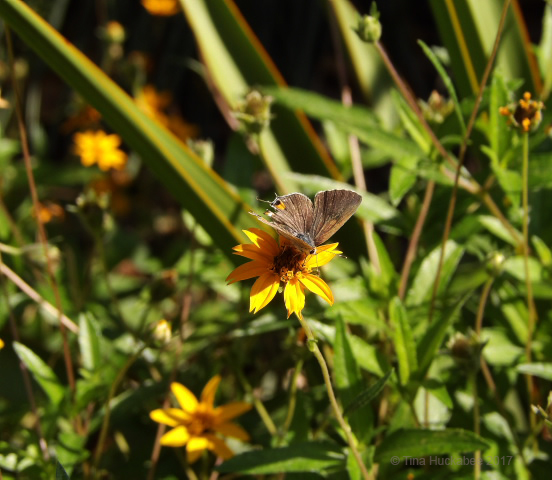
Nectaring Gray Hairstreak (Strymon melinus) on Zexmenia (Wedelia acapulcensis var. hispida).  Twistleaf yucca (Yucca rupicola) serves as a backdrop

Established to educate and encourage Texans to recognize and utilize our lovely, valuable native plants in personal and public gardens, many communities in Texas sponsor events promoting the use of native plants during this week of native plant love.
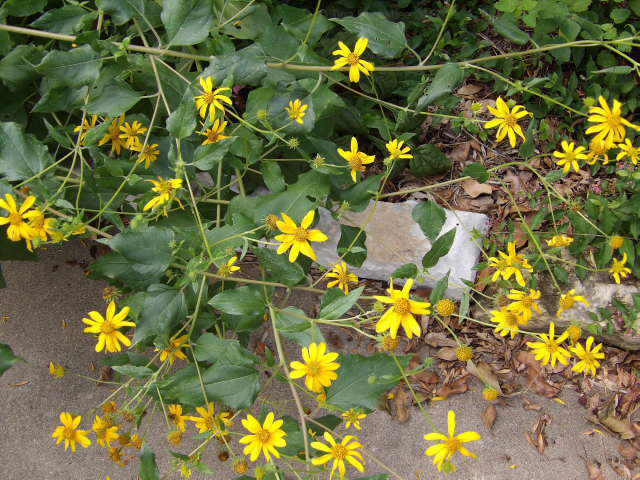
Plateau goldeneye (Viguiera dentata)


Native plants are valuable for many reasons:  they’re easy to grow and maintain, and require less irrigation; they feed and protect native fauna; they’re key to biological diversity, and vital for a healthy environment.

Shrubby blue sage (Salvia ballotiflora)


Plants can be native to a wide geographical area–like the whole of North America–or specific to a small, confined eco-system–like the area in which you live.

Texas Craglily (Echeandia texensis)


Natives belong where you live, whether you’re in Texas or some other fabulous place.

Turkscap (Malvaviscus arboreus var. drummondii) and White tropical sage (Salvia coccinea)
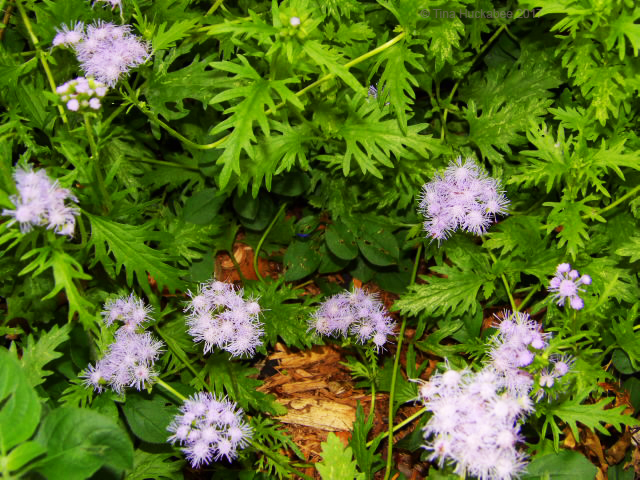
Gregg’s mistflower (Conoclinium greggii)


Do we need to practice purity in our gardening aesthetics and utilize only natives in our gardens? Well, it would be nice if we planted all natives, all the time, but for many gardeners, that’s simply not possible because native plants aren’t always as commercially available as non-native plants.  And it’s true that there are many non-native, well-adapted plants which enrich our gardens and beautify our world; it’s perfectly fine to garden with both natives and non-natives.

Red tropical sage (Salvia coccinea) paired with non-native, potted Yucca filamentosa ‘Golden Sword’

But when you plant natives in your garden, you help define the place you live. What grows for me here in urban Austin, Texas doesn’t work–or may not fit–for gardeners in Chicago, Illinois,  Eugene, Oregon, or Bangor, Maine.  What grows here, doesn’t necessarily grow there; plant diversity makes the world go ’round.  All regions enjoy unique botanical flavor and that should be appreciated–and practiced–by those who’re driven to create gardens.

Blue mistflower (Conoclinium coelestinum)


Plant natives in your garden for ease and practicality.

Rock rose (Pavonia lasiopetala)


Plant natives to protect and nurture wildlife.
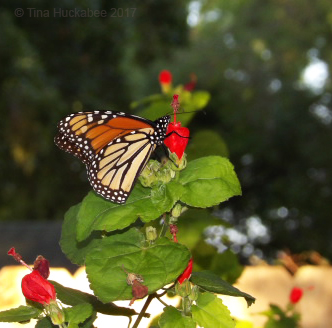
Migrating Monarch (Danaus plexippus) nectaring on Turkscap


Plant natives for seasonal interest and to elicit a sense of place.

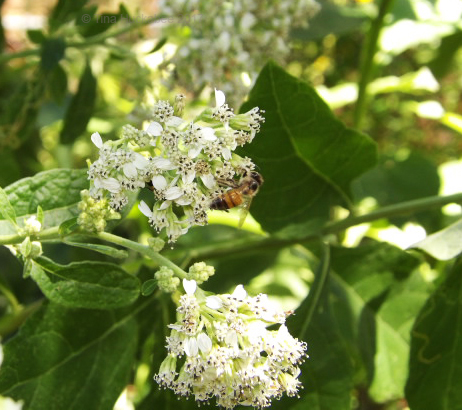
White mistflower (Ageratina havanensis)


Especially in urban areas, the use of native plants helps restore wildlife habitat and regional character.

Migrating Monarch on Plateau goldeneye


Flowers in the city are like lipstick on a woman–it just makes you look better to have a little color.  Lady Bird Johnson

Plateau goldeneye


For more information about Texas Native Plant Week, check out these links:

Lady Bird Johnson Wildflower Center
Native Plants of Texas

Frostweed (Verbesina virginica)


Today I’m also linking with Carol of May Dreams Gardens for Garden Bloggers’ Bloom Day.  Check out flowers from all over the world, honoring all things blooming–native or otherwise.
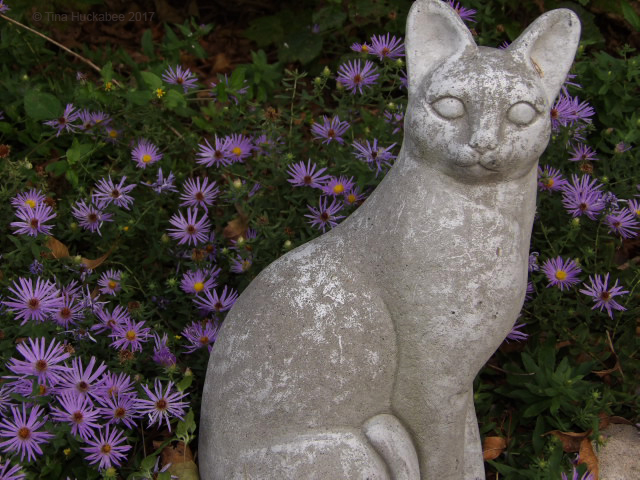
Wild blue aster (Symphyotrichum oblongifolium)
Transitions: Wildlife Wednesday

Summer wanes, but heat persists.  The days grow shorter, nights are longer; all are cooler.   Rain falls, gently, but also in sheets and deluges. Here in Central Texas, September weather conditions tend to the transitional and this past month certainly bolstered that weather paradigm. Summer 2017 is now in the history books and autumn will write its own story.  But no matter the conditions, garden wildlife continue their activities:  eating, dying, growing, defending, migrating.  Today is the first Wednesday of the month and time to appreciate those with whom we share space in the wilds of our gardens and neighborhoods.

I’ve been watching this beauty,

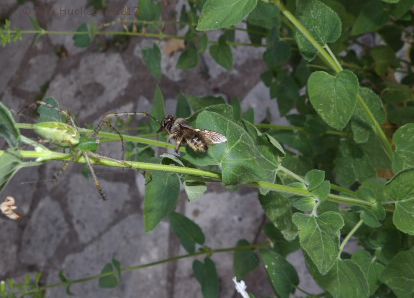
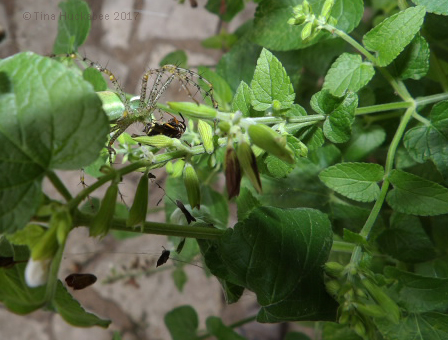
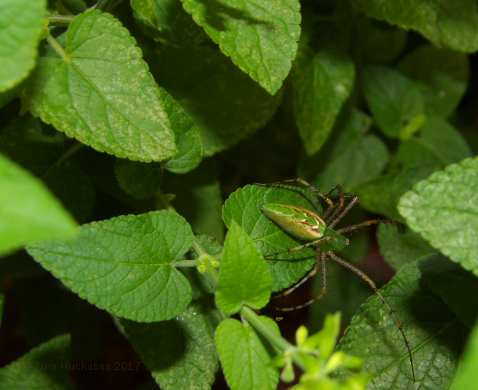
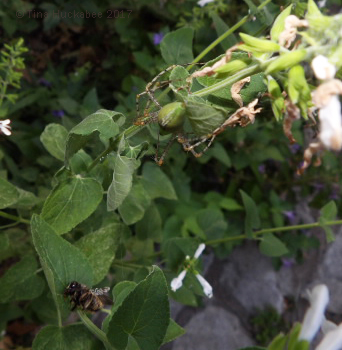
…a Green Lynx SpiderPeucetia viridans, for a couple of weeks.  She perched atop a White tropical sage, Salvia coccinea, successfully hunting various pollinators who happen her way while going about their own feeding business. She snagged a Horsefly-like Carpenter beeXylocopa tabaniformis, and while I angled for a photo, the startled spider dropped the bee onto a leaf below the spider’s lair. 

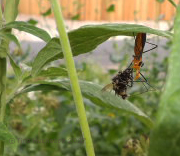
Not willing to lose out on a juicy bee, Ms. Spider makes her way along the stem to her repast.

Sniff–the X. tabaniformis bees are my favorite bee species and I hate to see one of them become someone’s meal.  But everyone must eat, including garden spiders, and that’s the way of wildlife–and wildlife gardening.

This little bee, perhaps a Sweat bee, Halictus tripartitus, and another common native bee in my garden, also fell victim to the spider’s appetite and hunting skills.

Another sniff by me.  Well, it can’t always be bad insects that are eaten.  I had words with Ms. Spider about expanding her food repertoire, but she remains on the Tropical sage, hunting and eating her fill.

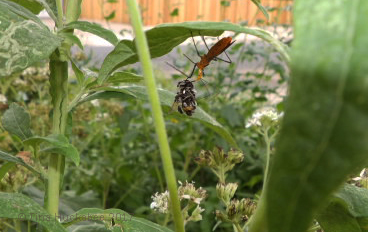
On this Frostweed, Verbesina virginica, a Milkweed Assasin Bug,  Zelus longipes, demonstrates its hunting prowess. The snared snack is yet another Horsefly-like Carpenter bee.  There are lots of these bees in my garden, so it makes sense that some are going to become prey for hunters.

I wish I could warn the bees about the impending danger lurking amongst the flowers, but they’re on their own in the big, bad, dangerous garden-world.

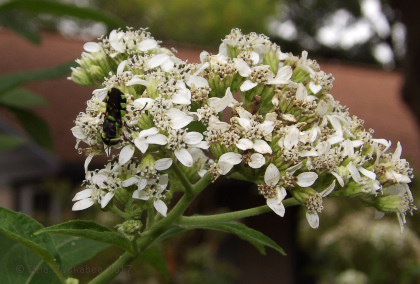
FrostweedV. virginica is the best, THE BEST,  pollinator plant in my garden.   When it blooms each autumn, I’m always amazed at the variety of insects partaking of its bounty. Each blooming season I see and learn about new-to-me pollinators by watching what visits the Frostweed flowers.

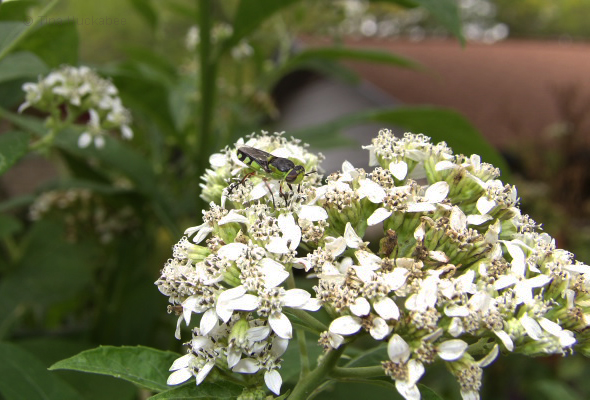
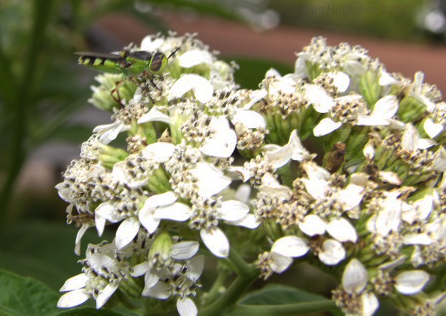
I observed this handsome critter on some Frostweed blooms:

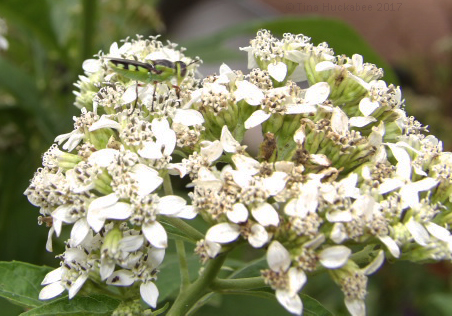
He/she is a Soldier flyOdontomyia cincta. No doubt my garden has benefitted from this insect before, but I’ve never seen one.  Turns out that the larval form of this insect is aquatic; the adults feed on nectar, the larvae feed on algae.  I have a pond, as do several neighbors, so it’s a wonder that I’ve never seen this gorgeous insect before.

I can’t decide if its coloring is akin to the loud clothing combos of a golfer or the eye-popping garb of a disco dancer, but I’m sure glad this one came by for a sip so that I could admire its kelly green-and-black striped costume and deep maroon eyes.


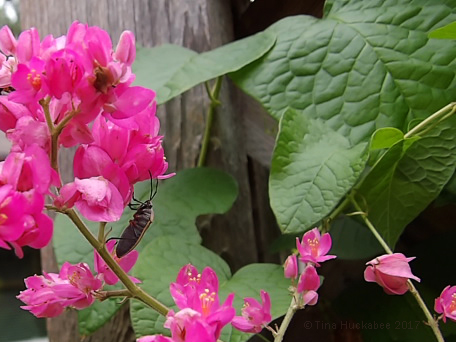
This Largus BugLargus succcinctus, may not be as beautiful as a butterfly or as industrious as a bee, but it dines on the Barbie-doll pink blossoms of the Coral Vine, Antigonon leptopus, pollinating with the best of them 

Another stellar autumn pollinator plant, the Coral Vine is beloved by honeybees.  The vine is currently in motion with the buzzing activity of huge numbers of honeybees working these sweet blooms.


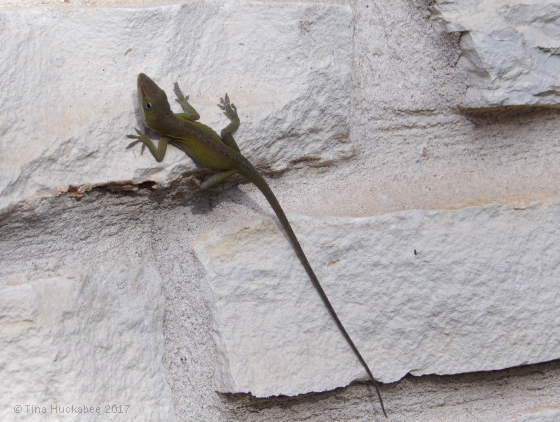
I haven’t posted recently about the resident Green Anole, Anolis carolinensis, lizards in my garden, but there are plenty of them around, eating anything smaller than themselves.

Hanging out on the front wall of the house, neither green nor brown is particularly effective camouflage.

This one was in brown-to-green transition as he looked warily at me, assuming some invasion of his territory. He has nothing to fear from me–I love these little ones and am happy they like my gardens.

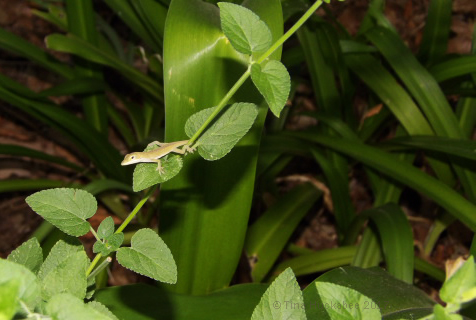
This very little one is obviously a juvenile, at only about 2.5 inches in length, compared to the 6 or 7 inches for adults.  In late summer and early fall, it’s common to spot these teenage anoles.  They’re even cuter than the adults.


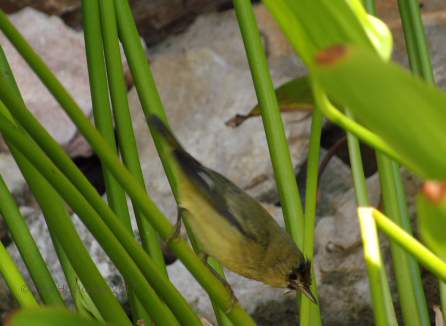
Bird migration was a big win in my garden during spring, but there has been little migratory movement through my garden this past month.  I spotted what I think was an Eastern Phoebe and another bird who was yellow with wing bars–that describes quite a few migratory birds, but that’s the extent of bird migration action. This juvenile (?) Wilson WarblerCardenllina pusilla, enjoyed the pond and also picked insects from the Yellow bells, Tacoma stans and the Autumn sage, Salvia greggii.

I hope the migrating song birds are simply finding more amenable conditions west or east of my garden.

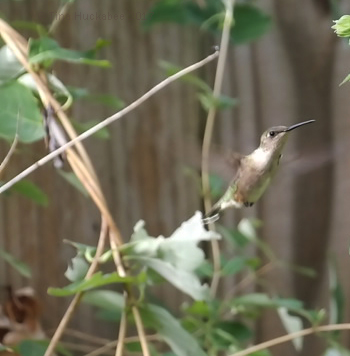
Hummingbirds were a constant this summer and there are still a couple of them around, chasing one another and fueling up for migration to Mexico and Central America on their favorite nectar plants.

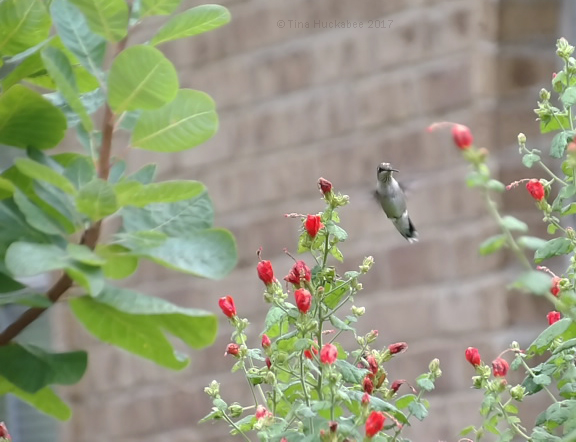
She can’t decide which Turk’s cap blooms (Malvaviscus arboreus) to feed from.

Female Black-chinned HummingbirdsArchilochus alexandri are the most common hummers that I see.   I’ll miss their zooming antics, territorial squabbles, and annoyed, bossy chirps when they finally decide it’s time head south–which will be any day now.

Transitioning from summer to autumn provides interesting viewing of common and uncommon critters, while enjoying more pleasant temperatures.  I hope your garden is full of wildlife happenings and ready for autumn color. Please share your wildlife stories for this past month and remember to leave your link when you comment.  Good wildlife gardening to you!

A Harvey Harmed Garden

The damage my garden received from the rains generated by Hurricane Harvey was nothing–really nothing–compared to the destruction wrought throughout southeast Texas and into Louisiana.  What Rockport, Port Aransas, Houston, Beaumont and other areas endured was catastrophic.  While harm inflicted to my garden was annoying, it will allow for a transformation of an heretofore shady situation to one where sun lovers will  flourish.

So what was the damage?

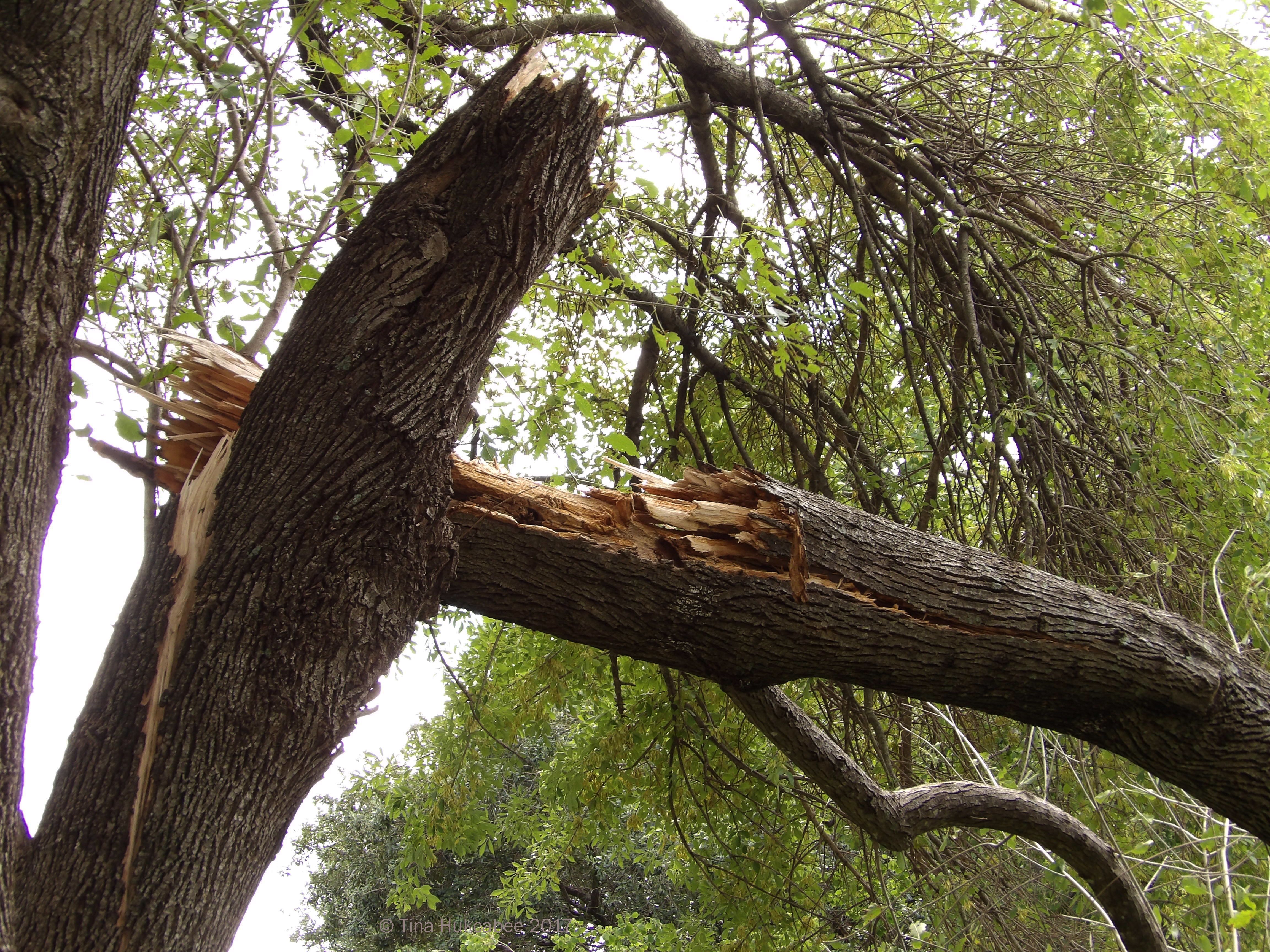
Yeah, that’s a problem. This mangled mess was caused by the 10-plus inches received that weekend and occurred in the form of a half-downed tree.

This mature Arizona Ash split at one of its two main trunks, not at the crotch (which might be expected), instead, a bit higher up.

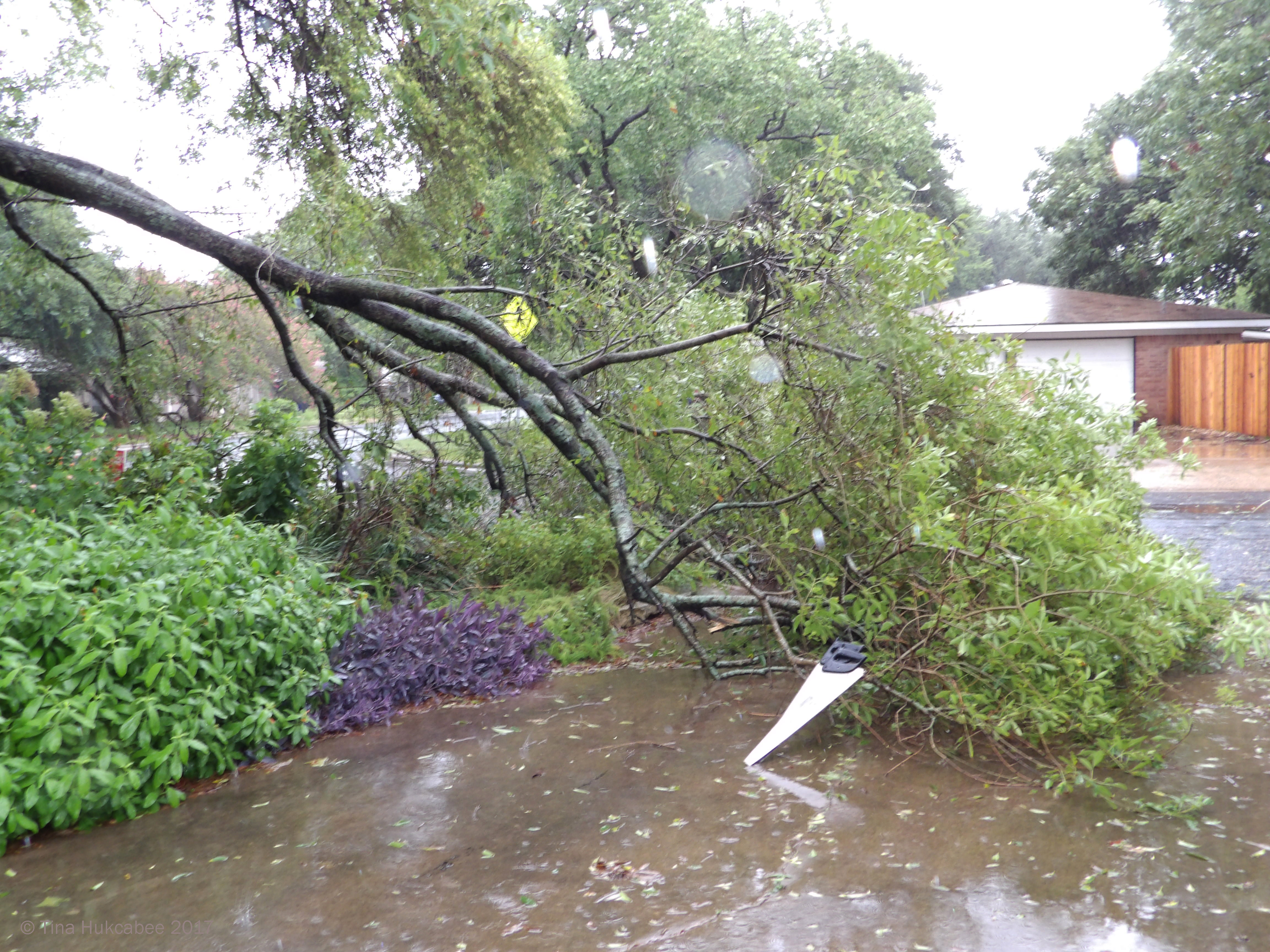
Splayed foliaged and branches decorated the front garden, street, and driveway.

I called my arborist that morning, but he wasn’t able to take this job.  I made several other calls, securing a promise from a neighbor’s arborist–I was 7th on his list.  Because it was unclear how long it would be before the arborist could work some pruning magic on the tree (it ended up being 10 days), we gathered various saws and pruning utensils and got to work on the smaller branches in the street and along the driveway to tidy the tangle of tree.

A week after we pruned, some lovely guys from the city of Austin’s waste crew came by and removed most of the tree detritus.  Eventually, the arborist crew arrived, took out the rest of the large branches, and all was cleaned up.

The garden was ready for an assessment and possible re-do.

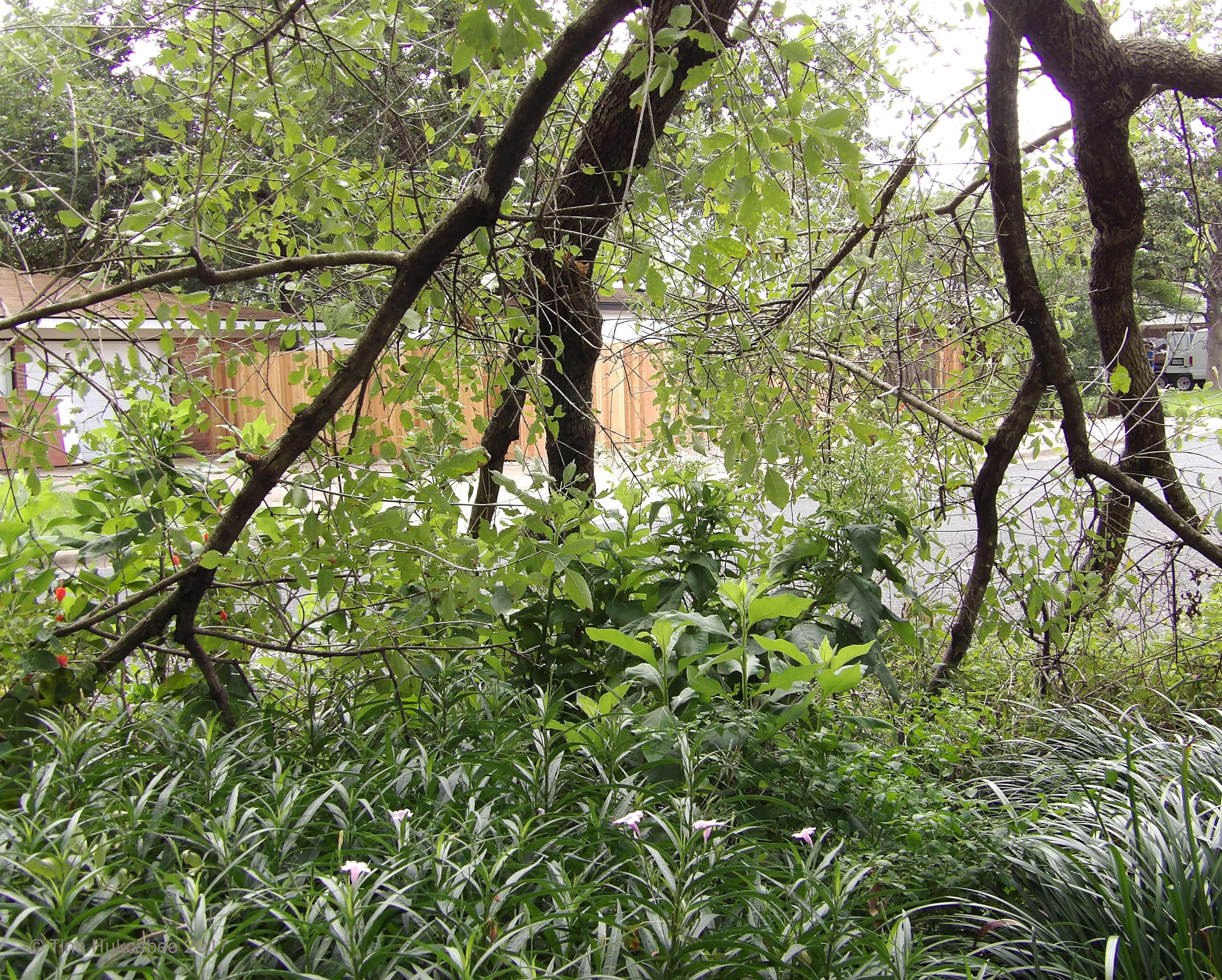
The fallen branch injured the Giant liriope and Inland sea oats that dominated the center part of this formerly shady garden.  With less overhead foliage, allowing for dappled morning and early afternoon light, and a now-clear western exposure, which means that the bright Texas sun will blast on the front of this garden, a reconsideration of plants is definitely in order.

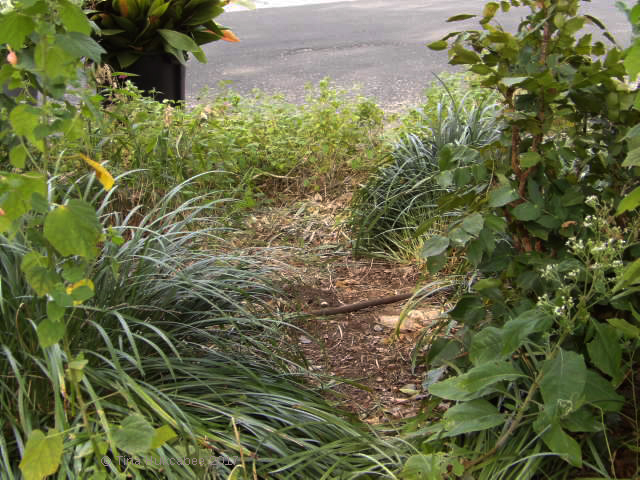
In this shot, some liriope has been removed, leaving a space for…?  Prior to the tree-fall, only the outer edge of this garden (at the street) received direct sun; after the tree-fall, all of this is in full sun.

This shot is taken from the street, looking toward the center part of the garden. The plants at the front of this photo are Rock rose (Pavonia lasiopetala) and thrive in full sun. The grassy Giant liriope can handle sun, but I’ve pulled them in favor of other perennials.


The dry-shade loving Cast iron plantsAspidistra elatior, must go–they will fry in the sun’s rays.

The deep green Cast iron is at the top of the shot, to the right of the silvery agave.

I’ve enjoyed the Cast iron plants in the front garden–there were three groups, only one remains for now.  They’ve provided evergreen structure in winter and a lushness that soothes in our hot summers.  But go these must and in fact, I’d already planned to remove one large section (opposite from this photo) this autumn because it’s receiving more sun, due to a neighbor’s declining trees.

I’ve removed the Liriope, Cast iron plants, and the Inland sea oats, finding homes for some, transplanting some, and ditching the rest.

Three of many bins of plants from this project.  The plants won’t go to the landfill, but will end up as part of  a sewage-sludge product called “DilloDirt,” an excellent garden amendment.


I’m in the process of transplanting some sun-starved shrubs and perennials from my increasingly shady back garden, looking forward to their thriving in a new, sun-doused home.  The fallen tree was a win-win for both gardens and for friends who were wanting shady plants for their gardens.

Lemonade from lemons.

A couple of nice gifts that Harvey’s rains left include these Red spider liliesLycoris radiata,

Blooming along with some happy Drummond’s ruellia (Ruellia drummondiana).

…and a clump or two of Oxblood liliesRhodophiala bifida.  

That said, neither of these beauties showed off much in my garden this past month.  Typically during September, there are several clumps of each that pop up and POP in the garden, responding to early fall rains.  This year though, they’re sulking and hiding for some reason.

Perhaps 10 inches over one weekend was too much rain?