It’s a Wrap: December Wildlife Wednesday

As we enter the last month of the year and I prepare for a Texas winter (such that it is), I welcome you to December Wildlife Wednesday, the final installment for 2017 of watching wonderful–sometime wacky–wildlife!  Wild critters in my garden are busy with their lives and are also providing entertainment and learning experiences for me.  I trust your garden has been graced with some wild happenings as well.

Winter Texans of the avian sort are settled in, having migrated from their breeding grounds in northern North America.  These various songbirds will spend the next 4-6 months of relatively mild weather eating their fill of available berries, seeds, insects, and suet in preparation for the arduous migration back to the places where they raise families.  These–and all birds–will be easier to spot once my deciduous plants shrug-off their foliage garb (leaving said foliage unceremoniously on the ground for me to pick up) and while that process has begun, it’s at least a month away before bare-n-naked trees will allow for better bird viewing.

This Ruby-crowned KingletRegulus calendula, is one of a pair visiting my back garden daily.

The ruby  streak on top of the head isn’t visible; this one could be a female.

I’ve only spotted the female at the suet feeder, but I’m sure the male pops on for a nosh, too–but, so far, not when I’m looking.  I eagerly await a glimpse of ruby-red in the garden which flashes when defending territory or charming Ruby-crowned Kinglet gals.


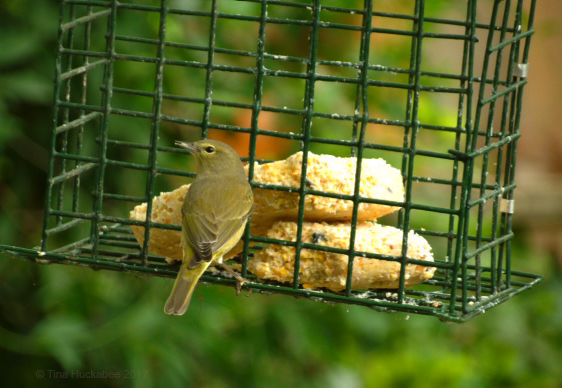
An Orange-crown warblerOreothlypis celata, frequently partakes of suet.

Easier to spot on the feeder, I prefer to watch them work through the garden, rapidly moving from limb to limb, and shrub to shrub, snipping insects as they go–but it’s challenging keep up with their speed-feeding movements.  Less colorful than some of the other songbirds, these little ones are elegant and with charm to spare.  I think there are two Orange-crowns in the garden, but haven’t definitively confirmed that.

For weeks, I observed one or two Eastern Phoebe flycatchersSayornis phoebe, but was either too slow with the camera, or didn’t have it at hand.  One morning on my way out, I saw this beauty through my bedroom window.

Catch me if you can!

I sprinted to where my camera awaited assignment, grabbed and prepared it for the shots as I hurried back to the window.  Success!

I’m waiting patiently for you to get your shots, lady! (claws tapping)

I didn’t dare step outside, as these birds have my blundering number and always take flight as soon as I make an appearance.  Interestingly, I haven’t seen the phoebes since these photos, so I hope my paparazzi-like behavior didn’t scare them off.   According to All About Birds, these flycatchers are year-round residents in some parts of Central Texas, though they are new to me.  Their wintering grounds span West, East and South Texas and southward through Mexico.


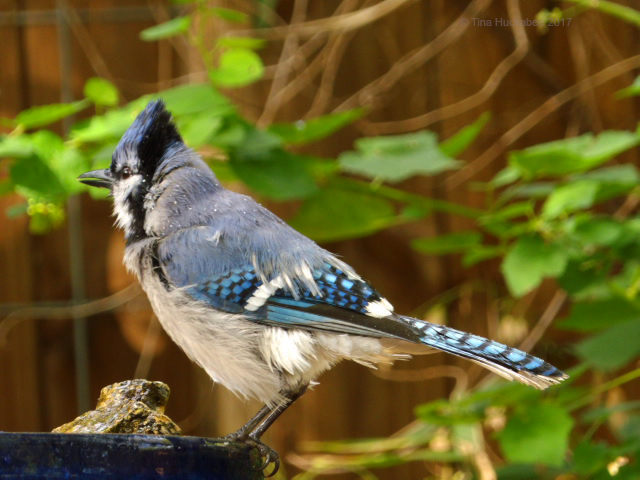
The local bird characters provide a show as they go about their daily business.  A bathing Blue JayCyanocitta cristata, always elicits a grin.
 

It’s a toss-up whether this Carolina ChickadeePoecile carolinensis,


…or this Carolina WrenThryothorus ludovicianus, wins the cute bird-of-the-month prize.

Shall we have a vote?

This wren is certainly laser-focused on something  worth investigating.


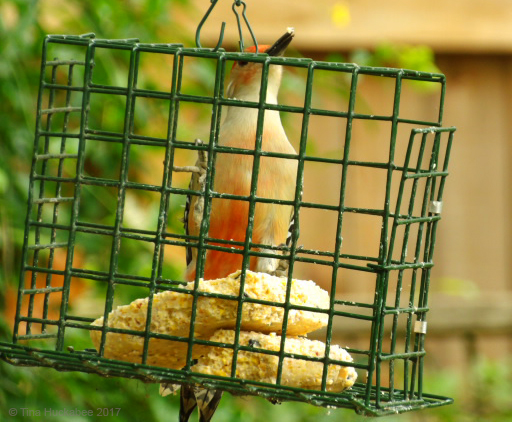
A male Red-bellied WoodpeckerMelanerpes carolinus, loves the suet I provide once the temperatures are reliably cool.

A female Red-belly also visits; I assume they’re mates, but don’t know where their nest is located.


Not in my back garden, but I spotted this gorgeous Great Blue HeronArdea herodias, resting in my neighbor’s tree late one afternoon.

I see Great Blues fly over my neighborhood throughout the year, as they keep a keen eye on the urban creeks which spiderweb through Austin.  In my own garden, they pop in mid-to-late spring after I’ve pruned the pond lilies, which frees-up access to available fish.   For a month or so, the poor little fish are vulnerable because they have fewer foliaged places to hide and the herons know that when lily pads are limited, they’re ‘shooting’ fish in a barrel!   I was pleased to see this handsome heron, though it loped off as I gawked in admiration.


The state bird of Texas is the Northern MockingbirdMimus polyglottos.  I’ve seen this one, perched silently and un-singing, on the back fence.
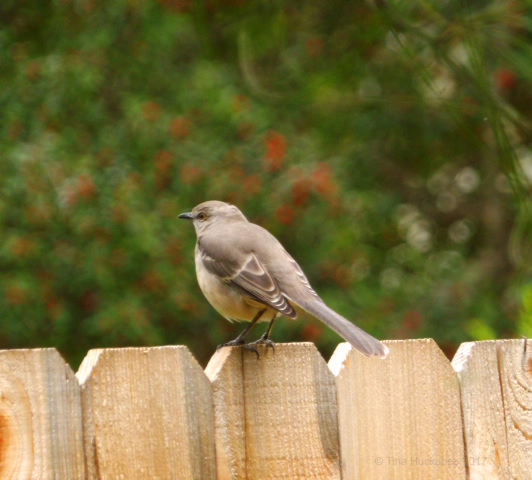
A contemplative bird.


On Thanksgiving morning I was sipping coffee and perusing the local newspaper at my kitchen table.  From where I sat, there is a clear view to the back garden and  I looked up just as a large, fast bird streaked across my line of vision.  Recognizing a hawk in hot pursuit, I snatched my camera and caught this just-landed Red-tailed HawkButeo jamaincensis, in a neighbor’s tree.

Wow!  This bird was huge, so I’m guessing she’s a female and probably disgruntled at the lack of her own Thanksgiving feast.  Dove with cranberry sauce, anyone??  As I snapped a few shots, a Blue Jay was harassing her, so she took wing, landing on another tree further away.

Ms. Red-tailed refused to turn around and acknowledge my presence.

She perched there for a long time, probably re-thinking her strategy for snagging a meal.  There are a variety of smaller raptors in my neighborhood:  this autumn I’ve seen a Cooper’s hawk and a Sharp-shinned hawk–but I think this is the first time that a Red-tailed has wooshed through the back garden.


The birds are active, but they’re not the only winged-things around.  There have been plenty of butterflies, moths, and honeybees, though the native bees have gone to sleep for the season.  The cheery, yellow Southern DogfaceZerene cesonia, is a common autumn butterfly here, but always so flighty that I rarely catch a good photo–until recently!
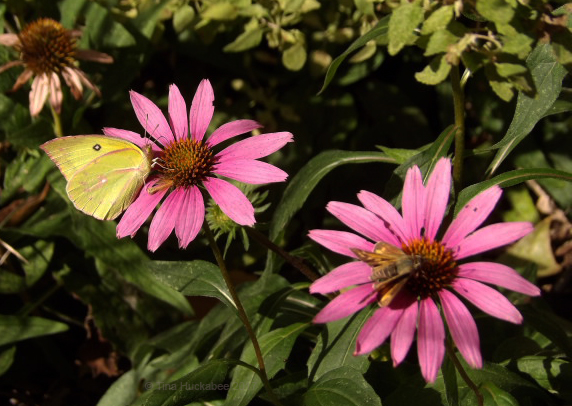
Woot!  Nectaring on the autumn crop of Purple Coneflower, Echinacea purpurea,  this one shares the bounty with an equally busy Southern Broken-DashWallengrenia otho.

The orange-brown on the wings is plenty attractive, but the Southern Broken-Dash also shows a beautiful, iridescent blue-green on the upper side of its thorax.

Nectaring at a Purple coneflower.
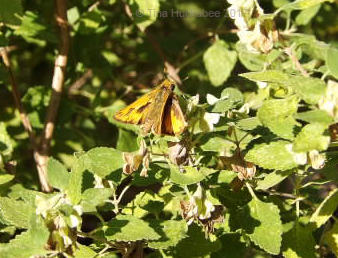
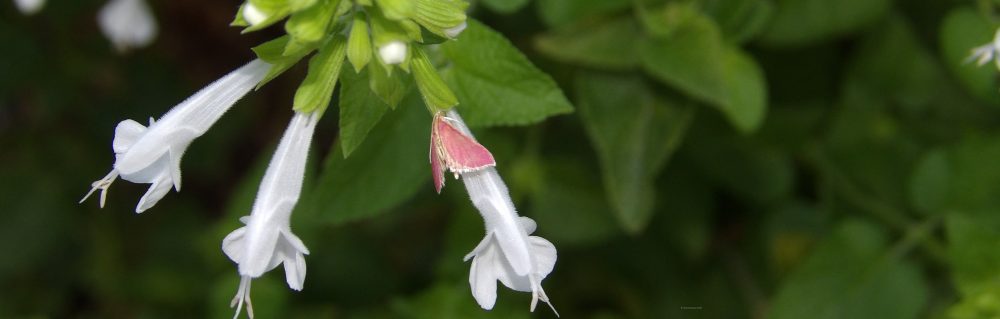
Sunning on the foliage of the Shrubby Blue sage.


That same afternoon, this Clouded SkipperLerema accius, also vied for attention.
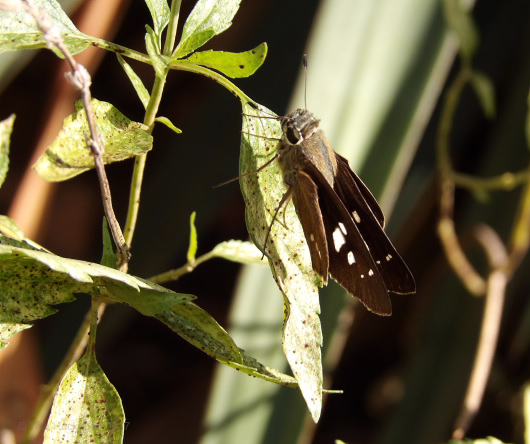
I’ve been amazed and quite pleased at the numbers of small skippers and even larger butterflies in my garden this past month, though I’ve mostly appreciated their beauty  and not rushed to get photos.  Keep up the good work, pollinators!


It’s not all about desirables in the garden though.  I thought I’d attempt attracting Eastern Blue Birds–or something equally fascinating–by leaving dried mealworms (yuk to me, but some birds totally dig them), but all I’ve managed to attract is this critter.
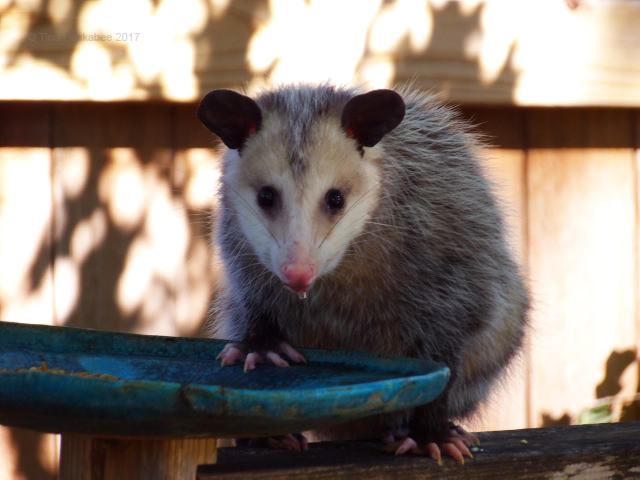
A drooling Virginia Opossum (Didelphis virginiana).

Grrrr.  As well, I suspect her in the crime of squatting in the Eastern Screech Owl house.  Everytime we open up the house to make it available for house-hunting owls, the camera shows a snoozing, or sometimes bathing, opossum.
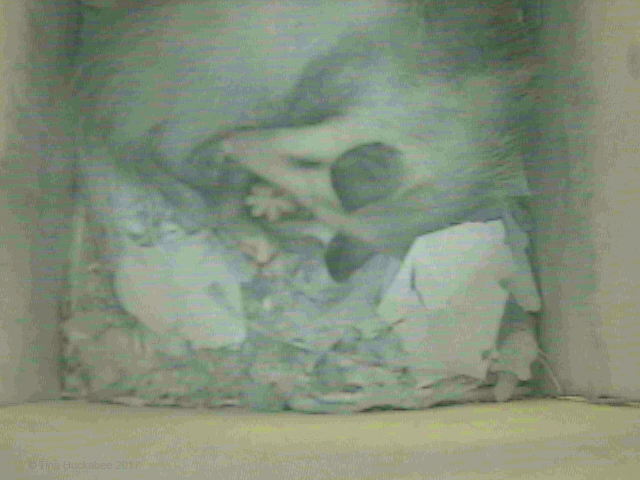
We wait until nightfall, let her vacate her comfy digs (opossums are mostly active after dark) then trundle up the ladder to (again!) close the door on the hole of the house for another week or so in hopes of discouraging her.  Once we reopen the door for owls looking for a home, invariably, within a day or so, Ms. Opossum snuggles back in.

It’s a drag being outsmarted by an opossum!

She enjoyed the mealworms, but I’ve removed them from the bird buffet menu.  She’ll just have to get her worms like the other opossums–by digging in my garden!
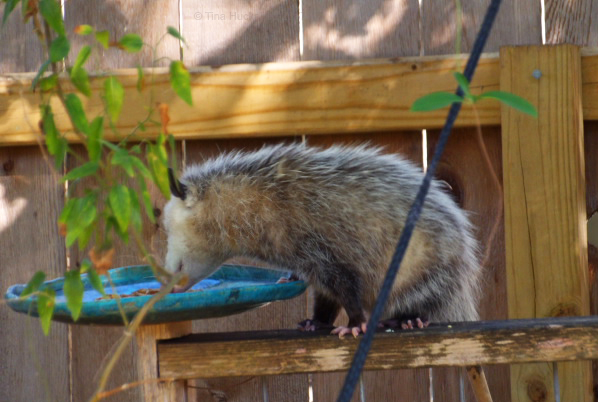
I don’t mind opossums (I keep telling myself), but this one is persistent and just won’t vacate the premises.

Check out her climbing claws. She may not be fast, but she’s adept.

Soon, the neighborhood owls will be courting-n-sparking and they’ll want that cozy box for their babies–you know, the one that we built for THEM!

Celebrating lots of life in the garden for Wildlife Wednesday, I hope your garden is full of wildlife happenings and reaping autumn bounty. Please share your wildlife stories for this past month and remember to leave your link when you comment.

Good wildlife gardening to you!
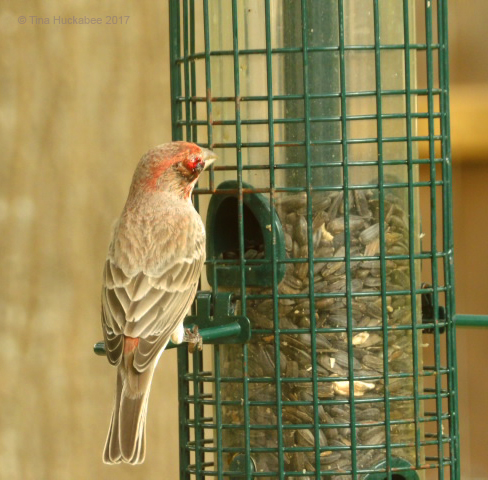
 

A FeederWatch Find

In a recent post, Birding for Fun and Profit, I mentioned that volunteer birders across Canada and the U.S. are instrumental in assisting with research related to wild bird populations by submission of raw data observations of kinds and numbers of birds visiting yards and gardens. Aside from the pleasure of bird watching (and complementary teasing of friends and family which invariably accompanies the hobby), is the knowledge that bird watching advances true scientific efforts.  Project FeederWatch has tracked the advancement of certain avian diseases and requests its citizen scientists to report instances in their data logs. This past week, for only the second time (and first time during my “official”  Project FeederWatch period),  I’ve observed a bird with symptoms of red, swollen, and crusty eyes which is caused by the bacterium, Mycoplasma gallisepticum.

This little guy was at my feeder this past week, unfortunately  demonstrating a classic case of House Finch Eye disease, a kind of conjunctivitis caused by M. gallisepticum.

This male House Finch’s eye is almost completely closed due to inflammation.

First observed in the mid-1990s by Cornell feeder-watching volunteers, this disease has spread throughout the House FinchHaemorhous mexicanus, population of North America.  The poultry respiratory disease made a species leap to wild House Finch populations and because the beginning of the epidemic can be traced to a specific point (Maryland) and time (February 1994), and because Cornell Lab of Ornithology’s Project Feederwatch was in full swing, volunteers reported sightings describing House Finches with symptoms of eye disease and scientists got to work.

Within a few years, reports of diseased House Finches were common throughout the U.S.  With raw data provided by Cornell’s “army” of bird watchers and the creative impulse of a Cornell Lab scientist, Belgian-born ornithologist, André Dhondt, an interdisciplinary research team has studied the evolution of this new disease from its inception and analyzed its impact on a given population–in this case, the hapless House Finch.  In the two decades since M. gallisepticum debuted in that small population of Maryland House Finches, the process of disease evolution–mutations coupled with population dynamics–is better understood, and scientists are now utilizing the gained knowledge towards a fuller understanding of disease spread in humans and development of immunities.    For a fascinating read, check out this article: House Finch Eye Disease: Outbreak, Then Understanding.

As for my little diseased finch, I haven’t seen him in a couple of days. I have noted his presence on my data for the week. Last year, I always indicated  “yes” and “zero” responses to the questions of if I looked for House Finch Disease and how many finches I saw.  This week,  it’s still a “yes” but now with a “one.”  I’ve only seen one other House Finch with crusty eyes and that was on a female House Finch in May 2016. With each passing day that I watched her, she became less able to function at the feeder. Both of her eyes were swollen and nearly closed; she would flutter until she happened to land on a branch, or the feeder, or the ground.  It was clear to me that she couldn’t see well enough to fly and perch.  For her, feeding became nearly impossible due to her poor eyesight. Eventually, she stopped visiting my back garden.

For what it’s worth, the other eye of the finch I’ve observed this week is healthy and unimpaired and he’s flying and feeding normally.   Additionally, most birds aren’t afflicted by this disease; continent-wide, American Goldfinches (which I only see in late winter) and a few others have been impacted.

What to do?  Well, there’s really nothing I can do to help individual birds.  They might recover on their own, but more likely, they’ll starve or become prey for someone else once they’re so blinded that they cannot feed and fend for themselves.  I am wiping the feeding stations on the feeder each evening with a diluted bleach/water solution, and that’s one easy way to keep the feeder clean.  Feeders should be washed once-per-month, though I have to admit that I don’t do that as regularly as I should; I should make that change.  Other tips for healthy bird feeding include regularly raking or sweeping the area underneath feeders and spreading feeders throughout the garden so that birds aren’t crowded.   Always, if you catch a sick bird, contact a wildlife rehabilitator in your area–he/she will have the expertise to care for the sick bird.

While I certainly subscribe to the dictum of letting nature take its course, we gardeners and bird watchers can help our wild ecosystem partners thrive by simple changes in our gardening and bird-feeding practices. Let’s take care of our wild birds!


Grasses, Berries, Groundcovers: Autumn Images

Cooler temperatures and regular rainfall herald autumn in Central Texas–and we all breathe a sigh of relief that the broil of summer has passed. Perennials awake from their summer siesta, ushering in a second spring of blooms. From September until first frost, there are easily as many blooming beauties, especially of the native kind, as in spring.

Our native grasses, soft and elegant throughout the summer, acquire a warmth of color and rock dramatic plumage in autumn, challenging the beauty of accompanying blooms.

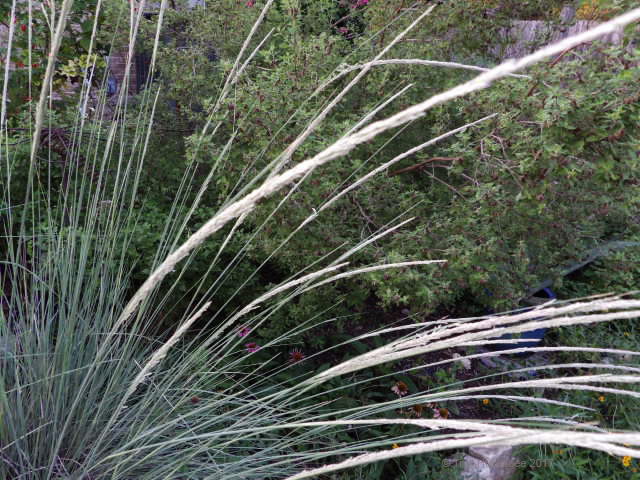
Big muhly (Muhlenbergia lindheimeri) graces a combo of Plateau goldeneye and Turkscap.

I’ve had mixed results with Big muhly, as my front garden has historically been too shady for this sun worshipper, while my back garden offered only a few spots of sun, coupled with heavier soil, so muhlies were typically short-lived.  With more opportunity for the sun to blast my front garden, the four Texas native Big muhlies planted have found a home.

The same muhly at a different angle.


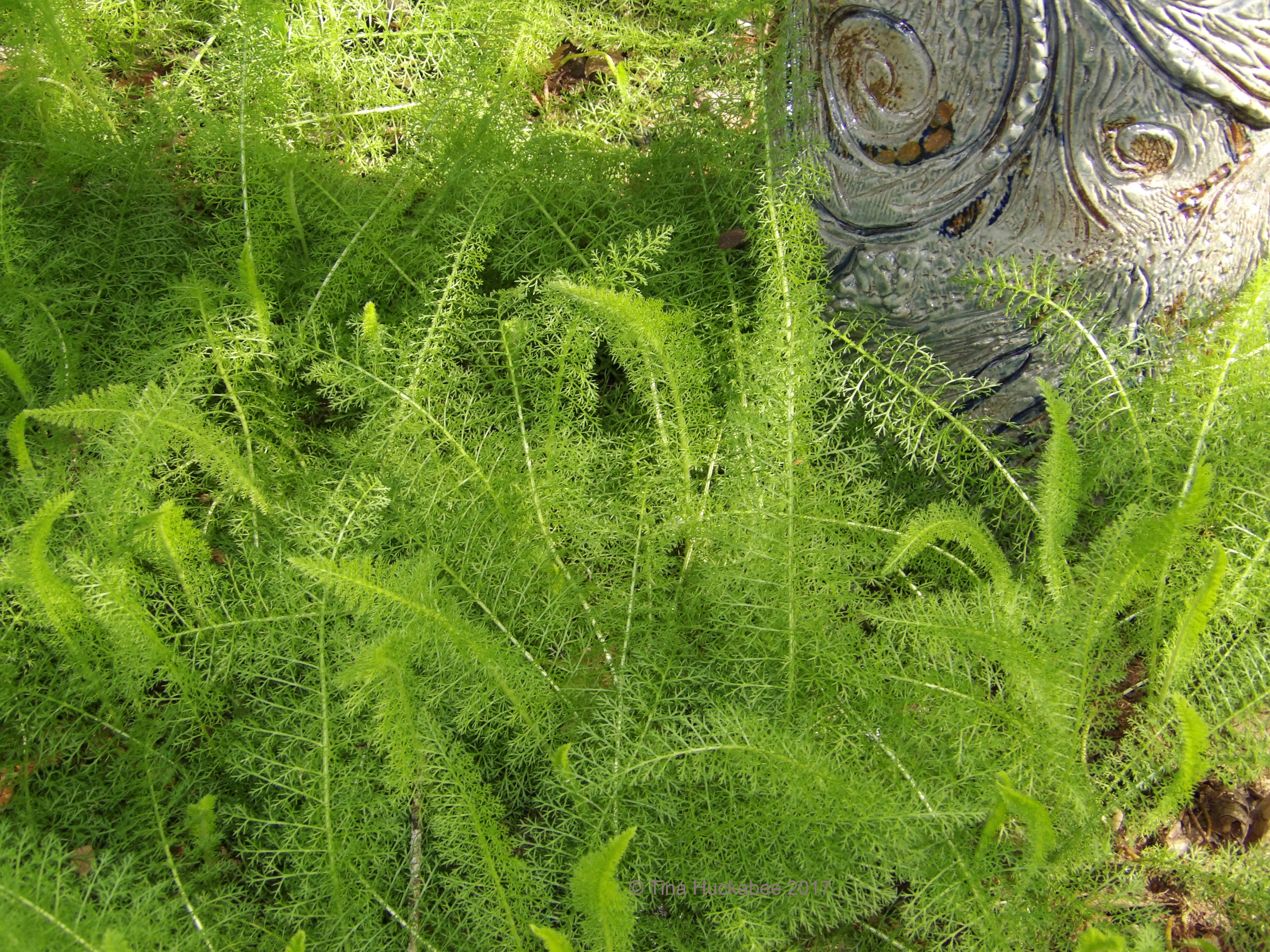
Common yarrow, Achillea millefolium,  is a native North American plant which grows throughout the continent.

A beautiful ground cover for most of the year–especially in winter–yarrow blooms white clusters atop 2-3 foot stems in June and July, the florets turning toasty in August.  Mine haven’t bloomed particularly well in the last 2 years, but I don’t mind, since it’s the lacy foliage that I prize.

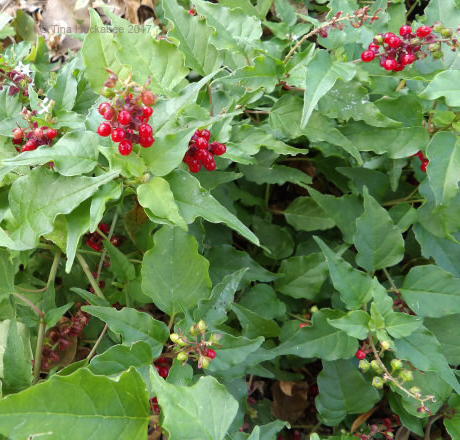
For wildlife, autumn provides a boon of berries, and Texas native plants oblige in spades.  Pigeonberry, Rivina humilis,  is a favorite of birds, especially–you guessed it–of pigeons and doves.

Leaves are ruffly and bright green, complementing both the tiny pink-to-white blooms and the cherry-red berries.   Once a light freeze happens, the foliage will blush burgundy, until a hard freeze renders this small ground cover dormant until late spring.

For now, the leaves remain a cheery green.


Another native plant, the deciduous herb, Chili pequinCapsicum annuum,  provides fruits for birds and mammals.  Birds are frequent visitors, so much so that another common name for this plant is Bird pepper.  Texas’ only true native chili pepper, the fruits are hot, but birds (and husbands) love the taste.

Red berries, ripe for picking.

The leaves are small and dainty, and the form of the shrub, elegant.    I love them planted as a mass, with 3 or 4 together.

Chili pequin planted with common yarrow.


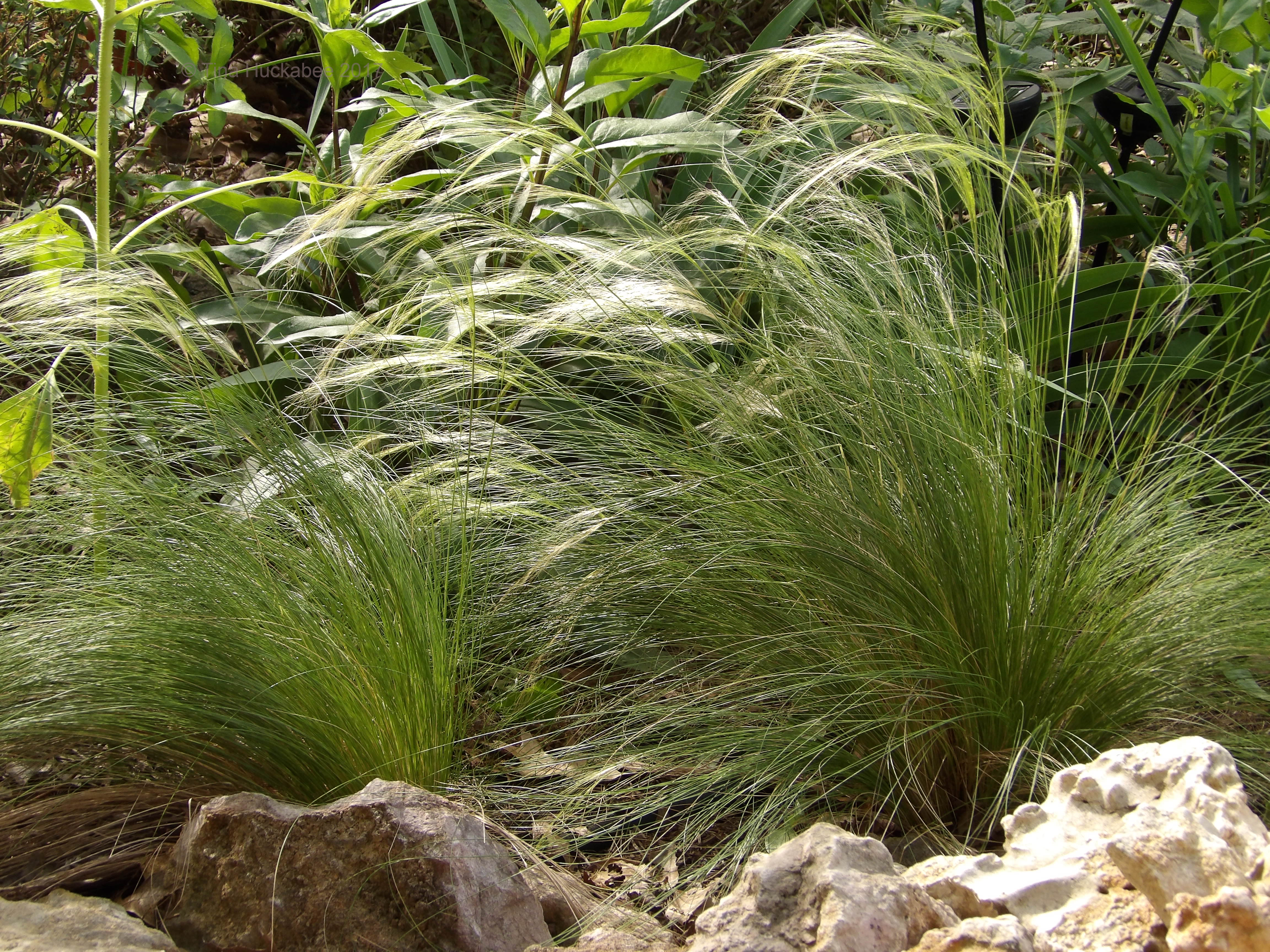
Mexican FeathergrassNassella tenuissima–for obvious reasons that you can observe, has become a popular landscape plant throughout North America.

This is the spring view of two of the Mexican Feathergrass in my garden.

Native to Texas and New Mexico, southward into Mexico, and with a separate native population in Argentina and Chili, the Mexican Feathergrass is a tough, drought-hardy perennial grass prized by gardeners and easy to grow.

The autumn view of the same two plants. More muted and worn from a full growing season, these two still accent the garden and complement the rocks which border the pond.

I’ve grown Feathergrass in both shade (not deep, but dappled) and sun.   It’s been the native grass that has performed best for me and seems a go-to grass for both home and commercial landscapes in these parts.  It seeds out, not obnoxiously, but just enough that I can transplant and use in different situations.

Thanking Christina of Creating my own garden of the Hesperides for hosting this monthly tribute to foliage; please check out her lovely blog for more fall foliage fanfare.