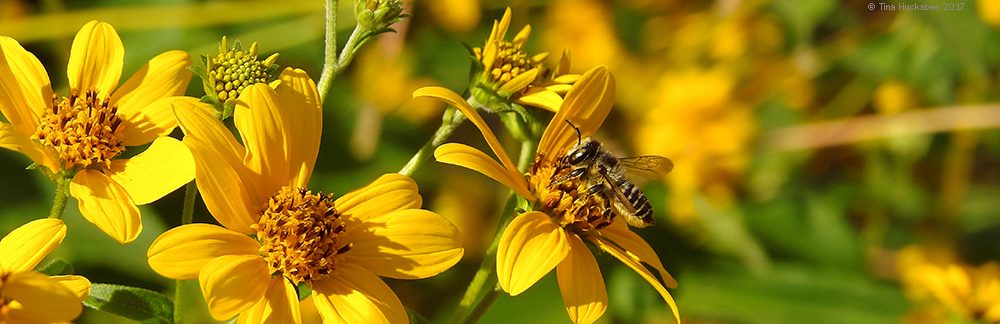
Winter(?) Blooms

While it flies in the face of garden normalcy, it’s been a good winter for many of the flowering perennials in my garden.  Few plants were sent deep into dormancy, so flowering florals have been a constant.

This cheery cool season bloomer has brightened the edge of a garden for months.  Four-nerve DaisyTetraneuris scaposa, is a tidy little thing.  Evergreen slender leaves serve as a base for sprightly yellow daisies.  Even after a hard freeze, this is a typical winter bloomer.


Owing to the mild winter, there are a couple of Purple coneflowerEchinacea purpurea, eager for spring to begin.  Interestingly, the established plants, some of which are years old, haven’t bloomed up yet.

This group volunteered themselves for a pathway decoration.   I’ll leave them be–who am I to yank them up when they’re so charming?


Another beneficiary of our lack of freezes this winter are the Tropical sageSalvia coccinea.  This particular one is red, but the white ones have bloomed all winter too.  They’re a little lanky now, but I’m still enjoying the accents of red, so they’ll remain until the new growth catches up with the old-growth blooms.


A cousin of the S. coccinea is this salmon-colored Autumn sageSalvia greggi.  It’s not a bountiful bloomer, but only because it grows in too much shade.  Still, the blooms are beginning and will grace the garden for the next couple of months, taking a break during our hot summer, resuming flowering in fall.


Another “victim” of the mild winter is the Mexican honeysuckleJusticia spicigera.  This is a funny plant as it doesn’t have a specific bloom time. In mild winters like the one this year, it blooms all winter, well into spring.  In a “normal” winter (whatever that is), it’ll be knocked to the ground, requiring several months to flush out before flowering ensues.

I’ve thoroughly enjoyed these winter-orange blooms and so have the honeybees.  Most of the native bees are dormant for now.

Mexican honeysuckle is also a great plant for part shade–yay for me as I have plenty of that!


My two red roses have produced luscious blooms all winter, non-stop.  This, the Martha Gonzales rose,

…and its botanical doppelgänger, the Old Gay Hill rose.  Easy to grow, disease-free, and gorgeous against the blue Texas sky, both roses are head-turners.  I’m not going to prune them just yet, against common gardening wisdom;  there will be time later for that.


In the last week or so, the Southern dewberry, Rubus trivialis has burst out in blooms.

The sweet, snowy flowers attract skippers and honeybees, and dot the back of the garden, clambering up a fence and creeping along the ground.

The buds are a pure pink, so provides a bit of a color two-fer.  Alas, it’s more than likely that the birds will pick off the berries before I get to them.


I finally found the one spot in my garden for Desert mallow, Sphaeralcea ambigua.  Native to regions west of Texas, this lovely requires full sun and excellent drainage.  It’s a high elevation shrub, but the best I could do was pop it into a raised bed.  I love it, blooms or not, and the tangerine flowers paired with that grey-green ruffle of foliage is a winning combination.

The native Blue Orchard bees, recently awakened from their own year-long dormancy, have enjoyed the pollen provided by this mallow.


A passalong plant,  Giant spiderwort, Tradescantia gigantea, delivers blasts of purple for this gardener and loads of nectar and pollen for the pollinators.  Honeybees are in a frenzy gathering the pollen as they gear up for spring.

I have quite a few clumps of this spiderwort and they seed out prolifically.  They’re easily pulled up and tossed into the compost, or even better, gifted to unsuspecting gardeners.

I like that the insect (a fly or native bee?) is also interested in the plant.  I wonder if he/she is responsible for the hole in the leaf?

Purple power rules the garden with these spring pretties.

Most of these perennials and shrubs bloom at least some during a colder winter, but this year, that floral show has been richer.  Of course, as we enter March, the month of spring, an overnight light freeze or two is predicted in the next few days.

Typical.

The native plants will be fine, the irises, reaching to the sky and starting their blooms, might be damaged.  Time–and actual temperature–will tell.  Regardless, spring is now knocking at the garden gate and winter is mostly done.

How has your winter garden fared?

Hoot-n-Annie

I’ve long thought that naming wildlife an unwise practice.  When I first installed a water fountain at my back patio, we purchased three “feeder” goldfish which the kids and I named.  The fish didn’t last long, as one of our dogs decided that sushi was something he enjoyed.  Once our pond was built and we had even more fish we could name–at first, koi, and later, goldfish and gobs of gambusia (mosquito fish), I’ve steadfastly refused to name even one of the swimmers.  Herons, plain bad luck, as well as old age, all end the fish and I don’t want to lament their loss by name.

The same is true for my regular bird visitors.  I’m fond of the pairs of Carolina Chickadees and Wrens, and Black-crested Titmice, and many others, who I see in my garden.  I’m charmed when they bring their babies to visit and feed in late spring and summer, enjoying the this is how you survive lessons imparted by the excellent parents to their eager and darling offspring.  But I dare not name any one of them.  Ditto for the wintering warblers who daily flit in the garden from November through May.  I already miss them when they leave to wing northward for summer;  how much more would I regret their flying the garden nest if I called them Joe or Rufus or Abigail?

So why name the Eastern Screech-Owl couple who, it appears, are (perhaps?) in the process of choosing to raise a family in my garden?

In a word: weakness.  And, maybe a second word: affirmation.

Meet Hoot and Annie.  Hoot-n-Annie.

The male, Hoot, guarding the nest box.  He wasn’t interested in showing me his pretty face, but I can share his beautiful wing plumage pattern with you.

Annie, trying the nest box on for size. She was tolerant at my photo taking, but I didn’t bother her much–just enough to get this shot.

Here’s a look from our owl cam. What you’re looking at are her tail feathers–her head is looking out the nest box hole.

There are several problems with the conferring of these names, notwithstanding the stupidity of  perceived control.   Firstly, Eastern Screech owls don’t hoot, they trill (in varying forms), and they also make bill claps and low chuckling sounds.  Check out this link to Cornell Lab’s Eastern Screech-Owl sounds to understand what we’ve been hearing for a few weeks now and why “Hoot” is a goofy–and erroneous–name.  Secondly, the life of Screech-Owls is fraught with danger.  Of course that’s true of all wildlife, thus the wisdom of not naming the wild critters in my garden.  We can provide the right habitat,  day and night, but we have little influence over their destiny.  Cars, bigger owls (there’s a Great Horned Owl pair in our neighborhood), and maybe rat poison, are all hazards to Screech-Owls.  Also, Screech-Owls are risks to the smaller birds, toads, and insects in and near my garden.

And so it goes with the wildlife food web.

But I have hope and a sense of reassurance with this particular canoodling pair of owls.  It’s been a few years since we’ve enjoyed the privilege of intimately observing the shy, elusive night birds–more about that at another time. The previous owl pairs were always Mama Owl and Daddy Owl, and except for the last clutch of Screech-Owl fledglings, I never named the babies.  But the dearth of owl watching and owl learning in the last two years renders me sentimental and hopeful about their recent presence in the garden. The strong bond between adults, their focused and shared care of chicks, and their important contribution to diversity of the wild community (of which my garden is a small part) is heartwarming and affirming.  Appreciation of the natural order continues, as (selfishly) does my own education and enjoyment.

If the Screechies move in and raise their family, a kind of avian hootenanny in celebration of life’s dance of diversity and songs of progress will be in place, at least for a specific time and type.

I’m glad to join in today with Anna’s Flutter and Hum and her wonderful Wednesday Vignette.  Please pop over for garden, nature, and other musings.

Addendum:  It appeared as if Hoot and Annie were settled in and comfortable in the owl house.  But one evening in early March, I strolled the garden;  Annie was in the box and looking out. She saw me and immediately took flight.  From that point forward, the owls didn’t inhabit the house, though on a couple of occasions, I saw an owl before dawn perched just outside the box and from time-to-time we’ve continued to hear at least one of the owls trilling.

It’s now three years since an Eastern Screech couple has successfully raised a brood of babies.


The Landing

Outside on a comfortable–warm, in fact–February afternoon, chasing the earliest emerged native bees in my garden and with some success, I spied this charming scene:

I like that the seed balances on the slender arm of a Globe mallowSphaeralcea ambigua, and appears steady and content, perky and upright.

I wonder, though, is it satisfied with the landing?  Afterall, this particular seed is from an American SycamorePlatanus occidentalis, and the goal of the wind-driven reproductive morsel is terra firma–which it missed by about 18 inches.  The achene, with attached propelled pappus, was driven from a nearby mature sycamore by puffs or bluffs of wind.  Who knows when the seed landed on the mallow, probably recently, but is it eager to be whooshed by air or washed by rain to the ground for continuation of the adult sycamore’s legacy?

The Globe mallow ignores the seed–it has its own blooming and reproduction to consider.

How many of us land like the seed, or ignore those who land around us?  How does that impact the course of life?

Joining in today with Anna’s  Flutter and Hum and her wonderful Wednesday Vignette.  Please pop over for garden, nature, and other musings.