What Is It About Yellow Flowers?

They’re just so…yellow.
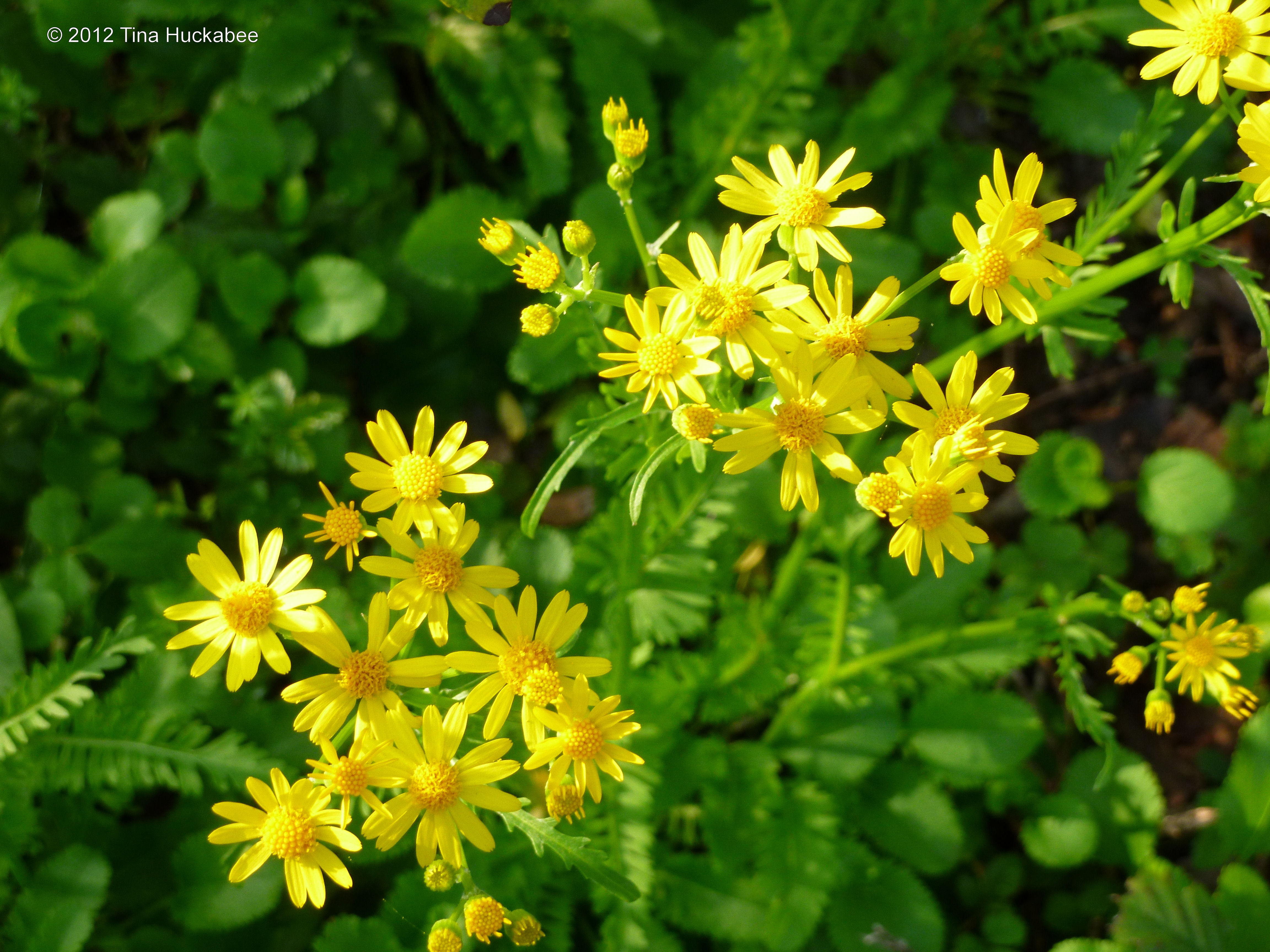
And bright.
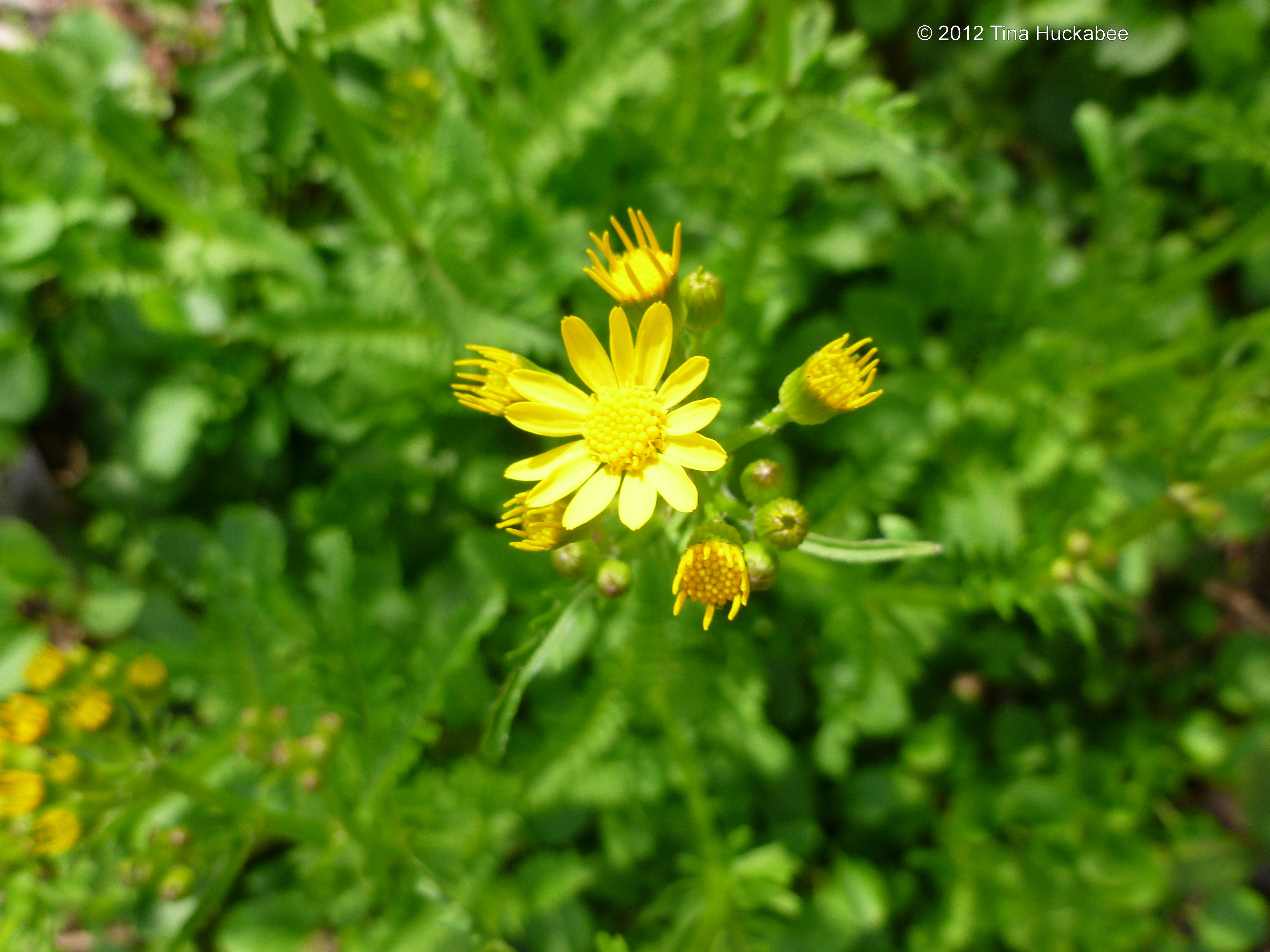
And cheerful.
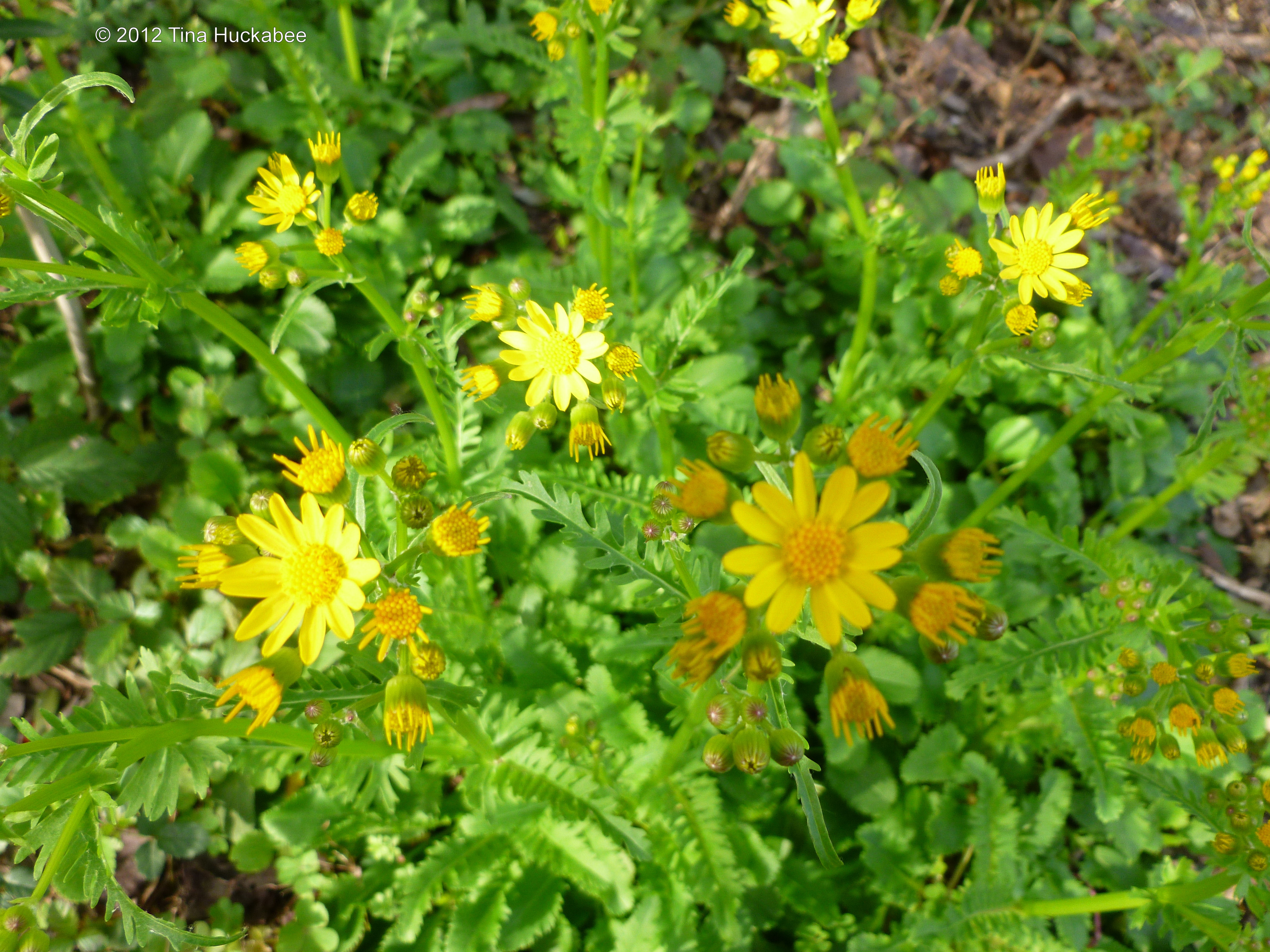
And, unfortunately, not planted or grown commercially nearly as much as they should be.  The Golden Groundsel (Packera obovata) is a beautiful spring blooming perennial ground cover native to much of North America, including Texas.  It belongs to the Asteraceae (Aster) family of plants,

and is a wonderful addition to a shade or part-shade garden.  It can be planted in a formal setting or as drifts in a woodlands garden.  But in either place, it brightens the late winter/early spring  garden spectacularly.

I first became acquainted with Golden Groundsel just over two years ago, when I noticed a patch of bright yellow  flowers in one of the native woodland areas that I garden at the Green Garden in Zilker Botanical Gardens (ZBG).  That patch absolutely resonated yellow! I recognized the plant because I had read about Golden Groundsel before, although this was the first time I’d actually seen it in a garden.  Most of the year, it’s a ground cover with evergreen, oval and finely serrated leaves.

In January/February (in Austin), it sends forward its bloom stalks.  The slender stems grow to about a foot tall, then burst open with shockingly bright, little flowers.

It colonizes well in ideal conditions and is an easy plant to grow.  Its water requirements are moderate and it fits well in a xeric landscape.  If it gets water once a week in a hot, dry summer, it’ll be just fine.  In the Green Garden,  I moved some Groundsel in late spring of 2010 to this spot,

and while it bloomed last spring, it’s even lovelier this year.  Here, it gets mid-day sun in the summer, with dappled light most of the rest of the day.  It also receives irrigation once per week.  Its companions include Turk’s Cap, Twisted Leaf Yucca, Purple Coneflower and also Columbine.

The two other areas where Golden Groundsel is planted in the Green Garden receive more shade and thus, the plants are not yet blooming.  This group is in a native woodland area which receives very little irrigation.
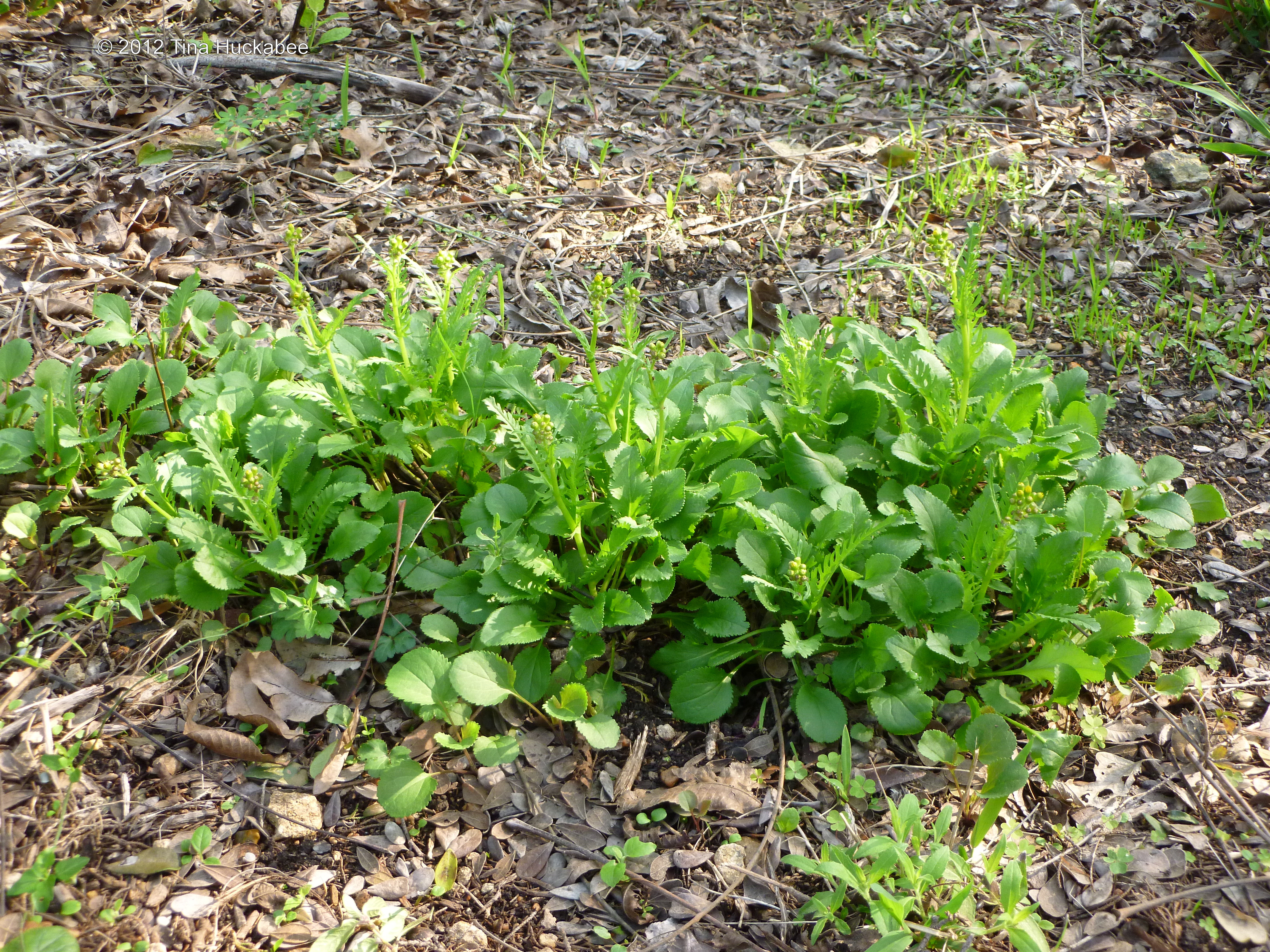
This second group is planted in the Habitat Garden.  This colony began with six starts, about 15 months ago.  It gets regular (once/week) irrigation and dappled light.  The soil is a bit on the heavy side and you can see how well it’s filled in.
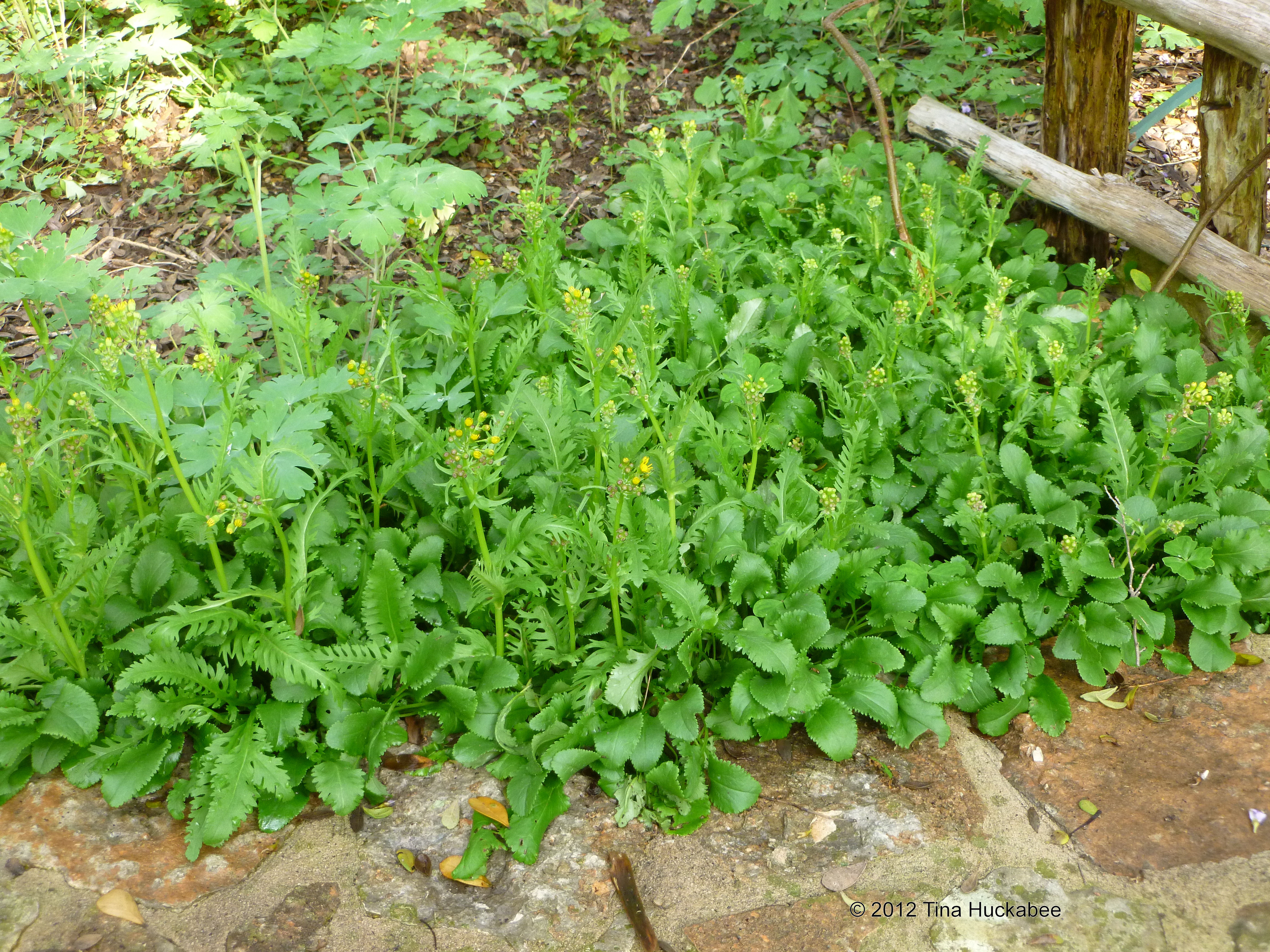
Golden Groundsel is a good nectar source and given that it’s often one of the earliest to bloom, very appreciated by hungry bees and butterflies.  Oddly, it’s blooming a little later this year compared to the last two years.  This is in contrast to so many other plants which are blooming earlier than their normative bloom times.

Golden Groundsel spreads by  roots and by seeds–don’t cut back the flower stalks until the seeds have ripened and dispersed.  It doesn’t seem to spread voraciously by seed though.  My only experience with propagating Groundsel is by root division. When I transplanted the Groundsel at ZBG, I had to be careful about where I dug the plant up from the soil.  Several times I shoved my trowel firmly into the ground, assuming that I was well-underneath a nice root ball, only to realize that the rosette that I was attempting to dig up was connected to another by a runner and there was no root to excavate.  So, if you separate this plant, you must  be sure that the rosette you’re aiming for actually has some root.

When I decided to write about this plant, I called a number of the independent nurseries in and around the Austin area to check for availability and almost no one was familiar with this plant.  Only the nice folks at Barton Springs Nursery  knew anything about Golden Groundsel although they don’t carry it regularly.   I do know that it’s sometimes available at the Lady Bird Johnson Wildflower Center’s plant sale, but I don’t know if they grow it for every sale.

For more information about this great and underused native plant, check out the Central Texas Gardener link–Golden Groundsel was the “Plant of the week” for the  October 1, 2011 program.  Or, as always, you can find information on the page for Golden Groundsel in the Native Plant Database.

I’m going to purchase and plant this lovely perennial for my own garden.  Gardeners should encourage their local nurseries to carry available, but rare, plants.  In turn, growers will begin to produce these plants for retail sales.

I’ve Got A Crush On You

It’s Valentine’s Day and I’m gushing about my love for a red, red…tubular shaped flower which blooms on a Texas tough vine.

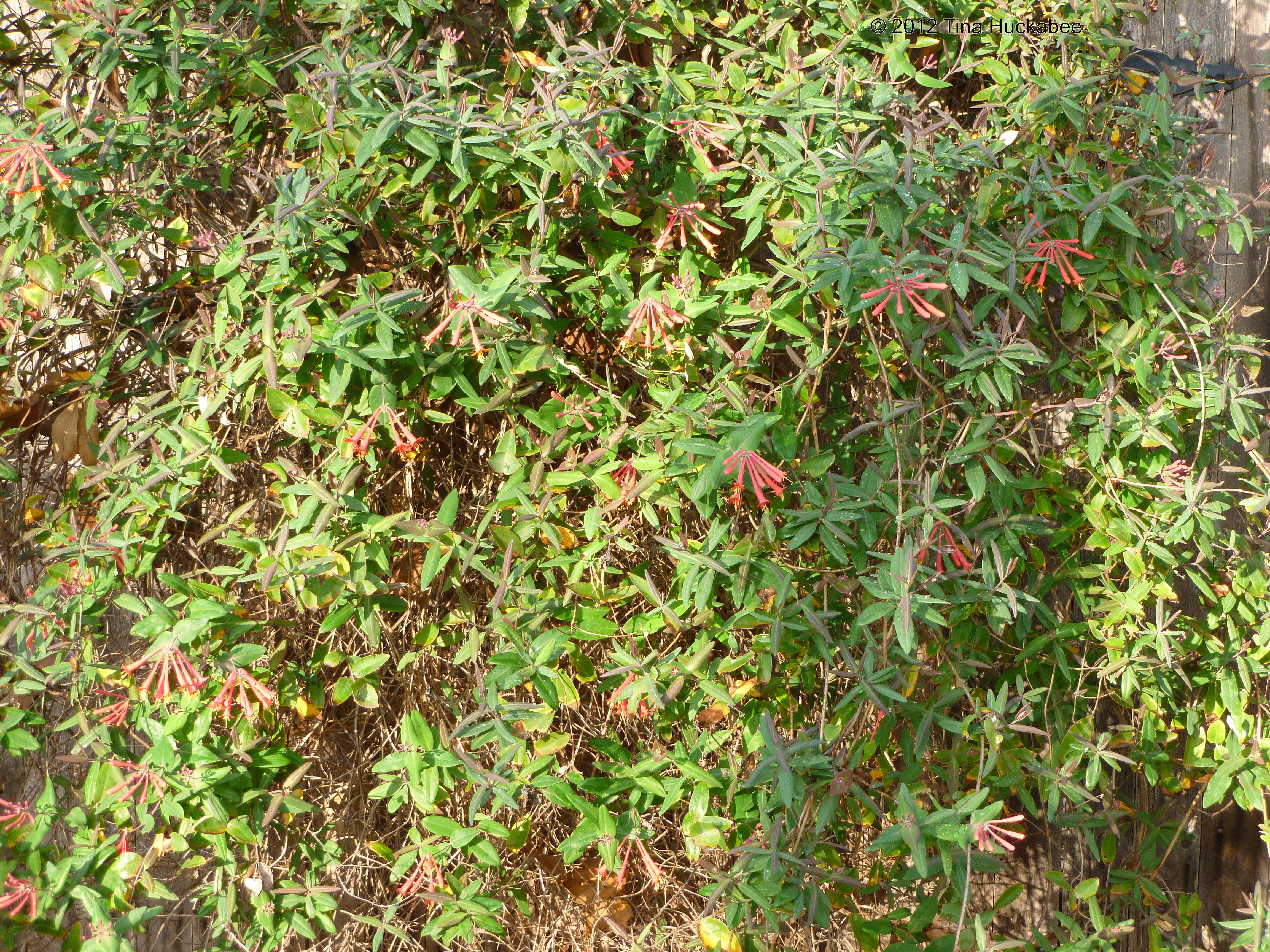
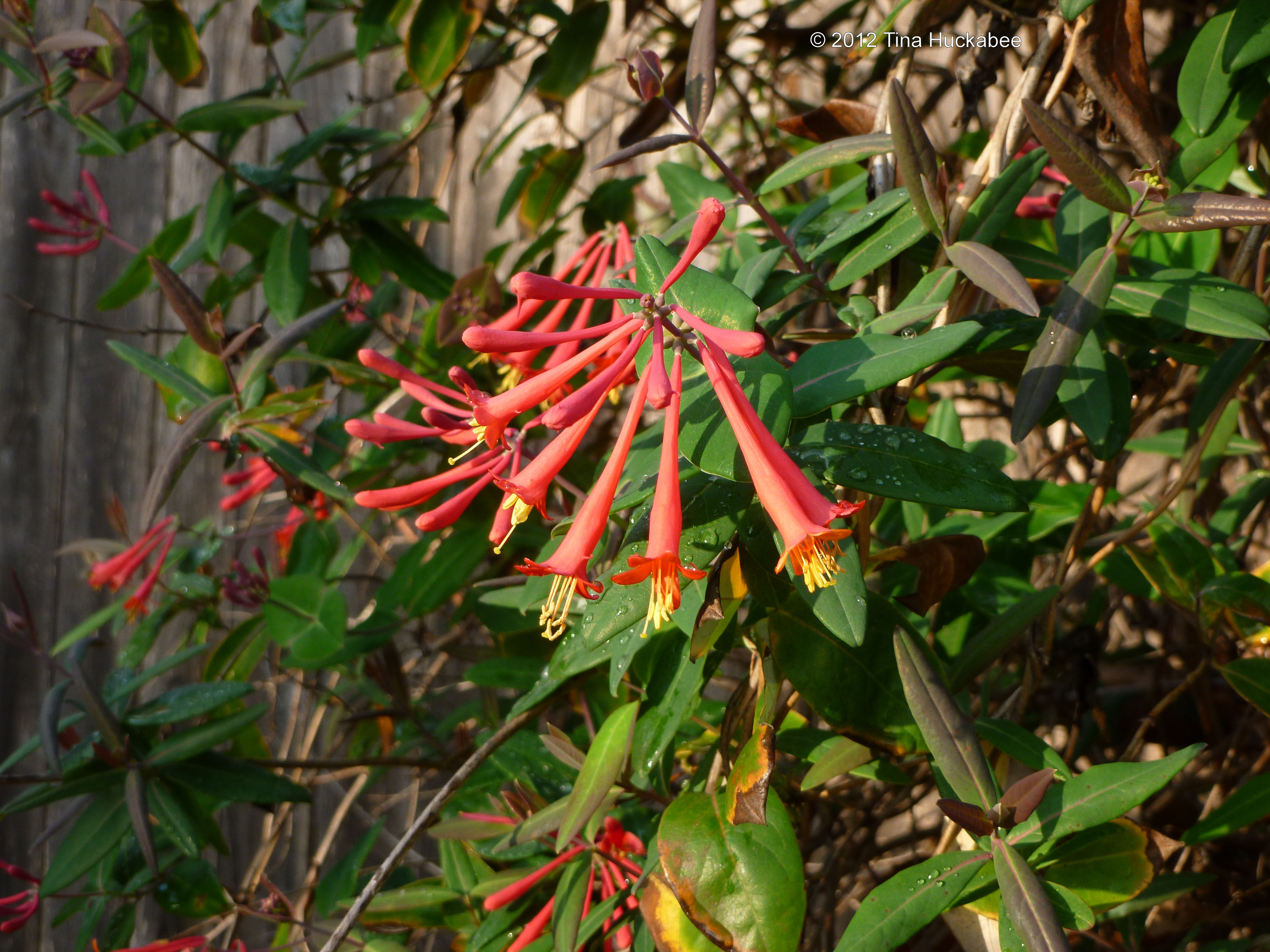
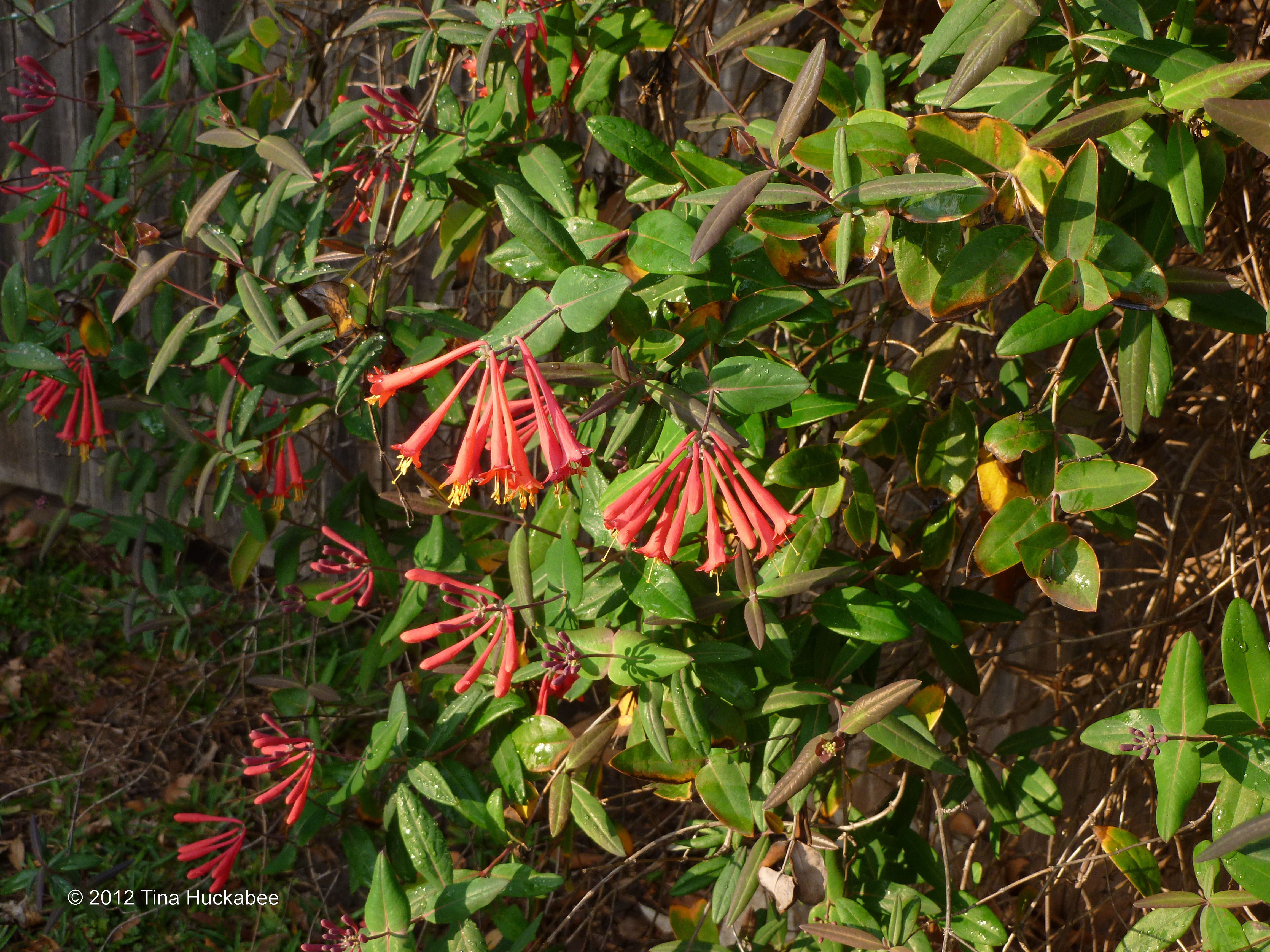
I’m aflutter over Coral Honeysuckle (Lonicera sempervirens).  A vine to please wildlife and people alike, this lovely and hardy plant is native to Texas, but is found in other parts of the United States.

The vine is generally evergreen in the Austin area, although can become thin in a very cold winter.  My experience is that the vine blooms mostly during springtime, but I’ve seen it bloom well into summer with rain and/or irrigation.  I’ve also seen occasional blooms in the fall and winter. With our mild winter this year, it’s blooming earlier than usual.

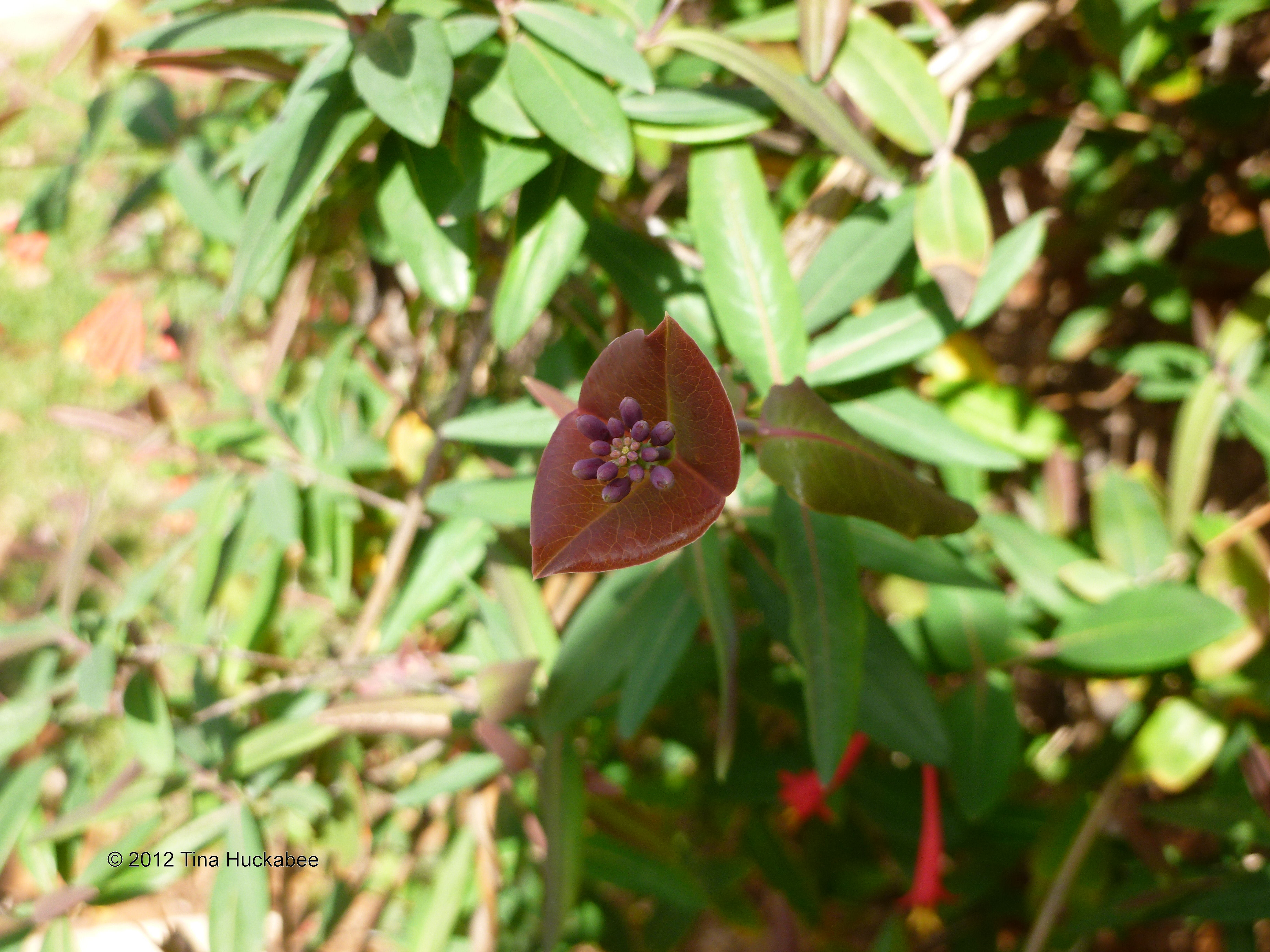
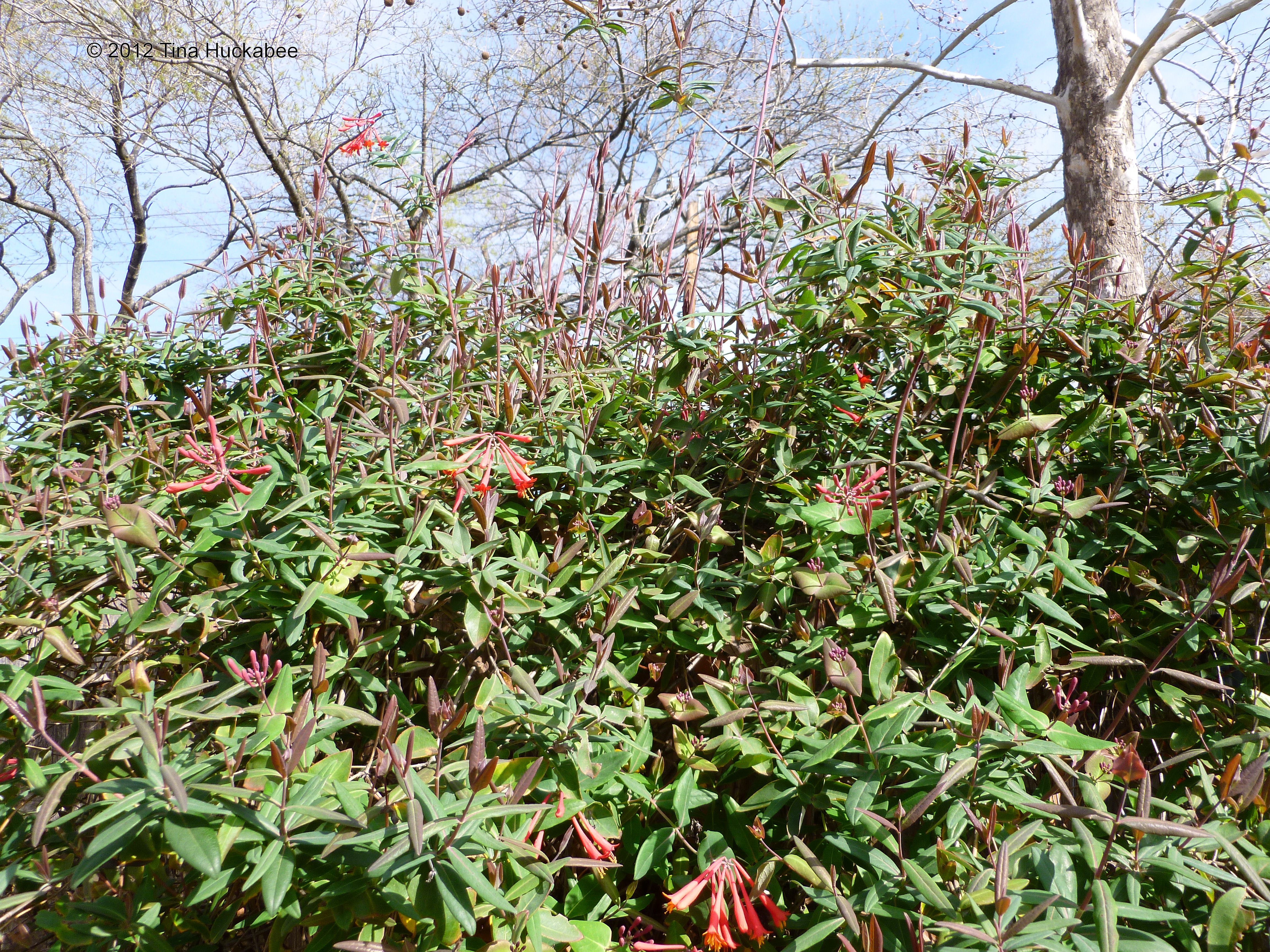
The leaves are rounded or oblong, with a point at the end and are paired and opposite from one another.

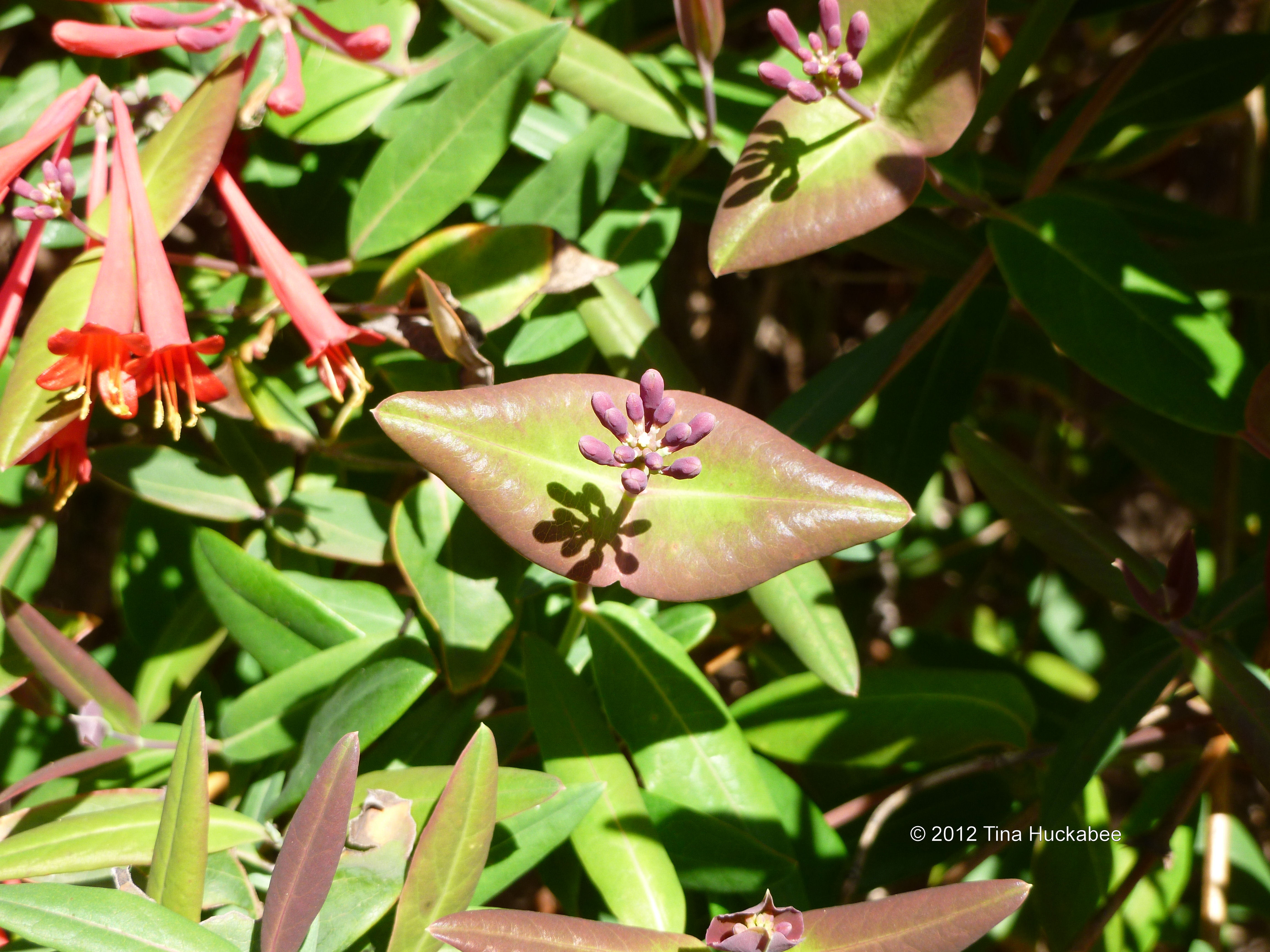
I find the new leaves attractive because of their rich bronze color and during the main bloom time, the combination of the bronze leaves and new blooms is especially beautiful.

The flowers are grouped in clusters and are red with yellow interiors.  So pretty!

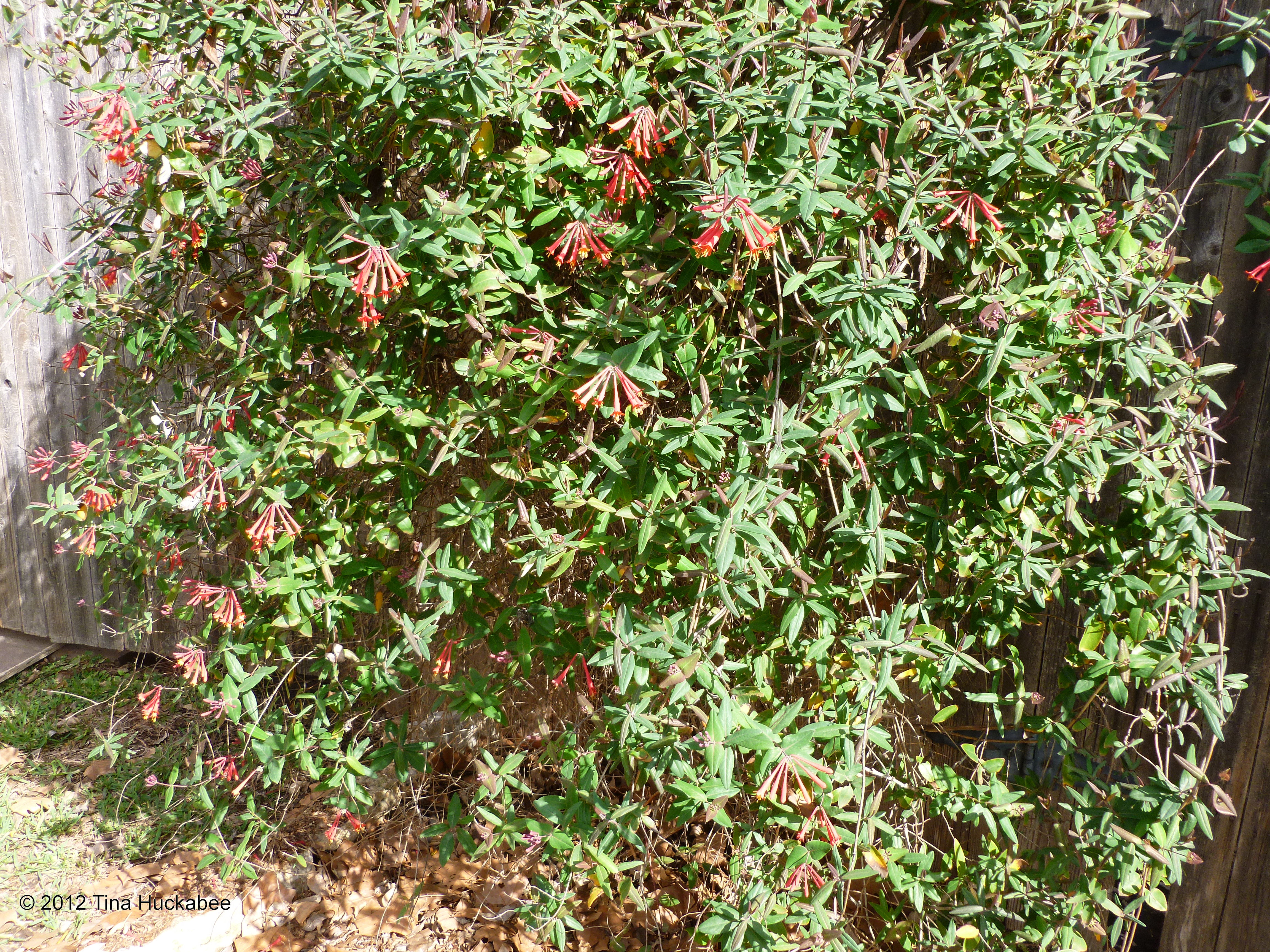
In spring, the well-behaved climbing vine is loaded with these gorgeous clusters of blooms.

If the timing is right and there are hummingbirds around, they’ll be courting these flowers.  Coral Honeysuckle is an excellent wildlife plant.  It provides nectar (for hummers, bees and butterflies) and a fruit that many birds love.  I’ve had fruits develop on my vine, but they never remain long because the birds snatch them up as soon as they ripen.  The mature fruit is an iridescent coral color.   It’s a little too soon after the beginning of the bloom season for mature fruit, but there are some nascent fruits developing on my vine.

Coral Honeysuckle is also the larval host for the Spring Azure butterfly and the Snowberry Clearwing Moth.  (Check out the Lady Bird Johnson Wildflower Center page on Coral Honeysuckle.)

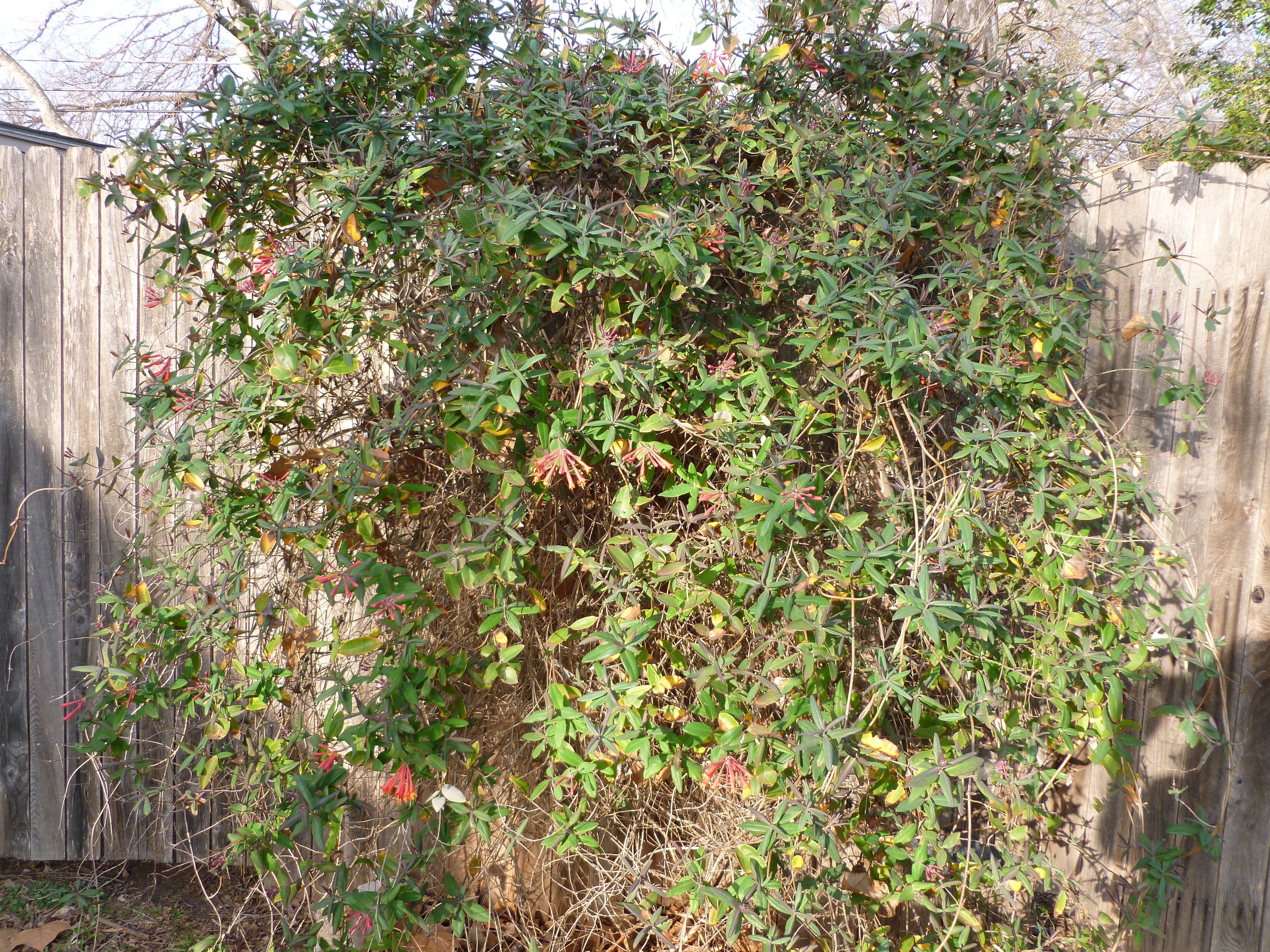
As with many vines which bloom prolifically, Coral Honeysuckle blooms best in full sun, but it will bloom in part shade, but probably not deep shade.  I planted this one three years ago this month.

It grows moderately quickly–I stapled a large wire mesh to the fence to assist the vine with its climbing needs and away it went.  Coral Honeysuckle is beautiful planted over an arch as an entry to a garden space.  I clip off any dead undergrowth (or at least, I should…) and any errant branches.  As the new growth reaches skyward, I’ll bend the branches into the existing vine or I’ll prune them, depending upon whether there’s room for the vine to spread.

I don’t have any irrigation on this vine, so this past hot and dry year, I only watered it when I noticed it looking sad and dejected.  In fact, according to the The Lady Bird Johnson Wildflower Center, it’s a plant that doesn’t particularly like being in heavy or wet soils.  I’ve never experienced any disease or insect problems with the vine, but the ones I’ve grown or gardened around have all received full sun.

I’ll enjoy the luscious blooms of Coral Honeysuckle and appreciate its steadfast and reliable presence in my gardens.  It’s no wonder I have a crush on this plant.

A Flock of Fall Fruits

There are an abundance of berries on shrubs and trees in my gardens this fall.  I choose to believe it’s because they are happy, loved and established rather than some exhibition of desperation, a last-ditch effort to reproduce, given the exceptional drought they’ve lived through this past year or so.

I didn’t expect much of a berry show this year because of the drought, so I’m glad that I was wrong.

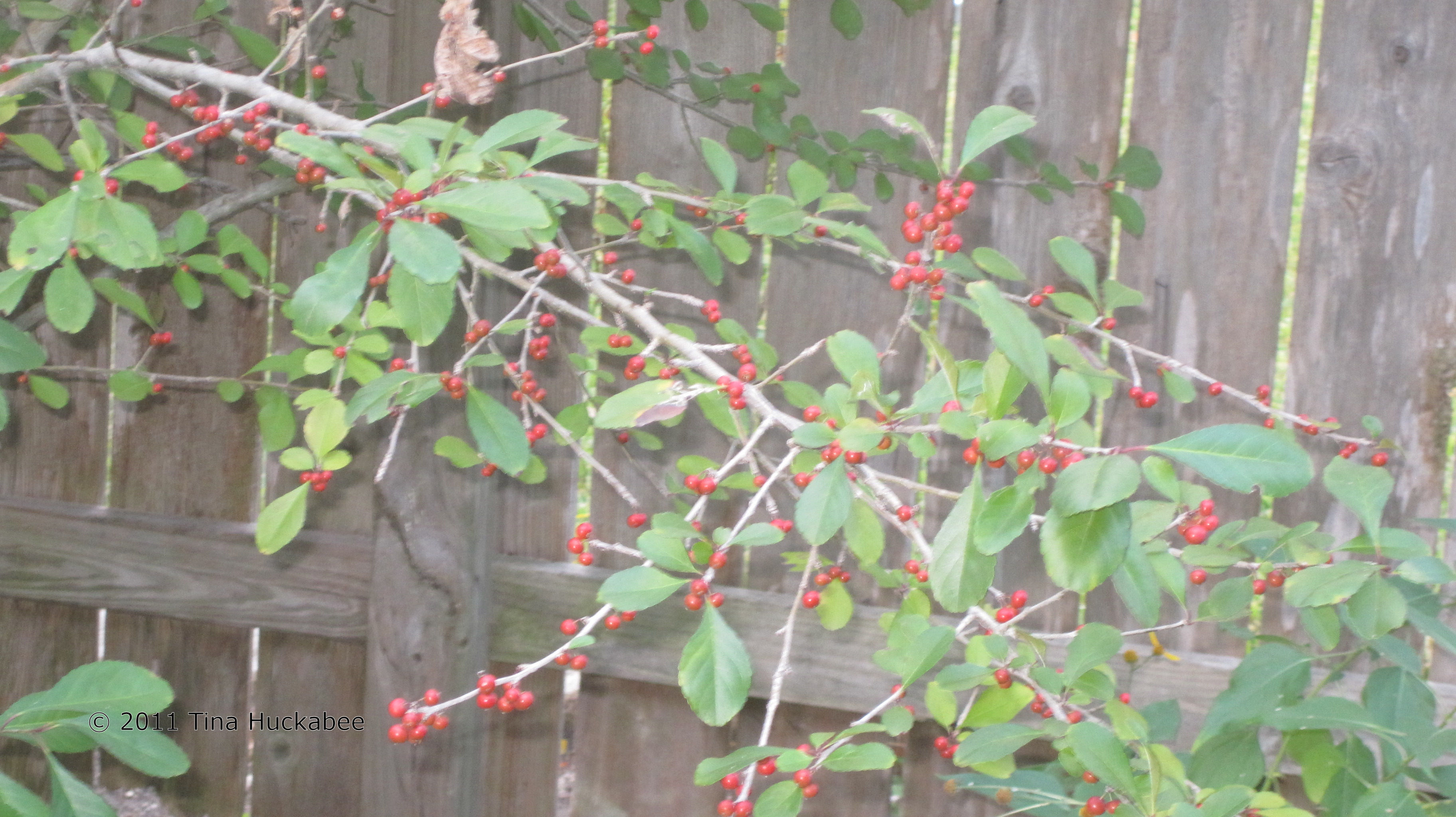
My Possumhaw Holly (Ilex decidua) has been an inveterate berry producer for some years now.

It’s about eleven years old and usually by  November, it showcases its lovely, lush red berries.

The birds (mockingbirds, bluejays and cedar wax-wings) love this berry and are very generous with me:  they don’t eat these fruits to extinction until early spring so I get to enjoy the beauty of the berries throughout winter. Interestingly,  many of the berries that developed last fall stayed on the tree well into this past summer, a surprise to me given the limitations of wildlife food available this year.

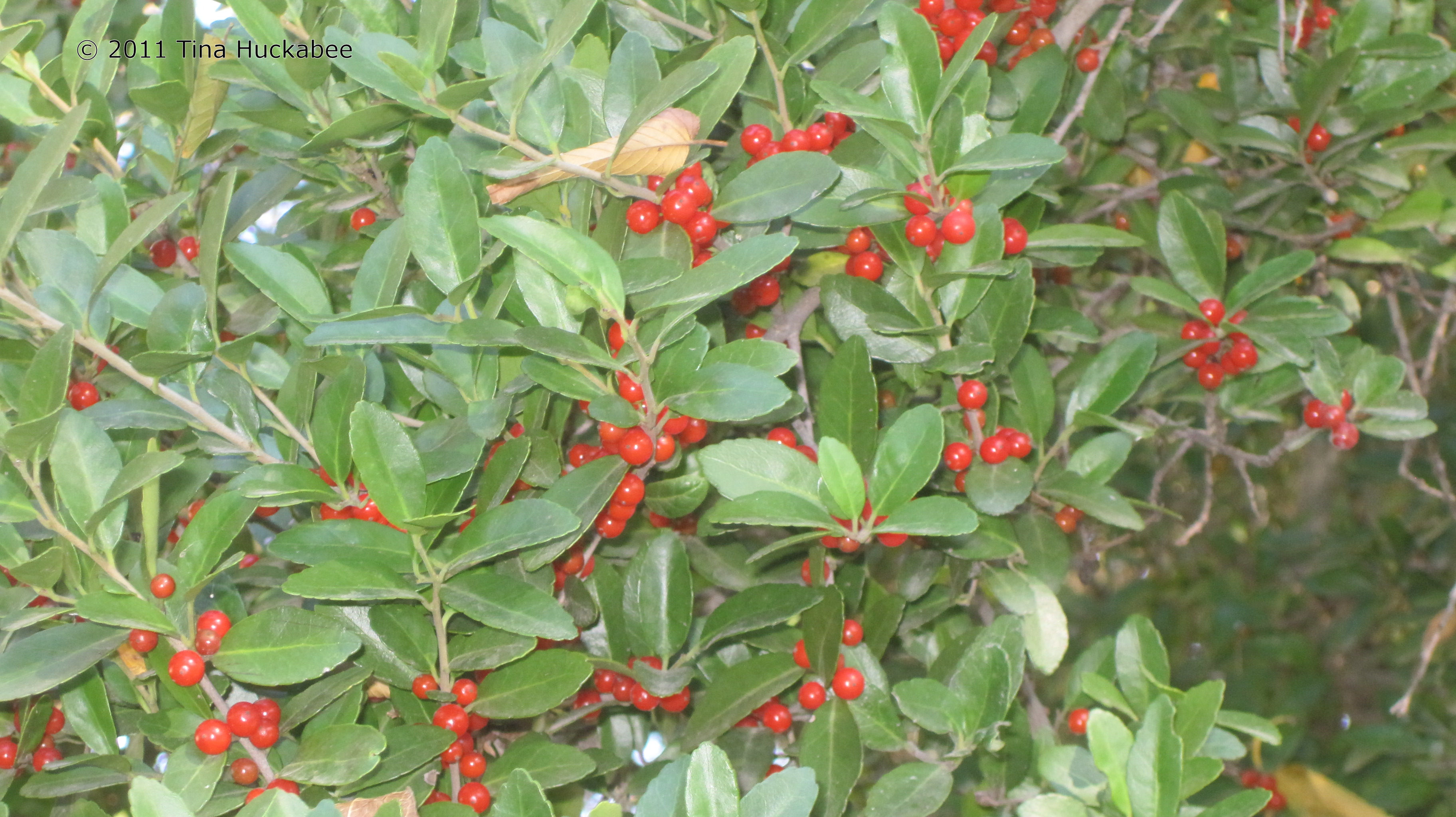
My neighbor has the related Yaupon Holly (Ilex vomitoria), just over the fence which separates our property.

I like these two small, native trees planted so closely together.

The Yaupon remains evergreen during winter and the Possumhaw is deciduous after our first hard freeze.  The berries will remain on both trees until birds and squirrels devour them.  The Possumhaw has slightly larger and darker red berries,

while the Yaupon’s fruits are smaller, scarlet red and shiny.

Both trees are excellent landscape and wildlife plants for Central Texas.

The non-native, but well-adapted Dwarf Burford Holly (Ilex cornuta ‘Dwarf Burford’ ), is also exhibiting a bumper crop of berries this year.

Typically, these berries stay on the shrubs until the cedar wax-wings swoop, en masse, and eat them all, usually in one afternoon, sometime in late February or March.  These shrubs are very slow-growing.  I planted them in 1990 and it took  many years for them to reach their mature size.  They’ve always been good berry producers though.

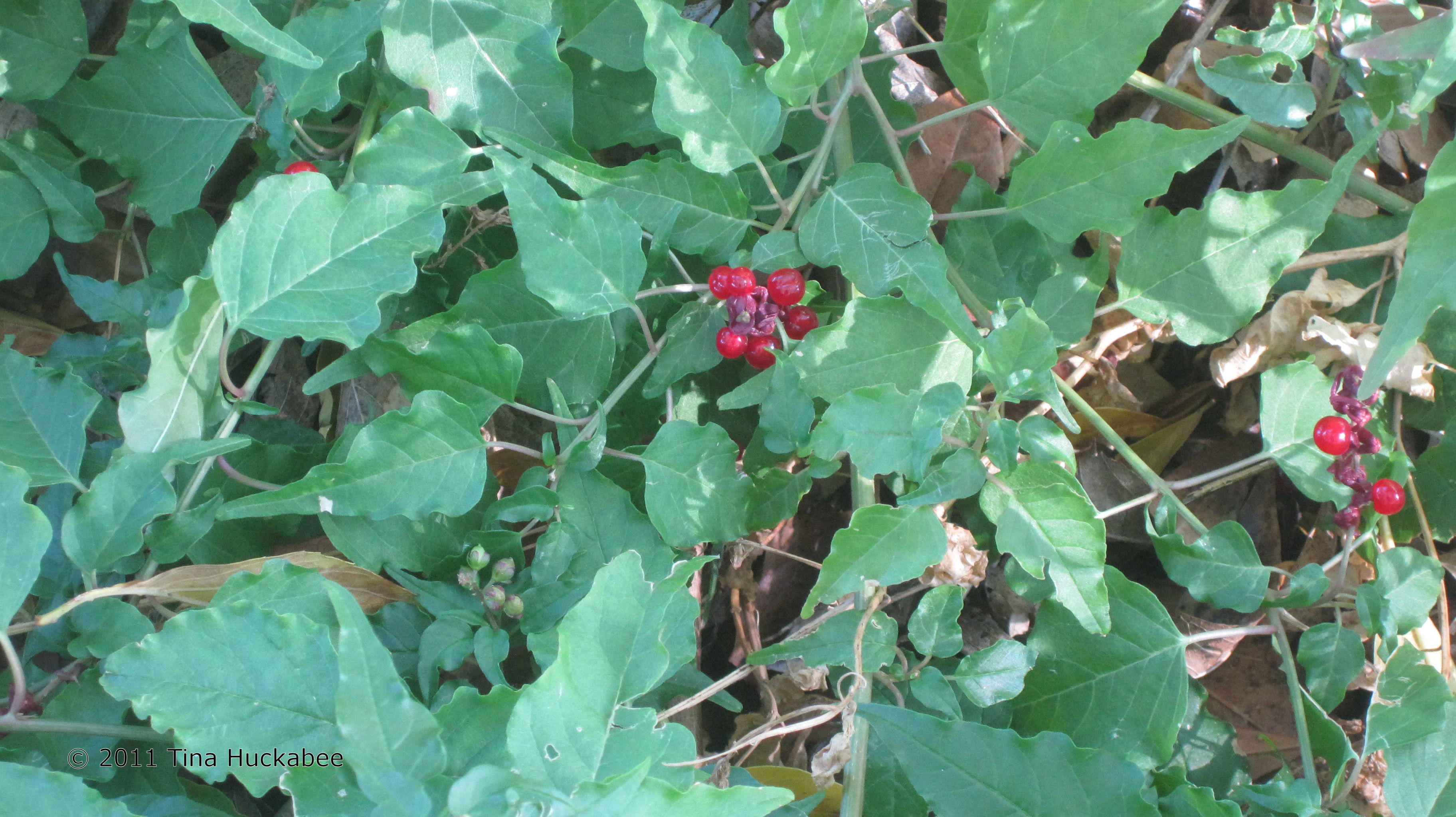
Pigeonberry (Rivina humilis) are still producing their little, brilliant red fruits this year as well.

I’m guessing that the recent rains we’ve had contributed to the slightly longer bloom ‘n berrying time for this plant.

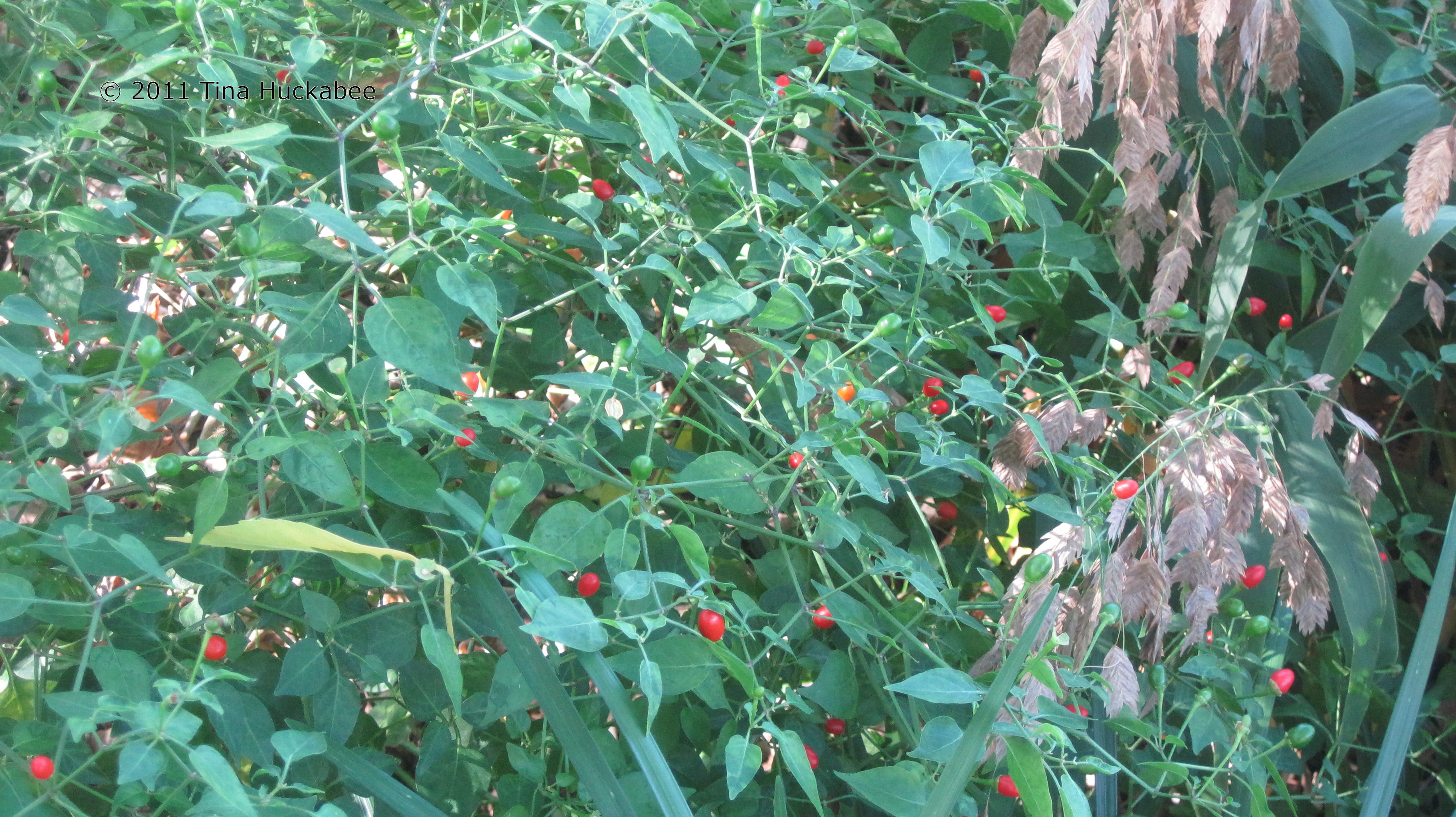
The Texas native pepper, Chile Pequin (Capsicum annuum), also is a reliable fruit producer, although this year (at least in my garden), the fruits (peppers) developed a little later than usual.

Typically, the peppers develop in the summer months, turning red by late August/September.  Aside from the later ripening time, there aren’t as many peppers on my Chile Pequin plants this year as in others.  The mockingbirds have visited these plants recently, so it’ll be interesting to observe whether the fruits remain throughout winter.  Usually they do, that is until a very hard freeze.

Conversely, some of the other fruit producers  have had their fruits gobbled up (seemingly) about three seconds after ripening.  I haven’t seen a Turk’s Cap (Malvaviscus arboreas) fruit or a Barbados Cherry (Malpighia glabra) fruit since earlier in October.  I did however, see a mockingbird flitting about those plants, often with a fruit wedged firmly in his beak.  I wonder if there’s a connection??

What berries to you and your wildlife enjoy?