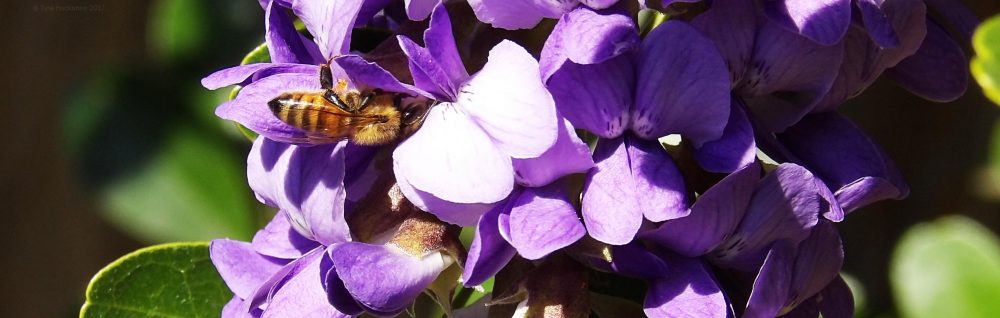
While most humans are staying at home–and it’s a smart thing to do–the birds of the world are in migratory mode, traveling great distances to find their mates and start their families. It’s bird time and spring migration is well-underway. I’m fortunate that my garden is smack in the middle of the North American bird highway, allowing for a good variety of birds who winter in Central and South America and breed in the northern parts of North America, to wing in for a visit.
The migrants mostly visit my garden for rest, but gobbling some insects and a dip-n-splash in the pond and bird baths are also part of their agendas. Each spring, I welcome back birds that I observe, albeit briefly, once or twice a year. Autumn migration happens too, from August through September, but in my garden, spring is the the primary bird show.
One of my favorite migratory birds is the Lincoln Sparrow, Melospiza lincolnii, who visit in both spring and autumn. Cornell Labs uses the term “dainty” to describe Lincoln Sparrows; I’ve described their coloring as elegant: adults are graceful, painted in subtly marked cream and grey, with highlights of varying shades of brown. Lincolns aren’t flashy, but instead handsome, low-key little birds.
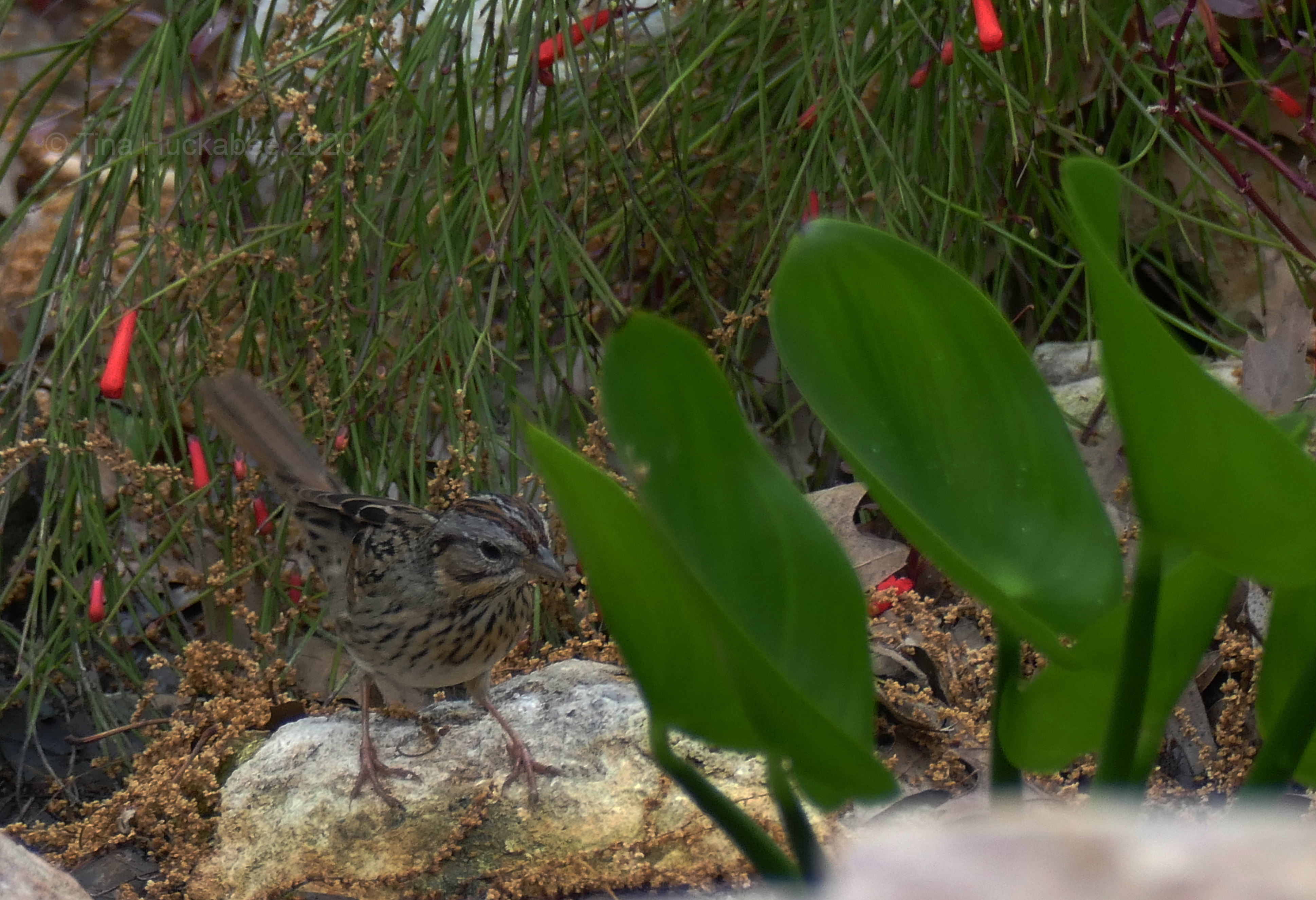
Lincoln Sparrows hop along the ground and through the shrubs foraging for insects. They’re quite shy and secretive, therefore difficult to observe, as any movement sends them aloft to safety. I get my best views when they’re at the pond; they especially enjoy the bog.
According to Cornell’s All About Birds website, the Lincoln Sparrows breed in far north Canada, with their migratory routes in the northern and Midwestern parts of the U. S. Texas is included as the ‘non-breeding’ area, though the only time I see them is during the two migratory seasons. I’m glad to welcome them to the garden whenever they like.
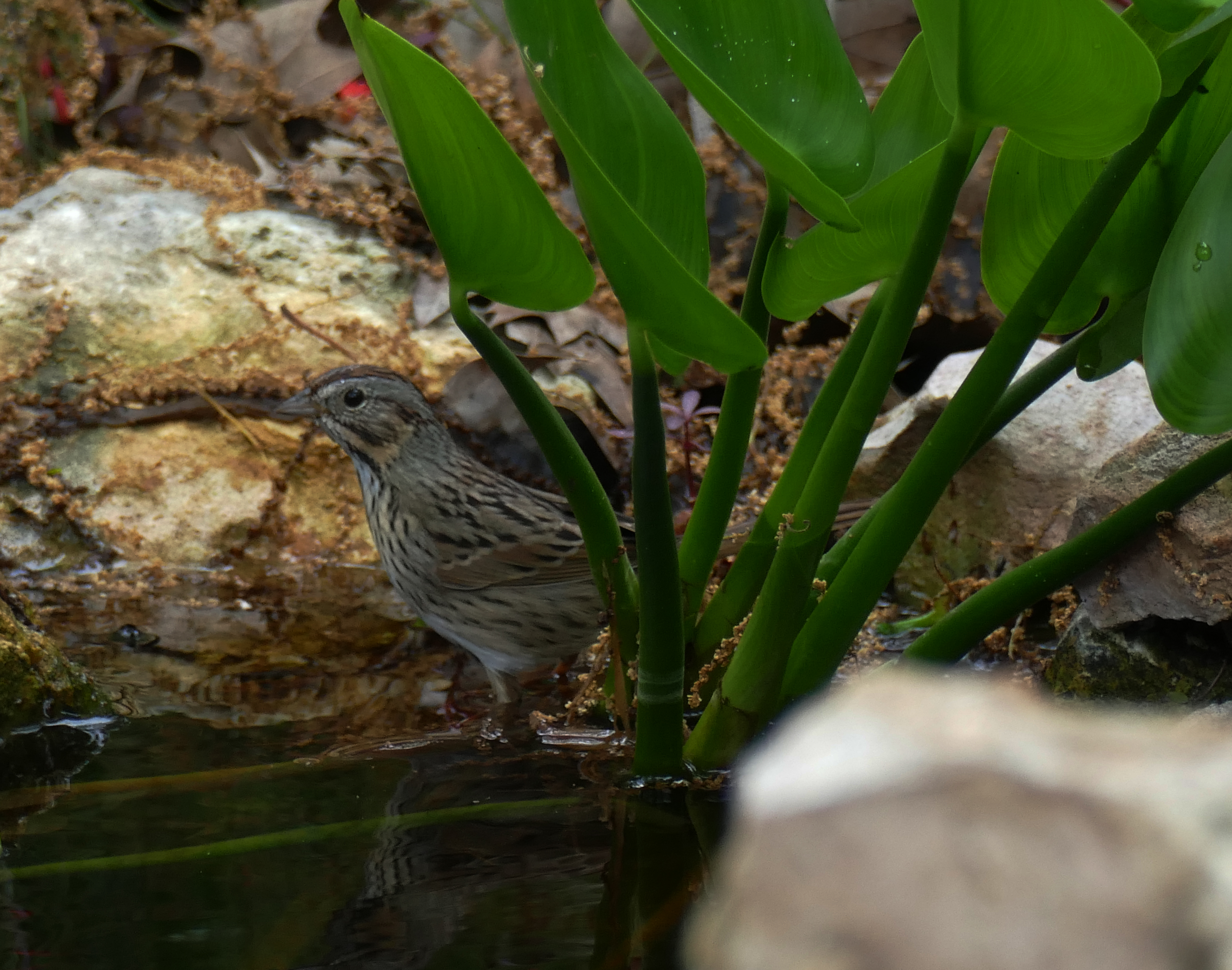
Another common, mostly spring, migrant in my garden, is the Nashville Warbler, Leiothlypis ruficapilla. Grey and yellow with a ring of white around their eyes and perfectly round heads, they’re cute, petite birds. See the little smudge at the top of this fella’s head? That’s the blush of brown that signifies he’s a he. Typically, the brown patch is hard to see. I usually don’t notice it, even with binoculars, until I download a photo.
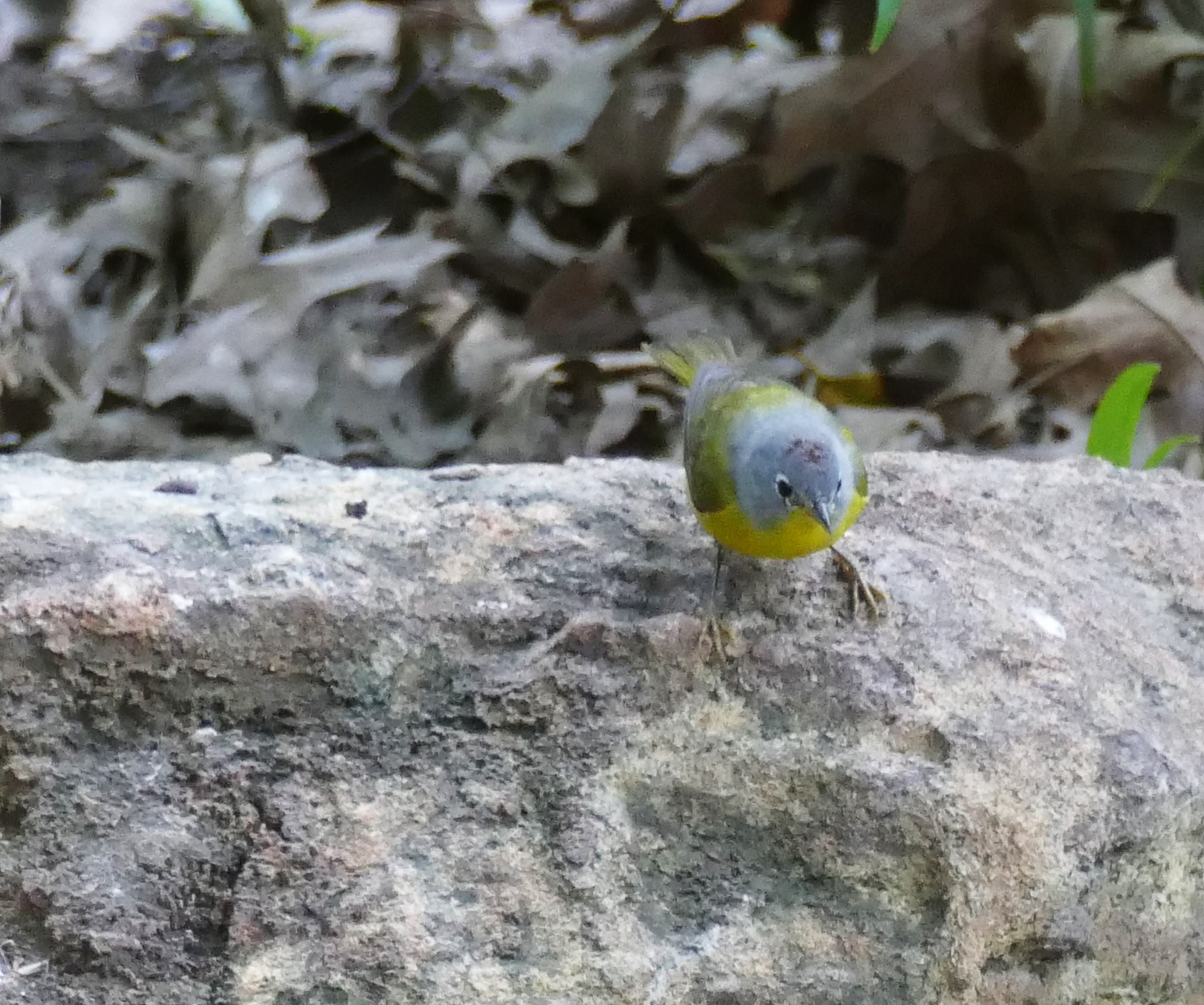
He’s showing off his good side,
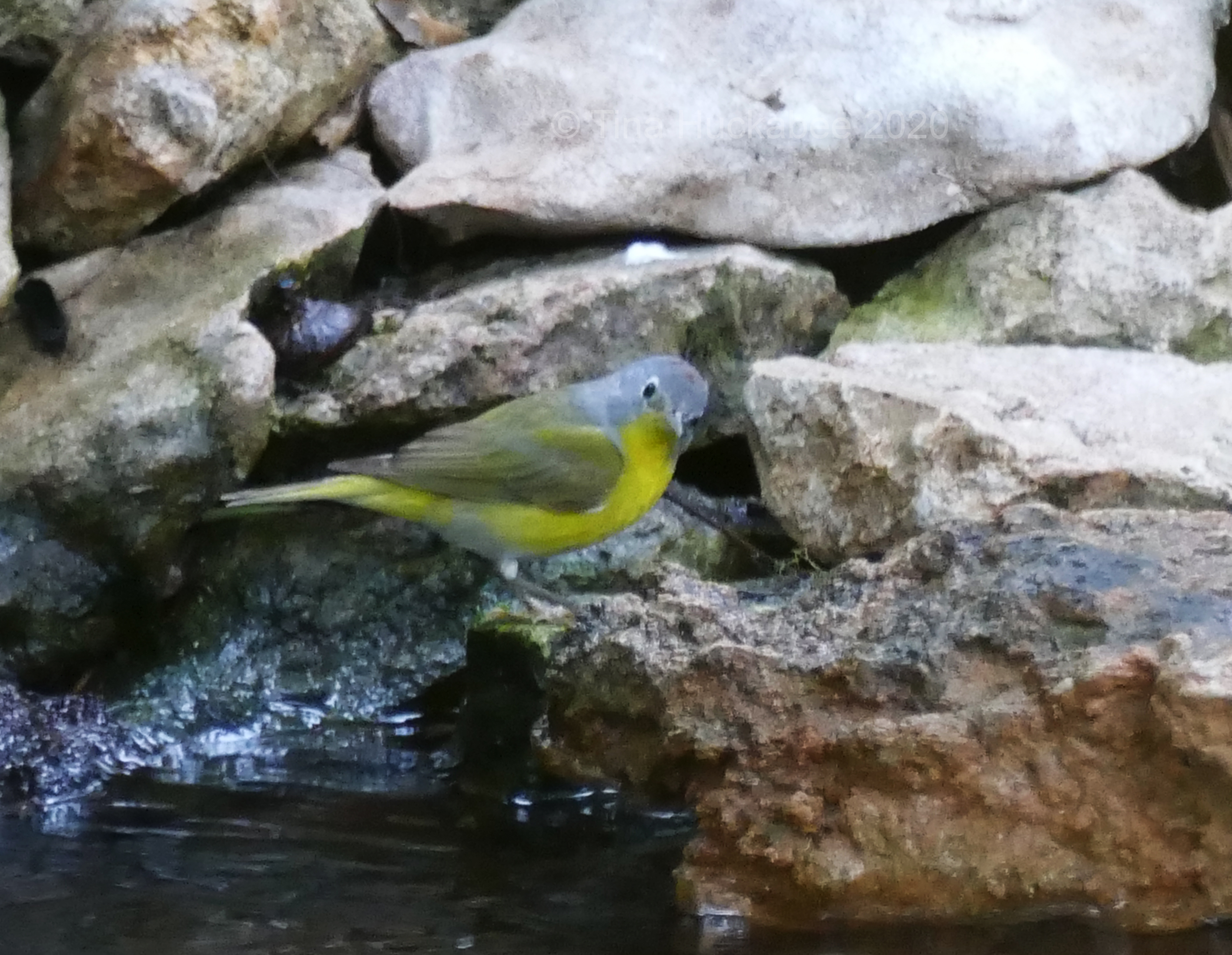
…and staring (or is it glaring?) at the camera.
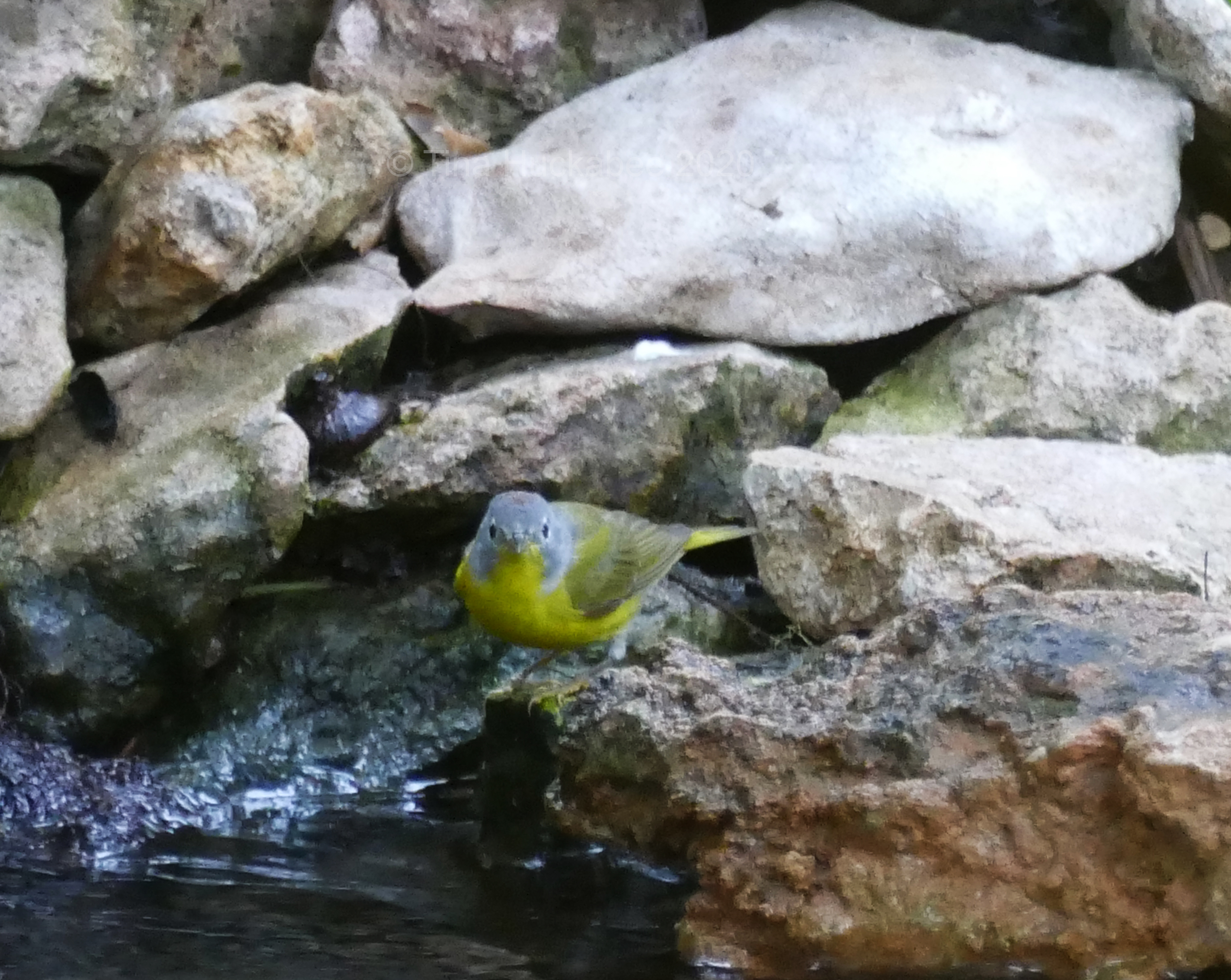
As a species, I see more individual Nashville Warblers than any other migratory bird. Instead of just one, once-in-a-while, for a few weeks, it’s not unusual for me to see two, three, and even four, hanging out together, traipsing down the rocks for a dip. They’re not great at social distancing.
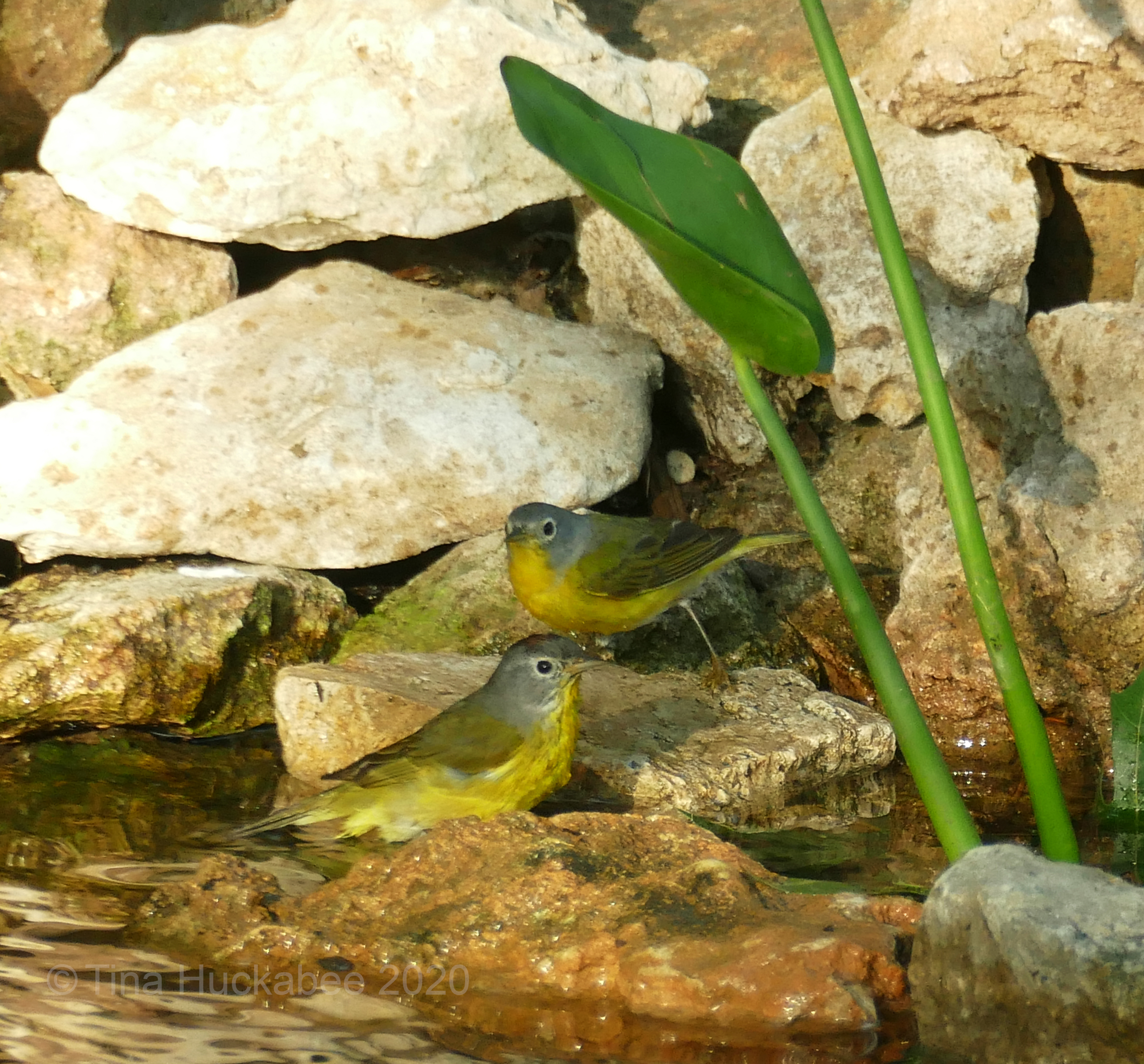
Most Nashville Warblers migrate along the coastal regions, but they have migratory routes through almost all of Texas. Yay for Texas birders!! The Nashville Warbler isn’t more common in Nashville than in other place. They’re so named because the species was first observed–then named–in Nashville, Tennessee by Alexander Wilson in 1811. Just to make things complicated, there’s also a Tennessee Warbler, Leiothlypis peregrina, which has also come through my garden recently, but I couldn’t get a photo. Or, at least not one that was anything but a blur.
Everyone wants to catch a peek of a Painted Bunting, Passerina ciris, and it’s obvious why.
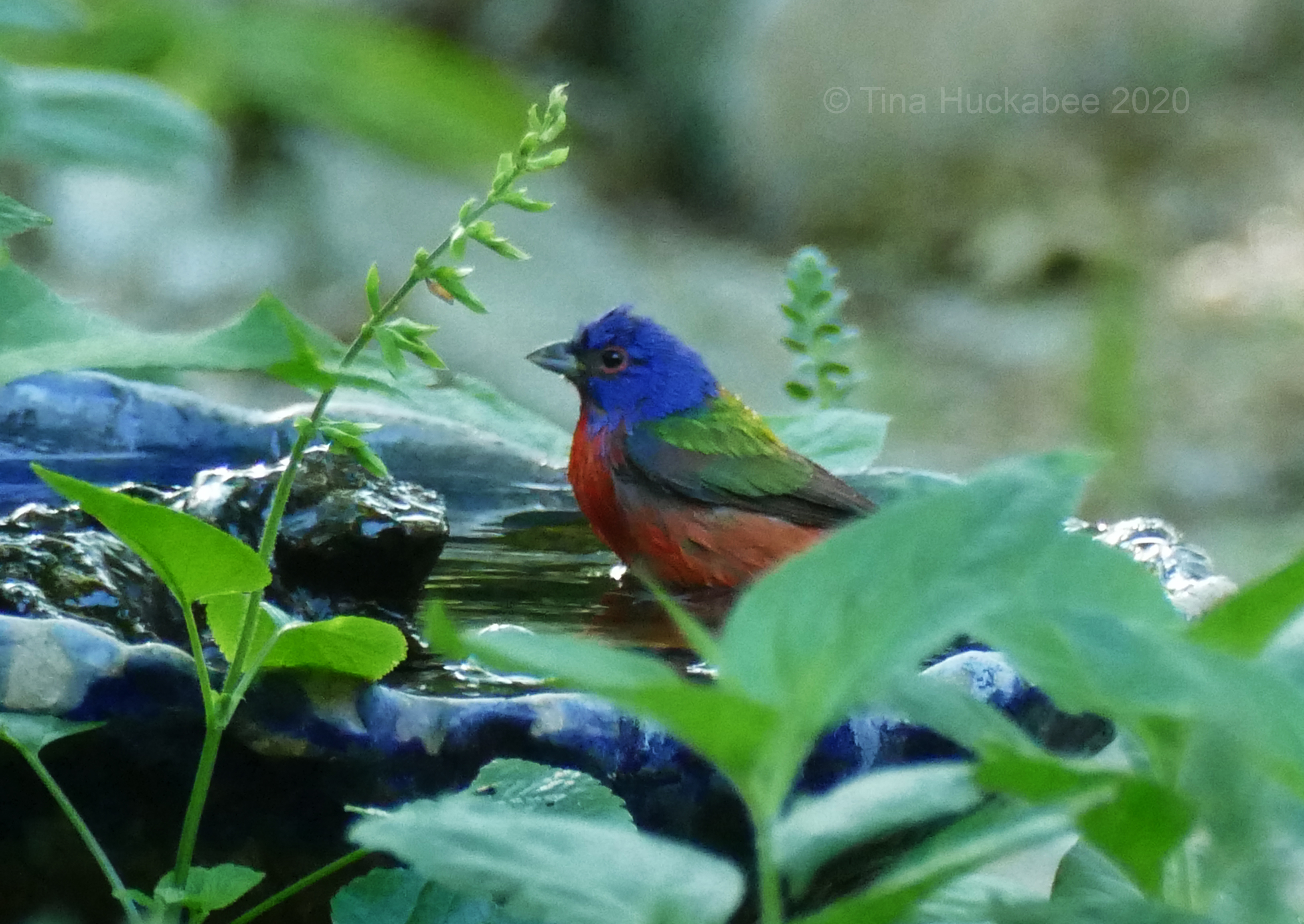
Considered one of the most beautiful, if not the most beautiful, bird in North America, All About Birds describes Painted Buntings as birds that “…seem to have flown straight out of a child’s coloring book.” The males are stunning: brightly colored and wildly patterned, and the females, while dull in comparison, are pretty great looking too, despite the lack of color pizzazz. I’ve enjoyed several visits from one, or a couple of visits from several–I’m not certain which. Most of my Bunting sightings were miss-it-if-you-blink glimpses, but I was tickled to watch this one bathe for a while in one of my bird baths that sports a little pump which bubbles water.
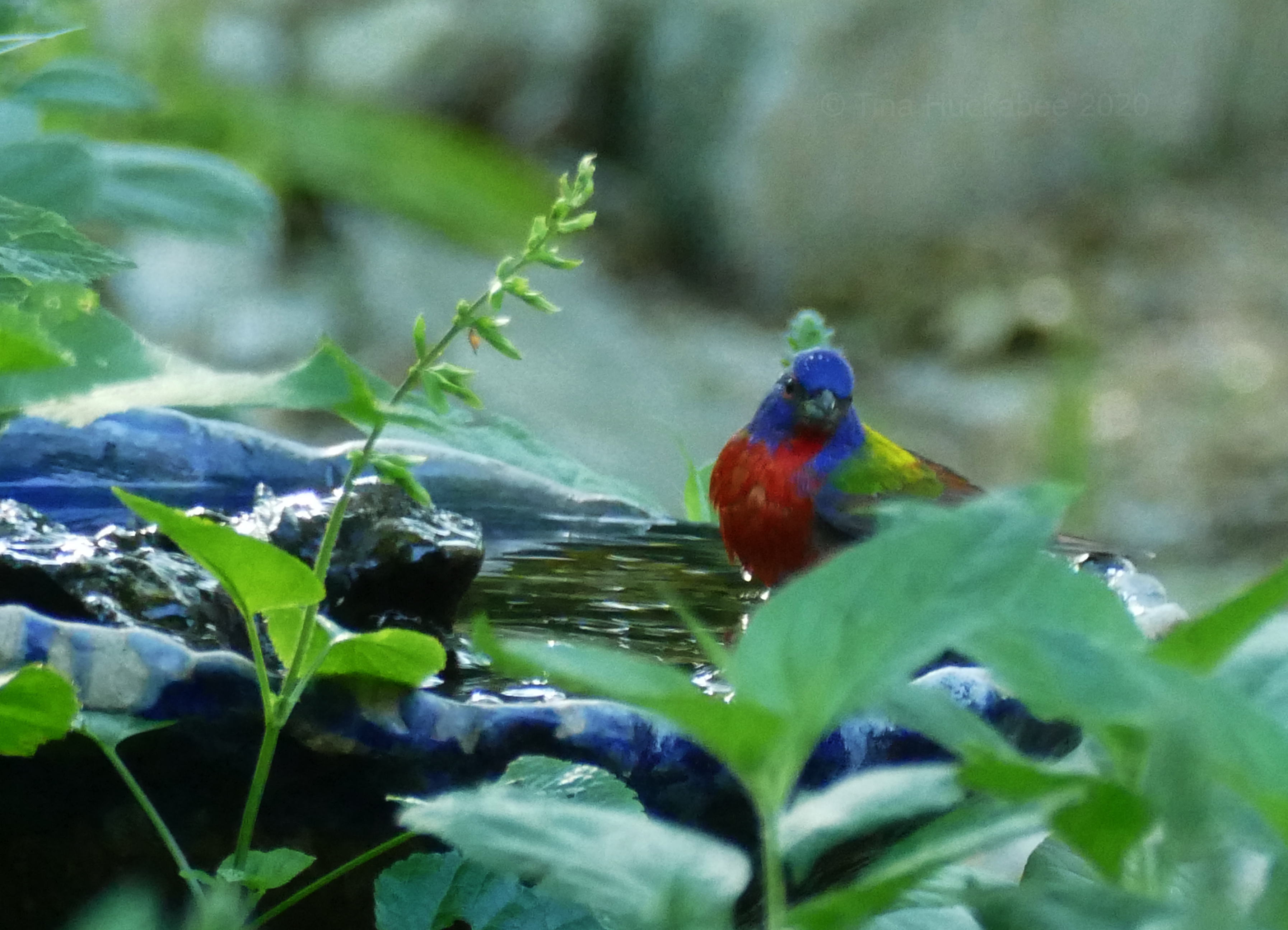
The female who visited was skittish; I saw her twice, only briefly. I’ve typically seen more Buntings in May, so there’s still a good chance that more will come through. Besides bathing their gorgeous selves, I’ve seen Painted Buntings nibble at the seeds of the native Mexican Feather grass, Nassella tenuissima, and at the seeds one of the early spring-blooming perennials, Lyreleaf sage, Salvia lyrata. There’s a lesson: if you plant native, the birds will come.
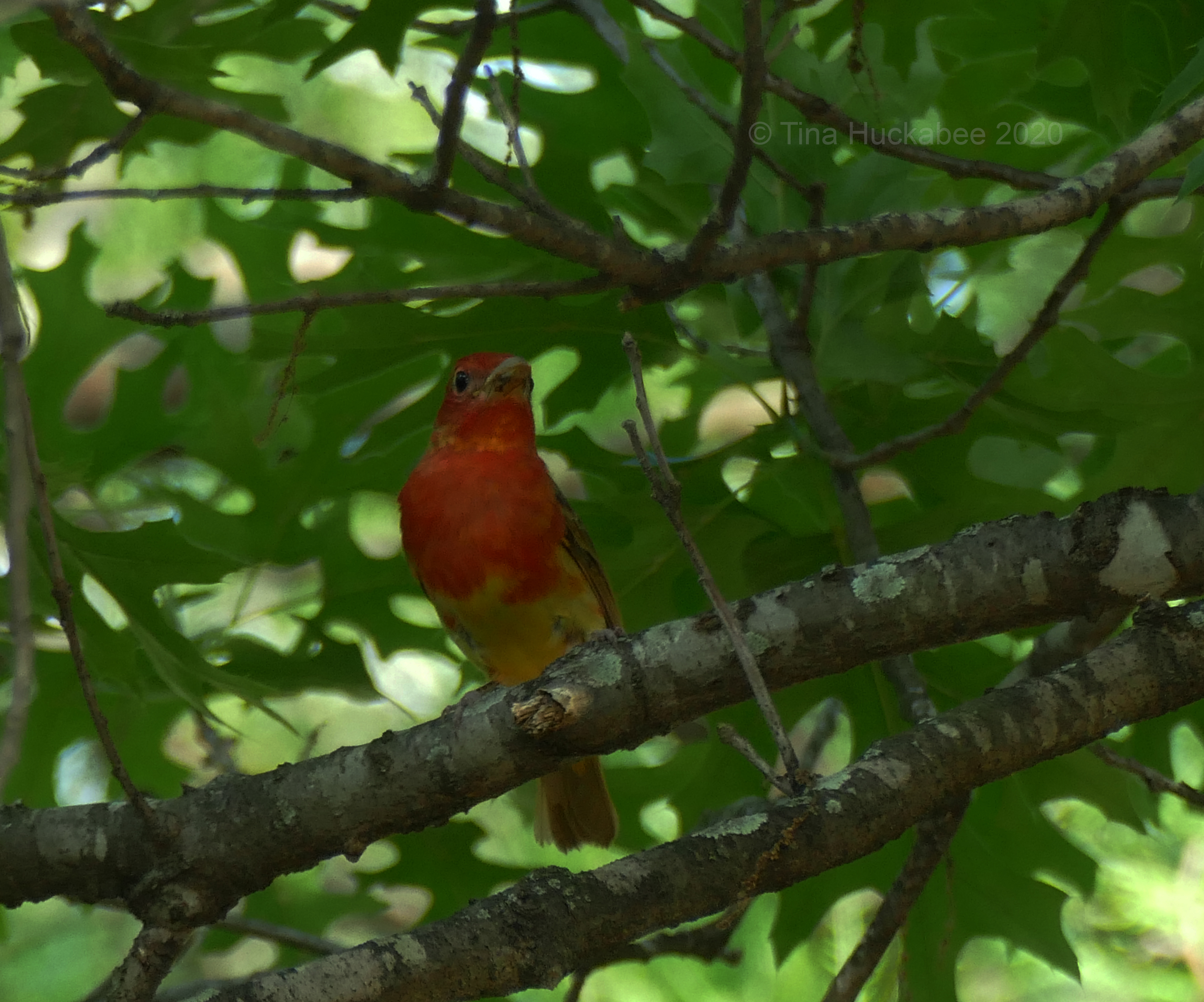
I think the bird charm prize must be awarded to this female Summer Tanager, Piranga rubra. The Summer Tanagers, usually one mature male, a female and one or two juveniles, show up at the end of April for a couple of weeks. It isn’t the pond which draws them, nor is it the native plants that they hunger for. So why do these bird hang out in my back garden? For the honeybees!
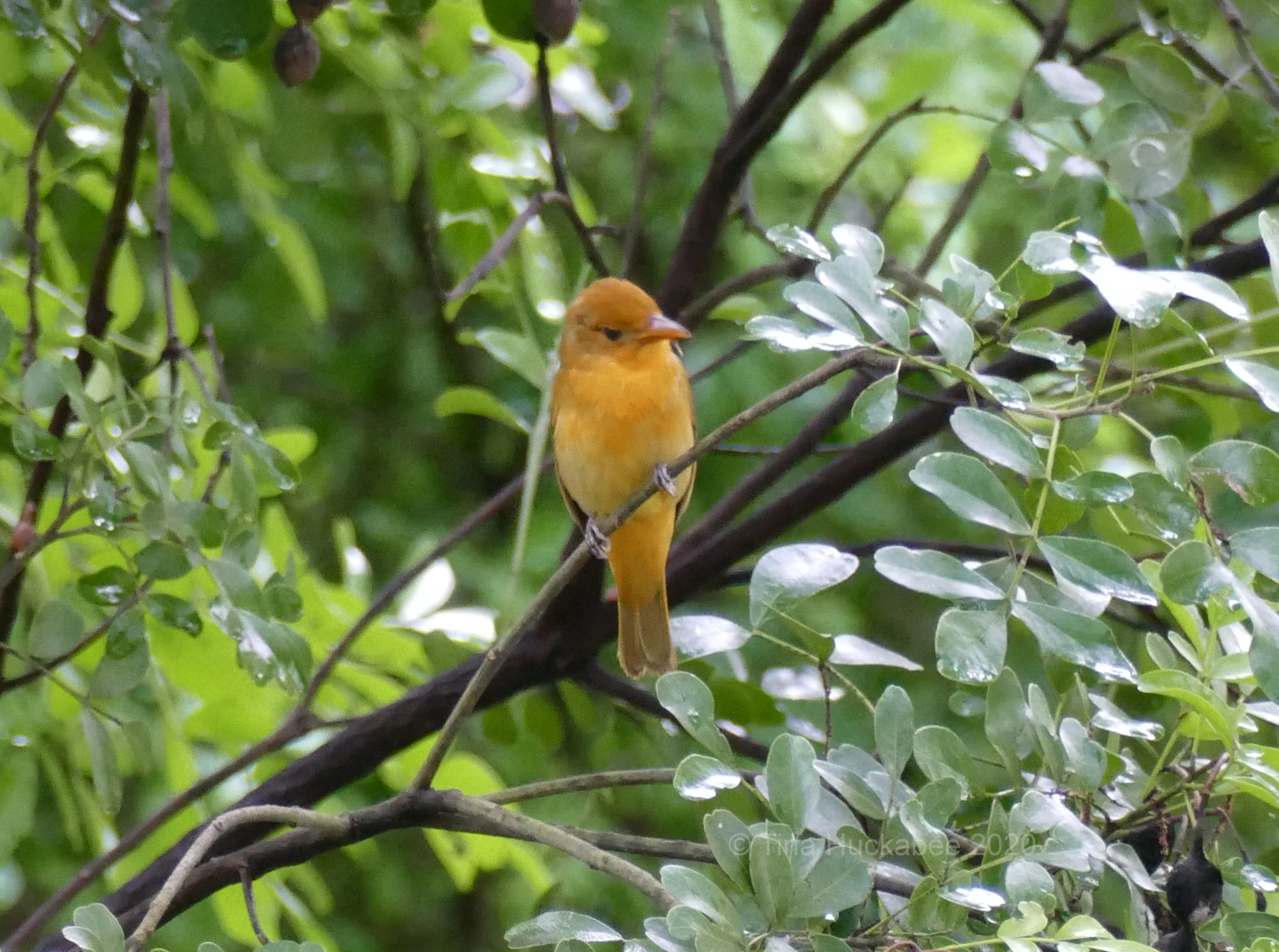
Summer Tanagers are adept hunters of bees and wasps, catching the insect treats in the air and eating them in trees, or sometimes, on the rooftop of a defunct beehive.
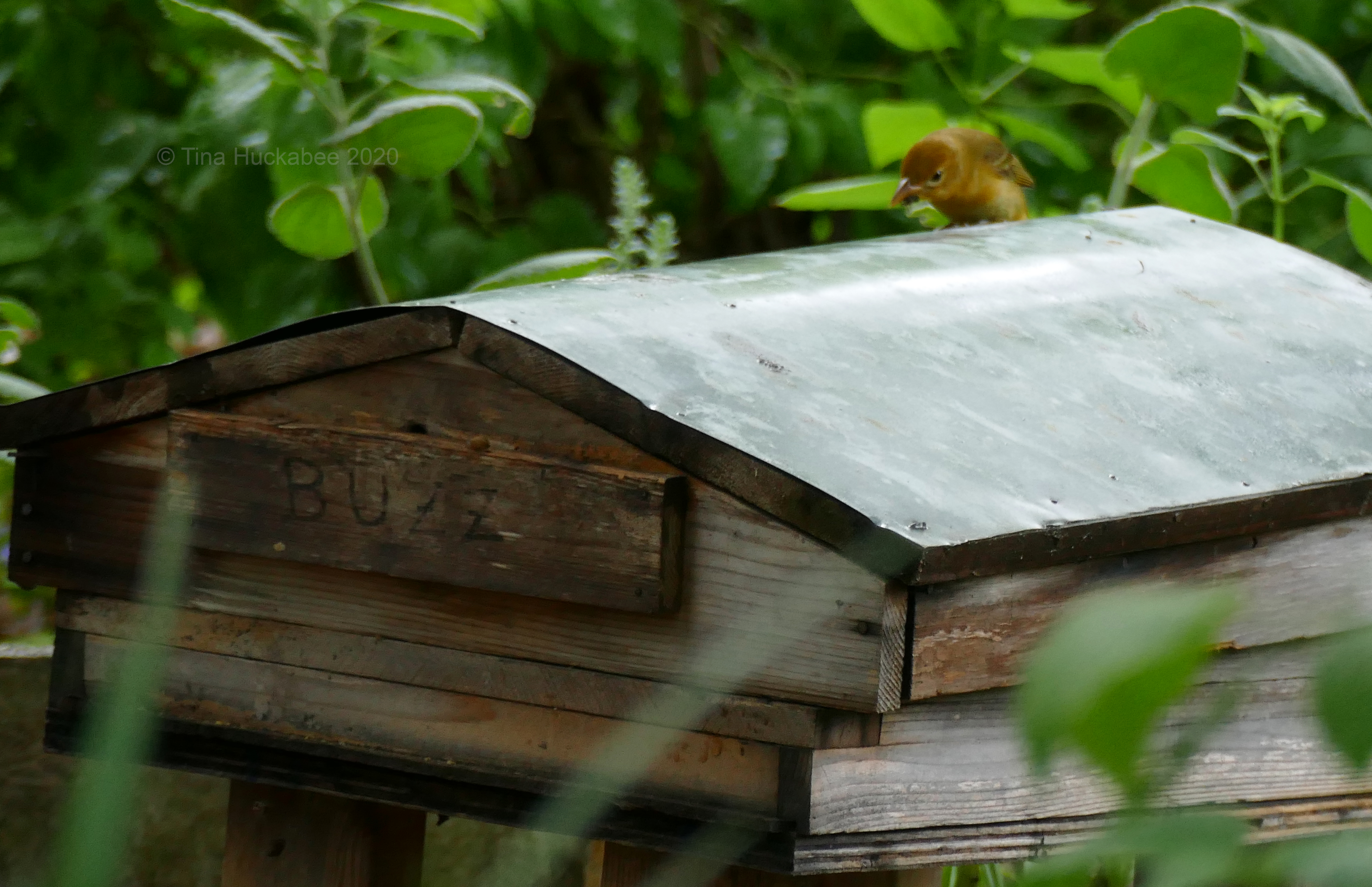
While the photo isn’t particularly clear, as I watched, she definitely snagged a bee. The bee is most likely from the hive named Woody, which resides to the left, just out of frame, but Ms. Bee-hunter plopped down on top of poor Buzz to snarf the snack. Tanagers beat their bee snacks on a branch (or rooftop) then rub the bee on a surface until the stinger falls out. Then gulp–and yum! It’s a sting-free meal!
This female tanager has been in the back garden most mornings for a week or so and a joy to watch.
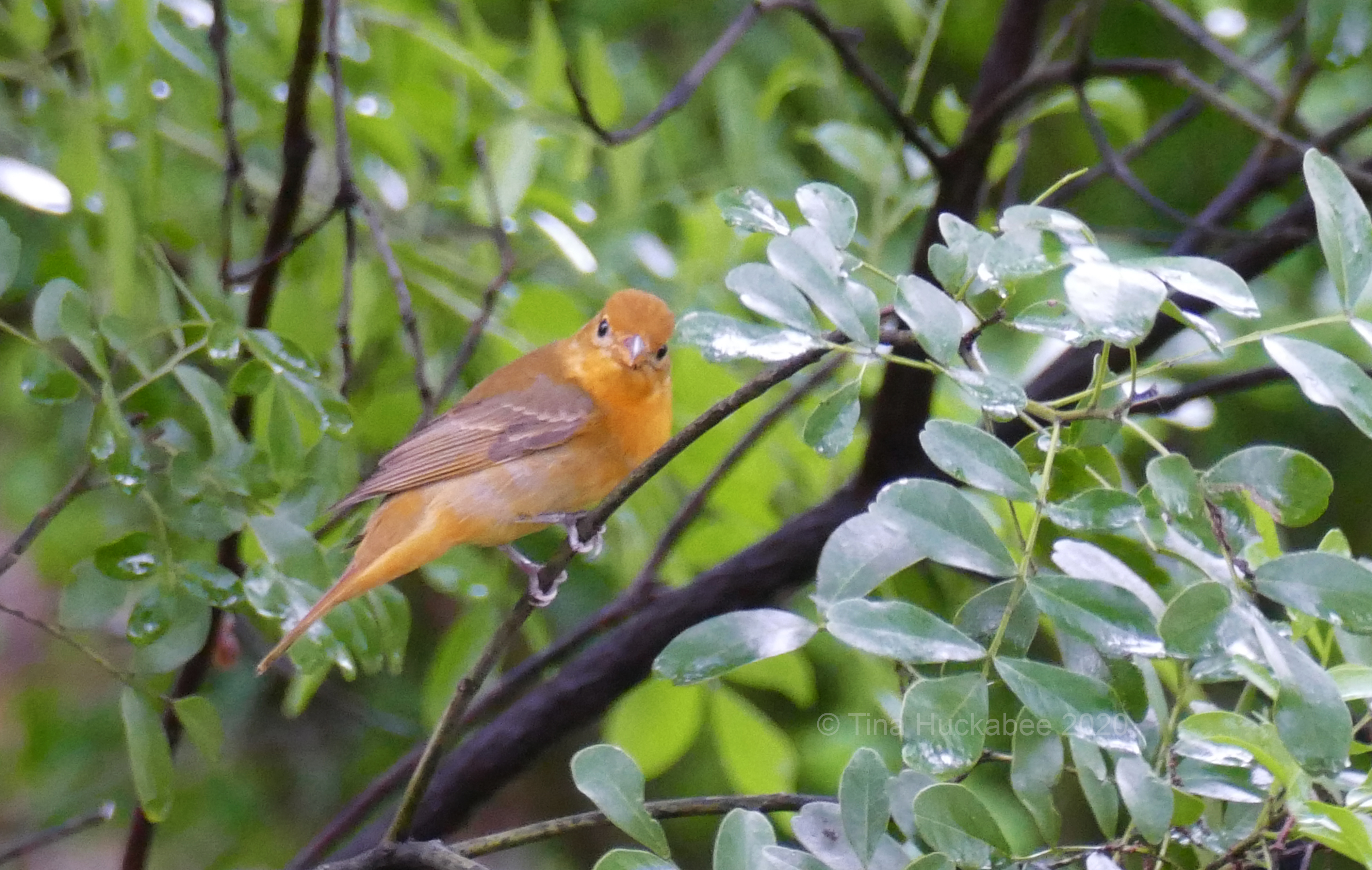
She’s alighted on the black-oiled sunflower feeder several times. I love the disgusted look on her face as she must be thinking: I’m not gonna eat this. Do other birds actually eat this junk?
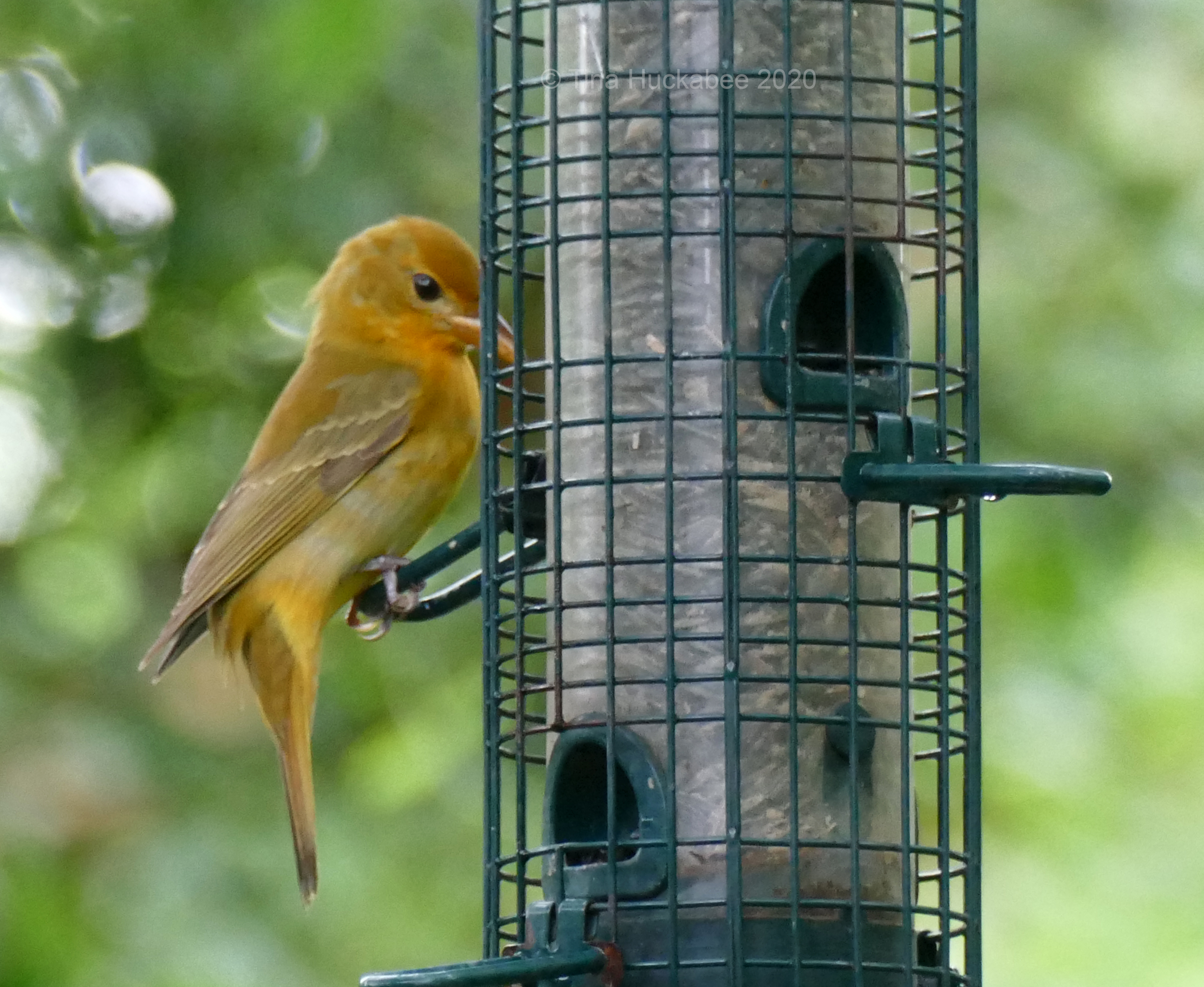
True to form, as she perched on the feeder, she kept a keen eye out for flying insects, ready for action when one became available.
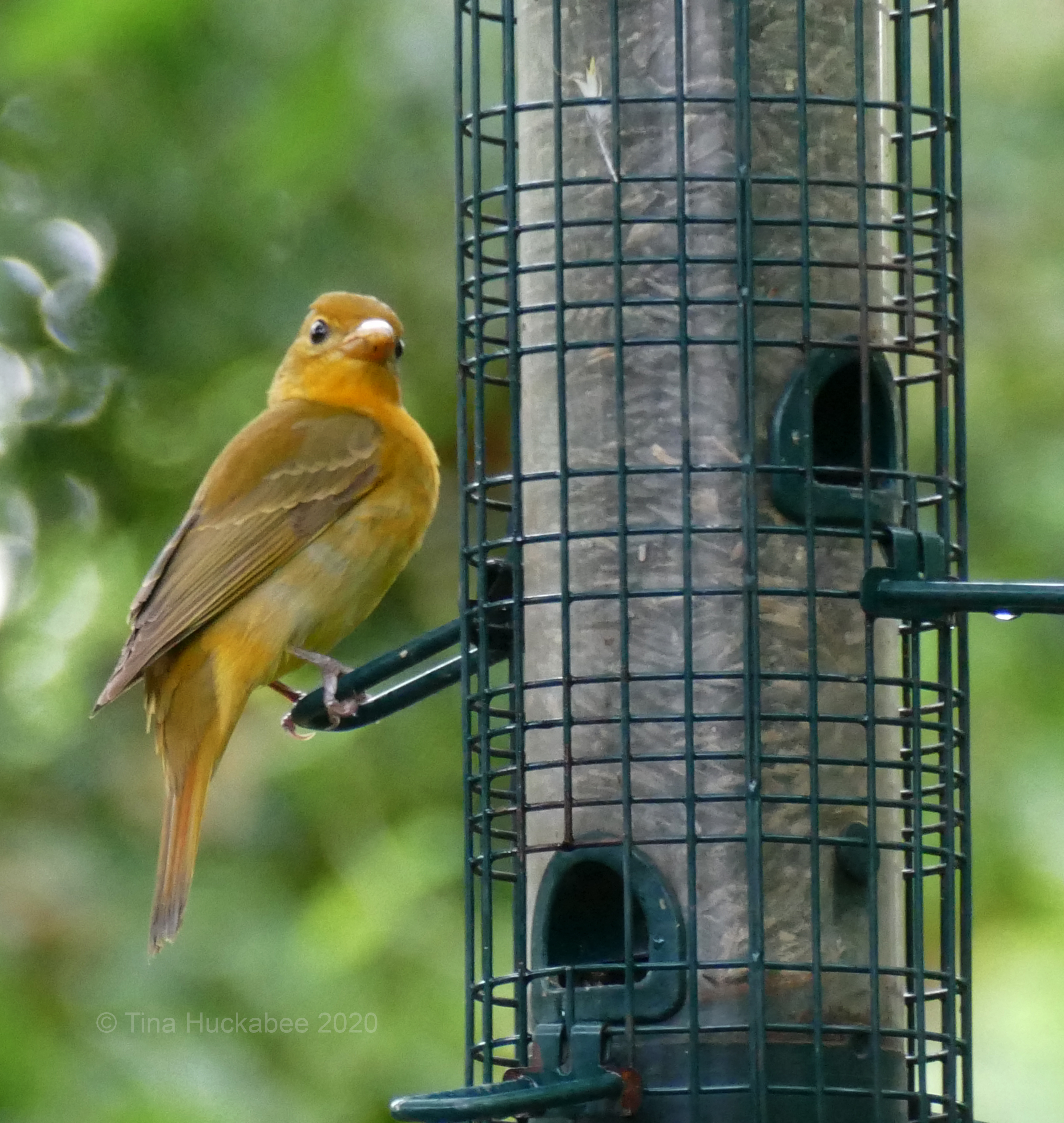
Compared to the bright red male she’s not as colorful. But her intelligence is obvious and she’s also a pretty, pretty bird.
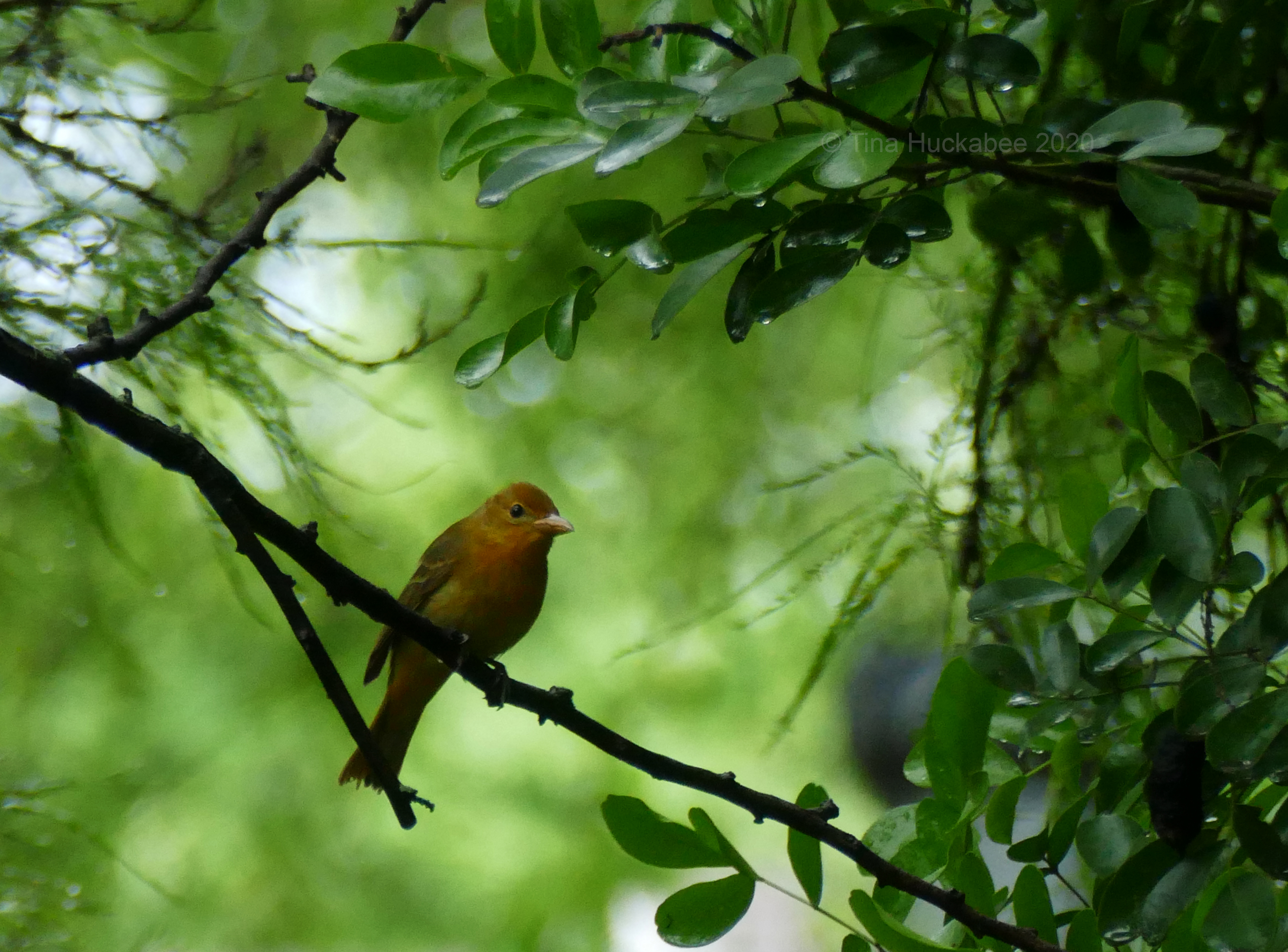
I observed a mature male once early in the migration season, but he was gone in a flash. An immature male has also been hunting bees, alongside the female.
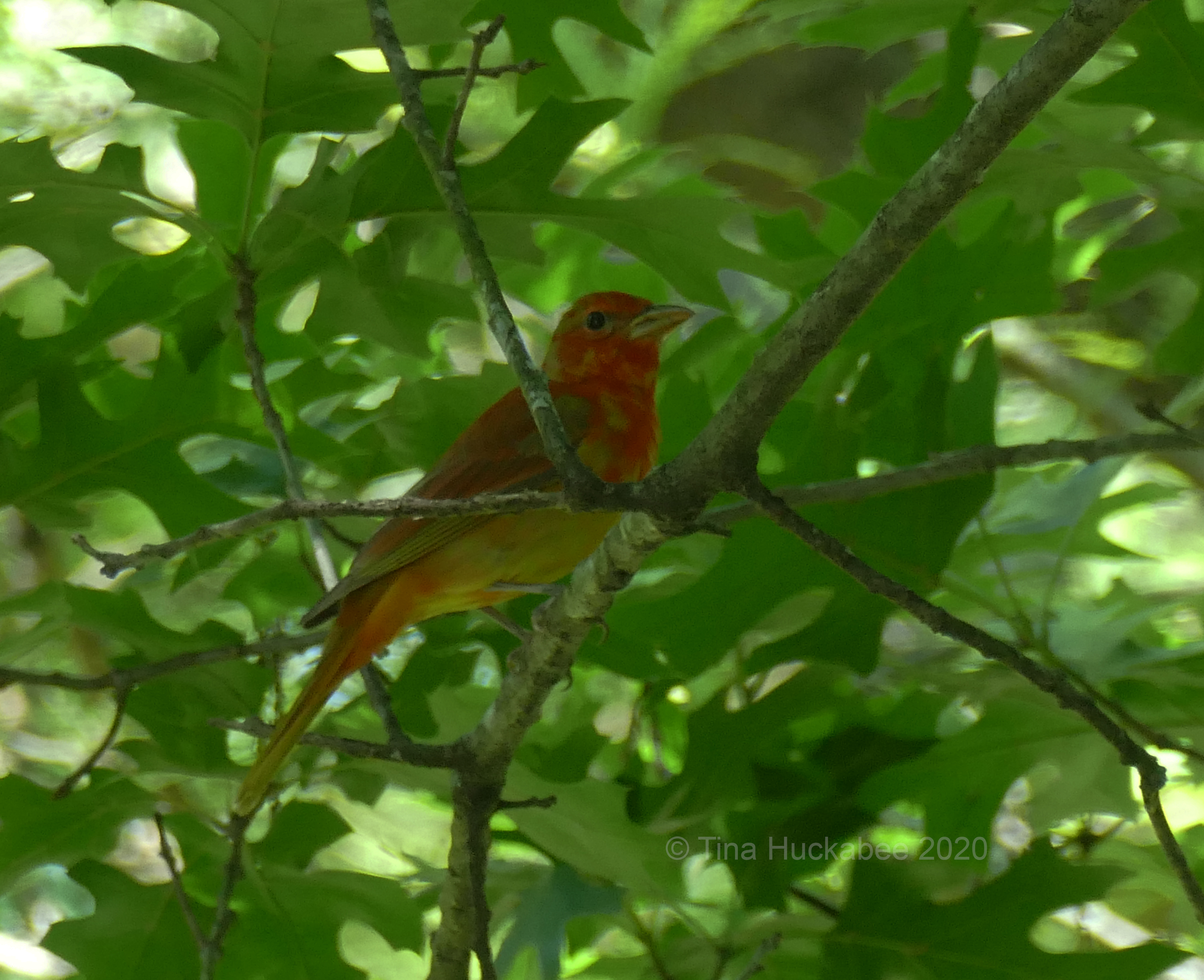
That seems to be a pattern: in late April, I’ll see a mature male; maybe he hangs around, maybe not. Then I observe both a mature female and an immature male, both hunting in my back garden for a week or two–then, they’re gone. Central Texas is Summer Tanager breeding ground, but I only ever see them from late April and into early May. They’re welcome to hang out though, as I always have a supply of bees.
The juvenile males are showy, even with their undecided coloring–splotches of red here, dabs of yellow there. But like their elders, observing their keen hunting skills is a treat–and a privilege.
This little dab of sunshine zoomed around the garden, landed in a tree and then proceeded to give me the stink eye. A male Yellow Warbler, Setophaga petechia, I typically have a gaggle of males and females show up in spring, flit around the pond for a few days, then move on to parts unknown.
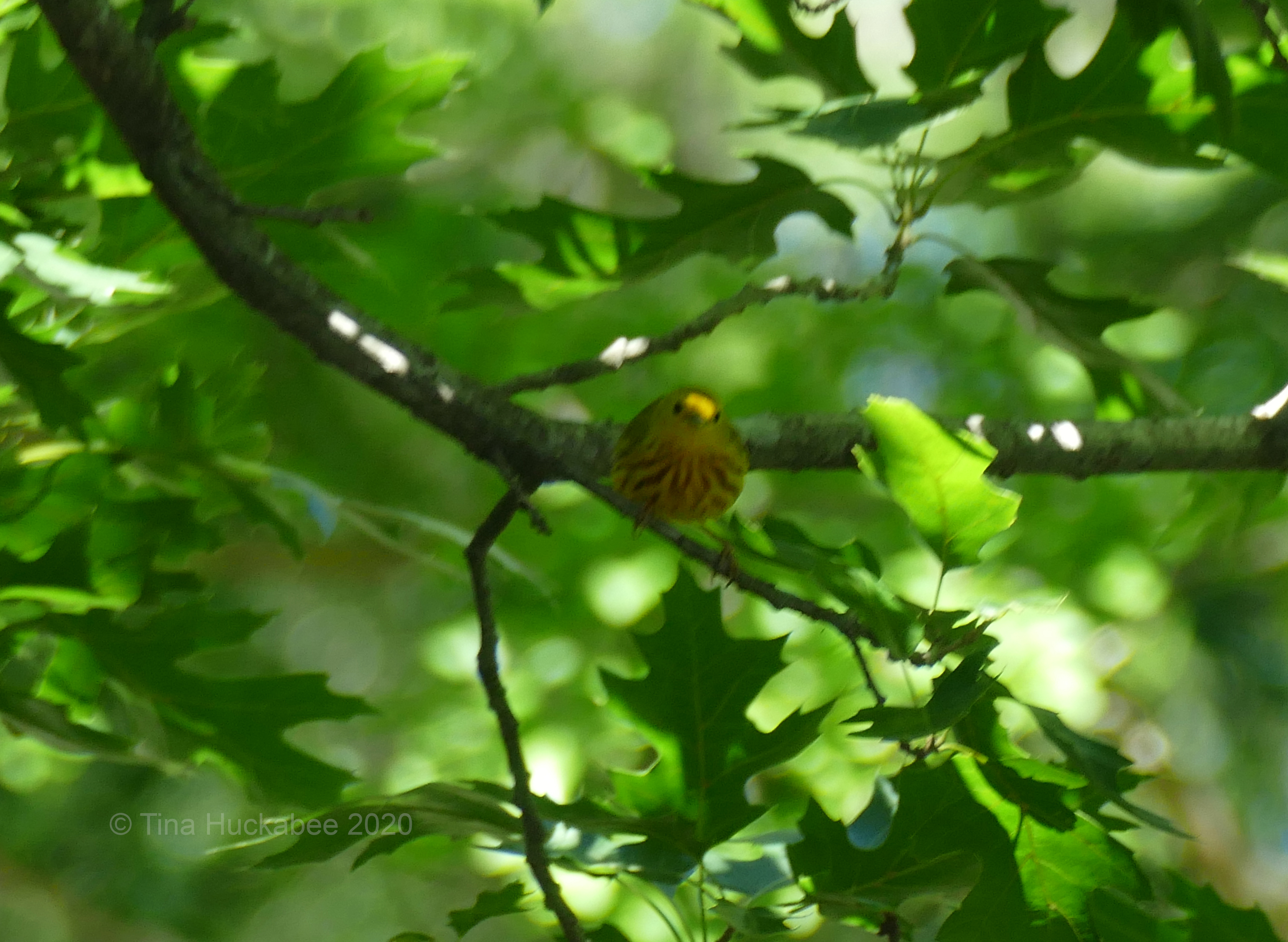
It’s not a very good shot of this lovely, tiny bird; I’m including it just in case it’s the only one I see this season. He’s a pure yellow, with burnished streaking throughout the breast. The females are also yellow, though in a muted hue, and lack the breast streaking. Both have adorable faces. All of Texas is in their migratory path and north of Texas, they breed throughout a huge swath of North America. I hope to see more of them in the next few weeks.
A different yellow caught my attention one evening, near sundown. Again, it’s not a great shot, but I’ve never seen a Blue-winged Warbler, Vermivora cyanoptera before.
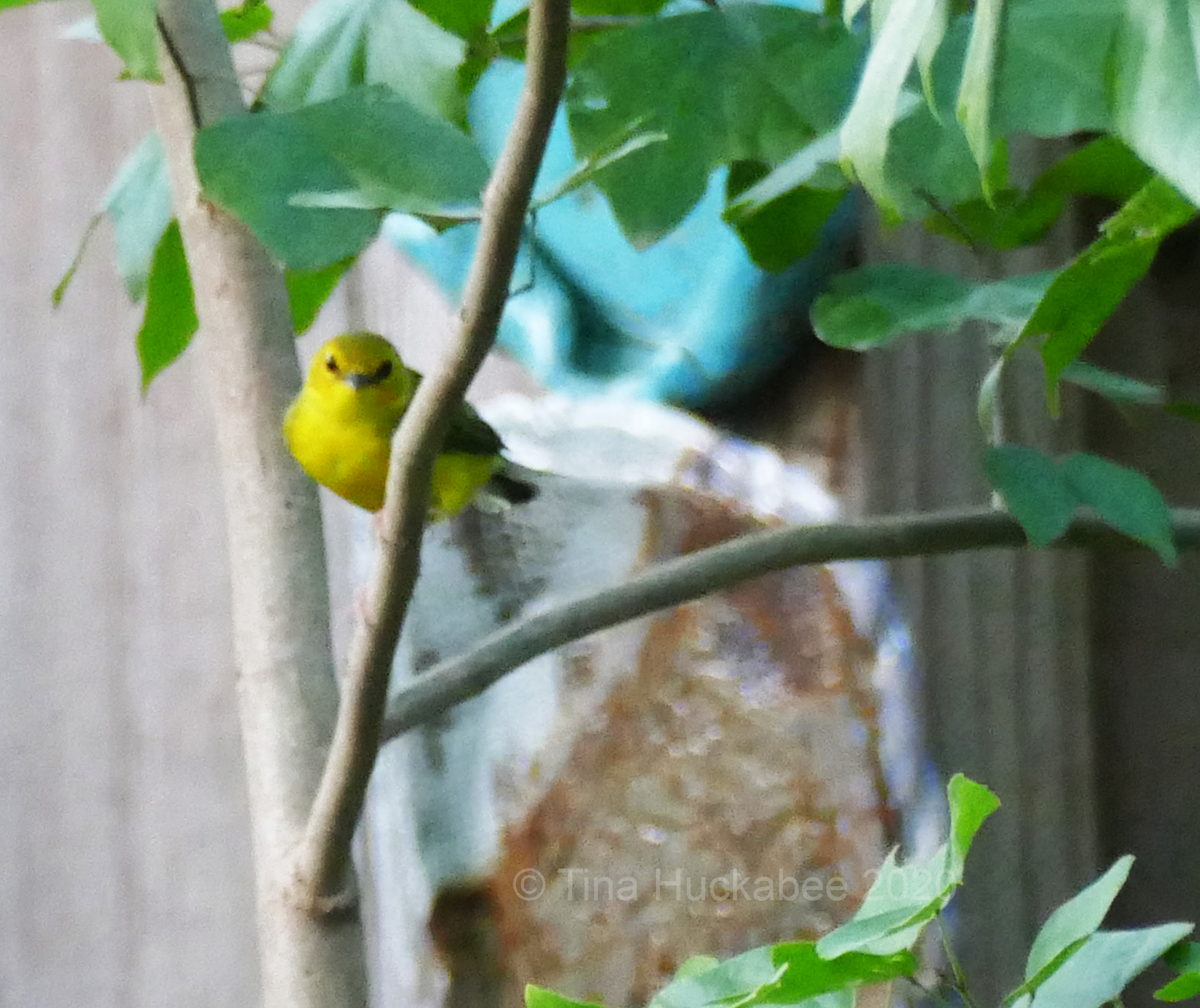
I don’t think the bird was in my back garden for more than a minute and I feel fortunate that I grabbed the camera and snapped the shot. Considered a rare bird for Central Texas, there are occasional sightings of Blue-winged Warblers during migration season. Blue-winged Warblers migrate through the eastern half of Texas and breed in the upper Eastern/Midwestern areas of the U.S. I think this one is a female, as she lacks the dramatic black eye mask of the male and had less white on her wing-bar.
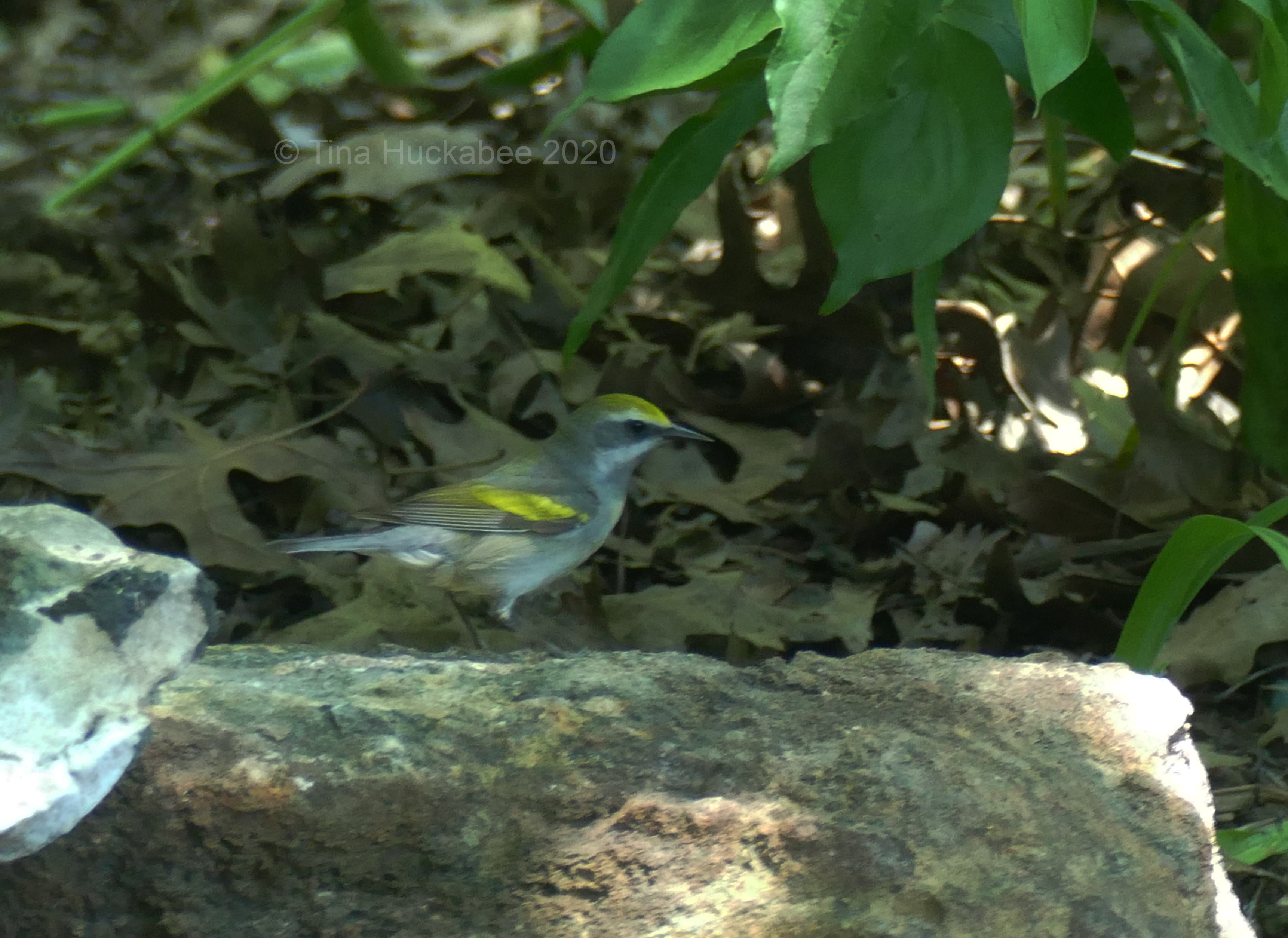
A rarer bird for Central Texas also appeared in my garden a few days later. It wasn’t in the garden for long and certainly didn’t stay still at all, but this Golden-winged Warbler, Vermivora chrysoptera, provided some excitement for me.
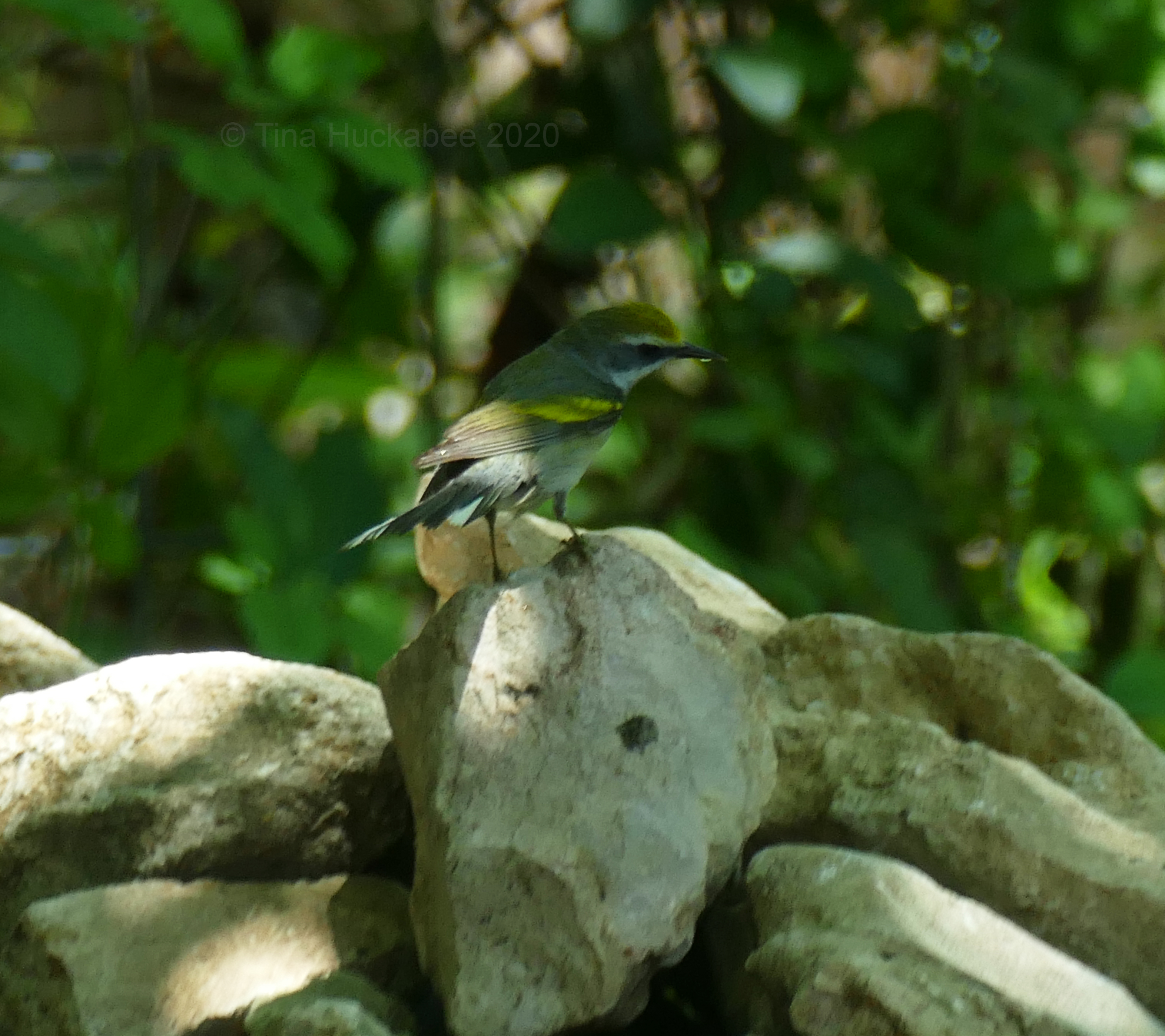
With a quick perusal of Cornell’s site, I assumed this one was a female. As it happens, Golden-winged Warblers and Blue-winged Warblers interbreed and hybridize, creating varying color combos. Originally, ornithologists thought that the hybrids were separate species, but now think differently. I believe this one is a “Brewster’s” which sports a white throat and more gray coloring. A different hybrid (“Lawrence’s Warbler”) tends more yellow.
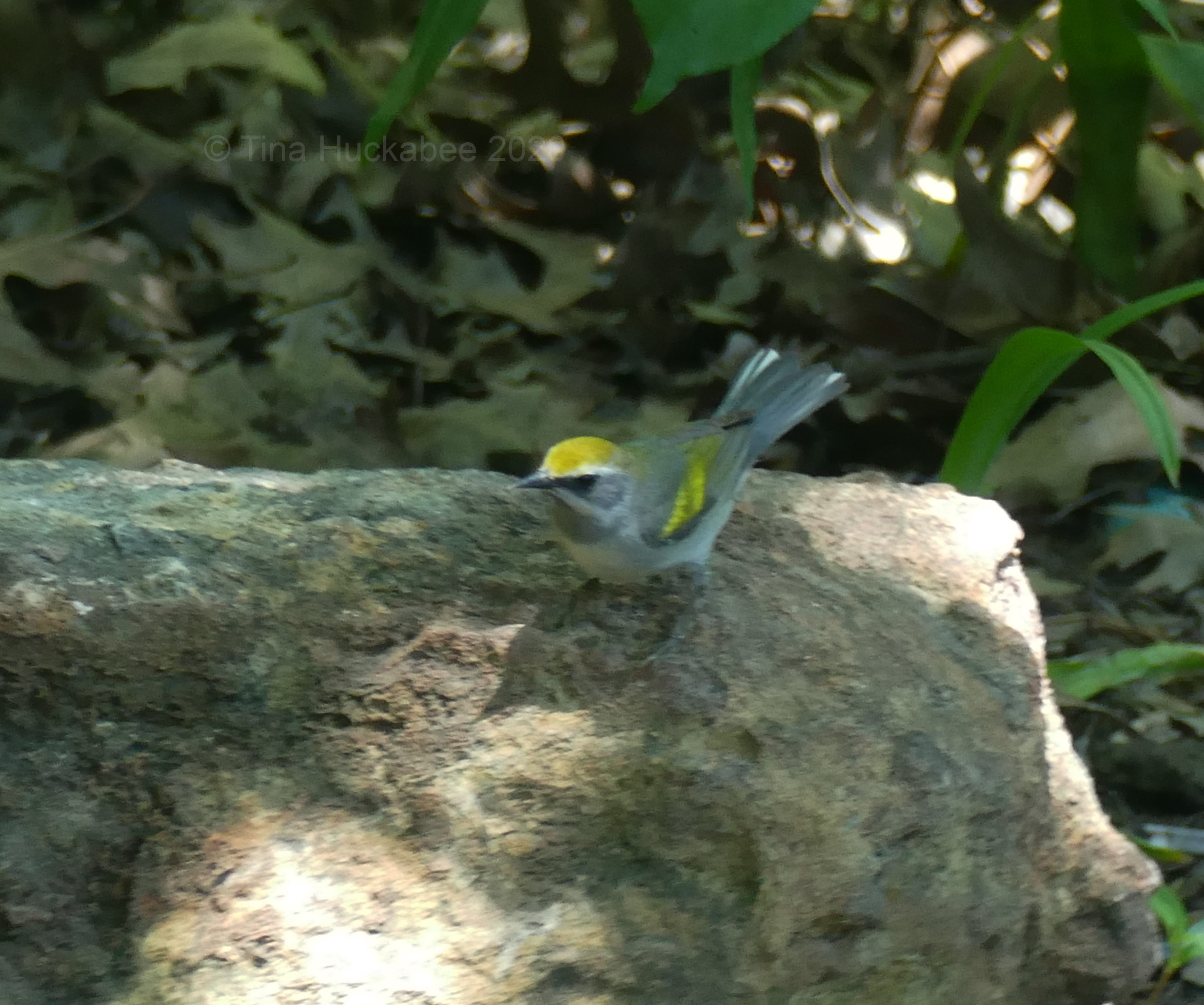
I’m especially honored to have observed this little beauty, even for just a few moments, as it’s a bird which has endured one of the greatest population declines of all songbirds. The largest population is in Minnesota, and Cornell Lab of Ornithology, along with an organization called the Golden-winged Warbler Working Group, have developed a conservation plan to grow the population. I hope it succeeds. Golden-winged Warblers breed in the same region (Great Lakes) as Blue-winged Warblers, though in a much smaller area.
It feels like there haven’t been as many birds coming through my garden this past month, but May is usually the primary migration month, at least for my garden. That said, I’m thrilled with the two rare bird sightings and grateful that my garden provides some safety and respite for these remarkable creatures.
If you’re interested, Cornell Lab sponsors Global Big Day, this upcoming Saturday, May 9, 2020. The purpose is to observe and celebrate the birds around you–wherever you may be. Birders big and small, expert or novice, gather in their spaces (social distancing, of course–that’s the birding way) and report the birds observed. It only requires a few minutes of time, or you can watch on-and-off during the day. Once the data is in (either through e-bird, or by email) it’s a fascinating look and a quick snapshot at what birds are where, all around the world. Check out the link above if you’re want to participate–it’s easy, fun, and educational.
You never know who might see in your garden.
Today is Wildlife Wednesday and if you’re so inclined, share your wildlife happenings here. Also, it’s Wednesday Vignette, so I’m also linking with Anna at Flutter and Hum. Check out her site for gardening stories of all kinds.
Happy wildlife gardening!


 My Gardener Says...