Spring is new life and verdant growth, but is also well behind us and with it, the boom of babies born. There are still some critters in offspring production: insects, rodents, sparrows, doves and others, I’m sure, who produce youngins’ year-round, or nearly so. But for many of my local wildlife, their baby-rearing days for this year are drawing to a close. Baby birds are no longer helpless chicks, but are at fledgling and hatch-year stages; almost, though not quite, independent. Some lessons are still imparted by dedicated parents, like this handsome daddy Red-bellied Woodpecker, Melanerpes carolinus.
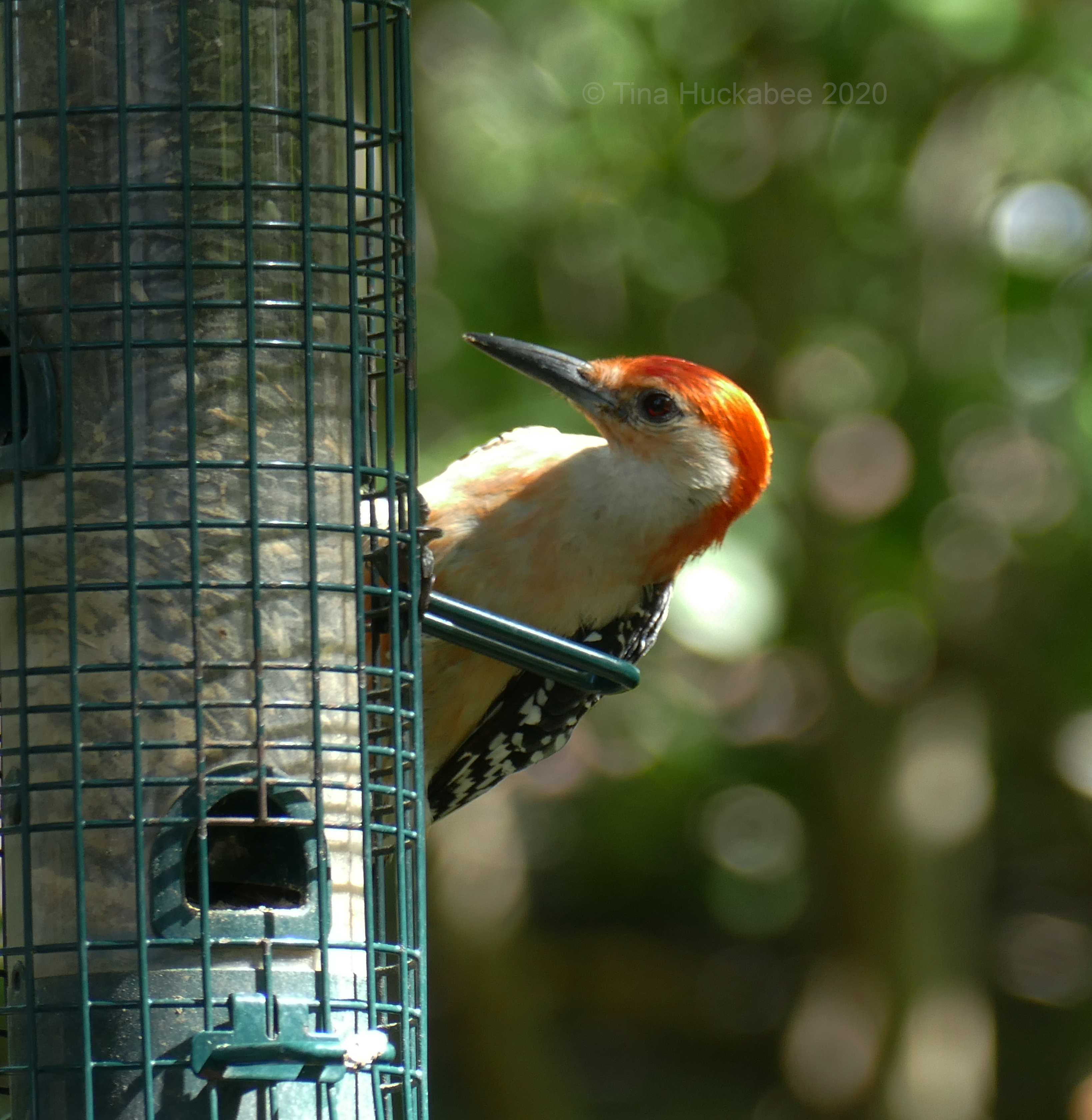
Such a pretty woodpecker! His head is most definitely red, but it’s the blush on his belly which gives this interesting bird its common name.
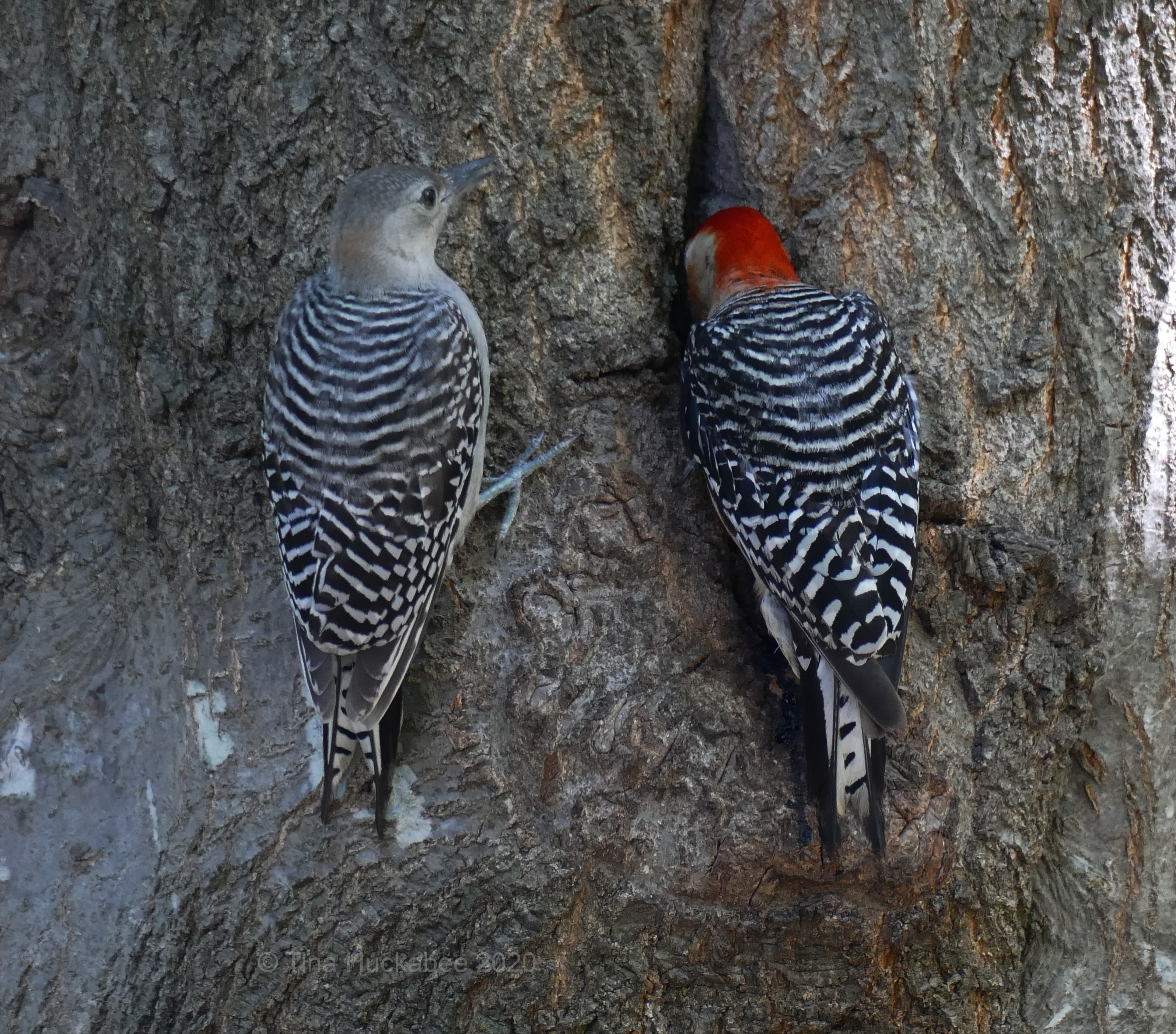
As dad picks up a black-oiled sunflower, baby red-bellied waits patiently on the trunk of the near-by Oak tree.

C’mon Dad! I’m hungry!
I observed this sweet familial scene for about 15 minutes. Dad flew to a feeder–mostly the sunflower, sometime the peanut–grabbed a morsel, then zipped back to the tree. When the snack choice was a sunflower seed, he’d spend a minute working the seed-coat off by hammering it as it was secured in the crevice of the bark. I wonder how he’d learned–by experience or from his parents–that by placing the seed in the crevice, he could better work the seed without its falling on the ground? Finding an easy source of available food and preparing it for a meal would a skill dad would want to pass on to junior. Modeling is the best form of teaching!
It’s not yet clear if the fledgling is male or female, but there is the suggestion of rosiness on the back of baby’s head. Time will tell. Male Red-bellied red heads begin between their eyes and cover over the tops of their heads. Females’ red heads start toward the backs of their heads, leaving their sweet faces mostly non-red.

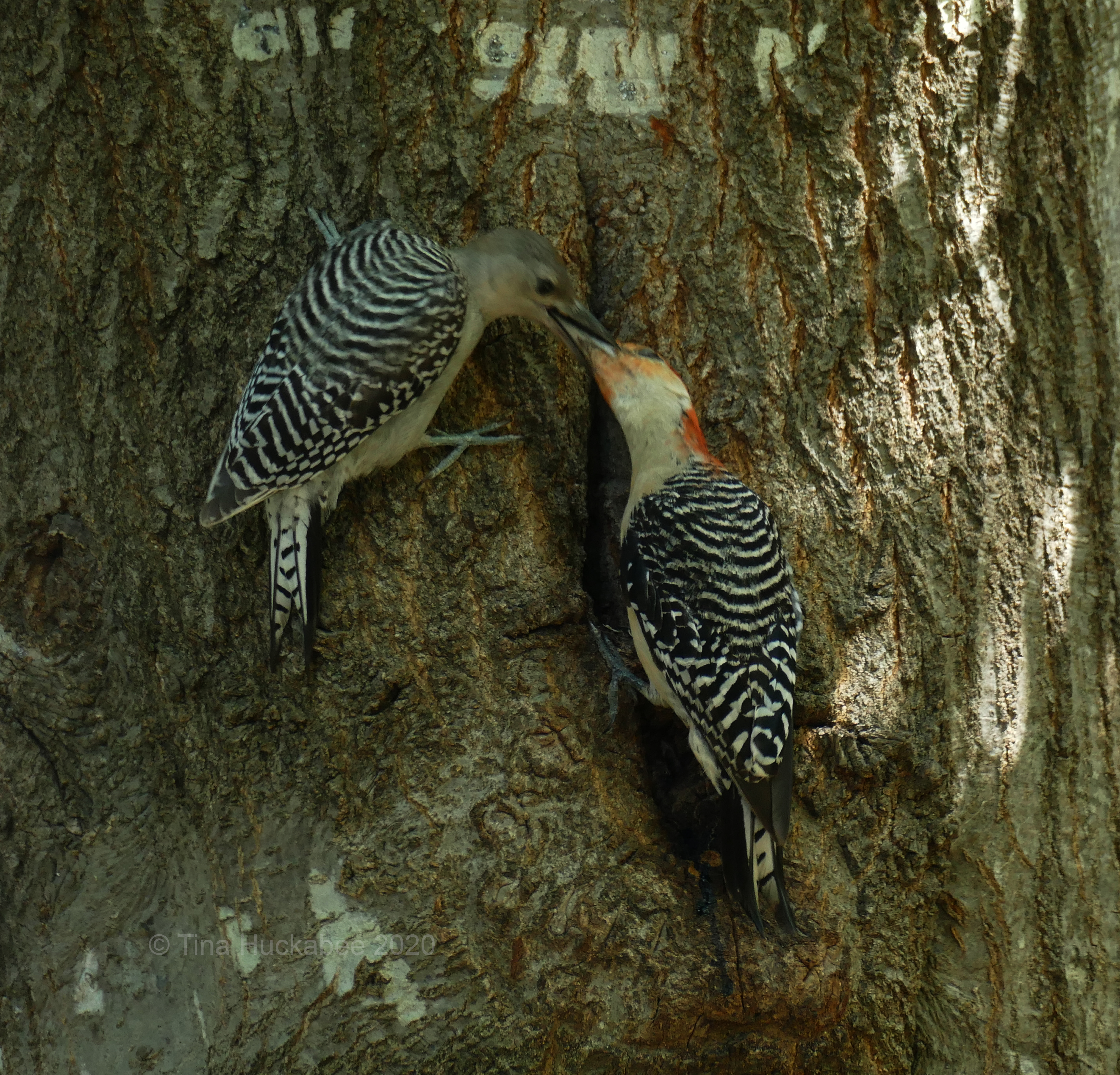
The youngster knows a treat is coming and inches closer in anticipation!
Yum!! Thanks, Daddy! 
Woodpeckers are common feeder birds, but they eat a wide variety of foods: all kinds of insects, spiders, nuts from a variety of trees, and seeds from annual and perennial plants. According to Cornell’s page on Red-bellied Woodpeckers, they sometimes eat lizards, nestling birds, and small fish. I’ve watched as woodpeckers (Downy Woodpeckers, too) glean insects from the barks of trees, but I’ve never witnessed any munching on protein from higher-up along the food chain.

“Yes, Little One, you might someday enjoy the crunch of a lizard.”
I watched these two in my back garden as they hung out on my Red Oak tree, but commonly, I’ve seen Red-bellied Woodpeckers–mom, dad, kids–hitch themselves along the thick branches of my neighbor’s large front garden Arizona Ash tree. That tree now belongs to my SIL: different neighbor, same house and tree.
The ash is old and particularly weak-wooded. During a May storm, a major branch broke, landing in multiple pieces at the end of SIL’s driveway. It was rather dramatic! Thankfully, no one and nothing (except the branch) was damaged. Interestingly, the break occurred at an established Red-bellied Woodpecker nesting site. Especially in the last few years, I’d observed little red-heads hanging out from the hole that some dad started and some mom helped finish. This spring, before the break, bully European Starlings chased off the Red-bellied Woodpeckers, which was sad. In retrospect, I’m glad the Red-bellied babies weren’t in the nest when the storm came and the limb fell.
As neighbors stood around and marveled at the mess, recounting their own storm horror stories, I cast my eye on the portion that housed the woodpecker hole and nesting cavity. SIL was on-board with me taking it–for what, I wasn’t yet quite sure.
That piece of former woodpecker nest now sits in a garden just below the tree. 
The hole, drilled through the thick bark by determined, hammer-beaked woodpeckers, is a door/window into the tree. The nest cavity was fairly roomy and the sides of the hole were completely smooth, an exemplar of fine crafting by woodpeckers.
At the storm-driven break, obviously weakened by the nesting of generations of Red-bellied Woodpeckers, I filled the former nest with potting soil after plugging the woodpecker hole with crushed granite. I popped in a stem of Ghost Plant, Graptopetalum paraguayense and the plant is doing well in its new home. I just need to water from time-to-time. Ahem.

I enjoy observing the excellent parenting skills of the various birds who visit my garden. For a while longer, I’ll watch the juveniles’ antics as they mature. Autumn isn’t too far in the future and the new generation will eventually leave, moving on to their own territory to find mates and continue the cycle.
What wild things did you see in your garden this past month? Please leave a link, if you’d like to share your garden’s wild ways. Happy wildlife gardening!



 My Gardener Says...