
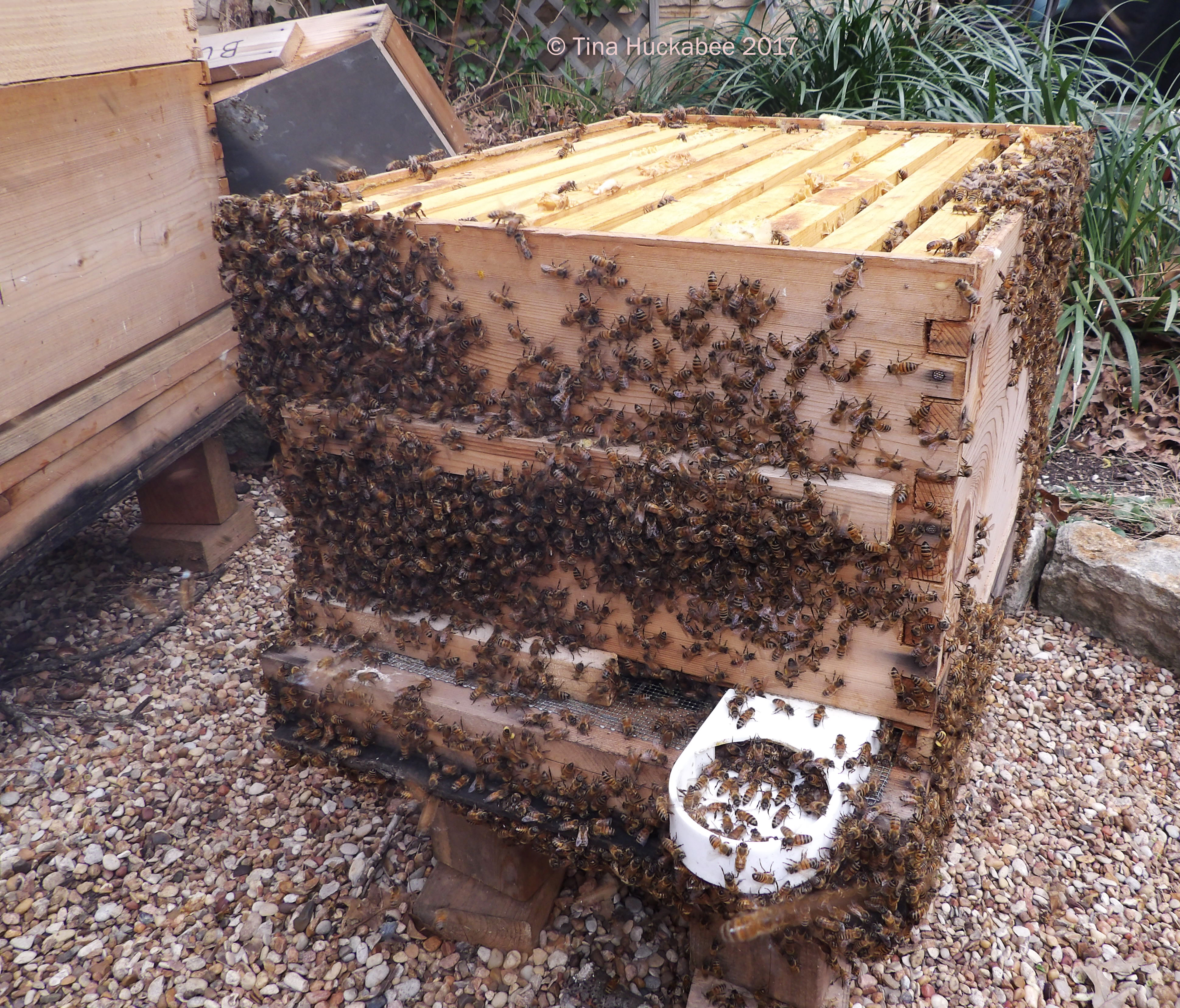
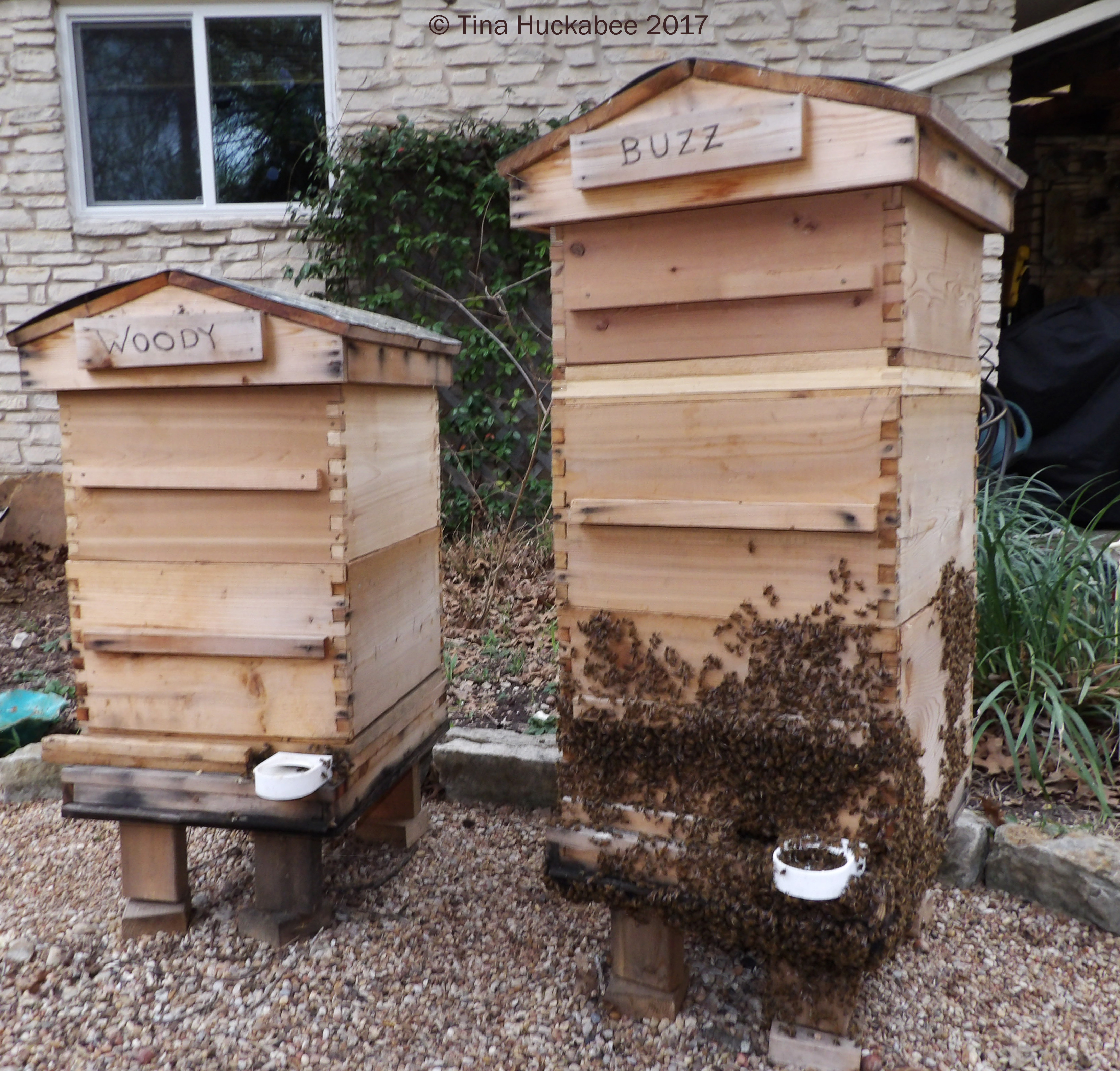
Several weeks ago and for the second time this season, Bee Daddy and I checked our honeybee hives, Buzz and Woody. We knew that we needed to peek in on the girls, but weather and schedule conflicts conspired to repeatedly delay the inspection. Toward the end of a weekend where rain was forecast, but had yet to materialize, I impulsively opened the lid to Buzz and was astonished to find busy bees jam-packed up against the lid–comb built horizontally, rather than vertically–and nurse bees tending plenty of larvae. In other words, the bees were so packed in and crowded, that there was no more room along the frames for the queen to lay eggs.
Overcrowding in a honeybee hive is what will cause the bees to procreate or reproduce another hive. SWARM!!
Oops! We realized we’d better hop to it and to check things out before Buzz and/or Woody initiated a swarm. A honeybee hive is a superorganism consisting of many individuals, but who function as a whole organism. Individual honeybees don’t mate and reproduce, they have a queen who mates and lays eggs and that’s her only function. The workers are all of the other honeybees who keep the organism, the “hive,” clean, fed, and productive. If a hive becomes crowded to the point where the queen has difficulty finding places to lay eggs, the bees will produce another queen. The original queen will leave the hive to form a new one, taking roughly half of the workers with her. Two queens, two hives–that’s honeybee reproduction.
I knew that with our spring blossoms in full swing that the bees had been crazy busy with nectar and pollen gathering, but I didn’t realize just how successful they’d been. While I’m not anti-swarm, I’d rather my hives not swarm because we’d lose half of our workers and we don’t know where the gone girls would end up–they might land in unfriendly hands. To control the situation, we quickly donned our bee suits, fired up the smoker, and got to work controlling nature.
We all know how well that usually turns out.
Once we opened Buzz and Woody, our first order of business was to scrape away the rogue comb with larvae and to disposed of it. I hated to do that, but we can’t allow the bees continue building there because it would make subsequent checks impossible. So scrape we did. I don’t have photos of that stuffed-wherever-they-had-room-to-build-it comb, but after we cleaned it up, we began pulling out frames to check for brood and also, to check for queen cells: remember that, it will be important later. In both hives there was beautiful egg laying pattern in many of the combs, with both capped and uncapped brood. The flatter capped brood are those that will become valuable female workers.
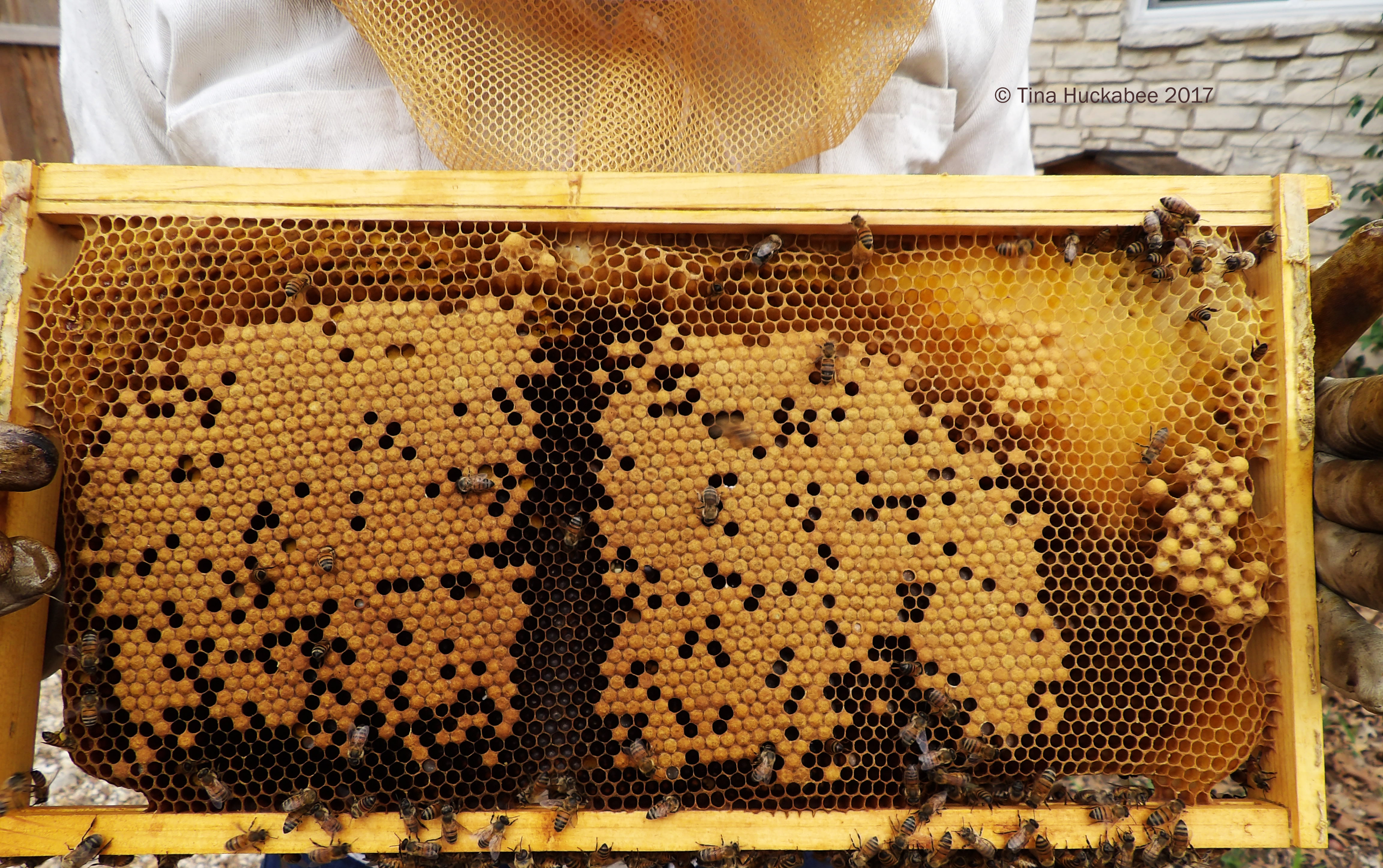
The area of no capped brood in this photo is where I placed a rubber band after having broken the comb in the previous hive check.
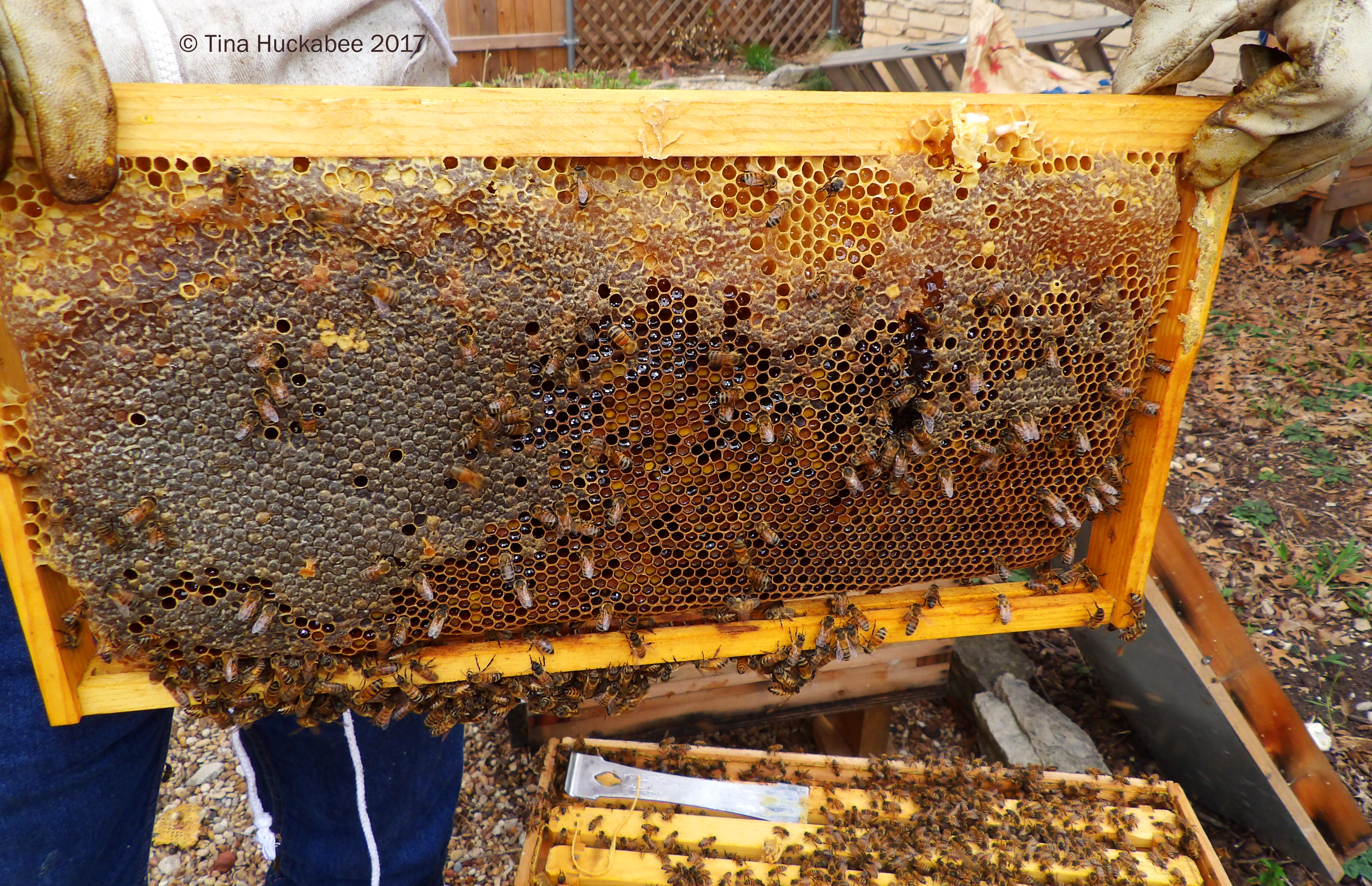
There was also capped brood of drones, or male bees. The drone eggs are usually laid at the sides and bottoms of the frames and, once capped, are larger and rounded.
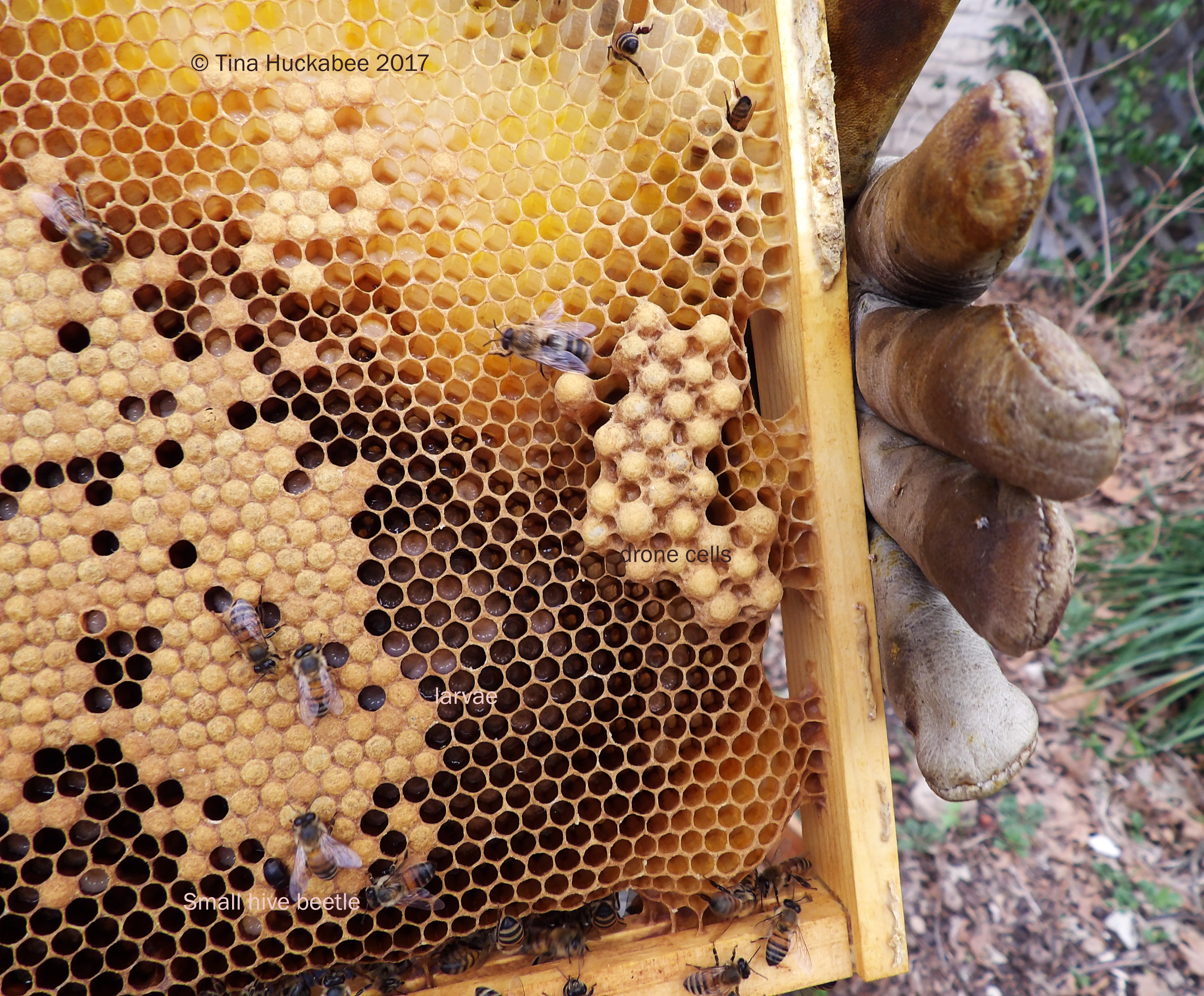
The only job for a drone bee is to mate with the queen–that’s it. Drones don’t gather pollen, they don’t gather nectar, they don’t take care of baby bees; they do nothing toward the good of the hive. They mate with the the queen and that’s all they do. That’s fine in the real world, but our queens are mated when we purchase them, so drones in our hives are superfluous.
Sorry guys, you’re worthless deadbeats. You eat the food, you sit on the comb, you watch bee TV, and you don’t do a damn thing.
Actually, we generally allow our drones to live because the honeybees we purchase (BeeWeaver Apiaries) are varroa resistant and that’s a good genetic quality to send out into the world. The drones from our hives potentially mate with “wild” honeybees and that ability to rid themselves of Varroa destructor mites is a powerful and positive genetic component to pass on.
Buzz and Woody were so full that we added another brood box to each; both now have two brood boxes, with room to grow. To Buzz we also added a shallower top box called a dadant box; it will be only for comb and honey. How do we keep the queen from moving into this top box and laying eggs? We added a queen exlcuder (a metal frame laid horizontally atop the second brood, now middle, box), between that brood box and the new dadant box. Only the worker bees can enter the dadant–the slats are too narrow for the larger queen to get through.
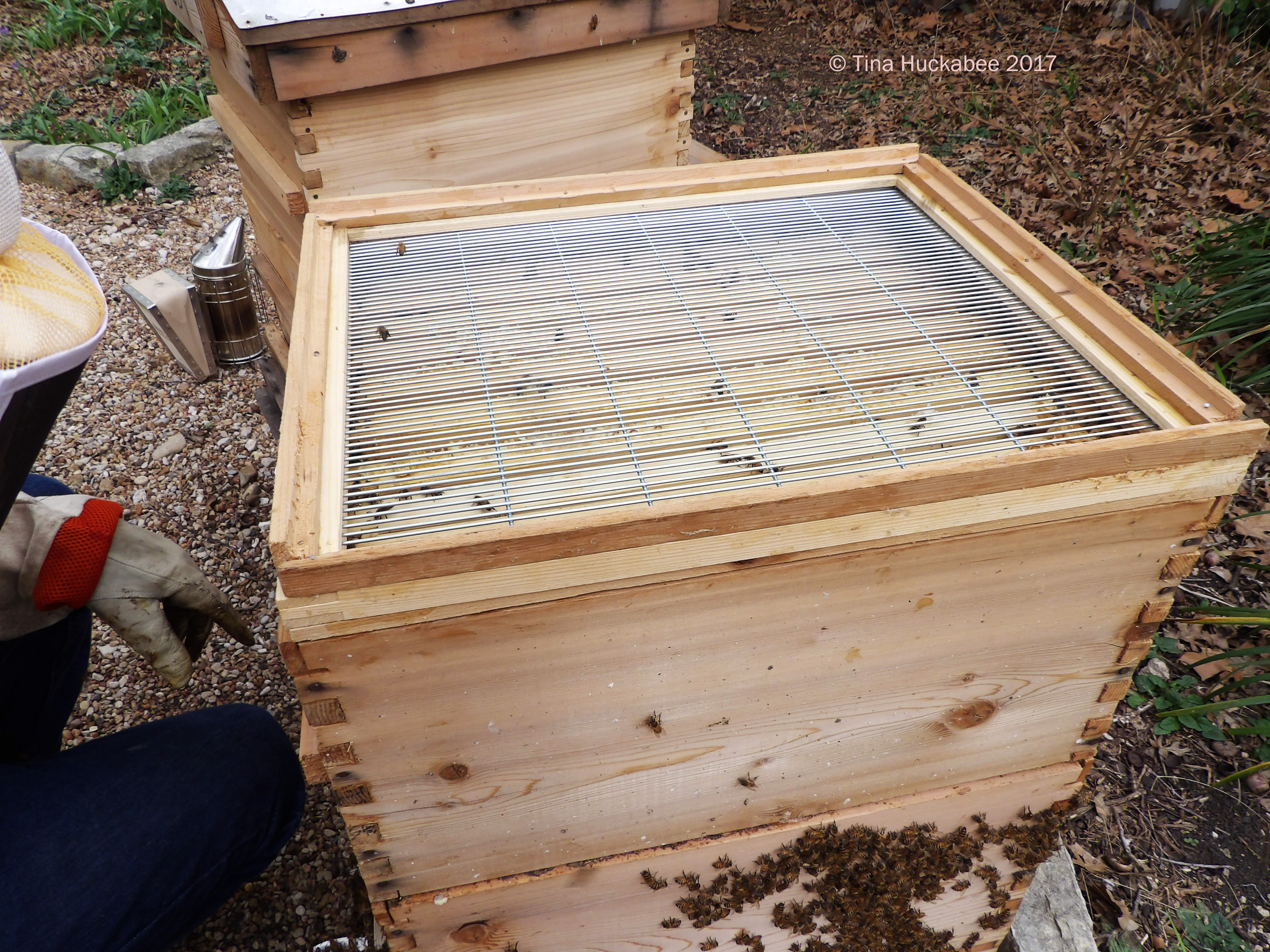
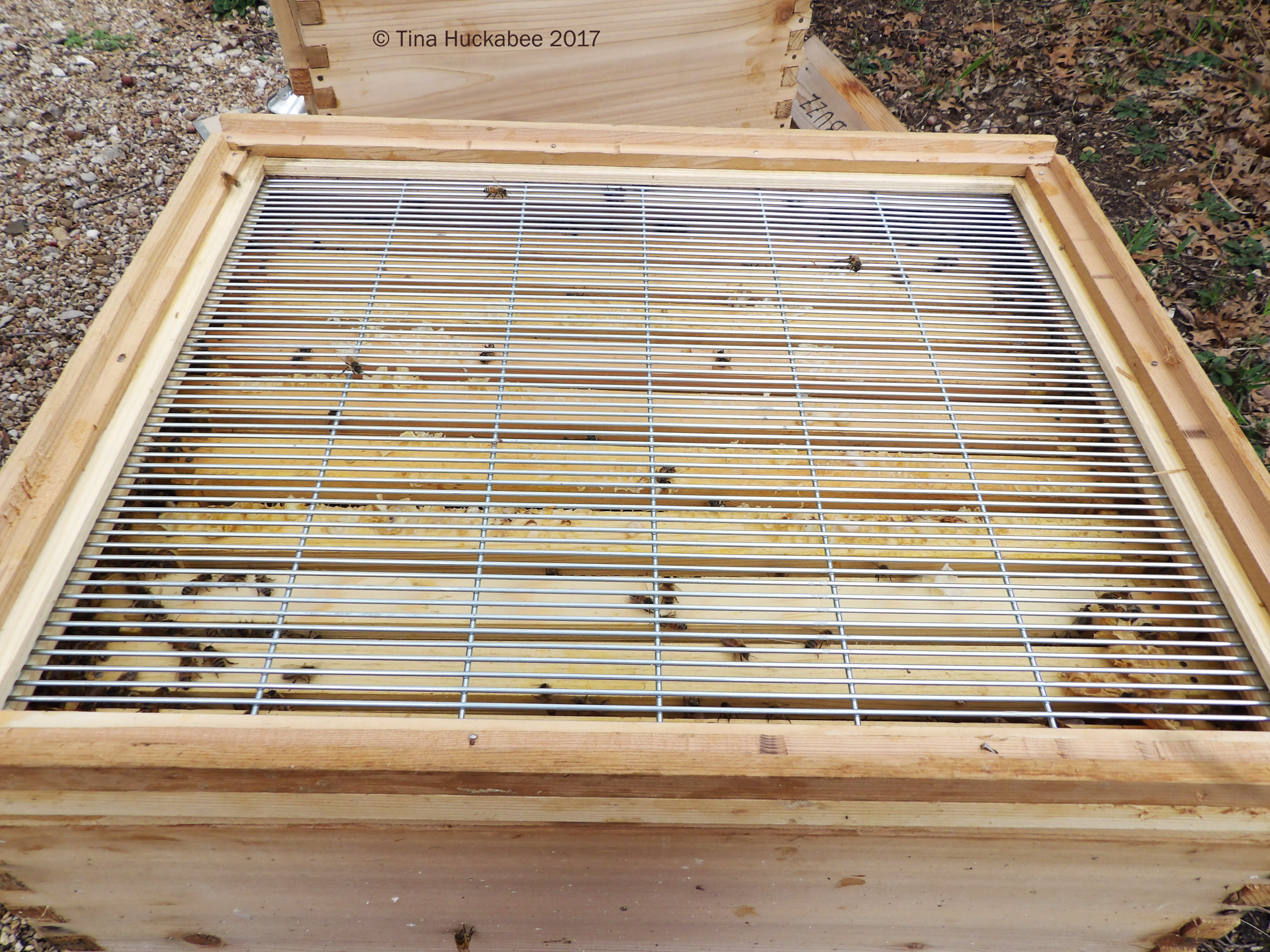
The workers will build comb and make honey, but with no queen in that box, there will be no eggs: all honey, all the time. I don’t expect honey for quite a while from Buzz, but we hope to extract some by the end of this season.
In opening these cramped hives, we knew that there was a possibility that the honeybees had begun the swarming process by creating one, or more, queen cells. Sure enough, we saw several in both hives like this:
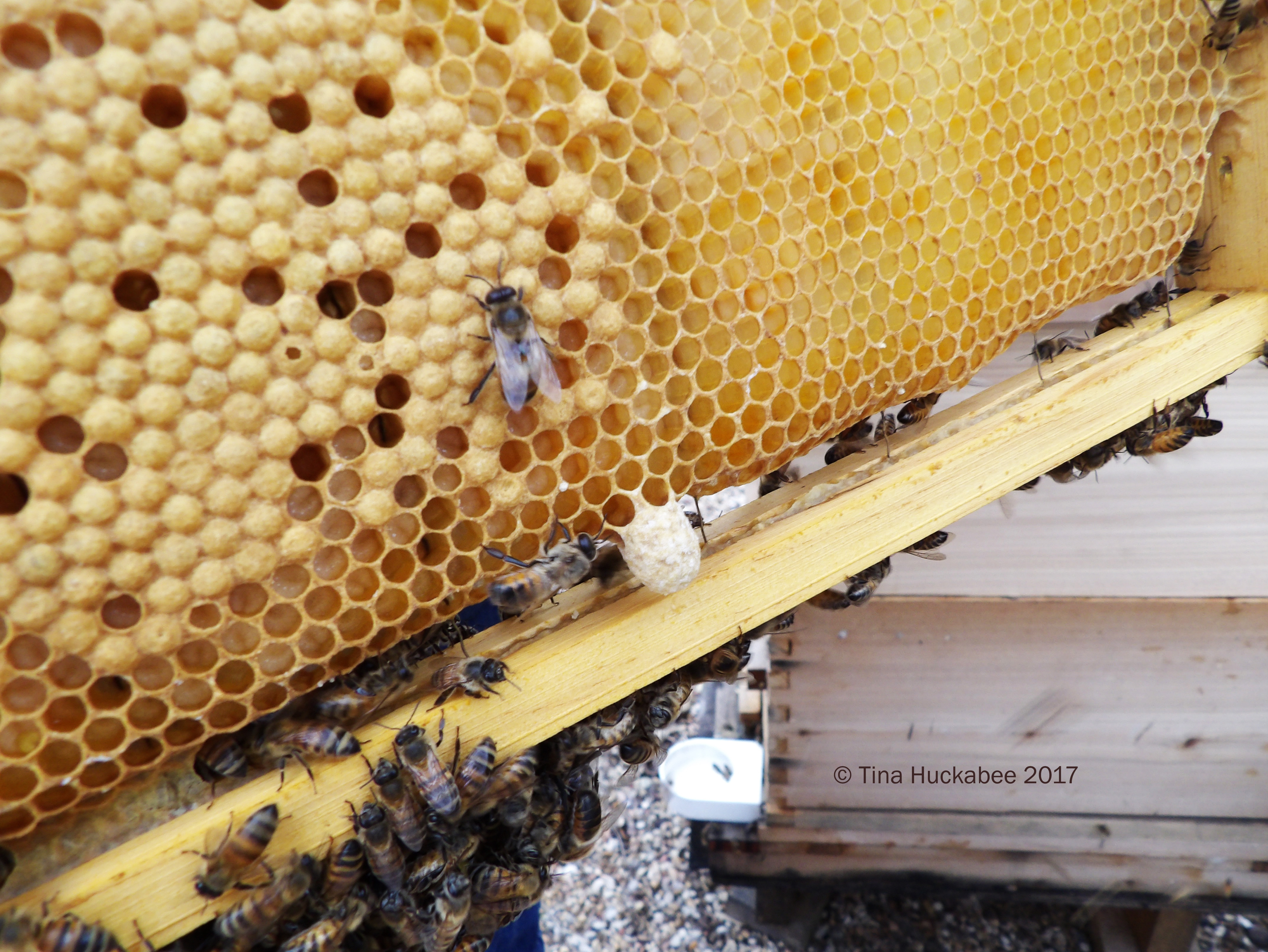
The queen cell is that bulbous thing at the bottom of the frame. The other capped brood are regular workers. There are also a number of uncapped larvae–I call them “squishies.”
Queen cells are oblong and peanut-shaped and usually placed at the bottom of a frame; they are distinctive from all the other capped brood. There is another type of queen cell besides the overcrowding sort; remember that, it will be important later. Since we have laying queens, we snipped off each queen cell that we saw. In theory, the queens are laying eggs well, we’ve added brood boxes, thus giving both hives more space to grow, so the honeybees shouldn’t swarm.
Fingers-crossed.
The bees were cranky about the intrusion and our having turned their homes inside-out, but by nightfall, all had marched back into their respective hives.
That same weekend, I finally processed the honey that I’d removed from Scar, our original hive, which I wrote about at the end of my last Bee Mama post. I crunched the comb and dripped as much honey as feasible into four, 12 ounce jars.
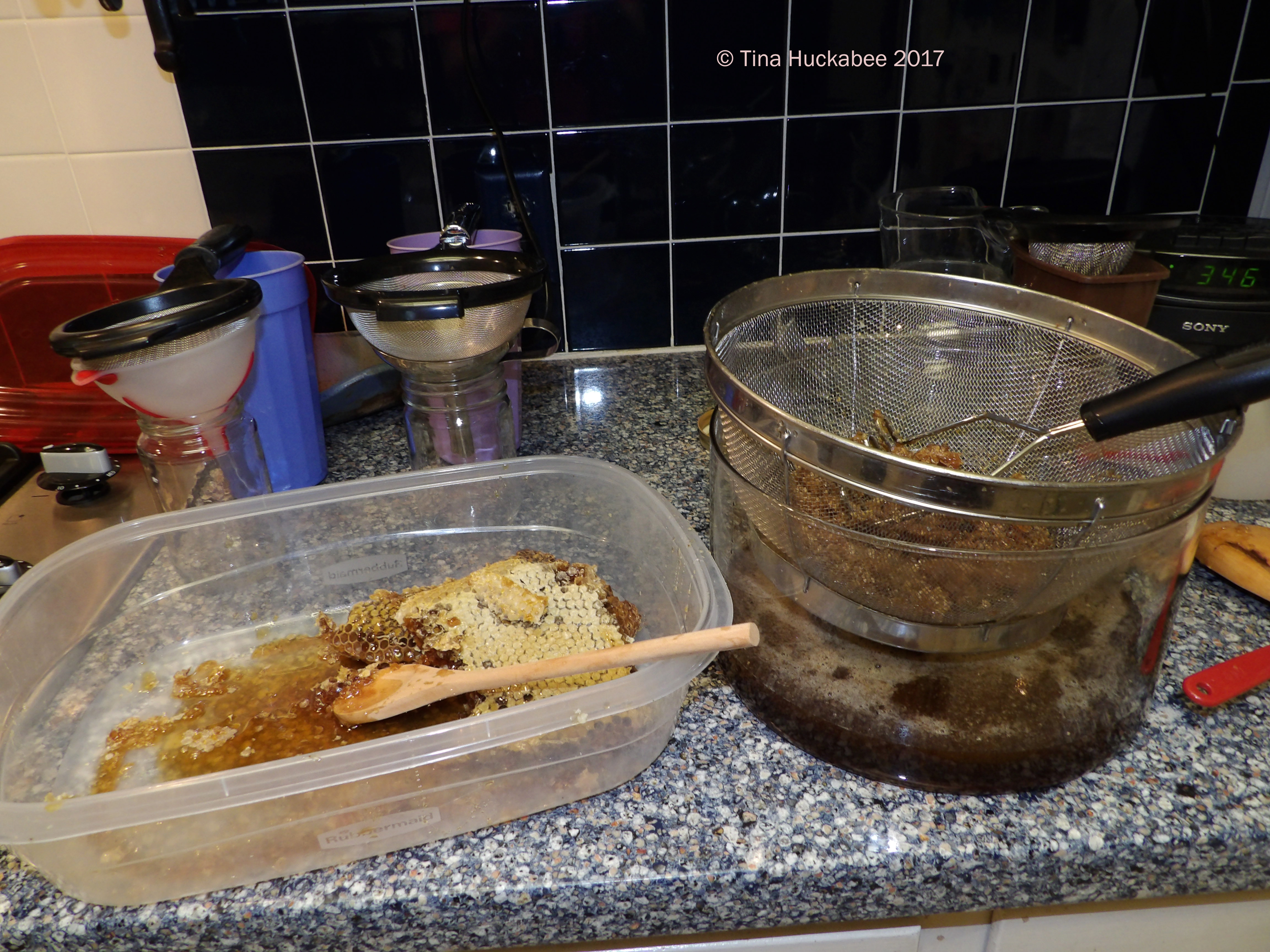
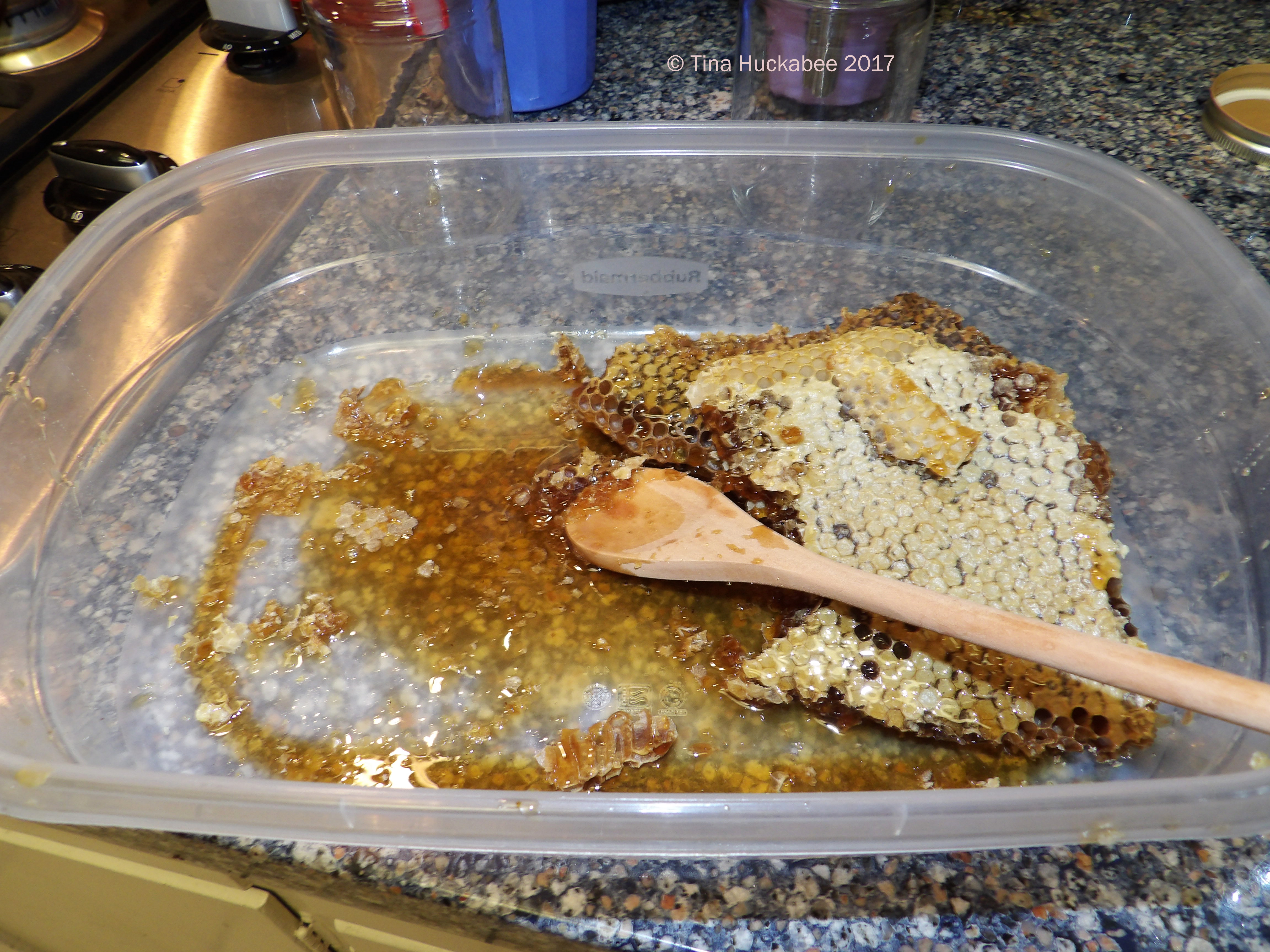
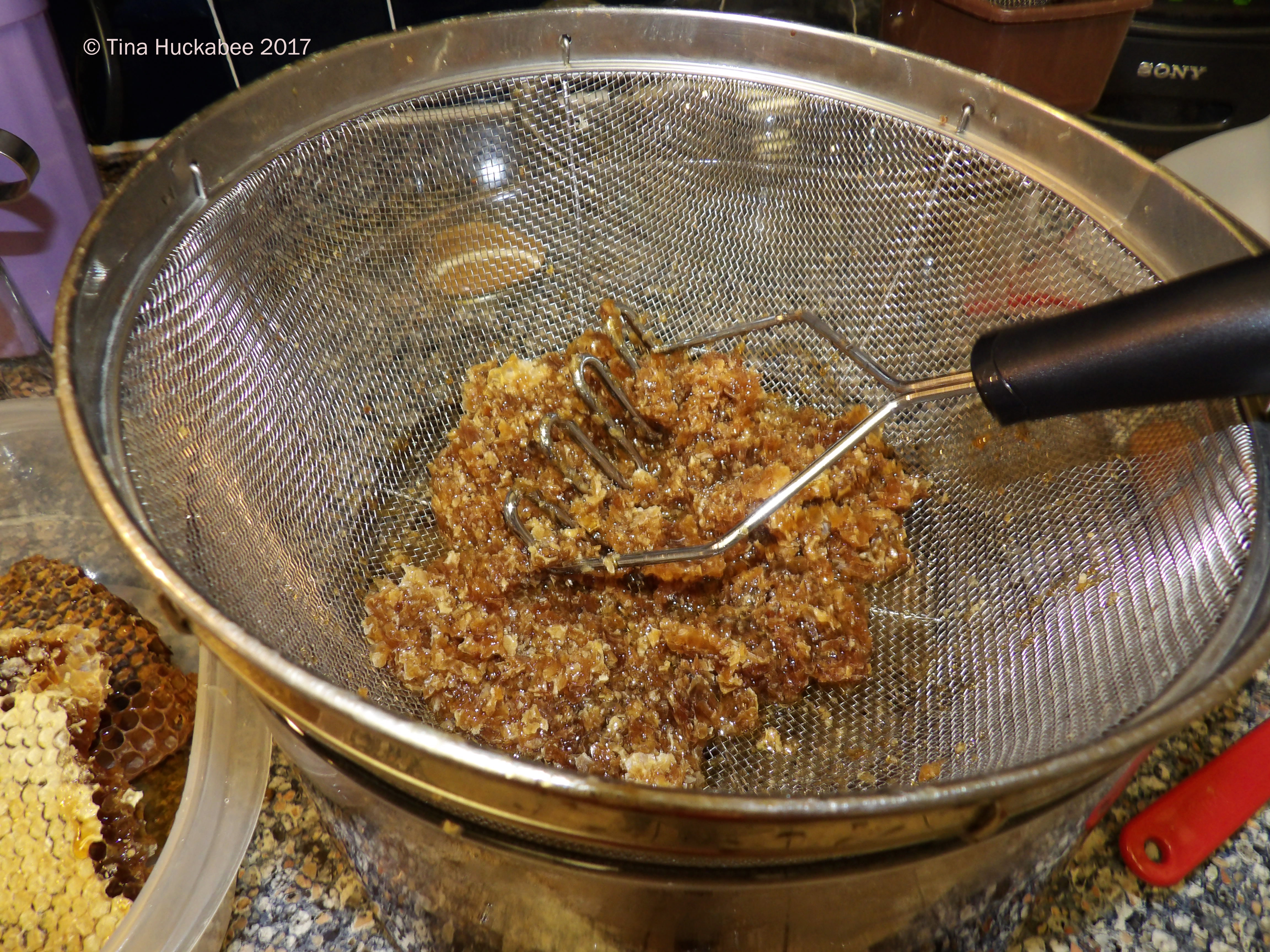
Fall honey!!
As has been my practice, I laid out the rest of the pulverized comb with plenty of honey still available for the bees to enjoy.
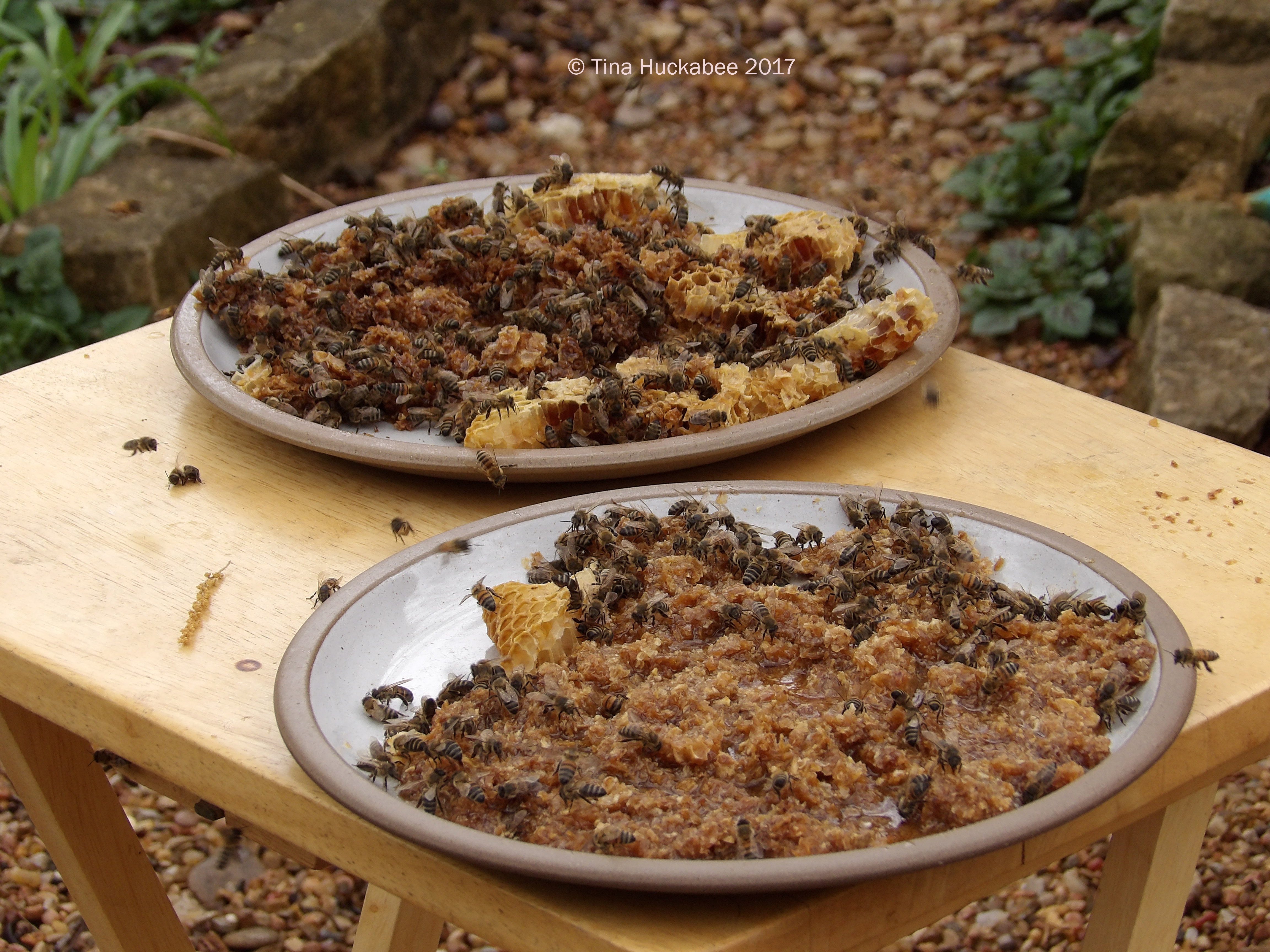
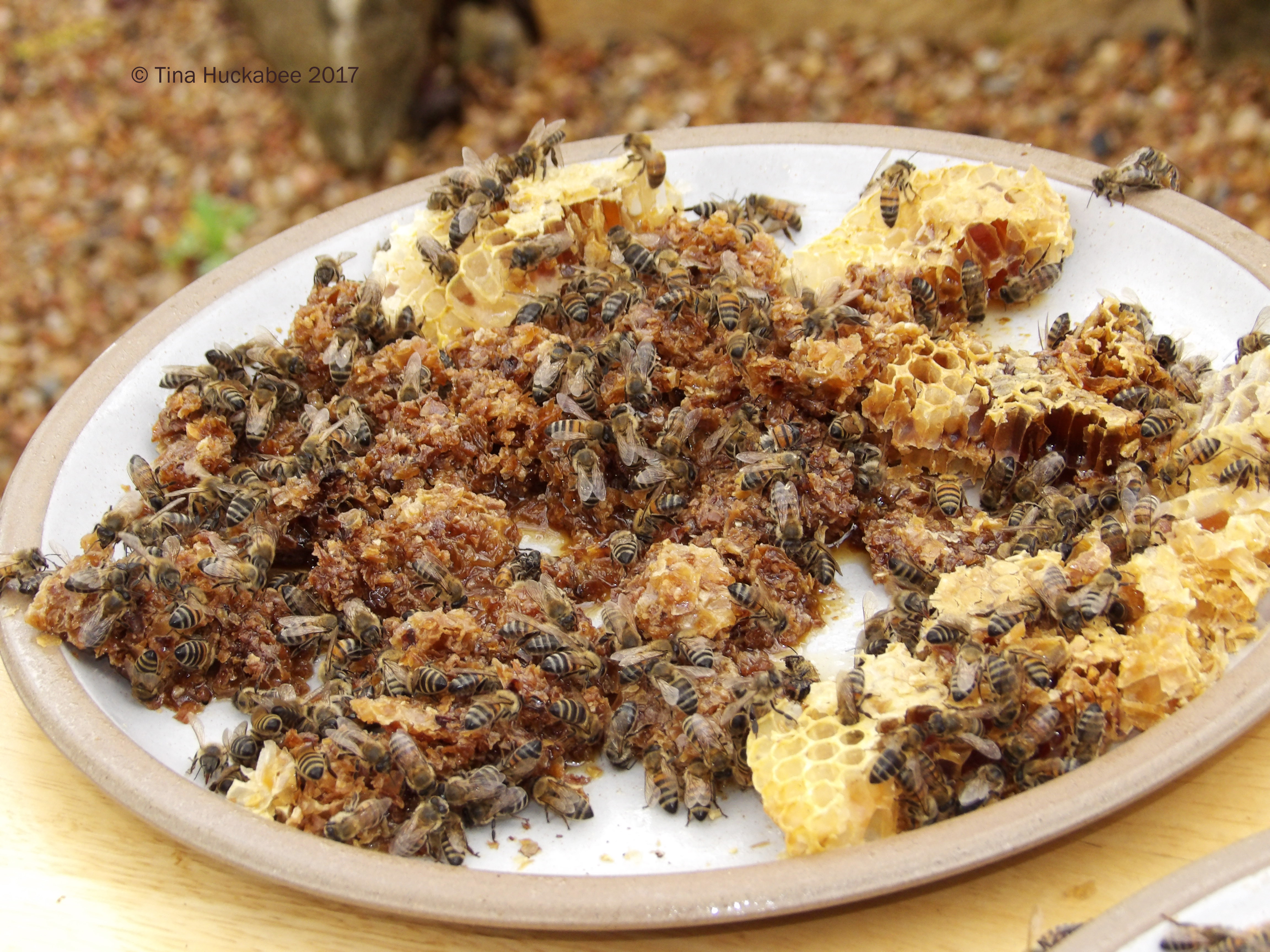
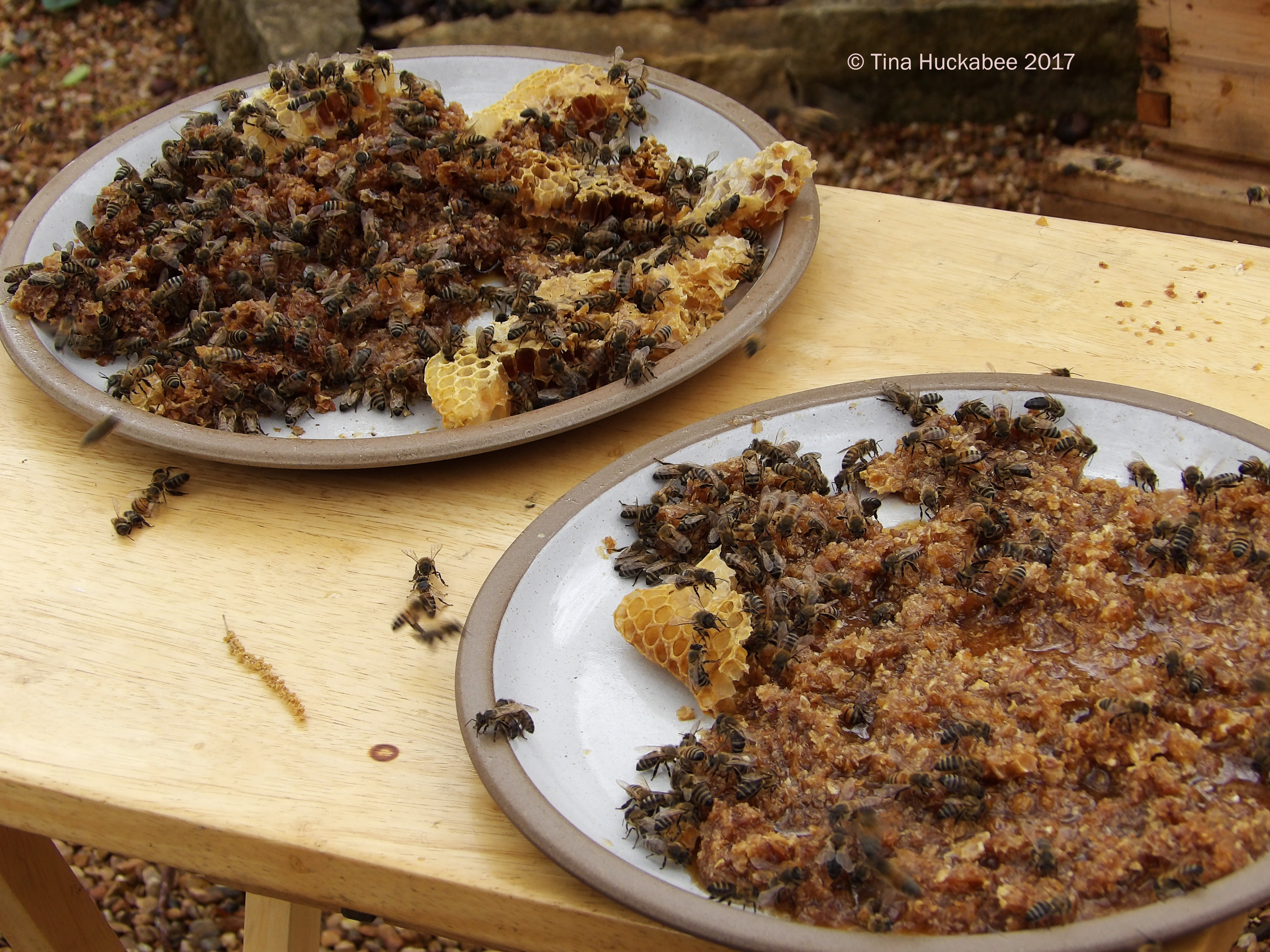
By the end of the next day, there was only dry comb left. I think bees like honey, what do you think?
That check took place almost three weeks ago. We’ve checked again this past Sunday, with interesting results.
Stay tuned….











 My Gardener Says...