A FeederWatch Find

In a recent post, Birding for Fun and Profit, I mentioned that volunteer birders across Canada and the U.S. are instrumental in assisting with research related to wild bird populations by submission of raw data observations of kinds and numbers of birds visiting yards and gardens. Aside from the pleasure of bird watching (and complementary teasing of friends and family which invariably accompanies the hobby), is the knowledge that bird watching advances true scientific efforts.  Project FeederWatch has tracked the advancement of certain avian diseases and requests its citizen scientists to report instances in their data logs. This past week, for only the second time (and first time during my “official”  Project FeederWatch period),  I’ve observed a bird with symptoms of red, swollen, and crusty eyes which is caused by the bacterium, Mycoplasma gallisepticum.

This little guy was at my feeder this past week, unfortunately  demonstrating a classic case of House Finch Eye disease, a kind of conjunctivitis caused by M. gallisepticum.
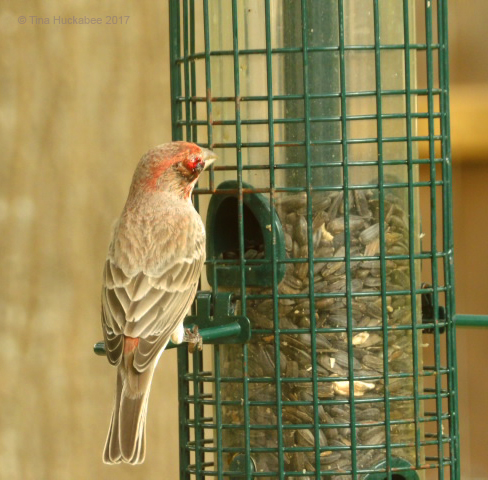
This male House Finch’s eye is almost completely closed due to inflammation.

First observed in the mid-1990s by Cornell feeder-watching volunteers, this disease has spread throughout the House FinchHaemorhous mexicanus, population of North America.  The poultry respiratory disease made a species leap to wild House Finch populations and because the beginning of the epidemic can be traced to a specific point (Maryland) and time (February 1994), and because Cornell Lab of Ornithology’s Project Feederwatch was in full swing, volunteers reported sightings describing House Finches with symptoms of eye disease and scientists got to work.

Within a few years, reports of diseased House Finches were common throughout the U.S.  With raw data provided by Cornell’s “army” of bird watchers and the creative impulse of a Cornell Lab scientist, Belgian-born ornithologist, André Dhondt, an interdisciplinary research team has studied the evolution of this new disease from its inception and analyzed its impact on a given population–in this case, the hapless House Finch.  In the two decades since M. gallisepticum debuted in that small population of Maryland House Finches, the process of disease evolution–mutations coupled with population dynamics–is better understood, and scientists are now utilizing the gained knowledge towards a fuller understanding of disease spread in humans and development of immunities.    For a fascinating read, check out this article: House Finch Eye Disease: Outbreak, Then Understanding.

As for my little diseased finch, I haven’t seen him in a couple of days. I have noted his presence on my data for the week. Last year, I always indicated  “yes” and “zero” responses to the questions of if I looked for House Finch Disease and how many finches I saw.  This week,  it’s still a “yes” but now with a “one.”  I’ve only seen one other House Finch with crusty eyes and that was on a female House Finch in May 2016. With each passing day that I watched her, she became less able to function at the feeder. Both of her eyes were swollen and nearly closed; she would flutter until she happened to land on a branch, or the feeder, or the ground.  It was clear to me that she couldn’t see well enough to fly and perch.  For her, feeding became nearly impossible due to her poor eyesight. Eventually, she stopped visiting my back garden.

For what it’s worth, the other eye of the finch I’ve observed this week is healthy and unimpaired and he’s flying and feeding normally.   Additionally, most birds aren’t afflicted by this disease; continent-wide, American Goldfinches (which I only see in late winter) and a few others have been impacted.

What to do?  Well, there’s really nothing I can do to help individual birds.  They might recover on their own, but more likely, they’ll starve or become prey for someone else once they’re so blinded that they cannot feed and fend for themselves.  I am wiping the feeding stations on the feeder each evening with a diluted bleach/water solution, and that’s one easy way to keep the feeder clean.  Feeders should be washed once-per-month, though I have to admit that I don’t do that as regularly as I should; I should make that change.  Other tips for healthy bird feeding include regularly raking or sweeping the area underneath feeders and spreading feeders throughout the garden so that birds aren’t crowded.   Always, if you catch a sick bird, contact a wildlife rehabilitator in your area–he/she will have the expertise to care for the sick bird.

While I certainly subscribe to the dictum of letting nature take its course, we gardeners and bird watchers can help our wild ecosystem partners thrive by simple changes in our gardening and bird-feeding practices. Let’s take care of our wild birds!

 

Grasses, Berries, Groundcovers: Autumn Images

Cooler temperatures and regular rainfall herald autumn in Central Texas–and we all breathe a sigh of relief that the broil of summer has passed. Perennials awake from their summer siesta, ushering in a second spring of blooms. From September until first frost, there are easily as many blooming beauties, especially of the native kind, as in spring.

Our native grasses, soft and elegant throughout the summer, acquire a warmth of color and rock dramatic plumage in autumn, challenging the beauty of accompanying blooms.

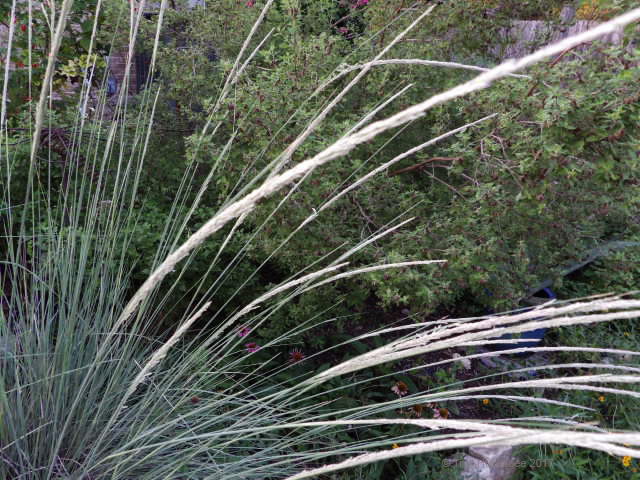
Big muhly (Muhlenbergia lindheimeri) graces a combo of Plateau goldeneye and Turkscap.

I’ve had mixed results with Big muhly, as my front garden has historically been too shady for this sun worshipper, while my back garden offered only a few spots of sun, coupled with heavier soil, so muhlies were typically short-lived.  With more opportunity for the sun to blast my front garden, the four Texas native Big muhlies planted have found a home.

The same muhly at a different angle.


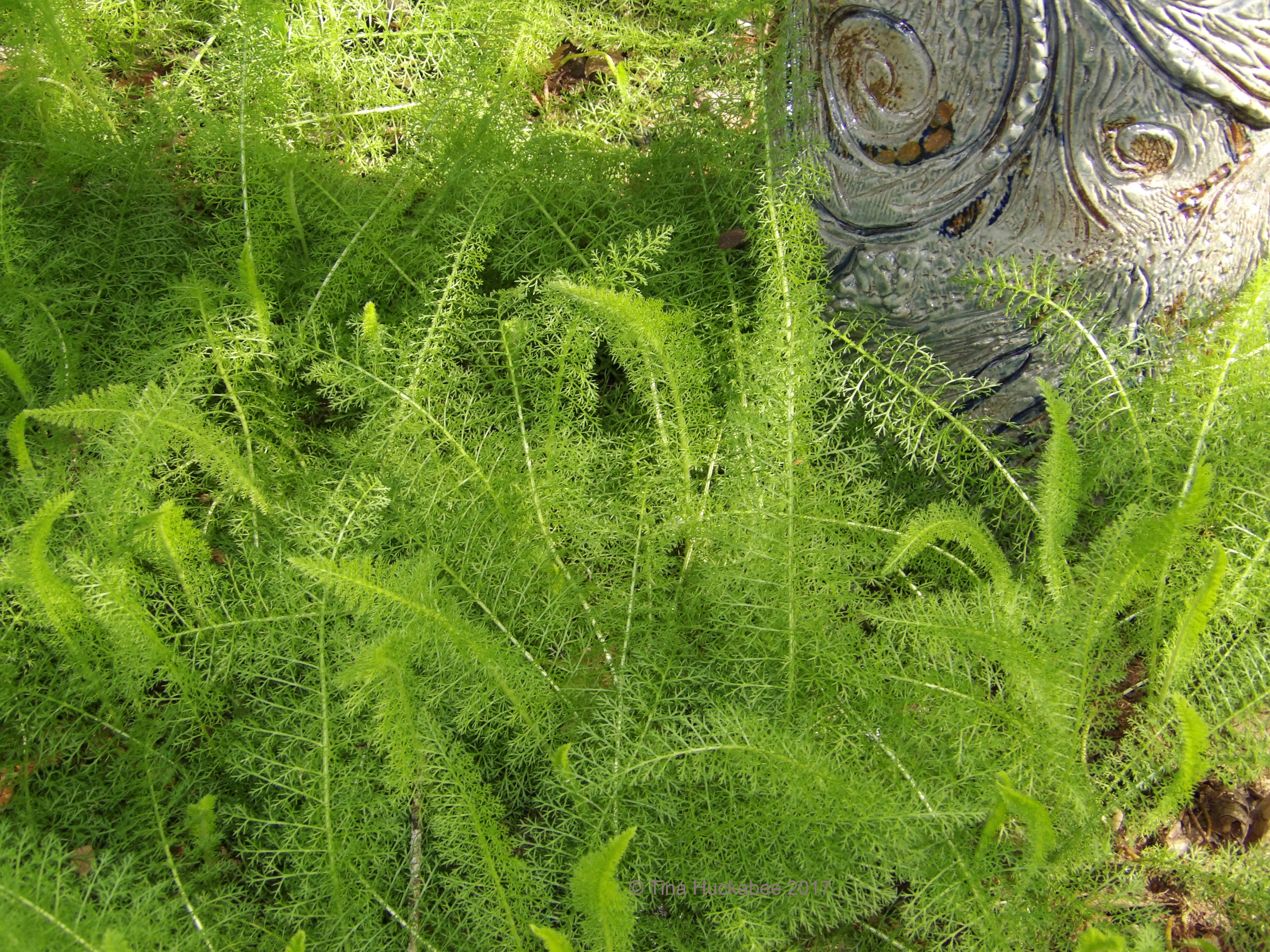
Common yarrow, Achillea millefolium,  is a native North American plant which grows throughout the continent.

A beautiful ground cover for most of the year–especially in winter–yarrow blooms white clusters atop 2-3 foot stems in June and July, the florets turning toasty in August.  Mine haven’t bloomed particularly well in the last 2 years, but I don’t mind, since it’s the lacy foliage that I prize.

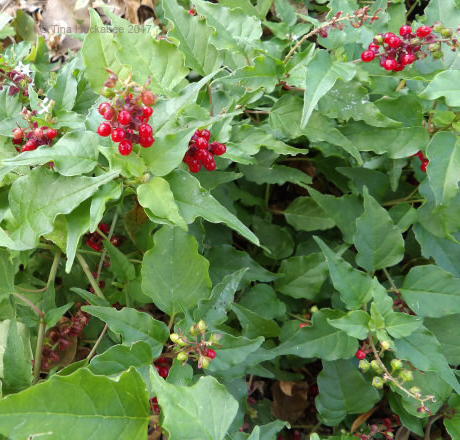
For wildlife, autumn provides a boon of berries, and Texas native plants oblige in spades.  Pigeonberry, Rivina humilis,  is a favorite of birds, especially–you guessed it–of pigeons and doves.

Leaves are ruffly and bright green, complementing both the tiny pink-to-white blooms and the cherry-red berries.   Once a light freeze happens, the foliage will blush burgundy, until a hard freeze renders this small ground cover dormant until late spring.

For now, the leaves remain a cheery green.


Another native plant, the deciduous herb, Chili pequinCapsicum annuum,  provides fruits for birds and mammals.  Birds are frequent visitors, so much so that another common name for this plant is Bird pepper.  Texas’ only true native chili pepper, the fruits are hot, but birds (and husbands) love the taste.

Red berries, ripe for picking.

The leaves are small and dainty, and the form of the shrub, elegant.    I love them planted as a mass, with 3 or 4 together.

Chili pequin planted with common yarrow.


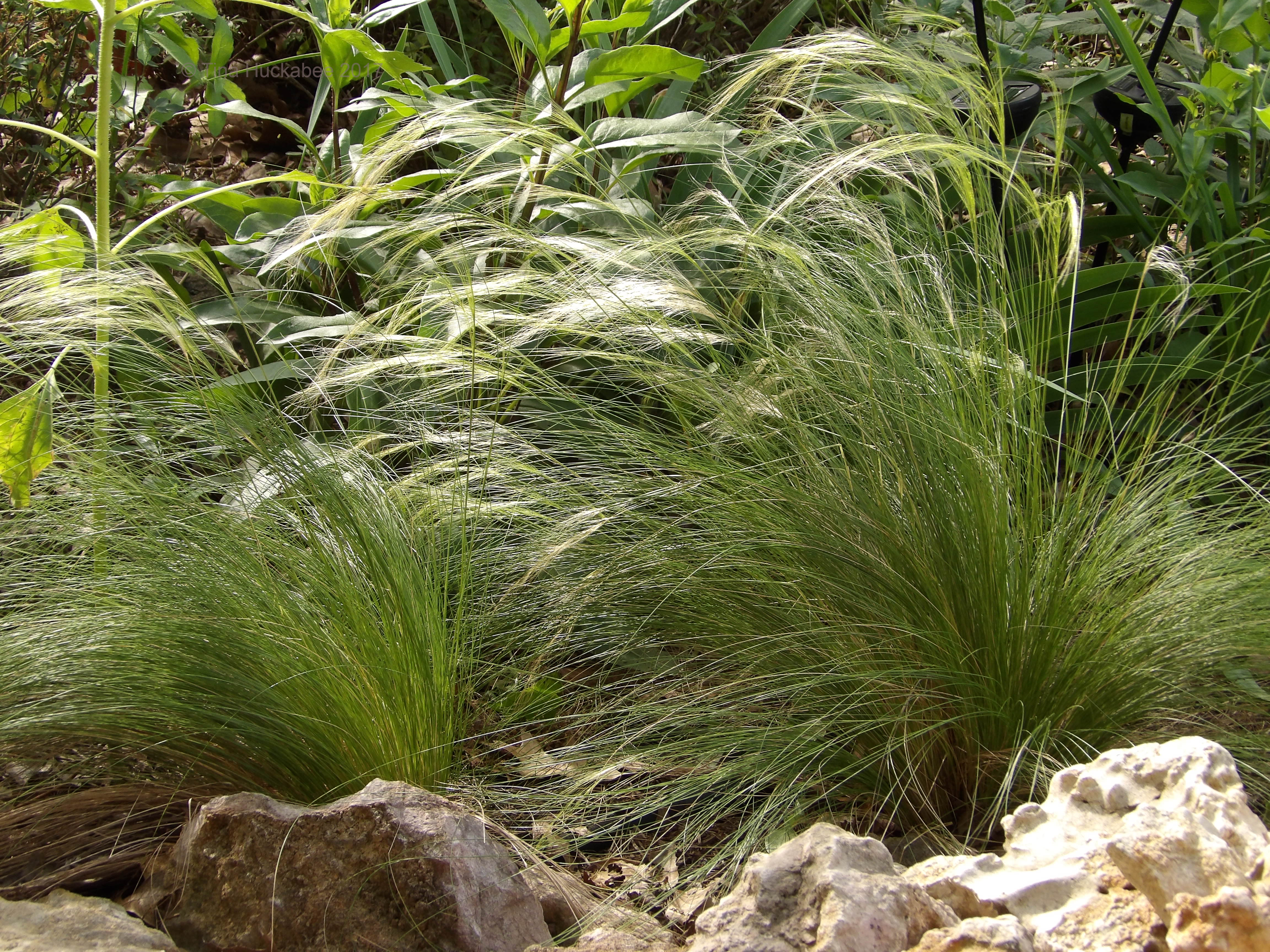
Mexican FeathergrassNassella tenuissima–for obvious reasons that you can observe, has become a popular landscape plant throughout North America.

This is the spring view of two of the Mexican Feathergrass in my garden.

Native to Texas and New Mexico, southward into Mexico, and with a separate native population in Argentina and Chili, the Mexican Feathergrass is a tough, drought-hardy perennial grass prized by gardeners and easy to grow.

The autumn view of the same two plants. More muted and worn from a full growing season, these two still accent the garden and complement the rocks which border the pond.

I’ve grown Feathergrass in both shade (not deep, but dappled) and sun.   It’s been the native grass that has performed best for me and seems a go-to grass for both home and commercial landscapes in these parts.  It seeds out, not obnoxiously, but just enough that I can transplant and use in different situations.

Thanking Christina of Creating my own garden of the Hesperides for hosting this monthly tribute to foliage; please check out her lovely blog for more fall foliage fanfare.

Birding for Fun and Profit

Okay, it’s a click-bait sort of title.  You’re not going to gain any profit, save learning about your winter birds, by watching birds in your own back (or front!) yard, but you can aid ongoing research about North American birds by participating in Cornell Lab of Ornithology’s and Bird Studies Canada’s Project FeederWatch.  Besides, bird watching is fun and interesting, especially for bird geeks!  Who wouldn’t swoon at viewing this handsome chap?

Blue Jay (Cyanocitta cristata) bathing.  Check out the droplets of water on his feathers.  A year-round resident of Central Texas, Blue Jays are stunningly beautiful,  charming–and noisy!

Project Feederwatch enlists citizen scientists (a highfalutin, fancy-pants term for volunteer) to regularly watch birds from specific spots–back yards, front yards, community gardens–from November to April, and then report numbers and varieties of birds who show up due to something  placed to attract those birds.  Appropriate bird paraphernalia includes feeders (duh…), water features, houses and the like.  There are specific counting measures (easy to understand and follow) and the method for uploading to Cornell’s site is easy-peasy.  The weekly time commitment is whatever you want it to be (15 minutes or  hours-long), and with specific parameters–also doable.

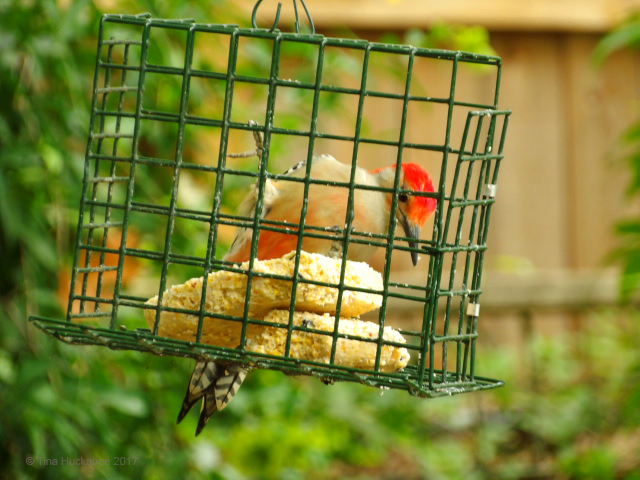
The real treat is that instead of being a weird birder, you have a legitimate scientific excuse to watch birds such as this lovely guy:

Shy and wary, this Red-bellied Woodpecker (Melanerpes carolinus), is another year-round resident, but I only see them in my garden during winter and early spring.  He and his mate are mad for suet!

Research on North American bird populations by information gathered from regular bird-crazy folk and has yielded vital details about altered migratory patterns and populations, spread of diseases (like House Finch conjunctivitis), and how and what impacts birds throughout the continent.  The data collected assists scientist with the following  (from Project FeederWatch):

  • long-term trends in bird distribution and abundance
  • the timing and extent of winter irruptions of winter finches and other species.
  • expansions or contractions in the winter ranges of feeder birds
  • the kinds of foods and environmental factors that attract birds
  • how disease is spread among birds that visit feeders

And gosh darn it–birds are beautiful and vital for our gardens and the ecosystem as a whole.  Why wouldn’t you want to learn more about their habits if what you learn potentially helps them survive and thrive?

My winter birds are showing up and showing off!

An Orange-crowned Warbler (Oreothlypis celata) waits his turn at the suet feeder. He, his mate and other warblers will likely be present in my garden until April–then head north for breeding.

To participate, check out Project FeederWatch.  There’s a required small fee ($18) US, ($35) CAN, which covers various administrative costs.  Officially, Project FeederWatch started this past week, but jump in whenever you have the time and inclination–bird lovers everywhere will cheer and the fine folks at Cornell Lab of Ornithology and Bird Studies Canada will appreciate and utilize your efforts and data.

Additionally, if you love wild birds and regularly feed them, this timely Cornell’s All About Birds article is a reminder about the various types of feed appropriate for birds and is a good read, whether or not you participate in Project FeederWatch. It’s an excellent reminder that our choices of bird feed should be about their needs and not just what we think they should have.

Orange-crowned Warbler enjoying some fat-filled suet.

Happy backyard birding!