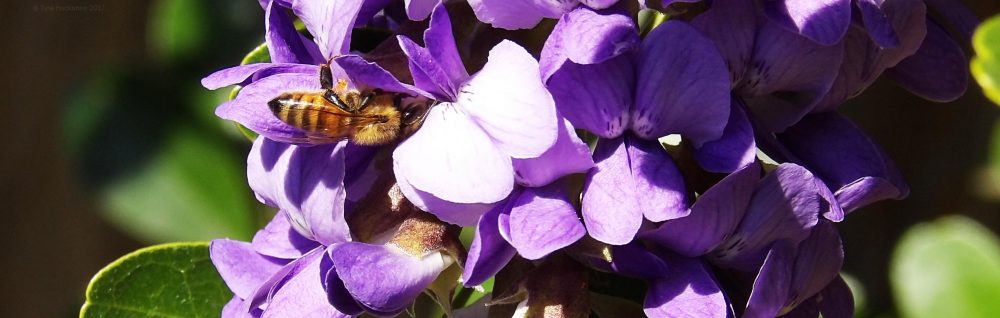
Happy 2019–may it be a year of peace for all and good gardening for those who seek, and find, solace in the outdoors. Today is Wildlife Wednesday, marked on this first Wednesday of the month, with the goal of chronicling the wild ones in our gardens and celebrating the connection with nature that a garden delivers.
One afternoon recently, I wandered my garden, reviewing the limited freezer-burn damage on certain perennials, and a lone butterfly caught my attention as it fluttered past me, wacky and zig-zaggy, but with purpose. It alighted on a nearby ceramic sphere which has, from time-to-time, supplied landing for other winged creatures.

The butterfly was still for a time, then turned around, modeling its stylized wings, allowing photographic capture from different angles. While it seemed that the butterfly invited viewing at varying perspectives–proud of its pulchritude, no doubt–I’m not sure that he/she appreciated the photography session.
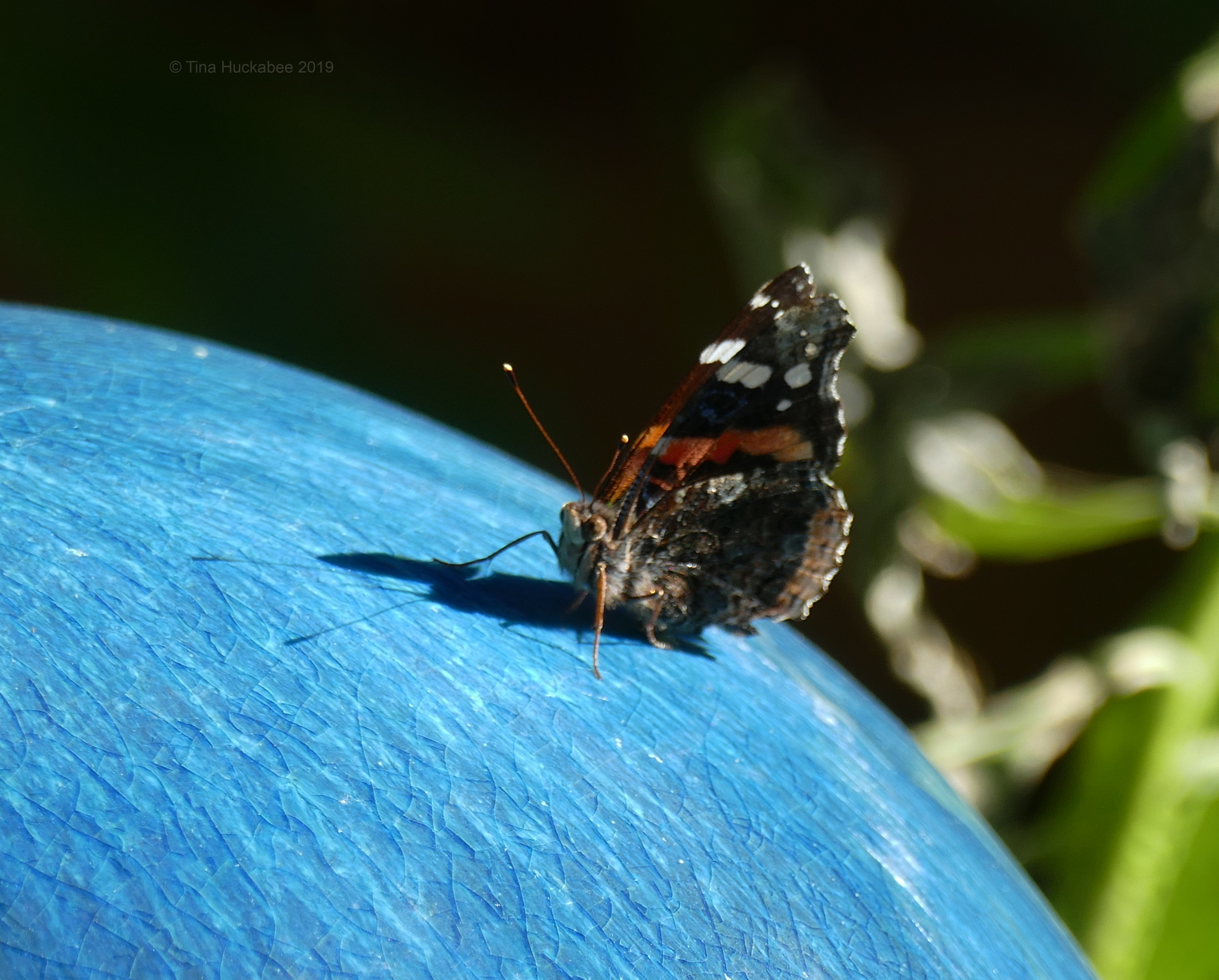
It to dared me to get closer. I didn’t.
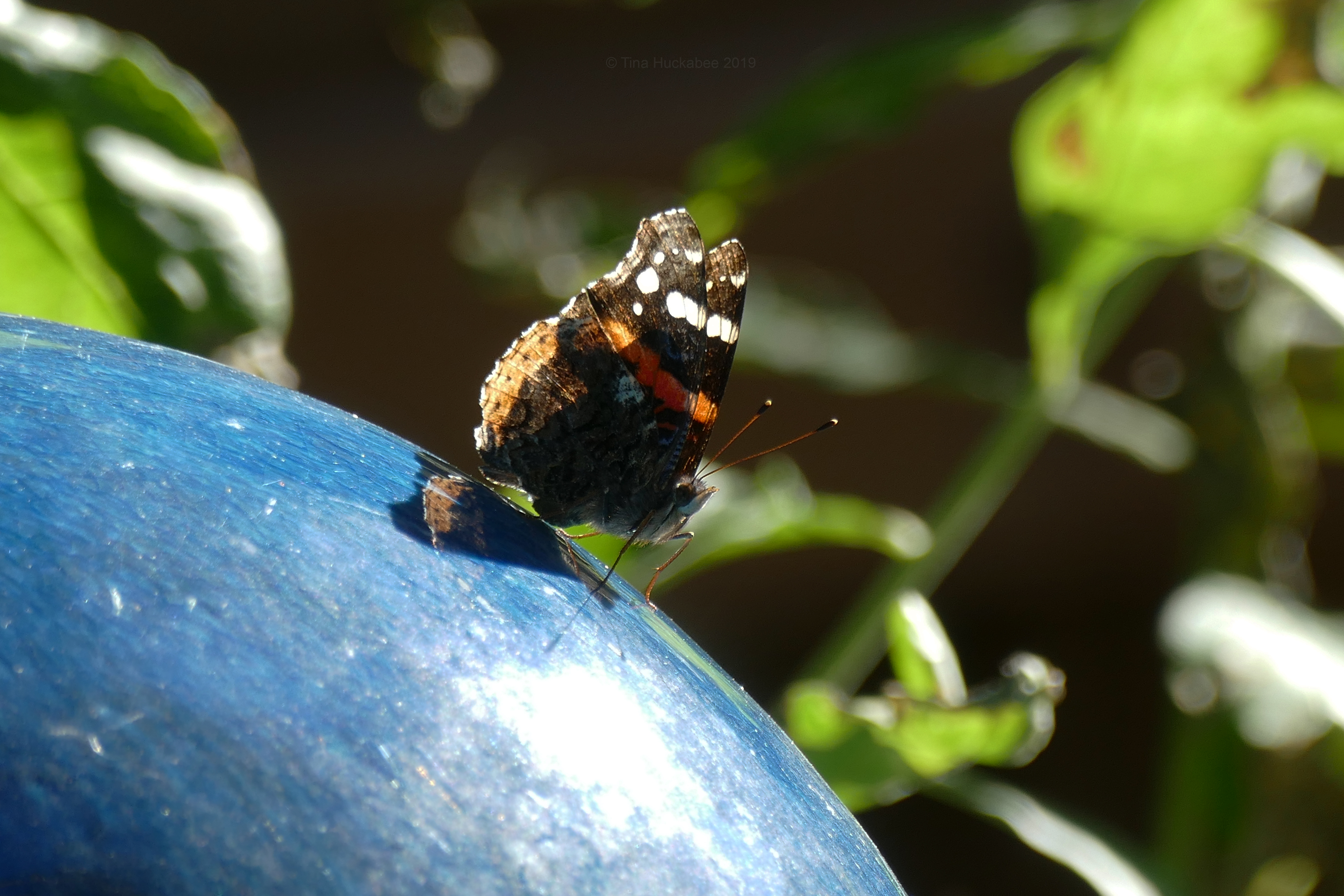
This autumnally hued butterfly is a Red Admiral, Vanessa atalanta, and is common throughout the continental United States and other parts of the world, including Europe, Northern Africa, and Asia.
It’s a butterfly of the Earth.
Not endangered in any part of the world, this member of the Nymphalidae family primarily feeds on tree sap, bird poop, and fermenting fruit, more than imbibing from blooms. I recall one nectaring at some flower in my garden, but I can’t remember which flower–I’ll need to pay more attention next time. As far as I’m aware, I don’t grow any of its host plants (those plants that the adult lays eggs upon and that the caterpillars eat from), which consists of various types of nettles. But there must be host plants in my area because Red Admirals are regular visitors in my garden throughout the year: spring, summer, autumn, winter.
The butterfly perched on the globe in daylight, near the sun’s reflection; the un-butterflied half of the sphere remained in darkness.

The blue globe, with its swirls of green in foliage reflection, evoked for me the beauty, and innocence, of the first view of our lovely Earth, taken 50 years ago on December 24, 1968, by astronaut Bill Anders, as he and his crewmates orbited the moon aboard Apollo 8.
Earthrise.
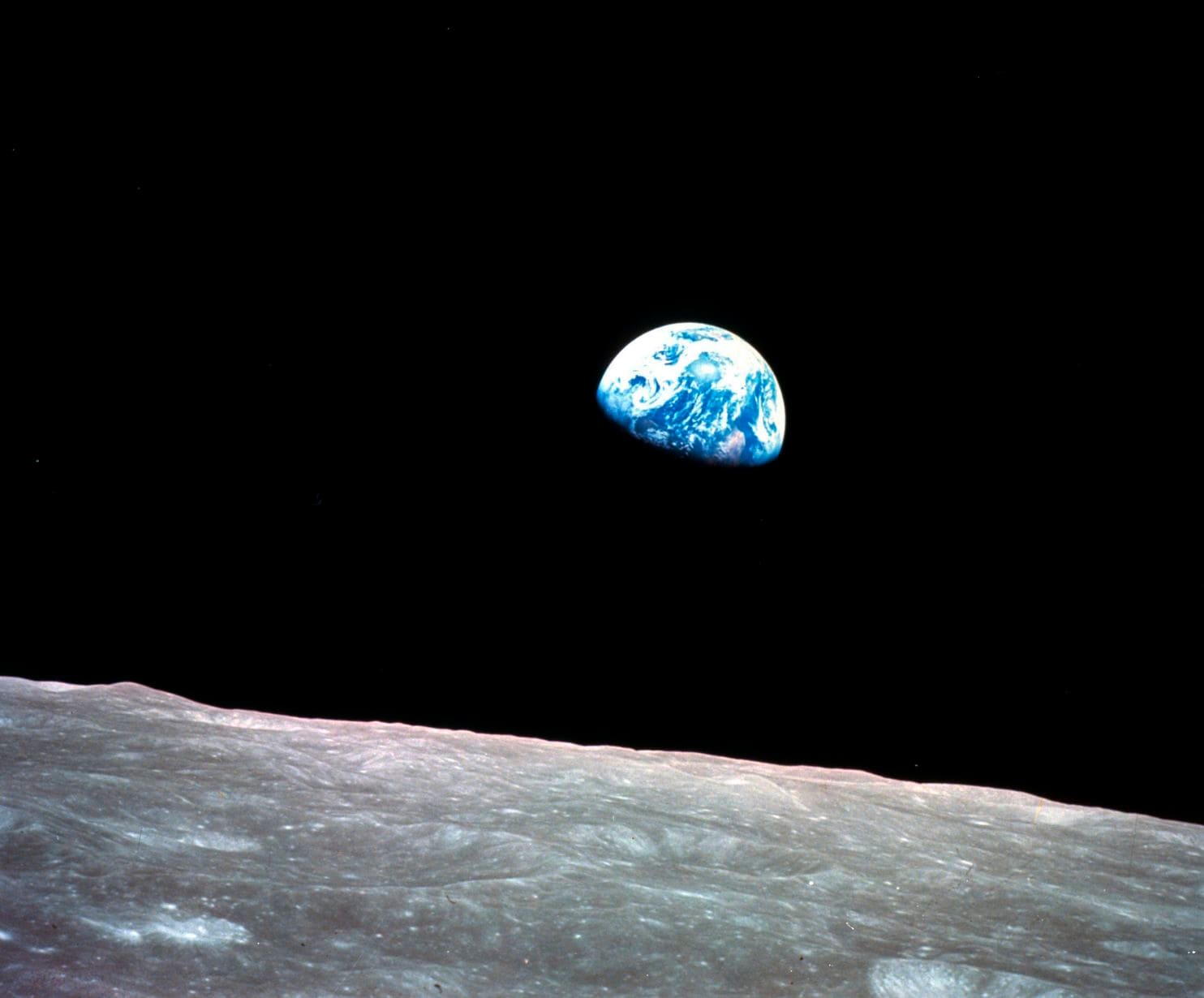
During the fourth orbit of the moon, Anders captured the historic and iconic view of our little blue and white planet, seemingly alone and vulnerable, but stunningly beautiful.
Anders snapped the iconic Earthrise photo during the crew’s fourth orbit of the moon, frantically switching from black-and-white to color film to capture the planet’s exquisite, fragile beauty.
“Oh my God, look at that picture over there!” Anders said. “There’s the Earth coming up. Wow, is that pretty!”
Before the flight, no one had thought about photographing Earth, according to Anders. The astronauts were under orders to get pictures for potential lunar landing sites while orbiting 70 miles (112 kilometers) above the moon.
“We came to explore the moon and what we discovered was the Earth,” Anders is fond of saying.
Earthrise changed how we saw the Earth and is credited with emboldening the environmental movement. The photo remains a symbol of Earth’s beauty and fragility, but also of our eternal relationship with, and sense of responsibility toward, our only home.
I remember bits about the Apollo missions, as viewed on my family’s black and white television set and as seen in color photos in LIfe and Time magazines. Earthrise has been a part of my life since childhood.
In my own gardening experience on my little plot of the Earth, at a local botanical garden where I gardened for a time, and at others’ gardens that I’ve tended, I’ve been all-in for the flowers and foliage. My original interest in gardening focused on creating interesting spaces of color and texture which would require less maintenance than an expanse of lawn. I was attracted by and interested in native Texas plants, but have always included hardy non-invasive non-natives that add structure and variety, augmenting the diversity of the gardens.
Over time, I’ve observed what other gardeners and naturalists have observed: wildlife– pollinators, birds, amphibians, mammals, and reptiles–appear when an environment is welcoming and conducive to their needs. Gardens with limited (or no) chemical intervention, and which provide water, cover, and food, nurture and protect complex ecosystems. I’ve come to understand the synchronistic thread which binds plants to their insects, birds, and other wildlife, and now appreciate how wildlife enriches–and is enriched by–gardening choices. Like Astronaut Anders, who came to discover the moon, but instead, found the Earth, I explored gardening and discovered wildlife.
I still love a pretty plant, but I strive to garden for wildlife. My gardening choices favor the feeding and protecting of wild creatures endemic or migratory, who live in or visit my garden. More than when I embarked on this avocation, I recognize the value of the whole system–plants, wildlife, environment–rather than following garden fads, or planting, willy-nilly, with little regard to the whole picture.
I hope your gardening experiences involve wild critters and if not, that you’ll spend some of 2019 studying your region to learn how to best provide for wildlife, and thus bringing life to your garden.
For more about Apollo 8 and the Earthrise photo, check out this Washington Post article (be sure to watch the embedded video which re-creates the situation which made the photos possible!) and also, this mini-documentary from PBS, Earthrise, .as told from the perspectives of the three astronauts.
Please leave a link to your Wildlife Wednesday post when you comment here.Happy New Year and good wildlife gardening for 2019!





 My Gardener Says...