Looking out the kitchen window recently, I noticed that my little female cat, Astrud, was staring intently at something. I assumed that what she was concerned about was the neighbor’s big tom cat who, at times, sneaks into my garden, so I went outdoors to shoo him away. Well, it wasn’t the neighbor’s tom cat that Astrud communed with, but instead, this juvenile Virginia Opossum, Dedelphis virginiana.
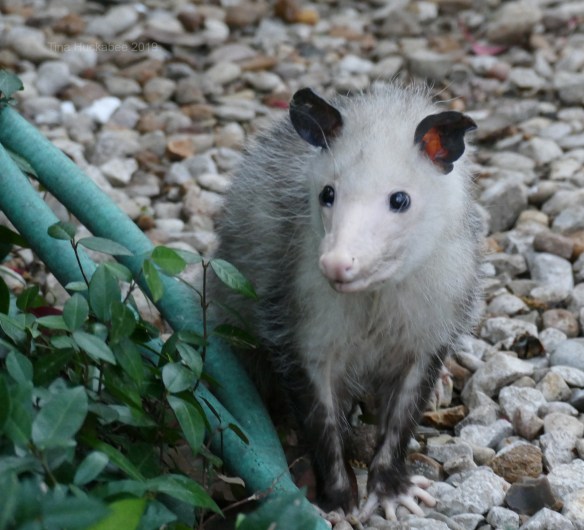
The two of them engaged in a relaxed standoff, neither seemingly fussed about one another’s presence. I sat down about 10 feet away to observe; Astrud casually glanced at me, while the opossum snuffled and sniffed. Opossums have poor eyesight, but a refined sense of smell and I’m sure he/she was assessing the situation with the nose. Within a couple of minutes, Astrud lost interest in the opossum, trotting away to investigate something new and different. The opossum, on cue, bundled under a gate, waddling off to unknown places.

Am I staring at you or are you staring at me?
It was a cute encounter and fascinating to observe.
I take a benign view of opossums. They amble through my garden during the night, sometimes I see them early in the morning. When I dump the day’s veggie remains in the compost (usually after dark and I always forget to bring a flashlight), I jump when I realize there’s a marsupial munching on a meal. I fret when one moves into the owl house, but otherwise, I consider opossums as part of the garden and local environment. Opossums bother no one and eat a variety of foods, which, upon expulsion of the seeds, helps the spread of native plants. They sometime eat rats and mice and I’m all for that.
I’ve come across people who are creeped-out by opossums. I think their squeamishness results from wariness about opossum behavior. Opossums are shy and mostly active at night. They’re secretive, skulking, and mostly unseen; nighttime activity is intrinsically uncomfortable for some folks. Opossums also have that bare tail and lots of pointy teeth, and they’ll hiss to be scary if cornered, though generally, they’re not aggressive critters. And–let’s be honest here–in the looks department, they’re not pretty. They’re certainly not as pretty as the average cat; Astrud would win a beauty contest, hands-down. But why do most people favor their cute kitties, who are outdoor, invasive killing machines, over a less-than-gorgeous native critter, one who has a place in the ecosystem, who evolved here and belongs here? Opossums are some of the oldest mammals inhabiting North America.
I wouldn’t dream of installing an invasive plant in my garden–not for a minute–and I have tut-tutted when others, who, usually in ignorance or in response to poor advice, planted something that is invasive. I’m always (okay, usually) polite in correcting information about native plants versus invasive plants, employing a teachable moment policy. Using well-adapted non-natives in the garden? Sure, I have plenty of those and encourage others to use them, but I’m careful not to promote or utilize recognized invasives in my garden and encourage others to go native or use non-invasive, non-natives.
However, my go native self-righteousness doesn’t apparently extend to preventing my cats from roaming the garden. I allow my cats (I have two) outdoors, and they’re not a native species to North America, though there’s certainly a good argument that they’re well-adapted.
Astrud is primarily an indoor cat. She ventures into the back garden for brief visits: she loves to go out first thing in the morning for a few minutes, and then again near sundown for an hour or so. My other cat, Nuri, is a true indoor/outdoor cat, though is spending more time indoors as he ages and since he was diagnosed with heart disease. Originally, I’d planned to keep Nuri indoors only, but that one time that I let him out, well, he decided outdoors was a great place to be a cat. Of course all cats, mine included, might catch birds, but until the past few years I wasn’t aware of just how much damage outdoor domestic cats inflict on native birds. Using information from 2013, it’s estimated that the “free-ranging” domestic cat population kill 1.3-4 billion birds each year in the US.
That’s a lot of birds. As well, these same cats kill a variety of small mammals and other wildlife.
So why let them out at all if I’m so concerned about preserving native habitat in my urban environment? Why the inconsistency? I guess it comes down to the oh-so-human practice of hypocrisy–and like most humans, I am a practitioner thereof.
Wild things have many obstacles to their survival: loss of habitat, agricultural and home garden chemical use, increasing urbanization…and domestic cats. My cats have hunted and killed native wildlife in my garden; fortunately, only a few have fallen to their skills. Still, some small snakes, lizards, and yes–birds have been killed by my pets and I’m ashamed that I allowed them outside to inflict harm to endemic species. That said, as I’ve learned more about our native fauna, I’ve worked hard to provide a safe haven for wildlife in my garden and my cats are only out when I’m home and can keep my eyes on their actions.
What to do? Well, the best thing is to keep cats indoors. They’ll live longer and wildlife will be safer. Going forward, any cat I adopt will be an indoor cat, but my two are older and daily habits are tough to break. Astrud is basically an indoor cat, with a few minutes outside most days. With Nuri, it’s more complicated, because he’s always been indoor/outdoor fella and it’s hard to teach an old cat new tricks–or something to that effect.
I limit the cats’ outside time–especially during spring and autumn bird migration, and when the resident baby birds fledge–to early nighttime and when I’m in the garden supervising their feline affairs. Most of the time, both cats wear a BirdsBeSafe collar, which is made by good folks to help birds be safe from cats. Doesn’t Nuri look handsome in his BirdsBeSafe collar? And his bird companions don’t seem to mind him at all!

The theory behind the collar is that it’s not a bell on a collar (ahem–the dinner bell) which will protect a bird from a stalking cat, but the bright colors on the collar, which (specifically) song birds discern. Cats are good predators in part because their coloring serves as camouflage and they move stealthily, so that a bell probably won’t sound in time for a bird to escape. But with the BirdsBeSafe collar, songbirds are alerted by movement and bright colors, and will fly to safety.
For more information on this collar, check out this 2015 article from Science Direct about the effectiveness of the BirdsBeSafe collar.
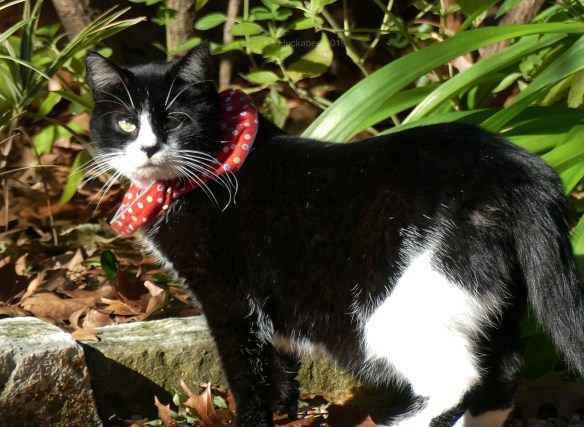
While birds might be safer with a cat wearing the collar, the collar won’t help butterflies or amphibians from becoming victims. The collar on the cats is only a partial solution to allowing my purry invasives out in the garden, but for now, it works: my fuzzy-butts have some outdoor time (with supervision) and wildlife is generally safe in my garden.
What wild critters are in your garden? Do you have workaround to make your garden safe for wildlife, while allowing pets some outdoor time? Please leave your link when you comment here and happy wildlife gardening!








 My Gardener Says...