Strings of Pearls

The toads were late to the garden party this spring but they’ve finally arrived and are croaking, mating, laying eggs–and filling their niche in the garden environment.
IMGP7518.new
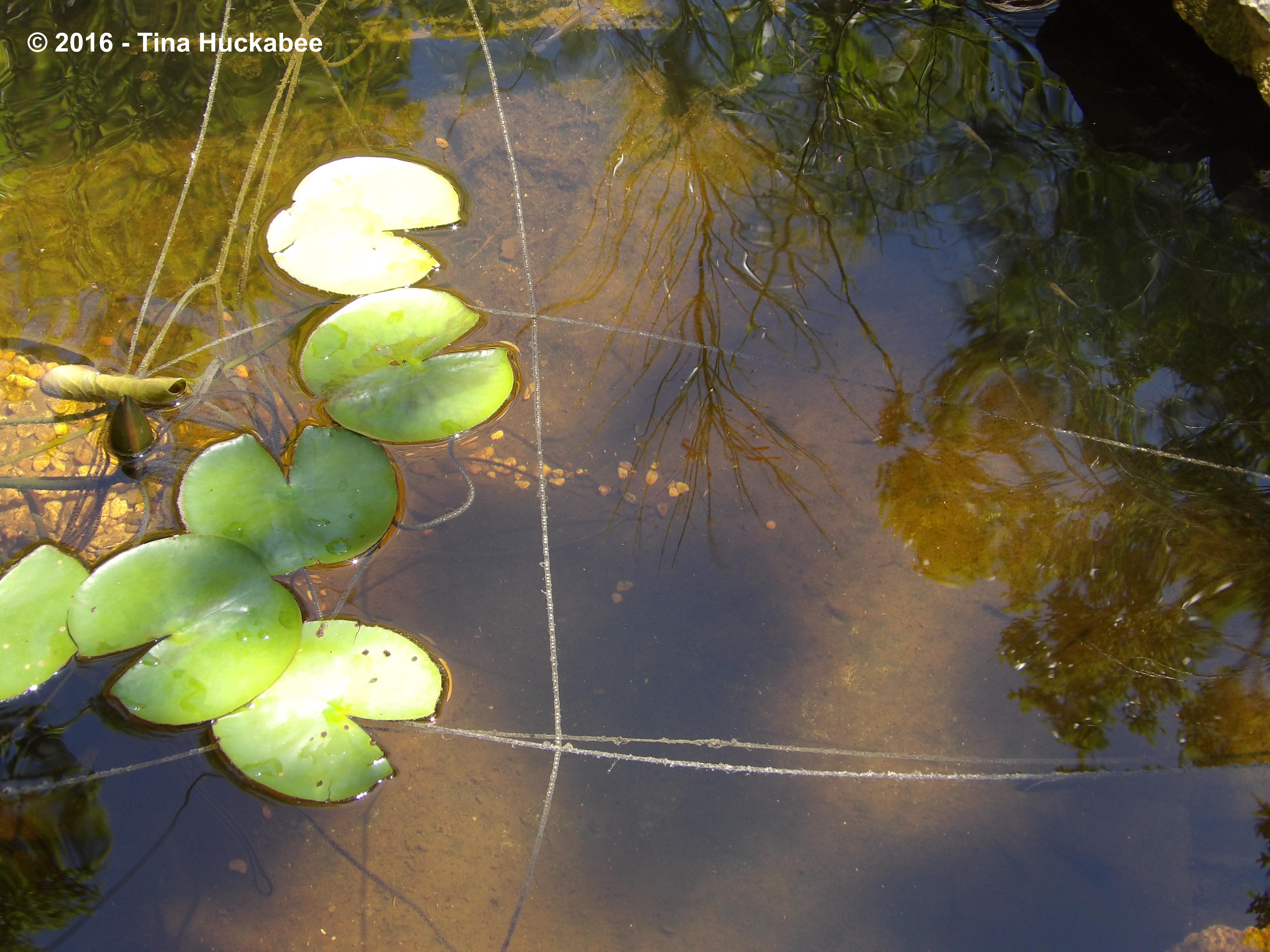
I always think of the gelatinous strings of toad eggs as amphibian strings of pearls–and hopefully that mental image doesn’t put anyone off of wearing the real things. The Gulf Coast Toad or Coastal Plain Toad , Ollotis nebulifer (Bufo valliceps), is the likely species that laid these eggs-in-goo and soon there will be more toads for the croaking, mating, and egg laying. No doubt, some of the toads will make yummy meals for the resident Eastern Screech Owl, Megascops asio, parents and their 5 offspring.

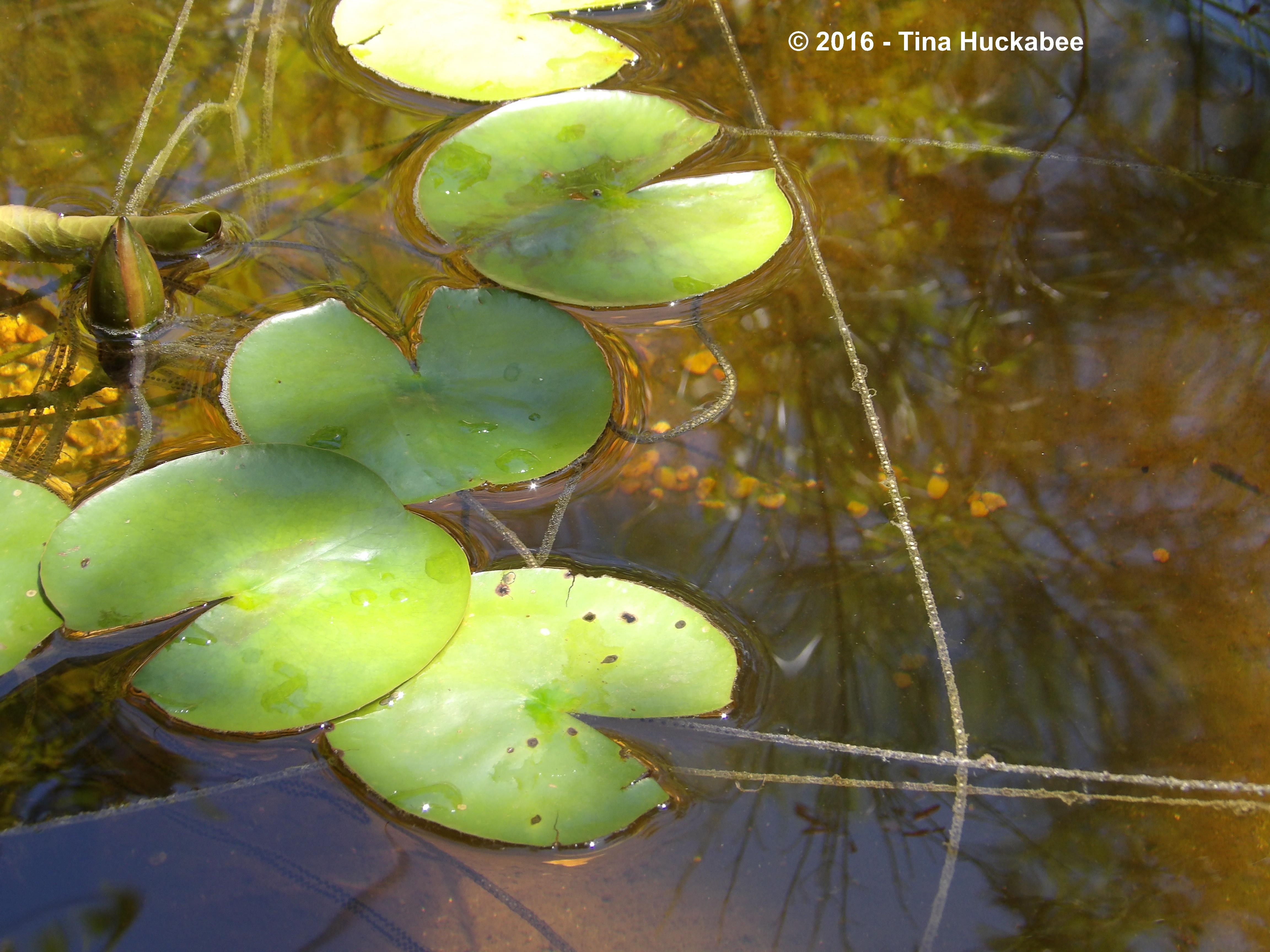
Along with toad eggs and fish, the pond hosts some handsome and varied foliage. I separated the ‘Colorado’ and ‘Claude Ikins’ waterlilies last month; both have since bloomed and very soon, will put on a rapid growth of lily pads, enough to cover about 75% of the pond surface by early summer.
IMGP7516.new
The pads serve as landing strips for bees and dragon/damsel flies, and occasionally butterflies. More importantly, the pads keep the water temperature even during the summer months, as well as cover and protect the fish as they swim underneath the pads.
IMGP7517.new
I also separated the Texas native Pickerel Rush, Pontederia cordata which grows in the bog.
IMGP7352.new
IMGP7349.new
The open, moving water has given the birds, especially the little warblers and finches, a fun place to bathe. Every year, I promise myself that I’ll keep this assertively growing plant from filling in the bog–and every year I fail in achieving that goal. So this year is THE year: I’ll save some space in the bog for the birds to bathe–I’ll consciously weed out the Pickerel rush, even if it’s a weekly chore, so the birds can bathe in moving water.

Says me!

Another lovely and important pond foliage plant requiring yearly separation is the Ruby Red Runner, an Alternanthera hybrid that grows in the waterfall feature. Like the Pickerel rush, Ruby Red Runner serves as a biological filter for the pond.
IMGP7525.new
Ruby Red Runner grows vigorously, sprawling all over the edges of the pond as the weather warms and the days lengthen.

Taking in a wider view, I’m happy with the perennials which frame the pond.
IMGP7179.new
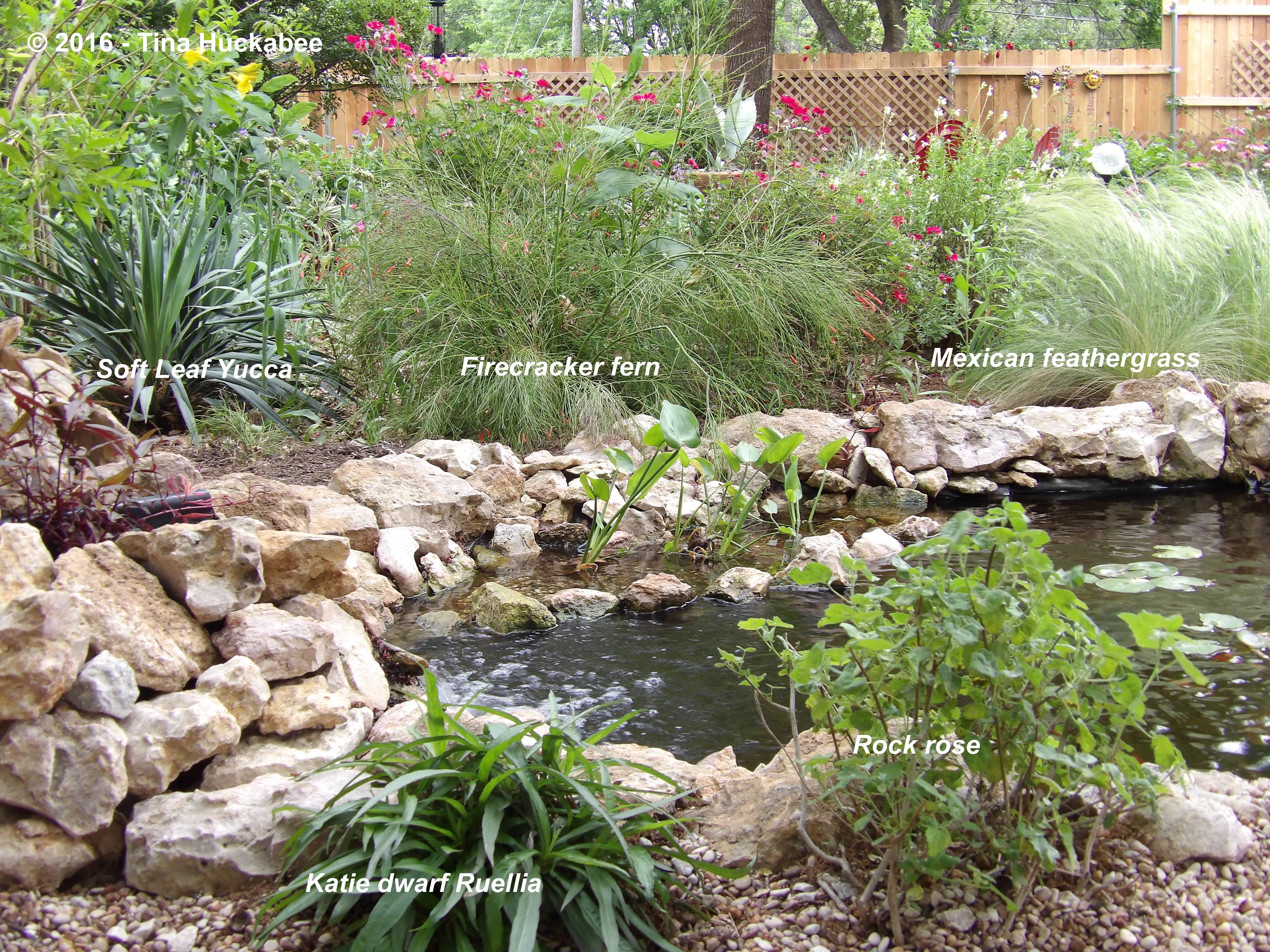
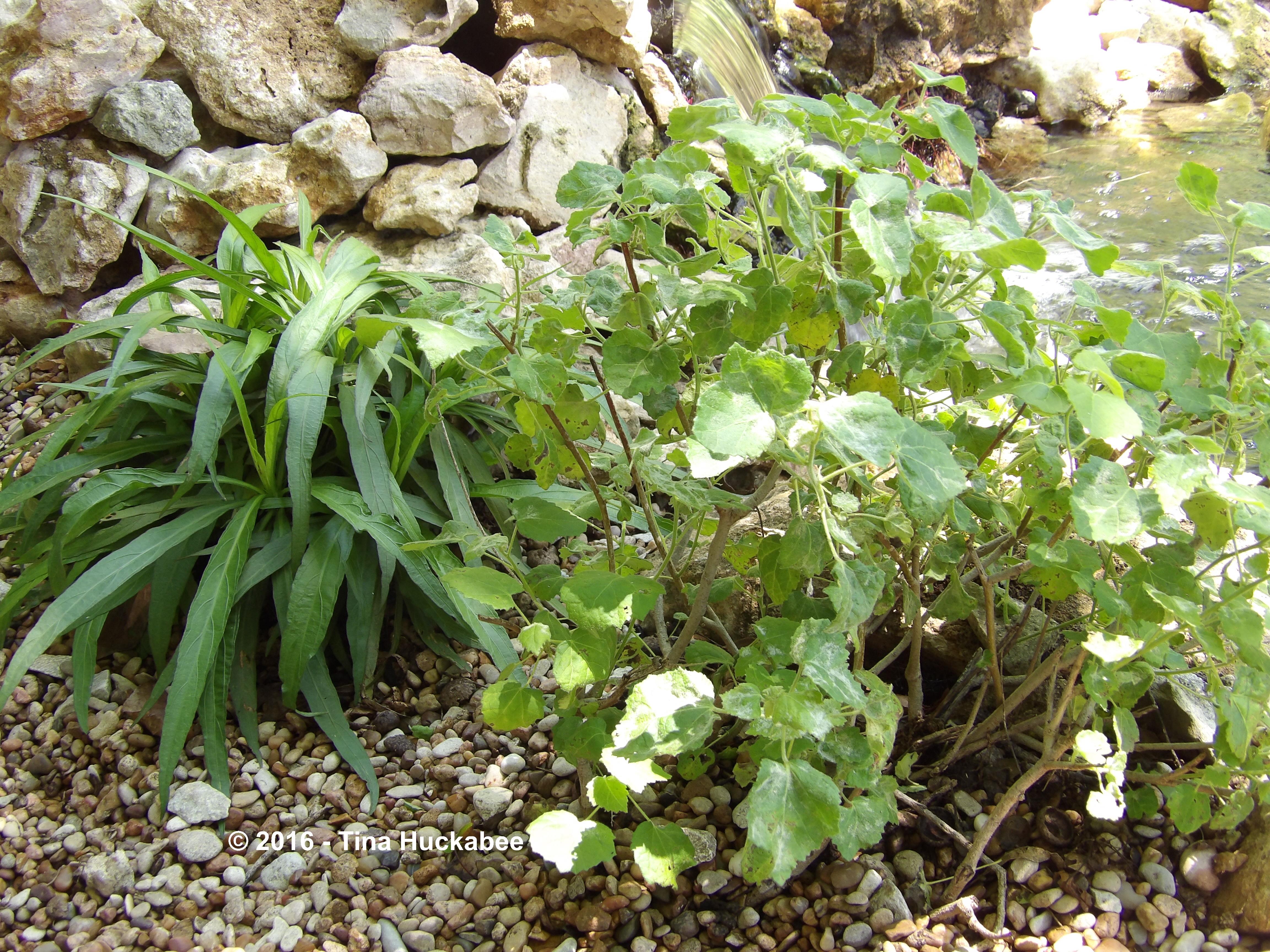
Across the pond from the perennial garden, is a pea gravel sitting area and pathway. A Katie dwarf Ruellia, Ruellia brittoniana ‘Katie’, and a Rock rose, Pavonia lasiopetala, volunteered themselves for this spot and fit well beside the pond.
IMGP7524.new

These two neighbors sport opposite leaf types: ‘Katie’ is lance-like and deciduous and Rock rose is oval, scalloped, and semi-evergreen.


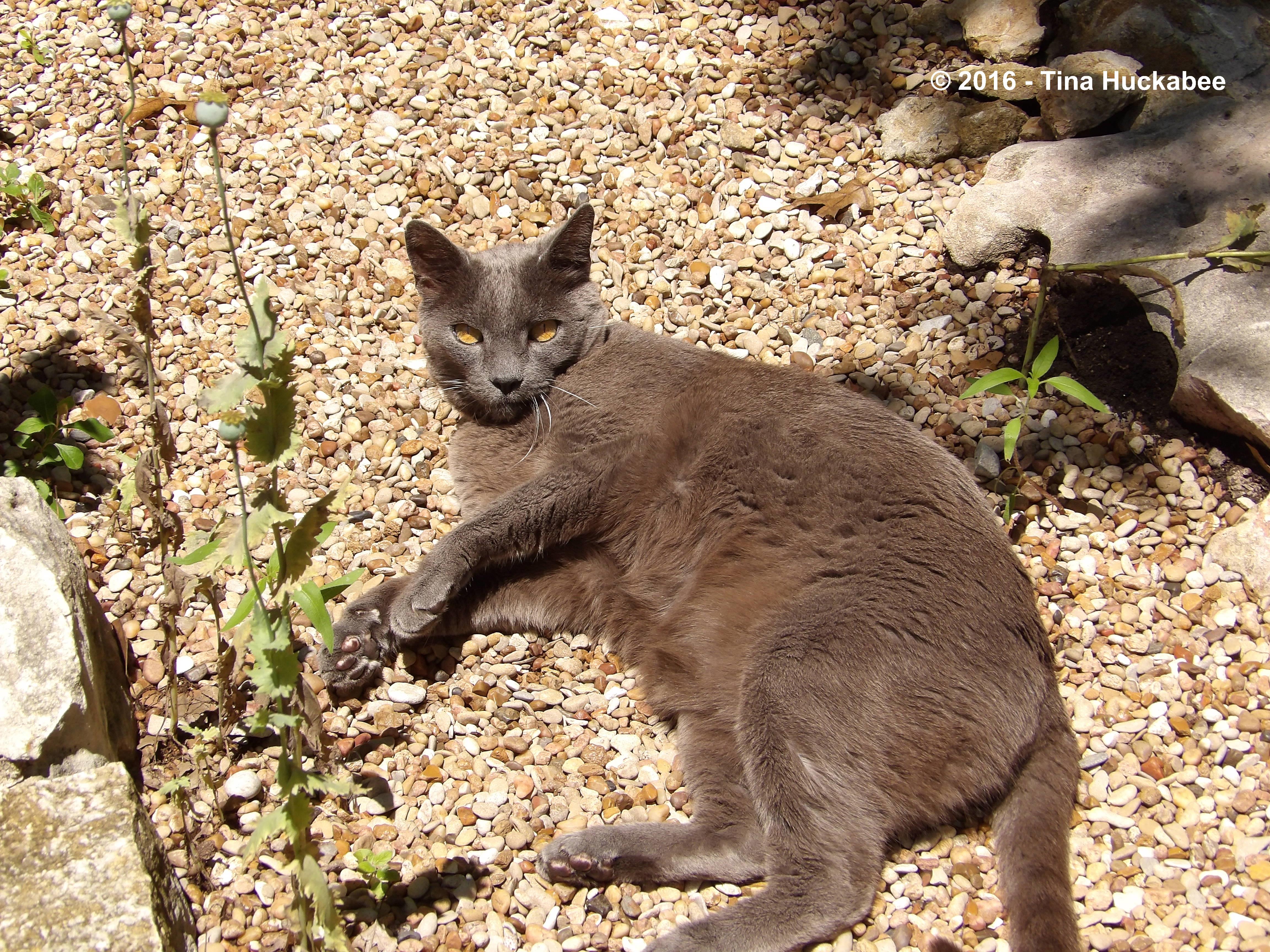
Nuri the Cat is comfy as he lies on the warmth of the pea gravel. Lazy cat.
IMGP7532.new

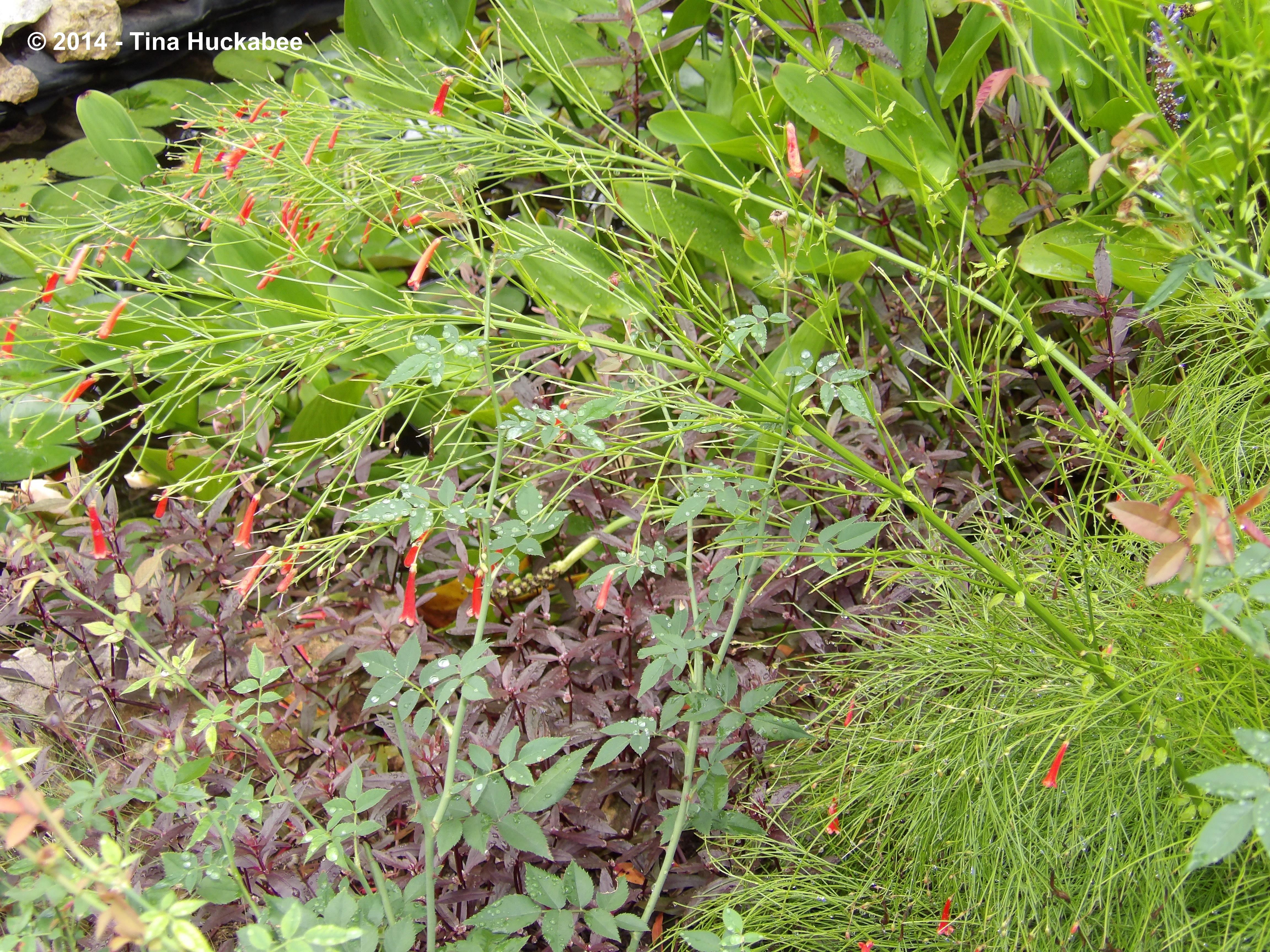
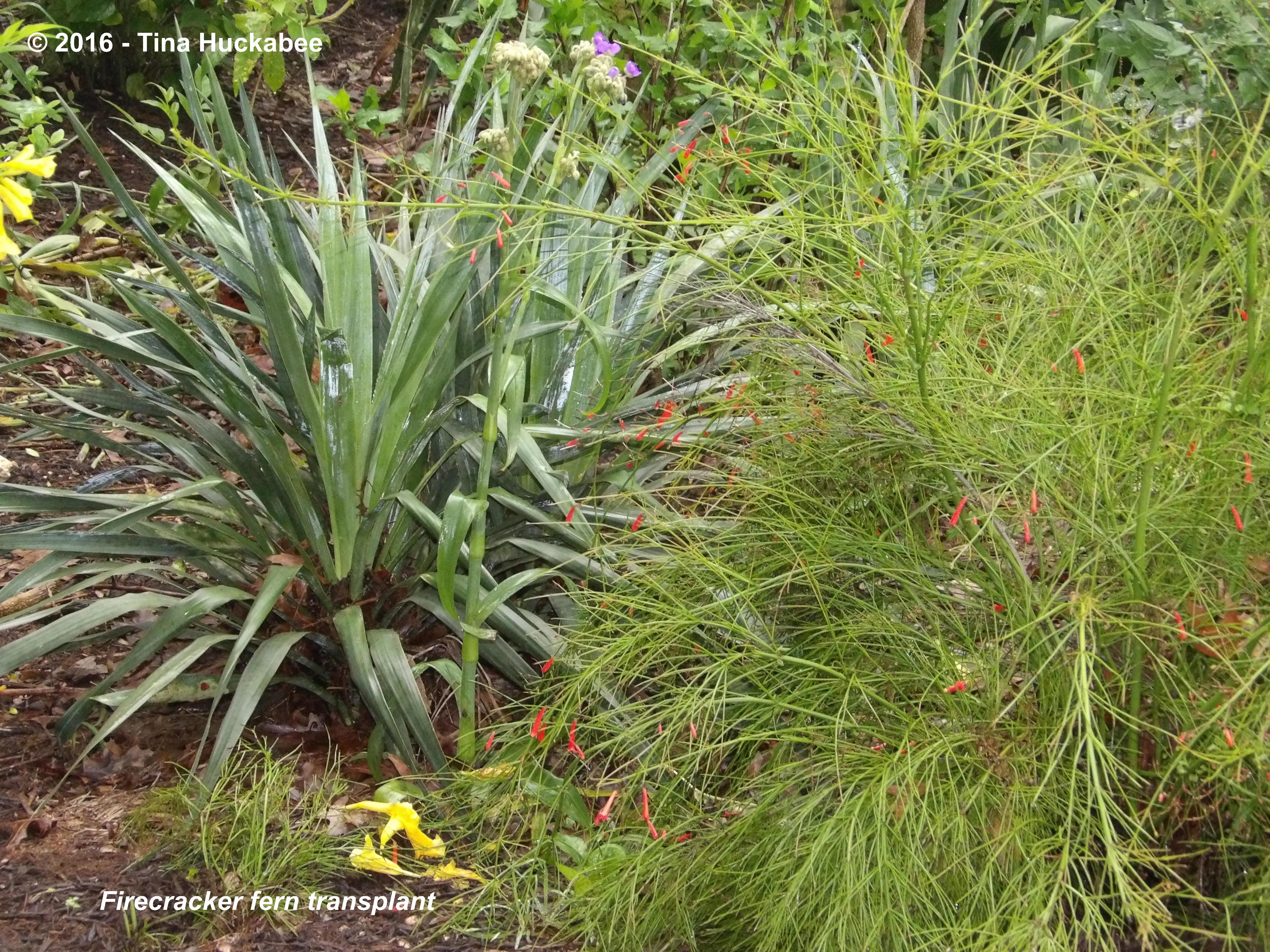
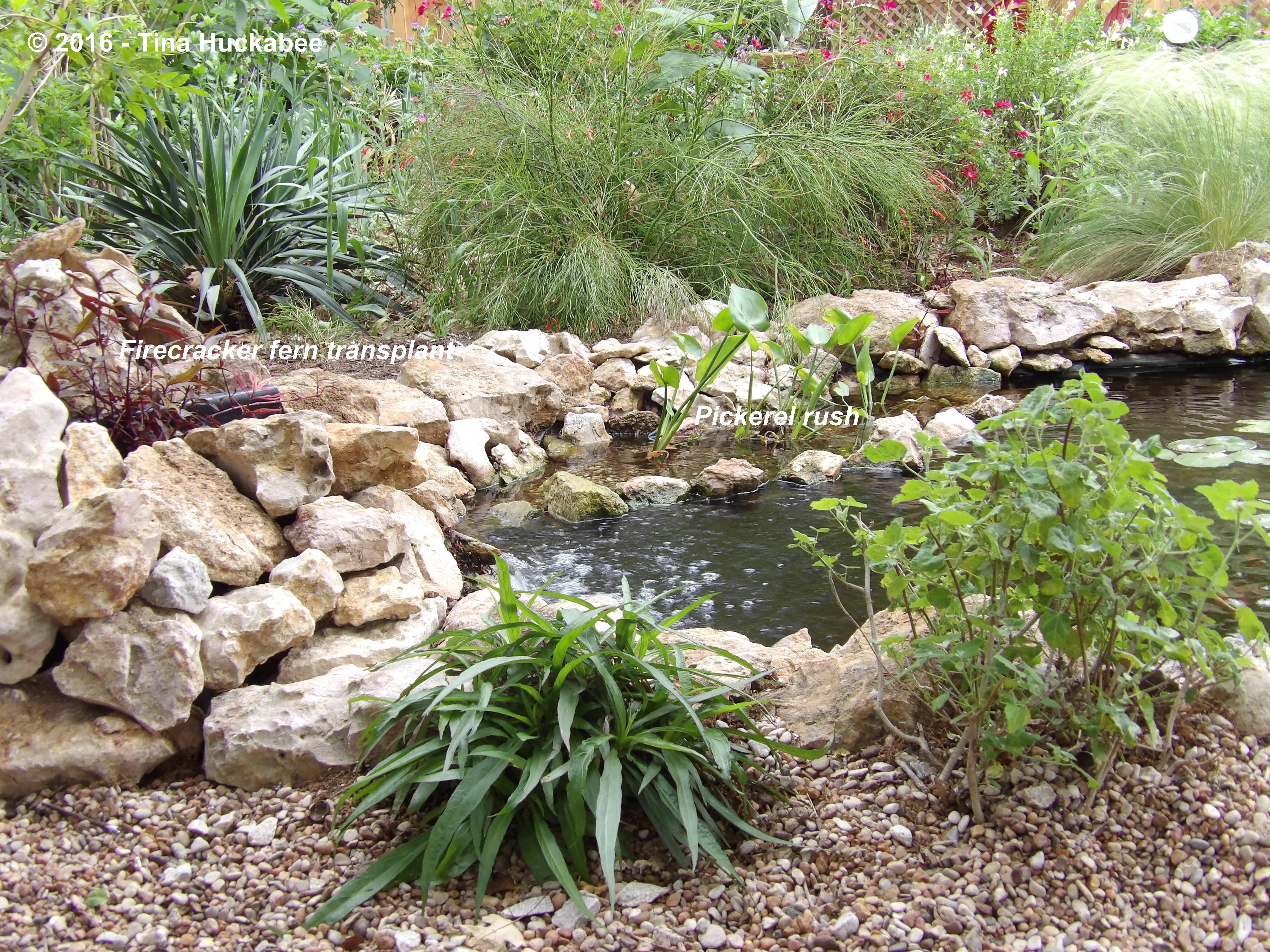
The evergreen Soft Leaf Yucca, Yucca recurvifolia, is a pup from the original, now-deceased mother plant. Just in front of the yucca, I recently transplanted some Firecracker fern, Russelia equisetiformis, that rooted out from the mother plant, to its right in the photo.
IMGP7355.new

It’ll be a couple of years before the transplanted Firecracker fern reaches maturity, but I think these two arching perennials paired side–by-side will be a nice addition to the garden and the pond.
IMGP7180.new.new
The mature Firecracker fern bloomed all winter during our non-winter winter, but is in a resting cycle now. The blooms of this plant are show-stoppers, but the foliage is also special: cheery, spring-green coloring pairs with graceful, arching stems and slender, elegant foliage.

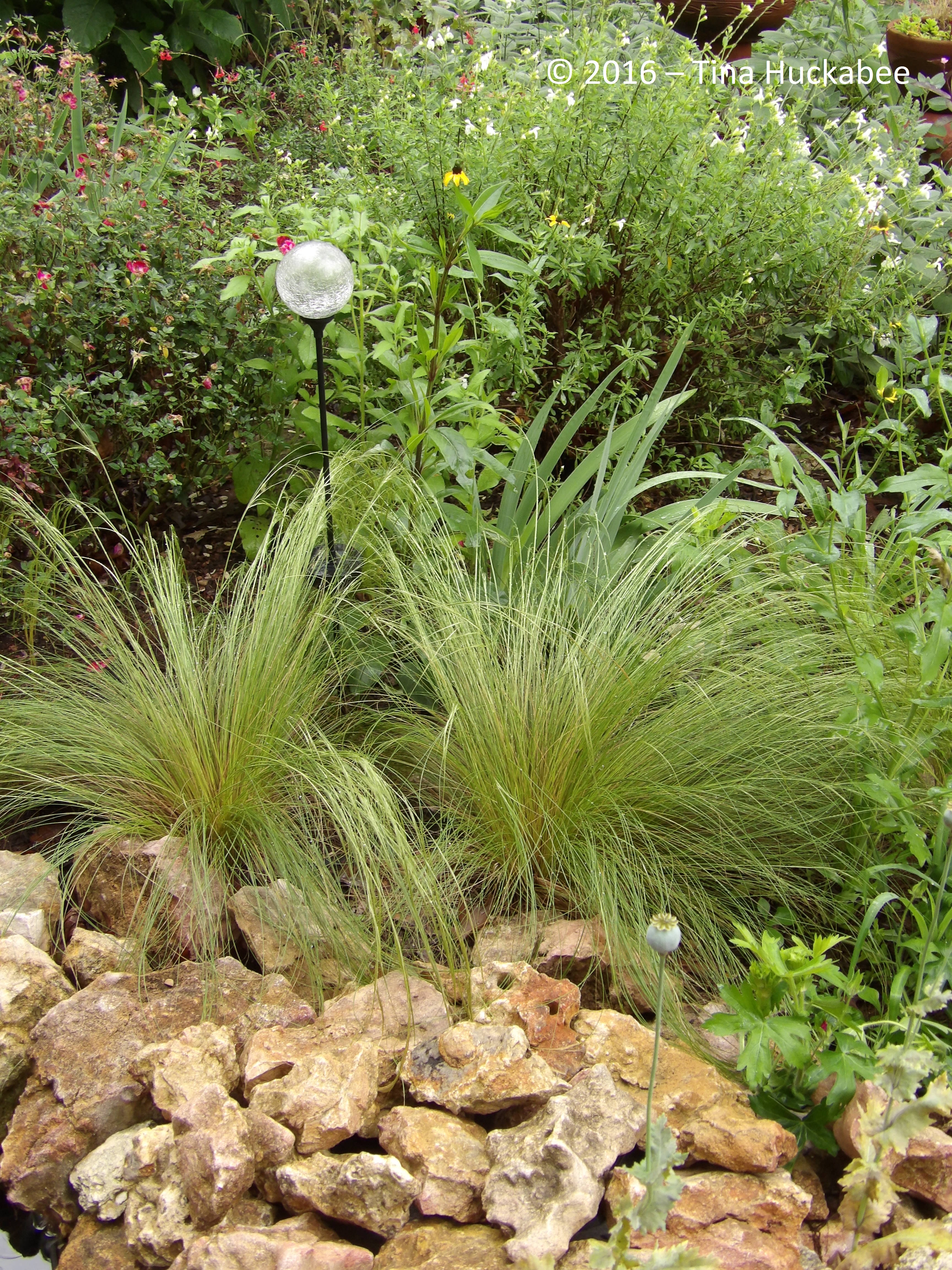
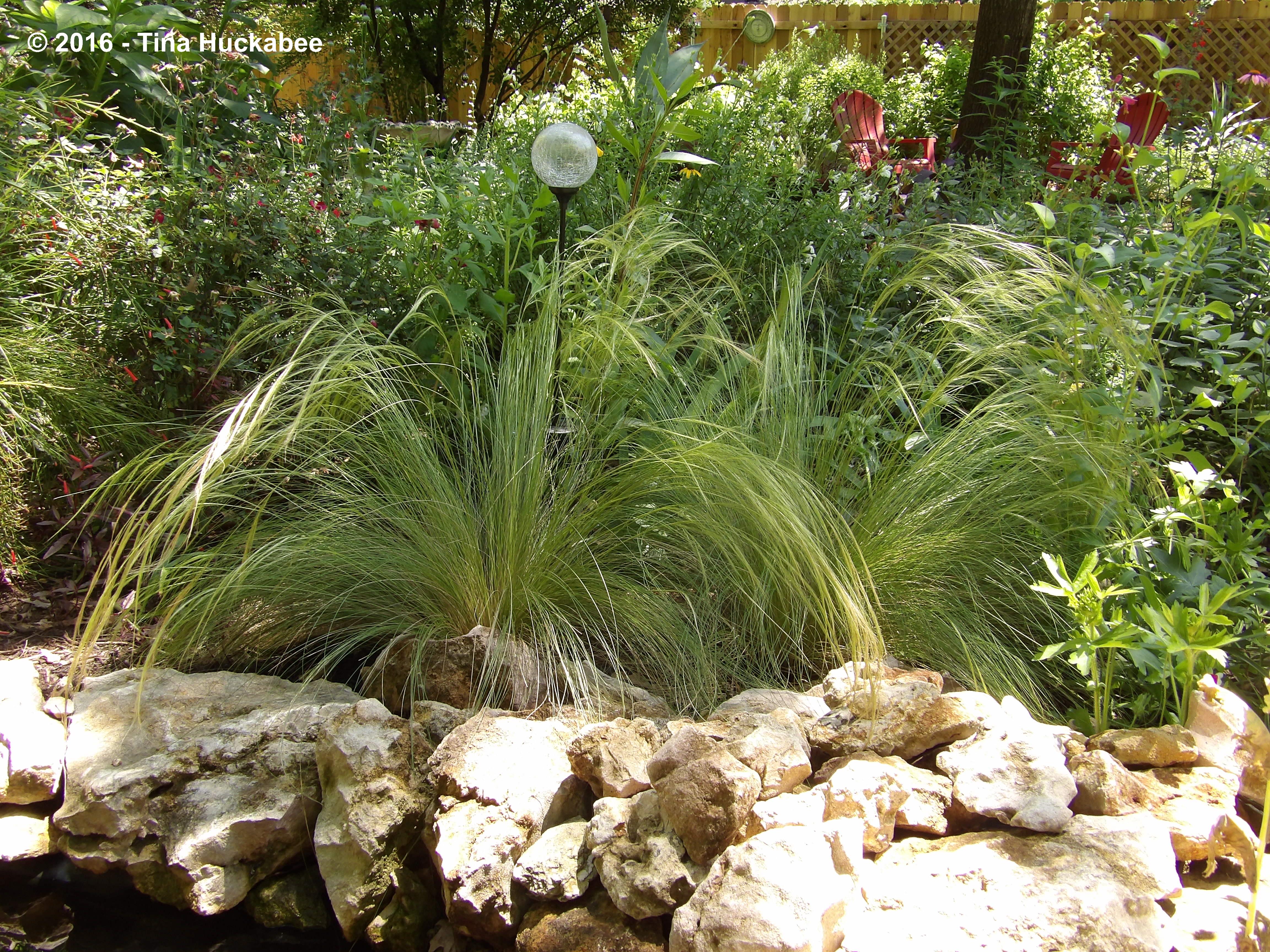
Mexican feathergrass, Nassella tenuisima–soft and silvery all year–is stunning in spring glory.
IMGP7519.new

Behind the Mexican feathergrass, from left to right, is Martha Gonzalez rose, white blooming Autumn Sage (Salvia greggii), Iris, and Blackeyed Susan (Rudbeckia hirta var. pulcherrima)

IMGP7360.new


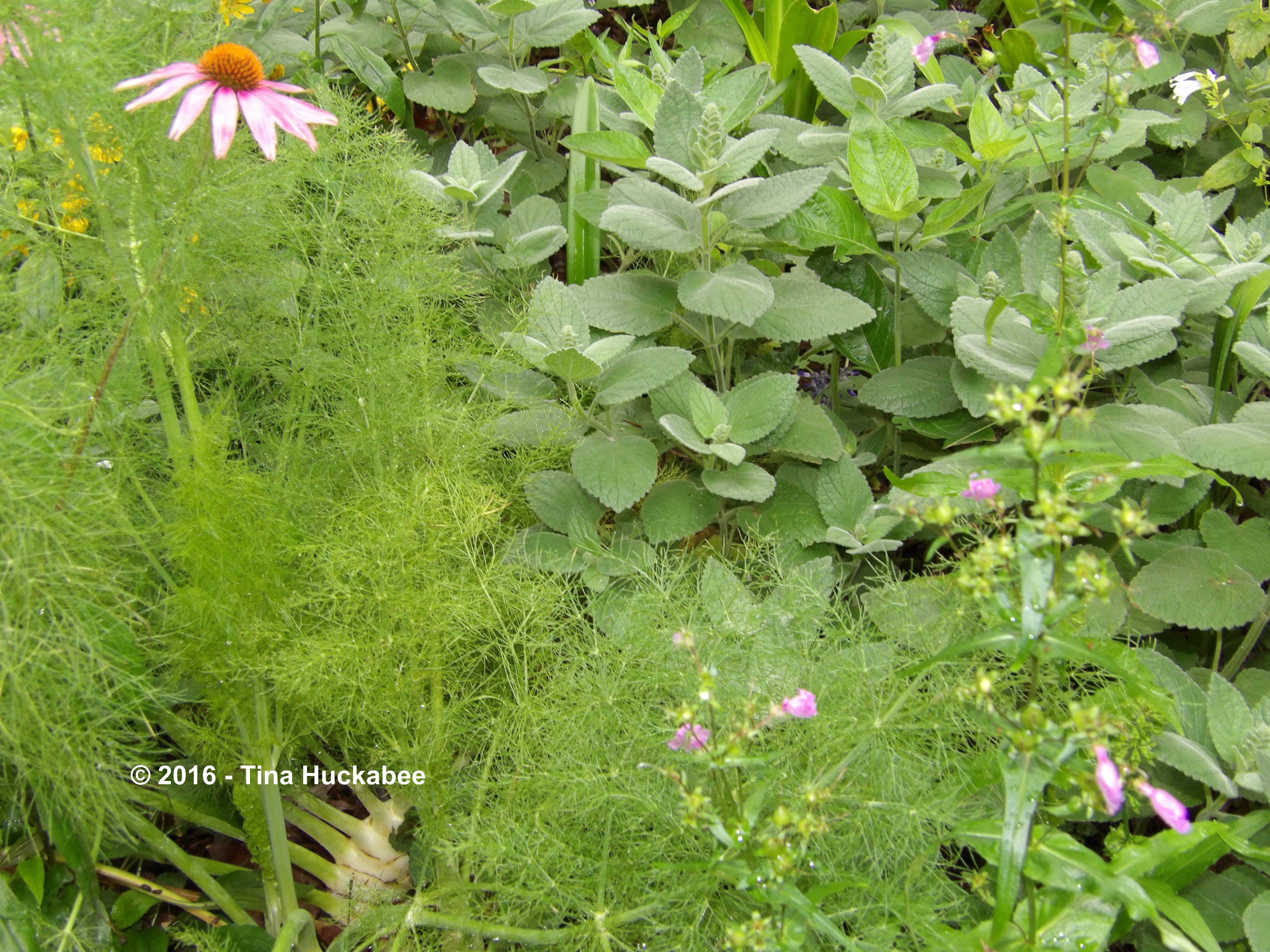
In the perennial bed bordering a different curve of the pond, a feathery, bright green fennel (planted for butterfly larvae), combines with grey-green Heartleaf skullcapScutellaria ovata. I guess it’s true that opposites attract.
IMGP7347.new

Nearby, Winecup, Callirhoe involucrata, clamors over the limestone rocks bordering the pond.
IMGP7359.new
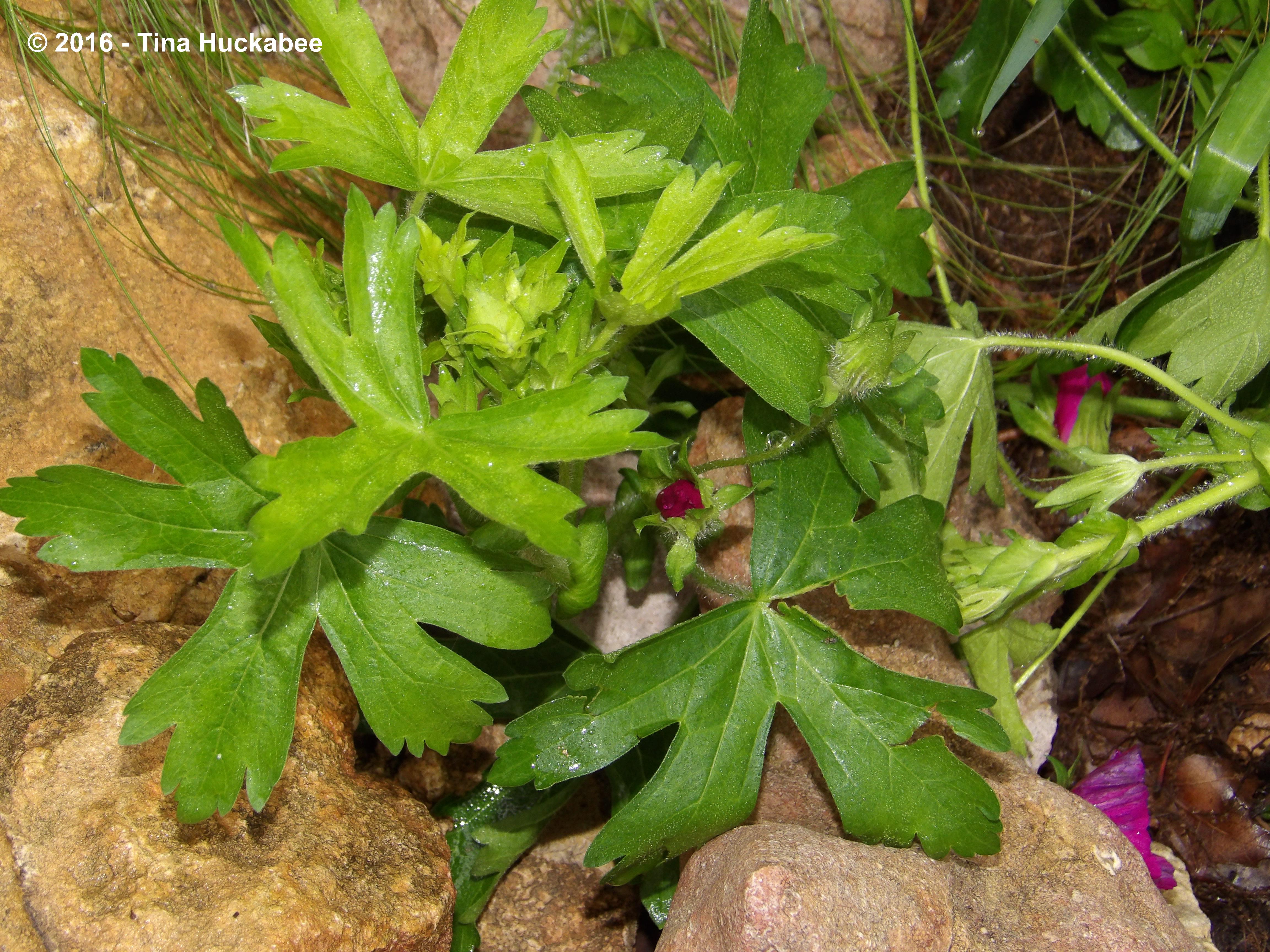
Individual leaves of Winecup are lobed and hairy. Winecup grows as a ground-cover and spreads about 3 feet wide during the bloom season, which is beginning.
IMGP7528.new

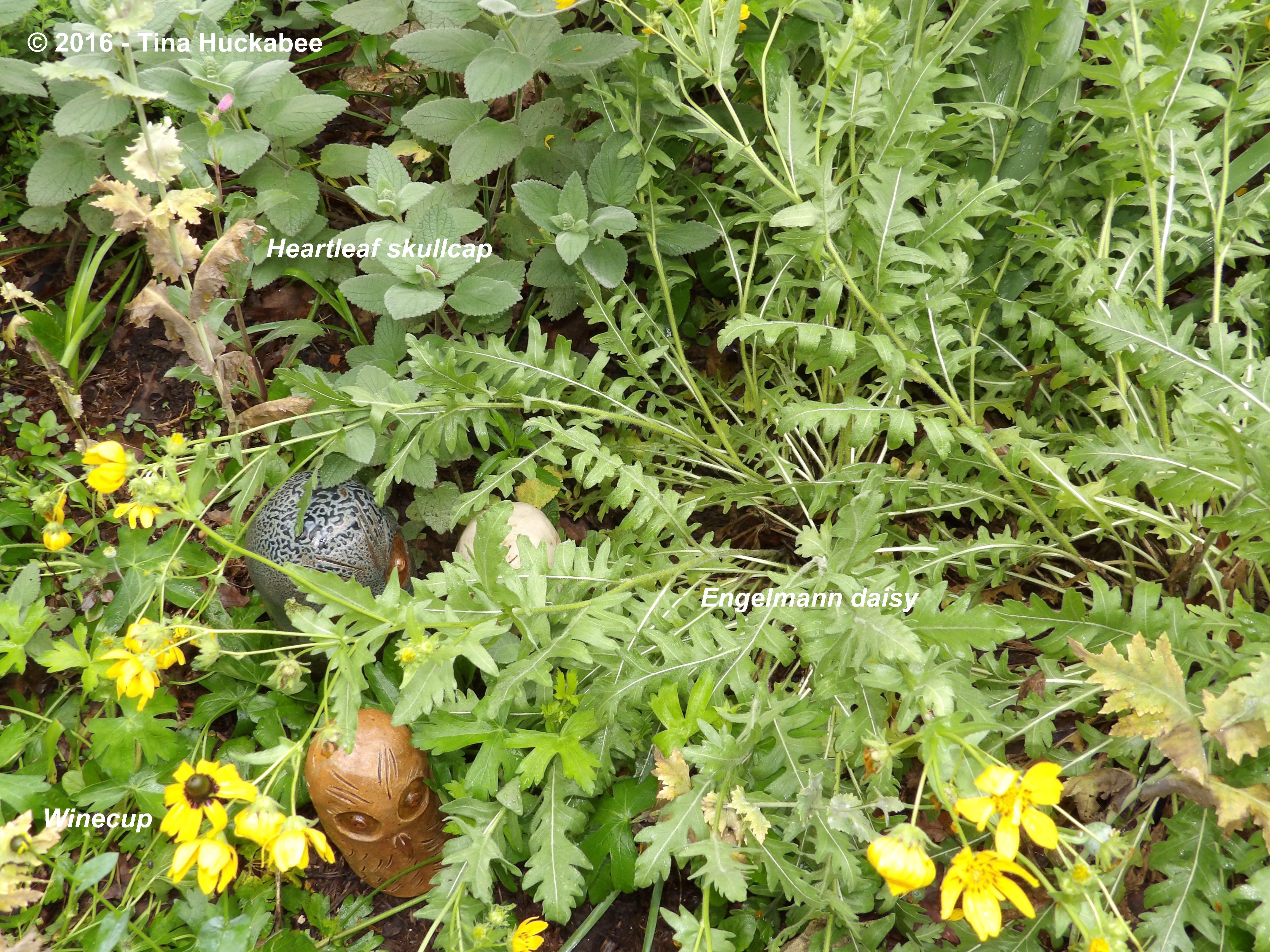
Engelmann Daisy, Engelmannia peristenia, bursts with flowers next to more Heartleaf skullcap.
IMGP7362.new

The two flowering yellows are Blackeyed Susan ( left) and Engelmann daisy (right).

Like the Winecup, the foliage of the Engelmann daisy is deeply lobed–another common name for this spring/summer daisy is Cutleaf daisy. Engelmann daisy is an excellent pollinator plant, the blooms attracting a large variety of native bees, flies, and butterflies.

Celebrating foliage in the April garden, many thanks to Christina and her lovely Creating my own garden of the Hesperides. Check out her Garden Bloggers’ Foliage Day for a look at foliage in many gardens, from many places.

Foliage Follow-Up, November 2014: The Non-Freeze

My gardens are slowing down in preparation for winter, but haven’t experience the frosty nip that was promised earlier in the week. Thank goodness!  I’m not quite ready to give in to the dark season.  Not Just Yet.

Focusing on mid-November foliage, I’m joining with Pam at Digging for Foliage Follow-Up.

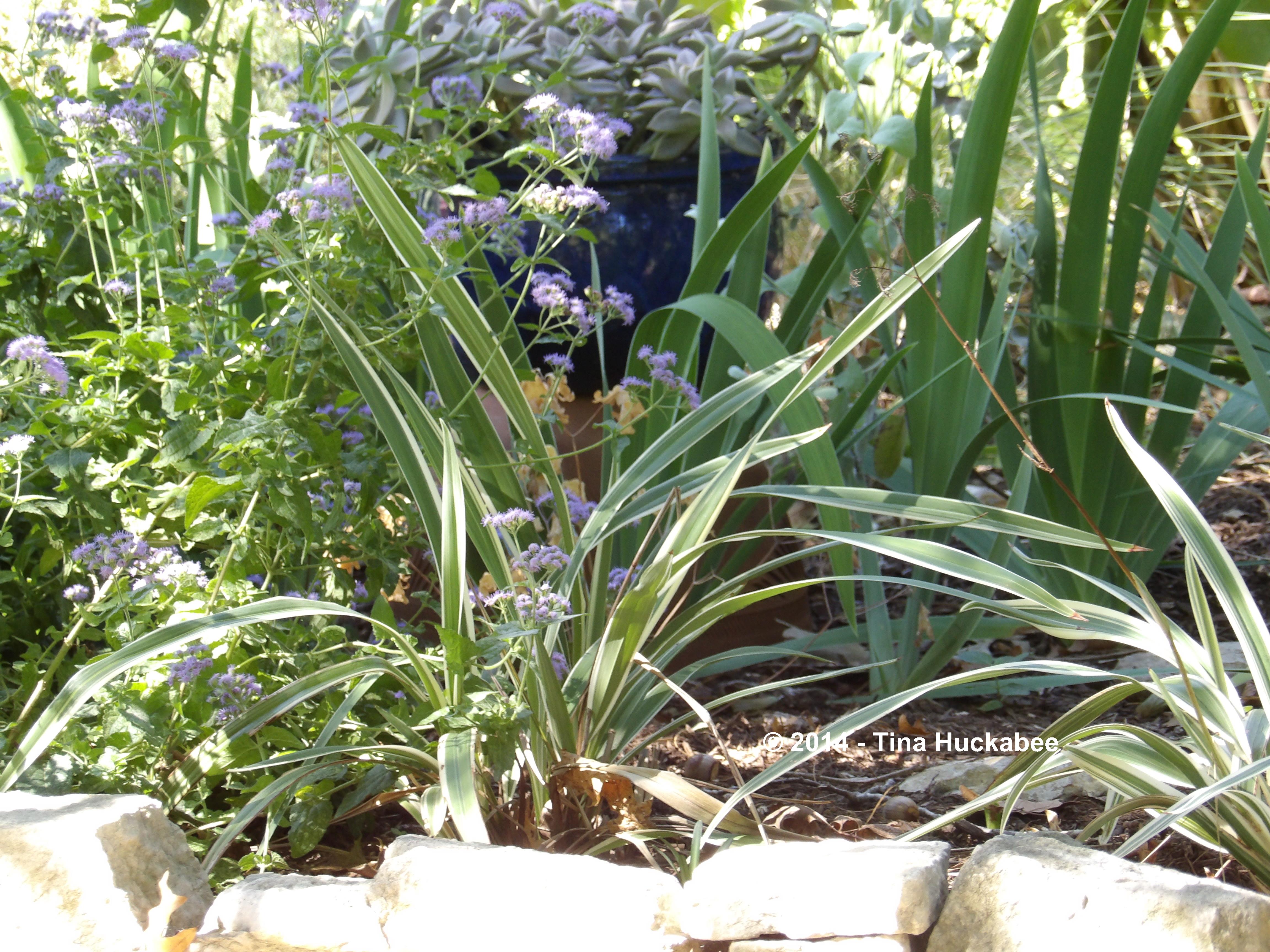
In one corner of my garden with dappled light most of the day and some direct sun off and on, are a couple of favorite foliage vignettes.  One such is of Iris straps, Blue MistflowerConoclinium coelestinum,  and cobalt-blue containerized succulent Ghost Plant, Graptopetalum paraguayense.

IMGP1798.new

Planted alongside that mix are several  Dianella or Variegated Flax Lily, Dianella tasmanica ‘Variegata’. IMGP1865.new

I love the wide, grass-like foliage of Dianella with its snazzy white stripes down the sides.IMGP2017.new

When a freeze was predicted this week, I covered the Dianella, though my concerns were unwarranted.  Last winter, I covered all of my Dianella each time the temperature sank into the ’20s, especially for extended periods. They soldiered through winter like the garden champs they are and thrived in our long, hot summer. Dianella nicely combine with Iris and Soft-leaf Yucca straps,IMGP1864.new

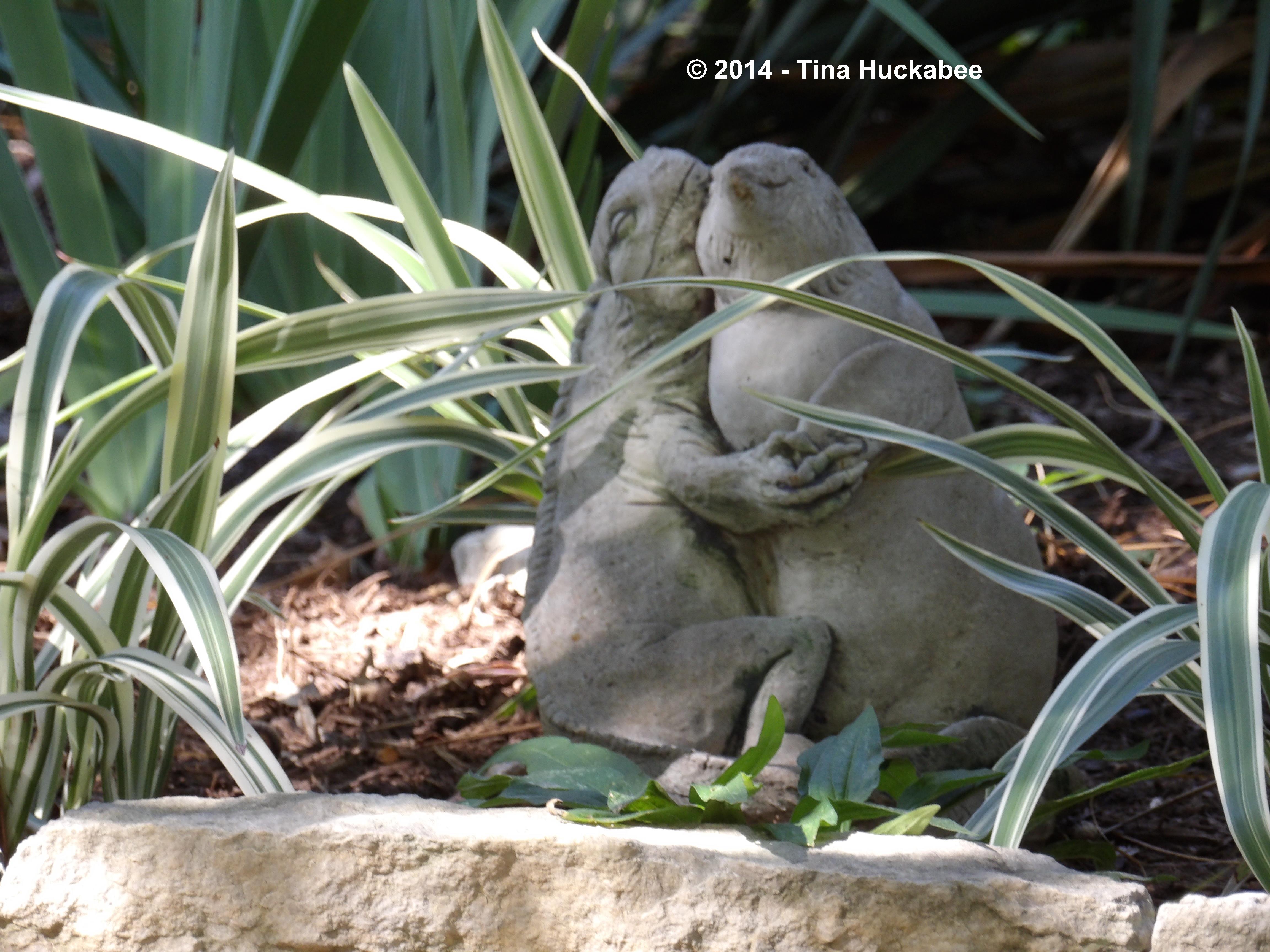
…as well as with these snuggly Love-Critters.

IMGP1862.new

Ghost Plant is unkillable:  it goes for months without water, isn’t fazed by freezes (or at least mine haven’t been), can re-grow if a stem is broken.

IMGP2642.new

My kinda plant.

Maiden GrassMiscanthus sinensis ‘Adagio’ is in its glory now.IMGP1868.new

IMGP1870.new

IMGP1872.new

The beautiful seed heads reflect the sun as it briefly peeked through our mostly cloudy week.

Toasty-seeded Inland Sea OatsChasmanthium latifolium and the green swath of Cast Iron Plant,  Aspidistra elatior are a striking pair.

IMGP1881.new

Added to this scene is Purple HeartSetcreasea pallida, which dramatizes that story a bit.

IMGP1882.new

Big MuhlyMuhlenbergia lindheimeri and Soft-leaf YuccaYucca recurvifolia  are cool weather troopers.IMGP2399.new

Graceful while also lending structure to the garden, these two are beautiful companions throughout the year, hot or cold.

IMGP2518.new

I took this photo of  evergreen Yarrow, Achillea millefolium and Chile Pequin, Capsicum annuum var. glabriusculum,  just before what was supposed to be a freezing night.  I figured the fruits wouldn’t survive the plunging temperatures and wanted to record them for posterity.IMGP2529.new

I’m happy to report that the fruits are still available for dining by interested birds.

I love the twisty-curvy foliage of Corkscrew RushJuncus effusus spiralis, silhouetted over a pair of Mexican FeathergrassNassella tenuissima.

IMGP1875.new

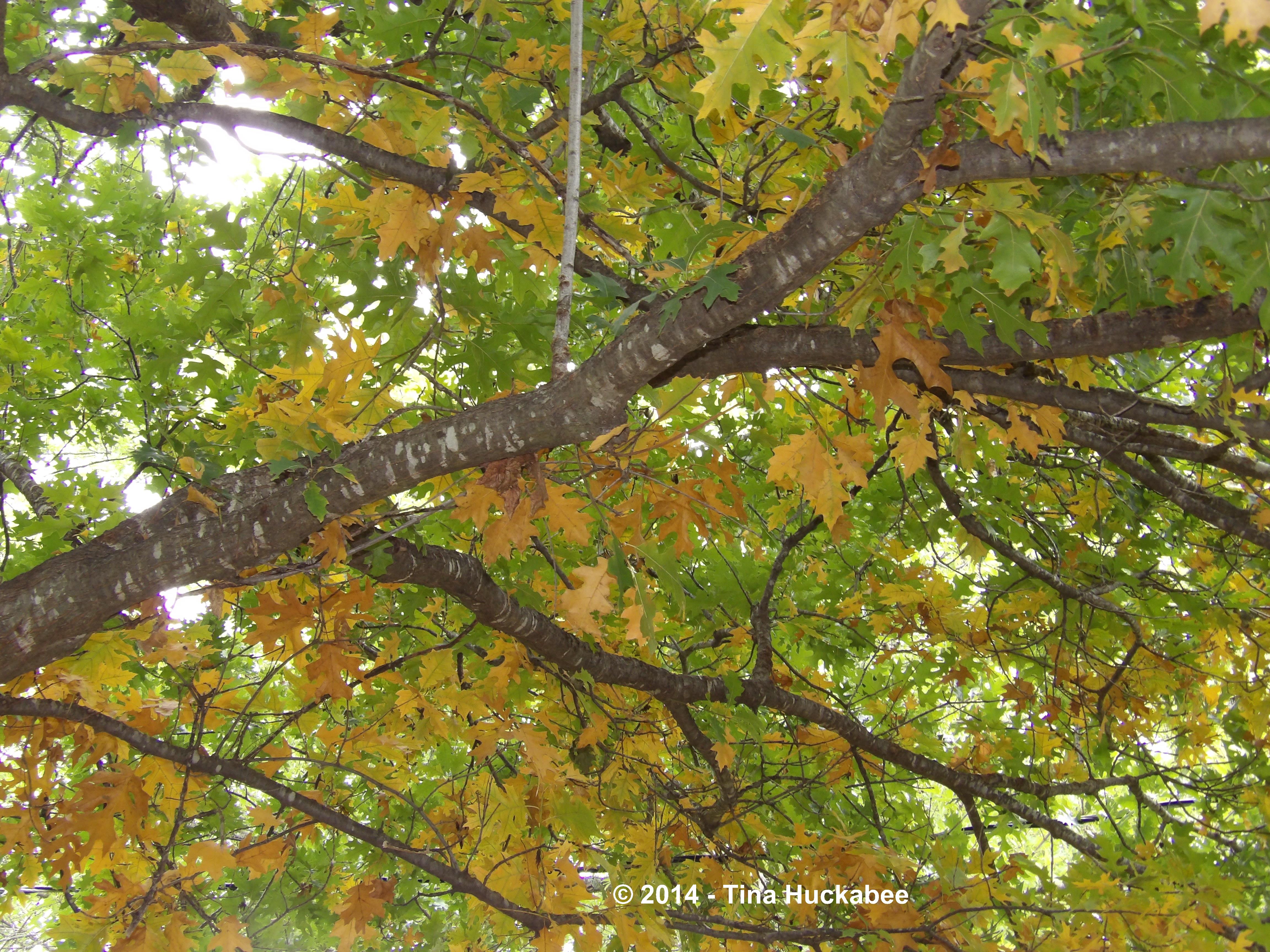
Finally, the leaf change is beginning on my Red Oak, Quercus coccinea.

IMGP2641.new Here in Central Texas, our tree foliage color change occurs later than that of our northern kin, but beautiful and appropriate for our climate and region. There will be more of this in the weeks to come.

Digging hosts Foliage Follow-Up–drop in for a look at November foliage fanfare.

Foliage Follow-up, September 2014

As with our blooms, the Central Texas foliage perks up with September rains, shorter days, and the suggestion of cooler temperature ahead.  I join with Pam at Digging to celebrate the end of summer, new beginnings for autumn, and all things leafy.

The pond garden is a riot of fascinating foliage.  Just take a look! P1070046.new

Lots of foliage action in this shot!  Clockwise from the bottom, the actual water plants include the lily pads of the two lilies I grow (Colorado and Claude Ikins), the Ruby Red Runner, and the showy leaves of the Pickerel RushPontederia cordata.   All three pond plants contribute to the biological filtration of my pond, though I also have a mechanical filter.

Continuing with the tour d’ foliage, the plants adjacent to the pond include tropical Yellow Bells, Tecoma stans, Soft-leaf Yucca, Yucca recurvifolia, Firecracker Plant, Russelia equisetiformis, Martha Gonzales Roses, Iris, Autumn Sage, Salvia greggii, and Mexican Feathergrass, Nassella tenuissima.  All of these perennials sport differing widths, textures, and colors of leaves.

P1070034.new

Ruby Red Runner dies back in the winter, but by late summer into fall it’s full-on lovely and spreading.

P1070042.new


P1070035.new

It’s seeded out in several places around the pond. This plant, usually used as a waterfall biological filter and prized for its attractive foliage, produces teensy puff-ball flowers,

IMGP0402_cropped_3073x3308..new

…which go to seed, thus, the spread.

Another view of the plants near the pond…

20140914_19.new

Not much blooming in those photos, but a variety of leaf beauty.

I particularly like these water shots with the creeping roots of the Ruby Red Runner, spreading its spidery fingers toward the lily pads,

P1070057.new

P1070056.new

…as if the roots are creeping outward to grab the pads.  Or maybe they’re just reaching out for a watery hug!

The soft, elegant foliage of Lindheimer’s Senna, Senna lindheimeriana,

20140914_11.new

lends structure to, but also softens the back of my garden.  Combined with the bright green leaves of the Yellow Bells and spiky, but matching-in-color American Century Plant, Agave americana,

P1070358.new

20140914_14.new

…the Senna fits well in this spot.

The morning after a recent rain,  the foliage of the Purple Heart, Setcreasea pallida, retained droplets along its edges.

20140914_54.new

With “traditional” autumn coloring, (which doesn’t happen for Central Texas on a large-scale until late November/December), the plumes of the Maiden Grass, Miscanthus sinensis ‘Adagio’, beautifully complement the flowers of Turk’s CapMalvaviscus arboreus, and the orange blossoms of Flame Acanthus, Anisacanthus quadrifidus var. wrightii.

P1070133.new

Here’s a closer look at the inflorescence of the Maiden Grass.IMGP0268.new

Along with the orange-y and autumn-y color theme, this new ceramic container is planted with the ‘Color Guard’ YuccaYucca filamentosa ‘Color Guard’, accompanied by Woolly Stemodia, Stemodia lanata.

P1070197.new

The container sits amidst a nest of blooming and berrying Pigeonberry, Rivina humilis.

What interesting foliage is gracing your garden space now?  Celebrate foliage in your gardens and learn about other foliage by visiting Digging for September Foliage Follow-up.