I adore Grackles.
You ask: what is a Grackle?–double-checking the header on your screen, because you were planning to peruse a gardening blog, but now you think you accidentally clicked on a blog about outer-space aliens.
The Grackle is a type of bird and the kind I know best and chuckle at is the Great-tailed Grackle, Quiscalus mexicanus. My resident (or recently resident) Grackle is no longer of the great-tailed variety.

He’s done lost his tail!
Not all the Grackles have lost their tails, but this one has and he appears…unbalanced.
I keep expecting him to topple over because he is so lacking in tail feathers. Would he topple beak first? Beak-first, he would be thus impaled by his beak in the soil of the garden or perhaps along one of the cracks in the limestone patio. But if the toppling came butt-side, well, he’d just look silly, sitting there without his tail feathers, skinny legs splayed and gnarly claws up in the air.

Where are his tail feathers? Those fine, fanned feathers probably fell victim to molting which occurs this time of year to many bird species. (As an aside, when I check out the molting bird photos posted by bird enthusiasts on Facebook’s Birds of Texas group, I’m horrified at the lack of pulchritude that formerly gorgeous birds, like Northern Cardinals, display. Molting birds are not pretty birds–they may be very nice birds and very interesting birds, but they are not attractive birds.) For the record, my Northern Cardinals remain gorgeous.
And my Grackle–great-tailed or not–is still attractive, though he does appear molty in other parts of him besides his lack of tail–note his tatty head feathers. Molting notwithstanding, one can appreciate the beautiful iridescence of his coloring–lovely black, but so much more in blue and purple sheen. His bright, discerning eyes suggest intelligence and cunning.


Grackles are clever birds, adjusting to myriad environments and increasing their range in North America because of their adaptability. Native to Mexico, they’ve expanded their range throughout the 20th century and into the 21st. They thrive in urban environments: pooping on cars, careening in front of those same cars along some roads, and squawking, squeaking, and beeping with conviction and importance, especially in early morning and as they gather in groups just before sundown. Grackles are omnivores–they’ll eat anything and I really mean anything. Cheeky birds, they’re also fun to watch. When I still had turf that needed mowing, Grackles always accompanied me as I dutifully completed my chore, because while mowing, I flushed out crickets and other insects for their dining pleasure. Grackles were good companions in that despised homeowner’s responsibility. And there is no better show than watching a Grackle guy wooing a Grackle gal–it’s the stuff of urban legend.
I suppose if observed in flocks, queued-up along utility lines or strutting (and they do strut) around the parking lots of grocery stores, waiting for dropped, or better yet, spilled items, they can be disconcertingly…mob-like. Grackles are loud and raucous–part of their charm, I think, and they’re big birds, too. They could be considered slightly intimidating, as they single-mindedly scrounge for seeds, insects, or bits of dropped take-out. They’re vociferous, but harmless–just always on the make for a snack.
My less-than-great-tailed Great-tailed Grackle will eventually grow his tail again. He’ll look like this one, perched high in my American Sycamore tree in April: sunning, stunning, and regally showing off for the ladies. And look at that great tail!

Or check out this photo courtesy of Cornell Lab of Ornithology. This has to be a definitive Great-tailed Grackle photo: a cocky, confident, Grackle-about-town.
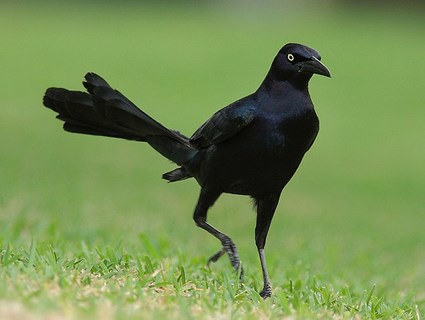
© Kaustubh Deshpande, TX, Dallas, May 2009
This guy,
…who could be the same guy in the Sycamore photo, will once again be a lovely specimen of an avian figure as autumn and winter arrive and when the courting season approaches. The more Grackles, the merrier, or at least funnier and noisier, the garden.
A worthwhile read for an amusing, and sweetly touching, homage to the Great-tailed Grackle, check out this article from Texas Monthly, by John Nova Lomax: Eight Reasons Grackles Are Awesome
Grackles really are awesome.
 My Gardener Says...