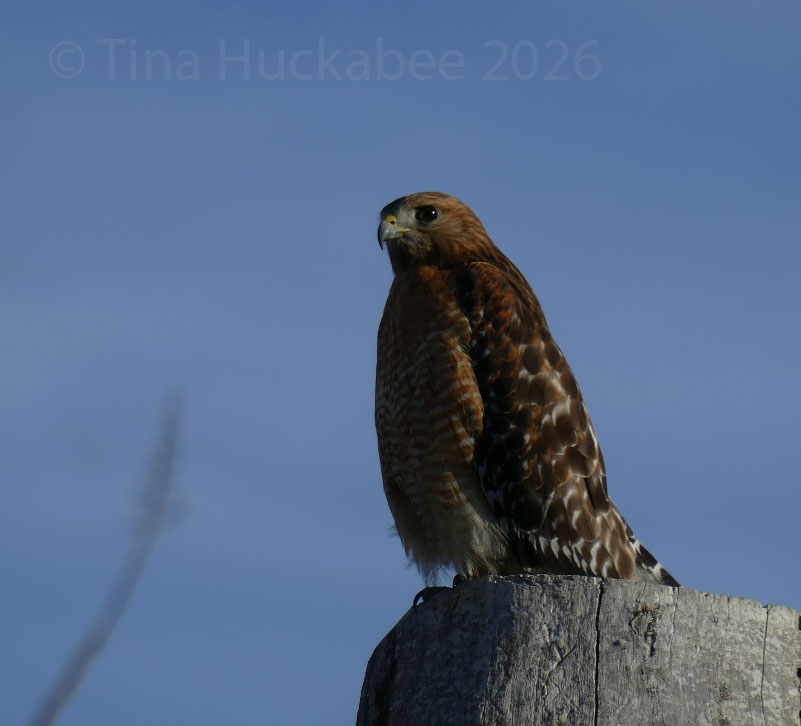
A neighbor alerted me to a Red Shouldered Hawk, Buteo lineatus, perched atop my SIL’s tree stump bordering my front garden. This handsome guy sat royally, observing his realm for at least one hour.
I’m not 100% sure it’s a male. If its mate was perched along side, the gender of each would be obvious: female hawks are bigger than their male partners. That being said, he’s not huge and usually, the girls are quite large birds. I’m sticking with my non-professional assessment that this hawk is a dude hawk.
I suspect it is one of the adult hawks who nested successfully in a tree around the corner from my house last spring, which you can read about here. Unhappily, about six weeks ago, I found some feathers–more than from a preening session–at a house on a street adjacent to my own. I don’t know what might have killed that hawk, as Red Shouldered hawks are apex predators for this neighborhood. I’m guessing that maybe the hawk victim was on the street and was hit by a car (though no blood, mess, or body was seen) or perhaps, the hawk died of rat poison. If that’s the case, whatever attacked and ate the sick hawk was also poisoned.
People, stop hiring companies that use rat bait stations. Despite what the company will tell you, that stuff kills more than rats. Check out this article from Audubon.
Recently, my lone hawk has perched in various spots around the neighborhood with no mate in accompaniment. I hope he finds a new mate; he’s a good-looking chap and I’m certain he has nice hawk manners. He was also a good provider to those two darling hawk chicks last spring.
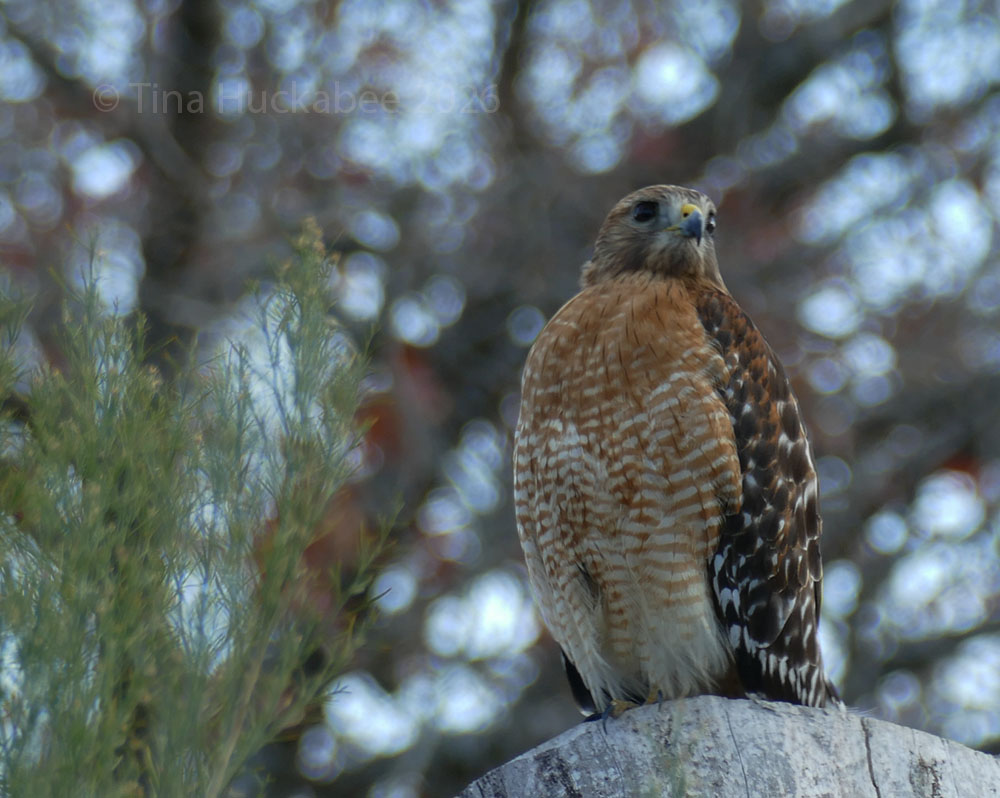
I took these photos while wearing shorts and a t-shirt. Yes, in January: welcome to Texas winter weather. One day it’s shorts, the next day it’s parkas and boots. I’ll be packing those shorts away–at least for the very near future–as Texas is about to a receive a dose of icy freeze. All my blooming things will be done for the year and winter pruning will ramp up next week. Boo.
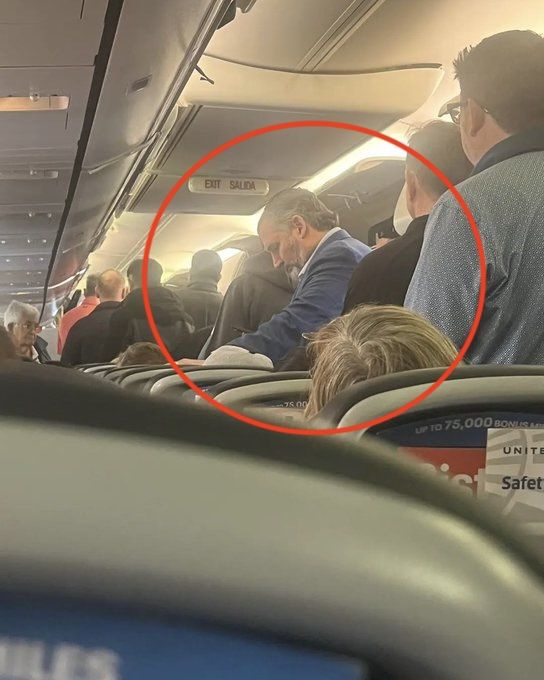
One can tell when there’s an ice event crossing the border into Texas, as our junior senator, Ted Cruz, hops a plane for a warmer place. This time it’s apparently that bastion of Blue, California.



You got me wondering how long it takes for a hawk to realize its mate is gone, and then to look for a new mate. AI gave this answer: “Hawks often recognize the absence of a mate immediately and will typically seek a new partner within a matter of days or weeks, particularly if the loss occurs during the breeding season. While many hawk species (such as red-tailed hawks) are monogamous and mate for life, they are instinctually driven to survive and reproduce, meaning they will quickly replace a mate that has died or disappeared to ensure the success of their territory and offspring.”
LikeLiked by 1 person
I’m sure that’s all correct, but I wonder: how many single Red Shouldered hawks are randomly hanging out in north-central Austin, just waiting to meet the Mr/Ms Right? My hawk friend was in my Sycamore tree earlier this morning, ignoring the protestations of the Blue Jays.
LikeLike
Sad to hear about the use of rat poison and loss of the hawk. Audubon in our state has been pushing a bill through for a ban on anticoagulants after we’ve lost many raptors and mammal predators like foxes. It is a horrible death, what are folks who use this stuff thinking… or not?
LikeLike
Of course, I’m not sure it was poison, but there are neighbors who use companies with that ‘service’. I’ve spoken with 5 or 6 neighbors over the years who had bait boxes put out, all of whom were horrified when I explained the ramifications of using those products. Each neighbor–to their great credit–immediately contacted the companies and had the boxes removed. But, it’s an ongoing struggle to educate.
Good for your state to consider banning such awful products. I’m afraid Texas isn’t so progressive on some (ok, many) kinds of things.
LikeLiked by 1 person
That is an exceedingly handsome hawk. It’s great that he stayed put for your camera. The length of time that he stayed put suggests waiting: perhaps for the missing mate, or perhaps for a passing female to notice him and stop by for a chat. I’ve seen birds who’ve lost their nest and their young, and their grief is palpable. Nevertheless, they often rebuild and start over; it’s a marvel to see.
Your caution about the use of poison is important. It’s one reason ranchers and such don’t use poison against our rampaging wild hogs. Speaking of rats, after reading your entire post the old saying about rats leaving a sinking — or endangered — ship came to mind.
LikeLike
He’s a beauty! He was in my Sycamore this morning.
I do agree that birds and mammals grieve their losses, but you’re correct: they have to get on with the business of life and the future of their kind, though they probably don’t quite think of it in that way.
I’m really glad that ranchers in Texas have eschewed the use of poisons–very wise, indeed.
LikeLiked by 1 person