In February I wrote about the Red-shouldered Hawks who set up housekeeping in our Sycamore tree, adding their particular touches to an abandoned squirrel nest. Sadly, in March, after several days of high winds and the nest torn asunder, the hawks abandoned that tree. I didn’t see the hawks for a few days, but eventually found them busily building another nest in a huge, beautiful Red Oak, Quercus rubra, which grows just around the corner from my street. I guess the hawks chose well as that tree is taller and wider, with dense foliage for protection.
I’ve kept an eye on the hawk happenings, observing their new digs and parent hawk behavior. Typically, mom is on the nest, dad is nearby, serving as a protective sentry with his watchful hawk eyes.

I’ve only caught quick glimpses of fuzzy white chick heads, but never when I’m in possession of either my binoculars or my camera.
On this morning, dad was harassed by a vociferous Blue Jay, Cyanocitta cristata, off to his left.
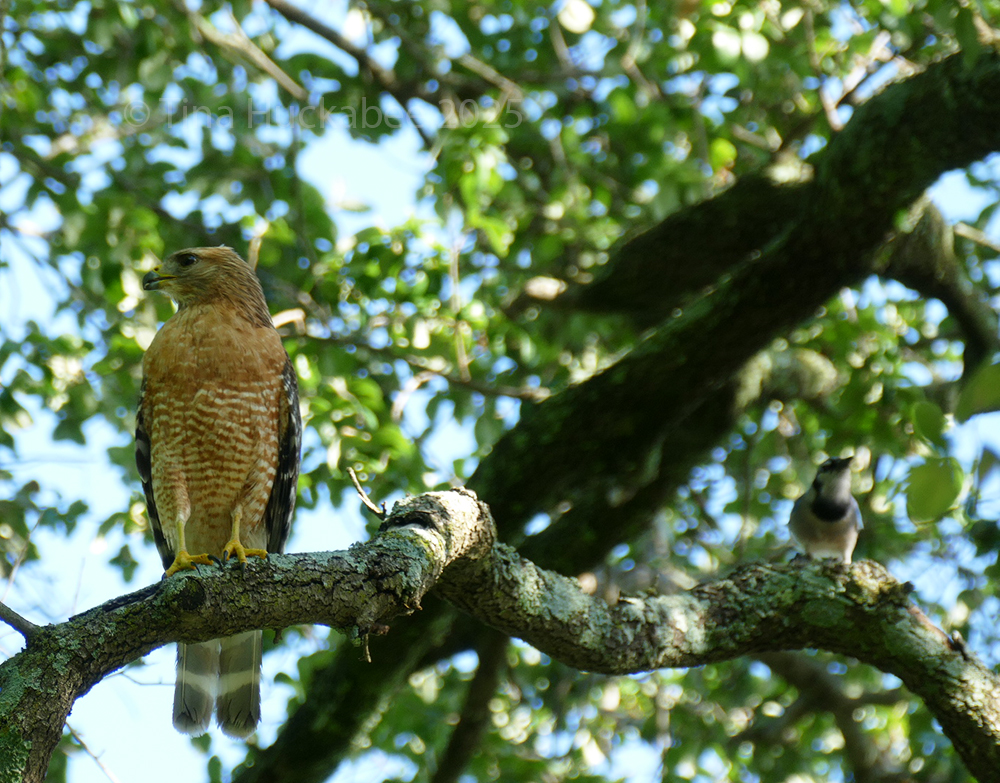
Dad hawk looks rather disdainful of the intrusion; he flew to a different branch a minute later, jay in noisy pursuit.
Mom hawk is in the nest, caring for the wee ones, hunkered down in their solidly built oak-leafy nest.
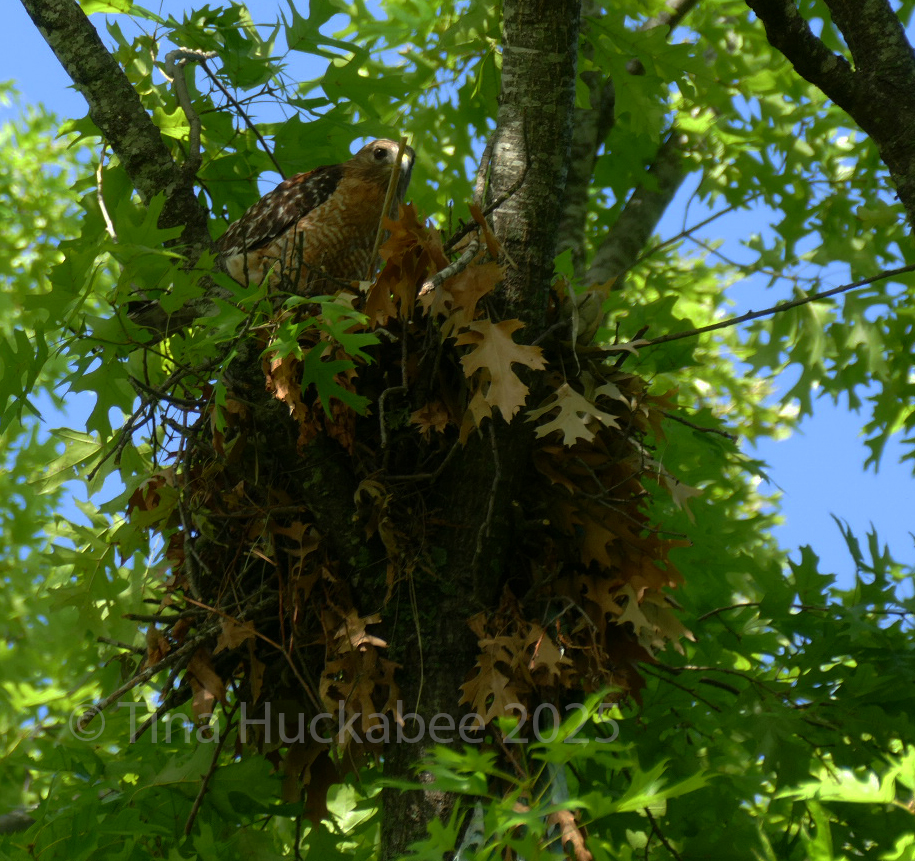
My SIL has been luckier in getting great shots of the hawk family, including this one of the two chicks, fierce-n-fuzzy they are! Look at those darling, terrifying faces!

I’ve been watching the hawks since late March, but only two weeks ago discovered that across the street, situated in a large Live Oak, Quercus virginiana, a family of Yellow-crested Night Herons, Nyctanassa violacea, have also settled in for their chick-raising. Bird neighbors! I’m guessing these two feathery families don’t share meals or coordinate play dates for the kids! I find it fascinating that these two large predator birds are relatively close together and are raising successful families. That said, while both species hunt, they hunt different prey, so there’s probably not much competition for food, at least between the families.
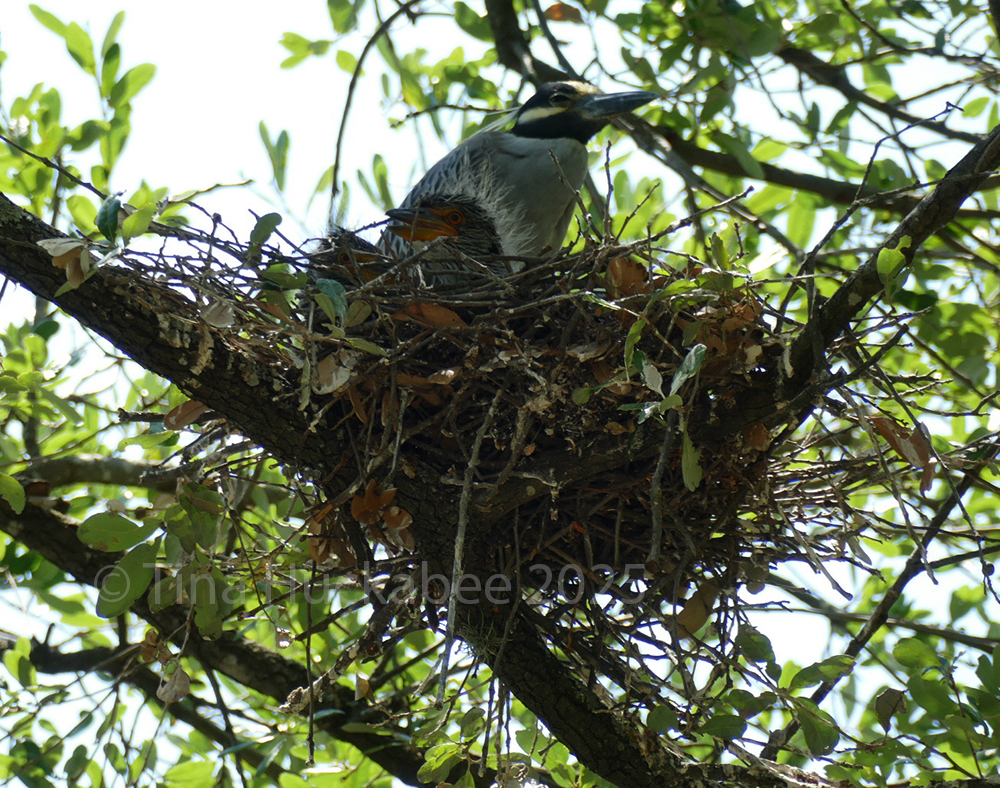
There’s always one adult heron near the nest, and often I see both adults, perched on opposite branches that book-end the large nest of babies in between. In this photo, one adult faces away from my camera, tail feathers and skinny legs in view. The other adult preens, its yellow crown visible in the morning sun.

The oldest chick (presumably) is on the left, the two younger in the nest, cuddled side-by-side.
Here, one adult preens and the three chicks are being chicks. The one on the right is larger than the other two, a little heron head sits in the middle, and a blob of feathery fluff is barely visible on the left side of the nest.
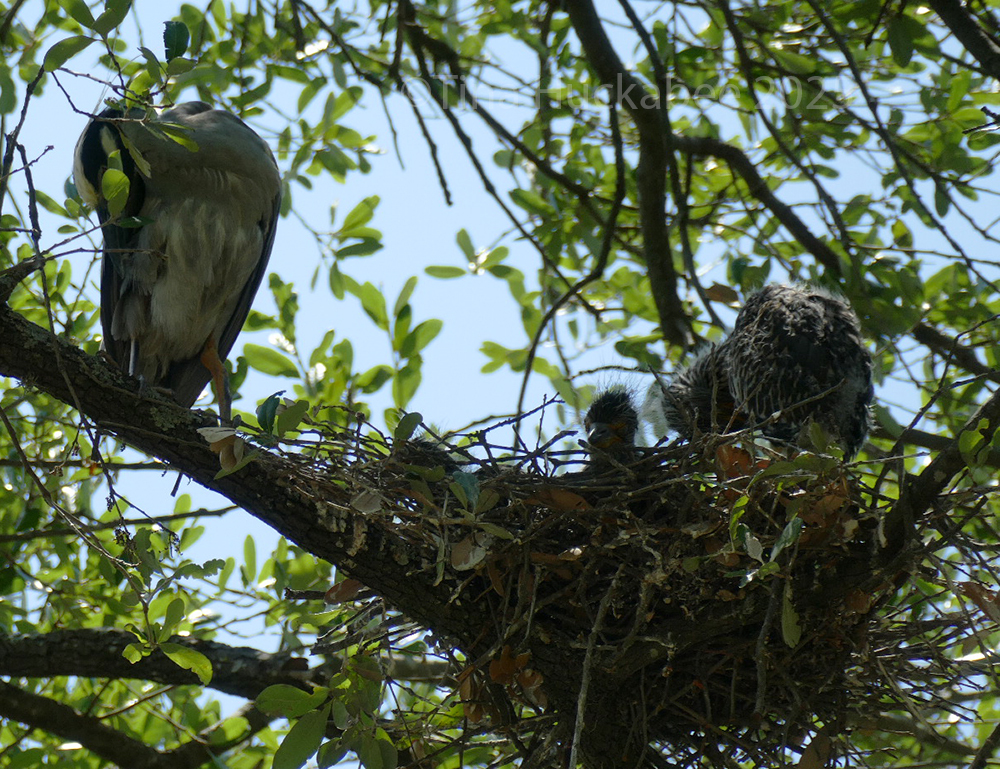
Adult heron and baby heron, each stare in different directions.
Another stunning shot from my SIL! All beaks and eyes, these little critters rock their dinosaur past.

I expect these characters to fledge in the next week or two. They’ll be spotted on rooftops, residents’ cars, and on lawns, and hopefully not in the street. I also hope they’re too big for the hawks to predate, but I’m not so sure about that.
Puffy clouds act as a visual connection between the hawks’ home tree on the right and the herons’ home tree on the left. The street sits just below, bisecting the two properties.

There are at least four other nesting heron families in this part of our neighborhood and in the larger neighborhood area, a nesting family of Red-tailed Hawks, Buteo jamaicensis, and at least one family of Cooper’s Hawks, Astur cooperii, call this area home. Providing for these predatory birds, as well as for multitudes of song birds, wood peckers, finches, mammals, and countless insects is why trees exist. Large native trees are not only beautiful for people to enjoy, but provide life and protection for wild things.
Plant trees, especially native trees, and prune sparingly. Wildlife will cheer!
Sad addendum: we just experienced a strong thunderstorm with high winds, heavy rain, and hail. I walked over to the street where the nests are and I spoke with the young woman who is the owner of the house with the heron nest. The nest is completely gone, a major branch broke that was above the nest. The young woman said she found one nestling dead; she hasn’t seen the other herons. The hawk nest is undamaged. I didn’t see any chicks, but they aren’t always visible. I looked on the lawn and didn’t see any bodies or live birds. The young woman saw one of the adult hawks drying itself.
 My Gardener Says...
There seems to be no general rule for which predators will prey on which other predators, but in specific cases we may be able to tell. As you said of the two you featured, their prey is different. While I can imagine a hawk going after a heron, I can’t imagine the reverse is at all likely.
Good pictures from your sister-in-law.
LikeLike
Sharon has a great camera, much better than mine for distance shots. She got it specifically for birding. The storm brought down the heron nest. I added some information at the bottom of the post.
LikeLike
Those hawk nestlings truly are adorable. The number of times my local hawk has been diving on the doves at the feeder, I suspect another nestful of youngsters is being fed. The bluejays are doing a lot of screaming recently, and a couple of days ago I saw several of them gang up on the hawk and drive it away. I’m sure it will be back.
I haven’t seen any nests close by, but there are mockingbird youngsters calling for food, and my cardinal pair are back-and-forthing like crazy. I have a little wren spending time here now, hopping around in my plants and plucking tidbits. The spiders have been thick, so I’m happy for the wrens to help clear them out.
The yellow-crowned heron’s nest looks just like one I spotted at Armand Bayou, right above the pond. I couldn’t believe how ‘messy’ it was, but the similarity with yours suggests that’s just the way they do it. There was an older juvenile on a branch not far from that nest, so it may be that the nest had served its purpose and wasn’t being so carefully maintained.
LikeLike
Those blue jays really know how to make a ruckus!
I added some information just now. We had a bad storm come through at about 6:30–the heron nest is gone, destroyed. At least one of the nestling died. Sniff.
LikeLiked by 1 person
I’m so sorry, Tina! I just looked at the radar history and saw the storm: not so large in area, but obviously powerful. There’s another one headed your way that’s around Burnet now; I hope it looses its oomph before it gets to you, or misses you completely.
LikeLike
Thanks for the heads-up. I guess I’d better get out with Duke the Dog! There are lots of branches down and even more foliage–I’ve got my work cut out for the next day or so. One of our larger oak limbs dropped, taking down about half of a Mt. Laurel.
As for the the poor birds, it’s so sad. The heron nest didn’t even exist. I’m hoping the other two nestlings are close enough to fledge age that they’ll make it, but that’s a tall ask. I’m a little less concerned about the hawks, as their nest looks just fine and other than being wet, they’re probably okay. I don’t always go out to listen for the Screech owls, but I’ll make a concerted effort in the next day or so. Hopefully, they’re intact, too. And the Bewick’s wrens parents (I can now hear the chicks!). Sigh. Life is hard.
LikeLike
Unfortunately a few miles can make a great difference, in the case of those herons for the worse. We watched the local news from 6 o’clock on with increasing trepidation as the weather reporter talked about the coming thunderstorm and the possibility of strong winds and hail. You’re about three or four miles southeast of us, but here we got only some heavy rain and no damaging winds or hail. What the follow-up coming down from Burnet brings remains to be seen.
LikeLiked by 1 person
Great post, Tina. You and your SIL got some great photos. I’m glad that your neighborhood is a welcoming habitat for so many species. Very encouraging!
LikeLike
Thanks, Eliza! It’s a pretty typical urban neighborhood, lots of lawn and boring green shrubs, but we do have wonderful trees. Even with the typical American sterile landscape, there is an amazing amount of wildlife here and I’m so grateful for that. Check the end of the post, I updated with some post-storm information.
LikeLiked by 1 person
Oh, sad news, Tina. Nature is a tough gal. Those fierce storms challenge one and all. 😦
LikeLike
I love this glimpse into the birds’ family lives! I have red-shouldered hawks where I live but I have never seen a nest, much less such a good look at the chicks. I really enjoyed this visit.
LikeLike
Thanks, Ranger! I feel so fortunate to have been able to observe the hawks and herons this spring. They’re remarkable survivors and most people don’t even know they’re around.
LikeLike
How impressive to have so many occupied nests in your neighborhood. Your advice about supporting native trees and wildlife is so apropros.
Thank you for sharing these wonderful stories and images, Tina. I wish both these families well.
LikeLike
It really is something to have so much here, especially given the number of lawns. But we have great trees and that’s the ‘hood’s saving grace, I think.
I’m glad you enjoyed the post. I added some information, as we just had a bad storm come through. It’s not good news…
LikeLiked by 1 person
Oh, no . . . 😦
LikeLike
I just heard a loud bird call that was new to me. I went outside and found the tree it was coming from. That’s when I had an ah-ha moment. I ran inside, grabbed my phone, downloaded the Merlin app in a flash, and went back out to try to record the call. It worked like a dream; I was hearing a different sound from a red-shouldered hawk. When I went to the Cornell site to double check it, sure enough: that’s what it was. As my grandma used to say, “So soon old, so late smart!”
LikeLike
Lol, I love that! When I first began watching the hawks back in February, I just assumed they were Red-tails. They didn’t quite look like Red-tails, but it was only with their calls that I definitively ID’d them. I’m sure hoping their babies are ok.
LikeLiked by 1 person
First, those are some really great photos. The Blue Jays never give up, but that is how I usually spot a raptor by all their ruckus. I thought the Night Herons were only near the Gulf. I have seen them in Galveston, but never around here and I’m near a lake. It is sad when a nest is lost.
LikeLike
Thanks, Judy! I particularly like my SIL’s photos, so good and at a distance.
One of the nestlings survived–the largest one! I saw an adult and the young’n this morning. The other adult is probably alive, but out catching some fish or toads. I’m hoping a second baby is somewhere around, but I think it’s unlikely.
LikeLiked by 1 person
Thanks for the great article and lovely photos, I was sad at the end to learn about the storm and its consequences. Nature! I look forward to your posts.
Take care.
LikeLike
Thanks, Frances! It is sad when nestlings die. The parents work so hard and are so diligent, the loss I’m sure must be hard for them. At least one of the nestlings is alive, I saw it in the tree with one of the parents! Good news!
LikeLike
Just read your addendum, Tina. That’s sad news for the heron family. I hope the hawks did better. Things can change so quickly. 😢
LikeLike
It’s very sad. Two bright notes, though: the hawk family is fine, both parents, both chicks. I walked by the heron tree this afternoon and the larger chick and one adult were in the tree. This evening, no herons in the tree. My hope is that mama heron and the other surviving chick are in a different tree, nearby. Nevertheless, at least one chick survived.
LikeLiked by 1 person
Thanks for the update, Tina.
LikeLiked by 1 person
OMG, those chicks are adorable! And your captures are amazing! That’s so sad about the herons: Nature can be both cruel and wonderful, and tragic and rewarding.
LikeLike
I was happy with my photos and thrilled with my Sharon’s, my SIL. And yes, to all you suggested about nature.
LikeLike
Pingback: Hawk Before The Ice | My Gardener Says…