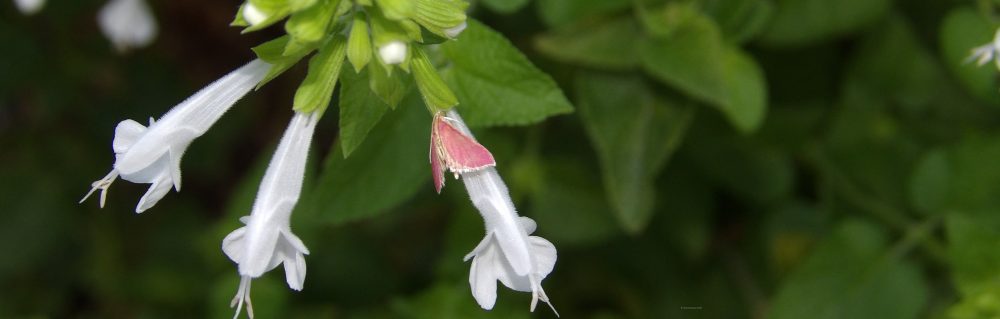
This winter has seen plenty of overnight light freezes in my garden, but only in the last few days were the conditions ripe for the formation of Frostweed, Verbesina virginica, ice sculptures. Two mornings ago, the day dawned cold, bright and sunny, with icy, exploded frostweed a new addition to the garden.

As I trundled around the garden, I observed many low-to-the-ground ice sculptures revealing themselves in light and shadow. Many plants produce ice sculptures during the first hard freeze of the season, but none with quite the drama of frostweed.
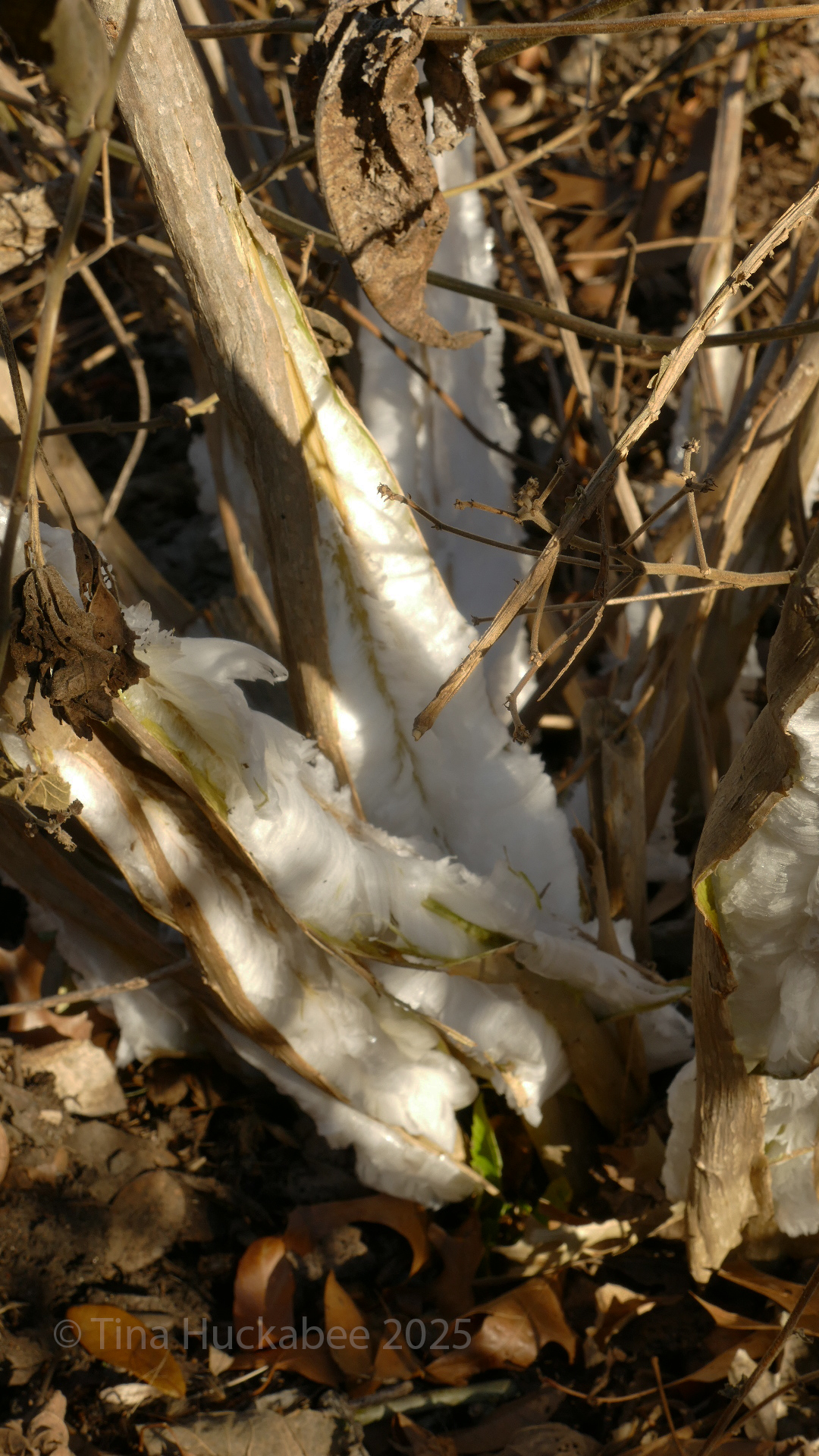
Morning sun highlighted fanned crystal formations, held firm along broken stems, as sturdy braces
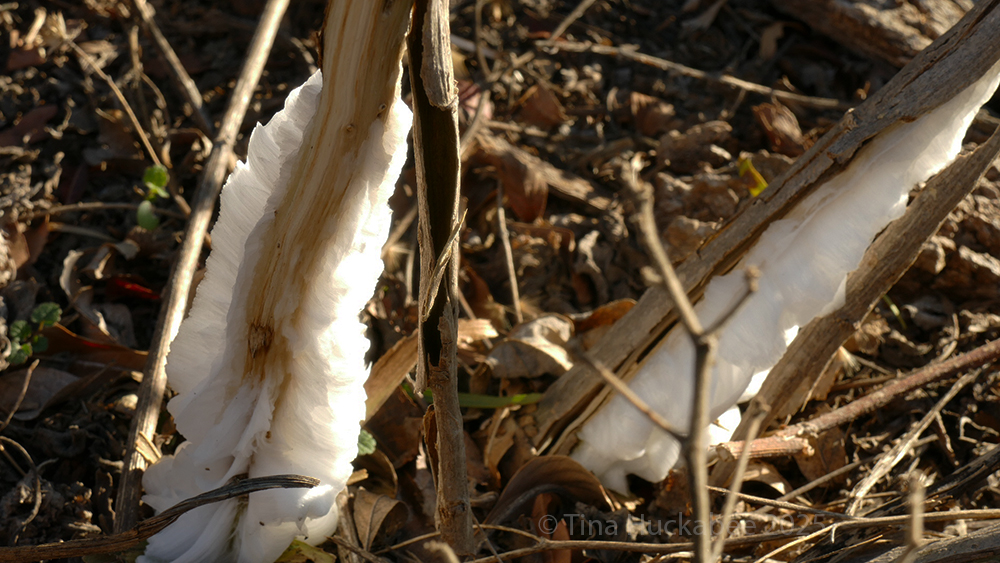
The temperature never rose above freezing that day and into the night, the fragile ice sculptures held. Indeed, by the next morning, many of the sculptures had expanded. The second day was cloudy, no sun rays to brighten the ice. Some newer sculptures, instead of traveling upwards the stems, remained close to the ground, the ice reminiscent of floral decorations from warmer days past.

I haven’t pruned the winter garden, at least not in any major way. But here, it’s clear that stems were cut, the ice crystals limited to hugging the ground, swirling around the stems, snuggled on fallen leaves.
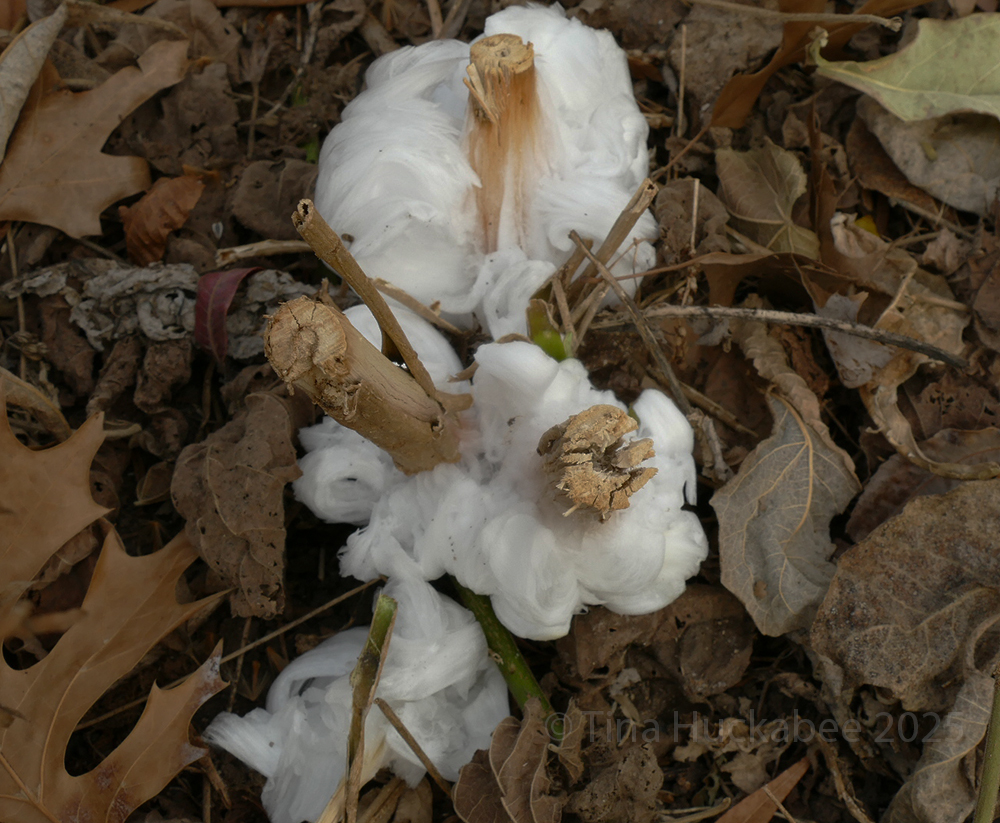
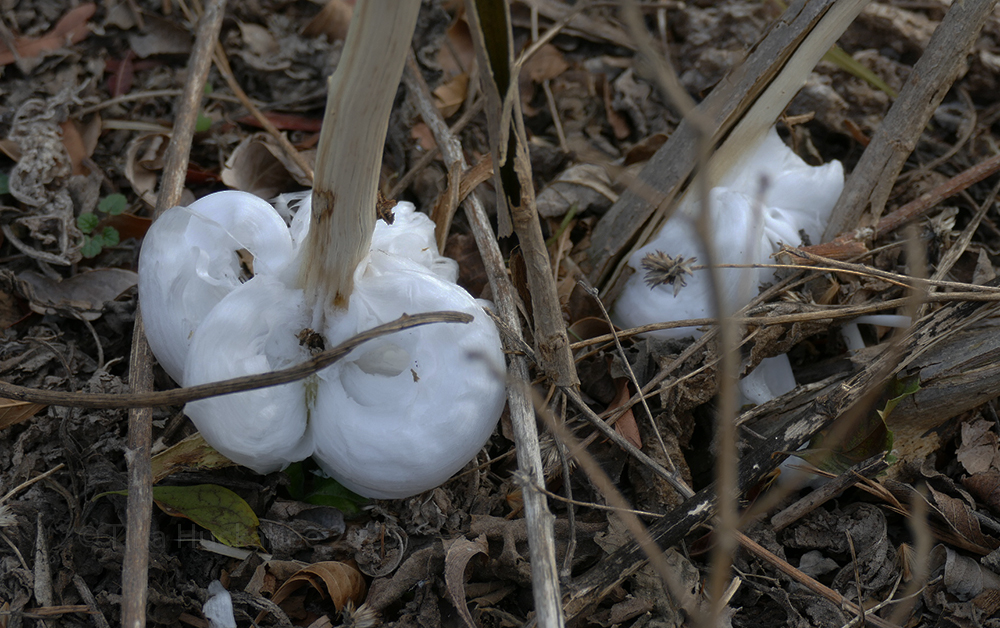
Frozen water proves stronger than sturdy stems.

This frostweed created the tallest of the ice formations in my garden, whirls around the stems, some 2 feet up from the ground. Green winter grass, coupled with some evergreen wildflower foliage, is a fetching background to the ice and winter-dormant stems.


Compare this photo with the first: it’s the same plant with more ice, less intact stems. Such is the way of frostweed ice sculpture work, rendering a new paradigm for the plants’ seasonal life. It’s an end, of a sort, though in reality, only a resting time. The roots below are priming for spring green.

This morning, snow is a light blanket in my garden. It’s not a powdery substance, but instead, sleet and snow mixed. It’s also quiet, the birds mostly still asleep or too cold to sing, except for the Carolina Wren–he’s awake. The Grey Fox, a regular night visitor to my garden, was out last night, caught on the wildlife camera prancing around the white ground, probably hunting. I hope it’s now in some warm, protect place, resting for the adventures to come.
This winter ice, whether snow, sleet, or busted plant stems, is fleeting–like so many things in the garden.
 My Gardener Says...
Hooray finally for your fine crop of frozen frostweed! It’s nice that the temperature, because frigid, didn’t soon melt the ice, but rather let you get to see some of the formations expand.
LikeLike
And the ice sculptures are still there, mid-afternoon!
LikeLike
How nice that they’ve lingered. With the overnight temperature predicted to drop to the lowest of the year, you may still have your sculptures tomorrow morning.
In Great Hills Park this morning I didn’t spot any frostweed ice in the usual place, but I was glad to find some icicles hanging from a cliff.
LikeLiked by 1 person
This was fascinating. Great photos of frostweed formations.
LikeLike
Thanks, Flower. It’s always fun to report on this winter happening!
LikeLiked by 1 person
Those are so cool. I never saw any in person. We woke up to 3 inches of snow. I’ll be posting some photos.
LikeLike
Wow! Three inches! We got a mix of sleet/snow and there’s still some in shady spots, but it was probably not more than a quarter of an inch, if that.
LikeLiked by 1 person
Oddly, there was more here in the south. Galveston was crazy with snow on the beach and big waves.
LikeLiked by 1 person
It happens, sometimes that the coast or Valley gets more snow than Central Texas.
LikeLike
I was thinking of you when I had a Kinglet with a nice red crown hopping around me on the back porch, cold and hungry.
LikeLike
Awe, they’re so cute, but super hard to get a good photo of! I had one in the early part of winter, but haven’t seen it for awhile.
LikeLiked by 1 person
I was so excited to see the Kinglet close up, I didn’t think about getting my phone out.
LikeLiked by 1 person
Frostweed is SO weird! It looks almost like a confection, or something that might top a fancy coffee beverage.
LikeLike
Lol, that’s a very good description! The ice swirls do look like some kind of confectionery goodie!
LikeLiked by 1 person
The other day I tasted a bit of the ice just to see if there might be some sweetness from the plant’s sap. I detected no flavor of any kind.
LikeLike
That was brave of you! Interesting that the plant didn’t impart any taste at all.
LikeLike
Fascinating. Thanks for sharing.
LikeLike
Thanks, and you’re welcome!
LikeLike
Such a fun plant to see, thanks for sharing yours, Tina! 🙂
LikeLike
Thanks, Eliza–it’s a winter thing!
LikeLike
Fascinating, and you got some great captures of it! Once we pull out of the subzero weather, I hope to head out to capture a few outdoor photos, too. Winter is brutal, but it is beautiful in its own way. ❤
Beth @ PlantPostings.com
LikeLike
I would have a tough time with months of it, but I wish we had a bit more of winter than we do. I look forward to your photos, Beth!
LikeLike
I actually headed down to the frostweed patch I know about a couple of days ago, but we’ve lingered at 33 or 34 — at least, until the real cold and snow came. In fact, it stayed above freezing last night until a plunge when the snow began. It would have been crazy to get out on the roads today, so I’m sure I’ll have to wait for next year to have another chance at seeing these.
You have some really nice formations. I especially like the tall, slender ones. Some remind me of Torah scrolls, and some of candles. These, and our snow, are a good reminder that winter, too, has a lot of variety to offer!
LikeLike
I’m sorry you missed your frostweed, it is a fleeting thing, these ice sculptures. Mine are still intact, but it’s only 27 now in the garden. By this afternoon, they’ll be gone for the year.
You’re right, they do look like Torah scrolls. 🙂
I like taking photos in winter, as the leaves are in such variety and the landscape is so different from the rest of the year.
LikeLiked by 1 person
How amazing! I’ve never heard of this plant, we don’t have it here in Australia. The ice formations are so incredible and unique. It almost looks like someone wrapped fairy floss (cotton candy) around the stalks. Thanks for sharing. ❄️🙂
LikeLike
This plant is native to Texas and not on too many nursery lists. But it is a great wildlife plant, great for pollinators and then the birds and mammals like the seeds.
I like your term ‘fairy floss’–rather poetic, I’d say!
LikeLiked by 1 person
This is such an interesting phenomenon. I always enjoy seeing your (and Steve’s) photos showing Texas frostweed.
LikeLike