During this time of year with shorter days, clouds impeding sunshine, and regular rain, the Forsythia Sage, Salvia madrensis, reigns supreme–and yellow–over the garden. This native plant to the Sierra Madre Oriental mountains in Mexico is right at home in my Central Texas Garden.
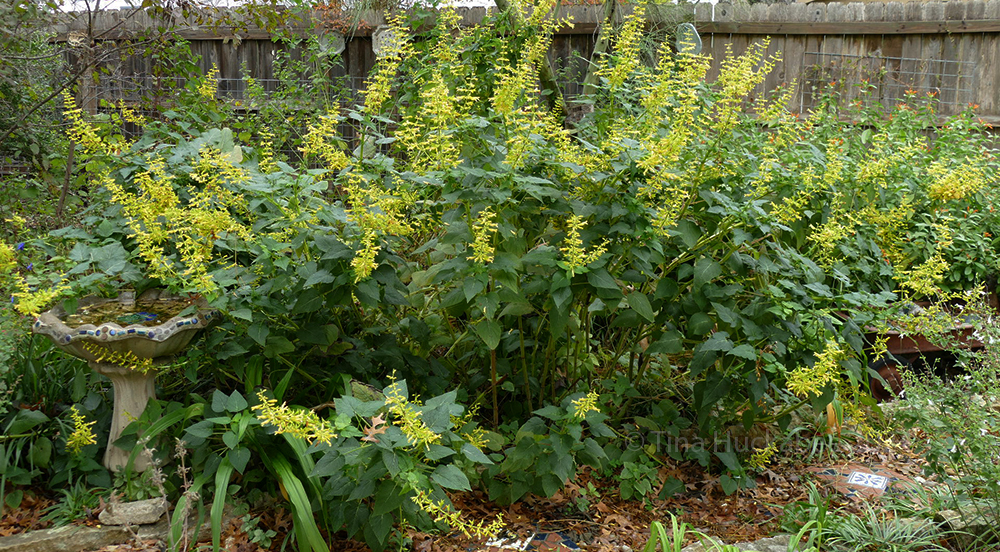
Many years ago, a generous gardener gifted to me some sprigs-with-roots of the delightful perennial and I’m always grateful for its graceful presence in my garden. Its foliage is a lush blue-green during late spring and throughout summer, the many flower spikes a cheery yellow, blooming from late summer until a hard freeze ends its season. Forsythia sage is one of the last plants in my garden to provide a big, blooming show.
This salvia likes some extra water during the hottest and driest times of summer, so I oblige by dousing the soil in which it thrives in between my once or twice per month irrigation. That being said, I’ve sometimes not given the extra drink, and other than looking a little sad, the plant always rallies with the next rainfall or soaker hosing–whichever comes first. Never has there been even the slightest hint of a brown or dying stem.
This sunny sage hasn’t seeded out, though it spreads by roots and is easily controlled. Mine is planted in a spot that receives brief full summer sun, but is protected from the late afternoon broil. Morning sun with afternoon shade is the ideal Forsythia sage situation.

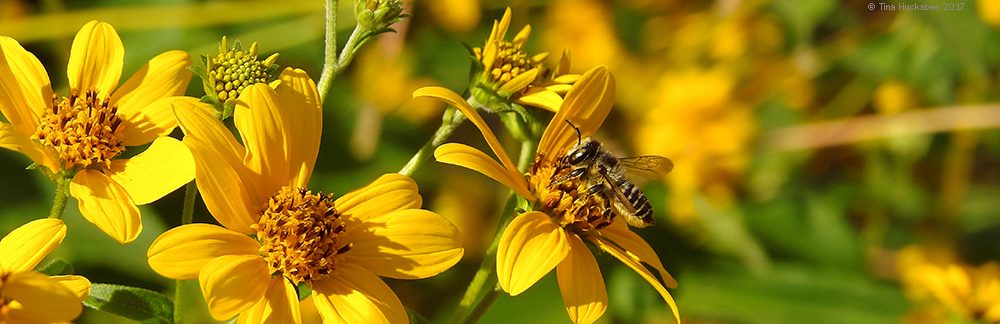
My honeybees and one native bee, the Horsefly-like Carpenter bee, Xylocopa tabaniformis, are the two pollinators that I’ve observed at the flowers.
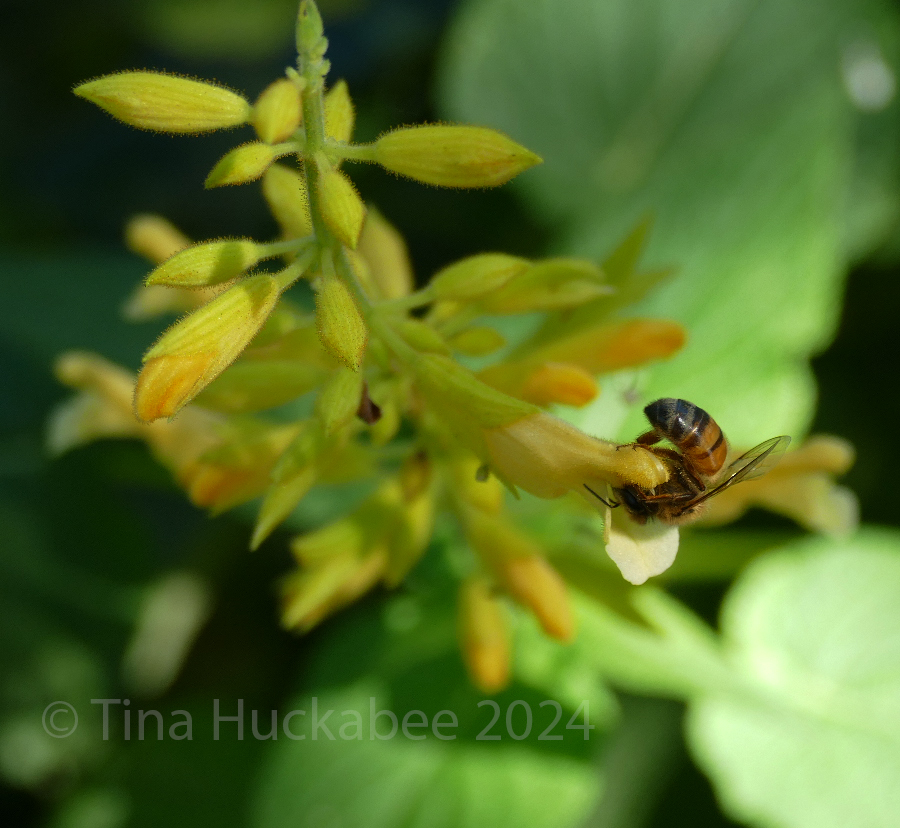
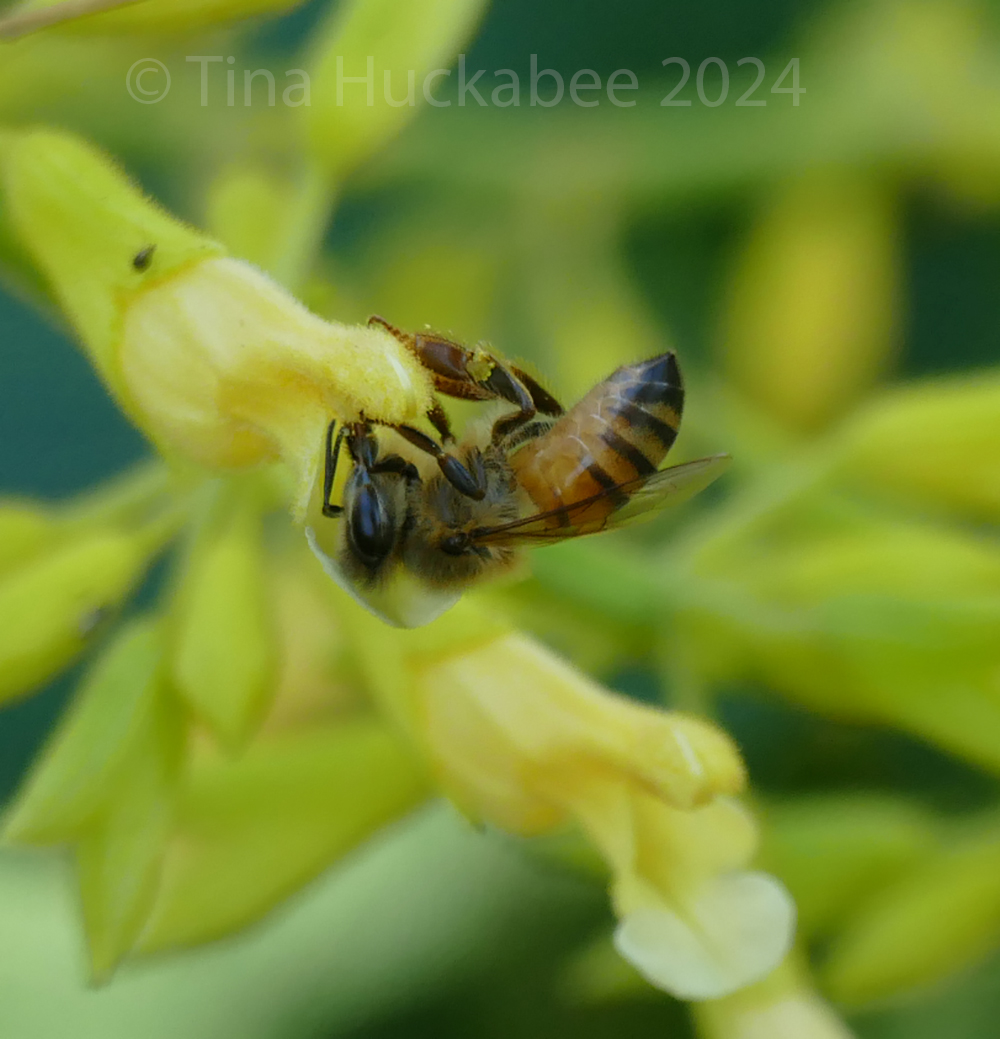
Honeybees are happily busy in the dark time of year.
I’ve seen plenty of squirrels and little birds use the dense foliage for cover and who knows what critters of the overnight wildlife shift also take refuge in the protective cover.
The first freeze of the year in my garden occurred recently, landing right at 32 degrees. I noticed that a bird bath in my front garden was left with a thin layer of ice that morning. The back garden, probably because of the shelter provided by the two big Red Oaks, stayed above 32, with no ice found in any water feature. I was glad for that, as the Forsythia sage is still beautiful, providing shelter and nourishment for garden beasties.
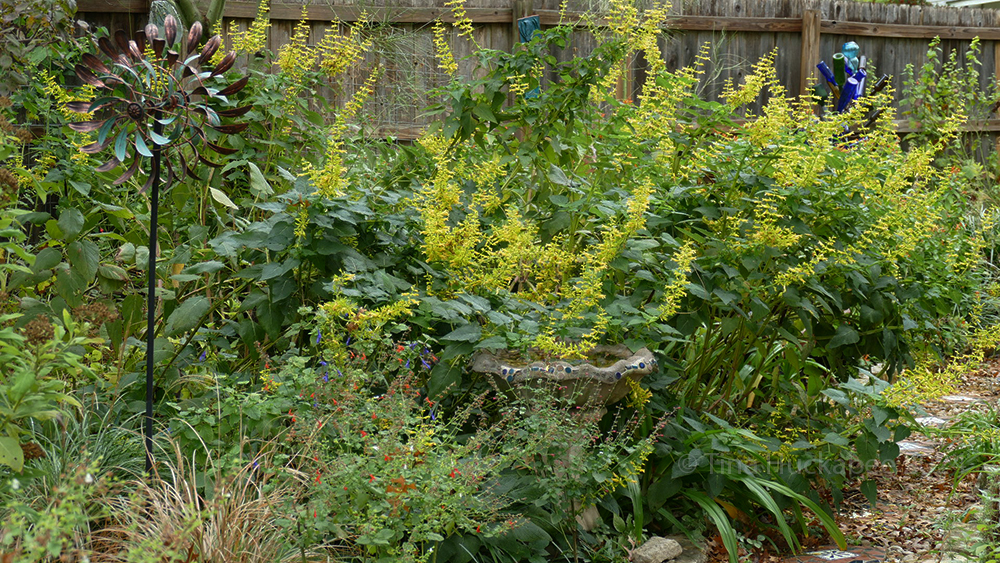
A killing frost is coming at some point in time in the next months. For now, the bees and I will enjoy this hardy and stunning perennial and appreciate its bright beauty in a dark time.


It’s easy to see why the wildflowers are called forsythia sage. In contrast, I puzzled for a moment over what the madrensis might refer to. You cleared it up in the next line with your statement about Mexico’s Sierra Madre Oriental mountains.
As far as I know, we haven’t gotten down to 32° yet in Great Hills, just a few miles from you. I hope not, because if we have, I missed my usual first chance to witness frostweed ice.
LikeLike
I think it may have just been a micro-climate thing. That morning, it was definitely colder than they’d predicted as I got out near sunrise to walk Duke the Dog. I checked KVUE, which is only about a mile from us and they were at 32. Then, I saw the ice in the birdbath. None of the baths in the back garden had ice, so it was definitely not 32 there, at least near the ground.
I’ve found that frostweed needs a more sustained freeze before it does its icy thing–but that’s coming our way, too!
LikeLike
I love to grow some sunshine, too.
LikeLike
Yellow is just so cheery, especially when we need cheering. 🙂
LikeLiked by 1 person
Wow, my forsythia sage does not even come close to yours as it makes only one or two flower spikes a year. You definitely have the right climate for it. A bit north of here they hit 32 degrees, but we were only in the high 30’s. Back to 80 today. Can never put those shorts away.
LikeLike
I’m wearing shorts now! Yes, our weather is always back-n-forth, but this year, it’s really nuts.
LikeLike
The name gets my attention as much as the color in winter. There is no shortage of floral color during winter here, but I happen to be very fond of the real forsythia. It is rare here, although a few tires specimens inhabit our landscapes. Does Salvia chiapensis bloom through winter? It is new for us, and although I am not overly impressed with it, everyone else is.
LikeLike
I don’t know the S. chiapensis plant!
LikeLiked by 1 person
I have difficulty describing color, but I believe that it is sort of a bright purplish pink, like that of perennial pea.
LikeLiked by 1 person
This looks and sounds like a remarkable plant. To follow up on Steve’s comment above, madrensis could also be interpreted as the plant’s motherly side of providing for so many crucial critters so late in the year. Including providing cheer to you and to the rest of us.
Warm greetings,
Tanja
LikeLiked by 1 person
I think madrensis does refer to the mountains (at least everything I’ve read about the plant suggests that), but, like you, my first impression was the name was more of a maternal link. GMTA! It is a cheery plant and I’m enjoying it so much!
LikeLiked by 1 person
😊
LikeLike
That’s a beautiful Salvia, and it does indeed look very happy and healthy! If I lived in your climate, that is one I would want to grow.
Beth @ PlantPostings.com
LikeLike
You’re way to cold for this pretty, but you can grow things that I wouldn’t try. That’s one reason we blog, isn’t it? To enjoy what’s in others’ gardens!
LikeLike
What a beauty en masse. I like your cool wind sculpture, too. 🙂
LikeLiked by 1 person
It’s very pretty in a big group. And thanks, I like that sculpture too, it’s almost always in motion!
LikeLiked by 1 person
This sure is a spot of sunshine in your garden! I love forsythia, and always think of it in spring; it was one of our first signs of midwestern spring, but this plant has the great advantage of keeping color right until frost. It’s interesting that it’s native to Mexico. I found another sage new to me in the garden at Medina: the Mexican bush sage (Salvia leucantha). It has white flowers with purple calyces — and also blooms until first frost.
I was curious about the salvia that Tony mentioned. Lo and behold, it’s another Mexican native. I found an article that said: “This plant comes from the area near San Cristobal at an elevation between 7000 to 9,500 feet in the province of Chiapas, Mexico. It was first collected in 1981 by a group collecting for the University of California Berkeley Botanic Garden.” Not only that, San Marcos growers can provide it for you!
LikeLike
I’ve never seen “real” forsythia, except in photos. I’m familiar with Mexican bush sage and used to have one or two. As my garden space became shadier, I couldn’t grow it anymore. I had plans to add it to the front garden 3 years ago, but ran out of room. That’s my biggest problem: not enough room for all the plants I want! The Mexican bush sage is very popular here in Austin, one can see it everywhere!
I looked at photos of the S. chiapensis, it’s very pretty!
LikeLiked by 1 person
Oh i just love this! I realize I’ve steered clear of all yellow salvias because of how INCREDIBLY allergic (topically) i am to Jerusalem sage- which i found out after I hand unloaded a truck of them at the garden center I worked at in college. This looks like it doesn’t have the powdery leaves like the Jerusalem sages do though- so I’m going to keep an eye out for it and add it to the garden!
LikeLiked by 1 person
I’ll bet you can find this plant at one of your SA nurseries and it should grow beautifully there! Good luck finding it, it’s a winner!
LikeLiked by 1 person