
In early June, at the first hive check of the month (we check our hives every 2-2.5 weeks from late February through October), we realized that there was no activity around our hive, Woody. No bees were flying in, no bees were flying out. The hives sit at the back of the garden and I don’t garden-putter much in that area, so day-to-day, I don’t pay close attention to the honeybee goings-on.

When we opened up the hive, it was empty of life. The comb was beautiful and intact and the bees had eaten all the honey in the the 30 frames, there wasn’t a drop left! Woody’s bees had absconded, meaning that the hive performed a total swarm: the queen and all the workers left, permanently, and for unknown reasons. Honeybees will abandon their hive if the resources are scare (not in this case), or if there is prolonged, rainy weather (didn’t happen), or for other, only-for-honeybees-to-understand, reasons. Bingo! We believe the hive absconded just a few days before the planned the hive check and during the previous hive check, Woody was a healthy, active hive.
The one issue that could have have caused Woody to search for and move to different real estate is that the stronger hive, Bo-Peep, might have been robbing Woody of its honey, and perhaps Woody’s ladies had enough of that nonsense. Realistically? We’ll never know why the bees left. Absconding happens, not often, but it’s a natural process, akin to honeybee swarming, though with different causes and goals. Woody’s absconding is our first experience with this particular honeybee happening.
We dismantled the hive, laid the parts–boxes and frames–in the garden, preparing to freeze the frames to kill any wax moths or other invasive insects and their eggs. We’ll wash the hive boxes with a bleach/water mixture to kill eggs snuggled in cracks and crevices.
I should add that we don’t think the bees absconded because of wax moth eggs or larvae that were in the hive. Every hive in Texas has wax moth eggs and at least, early stage larvae. Wax moth larvae are truly nasty critters, but a healthy hive will keep the hive free of an infestation. Bees are tidy gals! Weak hives are vulnerable, and empty wax frames just sitting around are an invitation for moths to lay eggs so that the gross caterpillars eat their way through the wax.
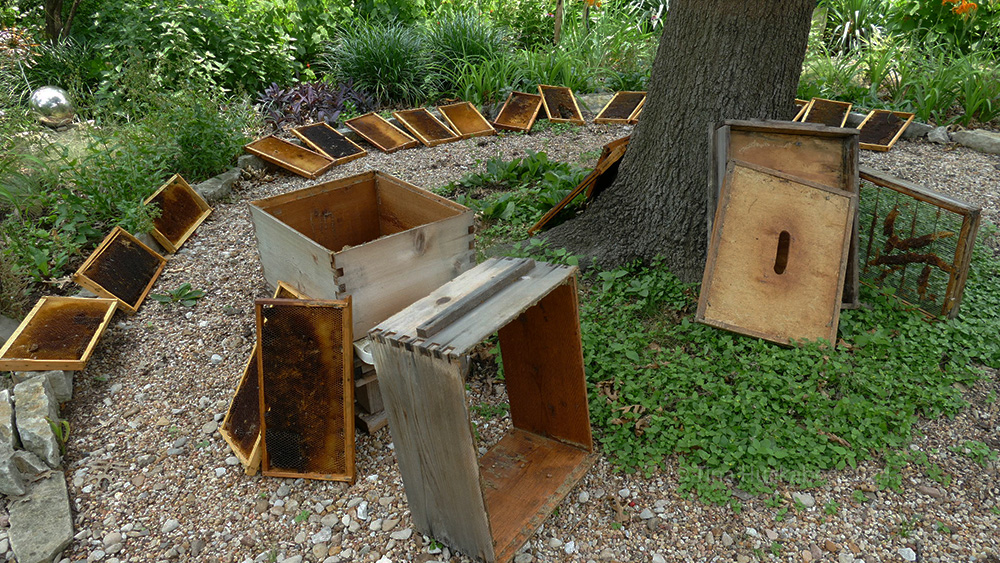
Even in the few days that the bees weren’t in the hive, wax moth larvae had hatched and commenced with their wax destruction. The larvae eat the wax, leaving frass and webbing as they move through the comb. A serious infestation will destroy a hive in a matter of days. We lost a hive to wax moth several years ago and it was horrific. It was one of the foulest, most disgusting clean-up chores I’ve ever been forced to engage in.
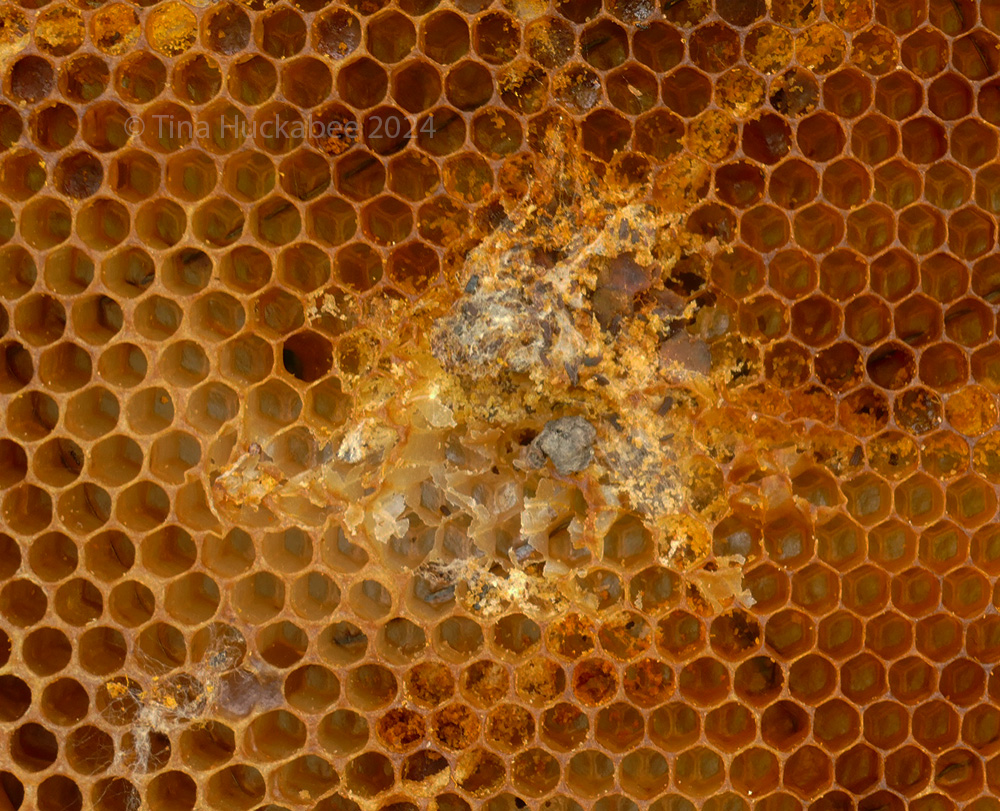
If you look carefully at the comb cells, you can see some of the small, newly hatched larvae.

The larvae grow to about 1 inch long and are quite plump before they’re ready to pupate and morph to their adult selves. Freezing the frames for 3 days is the best insurance for killing any eggs or larvae. Each time we take honey frames for extraction, we pop the frames into our freezer for the allotted 3 days; afterwards, we store the frames in plastic bins. We extract as soon as we have time (it’s a process), because no matter how tight the lids are, if we don’t extract within a month or so, wax moth larvae somehow appear, even when we’ve taken correct precautions.
Bo-Peep is now our only hive.
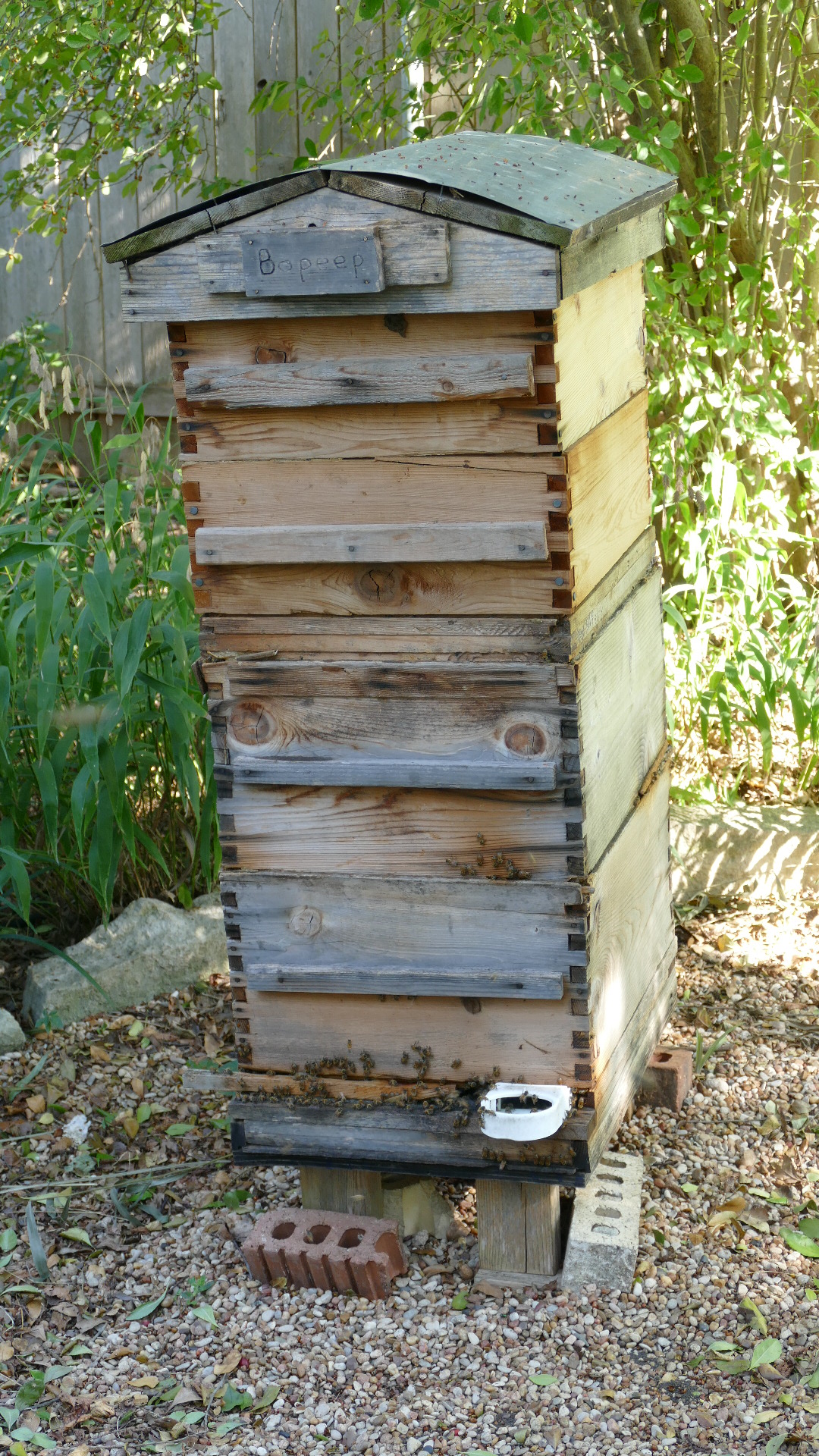
Bo is a prolific honey producer. This season, we’ve already extracted over 6 gallons of honey from her and we have 5 more frames ready to process. I’m hoping that at the next hive check, we won’t need to take honey to free up space in the hive, but we’re going to make sure we have a few frames ready for replacement–just in case! We want to leave plenty of honey for winter, but also to allow for space in the frames so that these busy bees will continue to do what they do–pollinate, slurp nectar, and make honey–in the cooler season ahead. Bees are honey hoarders and they force us to be honey hoarders!
They just can’t help themselves…


Hopefully you will get a queen from your existing hive to take up residence in woody.
LikeLike
We’re leaning in that direction, encouraging a swarm from Bo-Peep to move into a cleaned hive and set up their colony there. I’m not sure I want to go out and purchase more bees. We’ve got the winter to think about it, meanwhile, Bo-Peep is a boss hive!
LikeLiked by 1 person
Aw, rough luck! But 6 gallons is pretty amazing. I love honey, yay to bees! 👏🏼
LikeLike
Lol–6 gallons and counting!! Yay to bees, indeed! Wish you lived closer, we give you some honey!
LikeLiked by 1 person
💕
LikeLiked by 1 person
Always fascinating to read about your bees! Do you have to manually repopulate your empty hive, or if the Bo Peep bees were stealing honey from it will they also find it and move in? Also- wax moths sound AWFUL
LikeLike
Thanks, Lauren. What we’ve talked about is cleaning Woody’s boxes, and tidying up the frames, and during the spring, anointing the physical hive with lemon grass oil, which bees are attracted to. With luck, a swarm from Bo-Peep (which WILL happen, honeybees swarm!), will move in. We’d need to feed them and keep a close eye on them, especially if we think Bo is robbing from them. That would be the simplest way to get a new hive. There’s no guarantee though that a swarm would move in, we can only set up a situation where the swarm wants THAT hive. Or, we buy a package (a queen and 10 thousand workers). We’ve got the winter to mull.
It’s not a bad idea to have more than one hive. In our 10 years of beekeeping, each year has presented new challenges and there have been years where we lose a hive. If we have only one hive and we lose it, that means start over completely. That being said, I’m a little tired of beekeeping, though Bee Daddy wants to continue. Another set of decisions to mull over the winter. 🙂
Wax moths are disgusting, foul creatures. ‘Nuff said!
LikeLiked by 1 person
And if you’re ever up this way from SA, ping me for some honey!!
LikeLike
I’ve always associated the word ‘absconded’ with bank managers taking off with funds, or fringe relatives making off with recently departed Grandma’s ‘stuff’ on their way out of town. It made me laugh to think about it in terms of bees. At least when they absconded they left you the hive!
I’ve been trying to figure out my own little bee mystery. Every fall I find dead native bees on my boats: not many, but perhaps a dozen over a few weeks. Recently, I’ve been noticing live ones hovering around, landing on the metal stanchion bases. The only thing that seems reasonable is that they’ve consuming salts or other minerals there.. At least I know now what’s been attracting them.
And yesterday I saw another new ‘bee sight.’ I came across some tiny, tiny bees on tiny white asters — every one had those pollen saddlebags, but they were lemon yellow. So pretty. I think they were ligated furrow bees; they certainly were busy!
LikeLike
Well, the gals did spirit away the goods!! I think it would be a real trick if they could pick up the physical hive; I’d like to see that!.
Interesting about your dead bees, but what you suggest makes sense. For what it’s worth, the honeybees that are foragers are in their last job, the last part of their life. It’s normal for them to die away from the hive.
I just love the little native bees and how they show up, focused on one particular plant at a certain time of year. I wonder what they do the rest of the year? 🙂 It’s fun to watch all bees, but I’m really fond of the natives: there are so many different kinds, shapes, sizes. So fun to observe.
LikeLiked by 1 person
I get noisy alerts on my cell phone about people kidnapping children but I must have missed the one about your bees absconding.
Biologists put tags on mammals and birds to keep track of where they go. I wonder if entomologists could someday micro-tag bees to find out what happens to a colony that absconds. From what you’ve said about your remaining colony having persisted for so long, entomologists might have to do a lot of micro-tagging over a long period before learning about an absconding
LikeLike
That would be a very cool thing to do, tag the bees and figure out why they go, where they go. All I can hope for any of my bees who swarm every spring is that they end up somewhere safe.
LikeLike
I have been wondering how your bees were doing. I know you probably have addressed this question, but what do you do with all that honey?
LikeLike
We keep neighbors and friends supplied with honey. Also, it makes a nice gift for someone new in the neighborhood, or as a wedding present. Not everyone like honey, so I always ask. We also use it in baking, roasting veggies, and other kinds of cooking. That said, if we stopped beekeeping today, we’d probably have enough for the rest of our lives. It’s a lot of honey!
LikeLiked by 1 person
Success!!! Your comment worked. I’ll let my IT team know. I guess you have more uses for honey than me. I just use it in tea. I used to throw it out when it crystalized, but I was told it never went bad.
LikeLike
Yay! I seem to be past the not-appearing comments. Fingers-crossed that all is well, darned WP!
Lol–honey has been removed from pyramids, warmed up, and it’s just fine. The stuff has staying power!
LikeLike
All that honey–wow, that’s wonderful! Sorry about the loss of the Woody residents, but it sounds like that naturally happens sometimes. Hopefully, the next new group will be around for a long time. Thanks for all the fascinating information on how the process works. I’ve always been interested in honey bee hive activity.
Beth @ PlantPostings.com
LikeLike
Thanks, Beth. They’ve been so interesting to observe and while I’m a bit weary of the efforts involved, I have to admit I’d miss them if they weren’t in the garden!
LikeLike
I hope you and Bee Daddy aren’t too sorry about the loss of one of your hives, Tina!
I don’t know if you ever watched “Lark Rise to Candleford” on PBS, but your story reminded me of it. In one of the episodes a swarm of bees leaves their hive en masse and it is a big deal, because people attribute omens to their leaving.
Also, I’m curious to learn if there is there a difference between “swarming” and “absconding?”
LikeLike
I haven’t watched that program, but it sounds intriguing.
A swarm is how honeybees procreate. In honeybee biology, it’s not really about the individual bee, though, each bee is more than just an appendage, individual honeybees can’t survive on their own without the hive.
So in swarming, the old queen leaves with about half of the workers to find new digs, thus the one hive is now two hives. Swarming typically takes place from spring to mid-summer. A late swarm is unlikely to survive winter, as the colony won’t have enough time to build enough honey stores before the cold sets in.
Absconding happens when there is some threat or difficulty and the hive (we humans would use the term ‘hive mind’) deems it important to move to a safer, better place. It could be an issue of weather, lack of food sources, or many other reasons that the bees decide to abandon and find a new place to live.
We didn’t see anything unusual in Woody the 2 weeks before we realized they were gone, but we always noticed it wasn’t has strong a hive as Bo-Peep; it was also a younger hive. That’s why I wonder if Bo was robbing and Woody’s bees just didn’t want to put up with that anymore. Here’s a good link with explanations on both processes:
https://bee2bee.com.au/swarming-vs-absconding-what-do-we-need-to-know/
LikeLiked by 1 person
Thank you for the additional explanation and the link, Tina. Bees and beehives are so fascinating. I hope your absconded hive will find a new home and make it through the winter.
LikeLiked by 1 person
Tina, this was a fascinating read!
LikeLike
I’m glad you enjoyed it!
On another note, a while back, I suddenly couldn’t comment on the blogs that I follow, including yours. I emailed each writer if I could click on a ‘contact me’ or find an email on the website. Quite a few discovered my comments in their spam and moved the comments to the appropriate post. I never figured out the how or why I was suddenly tagged as a spammer, but who knows what these WP elves get up to? 🙂
Anyhoo, if you would be so kind to check your spam, as I just commented on your most recent post and it didn’t appear. Thanks so much–and just know that even if my comments won’t appear, I do always read and enjoy your posts.
LikeLiked by 1 person
Yes, it was in spam folder. I recall this happening before so hope the setting sticks this time. Thanks Tina!
LikeLiked by 1 person
Pingback: A Honeybee Decade | My Gardener Says…