While the various landscapes were stunning and the beauty of the birds mind-boggling, there were other wild things that we experienced in lovely Costa Rica. We spent most of our trip hiking in rural areas, national parks and reserves, as well as strolling through established garden spaces. Wildlife abounds in Costa Rica, confirming its reputation as a richly, bio-diverse nation.
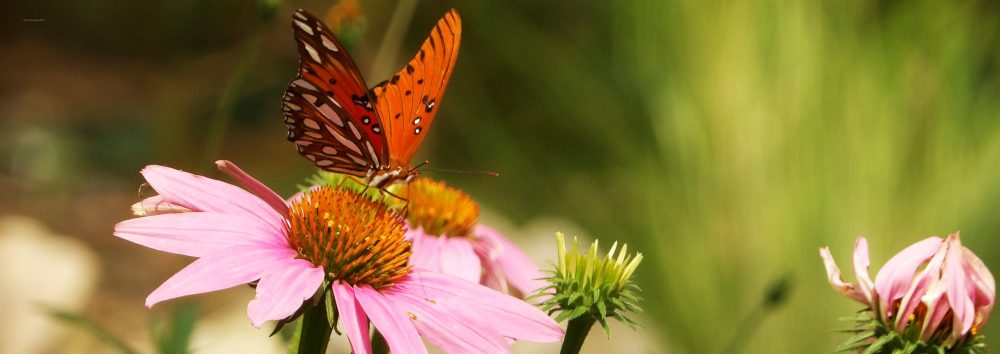
Where flowers are, pollinators follow and that’s certainly true in Costa Rica. We saw plenty of native bees, wasps, butterflies and moths. Many butterfly species we encountered live in a wide geographic range, including where I live in Texas. Familiar garden friends like Queens, Gulf Fritillaries, and Yellows thrive in Texas and also in tropical Costa Rica.
Most of my CR butterfly interactions occurred when the jeweled insects wafted along my path as I walked. Like those who visit my garden, the CR butterflies weren’t always cooperative when I wanted a photo. A few obliged, though, like this dainty, a Great Southern White, Ascia monuste.

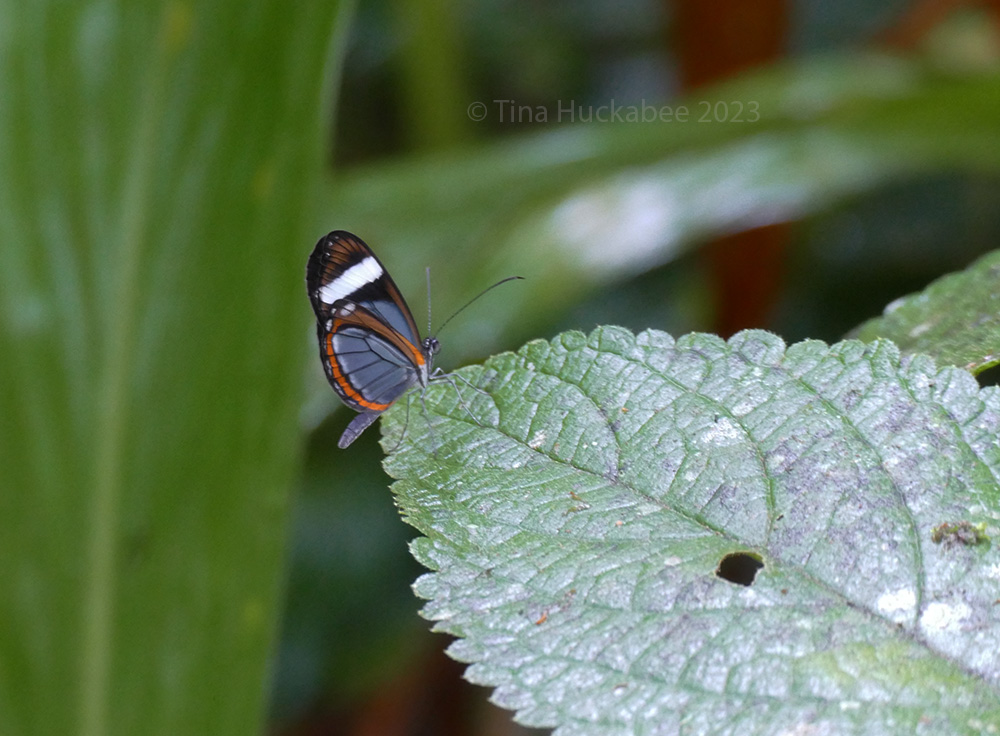
Clearwing butterflies, which I don’t see in Texas, are abundant in Costa Rica and we saw several kinds. I was fortunate to snap this resting Thick-tipped Greta, Greta morgane.
Ants were a thing on several of our hikes. In particular, cutter ants are always fascinating to watch. We saw several busy colonies, a couple with large mounds.

We also came across several groups, or maybe I should say columns, of army ants. They were amazing to watch, and determined as they marched, focused on forward movement, across pathways. As the ants marched, other insects cleared out of their reach, catching the attention of mixed flocks of colorful birds, ready to munch on fleeing, frightened insects. Poor insects: army ants on one side, hungry birds on the other! We observed this in forested areas and the events allowed us to observe tanagers and other gorgeous birds at work, nibbling on insects.
Coatimundi, or White Nosed Coati, are common in Costa Rica’s forest areas, and belong to the raccoon family. The local name for coati is Pizote. Family groups foraged in the gardens and green spaces near our the lodges. Coaties are comfortable with people, though they keep their distance–as we did from them. They are omnivores; we typically saw them noshing on seeds, roots, and leaves. In one case, an adult was munching on a small snake, but the coati was eating from the snake’s tail; the poor snake was still alive.

Sometimes, nature is a bitch.
At one point during the trip, I asked our excellent guide, Johan, about Costa Rican bats. He mentioned that many bats rest under large leaves during daylight hours. Later, as if he planned it, Johan pointed out a little bat, this Northern Ghost Bat, Diclidurus albus, resting under the protection of a large palm leaf.

Like bats worldwide, this little dude and his bat buddies are important pollinators and seed dispersers.
We frog hunted several nights, visiting nearby ponds, listening to nocturnal chirps and (fingers-crossed!) hoping for glimpses of eye-catching Costa Rican frogs. We saw a few Green-and-Black Poison Dart Frogs, Dendrobates auratus, but our photos weren’t clear, they simply looked like black and lime-green squiggles.
I don’t know the names of either of these two beauties, but they, and their kind, brightened the night life with their songs and good looks.


Yes, we saw sloths.

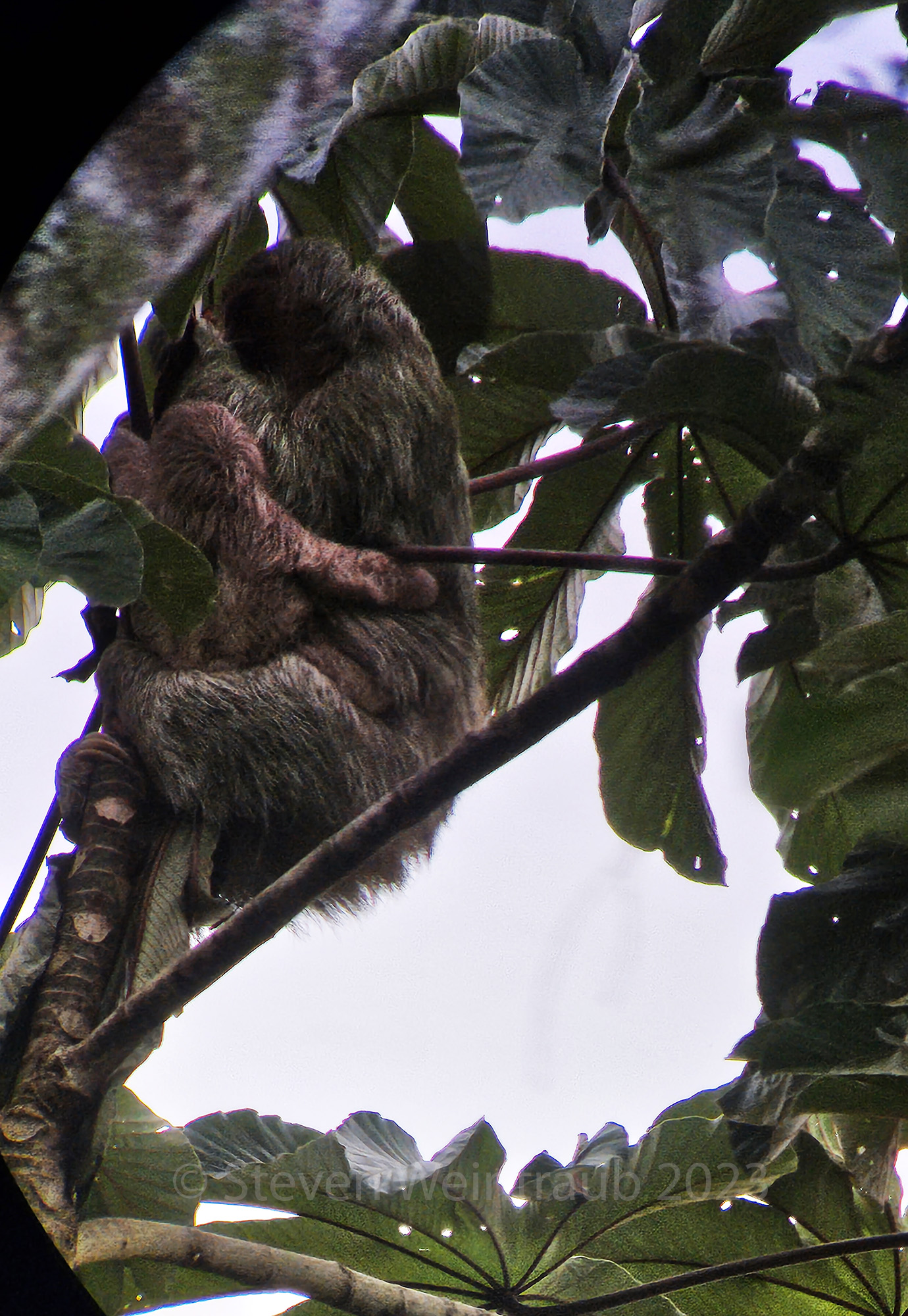
Cute, cute sloths. Hard-to-see-unless-pointed-out-to-us, sloths! We visited a small sanctuary with pathways winding through a dense, dark forested area. It didn’t take long before Johan spotted a sloth, which looked like a bundle of leaves way up near the top of the trees. This cutey is a Brown-throated Three-toed Sloth. Watch him stretch and move, sloth-like, ever so slowly!
Both the photo and video were taken with Steven’s (my husband) cell phone camera through Johan’s scope.
We were fortunate to observe this mother and her baby.
The sanctuary also is home to some Hoffman’s two-toed Sloths, but we didn’t see any.
Not far from the sloth sanctuary, we stopped at a favorite cafe of Johan’s to enjoy some delicious dragon fruit ice cream. It was some of the best ice cream I’ve ever eaten. Also having a snack, but of veggies from the cafe’s kitchen, were a troupe of Iguanas. This handsome male Green Iguana and his entourage of females are maybe just a bit scary–I mean, they’re really big lizards!

We cautiously eyed one another: me slurping my ice cream, iguanas crunching their veggies. While he may be called a Green Iguana, he isn’t green–as you can see. Costa Rican Green Iguanas come in different colors.
We also saw a number of iguanas on our wetland boat tour of the Tarcoles River, in the Central Pacific coastal area. Iguana’s are adept climbers, comfortable in trees.

Along the Tarcoles River boat trip Howler monkeys were tucked away in a thicket, eating foliage, and sedentary. Our boat and presence made them uncomfortable and the the howl that the male delivered resonated with warning. The good captain moved away, so as not to disturb them further.
In the Arenal volcano area, Spider monkeys were active and such fun to watch. Those arms-n-legs! Those tails! That agility! They climbed and swung through the trees, traveling from their daytime feeding areas to their nighttime nesting spots, all the action taking place just behind our lodge. They put on a good show!
There were 20-30 in this family group, including a mother and her baby. At one point, she needed to jump from one tree to another, a longer distance than most of her jumps, and was clearly nervous about jumping. As her infant was attached to her, she hesitated, she swung the limb she rested on, back and forth to gain momentum for the jump, but just couldn’t make the leap for several minutes. Eventually, she sprang, baby hanging on, and they landed safely.
Life is challenging when you’re a mom, especially if you swing from tree to tree. I hope they both rested well that night.

Some of our experiences during the trip happened so quickly that we hardly processed the event in real time and certainly weren’t focused enough to get photos or videos. One was as we ended a hike in the Orosi Valley, a young White-tailed fawn bolted out of the forest, just in front of us, and bounded away. As we looked, agape, just to our left, a handsome, dark-coated tayra ambled toward our path, then, viewing us, moved back into the cover of the forest. A weasel-type of mammal, tayras are omnivores. Johan speculated that the tayra was hunting and flushed out the fawn from its hiding place. He also wondered if the deer would be permanently separated from its mother.
The second drama unfolded during our hike in the Carara National Park when a pack of agouties spent several minutes chasing one another, their screeches echoing in the dense undergrowth. The agouti is a large and cute rodent, common in many parts of Central and South America. At several points, the agouties came within 4 or 5 feet of us, banking away as they continued pursuing one another, issuing their screeches all the while. We were confused and wondered about their motivation, until I noticed two of them, a male and female, mating, just off to our right. So it was a agouti-type OK Cupid flirt party and we were right in the middle of it!
Our time in Costa Rica was filled with wonder and great appreciation of the natural world. Coupled with that, we were welcomed by Costa Ricans and felt at home. We will return one day to this very special place; there’s so much to see and experience.
Pura vida, Costa Rica!

 My Gardener Says...
I’ve enjoyed following your CR posts, Tina. You clearly had a great tour guide, he made it a great trip for you.
LikeLiked by 1 person
It was a wonderful experience very much because we had an excellent guide in Johan!
LikeLiked by 1 person
Costa Rica should pay you a commission for your many photographs and descriptions that entice people to visit that country. Let’s hope the other Central American countries learn to follow Costa Rica’s example.
LikeLike
Haha–maybe I should send these posts to their PR person in government?
LikeLike
I really enjoyed all the photos and descriptions of your trip. I really can’t pick a favorite animal.
LikeLike
Thanks, Judy–we enjoyed ourselves so much!
LikeLiked by 1 person
This is a fascinating post. I really enjoyed seeing the Greta; that’s one beautiful butterfly. I was interested in the ants, too. I once came across leaf-cutter ants at the Attwater preserve, and they were fascinating to watch. They’re fast, too! I tried and tried to get some decent photos of them, but no luck. They chewed their way through a plant lickety-split.
I quivered a little when you mentioned the army ants. When I lived in Liberia, they’d come through from time to time, and if they were headed to hut or house, there was nothing to do but gather up any pets and leave until they were gone. They did clean out the insects. They served other, less pleasant purposes, too. Let’s just say that staking anything down in their path was one of the worst ways ever invented to get rid of enemies, political or otherwise.
I don’t know where I heard it, but the most perfect name ever for the sloth is “slowly-slowly.” They’re fascinating creatures. I just enjoyed a few minutes with this article, and learned that the sloth is related to the armadillo and the armadillo’s ancestor, the Glyptodon: a VW Beetle-sized, armadillo like creature. When Glyptodon’s roamed Central America, their shells often were used for shelter!
These posts have been great overviews of your trip! If you’d like to share more, feel free!
LikeLike
Thank you, Linda. I just loved this trip, everything about it was wonderful, even the rain. 🙂 (We actually didn’t have much, but it’s the tropics, there’s gonna be some rain!)
I agree with you about the ants, they’re were interesting to watch. I used to see them regularly in Corpus, at my parents’ home, though I don’t know that I’ve ever seen any here. I don’t even know if there are any in Central Texas–I need to check that out. As for the army ants, they’re a bit scary, to be sure. Johan warned us and other hikers to be careful where we stand and not put out feet in their path–big ouchies, evidentially. As for what you mentioned about Liberia, have you ever read Barbara Kingsolver’s The Poisonwood Bible? https://en.wikipedia.org/wiki/The_Poisonwood_Bible
You might find it very interesting.
Thanks for the slowly-slowly link. 🙂
LikeLiked by 1 person
I so appreciate the glimpses your different posts afforded of what looks and sounds like a wonderful country with warm and welcoming people and incredible ecosystems. I agree with your earlier statement that the US could learn a lot from how this country treasures and protects its natural treasures.
Thank you for taking us along on your trip.
LikeLike
I’m very happy you liked the post(s). You should plan a trip there sometime. It’s really well-worth a visit. Beautiful little country!
LikeLike