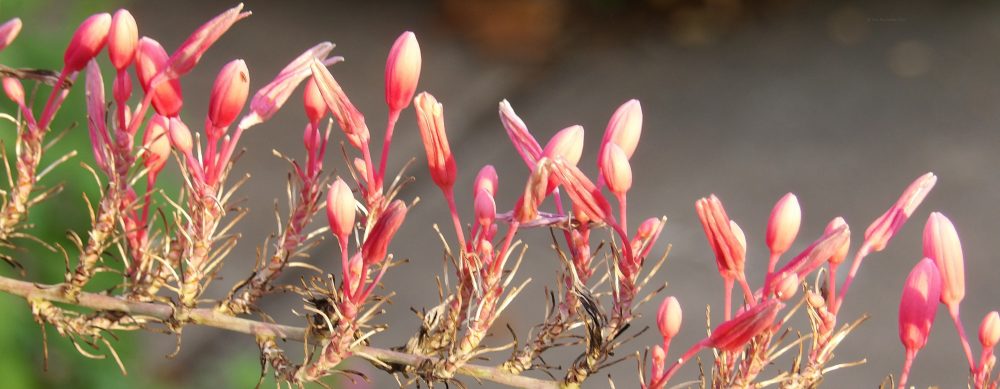
I’m happy to participate for the first time with Lucy and her Tree Following meme which is celebrated on the 7th of every month on Loose and Leafy blog. I discovered this charming gardening meme while researching garden blogging memes and it appeals to me. I relish the idea of a month-to-month, year-long study of a particular garden subject through its seasonal and gardening changes.
So, my tree for the coming year will be–drumroll please–the Retama, Parkinsonia aculeata, which is living happily in my garden in Austin, Texas, USA.

My Retama is situated in a moderate-sized urban garden, flanked on its right by a large, native Red Oak tree and a smaller native Mountain Laurel tree and on its left by a non-native Crepe Myrtle (which belongs to the back neighbor). Also and unfortunately, during the coming year of Retama-watching, we’ll have to tolerate the unattractive electric lines which span unceremoniously across the back of my property and will appear in many of the Retama photos.

Yuck. I don’t see those lines when I stroll my garden, gazing admiringly at the Retama or other garden pretties, but I certainly notice them in photographs.
I just want you to know that I know the lines are there.
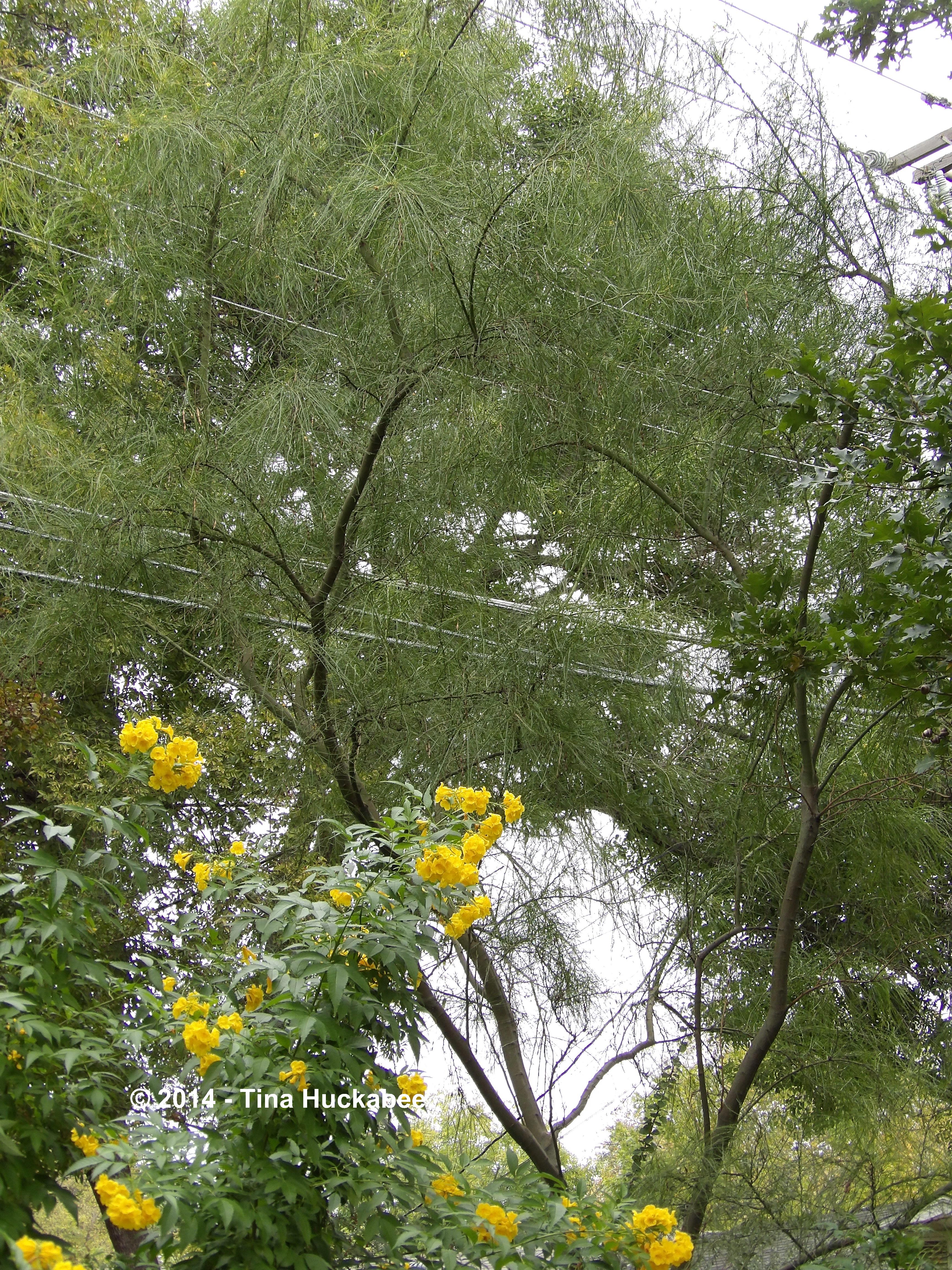
We’ll cover the basics today, accompanied by some November Retama photos. The Retama, Paloverde, Mexican Palo Verde, Jerusalem thorn, and Lluvia de Oro is a native-to-Texas tree with many names, it seems. Its native range is Central Texas, west to Arizona and southward to South America. It’s a small tree, usually 15-20 feet tall, with airy foliage and yellow bloom clusters in the summer months.
Silhouetted against a gray sky, its foliage and branch forms are graceful and elegant.


The bright green, tiny leaves are borne along a pair of stalks, opposite one-another.

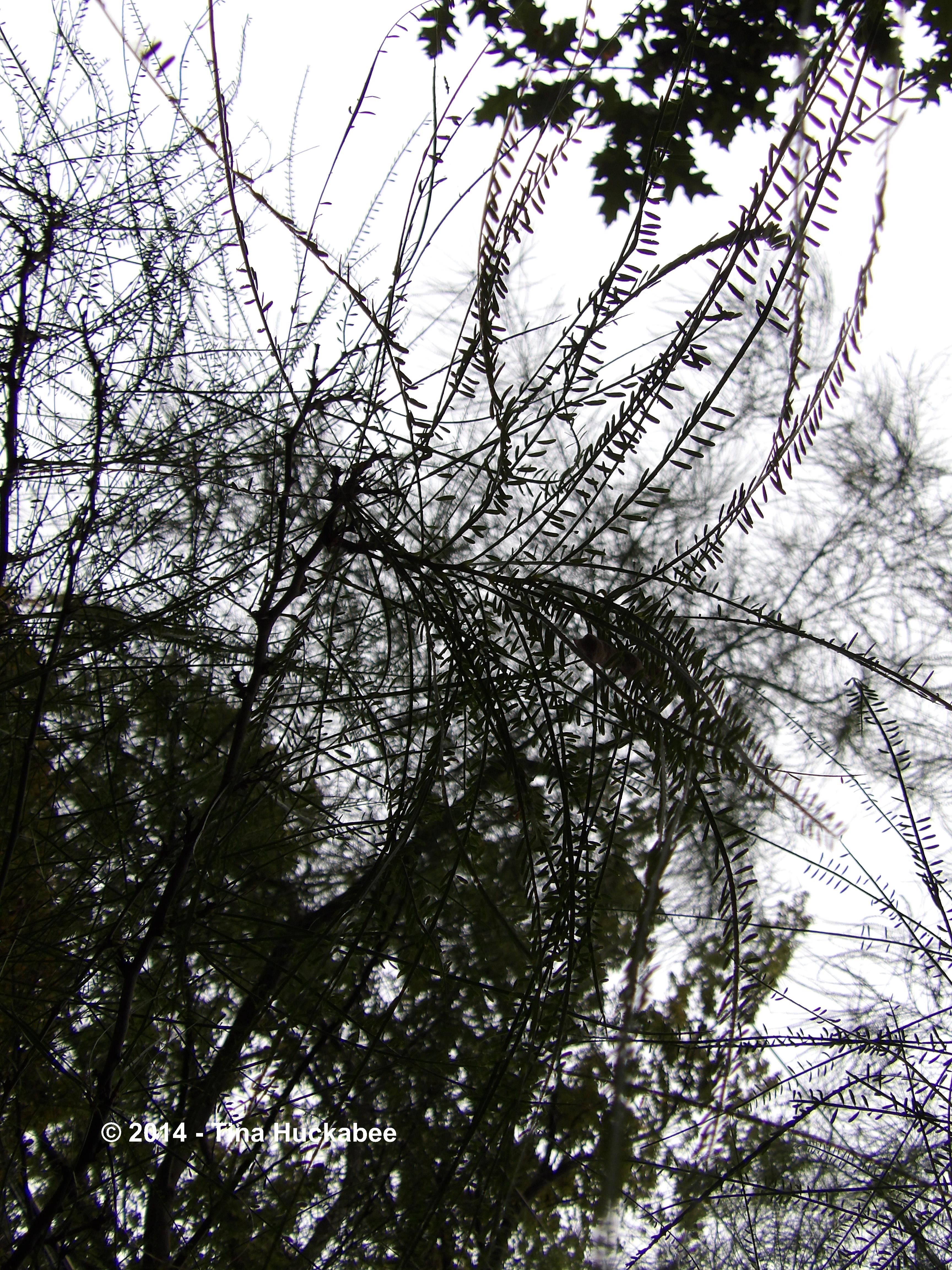
The fine foliage gives a feathery, soft appearance to the tree. The Retama is deciduous, but the bark remains green, even during winter.

The bark is completely green when the tree is young, developing a layering of textured orangy-brown bark as the tree ages, though the green bark remains a characteristic feature. The bark reminds me of the outer layer of cantaloupe.

Thorns grow along the branches,

…and yes, those thorns hurt when the gardener bumps against them while working around the tree. Which I’ve done. Numerous times.
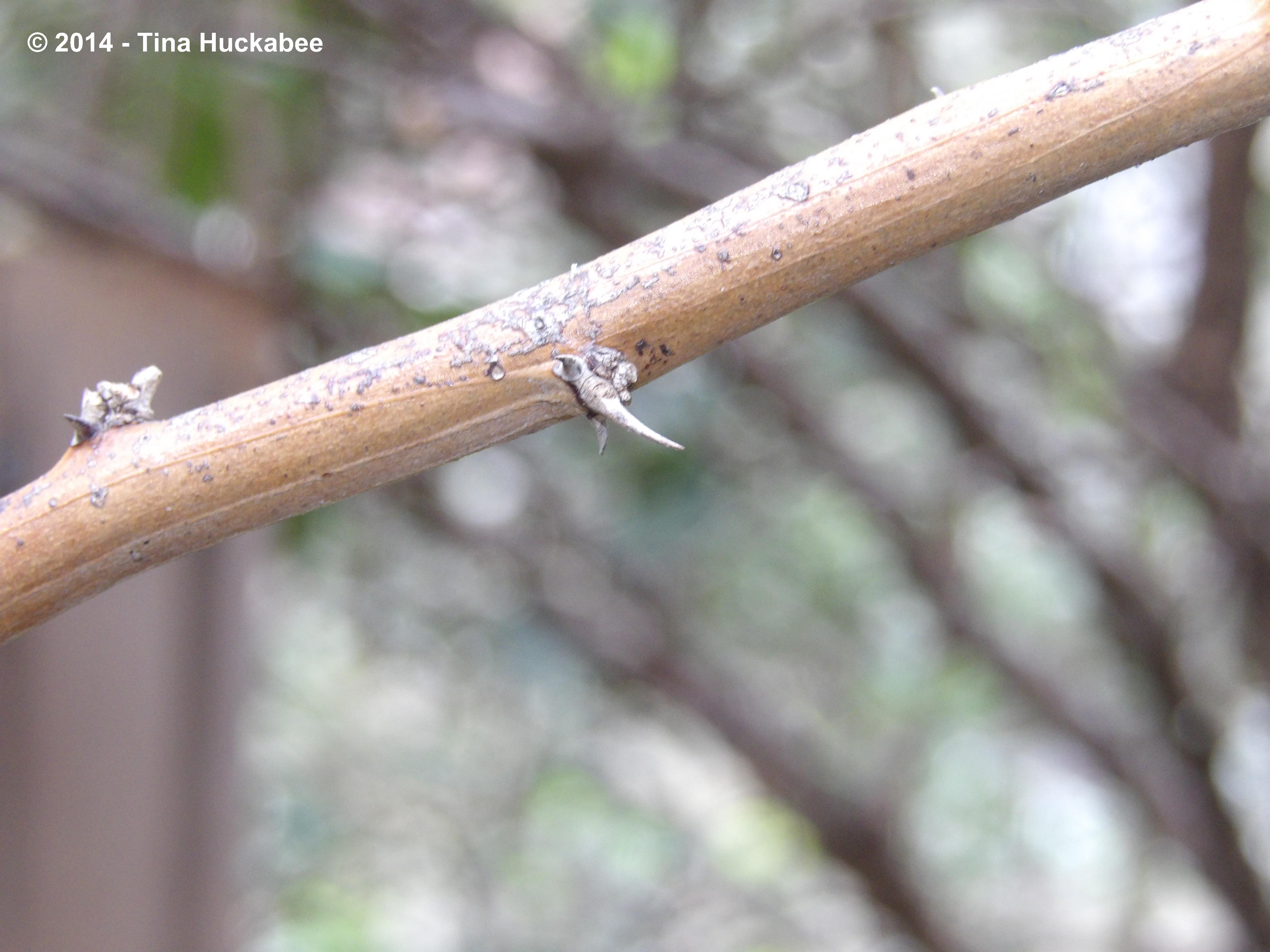
Ouch!
The seed pods are typical legumes, which makes some sense as this tree is in the Pea (Fabaceae) family.

The blooms are gone on my Retama as it is well into autumn, with shorter days and cooler temperatures. But the tree remains attractive and useful for the birds, like this migrating Blue-gray Gnatcatcher.

The tree is a favorite of many birds.
Retama.
When I was growing up, my mother called it Palo Verde. I’m not quite sure why I don’t use that moniker for this beautiful tree, but by whatever name it’s called, Retama is lovely and unusual and I look forward to studying it more closely this next year.
Thanks to Lucy for hosting Tree Following–please pop over to Loose and Leafy and check out trees being followed from all over the world.
 My Gardener Says...