Blues In The Garden

I love blue. Blue flowers, especially.

Blue–Plumbago (Plumbago auriculata),

Blue–Majestic Sage (Salvia guaranitica),

and Blue–Heartleaf Skullcap (Scutelleria ovata sp.bracteata).

In truth, most of what I consider “blue” in my gardens has a tinge of lavender or purple,  like this Heartleaf Skullcap,

which is currently at its peak of  loveliness in gardens all around Austin.

It’s difficult to capture the beauty of this plant with my little point ‘n shoot camera because of the subtlety of the blue/lilac bloom paired with the grey/green foliage.

I especially love it with my bright blue, well-used (by the birds, not me!)  bird bath.

Or combined with the cultivar Mealy Blue Sage and small, light blue bird bath situated on a bed of City of Austin recycled glass.

The  Henry Duelberg Sage is a great blue-blooming perennial for Central Texas.  This particular plant is the most purple of the Henrys in my garden,

but, it’s still mostly blue to my eyes.

I’ve noticed that the blues that I grow in my gardens are blue in real-time, but often show purple in photographs.  Conversely, the native bog plant, Pickerel Weed (Pontederia cordata), is blue to me in this photo,

but in real life, I see it as purple.

I favor blue accents in my  garden art as well.  I usually refer to accent  items as my garden ‘do-dads’.  I’m easy to buy gifts for because it’s fun to have funky or silly or interesting do-dads in the garden.  Do-dads–like my groovy gazing ball,

or my blue glazed pots for plants,

flanked by pots in the other colors I gravitate toward. I augment the blues in the garden with do-dads in these other colors.

But I tend to prefer garden accent pieces in hues of blues.  I chose tile and glass pieces  primarily in blues for the mosaic stepping stone under the archway,

although I could use a few more blue bottles on the bottle tree.

My tree tipped over during a heavy wind a few weeks ago and  two of the four blue bottles that were on the tree smashed–I’m still finding shards of blue glass in that bed.  Sigh.  I’ll have to buy more of this high sugar/caffeine soda for the bottle tree.  I’ll let The Boy drink those, though.

Oops.  Well, this isn’t in the garden and my favorite thing here isn’t the blue wall, either.  He’s studying hard for the SAT.  (More like hardly studying….)

Oh, and not to forget, my wonderful new, blue Sky Chairs.

My old ones finally ripped through ‘n through, requiring replacement.  I loooove these soporific chairs.  Many a snoozy (usually) weekend afternoon/evening I’ve spent lolling about in one or the other of these chairs–listening to the waterfall of the pond, watching birds/owls/bees/butterflies  and enjoying the fruits (or veggies) of my gardening labors.

What colors do you love in your gardens?

Hill Country Blues

I love blue flowers in the garden and my current favorite blue flowering perennial is the Henry Duelberg Sage (Salvia farinacea ‘Henry Duelberg’).

(As a disclaimer, many of these photos show the flowers of this post as more purple than they are in real life. I don’t know if it’s me or the camera. It’s probably me.)

It’s lovely planted with other mid-to-late spring bloomers.

I’ve grown the compact cultivar Mealy Blue Sage  for a many years in my gardens.

The true native Mealy Blue Sage is taller and typically a lighter blue than the cultivar Mealy Blue.  The cultivar has a darker blue bloom and is compact in form, reaching a height of about eighteen inches. It is a terrific addition to the garden.  They’re happiest and most striking when they’re blasted by the hot, Texas sun.

These three have been in this spot for several years and bloom stunningly in spring, with a second, less dramatic bloom cycle in the fall.  During the summer, the Mealy Blue Sage tend to bloom less and typically, I’ll cut them back to the ground in July or August.   The plants bloom again in the fall but once the temperatures are consistently chilly and the days are short, I prune the spent bloom stalks down to the base rosette for winter.  The rosette is evergreen for winter here in zone 8b.  This plant is so pretty when planted en masse and is excellent for the xeric garden, especially because of its compact form.

I fell in love with the  Henry Duelberg S. farinacea when I started working at Zilker Botanical Gardens a few years ago.  I manage the Grow Green Gardens as Zilker Botanical Gardens (ZBG) and these demonstration gardens are designed to showcase low maintenance, native and non-native plants.  The City of Austin’s Grow Green program provides a wealth of information for homeowners and businesses about proper landscape plant choices and irrigation techniques to enhance water conservation.  Many folks who live in and around Austin are familiar with the free Plant Guide (located in the above Grow Green link, bottom right hand side of page) where some of the more popular landscape plants for Central Texas are profiled.  The Henry Duelberg Sage is listed in the Plant Guide, but when I started working at ZBG, there wasn’t one planted in the Green Garden.

So, I fixed that.

This beautiful specimen blooms three-quarters of the year and is a dramatic addition to the entry of the Green Garden.  It’s produced loads of seedlings (which will be  planted in other gardens at ZBG).  This spring, a white blooming hybrid seedling, the Augusta Duelberg, has joined the mix.

Nice!!

I was so entranced with the Henry Duelberg and its performance at ZBG, that I bought several for my gardens.

The Henry Duelberg is larger than the cultivar Mealy Blue Sage and has a graceful, open form.  The stems are two to three feet tall and the flower spikes atop the stems are three to four inches long.  This gorgeous bloomer is probably a hybrid of the native  Mealy Blue Sage (S. farinacea).

The leaves are lance shaped and are located along the length of the stem.  The Henry Duelberg will bloom from mid-spring, through early summer.  In my gardens, it experienced a dormant period during the hottest part of last summer.   I pruned mine to the ground and once the rains began again, the Henrys enjoyed a nice fall bloom cycle.  Like the cultivar Mealy Blue, the Henry Duelberg can be pruned to its evergreen winter rosette at the end of the growing season.

The Henry Duelberg at the Green Garden bloomed all of last summer, but it’s more established and receives more water than my personal plants.

Both the Mealy Blue Sage and the Henry Duelberg are favorites of bees and butterflies, as well, though I’ve noticed more pollinators visiting the Henry Duelberg than the Mealy Blue. I planted two, four-inch pots of Henry Duelberg in the fall of 2010 and they have re-seeded, so I have  six of these plants now.  Thus far, all of mine are blue–none have hybridized to the white ‘Augusta’ form.

As with most plants in the salvia family, the hybrids and cultivars of S. farinacea are generally considered deer resistant.

The Henry Duelberg Sage was discovered growing without care in a Texas cemetery by  Texas  horticulturist and garden writer, Greg Grant.  He named the blue flowering plant after Henry Duelberg and the white variety after Henry’s wife, Augusta.  If this plant can survive neglected in an old cemetery, surely it’ll perform beautifully for you in your gardens. So go ahead–plant a Salvia farinacea (‘Henry Duelberg’) in your garden.

Or, if you prefer its little cousin, plant the Mealy Blue Sage.

Or, plant both and enjoy the show!

Shoshana’s Iris

I don’t know the true name of this iris. These plants (or more accurately, their ancestors), were in a small garden along the driveway when we moved into our home in 1985.  I was 25 years-old.  Was I ever that young????

They were nicknamed ‘Shoshana’s iris’ by Pam of Digging.  She dubbed these ‘Shoshana’s’ sometime after my 13 year-old daughter, Shoshana Weintraub suddenly died.  Shoshana died in April 2006 while on a Kealing Middle School band trip to Chicago.

I don’t specifically remember giving Pam any iris, but over the years, I separated them, moved them around and gave them away to many people. I gave some years ago to my mother in Corpus Christi, but the iris didn’t thrive in her sand and humidity.  Several of my neighbors have grown these lovelies in their gardens for years.  And Pam, in turn, has shared them with other gardeners outside my immediate circle.    Diana, of Sharing Nature’s Garden, recently profiled her ‘Shoshana’s iris’ in bloom, given to her by Pam.  So, it’s nice to know they’re out there in the world, blooming. And it’s even sweeter knowing that many gardeners call them ‘Shoshana’s’.  Any opportunity for Shoshana’s name to be spoken in the universe, is a good thing–whether in the guise of a beautiful flower or someone remembering  what a lovely gift my Shoshana was.

The color of this iris is richer than lavender, but not a true purple.  Lilac?  Okay, I’ll go with that, although to me, it is a deeper hue than lilac.  The fragrance is cloyingly sweet, but then, that’s what iris are supposed to smell like.  And it sports the signature ruffles common to iris.

I recall reading in one of Pam’s posts about this iris, and Pam called it “temperamental.”  I never thought of it as that, but it’s true that isn’t showy every year.  I often have a tinge of jealousy when I see another gardener’s ‘Shoshana’s’ blooming well (like Diana’s, this year), when mine are not.  This spring, I had only one stalk, with only four blooms. My other established iris bloomed beautifully, though.  I’ve observed over the years that this iris blooms less frequently than it once did.  Is it because of our generally warmer and drier climate this past decade or so?  Perhaps.  I know that it use to bloom, reliably and prolifically, every spring. Like most iris, it blooms best given more sun, but several of mine are in spots of dappled light to part shade–including the one that bloomed this year.

I enjoy the straps though, throughout the year; they add vertical, evergreen punctuation in clusters throughout my gardens.

Bloom time for this iris has passed, so ‘ll have to wait until next spring, once again hoping that ‘Shoshana’s iris’ will grace my gardens with its large, dramatic blooms.

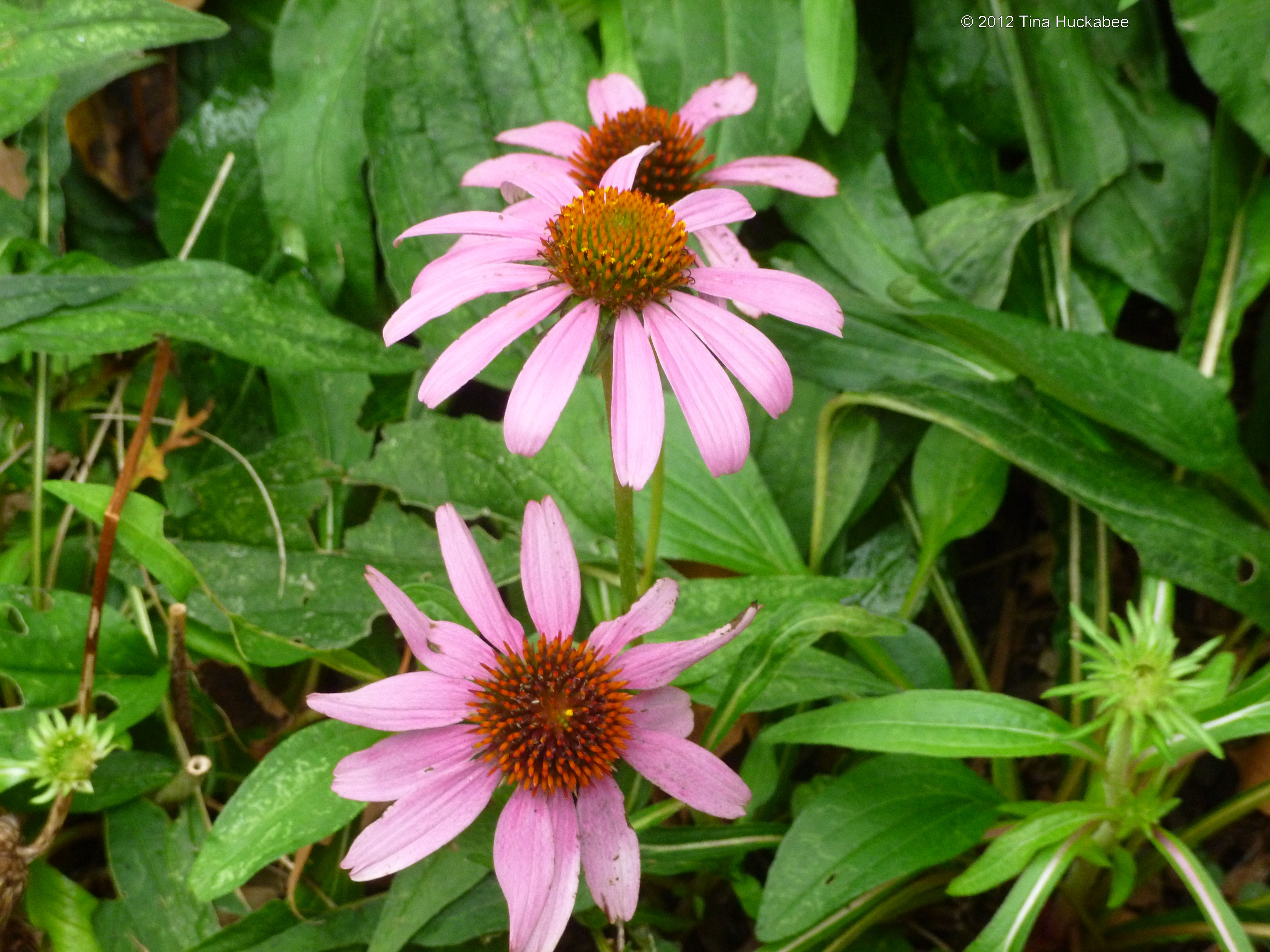
The name Shoshana means lily in Hebrew.  My Shoshana loved Purple Coneflowers–she thought they were “happy” flowers.  In a little garden atop her grave, surrounded by Texas limestone taken from my garden and accompanying her Texas pink granite headstone, I planted Coneflower and several lilies–some Crinum lilies (unknown name) from my parents’ garden, Oxblood Lily (Rhodophiala bifida) and Red Spider Lily (Lycoris radiata) from my own gardens.

There are no ‘Shoshana’s iris’ on Shoshana’s grave.